
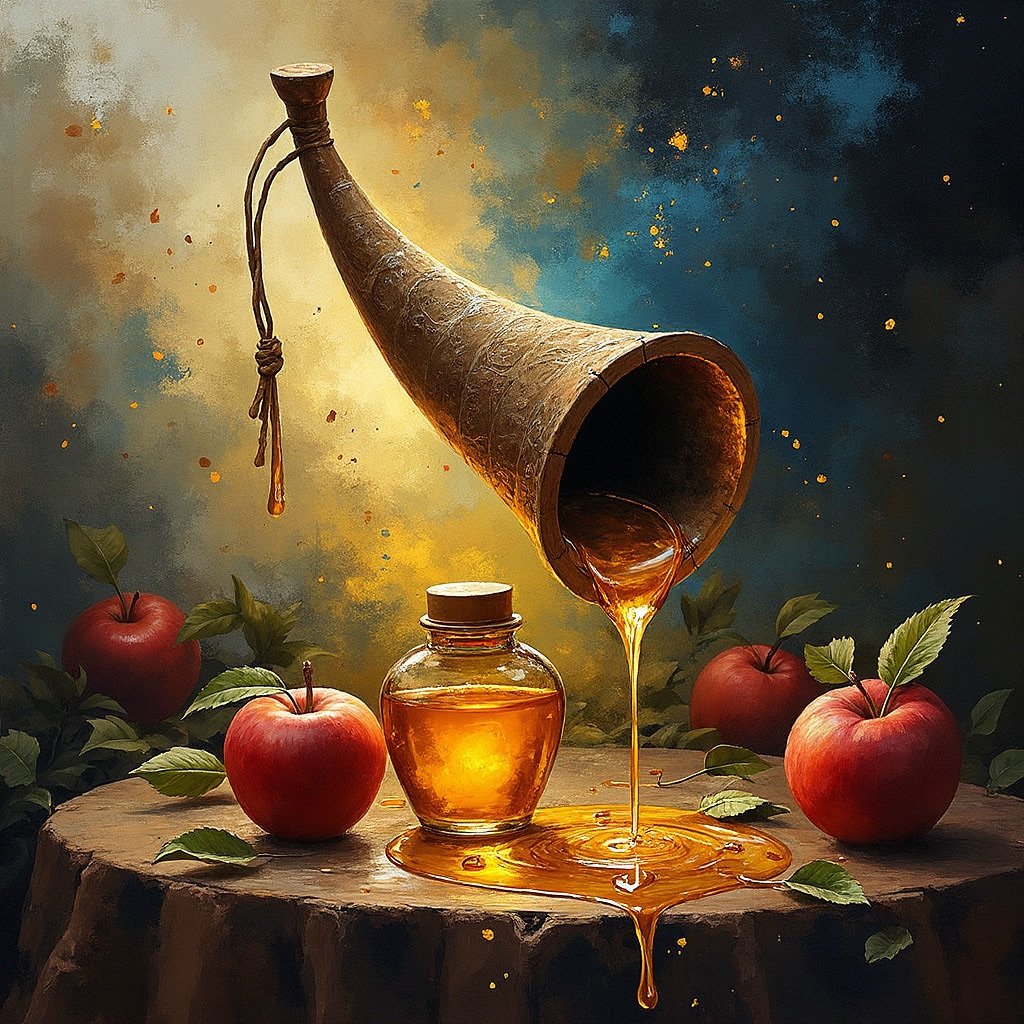
Kabalistic Rosh Hashanah
A Kabbalistic claim opens this teaching: the vast majority of religious leaders and laypeople — including many rabbis — do not understand Rosh Hashanah true purpose and power. That claim may sound bold; it is offered here not as an attack but as the classic Kabbalistic posture that much of the inner teaching has been concealed and must be revealed gradually. What follows is an exposition of Rosh Hashanah from that Kabbalistic perspective, drawing on the lineage of Kabbalistic teachers.
Common assumptions:
– Rosh Hashanah is an exclusively Jewish festival.
– It is simply the “Jewish New Year.”
– It is a day on which G-d sits in judgment and decrees reward or punishment.
Kabbalistic reframing:
– The terms “Jew” or “Judaism” are modern categories. Classical texts refer to the “Children of Israel” (Bnei Yisrael), the people who received the Torah and a method for spiritual rectification.
– The inner wisdom of Kabbalah presents Rosh Hashanah not as a private ritual for a single people but as a universal spiritual technology — available to all souls — whose use restores balance to the world.
– Rosh Hashanah is not primarily a literal “day of judgment” administered by G-d. Rather, it is a time when the law of cause and effect — the cosmic “court” — comes into clear operation. What returns to us on this occasion are the consequences of how we lived the previous twelve months.
Cause and effect: the operative “court”
Kabbalah frames moral and spiritual consequence in terms of natural law. Actions, words and intentions create energetic imprints — “blockages” that attract corresponding repercussions. In secular terms this resembles karmic causality; in Kabbalistic terms it is the universal law of cause and effect.
– Reactive behavior (anger, gossip, envy, selfishness) generates negative forces that attach to the soul.
– Those forces are like homing beacons for the returning consequences of the year’s actions.
– Rosh Hashanah is the moment when those returning forces are most clear and active. It is an opportunity to identify, confront and neutralize the results of our own conduct.
Important theological point: from this perspective G-d is not a prosecutor who arbitrarily punishes. The Divine is a single, positive force — infinitely compassionate — and the “judgment” we experience is the natural repercussion of our choices, not a change in G-d’s nature.
Defining the “crimes”
Kabbalistic teaching broadens the meaning of wrongdoing. Notable categories:
– Murder: beyond physical killing, “murder” includes humiliating, shaming or destroying another’s reputation, livelihood, or inner life.
– Slander and evil speech: Katon or lashon hara — any form of harmful speech — is a severe transgression in Kabbalah because words create real spiritual damage. Rosh Hashanah is when those words and their consequences come back to us.
– Adultery and envy: not only sexual infidelity but coveting what belongs to another — their status, success or possessions — is considered spiritual adultery because it arises from corrosive desire and lack of gratitude.
The remedy: admission, responsibility, change
Ignorance of the law of cause and effect is not an excuse. Yet Kabbalah offers hope: genuine internal change compels the universe to respond differently. The first steps are:
– Honest admission: recognize how we have contributed to the negative patterns in our lives.
– Full responsibility: accept ownership of words and deeds.
– Genuine resolve to change: without sincere intention to act differently, ritual alone has limited power.
When confession and real effort to transform are present, Rosh Hashaná becomes a pivot point — not merely a symbolic moment but a practical opportunity for altering one’s course.
The Shofar: more than ritual, a spiritual instrument
Most people treat the Shofar as a ceremonial symbol. Kabbalists teach that its sound has concrete, transformative effect when coupled with the correct inner intention and knowledge.
Analogies to understand the Shofar:
– Military laser defense: imagine cosmic “missiles” — the returning consequences aimed at the blockages we created. The Shofar does not merely shoot down “missiles”; when used properly it dissolves the blockages themselves so there is nothing for the missiles to target.
– Medical ultrasound: like ultrasound breaking kidney stones into passable fragments, the Shofar’s sound is described as a spiritual vibration that penetrates and removes embedded negative energies.
Two prerequisites for the Shofar to work:
1) Authentic desire to change — without sincere intent, the sound is only noise.
2) Conviction in the knowledge of what the Shofar does — doubt undermines effect; knowing how and why it works empowers it.
Destroying the evidence
Kabbalistic imagery speaks of the Shofar — combined with sincere change — destroying the “evidence” against us in the cosmic court of cause and effect. If the soul truly repents and reforms, the records of accusation are nullified. The prosecuting force — sometimes personified as the adversarial “Satan” in mystical literature — loses its case because there is no longer proof to substantiate the charges.
Rosh Hashanah is the “head” or seed of the year
Another subtle teaching is that Rosh Hashaná is not the New Year in the usual sense but the “head” (rosh) of the year — the seed that determines the character of the twelve months to follow. A few key points:
– “Rosh” means “head” — it refers to the origin or seed from which the year’s events grow.
– Planting a positive seed during Rosh Hashaná (true repentance, repair, and commitment) creates a different trajectory for the coming year.
– The Shofar’s source — the ram’s horn — is taken from the ram’s head, tying the instrument to the idea of “head” and seed.
Astrological and calendrical connection
Kabbalah links the ram (Aries) and the month of Nissan — the spiritual “new year” — with Rosh Hashanah’s role as the head of the year. In other words: Nissan corresponds to the seed or life-force of the year; Tishrei (when Rosh Hashaná is observed) is the head where that seed is planted. This interplay of head and seed is meant to help us act at the level that shapes outcomes rather than merely reacting to them.
Where this teaching leads next
This first installment outlines the Kabbalistic frame: Rosh Hashanah is a universal opportunity to confront the law of cause and effect, to take responsibility, and to utilize the Shofar as an instrument of inner cleansing — provided we bring authentic repentance and conviction.
Now I will explore further implications of this teaching: unexpected connections between the Shofar and human physiology (including the throat and cardiovascular system), how these teachings can be applied to personal health and to broader social healing, and practical steps for turning Rosh Hashanah into a lived spiritual practice that reshapes one’s year.
Closing reflection
If you are skeptical, good — skepticism can be the beginning of study rather than the end. Kabbalah invites investigation: the practices it offers are tools, not dogma. Rosh Hashanah, in this reading, is not a ceremony to be observed passively but a technical, inner craft to be learned and applied. The invitation is to engage: to examine the past year’s “evidence,” accept responsibility, and bring sincere intent to transform. If you do, the sound of the Shofar — literal and metaphorical — may become for you what Kabbalists have always held it can be: a force that removes blockages and plants the seed for a better year.
Rosh Hashanah — The Kabbalistic Technology of Renewal and Repair
Rosh Hashanah is more than a calendar marker. According to the Zohar and the classical Kabbalistic tradition, it is the one time of year when we can deliberately plant and steer the “seed” that determines the coming twelve months. In this second, more advanced installment on the Kabbalistic revelation of Rosh Hashaná, we explore deep teachings about health, relationships, prosperity and world peace — and how the Shofar, combined with genuine inner work, functions as a precise spiritual technology to clear blockages and restore flow.
I. Liver, Anger and the Roots of Disease
The Zohar points to a direct link between reactive emotions — especially anger, impatience and bitterness — and the liver. In classical language the Zohar refers to “hiel” (bile), an image that in Hebrew and in Western dictionaries also connotes spiritual bitterness or rancor. Kabbalistically, the liver is the organ that stores and secretes that bitterness. The Zohar goes further: bile’s chief component is identified with that substance which “conquers the arteries of the heart,” producing illness and, ultimately, death.
Read as a spiritual-metaphorical diagnosis, the Zohar teaches that unchecked reactivity and egocentric behavior generate inner “deposits” that harden arteries — not only physically in the body but also metaphorically in our relationships, finances and social life. Modern medicine, too, recognizes links between chronic stress, anger, and cardiovascular risk; the ancient text is striking in anticipating that connection and in presenting a remedy.
II. Arteries as Channels of Life — Physical and Spiritual
A core Kabbalistic image: everything that sustains life flows through arteries — not only blood and oxygen, but spiritual Light and blessing. When arteries harden, flow is blocked. The Zohar extends this image to all relationships and interactions:
– Marital and familial bonds are arteries of love and support; when blocked, intimacy and mutual nourishment die.
– Friendships and business partnerships are arteries for trust and prosperity; obstruction brings financial and social hardship.
– The national and global order mirrors a body: Israel is portrayed as the heart that channels spiritual Light to the nations. When that heart does not function, the entire organism — peoples and nations — suffer.
Hence, “diseases” such as poverty, corruption, war, addiction and personal illness are described as symptomatic of arterial blockages caused by ego-driven, reactive conduct. The Kabbalistic diagnosis is fundamentally ethical: behavior determines the flow of blessing.
III. The Shofar: A Spiritual Instrument of Purification
According to the Zohar, the Shofar is not merely ceremonial sound: it is a wind-channel, a musical conduit analogous to the human trachea. Just as the trachea channels air rather than food, the Shofar channels spiritual breath. When sounded with the proper intention and preparation, the Shofar:
– Cleanses the blood of toxins (metaphorically and, in the tradition, even physically),
– Dislodges “deposits” in physical and spiritual arteries,
– Reopens channels through which Light and blessing flow.
This is why Rosh Hashanah, with its Shofar-blowing and focused teshuvah (repentance), is held to be uniquely potent. The Zohar affirms that genuine regret, combined with the Shofar’s sound, can transform inertia into flow and restore health, harmony and prosperity for the coming year.
IV. Preparation, Intention and the Kabbalistic Key
The Zohar emphasizes that the power of the Shofar is not automatic. The tradition states that only a person who has prepared — the Zohar even prescribes a minimum of three days of meditation and inner work — can properly channel the instrument’s transformative power. Without such preparation and without the Kabbalistic formulas and meditative keys, the Zohar warns that the Shofar can fail to bless and may even bring judgment.
This teaching highlights an important practical point: ritual efficacy, in Kabbalah, depends on inner readiness — sincere remorse, humility, and focused intent. The Shofar amplifies and directs what the heart has already begun to change.
V. Esophagus, Trachea and the Alphabet of Desire
The Zohar uses Hebrew spelling and letters to convey a subtle mechanics of desire. The esophagus (Hebrew veshet: Vav–Shin–Tet) is associated with the material world (Malchut) because physical nourishment passes through it. The trachea (a wind-channel) corresponds to Binah, the sephirah of higher understanding and non-material sustenance.
When spiritual self-restraint fails and physical desire inflates, Kabbalists explain, the letter Vav can “grow” into a Nun. In the word-play of the Zohar, veshet (esophagus) can be rearranged into the letters that spell Satan. In that state the force of resistance and death — the negative counterpart — permeates the person for the year. Yom Kippur is singled out as the day in which that power is diminished; indeed, the numeric value of “the Satan” is cited as 364 — one less than the 365 days of the solar year — so Yom Kippur remains the critical day of dislodgement.
The remedy is symmetrical: the Shofar’s wind and the internal contraction of ego restore the letter Nun back into a Vav, returning the person to veshet and reconnecting to Binah. Again: this is technology of inner realignment, not mere symbolism.
VI. From Personal Repair to Global Peace
Kabbalah maps the microcosm to the macrocosm: personal healing ripples outward. When Israel functions as the heart — channeling spiritual illumination — nations receive nourishment. When individual and communal arteries are unclogged by repentance and the Shofar’s sound, conflicts and hatred can soften. The Zohar’s teaching here is radical in its simplicity: world peace begins with the person in the mirror. Political initiatives and public campaigns cannot substitute for the inner transformation that makes reconciliation and blessing possible.
VII. Practical Takeaways — How to Plant a Healthy Seed This Rosh Hashanah
The Zohar presents a clear, twofold protocol for creating a positive year:
1) Inner Work (Teshuvah with Authenticity)
– Undertake sincere reflection on your reactive moments over the past year.
– Own mistakes without rationalization; cultivate real remorse and resolve to change.
– Reduce impulses that inflate ego and resentment (anger, impatience, envy).
2) Intentional Participation in the Shofar Service
– Recognize that the Shofar is meant to be a focused instrument of spiritual re-alignment.
– Seek out gatherings where intention and preparation are honored; if you lead or blow the Shofar, prepare your mind and heart.
– Combine the sounding of the Shofar with concrete commitments to different behavior in relationships and business.
VIII. A Final Word on Responsibility and Power
Kabbalistic teaching places responsibility squarely on our shoulders: the state of the world is inextricably linked to private behavior. That is not a statement of guilt so much as an empowering truth: because our actions matter, we can make change. Rosh Hashanah is the annual hinge, the opportunity to clear the channels through which blessing travels — physical, relational, spiritual and national.
If these teachings resonate with you, carry them forward: meditate on them, apply them in practice, and share them widely. The Zohar insists that this is not theoretical contemplation but a practical technology. The Shofar is a tool; teshuvah is its engine. Together, used with clarity and humility, they can open arteries and enable a year renewed in health, harmony and light.