

Colleagues and Instructions: The Journey of the Soul
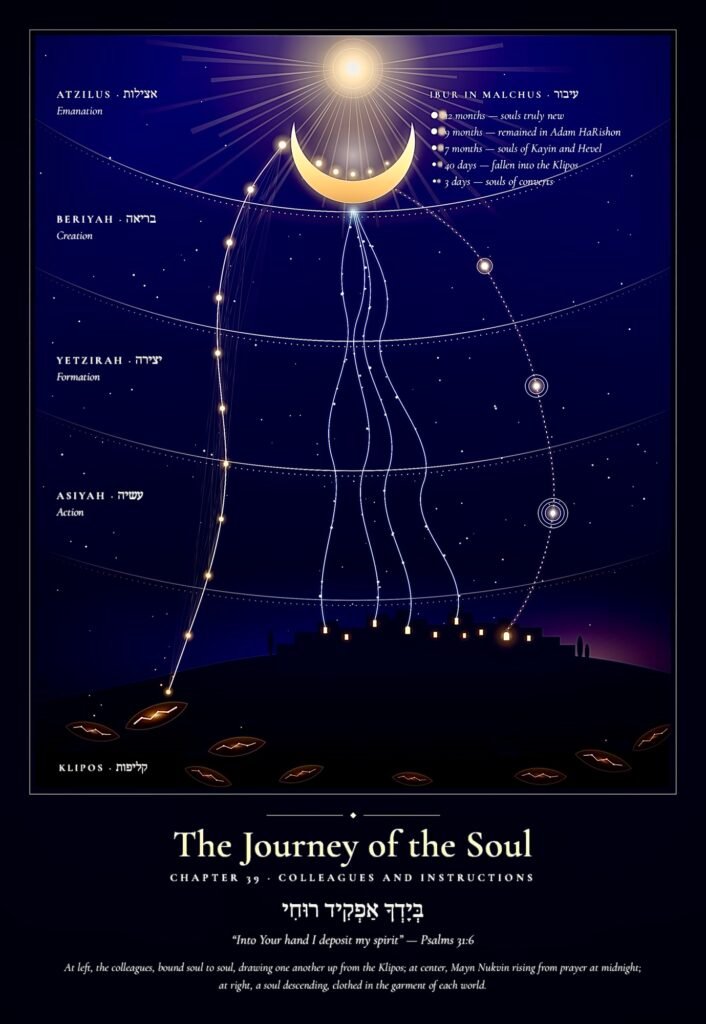
The chapter titled “Colleagues and Instructions” presents a complex vision of the soul’s passage through creation, sin, purification, and return. Its central concern is not only where souls come from, but how their histories shape their spiritual condition. Souls that appear alike in the world may carry very different inheritances: some are described as entirely new, others as having remained within Adam HaRishon, and still others as having fallen into the depths of the *Klipos*, the forces of spiritual concealment and impurity. Their origins determine how they are understood, how long they require purification, and how they may help one another ascend.
This account begins with the teaching that all souls were originally included in Adam HaRishon. In the wake of his sin, however, the human form was diminished, and the souls associated with it became separated according to their spiritual roots and conditions. The text interprets the tradition of Adam’s reduced stature as more than a physical change: it signifies a fracture in the unity of the human soul. Some souls remained close to Adam; others were passed to Kayin and Hevel; still others descended into the Klipos. The result is a hierarchy of spiritual histories, each bearing its own measure of blemish and promise.
The first category consists of souls described as truly new. These had been included in Adam HaRishon before the sin but were removed from him prior to it, ascending to their roots unblemished. Because they did not descend into the Klipos, they stand apart from the other categories. Their first appearance in the world is not simply another turn in a cycle: it is the emergence of a soul that has not previously undergone the same history of spiritual damage.
A second category comprises souls that remained within Adam HaRishon. They are also called new, though not in the absolute sense of the first group. Their first return to the world after Adam’s death is counted as their first incarnation, even though their initial formation in Adam is not counted that way. The text explains this distinction through the mystical language of “back-to-back” and “face-to-face” formation. Adam’s original formation, it says, occurred in a back-to-back state; the soul’s first true entry into worldly life is therefore reckoned from its later coming into the world after Adam’s death.
The souls associated with Kayin and Hevel form a third category. Adam bequeathed these souls to his sons while he was still alive, so their presence in Kayin and Hevel does not count as a completed incarnation in the same way as a later return after death. When they come into the world again, that return is considered their first. Yet they are more burdened than the souls that remained with Adam himself: they carry the blemish associated with Adam and an additional blemish associated with Kayin and Hevel.
A fourth category consists of the souls that fell into the depths of the Klipos after Adam’s sin. When these souls first enter the world, their appearance is already considered an incarnation, because their descent into the Klipos is treated as a prior spiritual passage. Their history is therefore marked by separation and concealment before their earthly life begins. Finally, the chapter names the souls of converts as a distinct category, with their own brief process of preparation before entering the world.
These classifications are not merely labels. They describe differing degrees of spiritual refinement and different lengths of preparation. Before entering the world, souls leaving the Klipos must undergo purification in *Malchus*. The text calls this process *ibur*, or spiritual impregnation: a period of gestation in which a soul is prepared to enter embodied life. The duration of this preparation varies according to the soul’s origin. Truly new souls remain in Malchus for twelve months; souls that remained with Adam for nine; those associated with Kayin and Hevel for seven; and souls that fell into the Klipos for thirty days. The souls of converts, by contrast, remain for three days, corresponding to the time required for conception.
The imagery of gestation gives the chapter’s account a striking tenderness. The soul does not simply cross a boundary from impurity into holiness. It is sheltered, formed, and refined before it enters the world. The length of its preparation reflects the work required for its purification. In this sense, time itself becomes a measure of spiritual transformation: the longer the soul remains in Malchus, the greater the refinement and illumination it may attain.
Yet the chapter’s vision is not one of isolated souls undergoing private repair. It emphasizes that souls can assist one another. The ascent from the Klipos is brought about through the prayers of the Jewish people, through *yichudim*—acts of spiritual unification performed by the righteous—and through the performance of mitzvot. These acts generate *Mayn Nukvin*, the “female waters”: an upward movement of holiness that draws spiritual sparks toward their source. Prayer and religious action, in this account, do not remain confined to the person who performs them. They participate in the restoration of the wider spiritual order.
This principle becomes especially significant when a soul that has already reached Malchus encounters another soul in danger of falling back into the Klipos. A soul undergoing its own preparation may be able to hold the blemished soul and bring it upward with it. To do so, it must place a portion of its own spirit within the other soul. That spirit serves as a garment and a source of strength, helping the blemished soul become rectified. The two remain connected until the Resurrection of the Dead, when they separate.
Here the chapter offers a profound account of spiritual companionship. A soul’s ascent may become the means of another soul’s rescue. The one being purified is not merely a passive recipient of help; it becomes a bearer of assistance. Its own movement toward holiness creates the possibility of lifting another. The relationship resembles the chapter’s title: souls are colleagues, bound together not only by shared origins but by mutual responsibility.
The chapter also preserves an important distinction between assistance and complete transformation. The soul that lends its spirit does not erase the other soul’s history. Rather, it provides a means by which that history can be repaired. The blemished soul remains itself, but it is clothed in a spiritual force that enables its refinement. Their connection is enduring, yet not permanent in the sense of fusion: at the Resurrection, each returns to its proper distinction. Unity serves restoration without abolishing individuality.
Taken as a whole, the chapter presents a universe in which spiritual life is shaped by inheritance but not imprisoned by it. A soul’s origin determines its condition and the work required of it, yet prayer, mitzvot, righteous intention, and the aid of other souls can alter its course. Even souls that have descended into the deepest concealment may be drawn upward. Even a soul already engaged in its own purification may become an instrument of mercy for another.
The teaching is therefore both intricate and hopeful. It portrays the human soul as carrying a history that reaches back to Adam HaRishon, while also insisting that this history can be transformed through relationship and sacred action. No ascent is entirely solitary. The prayers of the living can awaken what lies hidden; the righteous can draw souls toward holiness; and one soul can lend its strength to another. In this vision, creation is held together by a chain of mutual responsibility, and spiritual repair becomes a shared work—one in which every act of holiness may help restore not only the individual, but the fractured unity of the human soul.
The Soul’s Measure: Rectification, Companionship, and the Descent into the World
In the mystical account presented here, the soul’s journey is not a simple passage from one world into another. It is a gradual movement through spiritual realms, shaped by the soul’s condition, its opportunities for repair, and the deeds of those who are bound to it. A soul may linger in the *Malchus* of Atzilus for a period corresponding to its spiritual level; it may then descend through Beriyah, Yetzirah, or Asiyah before entering this world. Along the way, souls may be joined, sustained, and elevated through their association with one another.
The passage offers a striking vision of spiritual companionship. A higher or more complete soul can help a blemished soul remain in the *Malchus* longer than it would have remained alone. But this influence is not merely an act of generosity flowing in one direction. The companion who provides that support may itself be raised through the relationship. The bond between souls is therefore both a responsibility and a mutual path of rectification.
The Measure of a Soul’s Sojourn
The text describes different periods of remaining in the *Malchus*: twelve months, nine months, seven months, forty days, and even three days. These periods correspond to different spiritual levels. Some souls, including those described as the souls of converts, are said to remain there for only three days; others remain for forty days, seven months, nine months, or twelve.
When two souls are joined, the more elevated or beneficial level determines the duration of their shared sojourn. If a soul whose natural period is twelve months retains a blemished soul whose level would otherwise allow it to remain for only three days, the blemished soul remains for the longer period. The same principle applies to other levels: a soul associated with nine or seven months can extend the stay of one that would otherwise remain for forty days or three days. Conversely, if the soul providing support would remain for nine months, while the blemished soul it retains belongs to the twelve-month level, both remain for twelve months.
The governing principle is that the joined souls follow the more beneficial and elevated measure. The association does not diminish the higher soul to the level of the lower. Instead, the lesser soul is granted the opportunity to rise toward the greater one. Yet the relationship may also transform the higher soul, as the account of Rabbi Chaim Vital and his colleagues suggests.
Rabbi Chaim Vital and His Colleagues
Rabbi Chaim Vital relates that his teacher told him that the colleagues associated with him were reincarnations from the level of forty days. Vital, by contrast, was of the level of Kayin and Hevel, associated with seven months, and he understood this to be his first descent into the world. His presence, he was told, prevented his colleagues from falling into the *Klipos* and enabled them to remain in the *Malchus* for seven months rather than for their former, shorter period.
This relationship carried consequences for all involved. Vital understood that a portion of his spirit was mixed into each colleague, and that they received their spiritual sustenance through him. Their rectification therefore became his concern. If they were repaired, the portion of his spirit within them would be repaired as well. Their progress was not separate from his own.
The account then introduces a further possibility. Some of the colleagues may originally have belonged to the level of Adam HaRishon and, in that sense, to the nine-month level, although they had already descended into the world twice. If these souls had fallen to the level of forty days through blemish, but were raised by Vital’s seven-month soul, they might ultimately regain their original level. In that case, Vital’s association with them could raise him too: the soul that had helped them reach the seven-month level might itself be elevated to the nine-month level.
This possibility unsettled Vital, since he knew that some of his colleagues had roots in Adam HaRishon. He therefore wondered whether their shared sojourn had been seven months or nine. The uncertainty reveals how intricate the spiritual accounting is in this teaching. A soul’s present condition, its original root, its prior descents, and the influence of its companions may all bear upon its measure.
Vital also describes how the association unfolded. At first, he retained one soul. Then he and that soul together retained another. The next soul carried a spiritual contribution from both of them. The process continued, so that later members of the group bore elements of Vital and of those who had preceded them. The tenth soul, in this account, carried a spirit from Vital and from the nine colleagues before it. The group thus became a chain of spiritual participation: each new bond contained the accumulated influence of those already joined.
The Order of the Companions
Vital records the order of the first colleagues as it had been conveyed to him: first, himself, the young Chaim Vital; next, Rabbi Yonason Saggis; then Rabbi Yosef Arzin; and after him, Rabbi Yitzchak HaKohen. He did not know the order of the remaining companions.
At first, it might seem strange that Vital came before men who had entered the world before him. The text answers this by distinguishing the soul’s spiritual preparation from its bodily birth. A soul may precede another in the *Malchus*—where it serves as an *ibur*, or spiritual impregnation—while the other soul enters this world first. The sequence of spiritual association is not necessarily the sequence of earthly arrival.
This distinction opens onto a wider account of the soul’s descent. After completing its period in the *Malchus*, a soul may enter this world immediately. Another may first descend to Beriyah and remain there for a time, serving G-d among the angels. Still others may remain in Yetzirah or Asiyah before coming into the world. Their arrival may follow a set period, or it may be occasioned by prayer, merit, or a mitzvah performed by someone below.
The Worlds and the Soul’s Descent
The passage invokes the words associated with Elijah: “As the Lord, the G-d of Israel, lives, before whom I stand” (I Kings 17:1). It presents Elijah as an example of a soul that, after leaving the *ibur* of the *Malchus* of Atzilus, descended to Beriyah and remained there in divine service, like the ministering angels.
Not all souls follow the same route. Some descend from the *Malchus* of Atzilus to Beriyah and remain there; others remain in Yetzirah; still others descend to Asiyah, the world closest to embodied life. The pathway is not determined solely by the soul’s own level. It also depends on the actions of people in this world who are spiritually associated with it.
Prayer, in particular, is presented as having different degrees of power. Some prayers can elevate a soul only to the point of becoming an *ibur* in the *Malchus*. Others, performed with deeper intention and greater acceptance before G-d, may draw a soul down into this world. Some may bring it only as far as Beriyah, while others may reach further. The spiritual effect of prayer is therefore not uniform: it depends on the person performing it, the quality of the act, and the relationship between that person and the soul.
The root of the person’s own soul also matters. A person may draw into a child the soul closest to him according to the root of his soul, rather than another soul that is less closely related. In this way, spiritual kinship shapes the possibilities of descent and embodiment.
Clothing, Revelation, and Spiritual Rank
A soul that descends immediately into this world is not in the same condition as one that first remains in a higher world. The latter is said to be “clothed” in that world: a higher light is enclosed or veiled by a lower level of light. The clothing reduces the soul’s direct revelation, though the soul may still possess a higher spiritual rank than one that descended without interruption.
The passage distinguishes the worlds by the refinement of their clothing. Beriyah is more refined than Yetzirah, and Yetzirah more refined than Asiyah. A soul clothed in Beriyah is therefore less concealed than one clothed in Yetzirah or Asiyah. At the same time, the text makes a subtle distinction between rank and radiance. A soul that has been held in a higher world may be spiritually greater, yet a soul that descended directly may give off more light because it has not passed through an intervening garment.
Vital says that his own *Nefesh* spark did not descend immediately after leaving its *ibur*. It was held back above, though his teacher did not tell him in which world. Even this personal detail reinforces the central theme: the soul’s path is individual, and its manner of descent cannot always be inferred from its outward presence in the world.
A Responsibility That Flows Both Ways
The teaching returns to the obligation Vital bears toward his colleagues. Because a portion of his spirit is present within them, he must make an effort to rectify their deeds. Their righteousness benefits him, since the part of his spirit within them is repaired through their improvement. Yet, Vital is told, they do not receive the same benefit from his deeds; they gain nothing merely because he acts righteously. The relationship is therefore asymmetrical in its immediate consequences, even though it binds them together.
The passage then introduces the teaching that every righteous person possesses two souls: an inner soul within the body and an encompassing soul, or *Ohr Makif*, that remains above and hovers over the person. The inner soul inhabits embodied life; the surrounding soul stands beyond it, as a source of spiritual possibility. The encompassing soul is described as a channel through which a person may ascend.
This image deepens the account of companionship. Souls are connected not only through reincarnation or through their shared sojourn in the *Malchus*, but also through layers of spiritual presence that extend beyond the body. What appears to be an individual life may contain a network of spiritual relations: an inner soul, an encompassing light, fragments shared with companions, and roots that reach back to earlier states of existence.
Conclusion
The passage presents the soul’s journey as a process of descent, concealment, companionship, and repair. A soul’s time in the *Malchus* reflects its level, but that measure can be altered through association with a more elevated soul. The lesser may be raised by the greater; the greater, in turn, may be transformed through the very relationship that first made its descent possible. Spiritual companionship is thus neither simple charity nor mere proximity. It is a shared labor in which one soul’s repair becomes inseparable from another’s.
The account also insists that the soul’s path is shaped by human action. Prayer, mitzvos, intention, and merit may influence whether a soul remains above, descends through one of the spiritual worlds, or enters embodied life. Even the manner of descent matters: a soul may arrive directly, or be clothed in a higher or lower world before it comes to this one.
At its heart, the teaching is a meditation on responsibility. To be joined to another soul is to carry a portion of its destiny—and, in turn, to discover that one’s own rectification may depend upon the other’s. The soul does not journey alone. Its ascent is bound to the lives, prayers, and moral labor of those with whom it is joined.
Shmuel and the Two Levels of the Soul
The passage attributed to Shmuel presents the soul not as a single, simple presence, but as a layered reality. It describes an “Inner Soul,” which dwells within a person, and an “Encompassing Soul,” which remains above him. Together, these two levels offer a striking account of spiritual life: a person is at once rooted in the world and connected to a source beyond it. The text then extends this idea into a vision of responsibility, companionship, and the hidden bonds between souls.
The Inner Soul is the part of the spiritual self that inhabits a person and gives his life its inward character. The Encompassing Soul, by contrast, is not fully contained within the person. It remains above him, as though surrounding or sheltering his earthly existence. The passage associates the loss of these dimensions with sin: as a person falls spiritually, the levels of the soul descend, and one may ultimately be cut off and drawn into the *Klipos*, the forces of spiritual concealment and impurity. The righteous person, however, retains both levels. His life is therefore not confined to what can be seen or felt within him; it remains joined to a higher spiritual presence.
This distinction is more than a description of mystical anatomy. It establishes a moral and relational vision of human life. The Encompassing Soul does not benefit its bearer alone. Through it, “light and bounty” can flow to companions who are spiritually connected to him. They may receive strength, insight, and help toward their own correction. In turn, some of the light generated by their good deeds returns to the righteous person and reaches his Inner Soul. The passage thus imagines spiritual influence as reciprocal: one person’s elevation can nourish others, while their growth can also enrich him.
Yet this relationship has a clear boundary. The companions may draw from the righteous person’s Encompassing Soul, but they do not share in his Inner Soul and do not receive the merit of his commandments. His spiritual influence can guide and sustain them, but it cannot replace their own work. This is one of the passage’s most compelling teachings: spiritual leadership is generous, but it does not erase personal responsibility. A teacher may open a path, but each person must walk it.
The text develops this theme through its account of Shmuel and his companions in relation to the Arizal, their teacher. Their souls are described through the symbolic structure of the *sefirot*—the channels through which divine attributes are understood to flow. The companions are associated with different roots of *Chassadim* and *Gevuros*, corresponding to qualities of lovingkindness and restraint. Their distinct spiritual origins explain both their individuality and their connection to one another. They are not interchangeable followers gathered around a teacher; each possesses a particular place within a larger pattern.
This pattern also reveals the passage’s understanding of the teacher’s role. The Arizal is not merely a source of information. He is a spiritual root from which his companions receive nourishment and direction. Their relationship to him is expressed through the imagery of emanation, clothing, and flow: spiritual light moves through one level and becomes accessible at another. The imagery is intricate, but its central implication is clear. A community of disciples is held together not only by shared learning, but by unseen bonds of influence and obligation.
The passage’s discussion of “clothing” deepens this account. Every soul, it says, requires a vessel or garment through which it can exist in this world. These garments are connected to spiritual processes in the upper worlds, including the imagery of the wasted drops associated with Yosef HaTzaddik. The text interprets these drops as sparks of soul-light that were not joined to their proper destination and were consequently seized by the *Klipos*. It then relates different spiritual groupings to different forms of pairing and different kinds of garments.
This language can seem remote from ordinary experience, yet it gives the passage a powerful symbolic vocabulary for vulnerability and repair. A soul’s earthly presence is not presented as self-sufficient. It depends upon a spiritual “garment”—a form through which its light can be carried into the world. When that garment becomes entangled in forces of concealment, the task of the righteous is to help restore what has been displaced. The account of the Arizal and his companions is therefore also an account of rectification: spiritual life involves recovering scattered light and directing it toward its rightful purpose.
The contrast between the Ten Martyrs and the students of Rabbi Shimon bar Yochai makes this idea especially vivid. The passage associates the martyrs with *Gevuros*, powers of severity and restraint, and explains their suffering through the vulnerability of those powers to the *Klipos*. The students associated with *Chassadim*, by contrast, are described as not needing to die, because the forces of impurity do not grasp those qualities in the same way. Whatever the historical and theological complexity of this claim, its symbolic distinction is striking: not every spiritual quality encounters the same dangers, and not every soul’s path toward repair takes the same form.
At the heart of the passage is a vision of spiritual life as both intimate and expansive. The soul is intimate because it dwells within a person, shaping his inner life. It is expansive because it reaches beyond him, connecting him to teachers, companions, and higher sources of being. The righteous person’s responsibility follows from this dual nature. He must cultivate his own inner life, but he must also become a source of illumination for others. His influence is a gift, not a substitute for their effort; his companions are connected to him, yet remain answerable for their own deeds.
Shmuel’s teaching, as preserved in this passage, therefore offers more than a mystical map of the soul. It offers an ethics of connection. No person is spiritually isolated, and no person can live entirely through another. We are shaped by those who teach us, sustained by those who encourage us, and responsible for the light we pass on. But the work of becoming whole remains our own. The soul’s two levels—inner and encompassing—express this enduring balance: to be deeply oneself, and at the same time to belong to something greater.
The Hidden Architecture of the Soul
In the mystical account of the Ten Martyrs and the generations of sages who followed them, a soul is never merely an isolated spark. It is a measured emergence from a vast spiritual order: a drop shaped by a particular union, a light clothed in a particular vessel, and a life rooted in a particular configuration of divine attributes. The account’s intricate language of *Chassadim* and *Gevuros*, of *Yesodos* and pairings, describes not only how souls descend, but why some are associated with teachers, why others resist such classification, and why the manner of their emergence matters.
The Ten Martyrs, identified here with the level of the *Gevuros*, are presented as having no single, specific teacher. At first this absence seems puzzling. If some of their spiritual roots belong to the *Yesod* of Abba and others to the *Yesod* of Imma, should they not have two teachers, corresponding to those two sources? The question is raised, but the answer is withheld. The teacher, the account says, appeared to deflect the inquiry rather than resolve it. That silence is itself suggestive: the roots of these souls may not fit neatly into the ordinary pattern by which a spiritual lineage is assigned.
The explanation turns on the different ways that *Chassadim* and *Gevuros* are situated. The *Chassadim* of Abba, because Abba’s *Yesod* is narrow, do not remain inside it. They pass outward and surround it. By contrast, the *Chassadim* of Abba and Imma are described as contained within the *Yesod* of Imma, while the *Gevuros* are divided: some are in the *Yesod* of Abba, and some in the *Yesod* of Imma. This division makes a single teacher or source difficult to name. The Ten Martyrs belong to a spiritual category whose very structure is distributed.
The account then places these souls within a sequence of divine pairings. Each pairing produces its own pattern of spiritual “drops,” and each pattern gives rise to souls of a distinct character. The first relevant group is associated with the highest pairing, Yisrael with Rachel, and with the light of Abba’s intellect. From this level emerge the *Chesed* and *Gevurah* of Abba. Rabbeinu Hakadosh, who edited the Mishnah, is described as the *Yesod* from whom came the drops that became his students: Rabbi Chiya, Rabbi Oshaya, Bar Kappara, Levi son of Sisi, Rabbi Chanina son of Chama, Rav, and others. Here, teacher and students are not merely joined by study. Their bond is traced to a shared spiritual origin.
The next pairings reveal a more complex pattern. In the third pairing, Ya’akov and Leah unite after midnight. Leah, though associated with judgment, is then in a state of sweetening and extends through the full length of Zeir Anpin. From this pairing emerge ten drops: five *Chassadim* and five *Gevuros*, all from Abba. Because these pairings belong to the level of Ya’akov, which is associated with Abba, they are described as not requiring rectification through death.
A further union, the “Dark of the Morning,” produces two especially elevated drops: one containing five *Chassadim*, the other five *Gevuros*. Though only two drops, they are said to surpass the ten drops of the after-midnight pairing. Together, these drops form the spiritual roots of the teacher’s companions. The teacher himself is identified with the *Yesod* of Ya’akov, from whom the drops descend. Yet the account distinguishes among these groups: some companions learned with the teacher earlier, because their roots belonged to the pairing before midnight and did not have an independent teacher or *Yesod*. The two *Yesodos*—before and after midnight—are, in this case, counted together as one. What appears to be a simple question of lineage thus depends on subtle distinctions of time, configuration, and spiritual inclusion.
The fourth pairing, Yisrael with Leah during the weekday Afternoon Service, produces another kind of origin. Because the union takes place from the chest upward, there is no space for the *Chassadim* and *Gevuros* to spread within Zeir Anpin in the usual manner. Instead, the five *Chassadim* gather in the right arm, and the five *Gevuros* in the left. They are therefore regarded as two drops, corresponding to the two arms. This pairing is associated with the two brothers Pappus and Lulianus, who were killed in Lod. Their spiritual level is especially elevated, yet they too lack a recognizable *Yesod* or a specific teacher. The structure of their source differs from the familiar model of a single lineage.
The fifth and final pairing, Ya’akov with Leah before midnight, is described as complete judgment and is associated with those killed in Beitar. Here the *Yesod* is Rabbi Elazar HaModa’i, who was killed in Beitar. Across these pairings, the account links the fate of particular souls and communities to precise spiritual configurations. The historical tragedies of Lod and Beitar are not treated as events detached from the upper worlds; they become earthly expressions of deeper patterns of judgment, mercy, and union.
Yet the most striking distinction in the passage concerns not only where souls come from, but how they come into being. The drops that produce these exceptional souls are contrasted with souls said to result from wasted seed. In the ordinary process described, the male may be aroused without a corresponding arousal from the female, and the resulting drops emerge from the male’s own desire. Such drops arise from the brain of *Da’as*, where desire is awakened. They pass through the *Yesod* without first descending and becoming clothed in the six lower dimensions of Zeir Anpin. For that reason, they are described as possessing an extraordinary spiritual height.
The drops produced through a proper pairing follow a different route. The female is first aroused with desire for the male; only afterward is the male aroused. Their emergence is therefore not an expression of isolated male desire. Rather, they descend through the channels of the *Chassadim* and *Gevuros*, passing through the six ends of Zeir Anpin before reaching the *Yesod*. The distinction is not a simple ranking of souls, but a distinction between spiritual pathways: one shaped by mutual arousal and ordered transmission, the other by desire arising in the *Da’as* itself.
Finally, the account separates the soul’s “clothing” from the soul’s own light. The drops described above provide the vessels and garments through which the soul is embodied—the structures associated with its 248 limbs. But the light of the soul itself comes from its own root. Even where several souls share a level of *Da’as*, and even where their garments arise from related drops, they need not share the same inner source. Their outer forms may be connected; their deepest lights remain distinct.
This is the passage’s governing vision: spiritual kinship is real, but it is never merely uniform. Souls may share a teacher, a pairing, a vessel, or a level of divine attributes without possessing an identical root. Others may have no single teacher because their origins are divided across several sources. The account’s elaborate distinctions—between Abba and Imma, *Chassadim* and *Gevuros*, before and after midnight, inner light and outer garment—preserve the individuality of each soul within an immense order of connection.
The result is a portrait of spiritual lineage that is both intimate and vast. A teacher may be the *Yesod* from which students emerge, yet their inner lights remain their own. A group may share a common level, yet divide across different spiritual roots. And a soul’s earthly history may reflect a pattern formed far above it, in the hidden architecture of divine union. In this vision, no life is spiritually accidental—but neither is any soul simply a copy of another.
The Remnant in Exile: Soul, Time, and the Companions of the Arizal
The passage presents a mystical account of souls as garments formed from spiritual “drops”—emanations associated with pairings within the divine structure. Its language is intricate and, in places, damaged or uncertain, but its central vision is clear: human souls are not isolated creations. They belong to ordered lineages, arise through different inner and outer channels, and enter history at appointed times. The companions of the Arizal are understood within this cosmic pattern, as members of a particular spiritual generation whose work is bound to the final exile and to the discipline of rising at midnight.
At the heart of the account is the distinction between the inner and outer aspects of the garments of souls. The “drops” that clothe souls may derive from the external aspect of the brains of Zeir Anpin—the levels associated with Netzach, Hod, and Yesod of Abba or Imma—or from their inner aspect. These distinctions are not merely technical classifications. They suggest that souls may share a broad spiritual origin while differing in the depth, quality, and mode of their connection to it. The same divine structure gives rise to garments of different kinds: some more inward, some more external, some associated with the level of Yisrael, others with Ya’akov.
The passage gives these groups a biblical name: the “remnant.” Those associated with the level of Yisrael are called the “Remnant of Yisrael,” while those associated with Ya’akov are called the “Remnant of Ya’akov.” The prophetic verses that speak of a remnant are thus read not only as promises of national survival, but as descriptions of spiritual lineages. A remnant is what endures when a larger order has been diminished: the portion that remains, carries its inheritance, and preserves the possibility of renewal. In this reading, the remnant is both a people and a spiritual pattern—souls whose origins connect them to a particular divine configuration.
The text organizes these origins through five pairings. It also associates different groups of souls with distinct historical communities: the Ten Martyrs, the students of Rashbi, the students of Rabbi, the twenty-four students of the Arizal, and those killed at Lod and Beitar. The passage’s purpose is not simply to list these groups, but to place them within a recurring structure. Their suffering and their spiritual origins are understood as related: the historical loss of these communities becomes part of a larger account of how souls descend, are clothed, and reappear across generations.
Yet the order in which souls enter the world does not necessarily follow the order of their spiritual rank. The text emphasizes that the drops associated with the third pairing of Ya’akov and Leah, after midnight, are the last to arrive in this world. Their late appearance makes them especially relevant to the final exile. They belong to a generation that comes at the far end of a long historical process, when the spiritual night is deep and the work of repair is urgent.
This emphasis on time is expressed through the prophecy of Isaiah: “Watchman, what of the night?” The passage interprets *leil* as the period before midnight and *lilah* as the period after midnight, following a distinction found in the Zohar. The two terms represent two groups of souls: one associated with the first half of the night, the other with the second. Both are said to appear during the final exile, even though their spiritual origins differ. The prophecy therefore becomes a dialogue between the Divine Presence, dwelling in the exile of Edom, and the Holy One. The Presence asks what remains of the night; the answer is both dawn and night. Morning is coming, but the darkness has not yet vanished.
That tension gives the passage its emotional force. The “morning” refers to souls born from the pairing called the “Dark of the Morning,” while “night” refers to those born from the pairing after midnight. The future is not presented as a simple escape from darkness. Dawn is real, but so is the night that persists within the final generation. The souls who arrive at this threshold are therefore charged with a particular responsibility: they must live with an awareness of both promise and difficulty.
The text draws a practical lesson from this cosmic geography. Since the Arizal’s companions are said to belong to the pairing after midnight, they are instructed to rise precisely at midnight. The practice is more than a devotional discipline. It is an enactment of their spiritual identity. To rise at midnight is to meet the hour from which their souls are understood to derive; it is to align the body’s time with the soul’s origin. The Arizal’s warning that this practice would greatly assist them in understanding Torah suggests that spiritual knowledge depends not only on study, but also on the shaping of one’s life around sacred time.
The lists of companions that follow give this teaching a human and communal dimension. Rabbi Chaim Vital identifies one group as belonging to the inner aspect of the brains of Da’at. Other groups are associated with outer aspects, with the inner or external garments, and with different impressions of Yesod. The names are presented with care, but also with hesitation. Vital repeatedly admits that he does not know with certainty which individuals belong to which group, and that some may be exchanged or reclassified. His uncertainty is significant. The metaphysical scheme may be exact in principle, but its application to particular people remains partly concealed.
This modesty prevents the account from becoming a simple catalogue of spiritual status. The groups are not presented as fixed ranks that can be confidently assigned from the outside. Even the Arizal, according to Vital, expected that some companions might not remain in their original group and that others might take their places. Two days before his death, he reportedly said that those who had been part of the first group still required another “separation.” Their identities and affiliations were not yet fully settled.
The idea of separation is especially suggestive. A soul’s origin does not mean that its spiritual formation is complete. The garments may be refined, divided, or reassigned; the group itself may change. In this way, the passage joins cosmic structure to moral and spiritual process. A person may belong to a particular lineage, but belonging does not eliminate the need for preparation. Identity is inherited, yet it must also be made ready.
The passage’s final vision is therefore one of disciplined uncertainty. It speaks with confidence about the existence of inner and outer channels, five pairings, prophetic remnants, and the spiritual significance of midnight. At the same time, it acknowledges that the precise placement of individual companions is not always known. This combination of order and humility is central to its tone. The world has structure, but human beings do not possess complete access to it.
To read the passage as a whole is to encounter a theology of inheritance under pressure. Souls descend through layered channels; communities bear the marks of those origins; exile delays and distorts the fulfillment of their purpose; and practices such as rising at midnight help align a person with the spiritual work of the age. The “remnant” is not merely what survives catastrophe. It is what remains capable of carrying meaning forward. The companions of the Arizal, in this account, are a remnant of the night: souls whose task is to study, pray, and prepare at the hour when darkness is deepest—because that is also the hour in which the first signs of morning may be discerned.
Levels of Good and Bad
The passage presents good and evil not as simple, fixed categories, but as qualities mixed in different proportions within a person’s soul. Some people are mostly good, with only a small measure of evil; others are mostly evil, though they retain a portion of good. Still others stand between the two. These differences matter because a person’s spiritual condition is not understood as an unchanging label. It is a balance that can be strengthened, weakened, or transformed through conduct, companionship, and repentance.
The passage grounds this teaching in the verse, “If your enemy is hungry, feed him bread” (Proverbs 25:21). In its mystical interpretation, the verse points beyond ordinary generosity: even those who appear opposed to goodness may contain sparks that can be awakened. To offer them sustenance is, in part, to help the good within them emerge. The teaching therefore asks its reader to look beneath outward character and recognize the possibility of inner repair.
A spectrum rather than a division
The text describes several degrees of spiritual composition. A person may be “mostly good,” “mostly bad,” or somewhere in between, and there are many gradations within each category. The distinction is not merely theoretical. It determines how a person may change and what kind of influence is possible between people.
Those who are mostly good are expected to remain on the side of good. Those who are mostly bad, however, may still possess a little good that can be drawn out or redirected. In the passage’s symbolic language, the good and bad elements among a group of companions can separate: the good within one person may join with the good in another, while the evil within them is drawn toward those whose character is predominantly evil. The result is a kind of spiritual sorting. Those who are already inclined toward good become more complete in it, while those who reject goodness become more fully separated from it.
This image is striking because it presents moral life as relational. A person’s inner condition is not formed in isolation. The company one keeps, the affection one offers, and the influence one accepts can all affect which aspect of the self becomes stronger. Friendship is therefore more than social comfort: it is a setting in which character may be refined.
Friendship as a means of repair
The teacher’s instruction to love and teach his companions follows directly from this understanding. The narrator is told to make a great effort to bring the spiritually compromised back toward repentance. At the same time, he is told that through love and instruction he may receive from others the good that is missing from his own spiritual inheritance. In this account, companionship can help each person become more complete.
The idea is reciprocal. One person may help awaken the good in another; another may possess a particular quality that the first lacks. Love makes this exchange possible, while teaching gives it direction. The passage thus treats moral responsibility as both outward-facing and inward-facing: one should strive to improve others, but also remain humble enough to learn from them.
This teaching does not imply that every relationship is uncomplicated or that goodness can be taken from others without regard for their dignity. Rather, within the passage’s mystical framework, it expresses a demanding ideal: to seek the good in others, to help it flourish, and to allow the encounter to correct oneself as well.
The precariousness of the middle ground
The passage gives special attention to those who are balanced between good and evil. Their future, it says, depends on their deeds. If their actions are desirable, they may become wholly good; if their actions turn toward evil, they may move in the opposite direction. Balance is not presented as a permanent refuge. It is a state of possibility, and possibility requires choice.
The example of Achav illustrates this point. The text invokes the rabbinic interpretation that Achav was balanced and could not be judged until he inclined toward one side. In the passage’s account, a person who remains at the midpoint has not yet made the decisive movement that determines his direction. But once conduct tips the balance, the person’s moral trajectory becomes clearer.
This is a powerful ethical claim. Neutrality is not necessarily stability. When a person stands between opposing possibilities, even a single serious act may establish a direction. The middle ground demands vigilance because it can become either a threshold to goodness or a passage into wrongdoing.
The importance of conduct
The passage repeatedly emphasizes deeds as the means by which a person’s inner balance is expressed. Spiritual inheritance may shape a person’s tendencies, but it does not erase responsibility. The person who is in between is judged by what he does; the person who is mostly good must continue to strengthen the good; and the person who is mostly bad is still addressed as someone capable of repentance.
This emphasis prevents the teaching from becoming a simple doctrine of fate. The text speaks in the language of roots, sparks, and spiritual levels, yet it also insists that choices matter. A person’s origins may help explain his struggles, but conduct determines whether he moves toward repair or away from it.
The instruction to bring merit to sinners is especially significant. The narrator is told that people in his generation may listen to him and be moved by his words. This responsibility arises not from superiority, but from a perceived connection to those he is meant to help. The greater the capacity to influence, the greater the obligation to use it for compassion and moral change.
A vision of responsibility beyond one lifetime
The passage extends this responsibility beyond the living. It describes the possibility of aiding souls associated with earlier generations and raising them from Gehinom so they may return to the world and be rectified. Within the text’s mystical worldview, moral repair is not confined to one lifetime or even to one generation. The living may participate in the restoration of those who came before them.
The detailed account of spiritual roots, sparks, and angels gives this idea a ritual and cosmic structure. Particular figures are linked with particular qualities, and particular acts are understood as means of repair. Yet beneath the elaborate symbolism lies a clear moral intuition: the work of goodness is larger than the individual. A person may inherit unfinished struggles, and a person’s own efforts may help heal what remains unresolved.
Conclusion
The passage’s account of good and bad offers a vision of moral life as a changing balance. People differ in the mixture of good and evil within them, but those differences do not remove the possibility of change. The mostly good must continue toward completeness; the mostly bad may still be reached through repentance; and the person in between must recognize that actions will determine the direction of the soul.
Most importantly, the text makes moral growth a shared undertaking. Love, teaching, and companionship can strengthen what is good in others and in oneself. To feed an enemy, in this interpretation, is to refuse to treat any person as nothing but his worst qualities. It is to recognize the possibility of goodness, nourish it, and accept responsibility for helping it grow.
The Discipline of the Senses and the Elevation of the Sparks
In this passage, spiritual repair is presented not as an abstract pursuit but as a discipline of attention. The mouth, eyes, ears, and nose become instruments of moral refinement: what one refuses to say, see, hear, or seek out can help restore a damaged spiritual root. The text joins ethical conduct to the mystical language of sparks, names, and the *sefirot*, suggesting that inward transformation takes place through both daily restraint and contemplative intention.
The account begins with a series of personal commitments. The speaker resolves not to use the mouth for idle or mocking speech, associating this restraint with the rectification of the root of Yuval. He connects guarding the eyes from evil with the roots of Dathan and Aviram, and keeping the nose from foul or forbidden odors with the root of Yaval. Avoiding idle chatter is again linked to Yuval, while the study of Kabbalah—especially the Zohar, to the extent one is able—serves the rectification of Lemech. These correspondences may appear unusual to a modern reader, but their governing idea is clear: spiritual life is shaped by the ordinary acts through which a person directs attention and desire.
The passage then describes the elevation of seventy sparks that remain within the *klipot*, the forces or “husks” that conceal holiness. Each spark is understood as a *Yud*, the smallest letter of the divine name, because every soul contains ten *sefirot*. The numbers of sparks are therefore not merely a count. Multiplied by ten, they become a symbolic language of divine names and structures. Thirteen sparks associated with Korach yield 130; twelve associated with Dathan and Aviram yield 120; and the full arrangement is traced through the remaining roots, ultimately reaching twenty-two sparks, corresponding to the twenty-two letters.
This numerological framework gives the work of repair a cosmic dimension. A person’s conduct is not treated as isolated from the spiritual order. Rather, the repair of a particular trait is imagined as the recovery of a fragment of holiness from concealment. The names and letter-combinations used in contemplation provide a ritual vocabulary for that recovery. Yet the text does not leave the reader among abstractions. Each mystical correspondence is paired with a practical demand.
The root of Korach, associated here with Chesed, is linked to thirteen sparks and to the discipline of the eyes: one should not look beyond the permitted space of four cubits. The text connects the number of sparks with the gematria of “eye,” making the ethical practice itself part of the symbolic structure. The angels Michael and Uriel are named as helpers in this elevation. Whether read literally, devotionally, or as part of a traditional cosmology, the pairing makes a striking point: the gaze is not spiritually neutral. What a person chooses to look at can either scatter attention or gather it toward holiness.
Dathan and Aviram are associated with twelve sparks, the traits of Netzach and Hod, and the need to avoid looking at evil. Their elevation is entrusted to Rabban Gamliel, with Raphael and Gabriel named as assisting angels. Here, restraint is not passive. Refusing to look at what degrades the mind is presented as an active form of repair. It is a way of denying harmful images the power to occupy the inner life.
The root of Yitro is linked to six sparks and to Gevurah. Its discipline concerns the ear: one should guard against hearing slander and idle talk. The passage thereby extends its account of moral attention from seeing to listening. Speech can injure, but so can the willingness to receive and circulate malicious speech. The ear, like the eye, becomes a threshold. What enters through it may shape judgment, feeling, and conduct.
The root of Yaval is associated with eight sparks, Yesod, and the nose. Its repair requires avoiding foul odors and the scent of forbidden relationships. In the text’s symbolic system, the senses are not merely biological faculties; they are channels through which desire and discernment are formed. The nose’s discipline may seem less familiar than the ethics of speech or sight, yet it belongs to the same larger principle: holiness is cultivated through the careful governance of appetite and perception.
Yuval, associated with nine sparks and Tifferet, is repaired through the mouth. The instruction is to avoid idle chatter and scoffing. This is more than a call to silence. It asks that speech become measured, purposeful, and truthful. The mouth can diminish the dignity of others through mockery, or it can become an instrument of blessing, learning, and prayer. In this sense, the rectification of speech is also the rectification of relationship.
Lemech, associated with twenty-two sparks and Malchut, is linked to the study of Kabbalah and to sustained engagement with its wisdom. The passage recommends learning as much as one can, and assigns the angel Metatron to assist in the elevation of these sparks. This final correspondence broadens the discipline beyond restraint. Spiritual refinement does not consist only in refusing harmful impulses; it also requires the active pursuit of understanding. Study gives language and structure to the work of inward repair.
The passage’s instructions extend beyond the senses. The speaker is told to avoid taking large steps, to guard against pride, and to eat with moderation. He is urged to concentrate during prayer, especially when reciting “Restore our judges,” and to bring intention to blessings over things that give pleasure. He is also instructed to keep bread on the table, not to drink water after a meal, and to show care for the honor of colleagues. These details reveal the text’s distinctive vision of religious life: no corner of conduct is too small to bear spiritual significance. Humility can be expressed in the way one walks; reverence in the way one eats; respect in the way one treats companions.
Other instructions focus on ritual gestures and their associated intentions. During the sanctification in the repetition of the *Amidah*, the speaker is told to join his legs and contemplate a sacred sequence of letters. When dressing in Shabbat clothing, he is to direct his intention toward the name Zehariel. He is warned not to touch or remove hairs from his beard, even inadvertently, and to contemplate the numerical relation between the word “beard” and the name Shaddai. He is also told not to interlace the fingers of the right and left hands, but instead to meditate on a divine name when looking at his fingers.
The same attention is brought to the straps of the *tefillin*, which must not touch the ground. While tying them, the speaker is to contemplate the numerical relationship between the word “strap” and an expanded divine name. At the blessing after the meal, he is instructed to look into the cup and consider the water mixed with the wine, whose numerical value corresponds to nine *Yuds* found in expanded forms of divine names. These practices may seem intensely particular, but their purpose is consistent: to transform routine acts into occasions of awareness. The gesture becomes a reminder that the body, the ritual object, and the divine order are not separate domains.
The teacher also emphasizes rising at midnight. The reason, the passage explains, is connected to the spiritual source of the speaker’s soul. Those whose souls derive from a particular union are especially called to rise during the latter half of the night, repent, pray for the destruction of the Temple and the exile of the Divine Presence and the Jewish people, and then study Torah until morning prayer. Midnight is thus not simply a test of discipline. It is a time of mourning, longing, and study—a private participation in the collective suffering of exile.
The final section turns to the rectification of Kayin. The speaker is told that he has begun repairing a blemish associated with Kayin’s sin, since his own soul is rooted there. When the “depths of the sea”—an image for the force of the *sitra achra*, or the adversarial inclination—overwhelm him with sadness and temptation, he is to direct his intention toward the biblical words “maintaining lovingkindness for thousands.” On the words “for thousands,” he is to contemplate the names Adonai and Elohim, whose numerical values together yield 151; with the letters and the *kollel*, the total becomes 161, the value of *alafim*, “thousands.” The calculation turns a verse into a spiritual counterweight: when destructive forces press upon the mind, the words of mercy become an intentional act of resistance.
Taken as a whole, the passage offers a demanding but coherent portrait of spiritual discipline. Its world is one in which letters, numbers, names, angels, and bodily habits are woven together. Yet beneath the elaborate correspondences lies a practical ethical vision. Guard the senses. Speak with care. Refuse slander and mockery. Practice humility and moderation. Study deeply. Pray with attention. Remember the suffering of the community. Meet despair and temptation with words of mercy.
The text’s mystical language does not replace ordinary conduct; it intensifies its significance. A restrained glance, a withheld insult, an attentive blessing, or a night spent in prayer may become, in this account, a means of restoring what has been scattered or concealed. The elevation of sparks is therefore both cosmic and intimate: a repair imagined in the structure of the worlds, enacted through the smallest choices of a human life.
The Intention of Making the “Dry Land” Whole
The passage presents spiritual intention not as an abstract exercise, but as a daily discipline: a way of directing the heart toward repair. Its central image is the transformation of “dry earth” into “land”—a movement from barrenness and fracture toward wholeness, receptivity, and renewed life. The text links this work to the expanded Name *Elohim*, to the story of Kayin and his offering, and to the particular responsibility of someone whose spiritual root is associated with Kayin. It then widens its vision, describing prayer, sacred study, and the bonds between souls across generations as parts of a single labor of restoration.
The passage begins with a numerical meditation. The Name *Elohim*, spelled out with Alephs, has the numerical value of 291—the same as the Hebrew word for “land.” This correspondence gives the intention its focus. Each day, the practitioner is to keep in mind the possibility of making the “earth” whole again, especially on days devoted to Torah. The text insists on constancy: an intention repeatedly held in consciousness can shape the spiritual meaning of ordinary life. Torah study, in particular, calls for care because it places the learner in direct relation to sacred wisdom. The more closely one approaches that wisdom, the more attentive one must be to the inner work that accompanies it.
The image of the “dry earth” comes from the account of Kayin’s offering. Kayin brings flaxseed, and the passage interprets this offering as having weakened the earth. In the language of Kabbalah, Malchus—the final sefirah, associated with the receptive presence of the Divine—is called “earth.” When its flow of spiritual vitality is diminished, it becomes dry: a realm deprived of the life-giving influence of the upper worlds. Kayin’s punishment, wandering across the land, thus becomes more than a historical consequence. It reflects a spiritual condition in which the land itself has been impaired.
Against this background, the expanded Name *Elohim* becomes an instrument of repair. Because its numerical value corresponds to “land,” meditating on it can symbolize the return of Malchus from dryness to fruitfulness. The practitioner is instructed to remember the blemish associated with Kayin and to intend its rectification. The aim is not simply to contemplate a past failure, but to participate in the restoration of what that failure represents. The earth that had become dry can again become land: a place capable of receiving, sustaining, and bringing forth life.
The text makes this responsibility personal. The speaker is told that his soul comes from the root of Kayin, and therefore he should be especially mindful of this repair. Yet the teaching is not merely a statement about ancestry. It makes spiritual inheritance a form of obligation. To belong to a root is to inherit both its potential and its unfinished work. The practitioner’s daily intention becomes a way of responding to that inheritance—not by denying the blemish, but by directing attention toward its healing.
This emphasis on intention continues in the passage’s instructions for prayer. After the prayer, the speaker is told to recite verses expressing the hope that G-d will be King over the whole earth and that G-d’s Name will be One. The word “one” is associated with the first and last letters of the Hebrew word *echad*, whose numerical value is ten. The passage then connects this number to the ten sefirot and to the spiritual structure of Leah. The prayer’s language of divine unity is thus joined to a symbolic vision of the many becoming one: separate dimensions gathered into a single, harmonious order.
The passage also describes a *yichud*, a contemplative practice of joining the practitioner’s soul to the souls of righteous figures. The speaker is instructed to connect his *Neshamah* with that of Shimon HaPekuli in Beriyah, his *Ruach* with Rabbi Yochanan ben Zakkai in Yetzirah, and his *Nefesh* with Rav Yayvo the Elder in Asiyah. Each connection is associated with a divine or angelic name, particular vowels, and the ten sefirot of the relevant world. The details create an intricate structure, but the underlying principle is clear: spiritual connection is cultivated through disciplined attention and through the deeds that make such connection possible.
Crucially, the text explains that these bonds do not depend simply on the greatness of the righteous figures. They depend on the mitzvot the practitioner has performed. A person becomes connected to a righteous soul through shared spiritual work: a commandment fulfilled, a form of study undertaken, or a religious practice carried out with commitment. The passage therefore presents holiness as relational but not passive. The practitioner does not merely admire the righteous from afar; through action, he enters into a living correspondence with them.
The discussion of the speaker’s future son gives this idea a further dimension. The teacher predicts that the child will surpass his father in spiritual level and may one day teach him Kabbalah. Yet the child will remain connected to his father’s root. The passage describes this bond through the relationship of father and son, and also through that of teacher and student. These relationships are not treated as simple hierarchies. A parent may give something of the soul to a child, while a student may receive wisdom that eventually exceeds the teacher’s own level. Spiritual continuity can therefore involve both inheritance and reversal: the one who first gives may later learn from the one who received.
The passage’s account of souls associated with Kayin and Sisera likewise portrays spiritual history as complex rather than linear. It links the speaker’s soul and that of Rabbi Akiva with a root associated with Kayin and with the forces surrounding Sisera. Yet it also places these figures within networks of connection, including the “Sanctuary of Love,” where souls who share a spiritual affinity are joined. The text’s symbolic world does not erase the history of fracture; instead, it imagines that even souls entangled with difficult roots can participate in bonds of holiness and repair.
Taken together, these teachings describe intention as a sustained practice of responsibility. To think each day about making the “dry earth” into “land” is to keep a particular spiritual task alive: restoring receptivity, vitality, and unity where there has been diminishment. Torah study demands special care because it intensifies the encounter with sacred knowledge. Prayer gives this work a language of divine oneness. The *yichud* gives it a structure of connection. Mitzvot give it practical substance, while the bonds between parents, children, teachers, students, and righteous souls give it continuity across generations.
The passage’s central lesson is that spiritual repair begins with attention but cannot end there. Intention must be renewed, especially in the presence of Torah, and expressed through action. The image of land becoming whole is both cosmic and intimate: it concerns the restoration of Malchus, but also the shaping of a person’s daily consciousness. To hold this intention consistently is to treat every day as an opportunity to make what is dry receptive again, to turn inheritance into responsibility, and to help scattered parts of life move toward unity.
The Soul Deposited in G-d’s Hand: Prayer, Exile, and the Transmission of Sacred Wisdom
The passage from *Sha’ar HaGilgulim* gathers several themes into a single spiritual testament: the surrender of the soul to G-d, the discipline of constant reverence, the repair of a soul entangled in the world’s brokenness, and the grave responsibility involved in receiving mystical teaching. Its opening verse, “Into Your hand I deposit my spirit” (Psalms 31:6), is not presented merely as a general expression of trust. The speaker connects it to his particular spiritual constitution, to the divine Name, and to his obligation to pray with heightened intention. The account then widens from personal devotion to the cosmic work of redemption, before ending with the death of the Ari and a stark warning about the dangers of transmitting esoteric wisdom without the capacity to understand it.
The verse from Psalms gives the passage its central image: the soul placed in G-d’s hand. In the text, this act of entrusting is joined to contemplation of the Name Havayah expanded through the letter Heh, an expansion associated with the divine Name *B”N*, whose numerical value is fifty-two. The mystical practice is described as especially relevant to the speaker because he understands himself to be a “double” reincarnation, bearing both his own soul-root and a portion associated with Rabbi Akiva. The Name is therefore not an abstract symbol. It becomes a focus through which the speaker understands his own layered spiritual identity and seeks to hold that identity within the presence of G-d.
The passage calls this expanded Name *Machpelah*, “double,” associating its structure with the Cave of Machpelah and with paired forms. Its letters are contemplated as containing a pattern of doubling: the Yud is understood through its spelling, while the other letters are doubled in the expansion described by the text. This is a striking instance of the passage’s broader method. The visible form of a word becomes a spiritual map; its letters and numerical value are treated as vessels of meaning. Yet the practical demand that follows is simple and severe: the Name should remain before the heart, and the worshipper should cultivate fear of G-d continually. Mystical contemplation is thus not offered as a substitute for moral and devotional discipline. It is meant to intensify it.
The text next turns to the recitation of the psalms associated with “A Prayer of David,” said after the Kedushah. The speaker is instructed to say them with great intention because his principal spiritual light is rooted in the World of Yetzirah, the world to which these psalms are attributed. Their character is also associated with *gevurot*—powers of restraint, judgment, and disciplined force—and the speaker understands his own soul-root to be connected with that same quality. The implication is that prayer becomes most potent when it is approached with an awareness of one’s spiritual constitution. The worshipper does not merely recite words; he tries to bring the words, the soul, and the world from which they draw their force into alignment.
A related intention is attached to the morning prayer, “Merciful Father, listen to our voices.” The passage refers the reader to a fuller discussion elsewhere, but preserves an important principle: concentrated intention can elevate a person’s understanding. The claim is not simply that mystical intention adds hidden meanings to prayer. Rather, the act of directing the mind toward the sacred can refine the mind itself. Prayer is at once petition, contemplation, and a discipline of perception.
This conception reaches its most sorrowful expression in the account of rising at midnight to mourn the destruction of the Temple. The passage describes Rachel as descending from Atzilut into Beriah at that hour, carrying out a work of gathering dispersed sparks that have become mixed among the *kelipot*, the forces that conceal or obstruct holiness. The mourner’s grief is therefore more than remembrance of a historical catastrophe. It participates in a continuing spiritual exile. The Shechinah is in exile because human beings have helped make exile possible: through sin, good has become entangled with evil, and evil with good. To mourn the Temple is to recognize both the world’s fracture and one’s own responsibility for it.
That responsibility is especially weighty for someone who understands himself to be rooted in the soul-line of Cain. According to the passage, Cain’s root is marked by a particularly strong admixture of the serpent’s impurity, into which many pure souls have become immersed. The Ari therefore urges the speaker to mourn and weep with unusual seriousness. The point is not to claim superiority through secret knowledge, but to accept a greater burden of accountability. If one believes oneself especially entangled in the world’s spiritual disorder, then one must be especially vigilant in seeking its repair. The passage’s mystical language thus presses toward ethical seriousness: insight increases obligation.
The final section changes register. It recounts the Ari’s last words and death through the testimony of Rabbi Yitzchak HaKohen. As the Ari lay dying, he spoke of the hope he had held for his life and of the good he had wanted to spread through the world and through Torah. He then asked after Rabbi Chaim Vital, whose absence distressed him. The account suggests that the Ari wished to communicate a final secret, but the moment also becomes the occasion for a warning. He instructs his companions not to continue engaging in the wisdom he had taught them, because they would not understand it properly and might be led toward heresy or spiritual harm. Only Rabbi Chaim Vital, he says, should continue to study it, and even he should do so in secrecy.
This warning is among the passage’s most enduring lessons. Sacred knowledge is not treated as harmless information that can be distributed without regard to the recipient. The more powerful the teaching, the greater the need for preparation, humility, and sound judgment. Without these, a person may mistake speculation for revelation, or confuse symbolic language with literal certainty. In the Ari’s account, esoteric study can become spiritually destructive when pursued beyond one’s capacity. The restriction is not a rejection of wisdom; it is a recognition that wisdom demands discipline and that transmission itself carries moral responsibility.
The Ari’s death, described as occurring through a “Divine kiss,” gives the narrative an aura of sanctity, but the scene is also intimate and human. The teacher asks the Kohen to leave because of the laws governing the presence of a priest in a house with a corpse. Even at the threshold of death, practical religious obligations remain in force. The mystical and the ordinary are not separate worlds: the final moment of a great teacher unfolds within the concrete demands of Jewish law.
The passage closes with Rabbi Chaim Vital’s testimony that his teacher had promised to answer him when he prayed at the grave, and that this had occurred on many occasions. The account expresses a profound bond between master and disciple, extending beyond death. Yet it also returns us to the passage’s opening theme. The soul is entrusted to G-d, and the life of a teacher is measured by what he has transmitted: not only teachings, but obligations, cautions, and a model of devotion.
Taken as a whole, the passage presents mystical life as a demanding union of inward contemplation and outward responsibility. The divine Name is held before the heart; the psalms are recited with focused intention; the destruction of the Temple is mourned as a present wound; and the study of hidden wisdom is approached with restraint. The soul’s journey is never private in the narrow sense. It is bound to the repair of a fractured world and to the care with which sacred teachings are preserved. “Into Your hand I deposit my spirit” therefore becomes more than a verse of trust. It is a declaration that the soul, with all its complexity and responsibility, belongs ultimately to G-d.