
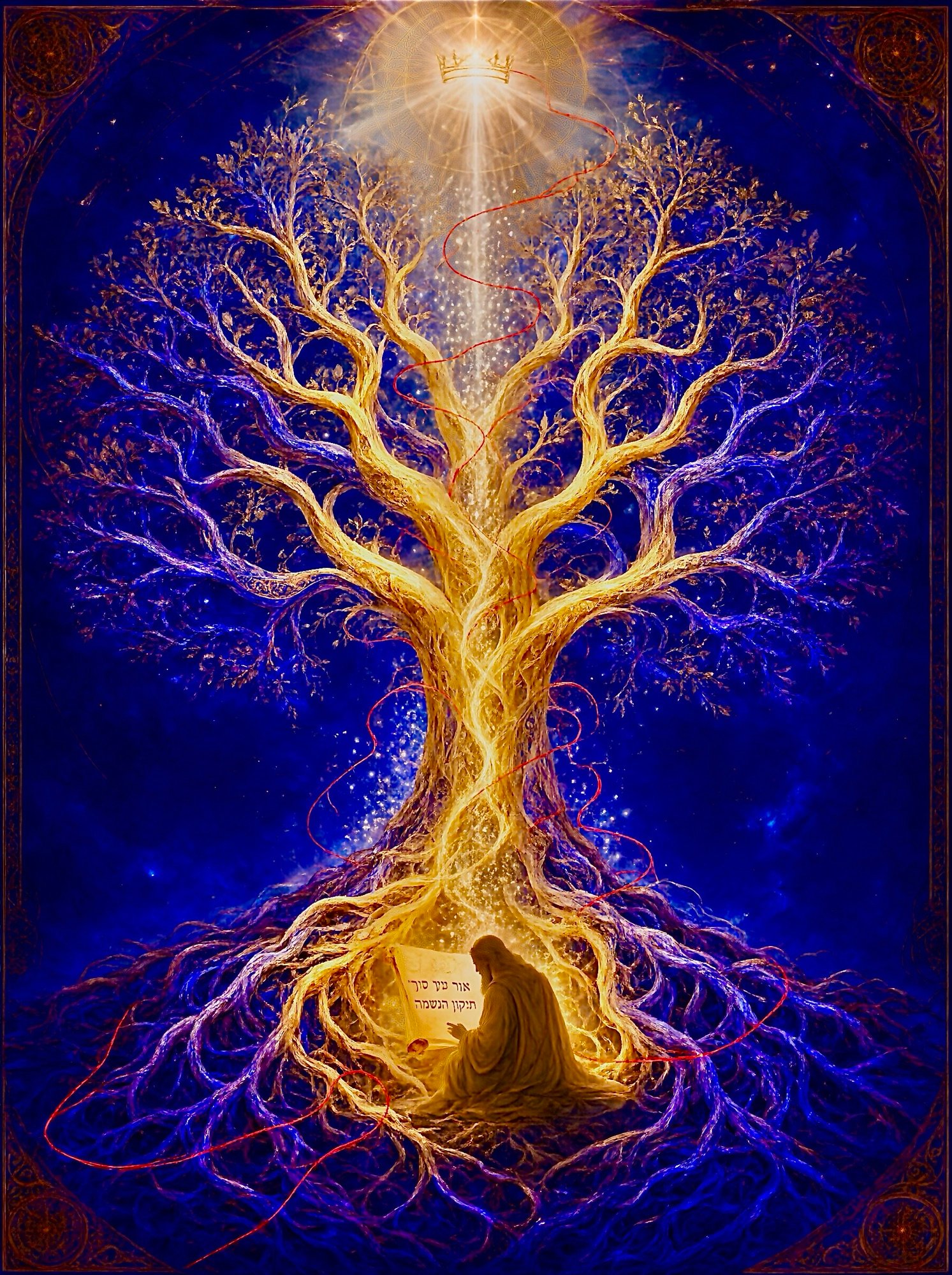
Roots in Detail
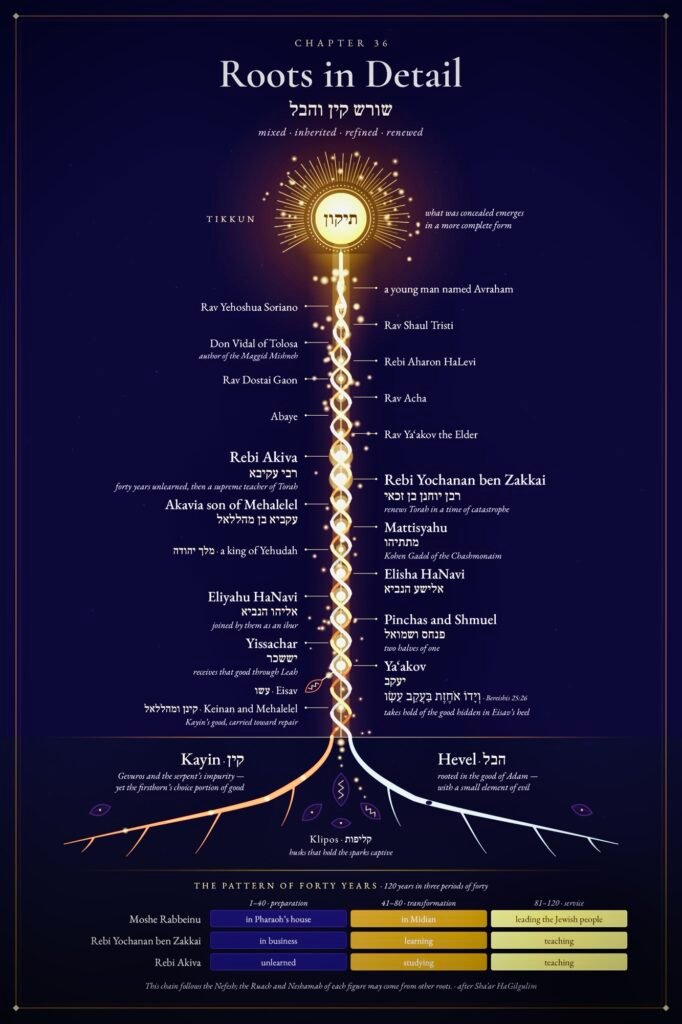
The passage presents a mystical account of how souls and their spiritual roots pass through generations. Its central thread begins with Kayin and Hevel, the sons of Adam, and follows a portion of their spiritual inheritance through Ya‘akov, Yissachar, and a succession of prophets, sages, and scholars. Beneath the many names and episodes lies a single theme: spiritual qualities are mixed, inherited, refined, and renewed across time.
Kayin and Hevel: Good and Evil Intermingled
The account begins by revisiting the roots of Kayin and Hevel. Earlier discussions, the passage notes, have already treated them at length; here, their remaining details are gathered into a more orderly narrative.
According to the teaching presented, Kayin and Hevel each contained a mixture of good and evil. Kayin’s root was associated chiefly with the side of Gevuros and with the impurity attributed to the serpent, though he also possessed a measure of good. Hevel, by contrast, was primarily rooted in the good associated with Adam, while still containing a small element of evil. The distinction is therefore not absolute: neither brother is described as wholly one thing or its opposite. Each carries an admixture, but in different proportions.
The good within Kayin is said to have been exceptionally elevated. As the firstborn, he held a choice portion of spiritual good. Yet that good was entangled with the evil within him, and so it required further rectification. The passage connects this process with later generations, referring to rectification associated with Keinan and Mehalelel.
This account makes the story of Kayin and Hevel more than a narrative of two brothers. It becomes an account of spiritual material that remains unfinished—good that must be separated from its entanglement and carried forward until it can be repaired.
From Kayin and Hevel to Ya‘akov and Eisav
The next stage appears in the birth of Ya‘akov and Eisav. The passage understands the twins as corresponding, in some respect, to Kayin and Hevel. The verse says that Ya‘akov emerged holding Eisav’s heel. In this mystical reading, the image signifies that Ya‘akov took from Eisav a particular portion of good: the choice element originally present in Kayin, which had become mixed with evil and had passed into Eisav.
The name Ya‘akov is connected here to the idea of the “heel.” The passage explains that the letters of the name allude to this lower or trailing part, and that Ya‘akov’s grasp of Eisav’s heel represents his taking hold of the good concealed there. The inheritance is not simply seized and completed, however. It continues to move through the family line.
When Ya‘akov fathers Yissachar, he passes on to him the portion of good that he had taken from Eisav. The passage links this transfer to the verse concerning Leah and Yissachar, interpreting its wording as an allusion to the spiritual inheritance Ya‘akov gave to Leah and, through her, to their son. Yissachar thus becomes a further stage in the repair of the good that had once been embedded in Kayin’s root.
This sequence—Kayin, Eisav, Ya‘akov, and Yissachar—illustrates the passage’s larger conception of spiritual history. A quality may be obscured in one generation, recovered in another, and transmitted onward in a form more suited to its eventual refinement.
The Soul’s Later Incarnations
The passage then traces the same spiritual root through a long line of later figures. It names Pinchas and Shmuel as two aspects of a shared spiritual identity, described as two halves of one. They are said to have entered Eliyahu as an *ibur*—a form of temporary spiritual attachment—remaining with him until the episode of the daughter of Yiftach. After being removed from Eliyahu, they are associated with his later journey to Mount Chorev and then with further stages of spiritual return.
The account proceeds through a series of figures: Shmuel HaNavi, Eliyahu HaNavi, Elisha HaNavi, a king of Yehudah, Mattisyahu the Kohen Gadol of the Chashmonaim, Akavia son of Mehalelel, and Rebi Yochanan ben Zakkai. It then identifies Rebi Akiva as a further incarnation of this root.
The list is striking not only for its length but for the variety of roles it encompasses. The root appears among prophets, rulers, priests, and sages. Its development is not confined to one vocation or historical setting. Rather, the same spiritual inheritance is portrayed as taking on different forms as it moves through time.
The passage also distinguishes between different levels of the soul. It cautions that its account concerns the *Nefesh*—the soul-level that reincarnated into these figures. Their *Ruach* or *Neshamah* may have come from other roots. This qualification is important: the text does not claim that every aspect of each person’s soul belonged to the same lineage. A person may contain several spiritual dimensions, each with its own origin and history.
The Pattern of Forty Years
A central reflection in the passage concerns the tradition that Moshe, Rebi Yochanan ben Zakkai, and Rebi Akiva each lived for 120 years, their lives unfolding in three periods of forty years.
Moshe spent forty years in Pharaoh’s house, forty years in Midian, and forty years leading the Jewish people. Rebi Yochanan ben Zakkai spent forty years in business, forty years learning, and forty years teaching. Rebi Akiva, according to the account, spent his first forty years as an unlearned man, the next forty studying, and the final forty teaching.
The parallel is presented as meaningful rather than coincidental. The passage explains that the roots of these souls were connected to Moshe, who is understood as containing all souls, and especially those of the righteous. Their lives therefore echo a shared pattern of preparation, transformation, and service.
For Rebi Yochanan ben Zakkai and Rebi Akiva, the first forty years were a period of spiritual concealment. The text connects this to a portion of the soul associated with one of ten drops of seed that emerged from Yosef between his fingers. During those early years, the *Klipos*—forces that obscure or obstruct holiness—had a hold on them to some degree, particularly on Rebi Akiva.
The passage connects this teaching to Rebi Akiva’s famous declaration in the Talmud that, before his transformation, he would have bitten a Torah scholar like a donkey. The remark is not treated as a mere expression of youthful hostility. It becomes evidence of the spiritual struggle that preceded his learning. His later greatness emerges from a past in which his potential had not yet been brought into its proper form.
At the same time, the text preserves a more tender detail: even when Rebi Akiva was still unlearned, the daughter of Kalba Savua recognized his modesty and distinctive character. His spiritual development had not yet reached its visible height, but qualities of humility and goodness were already present. The passage thus holds two truths together: he could be entangled in forces of opposition, yet still possess the beginnings of the character that would eventually support his transformation.
A Chain of Learning and Transmission
After Rebi Akiva, the passage continues the root’s journey through later generations of Jewish learning. It names Rav Ya‘akov the Elder, Abaye, Rav Acha, Rav Dostai Gaon, Rebi Aharon HaLevi, Don Vidal of Tolosa, Rav Shaul Tristi, Rav Yehoshua Soriano, and a young man named Avraham.
These figures belong to different periods and intellectual settings, but the account links them through a continuing spiritual lineage. In particular, it associates Don Vidal of Tolosa with the *Maggid Mishneh*, his commentary on the Rambam’s *Yad Chazakah*. The passage suggests that the spiritual connection between the author and the Rambam helps explain the work’s close engagement with the Rambam’s legal code.
The chain of incarnations therefore extends beyond the biblical and Talmudic worlds into the later history of Torah scholarship. The same root that appears in the lives of prophets and sages is also associated with commentary, legal analysis, and the transmission of learning. Spiritual repair, in this account, is accomplished not only through dramatic acts or prophetic missions but also through sustained study and careful interpretation.
The Meaning of the Narrative
Taken as a whole, the passage offers a vision of history in which spiritual identities are neither simple nor static. Good and evil may be mixed within a root. A good quality may become concealed, pass through a difficult stage, and later be reclaimed. One aspect of a soul may continue through a series of lives, while other aspects originate elsewhere. A person’s early life may appear far removed from the greatness that will later define him, yet the seeds of that greatness may already be present.
The account also resists a straightforward idea of inheritance. Ya‘akov does not merely receive a spiritual legacy; he retrieves a portion of good from within Eisav. Yissachar does not simply inherit from his father; he receives a specific element that has passed through a long process of concealment and recovery. Likewise, the later sages do not merely repeat the achievements of earlier figures. Each incarnation represents another opportunity for the root to be refined and expressed.
The story of Rebi Akiva is especially powerful in this regard. His first forty years are presented as a period of limitation and struggle, but not as a final judgment on his character. His transformation shows that a hidden spiritual potential can become the foundation of extraordinary achievement. The same life that begins in ignorance can culminate in learning and teaching.
“Roots in Detail” is thus an account of spiritual continuity and renewal. It portrays the soul’s journey as a gradual process of clarification: good is disentangled from evil, inherited qualities are redirected, and unrealized potential is brought into service. Across generations, the work of repair continues—through prophecy, leadership, study, and teaching—until what was once concealed can emerge in a more complete form.
The Hidden Journey of the Soul: Rabbi Yochanan ben Zakkai, Rabbi Akiva, and the Root of Cain
In the mystical account presented here, the lives of Rabbi Yochanan ben Zakkai and Rabbi Akiva are understood not only through their public deeds, but through the hidden journeys of their souls. Their histories are woven into a larger pattern of sin and repair, exile and return, and the gradual refinement of spiritual sparks. This is a language of reincarnation and soul-roots: a way of reading the sages’ lives as stages in a sacred process whose beginnings reach back to the earliest generations.
The account suggests that Rabbi Yochanan ben Zakkai and Rabbi Akiva bore traces of the root of Cain, intermingled with the root of Abel. Their spiritual histories therefore involved both holiness and fracture. In this framework, the sins attributed to them in youth are not incidental biographical details. They belong to a process of correction: the soul must encounter the consequences of its earlier condition before it can attain the wisdom and stature for which it is ultimately destined.
The teaching does not reduce either sage to his youthful failings. Rather, it presents their later greatness as the culmination of a long spiritual labor. The soul’s descent into the world is not simply a punishment; it is also an opportunity to repair what was damaged, to recover what had fallen, and to transform an inherited mixture of good and evil into a vessel for holiness. Their lives, in this reading, are not stories of perfection from the outset, but of perfection achieved through return.
Rabbi Akiva’s early life and the soul of the convert
The account gives particular attention to Rabbi Akiva’s origins. He was born to parents who were converts, and the text treats this fact as spiritually significant. It describes the holy soul entering him as clothed in a soul associated with the seed of Yosef, connected in the mystical interpretation to Yosef’s encounter with the wife of his master. The language of “wasted seed” belongs to the text’s esoteric vocabulary; it should be understood here as part of its account of spiritual repair, not as a simple biographical claim about Rabbi Akiva.
The passage carefully distinguishes between the soul itself and the coverings through which it enters the world. Rabbi Akiva’s essential soul, it says, was exceedingly holy and great. It was not merely a soul formed from the righteous in the Garden of Eden, but one that had descended after the primordial sins of Adam and Cain. Its passage through the depths of impurity required it to be clothed in other spiritual layers. One such layer was associated with the seed of Yosef; another, according to the teaching, was the soul that accompanies a convert.
This distinction is central to the account. A convert’s soul, as described in the Zoharic tradition invoked here, may be clothed within an additional soul associated with the righteous in the Garden of Eden. The convert’s spiritual identity is therefore presented as layered: a holy inner spark may be present, while other elements of the soul still undergo purification. In Rabbi Akiva’s case, the text sees this complexity as part of the explanation for his remarkable transformation.
It also links his first forty years, when he is portrayed as unlearned, to the lingering force of the *kelipot* and *chitzonim*—terms for spiritual coverings or forces that obstruct holiness. The passage invokes a rabbinic teaching about the difficulty of casting off the traces of one’s former condition, though the wording and number of generations in the excerpt appear uncertain. Its larger point is that Rabbi Akiva’s early limitations were not the measure of his ultimate capacity. They were part of the struggle through which his soul had to pass.
That struggle makes the later Rabbi Akiva all the more extraordinary. The man who began without learning became one of the greatest teachers of Torah. In the mystical account, this is not a contradiction but a revelation: the soul’s greatness was present even when it was hidden beneath layers of spiritual difficulty. His ascent shows how a life that appears at first to be marked by distance from learning can become a vessel of extraordinary wisdom.
The shared inheritance of Cain and Abel
The teaching places Rabbi Yochanan ben Zakkai and Rabbi Akiva within the spiritual lineage of Cain, while also associating them with the root of Abel. This is not a claim of simple descent in the ordinary genealogical sense. It is a statement about spiritual roots and sparks, through which the qualities and unresolved tensions of earlier figures are said to recur in later souls.
Cain and Abel represent, in this framework, an ancient division within the human story: conflict, loss, and the possibility of repair. A soul connected to Cain’s root carries the burden of that history, but also the possibility of transforming it. Rabbi Yochanan ben Zakkai and Rabbi Akiva are described as embodying two sides of a larger spiritual structure—like the right and left arms of Moses, with the root of Abel interwoven with that of Cain.
Their lives are thus understood in relation to Moses and to the number 120. The passage draws a connection among Moses, Rabbi Yochanan ben Zakkai, and Rabbi Akiva through the shared span of 120 years, presenting the relationship as a pattern of spiritual completion. Moses, in the account, asks that Torah be given through Rabbi Akiva—a tradition echoed in the Talmudic story in which Moses sees Rabbi Akiva teaching and is astonished by the future development of Torah. The mystical interpretation makes that story part of a larger chain: what begins with Moses is carried forward and unfolded through the sages.
The point is not that the later teachers replace Moses. Rather, they reveal dimensions of Torah that could not be fully seen at the beginning. Their souls carry forward the work of transmission, each in a different form. Rabbi Yochanan ben Zakkai preserves and renews Torah in a time of catastrophe; Rabbi Akiva becomes a towering interpreter and teacher. Their greatness is presented as a continuation of a sacred inheritance, but also as the fruit of spiritual correction.
Error, recognition, and repair
The account also places Rabbi Akiva alongside Jacob and Samuel as figures who misjudged a moment of destiny. Jacob hoped to reveal the end of days to his sons, but the vision was hidden from him. Samuel looked upon Eliav and thought he had found the one destined for greatness, only to learn that G-d sees differently. Rabbi Akiva, in the passage’s interpretation, believed that Bar Koziva—Bar Kokhba—was the Messiah.
The text draws a mystical connection between the names “Ya‘akov” and “Akiva,” suggesting that their similar letters hint at a shared kind of error. This is not offered as a dismissal of Rabbi Akiva’s judgment or of his spiritual stature. Instead, it frames error itself as part of the work of the soul. Even a great sage may misread a historical moment. The question is not whether a person is incapable of error, but how that error fits into a wider process of discernment and repair.
This is a sober and humane vision of spiritual greatness. It does not define holiness as flawless judgment at every moment. It allows for the possibility that a person may be deeply righteous and yet mistaken about the meaning of events. In the account’s mystical language, such mistakes become part of the soul’s correction, just as the earlier struggles of Rabbi Akiva become part of the path that leads him to greatness.
The spark within Og and the hidden holiness of the defeated
Another episode in the passage concerns Og, king of Bashan. It says that a spark associated with Rabbi Shimon ben Nesanel, remembered for his fear of sin, was present within Og. Moses was afraid to kill Og, and G-d told him not to fear. The teaching reads Moses’ hesitation as a response to the holy spark hidden within his enemy.
This episode illustrates a recurring principle in the account: holiness may be concealed within places that appear wholly opposed to it. The presence of a spark does not make Og righteous, nor does it erase the danger he represents. Rather, it explains why the encounter carries spiritual weight. The task is to distinguish the spark from the enclosing darkness—to recognize what is holy without mistaking the whole for its part.
The same principle governs the account of Rabbi Akiva. His early obscurity does not define his inner soul; neither does his later greatness erase the difficult layers through which he had to pass. In both cases, the visible surface is only part of the story. Beneath it lies a hidden spiritual history.
The root of Cain across generations
The passage concludes by naming many figures said to belong to the root of Cain. The list ranges across biblical history and the generations of the Mishnah: from early figures such as Cain, Yubal, and Lemech, through leaders, prophets, and kings, to Rabbi Yochanan ben Zakkai, Rabbi Akiva, and other sages. The list is not merely a catalogue. It presents history as a network of recurring spiritual roots, in which sparks move through different lives and eras.
Among the figures connected to this root are people associated with conflict, leadership, prophecy, and learning. The variety is striking. The root of Cain is not confined to one temperament or one moral character. It is a spiritual inheritance that may appear in many forms, requiring different kinds of correction in different lives. Some sparks are associated with public leadership, others with Torah, courage, judgment, or repentance.
Within this broad pattern, Rabbi Yochanan ben Zakkai and Rabbi Akiva occupy a place of special importance. Their association with the root of Cain does not diminish them. It explains the depth of the work they represent. Their souls are portrayed as carrying a difficult inheritance and transforming it through Torah, teaching, and service. Their greatness is not an escape from the past, but a redemption of it.
Conclusion
The mystical account of Rabbi Yochanan ben Zakkai and Rabbi Akiva offers a vision of human life in which spiritual identity is layered and history is unfinished. A soul may carry the traces of ancient fracture, pass through obscurity, and still rise to extraordinary holiness. Youthful sin, inherited impurity, mistaken judgment, and concealed sparks all belong to a larger drama of return.
Rabbi Akiva’s journey is especially powerful in this light. Born into a family of converts and described as unlearned for his first forty years, he becomes a supreme teacher of Torah. The account sees this transformation not as a sudden reversal but as the emergence of a holiness that had been hidden beneath spiritual coverings. Rabbi Yochanan ben Zakkai, too, stands within a chain of souls whose work is to preserve and renew Torah amid upheaval.
Their lives, as interpreted here, teach that greatness is not always visible at the beginning. The soul may arrive burdened by a history it does not understand, yet that history can become the very ground of its service. Through learning, humility, and repair, what was once fractured may become a vessel for wisdom. In this way, the lives of Rabbi Yochanan ben Zakkai and Rabbi Akiva are presented not merely as biographies of sages, but as chapters in the long, luminous work of restoring the soul.
Yochai and the Hidden Roots of the Sages
The passage from the “Gate of Reincarnations,” offers a striking vision of Jewish history. It does not tell that history chiefly through dates, places, or accounts of a person’s public life. Instead, it follows the hidden movement of souls: their origins in primordial spiritual roots, their return in later generations, and their participation in the repair of a world unsettled by the first human sin.
At the beginning of the passage, the author wishes to discuss Yochai, who is mentioned in the *Idra Rabba* of *Naso*. Yet he immediately acknowledges a limit to his knowledge: his teacher did not want to reveal the matter, and he does not know why. This brief confession gives the passage much of its character. The author is not presenting himself as one who has mastered every secret. He records what he has received, marks what remains unexplained, and allows uncertainty to stand. In a work devoted to hidden knowledge, the boundary between what is known and what is concealed is itself important.
The account then turns to a series of sages who, it says, “latch onto” the root of Kayin—Cain. The language is not that of ordinary family descent. It describes a spiritual affiliation: a soul, or a part of a soul, is connected to a particular primordial source and may appear in different historical lives. The passage names Tannaim, Amoraim, Geonim, and later halachic authorities, tracing this connection across many centuries of Jewish learning. Its purpose is not simply to list famous scholars. It is to describe a hidden lineage that runs beneath the visible history of the Jewish people.
The root of Kayin
In the framework of the passage, Kayin is not merely a figure from the opening chapters of Bereshit. He is the source of a spiritual root—a channel from which certain souls or soul-sparks may emerge. The text places this root alongside those associated with Adam and Hevel, or Abel. These roots are not presented as simple moral categories. To be linked to a particular root is not, by itself, a complete judgment of a person’s character. Rather, the root identifies one dimension of a soul’s spiritual origin and its role within the larger process of repair.
The passage’s lists include figures from very different periods. Among the Tannaim, it names Rabbi Shemaya the Pious, Rabbi Tzadok the Priest, and Rabbi Kruspedai, among others. It then moves into the era of the Amoraim, naming sages such as Rav Huna, Rabbi Chiya, Rabbi Levi son of Sisi, Rabbi Shimon son of Yehotzedek, Rabbi Yirmiyah son of Abba, Abaye, Rav Safra, Ravin, and many more. The catalogue continues through the Rabbanan Savorai and the Geonim, and eventually reaches the later decisors of Jewish law, including the Rashba, Don Vidal of Toledo, and Rabbi Yosef Karo.
The sweep of this list is important. The root of Kayin is not confined to the biblical past or to the earliest generations of rabbinic teachers. It continues to appear, according to the passage, throughout the history of Jewish scholarship. The spiritual lineage associated with the root is present among the sages of the Talmud, among the leaders of the academies, and among the authorities who later organized and codified Jewish law.
This continuity gives the passage a distinctive understanding of history. The generations are not merely a sequence of separate periods. They are connected by currents that may persist even when the people, institutions, and circumstances change. A soul-root associated with an ancient figure may take part in the work of Torah in a later age, in a different form and through a different intellectual task. The history of learning becomes, at the same time, a history of spiritual return.
A catalogue that admits its limits
Yet the author does not claim to explain every connection he records. At the outset, he says that the matter of the Tannaim who attach to the root of Kayin was not explained to him. He then gives the names he has received, but does not supply a full account of how each one belongs to that root. The list is therefore both informative and incomplete.
That incompleteness is not incidental. The passage repeatedly distinguishes between knowing that a soul is connected to a root and understanding the precise nature of that connection. A name may be transmitted, while the spiritual mechanism behind it remains hidden. The author’s note about Yochai makes this especially plain: even when a subject is known to exist, a teacher may choose not to disclose it.
The result is a text that combines assertion with restraint. It gives the reader a map, but not a full explanation of every point on the map. It identifies spiritual affiliations while acknowledging that the structure beneath them is only partly visible. This balance reflects a broader feature of mystical writing: knowledge is conveyed through carefully bounded disclosure, and a gap in explanation may be a sign of the tradition’s limits rather than a flaw in its argument.
The layered soul
The passage clarifies that the people listed do not necessarily belong to the root of Kayin in every aspect of their souls. It says that the figures under discussion are connected to the second level of that root “only on the level of the *nefesh*.” Their *ruach* and *neshamah* may come from other sources.
This distinction is central. In the Kabbalistic vocabulary of the passage, *nefesh*, *ruach*, and *neshamah* are different dimensions of the soul. They are related, but they are not interchangeable. A person may have a *nefesh* associated with one spiritual root, while the higher dimensions of the soul are connected to another. Consequently, a person’s spiritual identity cannot be reduced to a single origin or label.
The text explains this mixture through the consequences of Adam’s sin. The spiritual dimensions associated with Adam, Kayin, and Hevel became interwoven. The *ruach* of one root could become joined with the *nefesh* of another; the *nefesh* of one could be joined with a *ruach* from elsewhere. Human souls, in this account, are often composite. Their different levels may carry different histories and participate in different forms of spiritual repair.
This idea also helps explain why the passage is careful about its claims. To say that someone belongs to the root of Kayin may refer only to one level of that person’s soul. It does not necessarily describe the whole person, nor does it establish that every part of the person’s spiritual life shares the same origin. The text’s classifications are precise within their own terms, but they are not simple or exhaustive.
From historical names to spiritual structure
After listing sages and later authorities, the passage shifts from spiritual genealogy to the structure of the *sefirot*. It describes the flow of *gevurot*—powers associated with restraint, judgment, and severity—through the configuration called Ze’ir Anpin. Particular biblical and rabbinic figures are associated with particular stages in that flow, Chizkiyahu the King, Ezekiel the Prophet, Rabbi Akiva, Akavya son of Mahal.
Within the Katus: The Hidden Architecture of the Soul
The passage offers a vision of human identity shaped by a hidden spiritual architecture. Its language is dense with the vocabulary of Kabbalah: *Chesed*, *Gevurah*, *Tifferes*, *Netzach*, *Hod*, *Yesod*, and *Da’as*. These terms do not function merely as abstract ideas or labels for moral qualities. They describe channels and relationships through which spiritual vitality moves—descending, gathering, ascending, and becoming manifest in the lives of particular people.
Within this framework, the sages of the Talmud and the prophets are understood as more than individuals with distinctive personalities and histories. Each is associated with a particular spiritual root, a specific configuration of divine qualities, and a place within a larger order. Their wisdom, temperament, deeds, and even names can be read as expressions of that hidden structure. The passage therefore invites us to see biography and metaphysics not as separate subjects, but as two dimensions of the same reality.
The ascent of spiritual qualities
The opening section arranges a series of sages according to the movement of spiritual forces among the sefirot. A *Gevurah* that rises from *Netzach* toward *Hod* is associated with Rav Shmuel, son of Shilat. A “brain” that ascends from *Yesod* to *Hod* is associated with Rav Mesharshia, the student of Abaye. Other movements connect Rami, son of Tamari, with a *Gevurah* rising from *Yesod*, and Rav Chana of Baghdad with a *Chesed* rising from the same source.
The catalogue continues through the structure of Zeir Anpin. Certain qualities ascend from *Yesod* into the lower two-thirds of *Tifferes*, while others rise from that lower region toward the concealed upper third. Ulla, son of Koshav, Ravin, and Rav Chana of Baghdad are each associated with a particular force in the lower portion of *Tifferes*. Rav Mesharshia, Rav Shilo, and Shabchat, son of Ravina, are then connected with the movement from the lower two-thirds toward the hidden upper level.
The repeated language of ascent is significant. These souls are not simply assigned static positions in a spiritual chart. Their roots are described as moving: one quality rises from one sefirah to another, or passes from a revealed level toward a concealed one. The structure is dynamic. It suggests that spiritual identity is not merely a matter of origin but also of movement, relationship, and transformation.
The distinction between the lower two-thirds of *Tifferes* and its covered upper third is especially suggestive. A spiritual quality may have a revealed aspect, accessible to perception and expression, and a hidden aspect that remains concealed. The sages associated with these levels embody different stages of that passage. Some express the force in its more visible form; others are linked to its movement toward a deeper, less accessible level.
In this way, the passage gives spiritual geography a human face. The sefirot describe an ordered universe, but the names of sages make that order intimate. A quality that exists in the supernal structure becomes visible in a person’s learning, character, or role in the tradition. The individual is not erased by this system. Rather, individuality is understood as the particular way in which a spiritual force becomes present in the world.
The soul as a pattern of qualities
The passage’s account of the sages suggests that a person’s character can be read as an expression of spiritual structure. *Chesed* may appear as generosity, expansion, or kindness. *Gevurah* may appear as discipline, sharpness, or the power to distinguish. *Tifferes* may suggest balance and harmony, while *Hod* may involve a particular kind of receptivity or refinement. These qualities are not simply metaphors applied after the fact. In the passage’s worldview, they are the underlying patterns through which a person’s life takes shape.
This idea comes into focus in the discussion of Yonason, son of Harkinas, and Rabbi Akiva, son of Yosef. Yonason is associated with *Gevurah*, while Rabbi Akiva is associated with *Hod*. Both are described as belonging to the five *Gevuros* within the *Da’as* of Zeir Anpin. The text connects these spiritual locations to their intellectual temperaments: Yonason was sharper and more forceful in debate.
The association is more than a claim that Yonason happened to be argumentative or intellectually quick. His sharpness is presented as the human expression of a deeper spiritual quality. The structure of his soul is reflected in the way he thinks and speaks. The metaphysical and the psychological are therefore closely joined. A person’s manner of reasoning may reveal something about the spiritual root from which that person comes.
This approach also allows the passage to distinguish between individuals who share a broad spiritual category. It is not enough to say that two people belong to the same general domain. Each may occupy a different point within it, and that difference may account for the distinct character of each person. Spiritual identity is particular, not generic. It is a pattern with fine gradations.
Names as windows into spiritual origin
One of the passage’s most striking methods is its interpretation of names. Names are treated not merely as labels but as compressed clues to the soul’s structure. Their letters, sounds, and numerical values can reveal the spiritual level with which a person is associated.
Rabbi Yosi HaGlili, for example, is said to derive from the “left forelock” of the head, on the level of the divine name *El Shaddai*. The explanation turns on a numerical correspondence: the name “Yosi” and the Hebrew word *pe’ah*, meaning “forelock,” share the same gematria. The numerical equivalence is used to connect the person’s name with a particular spiritual location.
This kind of interpretation assumes that language is not arbitrary. A name can carry a trace of the reality it names. Its letters and numerical value may disclose a relationship that ordinary speech does not make obvious. The name becomes a small map: a condensed sign pointing toward the soul’s origin.
The same principle shapes the discussion of Rav Mesharshia. His name is examined letter by letter and connected to the divine names associated with *Tosefes Shabbos*, the added holiness that accompanies the approach of Shabbos. The interpretation is intricate, involving the letters *Yud-Heh*, the two letters *Shin*, and the numerical values of several divine names. Yet the purpose of the analysis is not simply to display numerical ingenuity. It is to show that Rav Mesharshia’s name encodes a spiritual role.
In this reading, the name does not merely identify the person. It reveals something of the path through which his soul participates in the sacred order. The letters become a kind of spiritual signature.
Passage, concealment, and the root of Kayin
The account of Rabbi Chutzpis the Translator introduces a more elaborate image of spiritual movement. His soul is associated with the *Gevurah* of *Hod* within the *Da’as* on the side of Abba.
Shabbos, the Rectification of Kayin, and the Work of the Soul
The teachings presented here describe the soul not as a solitary, unchanging identity, but as a spiritual root whose sparks may appear in different people and generations. In this account, the descendants and reincarnations associated with Kayin are engaged in a continuing work of *tikkun*—the separation and restoration of the good within a root that also contains disorder. The passages mention Chizkiyahu HaMelech, Rav Mesharshia, Yechezkel, Eliyahu, Yisro, Shimshon, and others as figures connected in different ways to that work.
Shabbos offers a fitting lens through which to consider this teaching. The text does not explicitly make Shabbos its subject, and its claims about reincarnation belong to a particular mystical tradition. Yet its central themes—restoration, the elevation of what is scattered, and the completion of an unfinished task—resonate deeply with the meaning of Shabbos as a day of holiness, rest, and spiritual wholeness.
The root of Kayin and the work of repair
The passage describes Kayin’s root as containing both good and evil. Its repair is therefore not simply a matter of erasing the past. Rather, the work is to distinguish what is valuable from what is damaged: to preserve the good and leave the evil behind. The account of Yisro expresses this image directly. Yisro, who is associated with Kayin’s line, is said to have “separated from Kayin”—that is, to have separated the good from the waste, leaving the harmful element in the *kelipos* and taking the good toward holiness.
This language of separation and refinement has a natural connection to Shabbos. The six days of the week are filled with activity, mixture, and unfinished labor. Shabbos does not deny the world of action; it gathers the week’s work into a different order. On Shabbos, ordinary time is set apart, and the material world is approached with greater awareness of its spiritual purpose. The day becomes a weekly act of distinction: not a rejection of creation, but a revelation of its holiness.
In that sense, Shabbos resembles *tikkun*. It gives human beings the opportunity to pause, gather what has been scattered, and recognize the good that may be obscured by the pressures of daily life. The repair described in the passage unfolds through generations; Shabbos brings a measure of that repair into the rhythm of every week.
Chizkiyahu and the unfinished task
A central figure in the passage is Chizkiyahu HaMelech. His name is interpreted as expressing the strengthening of the level called “the head” of Kayin’s root. The text associates this “head” with the name Yud-Heh and with Abba and Imma, the spiritual source of the lower *sefirot*. In this interpretation, Chizkiyahu begins a process of repair at the root’s highest level.
The passage connects this idea to the prophet Yeshayahu’s declaration, “You will die and not live.” The Talmudic interpretation cited in the text understands the words as referring not only to life in this world, but also to life in the World-to-Come. Chizkiyahu’s prayer—“With my days cut short, I will go into the gates of the grave; I am deprived of the rest of my years”—is then read as an expression of his awareness that his work remained incomplete.
Although fifteen years were added to his life, the passage says that these years did not constitute the full measure allotted to him. The remaining portion was completed through Rav Dimi of Nehardea, described as a reincarnation of Chizkiyahu alone, without the mixture of another spark. In this way, the text presents spiritual repair as something that may extend beyond a single lifetime. One person may begin the task; another may bring it to completion.
Shabbos gives this idea a weekly form. Each Shabbos arrives as a completion of the days that came before it, yet it also prepares the ground for the week ahead. It is both an arrival and a beginning. The work of the week is not always finished in the sense of being perfect, but Shabbos allows it to be gathered, sanctified, and carried forward. As Rav Dimi completes what Chizkiyahu could not finish in his lifetime, Shabbos completes the week without pretending that all human work is done.
Strength at the head, strength at the feet
The passage distinguishes between repair at the “head” and repair at the “feet.” Chizkiyahu and Rav Mesharshia are associated with the head of Kayin’s root; Yechezkel HaNavi is associated with its feet. The text links this to the verse, “Son of man, stand on your feet.” The image suggests that spiritual restoration must reach both the highest source and the practical ground on which a person stands.
This distinction is especially meaningful in relation to Shabbos. Shabbos elevates the mind and heart through prayer, Torah, and awareness of holiness. But its sanctity is also embodied in action: preparing for the day, welcoming it, refraining from weekday labor, sharing meals, and honoring the people around us. The “head” may represent intention and insight; the “feet” represent conduct and the ability to stand firmly in the world. A complete Shabbos joins the two.
The passage’s account of Rav Dimi underscores the importance of practical kindness. One of the mitzvos in which he was especially careful, the text reports, was accompanying guests and the dead. These acts of accompaniment are quiet but profound. They mean not allowing another person to be alone at a threshold: the guest who arrives, or the deceased who is being taken to burial. Shabbos likewise calls for a form of presence. Its holiness is not confined to private contemplation; it is expressed through hospitality, care, and the honoring of others.
Repair through discipline and relationship
Other figures in the passage illustrate different forms of spiritual repair. Yisro’s role is described as separating good from evil. Shimshon, understood there as a reincarnation of Nadav and Avihu, is associated with a different kind of correction. Because Nadav and Avihu are said to have entered the Mishkan after drinking wine, Shimshon’s lifelong status as a *nazir* is presented as a repair of that failing. The passage also connects his troubled encounters with Philistine women to the earlier refusal of Nadav and Avihu to marry.
These interpretations are complex and should be read as the text’s mystical account, not as a simple moral judgment about the people involved. Their broader lesson is that repair may take different forms. Sometimes it means separation and discernment; sometimes discipline; sometimes the acceptance of a responsibility that an earlier generation neglected. A person’s work is shaped by the particular fracture he or she is called to address.
Shabbos brings these forms of repair together. It requires restraint, but its restraint is not empty deprivation. It creates space for joy, family, community, prayer, and study. It teaches that holiness is not achieved by escaping ordinary life but by ordering life around what is most precious. The discipline of Shabbos protects the day; the joy of Shabbos reveals what that protection makes possible.
The soul’s work across generations
The passage also presents Eliyahu as a figure connected to the mixture of Kayin and Hevel, and as the future interpreter for Moshe in the generation of Moshiach. Moshe, who once needed Aharon to speak for him because of his “heavy mouth” and “heavy tongue,” will again teach Torah; Eliyahu will serve as his interpreter. The image is one of continuity: a weakness that once required help does not prevent future teaching. Rather, the relationship between teacher and interpreter becomes part of the way revelation is brought to the people.
This vision of spiritual continuity is closely aligned with the atmosphere of Shabbos. Shabbos links generations through repeated practices and inherited words. A family’s prayers, songs, meals, and customs carry memory forward, while each generation gives them new life. The day is at once ancient and renewed. It reminds us that holiness is not created from nothing in every generation; it is received, tended, and passed on.
The source’s account of reincarnation is one way of expressing this continuity: the soul’s work may outlast one lifetime, and a later person may complete what an earlier person began. Shabbos offers a communal and accessible counterpart to that idea. Every week, people inherit a sacred time and are asked to make it present again. The work is personal, but it is never merely private.
Conclusion
The teaching about Kayin’s root is ultimately a teaching about unfinished repair. Chizkiyahu begins the strengthening of the “head”; Rav Dimi completes what remains; Yechezkel is associated with the “feet”; Yisro separates good from waste; and other figures carry distinct forms of correction. The account portrays holiness as a process of refinement, in which the good is recovered and brought into its proper place.
Shabbos embodies that process in the structure of time. It separates the sacred from the ordinary without rejecting the ordinary. It gathers the week’s scattered labor, restores attention to what matters, and gives people the chance to begin again. Its rest is not an escape from responsibility but a vision of what responsibility is for: a life in which creation, relationship, and service can be recognized as holy.
In this light, Shabbos is more than a pause. It is a weekly act of *tikkun*—a strengthening of what is incomplete, a gathering of what has been dispersed, and a reminder that the work of repair can continue across generations.
The Hidden Architecture of Scripture: Names, Souls, and the Possibility of Redemption
The passage presents Scripture as a text with many layers of meaning. Its verses speak in their plain sense of Jerusalem, festivals, tents, goodness, and human history. Yet beneath that surface, the letters and words are understood to contain a second kind of language: one that reveals the spiritual identities of sages, the relationships between their souls, and the place of their lives within the structure of the divine worlds.
This hidden language is uncovered through several interpretive methods. Initial letters may spell a name; a letter may be exchanged for another through the system of *Atbash*; and the numerical values of words may disclose a connection between people or spiritual levels. In this way, a verse about Jerusalem can also allude to Rachel, Abaye, Rav Bibi, the Arizal, Rabbi Chaim Vital, Rami bar Chama, and Rava. The verse is not treated as a collection of unrelated clues. It is a meeting place where biblical language, rabbinic tradition, personal memory, and Kabbalistic teaching converge.
At the heart of the passage is an expansive vision of Torah. Scripture preserves not only events and commandments but also relationships: between teacher and student, father and son, one sage and another, and the human soul and its spiritual root. These relationships may be concealed in the wording of a verse, waiting to be revealed through careful interpretation. Yet the passage also recognizes that some matters remain hidden. A teaching may be recorded without being fully explained; a spiritual possibility may be described without having come to pass. Revelation and restraint are woven together.
A verse with many meanings
The discussion begins with Isaiah’s words: “Behold Tzion, the city of our festivals” (Isaiah 33:20). At its most direct level, the verse evokes Jerusalem as a place of holiness and celebration. But the passage reads it in several additional ways.
One method is *notarikon*, the interpretation of a word or phrase through its initial letters. Another is *gematria*, the practice of assigning numerical values to Hebrew letters and comparing the values of words. The passage also invokes *Atbash*, a system in which letters are exchanged according to their positions at opposite ends of the Hebrew alphabet: the last letter corresponds to the first, the second-last to the second, and so on.
These techniques are not presented as mere intellectual games. In the passage’s worldview, they reveal meanings already embedded within the sacred text. The visible words form one layer; their initials, numerical values, and letter patterns disclose another. A verse can therefore describe Jerusalem while simultaneously pointing toward a person, a soul-root, or a spiritual configuration.
The word *Tzion* is especially important. It refers to Jerusalem, but the passage also connects the verse’s initials with the name Rachel. Rachel, in turn, is associated with Malchus—the feminine or receptive aspect of the divine presence—and with the *Nukva* of Zeir Anpin. The verse’s “city” is thus more than a physical location. It becomes a symbol of the spiritual feminine, the divine presence as it appears within the world.
This interpretation makes the biblical image richer rather than replacing its ordinary meaning. Jerusalem remains Jerusalem, but it is also read as an expression of Malchus. The city’s holiness and the spiritual principle it represents are understood as related dimensions of one reality.
The passage also pays attention to the way the verse is phrased. It notes the wording used in translation and contrasts it with the wording of the Hebrew text. That difference is treated as significant: even the choice of expression may hint at the deeper meaning. In this style of interpretation, sound, spelling, grammar, and translation can all become part of the evidence.
Rachel and the spiritual city
The identification of Rachel with the verse’s hidden structure illustrates a central feature of the passage: biblical figures, spiritual concepts, and human souls are linked through symbolic correspondence.
Rachel is not mentioned explicitly in Isaiah’s verse, yet the initials of its words are said to yield her name through their numerical value. This connection leads the interpreter to Malchus, the final sefirah, which receives and manifests the influence of the higher sefirot. Malchus is associated with the divine presence as it is revealed in the world, and with the feminine aspect that enters into union with Zeir Anpin.
The “city of our festivals” can therefore be read as an image of this spiritual level. A city gathers people and gives them a shared place; a festival gathers a community in sacred time. In the passage’s symbolic reading, both images suggest the gathering and manifestation of divine presence. The city is not only a setting for holiness but a figure for the spiritual vessel through which holiness becomes present.
The passage’s interpretive method depends on the belief that language can hold several meanings at once. A word need not lose its plain sense in order to carry a mystical one. Rather, the plain meaning provides the ground from which the hidden meaning emerges. Jerusalem can be a city, Rachel can be a biblical matriarch, and both can also serve as symbols of Malchus.
Abaye and Rav Bibi: a connection left unexplained
The same verse is then connected to Abaye and his son, Rav Bibi. Their names are said to be hinted at by the initials of phrases in the verse, including the words describing the tent that “will not be displaced.”
The passage does not provide a complete explanation of why these names appear there. Instead, it records that the teacher did not wish to reveal more. This omission is not incidental. It shows that the text does not claim that every allusion can be fully unpacked. Sometimes the interpreter identifies a connection but preserves its mystery.
That restraint gives the passage a distinctive character. Its methods are intricate and its claims are ambitious, yet it does not present interpretation as a process of unlimited control. The reader may be shown that a relationship exists without being told everything about its significance. The allusion is disclosed; its full meaning remains guarded.
The relationship between Abaye and Rav Bibi is particularly suited to the passage’s broader interest in spiritual inheritance. A father and son are connected not only by family history but by the possibility of a shared spiritual root. The verse’s language about a tent that cannot be moved may suggest continuity, endurance, or the preservation of a lineage. The passage does not state this as its final explanation, but its placement of the names within the verse invites the reader to consider how scriptural language might hold the memory of a family relationship.
The teaching is also part of a chain of transmission. The narrator recalls what his father and master taught him, and what that teacher had received from the Arizal. The interpretation is therefore presented not as a private discovery but as inherited knowledge, passed from teacher to student and preserved through memory. Its authority rests partly on the method of interpretation and partly on the lineage through which it was transmitted.
The Arizal and Rabbi Chaim Vital
The passage’s most personal and dramatic revelation concerns the relationship between the Arizal and Rabbi Chaim Vital. The initials of the verse are associated with the name Yitzchak. According to the narrator’s recollection, the Arizal explained that this name referred to himself.
The Hidden Gate: Da’as, Kayin, and the Mystery of Sisera
The passage presents a dense web of Kabbalistic associations: the fiftieth gate of understanding, the hidden structure of *Da’as*, the roots of Kayin and Hevel, and the figures of Rami son of Chama, Rabbi Yirmiyah, Sisera, and Haman. Its method is characteristic of *sod*, the esoteric reading of Torah and rabbinic literature. A name, a number, a question in the Talmud, or a detail in a biblical verse may each become a sign pointing toward an underlying spiritual structure.
At the center of the discussion is *Da’as*—knowledge—not merely as intellectual comprehension, but as a hidden power that joins and transmits. The passage describes a concealed level of *Da’as* associated with Zeir Anpin, the configuration of divine attributes that mediates between higher wisdom and the lower worlds. This *Da’as* is linked to the “fiftieth gate,” a threshold of understanding that is both sought and, in its fullness, inaccessible. The “path not known” thus names more than an unsolved question: it evokes a boundary between what can be grasped and what remains concealed within the divine order.
Rami son of Chama and the fiftieth gate
The text identifies Rami son of Chama with an upper form of *Da’as* rooted in Kayin. It develops this identification through numerical and letter-based interpretation. Chama is associated with a numerical value of nineteen, while Rami is connected to the fiftieth gate and to pairings of letters whose combined value is 250. The initials of the phrase “How abundant is Your goodness” are then read as corresponding to “Rami.” These calculations do not function as proof in the ordinary sense. Rather, they are a symbolic language: numerical equivalence allows one name or phrase to disclose an affinity with another.
The passage also connects Rami to a sequence of marriages: he married the daughter of Chisda first, and Rava married her afterward. This biographical detail is treated as part of the same mystical pattern. Rami’s association with the upper *Da’as* and Rava’s with a lower pairing of Nukvah and the lower seven attributes of Zeir Anpin place the two figures within a symbolic hierarchy. The personal history of the sages becomes, in this reading, a reflection of relations between spiritual configurations.
This is a distinctive feature of the passage. It does not separate sacred cosmology from rabbinic biography. The lives and names of the sages are understood as vessels through which spiritual roots become visible. A historical event may therefore carry a significance that exceeds its immediate narrative setting.
Rabbi Yirmiyah: the question at the boundary
The discussion next turns to Rabbi Yirmiyah, whose questions in the Talmud are remembered for pressing the limits of legal definition. In Bava Batra, he asks about a case in which “one leg is in and one leg is out.” The passage also associates him with a question concerning a fledgling found within or beyond fifty *amos* of a dovecote. In the Talmudic setting, such questions concern the practical boundaries of ownership and legal status. The mystical interpretation hears another question beneath them: what happens when something stands partly within a domain and partly beyond it?
The image of one leg inside and one outside is especially apt for a discussion of the fiftieth gate. Rabbi Yirmiyah’s question inhabits a threshold. It does not fit neatly into either side of a boundary, and its force lies precisely in that instability. The passage relates this to the entry of the “brains”—the intellectual lights—into Zeir Anpin, which are clothed in the two lower attributes, Netzach and Hod. One “leg” enters first, and then the other. The legal question thus becomes an image of spiritual transmission: how does illumination pass from one level to another, and at what point can it be said to have entered?
Rabbi Yirmiyah was expelled from the Study Hall for asking such a question. The passage does not treat this humiliation as evidence that his inquiry was worthless. On the contrary, it suggests that the questions he asked below were also asked in the Heavenly Yeshivah. Because he intended to honor and enlarge the Torah through questioning, his questions earned him great reward. In this account, the earthly academy’s rejection does not settle the heavenly value of his inquiry.
The passage preserves uncertainty about why, precisely, Rabbi Yirmiyah was expelled in the mystical sense. That uncertainty is significant. The interpretation does not claim to resolve every mystery it encounters. It presents the question itself as a threshold—one that may be approached, interpreted, and reverenced without being fully mastered.
The roots of Kayin and Hevel
The next section turns from the fiftieth gate to the spiritual traits associated with Kayin and Hevel. Kayin is described as rooted in *Gevuros*, powers of severity, which are symbolized by fire. From this root, the passage derives characteristic tendencies: fear of water, which extinguishes fire, and fear of demons or harmful forces. These traits are not offered as universal judgments about people. They belong to a particular symbolic anthropology, in which temperament and spiritual ancestry are understood through the qualities of the forces from which a soul is said to derive.
Kayin is also presented as a person of action and craft. The passage points to his descendants Yaval and Yuval, associated in Bereshit with pastoral life and music. Hevel, by contrast, is linked to speech and the breath of the mouth. Accordingly, those rooted in Hevel are described as speakers, while those rooted in Kayin are associated more strongly with action and making.
This contrast is not simply between a bad brother and a good brother. The passage treats both roots as spiritually consequential, though Kayin’s root is especially vulnerable to the forces of *Gevurah* and to the *Klipos*—the shells or husks that conceal and distort holiness. The spiritual problem is not that power, action, or severity are inherently evil; it is that these forces can become detached from their proper source and captured by the forces of concealment.
Sisera and the corrupted Da’as
The passage then turns to Sisera, the commander of the army of Yavin, king of Canaan. Sisera is interpreted as a manifestation of the *Da’as* that stands behind the holy *Da’as* of Zeir Anpin—a distorted or concealed counterpart to sacred knowledge. The text associates Sisera with ten divine names, corresponding to five *Chassadim* and five *Gevuros* within *Da’as*. Together, these ten names yield the numerical value 260, which is connected to the letters Resh and Samekh in the name Sisera.
The interpretation continues through the expansion of the divine name *Havayah*. In its simple form, the name has the value 26; when expanded with the letter Aleph, it has the value 45. Their combined value is 71, associated in the passage with the remaining letters of Sisera’s name. The numerical analysis portrays Sisera as drawing strength from the full structure of *Da’as*: both its powers of kindness and its powers of severity.
The text acknowledges uncertainty about whether these forces derive from Abba, the configuration of Wisdom, or Imma, the configuration of Understanding. It offers possible explanations for Sisera’s association with Yavin and with Binah, while also considering a connection to the divine name valued at 72. The author does not conceal the limits of his recollection: he is unsure which explanation he heard from his teacher. This frankness gives the passage a particular texture. Its esoteric claims are presented not as a seamless system, but as teachings transmitted through memory, interpretation, and sometimes uncertainty.
The roots of Kayin are then placed within the five *Gevuros* of Imma. Because the *Klipos* can attach themselves to these forces, the sparks belonging to this root are said to have descended into the depths of concealment. Sisera becomes the emblem of this fallen *Da’as*: intelligence and power severed from holiness and turned toward destructive ends.
Haman, Rabbi Akiva, and the return of the sparks
Sisera is not an isolated figure in this account. The passage connects him to Haman, whose spiritual root is said to belong to the same *Klipah* of *Da’as*. It also associates Rabbi Akiva and Rav Shmuel son of Shilat with the root of Kayin, while describing them as having passed through, or been connected to, the same realm of concealment. The point is not that these figures are morally equivalent. Rather, the passage imagines spiritual roots as capable of appearing in radically different conditions: a force may be trapped in a *Klipah*, or it may be restored to holiness.
The verse “The stars from their courses fought against Sisera” (Judges 5:20) is read as carrying a further allusion. Its initials are associated with Haman, and the verse’s mention of Sisera links the two figures within the same symbolic field. The biblical poem thus becomes a map of spiritual conflict: the heavenly order itself rises against the corrupted *Da’as* represented by Sisera.
The passage then interprets the defeat of Sisera through the image of Jael striking his head and temple. The *Da’as* of Zeir Anpin is described as dividing, with its light extending toward Leah, who stands behind Zeir Anpin. The head tefillin, and specifically the *Dalet*-shaped knot, are associated with the Yesod of Imma within *Da’as*. The *Chassadim* emerge from the right side of the head and the *Gevuros* from the left. Against this structure, Jael’s blow to Sisera’s temple becomes more than a physical act: it is the subduing of a corrupted spiritual power at the point where its forces are organized and transmitted.
A theology of thresholds
The passage’s many strands—the fiftieth gate, Rabbi Yirmiyah’s legal questions, Kayin’s root, Sisera’s *Da’as*, and the defeat of Haman—are held together by the idea of a threshold. The fiftieth gate is the boundary of understanding. Rabbi Yirmiyah asks what belongs inside or outside a domain. Kayin’s powers stand at the boundary between holy force and its capture by the *Klipos*. Sisera embodies knowledge that has become distorted, while the defeat of Sisera represents the possibility of breaking that distortion.
The “path not known” is therefore not merely a path that has yet to be discovered. It is a path whose very nature is to remain partly concealed. The passage approaches it through names, numbers, verses, and rabbinic stories, but it does not pretend that these signs exhaust the mystery. Its interpretive method is exploratory: one clue opens onto another, and each connection reveals both a pattern and a limit.
In this vision, questions are not necessarily signs of failure. Rabbi Yirmiyah’s questions, though rejected in the earthly Study Hall, may have had a place in the Heavenly Yeshivah. The searching mind can serve holiness when its purpose is to deepen and honor Torah. Yet the same faculty of knowledge can also descend into distortion, as the figure of Sisera demonstrates. *Da’as* is powerful precisely because it joins, transmits, and gives form; it must therefore be directed toward holiness rather than allowed to become a vessel for concealment.
The passage ultimately offers a demanding account of spiritual life. The task is not simply to acquire knowledge, but to discern its root and direction. One must ask whether a force is still joined to its source, whether it illuminates or obscures, whether it carries the sparks upward or leaves them buried in the *Klipos*. The fiftieth gate stands at the edge of what can be known, inviting inquiry while warning against the illusion that every mystery can be possessed. Its path is hidden—but the effort to approach it, when undertaken in service of truth, may itself belong to the work of redemption.
The Dominion of Sisera and the Work of Spiritual Restoration
In the mystical account presented here, dominion is more than the possession of political or military power. It is a spiritual condition: the ability to command, direct, or obstruct the forces of life. A ruler’s power may rest not only on armies and territory, but also on the spiritual energies that sustain the world. In this framework, holiness is sometimes concealed within the *kelipot*—literally “husks”—which surround and obscure it. The *kelipot* are not simply empty or powerless. They can hold sparks of holiness captive, drawing vitality from what they conceal. The struggle between holiness and concealment is therefore also a struggle over dominion: over who or what will govern the hidden sparks and determine their destination.
The dominion associated with Sisera is understood in these terms. His power drew nourishment from a place of spiritual concealment, and his defeat consequently required more than a change in military fortunes. It demanded a reversal within the spiritual order that had sustained him. The episode of Yael, the wife of Chever the Kenite, is presented as the means by which that reversal took place. Yael is connected to the root of Kayin, and the text places her within the very sphere of concealment associated with Sisera. Her action thus carries a significance beyond the immediate event: the power that had been entangled with the adversary’s domain becomes the instrument of his downfall.
This is one of the striking features of the passage. Spiritual repair does not always come from outside the place of corruption. Sometimes it begins within the very domain where holiness has been hidden or distorted. Yael’s role can be understood as a transformation of that domain from within. The connection to Kayin does not simply identify her ancestry or spiritual origin; it locates her within a network of roots, consequences, and unfinished work. The same root that appears in a context of concealment may also provide the means for overcoming it.
The text further notes that Yael was later reincarnated as Eli HaKohen. This claim places her act within a continuing history of the soul. In the account’s view, a soul’s work may not be completed in a single lifetime or through one historical deed. A particular root can return in a new person, carrying forward an aspect of the earlier task. The later appearance of Yael’s soul in Eli HaKohen suggests that the spiritual significance of her encounter with Sisera belongs to a larger process—one in which roots recur, develop, and take on new forms.
This way of understanding history depends on a distinction between different levels within a soul-root. The root of Kayin is not treated as a single, uniform source. It contains more than one level, and different souls may receive different aspects of it. Some are associated with a higher or more complete dimension; others with a lower or more limited one. The passage discusses a second, lesser level of Kayin and connects it with later figures, while also admitting that the details concerning other souls from this root were not fully known to the author. That admission is important. The teaching offers a rich system of correspondences, but it does not claim that every connection can be established with equal certainty.
The same principle appears in the account of Hevel, Kayin’s brother. Hevel’s root, too, is divided into levels. One is described as more elevated and as having been inherited from Adam, while another is lesser and associated with Hevel himself. Moshe Rabbeinu is placed among the souls connected with the higher level. The text also considers figures such as Rabbi Akiva and Rabbi Shimon bar Yochai in relation to this elevated root, though it presents some of these identifications cautiously. The implication is that a shared root does not make different souls identical. Rather, it may provide a common spiritual source from which different qualities, tasks, and destinies emerge.
This distinction between roots and levels helps explain the long lists of biblical, rabbinic, and later figures that follow. The lists are not ordinary genealogies. They do not trace family descent in the familiar sense. Instead, they propose that spiritual qualities, unfinished tasks, or particular dimensions of the soul can recur across generations. A figure from the biblical era and a sage from a much later period may be connected because they share an aspect of a root, even though they lived in different societies and faced different challenges. The account imagines history as a sequence of appearances through which a spiritual source continues its work.
The account of the Ten Martyrs offers one of the clearest examples of this process of repair. Their deaths are presented not only as acts of persecution, but as events with a profound spiritual consequence. Because they died sanctifying the Divine Name, they gained the power to gather and elevate sparks trapped within the *kelipot*. Their martyrdom became a means of sorting out what had been held in concealment and returning those sparks toward holiness.
The image of “sorting” is central. The sparks are not simply lifted as an undifferentiated mass. They must be separated from the coverings that conceal them, gathered into order, and restored to a condition in which they can participate in holiness. The deaths of the Ten Martyrs are therefore described as a process of spiritual refinement. Their sacrifice helped to distinguish the sparks from the *kelipot* and enabled those sparks to ascend and be rectified.
The passage gives another reason for their deaths by describing a change in the spiritual conditions of the world. Before that time, souls could leave the *kelipot* and ascend as *Mayin Nukvin*, or “feminine waters.” In kabbalistic language, this image refers to an upward movement that awakens and enables divine union and repair. It represents a form of spiritual initiative: the ascent of what is below toward what is above, calling forth a response that can bring about renewal.
According to the account, after the time of the Ten Martyrs, souls no longer possessed the same ability to escape the *kelipot* and ascend in this way. The martyrs’ deaths were therefore necessary to raise the trapped sparks toward *Malchut*, the divine attribute associated with sovereignty, receptivity, and the manifestation of divine presence. Their sacrifice bridged a gap that ordinary spiritual processes could no longer cross. They performed, through their deaths, an act of elevation that had become otherwise inaccessible.
Their role was collective as well as individual. The Ten Martyrs are said to have incorporated the entire Jewish people. They corresponded to the ten tribes and to the ten drops associated with Yosef HaTzaddik in the text’s account of soul-roots. Their deaths therefore represented more than the suffering of ten particular individuals. The martyrs stood, in a spiritual sense, for a people and for the dispersed sparks within that people’s history.
The passage describes them as standing above the sparks in the mystery of *Mayin Nukvin*. Their position allowed the sparks below them to acquire the hope of eventual rectification. The language is both solemn and purposeful: the martyrs do not merely suffer on behalf of others; they create a possibility for repair. Their sanctification of G-d’s Name opens a path by which hidden holiness can be raised toward *Malchut*. Their deaths become a form of intercession, an act that serves a community and a world.
Rother: The Work of the *Nefesh*
In the mystical vision of the *Gate of Reincarnations*, a soul is not always a solitary traveler, passing whole and unchanged from one body to another. It may be understood as a root that sends out many branches: sparks of spiritual life appearing in different generations, taking on different names, and entering different circumstances. Each life brings its own trials, yet each may also continue a work begun before it.
To speak of Rother on the level of *Nefesh* is to focus on the soul’s most immediate presence in the world. The *Nefesh* is the life-force that animates the body and expresses itself through action. It is present in appetite and instinct, in habits and choices, in the way a person speaks, labors, loves, and responds to other people. It is the soul as it meets the material world.
The *Nefesh* may be called the lowest level of the soul, but “lowest” does not mean unimportant. It means closest to the ground: closest to the body, to daily life, and to the consequences of what a person does. A lofty idea may belong to the realm of thought, and a noble feeling may rise within the heart, but the *Nefesh* gives those possibilities form. It is where an intention becomes a deed, where spiritual aspiration becomes conduct.
This is why the work of the *Nefesh* is both humble and demanding. It does not ask only what a person believes or understands. It asks what that person does with what they have been given. Does strength become protection, or domination? Does intelligence become wisdom, or pride? Does desire become loving commitment, or selfishness? The *Nefesh* is the place where such questions are answered—not once, but repeatedly, in the ordinary decisions that shape a life.
The Soul as a Root
The text presents human history as a network of spiritual roots. It names prophets, kings, sages, scholars, and other figures, arranging them in lines of reincarnation and spiritual descent. These lineages suggest that lives are not always isolated episodes. A quality, a task, or an unresolved consequence may continue beyond the life in which it first appeared, emerging later in a different person and under different conditions.
A root, however, is not the same as a fixed destiny. It is not a sentence that determines every action, nor does it make one person identical to another. A root is better understood as a source of spiritual possibility and responsibility. It may carry a particular strength that needs to be developed, or a particular weakness that needs to be repaired. It may bring a person into contact with a recurring challenge—not so that the challenge must be repeated, but so that it may finally be met differently.
On the level of *Nefesh*, this idea becomes especially practical. The soul’s history is expressed through the conditions of a present life: the habits a person struggles to change, the relationships that demand care, the temptations that test their integrity, and the opportunities that call forth courage. Whatever the hidden history of the soul may be, its repair takes place through visible conduct.
A person may inherit a pattern without being required to continue it. Anger can be transformed into firmness guided by compassion. Fear can become caution without becoming cowardice. Ambition can be directed toward service rather than self-glorification. The very force that once caused harm may, through discipline and moral effort, become a source of good.
In this sense, reincarnation is not merely repetition. It is the possibility of return with a purpose: to bring an unfinished quality into a new setting and to give it a better expression. The soul may return to the same kinds of moral questions, but it is not condemned to give the same answers.
The Past and the Possibility of Repair
The text’s discussion of Er, Onan, Peretz, and Zerach places individual lives within a larger movement of consequence. Their stories are connected across generations, suggesting that what remains unresolved in one life may continue to exert pressure in another. The details belong to the source’s mystical framework, but the underlying moral idea is powerful: an action does not always end when the moment has passed. Its effects can remain in families, communities, and the inner lives of those who follow.
This does not mean that every hardship should be treated as punishment, or that an observer can safely infer the hidden cause of another person’s suffering. Such a conclusion would go beyond what a person can know. Rather, the teaching invites us to consider the lasting weight of our own actions. Cruelty can shape the atmosphere of a household long after it is spoken. Generosity can give another person strength years after the gift is made. A promise kept—or broken—can become part of someone else’s understanding of trust.
The *Nefesh* is where the past becomes a present responsibility. It is the part of the soul that must decide what to do with inherited conditions. A person cannot always choose the circumstances they receive, but they can strive to choose what those circumstances become. The past may explain why a certain struggle is present; it does not have to dictate the outcome.
Repair begins when a person recognizes a pattern and takes responsibility for their part in it. That recognition may require humility. It may require admitting that a familiar response is harmful, even if it once seemed necessary. It may require patience, because a deeply rooted habit does not disappear through a single act of will. The *Nefesh* is refined through repeated effort: choosing restraint again, choosing honesty again, choosing care again.
The Intimacy of Spiritual Influence
The passage concerning Ya’akov, Leah, Rachel, and Avigayil offers a particularly intimate picture of spiritual continuity. In the language of the text, spiritual influence may pass between people and generations, shaping not only the inner life of one individual but also the lives of those connected to them. The account describes sparks associated with Ya’akov as entering different relationships and later appearing in Avigayil. It links this transmission to Ya’akov’s years in Lavan’s household and to the spiritual consequences of his circumstances and choices.
The account is complex and belongs to a tradition of symbolic interpretation. Its significance on the level of *Nefesh* is not that every relationship can be reduced to a hidden spiritual transaction. Rather, it draws attention to how deeply human lives affect one another. We do not live as sealed containers. Our conduct enters the lives of others through our words, our commitments, our tenderness, and our failures.
What a person gives may become part of another person’s strength. What a person withholds may become part of another person’s wound. The effects are not always visible, and they are not always immediate, but relationships create continuities that reach beyond the moment in which they begin. The mystical language of soul-sparks gives this truth a spiritual dimension: our actions participate in a larger movement of life.
The story also suggests that spiritual work may be carried through relationships that are complicated or painful. A person may encounter responsibility in circumstances they did not choose. They may have to repair harm they did not originate, or learn to act rightly within a situation shaped by someone else’s decisions. The *Nefesh* is tested not only by what happens to it, but
The Work of Return: Reincarnation and Spiritual Repair
The passage presents reincarnation as a hidden structure beneath biblical history. Its figures do not stand alone, confined to the events of their own lifetimes. Rather, souls and fragments of souls move through generations, carrying with them both spiritual potential and unfinished obligations. A later life may become the setting in which an earlier failure is corrected, a lost spark is recovered, or a harmful trait is finally brought to judgment. Through this lens, the stories of Jacob, David, Abigail, Lavan, Bilaam, and Naval become parts of a single, extended drama of spiritual repair.
This way of reading Scripture depends on the belief that human history has more than one visible layer. On the surface, the biblical narrative describes marriages, journeys, conflicts, and acts of protection. Beneath that surface, the passage sees the movement of souls and the consequences of earlier choices. A name may conceal a connection; an episode may repeat the shape of an earlier episode; and a later relationship may complete work that began long before. The text therefore treats biblical history not as a collection of separate stories, but as an interwoven spiritual inheritance.
Jacob, Leah, and Abigail
The first part of the passage centers on Jacob and Leah. It describes a spiritual remnant—a “drop” of spirit—that Jacob left with Leah. That remnant, according to the interpretation, later returned in the person of Abigail, the prophetess who became David’s wife. Abigail is thus presented as more than a wise and courageous woman in the story of David. She also carries forward a spiritual connection to Jacob and Leah, linking their lives to hers.
The passage places this account within a larger idea of reincarnation and repair. David HaMelech is understood here as a reincarnation of Adam HaRishon, the first human being. A fragment of spirit associated with Jacob and Leah remains, in some sense, caught in the forces represented by the primordial Snake. David must therefore recover what has been left behind and restore it to holiness. His marriage to Abigail becomes one means by which this recovery is accomplished.
The image of a “drop” suggests something small but potent: a spiritual remainder that has not disappeared, even though it is no longer visible in its original setting. It persists across time, waiting to be gathered back into a more complete form. In this account, Abigail embodies that remainder. Her marriage to David is therefore both personal and cosmic. It is a union between two individuals, but it is also the meeting of spiritual histories that began in earlier generations.
This interpretation gives Abigail a distinctive role. She is not merely the object of David’s desire or the widow of Naval. She is a participant in the repair of an ancient spiritual rupture. Her wisdom and prophetic character make her especially suited to this role: she is able to perceive danger, speak with insight, and act decisively. The passage’s mystical reading does not diminish her agency. Rather, it places her actions within a wider spiritual significance.
The Flocks and the Echo of Jacob’s Service
The passage also draws a parallel between David’s men and Jacob’s years of service to Lavan. Jacob watched Lavan’s flocks before marrying Rachel and Leah. In the story of David and Naval, David’s men protect Naval’s shepherds while they are in the same region. The biblical description that they were “a wall” around the shepherds becomes especially important to the interpretation.
On its plain level, the phrase describes protection. David’s men guarded the shepherds and their animals, preventing harm from coming to them. But the passage reads this act as an echo of Jacob’s labor. Just as Jacob guarded Lavan’s property before receiving his wives, David’s men protect Naval’s shepherds before David takes Abigail as his wife. The repetition is not accidental in this reading. It signals that an earlier pattern is being reenacted.
The parallel gives the episode a ritual quality. The protection of the flock becomes a preparation for the marriage that follows. David’s men do not simply provide a service; their actions recall Jacob’s service and help establish the conditions for spiritual restoration. The story of the shepherds is thus woven into the story of the marriage. What might appear to be a practical detail becomes a sign that history is repeating itself in order to be repaired.
This idea of repetition is central to the passage. A later event may resemble an earlier one because the same spiritual work remains unfinished. The repetition does not necessarily mean that the later event is identical to the earlier one. Rather, it offers another opportunity to complete what was left incomplete. Jacob’s labor and David’s protection belong to different generations, yet the passage sees them as connected through a shared spiritual pattern.
The Two Sisters and the Work of Rectification
The passage offers another interpretation of the relationship between Jacob, Leah, and Abigail. It suggests that Jacob was punished for marrying two sisters, Rachel and Leah. The spiritual remnant associated with Leah then returned in the form of Abigail the prophetess. The text further proposes that the two women named Abigail—David’s wife and David’s sister—helped rectify the spiritual inheritance connected with Rachel and Leah.
This interpretation treats the consequences of Jacob’s marriages as something that extends beyond Jacob’s own lifetime. The issue is not left behind when the biblical story moves on. Instead, its effects continue to unfold through later generations. In this view, spiritual history is cumulative: choices and relationships leave traces, and those traces may require repair long after the original people are gone.
The two Abigails become significant because they allow the passage to imagine a form of balance. Abigail, David’s wife, is associated with the spiritual remnant of Leah; Abigail, David’s sister, is associated with the remnant of Rachel. Through these later figures, the earlier relationship between the two sisters is revisited and, in some sense, brought toward rectification.
The logic is not that the later women erase the past. Rather, their lives provide a new setting in which an old spiritual imbalance can be addressed. This is one of the passage’s most striking claims: the work of repair may be distributed across people who are separated by time and circumstance. A single person may not complete the entire process. Different lives may contribute different parts of the restoration.
Lavan, Bilaam, and Naval: A Moral Pattern Across Lives
The passage next describes a chain of three reincarnations associated with the name Naval: Lavan, Bilaam, and Naval himself. Their names are linked through the letters of Naval’s name: Lamed for Lavan, Bet for Bilaam, and Nun for Naval. This sequence is connected to a verse from Jeremiah about a person who unjustly gathers wealth, loses it midway through life, and is ultimately regarded as a scoundrel.
The verse provides the moral framework for the chain. The three figures are presented as stages in the unfolding of a persistent spiritual character. Lavan is associated with gathering stones and establishing a boundary with Jacob. Bilaam is associated with an expansive desire for wealth. Naval, the final figure in the sequence, becomes the culmination of this history. The passage links their names and actions to show how a pattern may continue across successive lives. Lavan’s role is connected to the stones he gathered for the covenant with Jacob. Bilaam’s role is connected to his desire for riches.
Names, Spiritual Roots, and Rahab’s Request
The passage presents a layered mystical interpretation of names, rabbinic figures, bodily features, and biblical events. Its method is characteristic of esoteric commentary: details that might otherwise seem incidental—letters in a name, the shape of a beard, a disagreement between commentators, or a scarlet cord in a window—are treated as clues to hidden spiritual realities. Beneath the surface of the text, the author sees a network of correspondences linking human beings to the sefirot, the divine attributes through which spiritual influence is understood to flow.
The name Tarfon and the symbolism of numbers
The discussion begins with the name *Tarfon*. The author divides its letters into numerical portions, assigning the combined value of 56 to the letters *vav* and *nun*. This figure is associated with a portion of the five *gevurot*—the forces of restraint, severity, and judgment in the mystical system. The remaining portion is connected to the number 288, which the passage associates with the *gevurot* as they descend through the worlds of Beriah, Yetzirah, and Asiyah.
The point is not simply that the name can be reduced to numbers. Rather, the numbers are treated as signs of spiritual structure. In this approach, a name may contain an encoded account of the forces or qualities associated with the person who bears it. The letters are not merely sounds used for identification; they are vessels of meaning. Their numerical values can be read as hints about the spiritual pattern behind the name.
The passage’s explanation depends on a broader mystical understanding of descent. Divine influence passes through different spiritual worlds, becoming increasingly suited to lower levels of existence. As it descends, it is filtered and reshaped. The *gevurot* are part of this process: they represent limitation and differentiation, qualities that help make a structured world possible. The numerical analysis of *Tarfon* therefore places the name within a larger account of how spiritual forces move through the cosmos.
Distinguishing two Rabbi Yehoshuas
The author next addresses an apparent disagreement about two rabbinic figures: Rabbi Yehoshua ben Korhah and Rabbi Yehoshua, the son of Rabbi Akiva. The author insists that these were two different people and rejects Rashi’s identification of them as the same figure in his commentary on the opening chapter of *Shevuot*.
This disagreement is significant because it reveals how the author approaches inherited interpretations. The writings of earlier authorities are treated with respect, but not as beyond examination. The author appeals to what he says he witnessed and maintains that his evidence contradicts Rashi’s conclusion. In doing so, he presents a model of scholarship in which tradition is authoritative yet still open to renewed interpretation.
The distinction between the two Rabbi Yehoshuas also fits the passage’s larger interest in individual spiritual identities. Just as two names may conceal different numerical structures, two figures with similar names must not be collapsed into one person if their identities and spiritual histories are distinct. Precision about names and persons is essential because, within this worldview, identity is connected to spiritual origin.
The Rambam, the Ramban, and the forelocks of Zeir Anpin
The passage then turns to the Rambam—Rabbi Moshe ben Maimon—and the Ramban—Rabbi Moshe ben Nachman. Both are connected to the name Moshe through a mystical interpretation of the “forelocks” of Zeir Anpin. Zeir Anpin is a configuration of the sefirot, often understood as a particular arrangement of divine attributes. In the passage’s symbolic language, parts of the human body correspond to aspects of this spiritual configuration.
The author explains that the forelock is associated with the name *El*, and that *El* is linked to *El Shaddai*. The numerical value of *El Shaddai*, according to the passage’s calculation, corresponds to the name Moshe. This connection allows the author to describe both the Rambam and the Ramban as “Moshes” in a spiritual sense. Their shared name is thus given a deeper significance: it reflects a common symbolic association with a particular spiritual level.
The passage also treats the beard and its features as more than physical details. In its account, the beard represents channels through which divine light is moderated and transmitted. Certain configurations of the sefirot are called *tikkunim*, or “rectifications,” because they shape and filter divine influence, making it possible for that influence to reach lower levels. The human body, including the beard and forelocks, can therefore function as a map of spiritual realities.
Yet the Rambam and the Ramban are said to come from different sides of this symbolic structure. The Rambam is associated with the left forelock, while the Ramban is associated with the right. The author uses this distinction to explain their different relationships to the wisdom of the Zohar. The Ramban, who is linked to the right forelock, is said to have merited that wisdom; the Rambam, linked to the left, is said not to have received it.
This explanation is not framed simply as a comparison of intelligence or learning. The author is describing what each sage was spiritually positioned to receive. In the mystical worldview of the passage, a person’s spiritual root shapes the kinds of insight available to him. Two scholars can both be great authorities and yet have different forms of access to sacred knowledge because they emerge from different spiritual channels.
The author further qualifies the claim about the Ramban. Although the Ramban is associated with the right forelock, he did not attain the wisdom of the Zohar in his youth. The passage says that he initially did not believe in it and came to study it only later, under the influence of his teacher, Rabbi Ezriel. This detail adds an important dimension to the theory of spiritual origin. A person’s root may create the possibility of attaining a particular wisdom, but that possibility does not necessarily unfold at once. It may depend on teaching, maturity, and the events of a person’s life.
Rahab’s request for a “true sign”
The passage’s interpretation of Rahab offers another example of its method. In the Book of Joshua, Rahab hides the Israelite spies and asks them for a “true sign” that she and her family will be spared. The author reads this request as more than a practical demand for security. Rahab, he says, possessed a holy soul and was destined to join the people of Israel. Her request therefore expresses a longing for spiritual elevation.
The passage connects Rahab’s soul to the root of Cain, which it has discussed earlier. It then interprets her words through the mystical structure of the sefirot. In this framework, Jewish souls are associated with Malchut, the divine attribute of sovereignty. Malchut is also described as feminine and as the source from which souls emerge. Rahab’s request, in the author’s reading, is a desire to be raised beyond the level of Malchut toward Tifferet of Zeir Anpin, a higher configuration associated with the masculine and with Torah. The author identifies that higher level with Moses. Moses represents Tifferet of Zeir Anpin, and Rahab’s request is understood as a desire for a soul connected.
Stas Pekarday: The Hidden Thread of Chesed and Redemption
The passage attributed to Stas Pekarday offers a sweeping account of spiritual continuity. It begins with a thread, follows that thread through the lives of biblical figures, and ultimately carries it toward the future redemption. In its kabbalistic framework, the thread is more than a physical object: it is a symbol of connection between souls, generations, and the divine attributes that shape the world. What appears at first to be a small detail in a biblical narrative becomes a key to understanding kindness, judgment, reincarnation, prophecy, and the repair of creation.
At the heart of the discussion is the idea that spiritual history is never merely a sequence of separate events. A soul may carry unfinished work from one life into another, and a quality expressed by one person may continue to unfold through descendants or later incarnations. The passage reads the stories of Avraham, Rachav, Chanah, Yael, Eli, Kayin, Yuval, Moshe, and Moshiach as parts of a single, interconnected process. Their stories are joined by hidden roots and recurring symbols—especially the thread, the cord, and the brook.
Avraham’s Thread of Chesed
The discussion opens with the Zohar’s interpretation of Avraham’s words, “from a thread to a shoe-strap” (Bereishis 14:23). The thread is associated with Avraham’s defining spiritual quality: *Chesed*, or lovingkindness. Avraham’s generosity was not simply a matter of personal character. In the passage’s mystical reading, it had cosmic consequences. His Chesed helped awaken souls that were spiritually distant and draw them toward holiness.
The Zohar describes these souls as connected with the *Sitra Achra*, often translated as the “Other Side”—the realm of spiritual opposition or impurity. Avraham’s work helped separate what was holy from what was spiritually obstructed, allowing souls to turn toward the side of holiness. The image of a thread captures the delicacy and persistence of this work. A thread is slender, but it can bind separate things together. It can pass through a narrow opening, connect one point to another, and hold a fabric in place. In the same way, Avraham’s Chesed reaches toward souls that might otherwise remain disconnected from holiness.
The passage also connects this spiritual work to the Zohar’s discussion of the *tachash* skins used in the Mishkan. The tachash is described as an animal whose identity was uncertain, and the text treats this uncertainty as symbolically significant. The image points to spiritual material that is mixed or difficult to classify. Avraham’s role, as the passage presents it, was to refine and elevate what was entangled with impurity. His Chesed did not merely welcome those already close to holiness; it helped make transformation possible for those who began at a distance.
This understanding gives Avraham’s thread a double meaning. It represents both kindness and spiritual connection. His generosity draws others closer, while his deeper spiritual influence helps prepare the way for their transformation. The thread is therefore a symbol of the quiet, often unseen work by which souls are brought into a new relationship with holiness.
The Scarlet Cord and the Work of Judgment
The passage then turns from Avraham’s thread to Rachav’s scarlet cord. In the biblical story, Rachav ties a scarlet cord in her window as a sign that her household is to be spared. The text interprets this cord through the language of the sefirot, the divine attributes through which spiritual influence is expressed.
Scarlet is associated here with judgment and with the feminine aspect of *Malchus*. Malchus is often understood as a receptive quality: it receives spiritual influence and gives it expression in the world. The passage links the scarlet cord to a particular spiritual configuration involving *Netzach* and *Hod*, the two sefirot associated with endurance, splendor, and the channels through which prophetic influence may flow.
This symbolism is complex, but its central idea is clear: Rachav’s cord represents a spiritual position that is not identical to the one represented by Avraham’s thread. Avraham’s thread is associated with Chesed and with the drawing of souls toward holiness. Rachav’s scarlet cord is connected to a different combination of qualities—one involving judgment, receptivity, and the channels of prophecy. The two images are not competing symbols. They represent distinct stages and dimensions of spiritual work.
The passage emphasizes that Rachav’s cord is tied after a higher form of spiritual elevation has not been achieved. Rather than being a sign of failure, however, this limitation becomes part of a different path. The cord is associated with Netzach and Hod, which are described as the “two thighs” of Zeir Anpin. These two qualities become the source of a later prophetic inheritance. In this way, what begins as a sign of protection in Rachav’s story becomes, in the mystical interpretation, a marker of spiritual potential that will unfold in another life.
Rachav, Chever, and Chanah
The passage describes Rachav as reincarnating first as Chever the Kenite and then as Chanah, the mother of Shmuel. These transformations are part of a broader kabbalistic understanding of reincarnation, in which a soul may return to complete or redirect work that remains unfinished. The account does not treat reincarnation as a simple repetition of the past. Each life gives the soul a new setting in which its underlying spiritual qualities can be expressed differently.
Rachav’s association with the scarlet cord is carried forward through these later incarnations. The cord’s connection to Netzach and Hod becomes especially meaningful in the life of Chanah, whose son Shmuel is a prophet. The passage regards prophecy as rooted in these sefirot, so Chanah’s motherhood is understood as the culmination of a spiritual process that began with Rachav.
This interpretation also gives new depth to Chanah’s words. When she says, “I am a woman of aggrieved spirit” (I Shmuel 1:15), the passage hears an echo of her soul’s earlier history. In a previous incarnation, she had been associated with spiritual distress and impurity. Her statement is thus read not only as an expression of present sorrow, but also as a hint of the burden her soul has carried.
Yet the point is not to define Chanah by that burden. Her story moves beyond it. She prays, is remembered, and gives birth to Shmuel, whose prophetic role becomes a source of spiritual influence. The soul’s earlier distress is not ignored, but it is transformed into part of a larger movement toward holiness. Chanah’s life demonstrates the passage’s broader principle: spiritual difficulty may be real and consequential, but it need not be the final condition of a soul.
Yael and Eli: A Change in the Form of Service
A parallel account is given of Yael, the wife of Chever the Kenite. According to the passage, Yael reincarnates as Eli HaKohen. The connection between the two figures is suggested in part by their names: “Eli” is presented as the reverse of “Yael.”
The Soul’s Long Journey Toward Repair
In the teachings of *Sha’ar HaGilgulim*, the soul is not understood as an isolated presence, sealed within a single life. It belongs to a far-reaching spiritual history. A person may carry sparks from more than one root, and those sparks may have become mingled through the choices and failures of earlier generations. The work of the soul is therefore not only to cultivate its own goodness, but also to help restore what has become scattered or obscured. Across successive lives, sparks are gradually separated from what conceals them and returned to their proper source.
This vision gives human history a hidden continuity. The people and events of the past are not simply finished chapters; their spiritual consequences continue to unfold. A soul may inherit a task that began long before its own life, while its actions may help bring healing to others whose connection to it is not immediately visible. In this way, the spiritual world is presented as a fabric woven from many lives: each strand has its own origin, yet the strands cross and influence one another.
Moshe Rabbeinu stands at the heart of this teaching as an example of a soul carrying more than one spiritual inheritance. His root is associated with Hevel, yet the passage also describes sparks connected to Kayin within him. This does not diminish Moshe’s holiness. Rather, it illustrates the complexity of spiritual repair. Even a soul of extraordinary purity may be connected to unfinished work from another lineage. Holiness, in this account, is not simply freedom from every trace of the past; it can also mean the capacity to gather, elevate, and repair what remains unresolved.
The connection between Moshe and the sparks of Kayin is especially significant because the teaching places its completion in the final generation. That generation is called “Bais Ya’akov,” a name that points toward the work still to be accomplished at the end of history. The sparks associated with Yuval, a descendant of Kayin, are described as requiring rectification in that era. They will come as an *ibur* in Moshe Rabbeinu: a spiritual attachment through which a soul or spark can participate in another’s life and work. The image suggests that the final stages of repair are not detached from the past. They are a continuation of it, bringing old spiritual fragments into a new opportunity for refinement.
The passage’s treatment of Lot offers a more detailed picture of how such roots can become entangled. Lot, the son of Haran, is associated with the right thumb of Adam HaRishon. This limb is linked to Binah, and the teaching draws attention to the Hebrew words *bohen*, meaning “thumb,” and *Binah*. Their letters suggest a hidden relationship between the physical limb and a spiritual quality. The thumb is not merely a part of the body in this interpretation; it represents a particular collection of sparks and a dimension of judgment.
The teaching explains that, after Adam’s sin, sparks from different spiritual roots became mixed. Hevel became intermingled with sparks associated with Kayin, and the sparks of Adam’s thumb were drawn into that mixture. Lot is therefore connected with Hevel, but not because Hevel is his deepest source. His more fundamental root is the thumb of Adam, whose sparks became entangled with Hevel’s. This distinction reveals an important principle: the lineage through which a soul is known may describe the place where its sparks became mixed, rather than the source from which they originally came.
Such a distinction makes the work of spiritual repair both delicate and demanding. It is not enough to identify a person with a single ancestor or spiritual quality. One must also recognize the layers within the soul: its original root, the places where it became entangled, and the work required to separate what has been joined. The soul’s history is therefore not a simple line of descent. It is a complex inheritance in which holiness and concealment may exist side by side.
This perspective also transforms the meaning of Abraham’s words to Lot: “Please separate from me.” On the surface, Abraham is asking Lot to part from him because their households and possessions have become too numerous to remain together. The passage, however, reads the separation on a deeper level. Abraham and Lot share a connection to the root of Adam, yet Lot’s sparks have become mixed with an unrectified spiritual element. Abraham’s request is thus understood as a call for the two paths to become distinct, so that each can proceed toward the work appropriate to its own root.
Separation, in this account, is not necessarily rejection. It can be a condition for repair. When different spiritual elements are too closely entangled, each may be prevented from fulfilling its purpose. To separate them is to make their identities clearer and their paths more truthful. Abraham’s words therefore carry both firmness and hope: Lot must move apart, but the separation serves a larger process of restoration.
The passage traces the consequences of this lineage into later figures as well. It associates sparks connected to Lot with Ruth and Naomi, whose lives become marked by loyalty, hardship, and renewal. Their story is not presented merely as a family history. It becomes part of the long movement by which sparks once caught in a troubled mixture can emerge into lives of devotion and purpose. Through their choices, what was scattered may begin to return toward holiness.
The account of Ben Zoma broadens the teaching from a handful of individuals to an entire multitude. Ben Zoma is associated with the root of the *bohen*, or thumb, and with a collection of six hundred thousand sparks. When he sees a great crowd on the Temple Mount, he says that the people were created to serve him. Read without its spiritual context, the statement might sound like an expression of arrogance. The passage interprets it differently: the people are connected to sparks that depend upon Ben Zoma’s root for their rectification.
Their service is expressed through the mitzvos they perform. Each person’s actions contribute to the repair of the sparks associated with this spiritual root. Ben Zoma, in turn, receives a share in the merit of their deeds—not because he has performed every mitzvah himself, but because his spiritual task is bound up with theirs. The relationship is mutual. Their actions help refine the sparks; his root gives their work a place within a larger process of repair.
This teaching offers a striking picture of spiritual responsibility. A person’s influence may extend beyond what can be seen or measured. Someone may assist others through an inward spiritual connection, while those others may advance a task that belongs to the person’s root. Merit, in this view, is not always solitary. It can be shared across a network of souls whose lives are linked by a common spiritual history.
The passage also emphasizes that the number of sparks associated with a particular limb or root is not always fixed. Sometimes a root may be divided into many sparks; at other times, fewer may be involved. The process depends upon the nature of the soul’s history and the work required for its repair. What remains constant is the underlying purpose: sparks that have become scattered must be refined and restored.
The same principle appears in the discussion of other roots connected with Hevel. The passage mentions Lavan, the son of Nachor, and includes Rabbi Chutzpis the Interpreter within a related spiritual lineage. It then turns to Bilaam and Balak, explaining the movement of spiritual lights.
The Hidden Roots of Souls: Connection, Rectification, and Responsibility
The passage presents human history as more than a sequence of events. Beneath the visible lives of sages, leaders, and biblical figures, it describes a hidden movement of souls: roots combining, sparks returning for correction, and spiritual influences entering or leaving a person. In this account, identity is not always simple or solitary. A person may carry the trace of another soul, inherit the consequence of an earlier act, or become joined to a spiritual root that reshapes the meaning of his life.
This vision offers a striking way to understand both closeness and responsibility. Souls may be connected across generations, yet each person’s choices remain consequential. A blessing can help complete a process of repair; a failure can cause a supporting spiritual presence to depart. The passage thus joins mystical interdependence with moral seriousness.
Roots that meet
The discussion begins with the idea that one soul may pass through the spiritual root of another and become joined to it. The language is technical, drawing on the imagery of the Kabbalistic worlds and their structures, but its central suggestion is intuitive: spiritual lineages can overlap. A soul associated with Hevel may be absorbed into a root associated with Kayin, producing a bond between figures who might otherwise seem distant.
The passage interprets this joining as a source of “connection and closeness.” Spiritual kinship, in this account, need not be limited to ordinary family descent. It can arise through shared roots, through the meeting of souls, or through a process of incorporation that gives one figure a place within another’s lineage. Such a framework treats the history of the sages as an inward history as well as an outward one: beneath their teachings and public lives, their souls participate in patterns of relationship that are not immediately visible.
The account of Rebi Chutzpis the Interpreter develops this theme through the language of spiritual courage. His name is associated here with the capacity to pass beyond established boundaries—to leave one level and break through the lights of Binah. The image is not merely one of boldness in speech. It suggests a soul able to move through constraining structures and emerge into a wider spiritual space. The interpreter’s task, by implication, resembles that movement: to cross from hidden meaning to articulated understanding, and to make what lies beyond immediate perception accessible to others.
Moshe, Hillel, and the language of hints
The passage next links Moshe and Hillel the Elder through a set of mystical correspondences. They are described as alike in humility and age, and their names are associated with two combinations of letters drawn from the seventy-two-letter Name. These combinations, in turn, are connected to the three verses describing the splitting of the sea: “And he traveled,” “And He went,” and “And he stretched out.”
The point is not simply that names can be rearranged into other names. Rather, the passage treats scripture as a field of concealed relationships. A phrase spoken to Moshe—“You need to help me”—is read as containing an allusion to Hillel. A biblical sentence can therefore carry more than its immediate narrative meaning: it can also disclose a spiritual correspondence between people separated by generations.
The author is careful to distinguish between what his teacher stated explicitly and what he understood by implication. That qualification matters. Mystical interpretation depends on transmission, but it also involves discernment: the student must distinguish received teaching from an inference drawn from it. The result is a portrait of tradition in which insight is both inherited and interpreted.
Moshe, Hillel, Rebi Eliezer, Rabbeinu HaKadosh, and the Rashbi are then placed within a network of upper roots and spiritual levels. The passage does not present them as interchangeable. Instead, it assigns them different positions within a larger structure, comparing their souls to foundations or channels in the divine configuration. Their greatness is expressed not only through personal qualities or historical deeds, but through the spiritual functions they are said to embody.
This section also introduces a distinction between the holiness of Shabbos itself and *Tosefes Shabbos*, the additional holiness that precedes or extends the sacred day. Some souls, the text says, belong to this additional dimension but cannot ascend beyond it, because their root lies there alone. The image gives spiritual difference a particular dignity: not every soul has the same source or the same range, yet each has a place within the sacred order.
Eliezer and the power of a blessing
The passage’s account of Eliezer, Caleiv, Lavan, and Naval HaCarmelli turns from spiritual structure to moral transformation. Eliezer is associated with the curse of Canaan, but Lavan’s words—“Come, blessed of G-d”—are presented as helping move him from the category of the cursed into that of the blessed. The blessing is more than courteous speech. It becomes an instrument of rectification.
The passage describes this process through reincarnation: Eliezer is connected with Naval, and the text also relates both figures to Bilaam. It then proposes a further link between Lavan and Caleiv. Caleiv’s designation as “son of Yefuneh” is interpreted in more than one way. One explanation associates the name with his turning away from the conspiracy of the spies. Another, more mystical reading treats him as spiritually “the son” of Lavan, because Lavan’s words helped bring about Eliezer’s correction.
This layered interpretation reveals a central principle of the passage: speech has consequences beyond the moment in which it is spoken. A blessing may assist a soul’s movement from impurity toward holiness, even when the speaker himself is morally compromised. Lavan is not portrayed as a righteous figure; nonetheless, his words are assigned a role in Eliezer’s repair. The spiritual effect of speech may therefore exceed the character or intention of the person who utters it.
Caleiv’s association with the expanded divine Name *Ban* adds another dimension. The Name is linked to the feminine principle and to the raising of *Mayin Nukvin*, the “feminine waters” that prepare for union and new life. In this symbolic language, Caleiv’s spiritual root is connected with receptivity, awakening, and the possibility of renewal. His resistance to the spies’ counsel is thus not merely an act of personal courage. It expresses a deeper capacity to preserve the conditions for spiritual life when others would turn away.
The spies and the withdrawal of support
The final section describes the spies as carrying an *ibur*—a temporary spiritual accompaniment—of the souls of the tribes of Israel. The passage reads Yosef’s words to his brothers, “You are spies,” as a hint toward this future event. It also finds significance in the biblical description of the spies as “heads of the Children of Israel”: through the souls accompanying them, they are understood to be connected to the patriarchal family in a direct spiritual sense.
Yet this assistance is conditional. When the spies decide to speak negatively about the land and turn away from their mission, the accompanying souls depart. The passage distinguishes *ibur* from reincarnation: an *ibur* can leave its host, whereas a soul that has entered through reincarnation is not understood in the same way. The distinction underscores the temporary and supportive character of the spiritual presence within the spies.
Here the mystical framework becomes an account of ethical choice. The tribes’ souls are present to help, but they do not erase the spies’ responsibility. On the contrary, their departure makes the spies’ decision more consequential. Spiritual assistance can strengthen a person, but it cannot substitute for the person’s own loyalty and judgment. When the spies choose fear and disparagement, the support that might have helped them resist that choice withdraws.
The comparison with Yosef’s brothers deepens the warning. Their earlier rejection of Yosef is echoed in the spies’ rejection of the land. In both episodes, a failure to recognize what is before them becomes a source of future suffering. The passage therefore treats biblical history as a pattern that may repeat itself: unresolved moral failures can return, not simply as punishment, but as opportunities for recognition and repair.
A world of connection and choice
Taken together, these teachings portray a world in which souls are deeply connected. One person may carry the trace of another; a blessing may help restore what was damaged; a spiritual companion may strengthen someone for a decisive task. Names, verses, and historical episodes become signs of relationships that cross ordinary boundaries of time.
But connection does not eliminate responsibility. Eliezer’s correction requires a movement toward blessing. Caleiv must turn away from the spies’ counsel. The spies, despite the spiritual assistance within them, remain accountable for their words and choices. The mystical structure of the world provides possibilities for repair, not an excuse to avoid moral action.
That balance gives the passage its enduring force. Human beings are not isolated, self-created individuals; they inherit histories and participate in relationships larger than themselves. Yet neither are they merely instruments of those histories. They can accept assistance or reject it, speak words that heal or harm, and choose whether to continue an inherited pattern or turn away from it. In this vision, spiritual lineage is not destiny alone. It is also an invitation: to recognize the hidden bonds that shape one’s life and to act in a way that brings those bonds closer to blessing.
The Spies’ Journey and the Souls That Remained
The Torah’s account of the spies includes a repetition that seems unnecessary at first glance. It tells us that the men returned from exploring the land after forty days. Then, in the next verse, it says: “They went and they came to Moses and Aaron” (Bamidbar 13:25–26). If the Torah has already told us that the spies went to scout the land and then returned, why does it repeat that “they went”? It could seemingly have said only that they came to Moses and Aaron.
The commentary explored here treats this repetition as a doorway into two levels of meaning. On the plain level, it helps connect the spies’ departure with their arrival before the leaders of Israel. On the Kabbalistic level, however, the repeated words reveal that the spies who came back were not spiritually identical to the men who had gone out. The verse’s wording hints at a hidden change: some of the spies returned without the additional souls that had accompanied them on their mission.
The apparent repetition
The two verses describe the journey in stages. First, the Torah reports that the spies completed their exploration after forty days. Then it describes them coming before Moses and Aaron, presenting their report, and showing the people the fruit they had brought from the land.
The phrase “they went and they came” can be understood simply as a way of joining the beginning and end of the mission. It recalls that these men had set out on a journey and now stood before Moses and Aaron to report what they had seen. The wording gives the return a sense of completion: they went out, they traveled through the land, and they came back to the camp.
But the commentary asks us to notice more than the ordinary sequence of events. The Torah could have said that the spies came back. Instead, it repeats the word “went,” as though the departure and the return need to be considered separately. The Kabbalistic interpretation takes this as a hint that something was different between the two moments. The men who left were accompanied by a spiritual presence that was no longer with most of them when they returned.
The meaning of *ibur*
The teaching explains this difference through the concept of *ibur*. In Kabbalistic thought, *ibur* is the temporary joining of an additional soul to a person. It is not the soul with which the person was originally born. Rather, another soul joins for a time, often to provide spiritual assistance or to help accomplish a particular task.
According to this interpretation, the spies did not leave for the land entirely on their own. The souls of certain tribal ancestors accompanied them in the form of *ibur*. These souls were present within the spies as they set out, giving the journey a deeper spiritual dimension. The mission was not only a physical survey of the land; it also involved spiritual forces and ancestral connections.
The spies’ failure changed that situation. When they returned with an evil report, the souls that had accompanied them departed from most of them. The men who came back were therefore not spiritually as they had been when they left. Their bodies had completed the same journey, but their inner condition had changed. The additional souls that had been present at the beginning were no longer within them.
This is why the repeated wording matters. “They went” refers, in this reading, to the spies at the beginning of the mission, when the ancestral souls accompanied them. “They came” refers to the spies at the end, after those souls had departed. The verse’s apparent redundancy becomes a compressed account of a spiritual loss.
Joshua and Caleb as exceptions
The teaching distinguishes Joshua and Caleb from the other spies. In Joshua, the soul of Ephraim remained; in Caleb, the soul of Judah remained. While the other spies lost the additional spiritual presence that had joined them, Joshua and Caleb retained it.
This distinction is reflected in the later verse: “Joshua son of Nun and Caleb son of Jephunneh survived from those men who went to spy out the land” (Bamidbar 14:38). The commentary gives special weight to the word “survived.” It does not read the verse only as saying that Joshua and Caleb escaped the fate of the other spies. It also understands their survival as a sign that the spiritual vitality associated with the ancestral souls remained within them.
The phrase “those men who went” is therefore significant. It points back to the spies as they were when they set out, accompanied by the souls of the tribes. Joshua and Caleb alone “survived” from that original group in the fullest sense: they retained the spiritual connection that had been present at the beginning. The others came back altered, having lost the additional souls that had accompanied them.
This reading does not mean that the spies’ physical identities changed. They remained the same men in the ordinary sense. The change was spiritual. The journey exposed the difference between those who remained faithful and those who turned away from their mission. Joshua and Caleb returned with their inner allegiance intact; the other spies returned without the spiritual support they had possessed when they left.
Caleb and the spiritual legacy of Judah
The commentary develops Caleb’s connection to Judah through the verse, “because he wholly followed the Lord” (Devarim 1:36). It treats this phrase as a hint to the soul of Judah that remained within Caleb. His wholehearted loyalty is not presented merely as a personal quality, although it certainly is that. It also expresses the spiritual character of the additional soul within him.
The name Yehudah is interpreted through its letters and their relationship to the Divine Name. The teaching focuses particularly on the letter *dalet* in Yehudah, connecting it to a mystical structure called *Achorayim*, meaning the “back” or rear aspect. In Kabbalistic language, this is part of a symbolic account of how the divine qualities are arranged and brought into harmony.
The technical details describe a process of repair and unification. The commentary sees Caleb’s connection to Judah as part of a spiritual work that helps bring about rectification. In this framework, Caleb’s faithfulness is more than an individual act of courage. It is also the expression of a deeper spiritual role: the presence of Judah within him enables a particular form of repair to continue.
This interpretation gives additional meaning to Caleb’s refusal to join the other spies in condemning the land. His loyalty is not only a reaction to what he has seen. It reflects the spiritual strength he carries within him. The soul of Judah remains with him, and Caleb remains true to the mission.
Caleb’s journey to Hebron
The commentary also connects Caleb to Eliezer, Abraham’s servant. The Sages teach that Caleb went to Hebron to pray at the graves of the patriarchs. The text links this journey to Abraham, who was the foremost of the patriarchs, and to Eliezer, who had served him.
In this interpretation, Caleb’s visit to Hebron is more than a private act of prayer. It reflects a connection to the spiritual roots of the nation and to the earlier service of Eliezer. Eliezer’s name is explained as “the help of God.” The commentary associates him with *Chesed*, lovingkindness, which is represented by Abraham. Eliezer’s role was to serve Abraham and assist in the work.
The Soul’s Long Journey: Reincarnation, Moral Repair, and the Hidden Order of Names
The passage offers a vision of human history in which no life stands entirely alone. Souls travel across generations, carrying spiritual qualities, unfinished tasks, and the consequences of earlier actions. A person may inherit an aspect of an ancient biblical figure, while a later act may help repair a wrong that began long before that person was born. In this account, the past is never simply past. It remains present in the lives of individuals, in the character of communities, and even in the hidden structure of sacred names.
This is a world shaped by *gilgul*, the return or transmigration of souls. The idea is not presented merely as a curious explanation for similarities between people separated by time. It provides a moral framework for understanding continuity and change. Souls return because something remains to be completed. A quality may need to be developed, a failure corrected, or a relationship restored. The journey of the soul is therefore also a journey toward repair.
The passage speaks of different aspects of the soul—especially the *nefesh* and *ruach*—entering later figures. These terms describe dimensions of spiritual life, rather than interchangeable labels. The *nefesh* is often associated with the vital or action-oriented dimension of the person, while the *ruach* is associated with character, emotion, and moral disposition. A soul’s aspects may have different histories and may be joined to different people. As a result, identity becomes layered: each person is an individual, but may also carry a spiritual inheritance from those who came before.
This understanding of identity is neither simple repetition nor the disappearance of individuality. A later person does not merely become an earlier figure again. Instead, the earlier soul or one of its aspects enters a new life, where it encounters new circumstances and new choices. The inherited spiritual history may shape the person, but it does not remove the need to act. Reincarnation gives the past a continuing presence; it does not make the future predetermined.
Hillel and Shammai as spiritual forces
The passage’s treatment of Hillel and Shammai shows how this mystical approach can illuminate not only individual lives but also intellectual and moral differences. The two great sages are presented as expressions of contrasting spiritual qualities. Hillel is associated with Rachel and with the “front” or outward aspect of *Malchus*, the divine attribute of sovereignty. His name is linked by *gematria* to Adonai, a divine name associated with that sphere.
This symbolism is connected to Hillel’s reputation for generosity. The passage recalls his kindness and his hospitality, suggesting that his spiritual orientation was one of openness and welcome. He embodies a form of religious leadership that draws others in, makes room for them, and responds to human weakness with patience. His authority is not presented as forceful or severe. It is expressed through generosity.
Shammai, by contrast, is associated with Leah and with the “back” or hidden aspect of the spiritual structure. The text relates his name to the *achorayim*—the “back” aspects—of expanded divine names. These correspondences connect him to *gevurah*: strength, discipline, and judgment. In this interpretation, Shammai’s severity is not simply a personal temperament. It reflects a spiritual quality that sets boundaries, insists on precision, and takes the demands of law seriously.
Hillel and Shammai thus represent more than two schools of legal interpretation. They embody two necessary forces in religious life. *Chesed*, loving-kindness, opens the door; *gevurah*, disciplined strength, defines the limits of what can pass through it. Kindness without judgment may become careless, while judgment without kindness may become cruel. The enduring value of their disagreement lies in the fact that neither quality can simply replace the other.
The passage further interprets the order of legal debate through its mystical structure. Leah is said to precede Rachel, and the opinions of Beit Shammai accordingly appear before those of Beit Hillel throughout the Talmud. This sequence is treated as more than editorial arrangement. It reflects the priority of one spiritual force within the larger structure of the tradition. Yet priority does not necessarily mean that one side is morally superior in every respect. The two positions remain in conversation because religious life needs both rigor and compassion.
The contrast also suggests that disagreement can itself be sacred. The schools of Hillel and Shammai do not merely cancel one another out. Their opposing positions preserve a tension that helps Jewish law think carefully about human conduct. The tradition’s ability to remember both sides allows it to retain the insight of each, even when one view becomes the practical ruling. In this sense, the mystical account of the sages is also an account of intellectual culture: debate becomes a way of holding different spiritual truths together.
Ben Azzai and the inheritance of judgment
Ben Azzai is placed within this symbolic pattern as a figure rooted in the spiritual lineage of Shammai, though located at a different point in relation to Rachel. The passage examines the letters of his name through *gematria* and connects them with the name Adonai. The numerical interpretation is intended to reveal a spiritual relationship that ordinary biography cannot show.
From there, the text turns to the question God asks Cain: “Where is Abel your brother?” This biblical question becomes a key to understanding the spiritual history of Shammai and Ben Azzai. The passage associates them with the *gevurot*—the forces of judgment and severity—that were present in Abel. The story of Cain and Abel is therefore not treated as a remote account of the first murder. It becomes the beginning of a spiritual pattern whose effects continue in later generations.
The connection is significant because it links moral qualities to moral history. Judgment and strength are not inherently evil; they can be necessary and even righteous. But the passage suggests that these forces carry a vulnerability. If they are distorted, they may become harshness, rivalry, or violence. Abel’s story marks an early wound in the history of these qualities, and later souls may inherit the task of confronting it.
The allusion to God’s question—“Where is your brother?”—also gives this mystical teaching an ethical center. Whatever the intricacy of the numerical correspondences, the underlying demand is plain: people are responsible for one another. Spiritual inheritance cannot be discussed only as an invisible arrangement of souls. It must be judged by how one treats a brother, a neighbor, or a stranger. The hidden history of the soul becomes meaningful through visible conduct.
Cain, Abel, Moses, and Jethro
The passage’s account of Cain and Abel unfolds most fully through the figures of Moses and Jethro. Cain is described as a combination of good and evil. His spiritual legacy does not travel as a single, undivided force. The evil aspect enters the Egyptian whom Moses kills, while the good aspect enters Jethro, who is also called the Kenite—a name associated with Cain.
This division makes the story of Moses’ early life part of a much older moral drama. The Egyptian whom Moses kills is connected to the violence of Cain, and the passage links the episode to the abuse of Shlomit bat Divri.
The Soul’s Journey Through Generations: Kayin, Reincarnation, and the Many Roots of Moshe
The passage presents the soul as a layered spiritual reality rather than a single, simple essence. A person’s soul may contain several levels, each rooted in a different spiritual world or configuration. Some levels may be revealed in a person’s life, while others remain concealed; some may be fully repaired, while others still require correction. The soul’s story can therefore extend beyond one lifetime. In the language of the passage, particular aspects of a soul may pass through successive generations, returning in different forms until their spiritual work is complete.
This teaching offers a way to understand reincarnation not as the repetition of an identical life, but as a process of repair. A soul, or a particular spark within it, may return to address what remains incomplete. One incarnation may bring a measure of correction, while a later one continues the work. The passage’s accounts of Adam HaRishon, Kayin, Nadav and Avihu, Lavan, Bilaam, and Naval HaCarmelli illustrate this idea in different ways. They are not all parts of one identical chain; rather, each example concerns a distinct spiritual root or spark.
Kayin and the inheritance from Adam HaRishon
The passage connects Kayin to a spiritual inheritance from Adam HaRishon. It says that the *Zihara Ila’a*—the supernal radiance of Atzilut—was originally included in Adam. After Adam’s sin, this spiritual light was removed from him, and a portion of it was bequeathed to Kayin, his son. The text then associates Nadav and Avihu with the *Ruach* and *Nefesh* of this radiance.
This is a subtle account of spiritual transmission. It does not necessarily mean that Kayin’s entire soul passed unchanged into Nadav and Avihu. Rather, the passage speaks in terms of particular levels and sparks: aspects of a spiritual inheritance that can be present in more than one generation. A soul may be complex enough to contain several roots, and one of those roots may continue its journey through later people.
The passage also identifies Chanoch with the *Zihara Ila’a* of Atzilut. This places the inherited radiance within a wider network of spiritual identities and associations. Such statements are not ordinary biographical claims. They belong to a symbolic system in which biblical figures may represent spiritual levels, soul-roots, or stages in the repair of a particular light.
It is important, however, to distinguish this account of Kayin’s inheritance from the passage’s explicit description of three incarnations. The excerpt does not say that Kayin himself reincarnated three times. Instead, it says that a spiritual level associated with Adam was passed to Kayin and later appeared in connection with Nadav and Avihu. The three-incarnation sequence described elsewhere in the passage concerns Lavan, Bilaam, and Naval HaCarmelli.
Lavan, Bilaam, and Naval: a three-stage journey
The clearest example of repeated reincarnation in the passage is the account of Lavan, Bilaam, and Naval HaCarmelli. Bilaam is identified as a reincarnation of Lavan. When Pinchas killed Bilaam, the passage says, Bilaam became somewhat rectified. He then reincarnated a third time as Naval HaCarmelli.
The text reinforces the connection between Lavan and Naval by noting that their names are composed of the same Hebrew letters. This kind of wordplay is significant in the passage’s interpretive world: a shared arrangement of letters can point to a shared spiritual root. The connection suggests that the three figures belong to one continuing soul-history, even though they appear in different times and circumstances.
This sequence can be understood as a gradual process. Lavan represents the first appearance of the soul-root in this chain. Bilaam represents its return in another form, where its spiritual condition is confronted and partly corrected. Naval represents a further incarnation, in which the work continues. The passage does not present reincarnation as a simple reset, in which a person begins again without connection to the past. Each life belongs to a continuing process, and the spiritual consequences of one incarnation may shape the next.
The claim that Bilaam became “somewhat rectified” is especially revealing. It suggests that correction need not be all-or-nothing. A soul may make progress without completing its entire repair. The work can be real and meaningful, yet still unfinished. In this view, reincarnation allows the soul to continue its journey toward restoration.
Moshe’s five levels of soul-root
The passage also gives a detailed account of the five levels within the root of Moshe Rabbeinu’s soul. These levels are associated with different regions of Zeh Anpin and with different degrees of concealment and revelation. They are not five separate souls, but five aspects of one profound spiritual root.
The first level is in the *Da’at* of Zeh Anpin, where the *Yesod* of Abba is clothed. This is the highest of the five levels described. It connects Moshe’s soul-root to the inner structure of divine knowledge and places his spiritual source above the more revealed levels that follow.
The second level is in the upper third of *Tiferet* of Zeh Anpin. Here the light is concealed within the *Yesod* of Imma. The passage associates this hiddenness with the verse, “Moshe hid his face” (Shemot 3:6). The concealment is not a sign of spiritual absence; rather, it indicates that the light is present but covered. Moshe’s response of hiding his face becomes a fitting image for a spiritual level that is too intense or too concealed to be encountered directly.
The third level lies in the lower two-thirds of *Tiferet*. In this region, the light is revealed, and from here the passage associates the emergence of Moshe’s prophecy. The contrast with the upper third is important. The same spiritual root can be hidden in one aspect and revealed in another. Moshe’s prophetic capacity is linked to the point at which the light becomes accessible and communicable.
The fourth level is in the *Yesod* of Zeh Anpin, where the “crown” of the *Yesod* of Abba is clothed. The passage associates this level with Shet, the son of Adam HaRishon, and connects it with a mystical interpretation of the verse concerning the body. The association with Shet places this level within the spiritual lineage of Adam’s descendants and links Moshe’s soul-root to an earlier human root.
The fifth level is described as the “steam” that emerges from the opening of the *Yesod* of Zeh Anpin. This level is associated with Hevel, another son of Adam HaRishon. The imagery of steam suggests something that emerges from within and passes outward: a subtle, mobile expression of a deeper source. Together, the five levels—Da’at, the upper and lower portions of Tiferet, Yesod, and the light emerging from Yesod—form one root.
The Journey of the Soul: Reincarnation, Responsibility, and the Work of Repair
In the teachings of reincarnation, the soul is not understood as a solitary presence whose story begins and ends within one lifetime. It is rooted in a larger spiritual history, unfolding through generations and taking part in a continuing work of repair. A soul may divide into many sparks, and those sparks may enter different people at different times. Each carries some portion of the root from which it came: a quality to be strengthened, a fault to be corrected, or a spiritual task left unfinished.
The tradition describes each root of souls as capable of dividing into as many as six hundred thousand sparks. These sparks do not necessarily share the same fate. Some roots are entirely separated from the *Klipos*—the forces of concealment and impurity—and all their sparks are ultimately rectified. Other roots retain a small remnant that remains uncorrected. Even after a long process of refinement, that last spark may be unable to emerge into holiness. The teaching associates this painful possibility with the words of the prophet: “They will go out and see the corpses of the men who rebelled against Me; their worm shall not die, and their fire shall not be quenched.” The image is stark, but its purpose is not to deny the possibility of change. It is to emphasize that the work of the soul is serious: spiritual repair is possible, yet it cannot be taken for granted.
The soul’s journey, then, is not simply a succession of lives. It is a process in which different aspects of a spiritual root may be separated, tested, and transformed. The *Nefesh*, *Ruach*, and *Neshamah*—the soul’s different levels—may enter different people, each carrying a distinct part of the larger history. One person may bear the burden of an earlier wrong; another may carry the goodness that survived it. A third may complete a repair that began long before. This is why the tradition can describe the same root as appearing in figures whose characters and destinies are strikingly different. The root persists, but its sparks may express themselves in many ways.
A teaching about the doubled names of the righteous offers a glimpse of this layered spiritual identity. Scripture calls, “Noach, Noach,” and later, “Moshe, Moshe.” The repetition is understood as a sign that every righteous person possesses two souls. The doubled name suggests that a person is more than a single, isolated self. There is the individual who lives in a particular time and place, and there is the deeper spiritual root that reaches beyond that life. These two dimensions are joined in the righteous person: the personal soul, with its own choices and responsibilities, and the larger inheritance through which holiness continues to unfold.
The connection between Moshe Rabbeinu and Hillel illustrates this continuity. Hillel is described as one of the sparks from the root of Moshe’s soul, a root that returns in every generation. Both men are remembered for their humility, and both are associated with a lifespan of one hundred and twenty years. Their resemblance is not merely a matter of temperament. It expresses the way a spiritual quality can be carried forward. Moshe’s humility does not remain confined to Moshe’s lifetime; it appears again in Hillel, adapted to another age and expressed through another life. The root is continuous, but each person gives it a distinct form.
This idea is especially vivid in the account of Kayin, whose soul is portrayed as a complicated mixture of good and evil. The impurity of the serpent is said to cling strongly to Kayin’s *Nefesh*, so that the evil within it can overpower the good. Yet Kayin’s story does not end with his crime against Hevel. His soul is traced through a succession of figures, and its different levels are associated with different forms of failure, promise, and repair. The teaching does not present Kayin as a single, unchanging symbol of wrongdoing. Instead, it asks how the harm he caused may be answered across generations.
The first stage of this process is linked to Moshe’s killing of the Egyptian. In the account, Moshe is identified with Hevel, the brother whom Kayin murdered. The Egyptian is associated with the evil lodged within Kayin’s *Nefesh*. Moshe acts through the Ineffable Name, described as the forty-two-letter Name, separating the evil from the good and directing it toward holiness. The soul then enters Yisro, who at that time is still a gentile. Yisro’s conversion marks a decisive transformation: a spiritual force associated with violence and estrangement begins to move toward belonging and sanctity.
The sequence is significant because it makes rectification more than a matter of simply removing wrongdoing. The evil must be separated from the good, but the good must also be given a new direction. In Yisro, the soul associated with Kayin’s *Nefesh* enters a life that can turn toward holiness. The beginning of Kayin’s repair is therefore connected to conversion: a movement from outside to inside, from alienation to participation in a sacred community. The tradition sees this change not as a denial of the past, but as a response to it.
Yet Kayin’s soul is not repaired all at once. The original good within his *Nefesh* is said to have passed through Keinan and Mehalelel. His *Ruach*, however, remained mixed with evil. That evil is associated with Korach, whose rebellion against Moshe echoes the ancient conflict between Kayin and Hevel. The words “And Korach took” are interpreted as a taking of a harmful possession. Korach’s act is not merely political dissent; within this spiritual reading, it repeats an old pattern of rivalry and opposition. The struggle that once took place between brothers returns in a new generation, now expressed as a challenge to Moshe and to the order he represents.
This repetition reveals one of the more unsettling aspects of reincarnation: an unresolved disposition may recur in a new form. The people and circumstances change, but the underlying impulse remains recognizable. The old jealousy may become a new rebellion; the old act of taking may become a new attempt to seize authority. The soul’s history is therefore not only a record of individual deeds. It is also a pattern that can be inherited and repeated until it is confronted.
But the same root that produces Korach’s rebellion also contains the possibility of goodness. The good of Kayin’s *Ruach* is said to have entered Shmuel HaNavi, who descended from Korach’s line. In Shmuel, the root is expressed not through contention but through prophecy and devotion. The contrast is essential: the tradition does not claim that a spiritual root determines a person’s fate. Rather, it describes a field of possibilities. A root may carry both destructive and holy potential, and the life of each person gives that potential a particular shape.
The final stage of Kayin’s repair is connected to Yisro’s relationship with Moshe. According to the account, Kayin had killed Hevel and taken Hevel’s twin sister. Yisro’s actions reverse this pattern. He welcomes and supports Moshe, sustains him, and gives him Tzipporah, who is identified with Hevel.