Cries the Righteous: A Sacred Geography of Safed
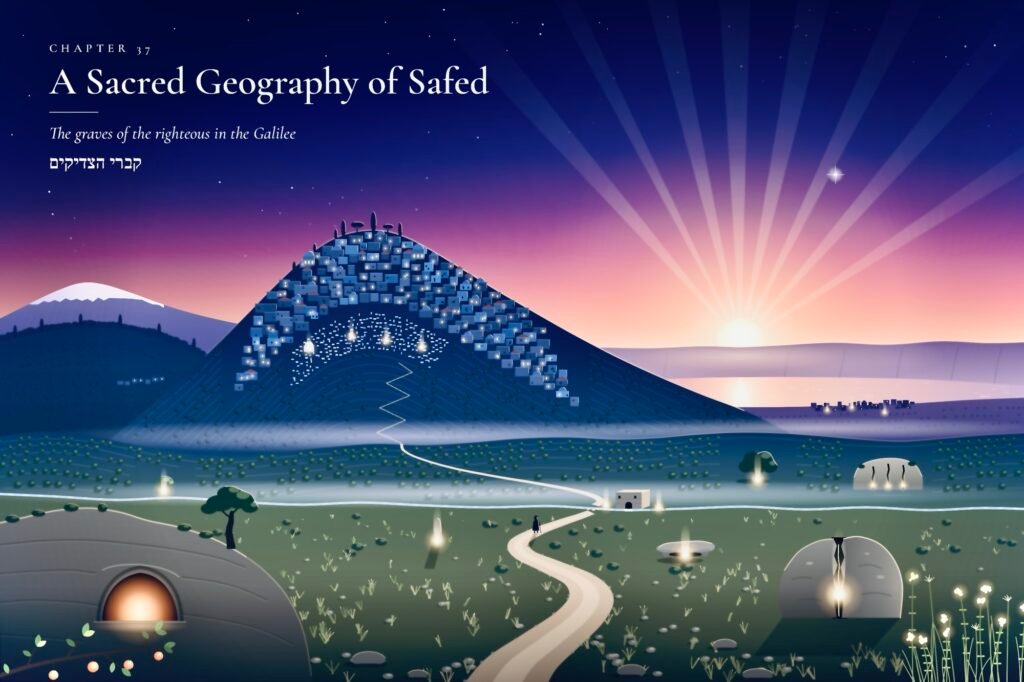
In this remarkable account, the landscape around Safed becomes more than a map of hills, paths, springs, and caves. It becomes a hidden register of holiness—a country whose stones and hollows preserve the presence of the righteous. The text records the burial places of sages and holy figures, some remembered by local tradition, others concealed from ordinary sight. Its central claim is not merely that these graves exist, but that they can be known through a kind of spiritual perception: the righteous remain present at their resting places, and their presence may be discerned by one granted the ability to see.
The account begins with the testimony of Shmuel, who explains that he writes according to what he received from his teacher. That teacher, he says, could see the souls of the righteous “in any place and at any time,” and especially at their graves, where their *nefashos*—their souls or spiritual presences—stand. From afar, the teacher could identify a righteous person’s burial place, speak with the departed, and learn from them secrets of Torah. Shmuel says that he investigated these claims repeatedly and found them true. Yet he refuses to elaborate further: such matters are “awesome and wondrous,” he writes, and too great for the book to contain.
This opening establishes the character of the work. It is at once a guide to sacred sites and a testimony to a world that exceeds ordinary knowledge. The descriptions are practical, even precise: a traveler is directed westward from the cemetery, down a mountain path, past a spring or a carob tree, toward a particular rock or cave. But the directions lead not simply to landmarks. They lead to encounters with memory, tradition, and the unseen.
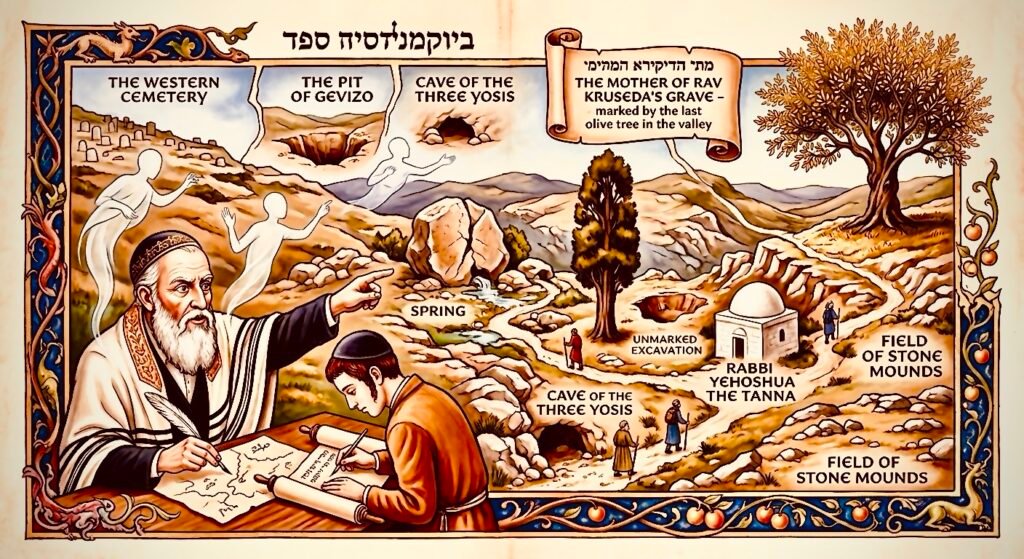
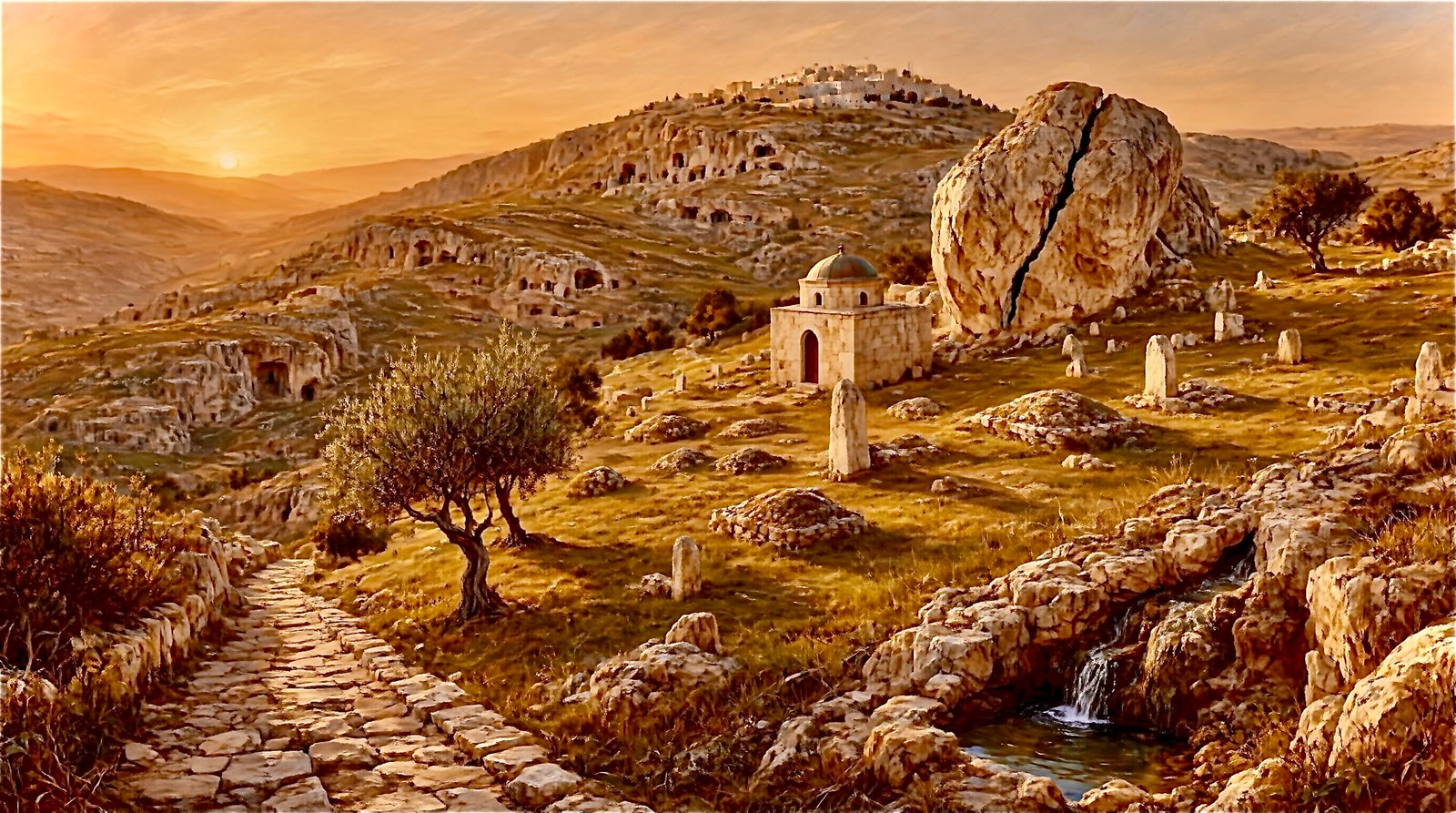
Safed and its surroundings are presented as a sacred geography shaped by the lives of sages. At the city’s western cemetery, a domed building is associated by popular belief with the prophet Hoshea ben B’eri. The text corrects that tradition: the grave, it says, belongs instead to Rabbi Yehoshua the Tanna. Elsewhere in the same cemetery, near a well called the Pit of Gevizo, lies Rabbi Shimon ben Chalafta, though no sign marks the place. The contrast is telling. Some graves are enclosed by buildings or preserved in local memory; others remain unmarked, known only to those who possess the proper tradition.
The surrounding mountain paths hold an even denser constellation of holy sites. Rabbi Chiya, associated with the *Idra Rabba*, is said to lie near a tall rock resembling a single wall. Rabbi Nechunia ben HaKaneh rests beneath a solitary upright stone. Rabbi Yitzchak Napcha is identified by a large rock split by a deep crack, while Rabbi Abba’s resting place lies in an excavation in the mountain above a place where cloth is washed. These descriptions give the landscape an almost architectural character: rock becomes marker, cleft becomes sign, and cave becomes a chamber of remembrance.
The text’s attention to such modest features is one of its most striking qualities. A grave may be identified not by a monument, but by a stone’s shape, a path’s incline, the position of a tree, or the sound and course of water. Sacred recognition depends on learning how to read the terrain. The landscape does not announce its holiness in grand gestures. It offers clues, and the traveler must follow them carefully.
Other graves are located along routes used for ordinary work and travel. Near the water where grain is ground, the account places Adino HaEtzani and Rabbi Chutzpis the Interpreter. A large, flat stone, hollow beneath and lifted slightly from the ground, marks the grave of Yehoyada HaKohen. A lone carob tree identifies the resting place of the son of Rav Safra. In each case, the holy and the everyday occupy the same ground. The river that turns a mill, the path descending a mountain, and the trees that shade a traveler all become part of a sacred itinerary.
This intimacy between holiness and ordinary life continues in the account of the three figures Yosi ben Yoezer, Yosi ben Meshulam, and Yosi ben Yochanan, whose graves are associated with a cave and its three cracks. Elsewhere, Rabbi Kruspedai “whose heart was sweet” is located between two mountains, while Antigonus of Socho and Nasan of Tzutzisa are found in excavations beneath rocks along the same ridge. The repeated emphasis on openings, clefts, and hollows gives the terrain a hidden, inward quality. The sacred is often not displayed on the surface; it is sheltered within the earth.
The southern approaches to Safed reveal another layer of the region’s memory. Near a spring called the New Spring, a cave known in Arabic as “Children of Yaakov” stands beside a building identified as the burial place of Rabbi Dosa ben Harkinas. The account affirms the tradition with unusual certainty: he is indeed buried there, and no other righteous person lies in that place. Further south, Rabbi Binyamin bar Yefes is associated with a valley cut between stones. Beyond a neighborhood of Arab homes lies a broad field of small stone mounds, where the text locates Binyamin HaTzaddik in the site of an ancient synagogue. Nearby rests Nachum Ish Gamzu. The mounds, the author says, cover the remains of a once-great and holy city.
Here the landscape carries not only the memory of individual sages but the memory of a vanished community. Ruins and stones become witnesses to a past whose scale can no longer be seen in the present. A place that appears to be merely a field of rubble is understood as the remnant of a city, and the site of an ancient sanctuary retains its sanctity even after the building has disappeared.
The account also includes a stark warning: north of Safed, along the road toward Ein Zeitun, lies the grave of “Yeshu the Christian,” which the section labels an impure place. I can personally confirm I walked that path or road and visited a site it feels very troubled and impure. One rabbi drove by car and saw me troubled and drove me to Safed. This notice interrupts the catalogue of revered sages and makes clear that the work is not simply a collection of picturesque traditions. It draws boundaries—between holy and impure, between places worthy of veneration and places to be approached with caution. The landscape is morally and spiritually charged.
Yet the final image returns to the tenderness of the opening. Between Safed and Ein Zeitun, near a stream descending from a pit called Gefar, the text identifies the grave of the mother of Rav Kruspedai, the kind-hearted. Her resting place is marked not by a monument but by the last olive tree in a valley. The detail is quiet and almost intimate. After the caves, mountains, ancient synagogues, and celebrated sages, the account preserves the memory of a mother at the edge of a grove.
Taken together, these descriptions transform the region around Safed into a map of spiritual presence. Its paths are routes through history; its stones are signs; its springs and valleys are woven into the lives of the dead and the living. The text asks its reader to imagine that the righteous have not vanished entirely from the places where they were buried. Their presence remains, though it may be invisible to most eyes.
That is why the catalogue is more than a list of graves. It is an invitation to see the landscape differently: to understand that a mountain may shelter a sage, a cracked stone may conceal a teaching, and an unmarked hollow may hold a presence known only through inherited wisdom. In this world, the land remembers. The task of the traveler is to listen—to follow the old paths, attend to the smallest signs, and recognize that beneath the visible surface of Safed lies a deeper geography, alive with the memory of the righteous.
The Hidden Geography of Holiness and A meditation on the graves and sacred places of the Galilee
In the Galilee, the landscape is never merely landscape. A mountain may shelter a cave of learning; a stream may trace the path between villages and generations; a solitary stone may mark the resting place of a sage whose name has endured for centuries. The passages presented here preserve a remarkable map of such places: not a map of borders and roads alone, but one in which geography is interwoven with memory, Torah, and the hidden lives of the righteous.
The account is attributed to Rabbi Chaim Vital, who records traditions received from his master, the Arizal. Its descriptions are strikingly precise. The traveler is guided northward from Tzfas, past streams and mountain paths, toward Gush Chalav, Biriyah, Avnit, Meiron, and Ein Zeitun. Distances are measured in cubits; directions are given by reference to a tree, a rock, a fork in the road, or the mouth of a cave. Yet the purpose of these details is not simply to help a visitor find a grave. They invite the reader to see the Galilee as a living archive—a place where the history of Torah is inscribed in stone.
A landscape of remembrance
The passage begins with a route from Tzfas toward Gush Chalav, where a stream called Karel gathers the waters descending from Biriyah and Ein Zeitun. Near this route, beneath a large stone leaning to one side, the text identifies the resting place of Rabbi Noson the Babylonian. Nearby, among rocky excavations on a mountain, it places Rabbi Shimon son of Menasyah. Farther along, the traveler encounters the deep stream associated with the region of Kizmiya and the well known as *Bir Al-Sheikh*.
This is a world described through ordinary landmarks: a leaning stone, a dry watercourse, a mountain’s edge, a cleft in the rock. But in the text, these features acquire a second life. They become signs of presence. A stone is no longer only a stone once it is remembered as the marker of a sage’s burial. A cave is no longer only a hollow in the mountain once it is linked to generations of Torah scholars.
The precision of the directions is itself an act of reverence. The account does not speak of holy people in vague, distant terms. It places them within the physical world, among the paths that travelers still walk and the hills they can still see. The sacred is not removed from the terrain. It is embedded within it.
The Galilee as a house of study
Among the most evocative passages is the description of a place on a mountain where Rabbi Shimon bar Yochai and his students gathered to study *Sifra di-Tsni’uta*, the esoteric work associated with the secrets of Torah. The text also links the area with the gathering of the *Idra Rabba*, the great assembly described in the Zohar.
The account names the places where particular figures sat: Rabbi Shimon bar Yochai in one rocky recess, Rabbi Abba in another, and Rabbi Elazar near a tree. It also identifies the burial place of Rabbi Yosi son of Ya’akov, who, according to the tradition recorded here, died during the *Idra Rabba*.
These details transform the landscape into a remembered study hall. The mountain is not merely the setting for a story; it becomes part of the story’s meaning. The students are imagined not in a distant, abstract world, but gathered among rocks and trees, studying the concealed dimensions of Torah in the very terrain that later generations would visit.
This image captures one of the enduring themes of Jewish sacred geography: holiness is created not only by what a place contains, but by what has happened there. Study, prayer, teaching, and spiritual companionship leave an imprint. The land becomes a vessel of memory because it has been the setting for a meeting between human beings and Torah.
The many generations of Torah
The names in this passage span an immense stretch of Jewish history. Alongside sages associated with the Mishnah and the Zohar, it mentions Amoraim of the Talmud, figures from biblical history, and other righteous individuals whose identities were preserved through local tradition.
The text identifies, among others, Rabbi Yosi of Peki’in, Rabbi Yochanan ben Brokah, Rabbi Yosi of Yukras, and Rabbi Kruspedai the Amora. It records a tradition that Rabbi Kruspedai was buried in a cave with two other righteous people whose names were unknown to the transmitter. It also places Elkanah, father of the prophet Samuel, alongside Rabbi Bena’a the Amora in a cave among the rocks.
The effect is not to flatten these figures into a single era. Rather, the passage gathers many generations into one sacred landscape. The Galilee becomes a meeting place of Jewish time: biblical memory, rabbinic debate, mystical teaching, and local devotion all inhabit the same hills.
The text also preserves uncertainty. At times, the author distinguishes between what people say and what his teacher accepted. In Biriyah, for example, some identify a cave as the burial place of Abba Shaul, but the Arizal is said to have rejected that identification, while declining to name the person he believed was buried there. Elsewhere, the passage corrects popular tradition, distinguishing Nechemiah HaAmasuni from Nachum Ish Gamzu. Such qualifications are important. They show that sacred memory is not presented as a collection of unquestioned claims; it is a tradition examined, compared, and sometimes revised.
The meaning of exactness
The text’s measurements—one hundred cubits, two hundred cubits, four hundred cubits—may seem at first like the practical notes of a guide. They are that, but they also express a distinctive attitude toward memory. To remember a sage is not only to preserve a name. It is to preserve the relationship between that name and a particular place.
A path bends; a stream dries; a tree may disappear. The descriptions therefore carry a quiet urgency. They attempt to transmit knowledge before the landscape changes beyond recognition. The reader is asked to imagine looking north from a certain point, turning west, counting a measured distance, and searching for a stone ledge or a narrow opening in the rock. The act of reading becomes almost an act of walking.
This closeness to physical detail also makes the tradition deeply human. The sages are not presented as distant icons alone. They are buried beneath stones, within caves, beside trees, and along routes used by ordinary travelers. Their holiness does not erase the material world. It gives the material world a deeper resonance.
A sacred map, not merely a guidebook
Read today, the passage can be approached in more than one way. It is a record of traditions about burial places and sites associated with Torah study. It is also a literary map of the Galilee, shaped by the religious imagination of its transmitters. Its value lies not only in whether every identification can be confirmed by modern historical methods, but in the way it reveals what a community sought to remember and how it understood the land.
The account’s central vision is clear: the Galilee is crowded with spiritual history. Its roads connect not only villages but generations. Its caves hold not only the remains of the departed but the memory of learning, devotion, and companionship. Its streams and mountains become part of a sacred narrative.
To walk through such a landscape with this text in hand is to encounter two maps at once. One is the visible map of roads, rocks, and villages. The other is a map of inherited memory, in which every turn may lead toward a sage, a teaching, or an event preserved in the tradition. The two maps do not compete. They deepen one another.
The passage from *Sha’ar HaGilgulim* thus offers more than a catalogue of graves. It presents the Galilee as a place where Torah has taken root in the earth itself. The stones are witnesses; the caves are classrooms; the paths are threads connecting one generation to the next. And the traveler, following the old directions, becomes a participant in that act of remembrance—moving through a landscape that is at once geographic, historical, and holy.
The Graves of the Righteous: Sacred Geography and the Memory of the Land
The passage presents a landscape in which mountains, caves, springs, villages, and city walls are more than features of the natural world. They are a map of sacred memory. Across the Galilee and around Tiberias, the text identifies places associated with prophets, sages, and teachers, preserving not only their names but also the paths by which a traveler might seek their resting places. Its descriptions are often tentative—“as people say,” “it seems to me,” or “I do not recall”—yet this uncertainty does not diminish the account. Rather, it reveals a tradition formed through testimony, reverence, and the careful transmission of local knowledge.
The passage’s first striking feature is its intimacy with the terrain. It does not locate holy figures through grand monuments alone. A grave may lie in the northwestern corner of a structure, in the second alcove on its eastern side, beside a narrow cave opening, or in a rocky cleft near a mountain path. The reader is guided from Ein Zeitun toward Almah, from Gush Chalav into a valley, from Tiberias toward its hot springs, and from one village to another. Sacred geography is therefore experienced on foot. To remember a sage is also to remember the incline of a mountain, the direction of a wall, the position of a spring, or the distance—measured in cubits or by the length of a journey—between one settlement and the next.
Caves are especially prominent. They are graves, sanctuaries, and thresholds between the visible landscape and a hidden spiritual world. Near the monument described at the beginning, a cave is identified as the burial place of Rebi Iloy, father of Rebi Yehudah, and the account specifies his location within it: the second alcove on the eastern side, near the southeastern corner. Elsewhere, a cave among the orchards of Achbara is associated with Rav Yannai, its narrow entrance fed by a spring that waters the surrounding land. The description is practical, almost matter-of-fact, yet it also suggests a profound correspondence between the holy person and the place: the sage rests within the earth, while water emerges from it to sustain life above.
The landscape gathers figures from many generations of Jewish learning. The prophet Yoel ben Pesuel is placed in a valley north of Gush Chalav. Rebi Nehurai the Elder is associated with a rock midway up a mountain near Ein Al Tinni, and the text links him to the Zohar. Yonasan ben Harkinas and Rebi Yitzchak ben Elyashiv are said to share a grave on the mountainside above Gavraiyitin. In the excavated spaces near Chukav, the account distinguishes among Rebi Zerika, Rav Samma, Oshaya of the group of sages, Mar Ukva, and Rav Levitas of Yavneh. These are not presented as a single undifferentiated company. The text carefully notes who lies together and who rests alone, preserving distinctions that matter to the tradition.
Tiberias forms the heart of this sacred map. Within the city, a synagogue is remembered as a place of exceptional holiness, and the passage records that the author’s teacher established his place of prayer in its western corner. Outside the city walls, a series of burial places extends the map into the surrounding fields and slopes. Rebi Yitzchak Nafcha is associated—though with acknowledged uncertainty—with alcoves near the northern wall. Rebi Yochanan ben Zakkai is placed in a courtyard containing monuments and coffins. Farther west, the Rambam is said to rest with his father. Beyond them, the cave of Rebi Chiya and his sons is described as holding not only Rebi Chiya, Yehudah, and Chizkiyah, but also Rav Hamnuna the Elder and Rav Huna the Exilarch.
These identifications are accompanied by stories that deepen the meaning of place. The account of Rebi Akiva describes an inner cave that opened when Eliyahu HaNavi and Rebi Yehoshua the Garsi entered to bury him, then closed after they departed. The visible cave is thus not necessarily the whole sanctuary; it is the accessible outer threshold of a burial place concealed from ordinary sight. The text directs the visitor toward the corner that corresponds to the hidden grave, turning orientation itself into a form of devotion. What cannot be seen may still be approached through careful attention to the landscape.
The author’s repeated qualifications are among the passage’s most revealing features. Some locations are reported as popular belief; others are offered as personal judgment. The author may recall that a place is associated with a righteous person but not remember precisely which one. He may defer to his teacher’s confirmation, or state that the identification appears likely to him. Such language gives the account a distinctive humility. It does not claim that every tradition has been verified beyond doubt. Instead, it preserves the layered character of sacred memory: local report, inherited teaching, personal recollection, and scholarly correction coexist on the same page.
That humility is especially important because the passage is more than a catalogue. It is an act of preservation. The names of sages and prophets are attached to particular rocks, caves, courtyards, and springs before those associations can fade from communal memory. The landscape becomes an archive, and the traveler becomes its reader. A cave is not merely an opening in stone; it may be the resting place of a teacher. A synagogue is not merely a building; it may hold the imprint of a master’s prayer. A roadside spring may carry a tradition as enduring as the water that flows from it.
The passage closes its survey of graves with a prayer that the merit of the righteous should protect the living. That prayer gathers the many places into a single spiritual geography. The tombs are scattered across mountains and valleys, yet they belong to one remembered world—a world in which the past remains present through names, routes, stories, and acts of reverence. The text invites its reader not simply to know where the righteous are buried, but to approach the land with attention: to walk its paths, listen to its traditions, and recognize that holiness may be found in a hidden alcove, a cleft in the rock, or a quiet place beside the sea.
Wild Apples
The passage titled “Wild Apples” belongs to a world in which the natural landscape is not merely scenery but a storehouse of powers—some dangerous, some medicinal, and some so mysterious that their uses seem to touch the borders of magic. Its descriptions of fruit, herbs, roots, and flowers combine practical observation with inherited lore. Yet the passage is also framed by a deeply personal act of preservation: the editor’s decision to publish writings he believes his father and master had intended to keep private. Together, these elements make the text more than a catalogue of remedies. It becomes a meditation on knowledge—how it is discovered, how it is transmitted, and what responsibilities attend its preservation.
The opening account of the wild apples immediately establishes the passage’s mixture of danger and remedy. The fruit is said to cause insanity in anyone who eats it, a warning that gives the plant an almost uncanny character. Its cure is not described as an ordinary medicine, however, but as an object worn on the body: the apples are wrapped in deer parchment and hung around a person’s neck. The charm is credited with a startling power. If someone raises a sword against its wearer, the weapon will turn against the attacker and kill its master. In the same breath, the text offers a more recognizably medicinal use: the dried and powdered peels can be applied as an ointment to strengthen weak eyes.
This juxtaposition is central to the passage’s imagination. A plant may be poisonous when eaten, protective when worn, and restorative when prepared in another way. Nature is not divided neatly into the harmful and the beneficial. Its effects depend on the form in which it is encountered and on the knowledge of the person who handles it. The apples are therefore not simply a remedy or a threat; they are a test of discernment.
The herbs that follow are recorded with a similar attention to visible form and practical application. One plant, called Totomilio, releases a milky substance when cut, said to confine quicksilver. Its head bears several buds, each with further buds, though the precise instructions for gathering it are missing. Another herb, identified by an Arabic name, has several long, needle-like structures at its head and a scent reminiscent of myrrh. It is associated with alchemical processes involving the transformation of substances and the preparation of pigments. These details suggest that the text’s herbal knowledge extends beyond household medicine. Plants are valued not only for healing the body but also for their role in craft and experimental arts.
Other descriptions are more directly therapeutic. A yellow-flowered herb resembling lentils is mixed with olive oil and vinegar and applied to cracked, itchy skin. The text recommends smearing it on the legs, thighs, and hands, repeatedly, in the evening and morning. The directions are plain and practical: they specify the ingredients, the affected parts of the body, and the rhythm of treatment. Elsewhere, a plant with broad, lettuce-like leaves and a tall central reed is described, though the surviving account is damaged and incomplete. The broken wording itself offers a reminder that this knowledge has reached the reader through fragile manuscripts, where even a once-careful description may now be partially lost.
Several plants are praised for their effects on the eyes. A mustard-like herb with yellow flowers is said to be beneficial to sight. Another, with short leaves resembling those of an onion, grows among hard rocks. The text distinguishes carefully between the plant growing within the rock and the plant growing above it: only the latter is considered useful. Its remedy is prepared as a confection with a three-sided vessel, raisins, and bee honey, and eaten each morning after fasting. A small herb with an olive-sized root and a yellow flower, meanwhile, is also made into a honey confection to brighten the eyes.
These prescriptions convey a strikingly intimate familiarity with the natural world. The plants are identified by shape, color, scent, location, and growth habit. Their uses are attached to specific preparations: drying and grinding, mixing with oil and vinegar, combining with honey, or eating after a fast. The text does not offer a general theory of medicine. Instead, it preserves particulars—the small observations and procedures by which knowledge becomes usable. Its authority rests in accumulated experience, passed from teacher to student and recorded with care.
The passage also reveals a world in which medicine, magic, and alchemy are not sharply separated. A charm that turns a sword against an attacker stands beside an ointment for weak eyes; a plant that treats irritated skin appears alongside one connected to quicksilver and alchemical transformation. To a modern reader, these categories may seem unlike one another. Within the text, however, they belong to a unified inquiry into the powers hidden in natural things. The same attentiveness that identifies a useful flower or root also seeks to understand how plants might protect, transform, or restore.
At the end, the catalogue gives way to a personal and spiritual reflection. The editor, Shmuel, announces that he has completed the book of his father and master, believing that nothing has been omitted and that the work has been carried through with divine assistance. He then explains that he discovered additional manuscripts among his father’s papers. These writings concerned the “root” of his father’s soul and had been entrusted to him by a revered teacher. Shmuel suspects that his father deliberately concealed them out of humility, unwilling to disclose such matters publicly.
His decision to publish them is presented not as a casual editorial choice but as a moral struggle. He fears that the writings may otherwise be forgotten, yet he knows that preserving them means acting against his father’s apparent wishes. He therefore asks for forgiveness, trusting in his father’s humility and piety, and prays that G-d will guide his words. The closing passage transforms the act of compilation into an act of devotion. To preserve knowledge is to serve memory, but it may also require judgment about the wishes of those who first possessed it.
In this way, “Wild Apples” is about more than unusual plants and their remedies. It is about the precarious passage of knowledge from one generation to another. The herbs are preserved through descriptions; the treatments endure through written instruction; and the teachings of the master survive through a son’s decision to record them. The text’s strange and practical details alike testify to a world in which learning is gathered patiently from nature and guarded through human care. Its luxury lies not in ornament but in the richness of attention: the belief that every leaf, root, flower, and fragment of inherited wisdom may contain a power worth remembering.