The Light of Redemption and Education: A Rabbinic Commentary on Sefer HaChinuch (The Book of Mitzvos)
Mitzvah 2
Nov 16, 2026 · @Kamil Levi Pyka-Penner
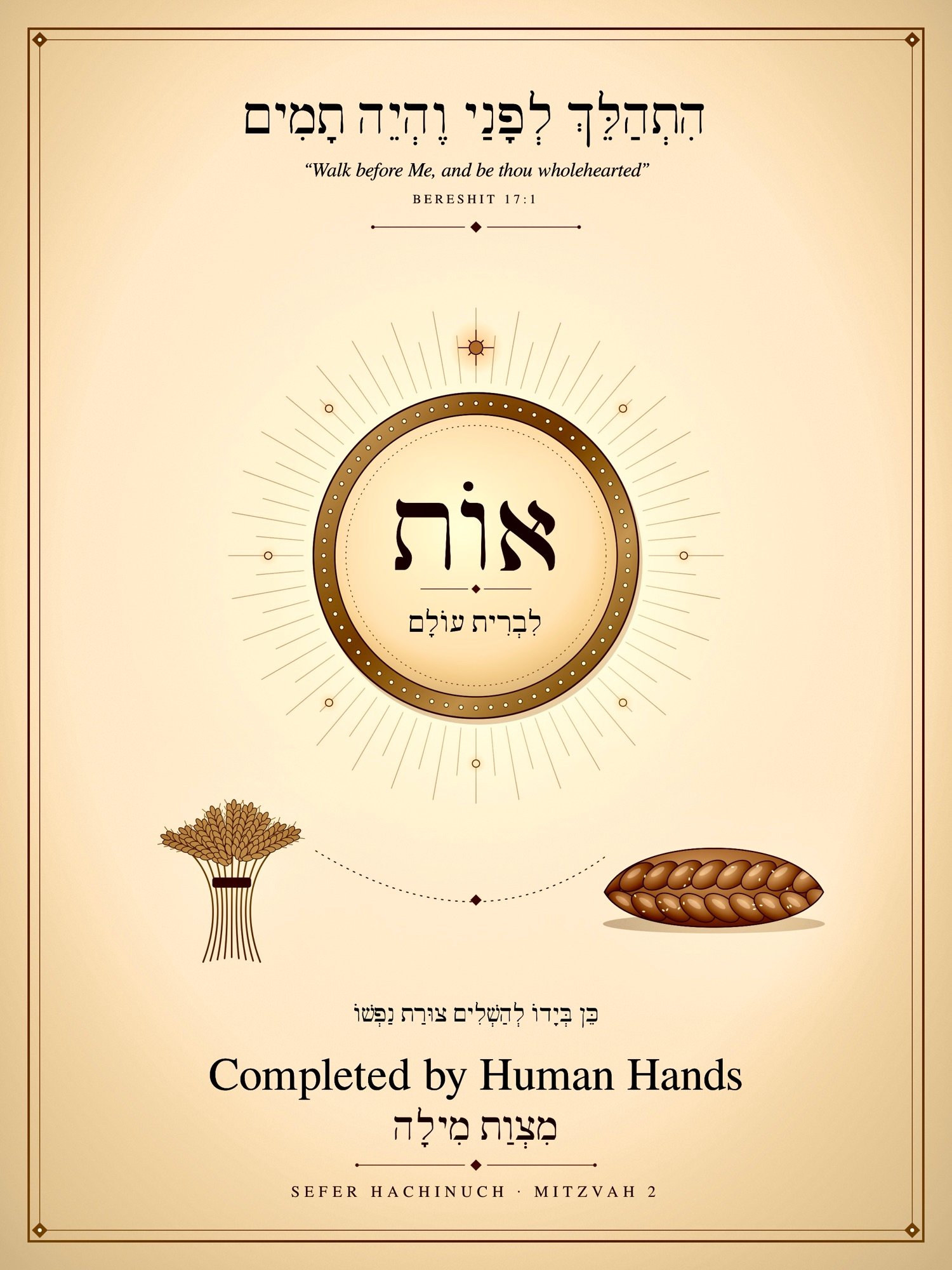
Completed by Human Hands: Milah, the Second Mitzvah of Sefer HaChinuch
A Note on Sources and Method
This essay keeps to the same narrow library as its companion. It draws only on Sefer HaChinuch itself; the elucidation, notes and two Insights of the elucidated English edition (pp. 65–72); the Minchas Chinuch as cited there; and the sources to which those pages direct the reader. Beyond the verses of Scripture themselves, nothing is brought in from outside that circle.
The Chinuch is quoted in my own Hebrew, with an original English rendering. Verses are given from the Masoretic text, in the Jewish Publication Society translation of 1917. Where the essay offers a reading of its own rather than reporting one, it says so.
I. From the First Mitzvah to the Second
In the Chinuch’s account milah is the mitzvah of human completion, and it completes what the first mitzvah brings into being. Its sign is placed on the organ through which the species continues, the organ of pru u’rvu. The response at the bris sends the child toward Torah, the marriage canopy and good deeds, and so back toward the first mitzvah.
The Chinuch’s own vocabulary binds the two chapters. In Mitzvah 1, one who refuses procreation will not לְהַשְׁלִים חֵפֶץ הַשֵּׁם, complete the desire of the Name to settle His world. In Mitzvah 2 the same two words return in reverse: חָפֵץ הַשֵּׁם יִתְבָּרַךְ לְהַשְׁלִים תְּכוּנָתוֹ. The Name desires to bring the nature of His chosen people to completion, and wills that the completion come by human hands.
This commentary argues that the whole chapter follows from that sentence. The body is created with an excess so that a human hand may remove it. The obligation passes from father to beis din to the man himself, each a human hand in turn. Shabbos yields on the eighth day, and the bris waits on the child’s health. Kares falls only on the one who, grown, refuses to complete himself.
II. The Text
The Chinuch’s chapter on milah runs to ten movements, longer than his chapter on procreation and fuller in its laws. The Hebrew is given without vowels; the English is an original rendering.
1. The mitzvah, its verse, and its repetition
לך לך יש בה מצות עשה אחת, והיא מצות מילה, שנאמר (בראשית יז, י) זאת בריתי אשר תשמרו ביני וביניכם ובין זרעך אחריך המול לכם כל זכר. ונכפלה בסדר אשה כי תזריע, דכתיב (ויקרא יב, ג) וביום השמיני ימול בשר ערלתו. והרבה מצוות כמו כן נכפלו במקומות הרבה בתורה, וכולן לצורך, כמו שפירשום חכמים זכרונם לברכה.
Lech Lecha contains one positive commandment, the mitzvah of circumcision, as it is said: “This is My covenant, which ye shall keep, between Me and you and thy seed after thee: every male among you shall be circumcised” (Bereshit 17:10). It is repeated in the portion אשה כי תזריע, where it is written: “And in the eighth day the flesh of his foreskin shall be circumcised” (Vayikra 12:3). Many mitzvos are likewise repeated in many places in the Torah, and all of them for a purpose, as the Sages, of blessed memory, explained.
2. What the mitzvah is
ועניין מצוה זו הוא, שחותכין הערלה המחפה ראש הגויה, ופורעין קרום רך שלמטה ממנה, כדי שתתגלה ראש העטרה שבאותו אבר, כי ידוע למבינים שתשלום צורת האדם בהסיר ממנו אותה ערלה, שהיא תוספת בו.
The substance of this mitzvah is that we cut away the orlah covering the head of the member, and uncover the soft membrane beneath it, so that the crown of that organ is revealed. For it is known to those who understand that the completion of the human form lies in removing from a man that orlah, which is an excess upon him.
3. The root
משרשי מצוה זו, לפי שרצה השם יתברך לקבוע בעם אשר הבדיל להיות נקרא על שמו אות קבוע בגופם, להבדילם משאר העמים בצורת גופם כמו שהם מובדלים מהם בצורת נפשותם, אשר מוצאם ומובאם איננו שוה, ונקבע ההבדל בגולת הזהב לפי שהוא סיבה לקיום המין, מלבד שיש בו תשלום צורת הגוף, כמו שאמרנו.
Among the roots of this mitzvah: the Name, blessed be He, wished to set in the people He separated to be called by His Name a fixed sign in their bodies, to distinguish them from the other peoples in the form of their bodies as they are distinguished from them in the form of their souls, whose going out and coming in are not alike. The distinction was set on the golden spring because it is the cause of the continuance of the species, besides the completion of the bodily form that it brings, as we have said.
4. Why man is not born complete
והעם הנבחר חפץ השם יתברך להשלים תכונתו, ורצה להיות ההשלמה על ידי האדם, ולא בראו שלם מבטן, לרמוז אליו כי כאשר תשלום צורת גופו על ידו, כן בידו להשלים צורת נפשו בהכשר פעולותיו.
As for the chosen people, the Name, blessed be He, desires to bring its nature to completion, and willed that the completion come by human hands. He did not create man complete from the womb, to hint to him: as the completion of his body’s form is by his own hand, so it is in his hand to complete the form of his soul by making his deeds fit.
5. The laws
דיני המצוה, על מי מוטלת מילת הקטנים, וכן מילת העבדים, יליד בית ומקנת כסף, והחילוק שביניהם. ובאי זה עניין דוחין בשבילה שבת ויום טוב, ואי זה קטן משהין מילתו יותר משמונה ימים, ויתר פרטיה, מבוארים בפרק י״ט משבת (דף קל ע״א ואילך), ובפרק ד׳ מיבמות (דף מז ע״ב).
The laws of the mitzvah are set out in the nineteenth chapter of Shabbos (130a ff.) and the fourth chapter of Yevamos (47b): upon whom the circumcision of minors rests; likewise the circumcision of slaves, the one born in the house and the one bought with money, and the difference between them; in what circumstances Shabbos and Yom Tov are set aside for it; which infant’s circumcision is delayed beyond eight days; and the rest of its details.
6. The blessings
ושם בשבת (דף קלז ע״ב) יתבאר כי המל מברך: ברוך אתה ה׳ אלהינו מלך העולם אשר קדשנו במצותיו וצונו על המילה. ואבי הבן, או בית דין במקום שאין אב, מברכין: ברוך אתה ה׳ אלהינו מלך העולם אשר קדשנו במצותיו וצונו להכניסו בבריתו של אברהם אבינו. והעומדים שם עונין: כשם שזכה לברית, כן יזכהו האל לתורה ולחופה ולמעשים טובים.
There in Shabbos (137b) it is explained that the one who circumcises blesses: “Blessed are You, Hashem our G-d, King of the universe, who sanctified us with His commandments and commanded us concerning circumcision.” The child’s father, or beis din where there is no father, blesses: “…who sanctified us with His commandments and commanded us to bring him into the covenant of Avraham our father.” Those standing there respond: “As he merited the covenant, so may God grant him merit for Torah, for the marriage canopy, and for good deeds.”
7. Where, when, and who
ונוהגת בכל מקום ובכל זמן. ואין הנשים חייבות במילת בניהן, אלא האב, או בית דין במקום שאין להם אב.
It applies in every place and at every time. Women are not obligated in the circumcision of their sons; only the father is, or beis din where the children have no father.
8. The man who does not circumcise himself
ועובר על מצוה זו ולא מל עצמו משהגיע לכלל עונש, שהוא י״ג שנה ויום אחד, בכל יום שיעבור עליו משיגדל ולא ימול עצמו, מבטל מצות עשה. ואם מת [והוא ערל במזיד] חייב כרת, אבל אין לאב חיוב כרת במילת בנו, אלא שעובר על עשה.
One who transgresses and does not circumcise himself, from the time he reaches the age of punishment, thirteen years and a day: every day that passes over him once grown without his circumcising himself, he annuls a positive commandment. If he dies [deliberately uncircumcised], he is liable to kares. The father, however, bears no liability of kares for his son’s circumcision; he transgresses a positive commandment only.
9. A singular mitzvah
ואין בכל התורה מצות עשה שחייבין על ביטולה כרת כי אם זו ושחיטת הפסח.
In the whole Torah there is no positive commandment whose neglect carries kares except this one and the slaughter of the pesach.
10. Coda
פרשת וירא אליו ופרשת ויהיו חיי שרה ופרשת תולדות יצחק ופרשת ויצא יעקב, אין בהן מצוות.
The portions Vayeira, Chayei Sarah, Toldos and Vayetzei contain no mitzvos.
III. A Covenant Commanded and Repeated
The Chinuch counts milah at its first command, to Avraham, and treats its restatement in Tazria as a repetition with a purpose. The first verse defines the mitzvah as covenant: זֹאת בְּרִיתִי, “This is My covenant.” As the edition’s first note observes, the covenant binds Hashem on one side and Avraham and his descendants on the other; hence the name bris milah.
The covenant is generational by its own terms: “between Me and you and thy seed after thee.” A mitzvah addressed to a man and his seed presupposes the first mitzvah, so the book’s second chapter begins where its first left off.
The restatement in Leviticus 12:3 adds a time: “And in the eighth day.” The Chinuch does not explain it here. He states a principle instead: many mitzvos are repeated in many places, וכולן לצורך, all of them for a purpose. Mitzvah 1 recorded no repetition; here, in the book’s second chapter, the principle is stated outright.
The edition supplies the purpose from Sanhedrin 59b. The Torah often repeats a whole mitzvah for the sake of one new law, and here the words “in the eighth day” teach that milah performed in its time overrides Shabbos (note 2; see section VII). It is the same daf of Sanhedrin the companion essay met when asking which commandments bind the Noahides.
Read together, the two verses give the mitzvah its two coordinates: a covenant with Avraham’s line, and a day fixed so firmly that Shabbos yields to it.
IV. Completing the Form
The Chinuch defines milah as completion by removal: what is taken away is an excess, and its removal perfects the human form. He describes two motions. The orlah covering ראש הגויה, the Mishnah’s term for the member (Negaim 6:7), is cut away. Then the soft membrane beneath is uncovered, כדי שתתגלה ראש העטרה, so that the crown is revealed.
The two motions have different origins. The edition’s fourth note records that Avraham was commanded the cutting but not the uncovering, periah (Yevamos 71b). Periah is derived from G-d’s word to Joshua, “circumcise again the children of Israel the second time” (Joshua 5:2), from the seemingly extra word שׁוּב, “again.” Tosafos there explain that periah was given to Moshe at Sinai as halachah le-Moshe mi-Sinai, and that Joshua committed it to writing.
The mitzvah as the Chinuch defines it thus carries two layers: Avraham’s covenant and the law of Sinai. Its last motion is named for what it accomplishes, periah, uncovering, and the Chinuch’s purpose clause turns on the same idea: שתתגלה, “that it be revealed.” On this reading, which is ours, completion here means unveiling what was already there.
His reason is brief and allusive: כי ידוע למבינים, “it is known to those who understand,” that the human form is completed by removing the orlah, שהיא תוספת בו, an excess upon him. The edition’s seventh note gives the classical ground (Nedarim 31b). For all the mitzvos Avraham performed, he was not called complete until he was circumcised, as it says, “walk before Me, and be thou wholehearted” (Bereshit 17:1), וֶהְיֵה תָמִים. The Midrash adds that until then he was considered blemished (Bereishis Rabbah 46:4).
The edition’s first Insight carries the idea back to Adam. Its sources teach that Adam was created circumcised, in the image of G-d (Avos DeRabbi Nassan 2:5), and after his sin drew a covering over the sign (Sanhedrin 38b, reading Hosea 6:7, וְהֵמָּה כְּאָדָם עָבְרוּ בְרִית, as “like Adam they transgressed the covenant”). Adam, created without an orlah, made one; Avraham, born with one, removed it.
Wherever Scripture uses the word orlah, the Insight observes, it names a barrier: the fruit of young trees (Vayikra 19:23), the “foreskin of your heart” (Devarim 10:16). Drawing on the Sfas Emes (Lech Lecha 5665), it reads the bodily orlah as the outward form of the barrier sin raises between a person and G-d. Drawing on the Maharal (Chidushei Aggados, Sanhedrin 38b), it reads Adam’s covering as the body’s mirror of his fall.
The Chinuch’s word and the Insight’s image meet. An excess that covers is a barrier, and to remove it is at once to complete and to reveal. The Insight closes with Rabbi Yitzchak Isaac Chaver: Avraham had already overcome the inner barrier, and G-d answered that change with the commandment of milah.
V. The Root: A Sign Fixed in the Body
The Chinuch’s root is that G-d fixed a permanent sign in the bodies of the people called by His Name, distinguishing them in body as they are distinguished in soul. Two Hebrew roots carry the sentence. קבע appears three times (לקבוע, קבוע, ונקבע) and בדל four times (הבדיל, להבדילם, מובדלים, ההבדל). The root is distinction, made permanent.
Both words answer the verses of the mitzvah itself. “And it shall be a token of a covenant betwixt Me and you” (Bereshit 17:11) supplies the אות. “And My covenant shall be in your flesh for an everlasting covenant” (17:13) supplies its permanence and its place. On our reading, the Chinuch’s “fixed sign in their bodies” is that verse compressed into a phrase.
Body and soul. The distinction in the body mirrors one in the soul: אשר מוצאם ומובאם איננו שוה, “whose going out and coming in are not alike.” The edition’s eighth note hears a biblical idiom here (II Samuel 3:25; Ezekiel 43:11) and offers two readings. One concerns conduct: a Jew’s speech, dealings and relationships are held to a higher standard. The other concerns origin and destiny: descent from Avraham, Yitzchak and Yaakov, who refined their traits and bequeathed them to their children (Ruach Chaim to Avos 5:3; Nedarim 31b; Rabbeinu Bachya to Bereshit 17:1; the Chinuch’s Introduction).
On the second reading, the sign in the flesh marks a lineage. What the body carries is a record of where the soul comes from and where it is going.
The place of the sign. The Chinuch explains why the sign is set on the גולת הזהב, the “golden spring”: לפי שהוא סיבה לקיום המין, because it is the cause of the continuance of the species. The edition’s ninth note reads גלה as a spring, as in “springs of water” (Joshua 15:19), the organ being the source of procreation (Rashi to Shabbos 151b; see Koheles 12:6 with Rashi).
Here the second mitzvah touches the first. The Rambam’s own Book of Mitzvos defines the intent of pru u’rvu as the perpetuation of the species (Sefer HaMitzvos, Asei 212), and the Chinuch places the covenant’s sign on the organ that serves that end. Every child born to a covenanted father comes from a body that bears the covenant. This is our reading of why the placement matters.
The Chinuch adds a second reason, the completion of the bodily form discussed above. The edition records a third from the Rambam’s Guide (Moreh Nevuchim 3:49): removing the orlah lessens physical desire, and the edition adds that milah thus stands for the power to master desire and direct it to its intended purpose. The Chinuch’s own root speaks of identity and completion rather than restraint, but the three can stand together.
VI. Why Not Born Complete?
The Chinuch anticipates the obvious question, and his answer is the theological center of the chapter. If the orlah is an excess, why is a man born with it? Because God wills that the completion come by human hands: “He did not create man complete from the womb, to hint to him: as the completion of his body’s form is by his own hand, so it is in his hand to complete the form of his soul by making his deeds fit.”
The edition’s tenth note traces the answer to the Midrash Tanchuma (Tazria 5). Turnusrufus asked Rabbi Akiva why, if milah is desirable, man is not born circumcised. Rabbi Akiva answered that many things are created raw and left to human beings to refine, and that the mitzvos were given so that Israel would be refined through them. The note points further to the Maharal (Tiferes Yisrael, ch. 2).
The two chapters in dialogue. In Mitzvah 1 the Chinuch spoke of man completing the desire of the Name; here he speaks of the Name desiring the completion of man. The vocabulary is the same (חפץ, להשלים), and the relation runs both ways. God desires a completed world and a completed people, and in both cases He wills that the completing be done by human beings.
From the womb. After the bris, as the edition’s twenty-first note records, G-d is blessed אשר קדש ידיד מבטן, “who sanctified the beloved one from the womb.” The Chinuch writes ולא בראו שלם מבטן, “He did not create him complete from the womb.” On our reading the two phrases divide the work: holiness is given from the womb, completeness is not. The first is a gift; the second is a task.
Adam and the womb. The Insight’s sources hold that Adam was created circumcised, which might seem to contradict the Chinuch. But the Chinuch speaks of what comes from the womb, and Adam was formed, not born. On this reading, which is ours, the first man was made complete and every man born of a woman begins incomplete. What Adam undid by his own act, his descendants restore by theirs.
Whose hand? The infant cannot circumcise himself, so the first completion is done for him by another. The completion of the soul, בהכשר פעולותיו, only he can do. The bodily sign is the model; the moral work is his own. The laws of the mitzvah, as section IX shows, trace exactly this movement from the father’s hands to the man’s.
VII. The Laws: Time and Life
The laws the Chinuch lists turn on two principles: the eighth day overrides Shabbos, and the child’s life overrides the eighth day. He names the topics and sends the reader to the nineteenth chapter of Shabbos (130a–137b), the primary source, and to the fourth chapter of Yevamos (47a–48b), which treats milah in conversion (note 17). The law is codified in the Rambam’s Hilchos Milah and in Shulchan Aruch, Yoreh De’ah 260–268.
The edition’s notes give the cases:
Case
When the bris is performed
Sources in the notes
A healthy son, born naturally
The eighth day, counting the day of birth, even on Shabbos or Yom Tov
Vayikra 12:3; Sanhedrin 59b; Shabbos 132a
A bris delayed for any reason
The first weekday afterward, never on Shabbos or Yom Tov
Note 15
A doubt whether it is the eighth day (birth at twilight)
Not on Shabbos or Yom Tov
Note 15
A son born by Caesarean section
Not on Shabbos or Yom Tov, even on the eighth day
Shulchan Aruch, Orach Chaim 331:4–5; Yoreh De’ah 266:10
An infant ill throughout his body
Seven full days after complete recovery
Yoreh De’ah 262:2
An infant with a minor local illness
Promptly after full recovery
Yoreh De’ah 262:2
A child whose two brothers died from their milah
When old enough that the procedure poses no danger to life
Yoreh De’ah 263:2; Pischei Teshuvah there
A slave born in a Jewish household
The eighth day from birth
Bereshit 17:13; Shabbos 135b
A slave acquired after his birth
The day of acquisition, even before the eighth day
Shabbos 135b
A male convert
As part of the conversion
Rambam, Isurei Bi’ah 13:4–6
Who bears it. From the eighth day until the child is grown, the father bears the primary obligation. If there is no father, or he refuses, it falls on beis din as representatives of the Jewish people, who are ultimately obligated (note 11; Kiddushin 29a with Sefer HaMiknah). For a slave, the Rambam appears to place the duty on the master, and then on beis din (Hilchos Milah 1:1). The Minchas Chinuch (§5) grounds this in the law that a master may not eat the pesach while his slave remains uncircumcised (see Mitzvah 17). The edition notes that the laws of slaves have no application today.
The eighth day is part of the mitzvah. Milah overrides Shabbos only in its time. A delayed bris waits for a weekday, and even a doubt about the day, as with a birth at twilight, keeps it off Shabbos (note 15). The day is not a deadline for the mitzvah but one of its components, which is why the Torah restated the mitzvah to name it.
Life comes first. The same law that lets milah override Shabbos makes it wait for the child. An infant ill throughout his body waits seven full days after recovery, and a child whose two brothers died from their milah is not circumcised until it poses no danger to his life (note 16). On our reading this follows from the root: a sign set on the source of life is never cut at life’s expense.
VIII. The Blessings
The Chinuch’s account of the blessings maps the child’s whole future, and its last words return to the first mitzvah. Three utterances frame the bris (Shabbos 137b):
- The one who circumcises blesses על המילה, “concerning circumcision.”
- The father, or beis din where there is no father, blesses להכניסו בבריתו של אברהם אבינו, “to bring him into the covenant of Avraham our father.” Today the sandak fills this role when the father is absent (Rama, Yoreh De’ah 265:1), and the blessing is said after the cutting and before periah (Shulchan Aruch, Yoreh De’ah 265:1).
- Those present respond: כשם שזכה לברית, כן יזכהו האל לתורה ולחופה ולמעשים טובים.
Two blessings for one mitzvah. The edition notes that this is unusual and gives the Bach’s two explanations (Yoreh De’ah 265:1). The second blessing may be a general thanksgiving for the mitzvah of milah, showing that the act is done for the Creator’s will and for no other purpose (see Tosafos, Pesachim 7a). Or the two blessings may correspond to the two parts of the mitzvah, milah and periah. The edition questions the second explanation: “the covenant of Avraham” seems ill suited to periah, which Avraham was not commanded (see Minchas Chinuch §3).
The timing of the father’s blessing sharpens that question. Said after the cutting and before periah, it stands exactly on the seam between the two layers described in section IV, with Avraham’s commandment behind it and the law of Sinai ahead.
The response. The Chinuch’s version speaks of merit: as he merited the covenant, so may God grant him merit for Torah, the canopy and good deeds. The edition directs the reader to the commentaries on Yoreh De’ah 265:1 for the versions of this phrase. Following the Abudraham (cited by the Beis Yosef there), it explains the choice of three: like milah, each is a father’s responsibility, to teach his son Torah, to train him in mitzvos, and to see him married (Kiddushin 29a).
On our reading the response completes the chapter’s argument. The infant merited the covenant without any deed of his own; what follows must be merited by deeds. Its third term, מעשים טובים, is the Chinuch’s own lesson, the completion of the soul בהכשר פעולותיו. Its second, the canopy, leads back to the first mitzvah of the book.
The edition records the rest of the rite. In some communities the father adds Shehecheyanu (Yoreh De’ah 265:7 with Beur HaGra). A cup of wine, the blessing אשר קדש ידיד מבטן, and the giving of the name follow (Yoreh De’ah 265:1 with Shach §6).
IX. Whose Hands? Father, Beis Din, and the Self
The Chinuch assigns the mitzvah to a sequence of hands: the father, then beis din, then the man himself. Women are not obligated in the circumcision of their sons; the Gemara derives this from “as God had commanded him” (Bereshit 21:4), אותו, him and not Sarah (Kiddushin 29a; note 23). Where there is no father, or he refuses, beis din acts for the Jewish people (note 11). If both fail, the obligation falls on the man himself from thirteen years and a day.
The edition’s second Insight asks what exactly the father is commanded to do. It begins from the rule that a person’s agent is like himself (שלוחו של אדם כמותו), which governs mitzvos as well as transactions. It then notes the exception: no one can appoint an agent to wear tefillin or sit in a sukkah, because these are mitzvos of one’s own body, מצוה שבגופו (Tosafos Rid, Kiddushin 42b). Is the father’s milah such a mitzvah? The Insight sets out three answers:
View
What the father must do
May a mohel act for him?
Sources cited
1. A mitzvah of his own body
Circumcise his son himself
No. Appointing a mohel does not fulfill it; if he is unable, he is exempt and the duty passes to beis din
Shach, Choshen Mishpat 382:4, with Ketzos HaChoshen; Ohr Zarua, Hilchos Milah 107, as read by Darchei Moshe, Yoreh De’ah 264:1
2. His mitzvah, open to agency
Have the act of circumcision done on his son
Yes. The agent’s act is credited to the father, because the agent achieves the same objective
Chasam Sofer, Orach Chaim 201; Ksav Sofer, Yoreh De’ah 121; Beis Ephraim, Choshen Mishpat 67; Tevuos Shor, Yoreh De’ah 28:14; Kreisi U’Pleisi 28:3
3. A duty to arrange
See to it that his son is circumcised
Yes, without any need for the law of agency
Maharach Ohr Zarua 11; Chidushei Rabbi Akiva Eiger, Avodah Zarah 27a
The second view rests on a distinction worth stating plainly. Tefillin must rest on the head and arm of the one obligated, which no agent can bring about. The father’s mitzvah is that his son be circumcised, and an agent brings about exactly that.
A consequence for the women’s exemption. Tosafos (Kiddushin 29a) ask why a verse is needed to exempt women, since milah is done only by day (Megillah 20a) and women are exempt from time-bound mitzvos. On the third view the question dissolves. Arranging a circumcision can be done by day or by night, so the parent’s duty is not time-bound, and a verse is needed (Tosafos Rid there; but see Divrei Yechezkel §45). The Insight points to other resolutions in Tosafos and in the Minchas Chinuch (§4, 6 and 9).
A reading. The three views place the mitzvah in three locations: the father’s hand, the father’s agency, and the son’s condition. The third defines the mitzvah by its result, as the Minchas Chinuch defined pru u’rvu by its result, living children. On this reading the first two mitzvos of the book share a structure: each obliges a father with respect to an outcome in his child.
The Chinuch’s own phrasing leans, if anywhere, toward the outcome. He asks על מי מוטלת מילת הקטנים, upon whom the circumcision of minors rests, and says women are not obligated במילת בניהן, in their sons’ circumcision. He speaks of responsibility for the son’s milah more than of an act of cutting, though he does not decide the question.
The sequence ends where the root said it would. Others hold the covenant for the child until he can hold it himself, and then it is his alone. Only he, and not his father, is liable to kares, for the verse assigns that penalty to the uncircumcised man himself (note 27; Rambam, Hilchos Milah 1:1).
X. Kares: Orlah as a State
The Chinuch makes milah one of only two positive commandments whose neglect carries kares, and he frames the transgression as a condition renewed every day. From thirteen years and a day, בכל יום שיעבור עליו, every day that passes over him uncircumcised, the man annuls a positive commandment. If he dies so, he is liable to kares. The father who failed to circumcise him transgresses a positive commandment but bears no kares, since the verse assigns that penalty to the uncircumcised man himself (notes 25 and 27).
The verse is Bereshit 17:14: “And the uncircumcised male who is not circumcised in the flesh of his foreskin, that soul shall be cut off from his people; he hath broken My covenant.” Following the Rambam’s introduction to Perek Cheilek, the edition defines kares as the severing of the soul from the source of its existence (note 26).
When does kares attach? The edition records a dispute (note 26):
- The Rambam (Hilchos Milah 1:2; see Kesef Mishneh) holds that the man violates a positive commandment every day, but is liable to kares only if he dies deliberately uncircumcised.
- The Raavad (there) and Tosafos (Makkos 14a) hold that he is subject to kares as soon as he fails to circumcise himself at thirteen, and can free himself from it by circumcising.
- For further discussion the edition cites the Minchas Chinuch (§26) and the Dvar Avraham (II 4:3).
A textual question. Where the Chinuch stands depends on his text. The edition follows the Venice printing of 5283 (1523), whose words והוא ערל במזיד, “and he is deliberately uncircumcised,” place the Chinuch with the Rambam. Those words are absent from most other manuscripts and printings, and without them, as the Minchas Chinuch (§7) observes, the Chinuch’s position fits the Raavad and Tosafos. For the student of the Chinuch, a bracket in one printed line decides his place in a dispute among the Rishonim.
Orlah as a state. Both views treat orlah as a continuing condition rather than a single omission. For the Rambam, kares follows a life that ends in that state; for the Raavad and Tosafos, liability begins with the state and lifts when the state is removed. The Chinuch’s daily formula expresses the same idea. On our reading this is the counterpart of the Minchas Chinuch’s analysis of Mitzvah 1: there, fulfillment is a standing state; here, transgression is.
The language of cutting. In Lech Lecha the covenant is “cut”: בַּיּוֹם הַהוּא כָּרַת ה׳ אֶת אַבְרָם בְּרִית (Bereshit 15:18). The penalty for refusing the covenant of cutting is וְנִכְרְתָה, to be cut off, from the same root: the one who will not cut is cut off. The observation is ours, but the Torah joins the two ideas in 17:14 itself: “shall be cut off… he hath broken My covenant.”
Milah and the pesach. The Chinuch closes by pairing milah with the slaughter of the pesach (Mitzvah 5), the only other positive commandment that carries kares (Bamidbar 9:13; note 28). The two are already joined in his book: a master may not eat the pesach while his slave remains uncircumcised (Mitzvah 17; Minchas Chinuch §5, cited in note 12). Both mark belonging, one to the covenant of Avraham and one to the nation redeemed from Egypt. On our reading, kares answers their refusal in kind: one who will not enter is severed.
XI. Coda: Four Parashiyos Without a Mitzvah
The Chinuch closes with a bare notice: Vayeira, Chayei Sarah, Toldos and Vayetzei contain no mitzvos. Yet the first of them holds the mitzvah’s first fulfillment in its appointed form:
וַיָּמָל אַבְרָהָם אֶת יִצְחָק בְּנוֹ בֶּן שְׁמֹנַת יָמִים כַּאֲשֶׁר צִוָּה אֹתוֹ אֱלֹהִים
“And Abraham circumcised his son Isaac when he was eight days old, as G-d had commanded him” (Bereshit 21:4). It is the verse from which the Gemara learns that the father, not the mother, is obligated (Kiddushin 29a; note 23). A father, on the eighth day, doing the act himself: the law of the chapter first appears as a scene.
The four parashiyos tell of Yitzchak’s birth and binding, of Rivkah, of Yaakov and Esav, and of the founding of Yaakov’s household. They add no commandment; they show the first two at work, generations born and brought into the covenant. On our reading the silence is fitting. The book’s next mitzvah, in Vayishlach, will again concern the body of a patriarch and the descendants who carry his memory.
XII. Conclusion
Read with its notes, Mitzvah 2 of Sefer HaChinuch makes a single argument: G-d wills that human beings be completed, and that the completing be done by human hands.
- The act completes the form by removing an excess, and reveals what the excess concealed (Nedarim 31b; Yevamos 71b).
- The root fixes a sign of distinction in the body, on the organ through which the species continues, so that the covenant passes with the generations (Bereshit 17:11, 13).
- The reason for the orlah is a lesson: as the body is completed by human hands, so the soul is completed by deeds (Tanchuma, Tazria 5).
- The law fixes the eighth day so firmly that Shabbos yields, yet makes the eighth day yield to the child’s life (Sanhedrin 59b; Yoreh De’ah 262–263).
- The hands pass from father to beis din to the man himself, and the authorities dispute whether the father’s own hand is required (Insight B).
- The sanction treats orlah as a state renewed daily, and cuts off the one who will not cut (Bereshit 17:14; Hilchos Milah 1:2).
The two opening mitzvos of the Book of Mitzvos form one movement. The first brings the generations into the world; the second seals each of them into the covenant, on the very organ of the first. In the first, man completes G-d’s desire; in the second, G-d desires man’s completion. And the child who receives the covenant on the eighth day is blessed toward the chuppah, so that the second mitzvah leads back to the first.
Questions for Further Study
For shiur, chavrusa, or seminar:
- The Chinuch states that repeated mitzvos are “all for a purpose” at milah, but not at pru u’rvu, which is also stated twice (Bereshit 1:28; 9:7). What follows for his reading of Bereshit 9:7?
- Avraham was not commanded periah (Yevamos 71b). Why, then, does the father’s blessing, said before periah, name the covenant of Avraham? Weigh the Bach’s two explanations against the Minchas Chinuch (§3).
- The Chinuch says man is not created complete “from the womb”; the Insight’s sources say Adam was created circumcised. Is the distinction between the formed and the born enough to reconcile them?
- Which of Insight B’s three views best fits the Chinuch’s wording, “upon whom the circumcision of minors rests”? Does the third view’s answer to Tosafos on the women’s exemption count in its favor?
- Without the Venice bracket, the Chinuch sides with the Raavad and Tosafos on kares. What in the chapter itself supports either reading?
- The Chinuch places the sign on the organ that is “the cause of the continuance of the species,” the same idea by which the Rambam’s Sefer HaMitzvos defines the intent of pru u’rvu. Is milah, for the Chinuch, partly a mitzvah about procreation?
Sources
Every source below is Sefer HaChinuch itself, the edition’s apparatus, or a work those pages cite. Verses are quoted from the Masoretic text in the JPS 1917 translation.
- Sefer HaChinuch: Mitzvah 2; Mitzvos 1, 3, 5 and 17 (for comparison); the Introduction (via note 8). Text: the Venice printing of 5283 (1523), as followed by the edition (note 26).
- On the Chinuch: Minchas Chinuch on Mitzvah 2, §3, 4, 5, 6, 7, 9 and 26; the elucidated English edition, pp. 65–72, notes 1–28 and Insights A and B.
- Scripture: Bereshit 15:18; 17:1, 10–11, 13–14; 21:4; Vayikra 12:3; 19:23; Bamidbar 9:13; Devarim 10:16; Joshua 5:2; 15:19; II Samuel 3:25; Ezekiel 43:11; Hosea 6:7; Koheles 12:6.
- Mishnah and Talmud: Negaim 6:7; Nedarim 31b; Megillah 20a; Shabbos 130a–137b, especially 132a, 135b and 137b, and 151b (Rashi); Yevamos 47a–48b and 71b (with Tosafos); Kiddushin 29a (with Tosafos, Tosafos Rid and Sefer HaMiknah) and 42b (Tosafos Rid); Pesachim 7a (Tosafos); Makkos 14a (Tosafos); Sanhedrin 38b, 59b.
- Midrash: Bereishis Rabbah 46:4; Midrash Tanchuma, Tazria 5; Avos DeRabbi Nassan 2:5.
- On the Torah and Avos: Rabbeinu Bachya on Genesis 17:1; Ruach Chaim on Avos 5:3.
- Rambam: Sefer HaMitzvos, Asei 212; introduction to Perek Cheilek; Moreh Nevuchim 3:49; Hilchos Milah 1:1–2, with Raavad and Kesef Mishneh; Hilchos Isurei Bi’ah 13:4–6.
- Shulchan Aruch and its commentators: Orach Chaim 331:4–5; Yoreh De’ah 260–268, especially 262:2, 263:2 (Pischei Teshuvah), 264:1 (Darchei Moshe), 265:1 (Rama, Shach §6, Bach, and Beis Yosef citing Abudraham), 265:7 (Beur HaGra) and 266:10; Choshen Mishpat 382:4 (Shach, with Ketzos HaChoshen).
- Later authorities: Ohr Zarua, Hilchos Milah 107; Maharach Ohr Zarua 11; Chasam Sofer, Orach Chaim 201; Ksav Sofer, Yoreh De’ah 121; Beis Ephraim, Choshen Mishpat 67; Tevuos Shor, Yoreh De’ah 28:14; Kreisi U’Pleisi 28:3; Chidushei Rabbi Akiva Eiger, Avodah Zarah 27a; Divrei Yechezkel §45; Dvar Avraham II 4:3; Maharal, Tiferes Yisrael ch. 2, and Chidushei Aggados, Sanhedrin 38b; Sfas Emes, Lech Lecha 5665; Rabbi Yitzchak Isaac Chaver, introduction to Haggadah Yad Mitzrayim.