
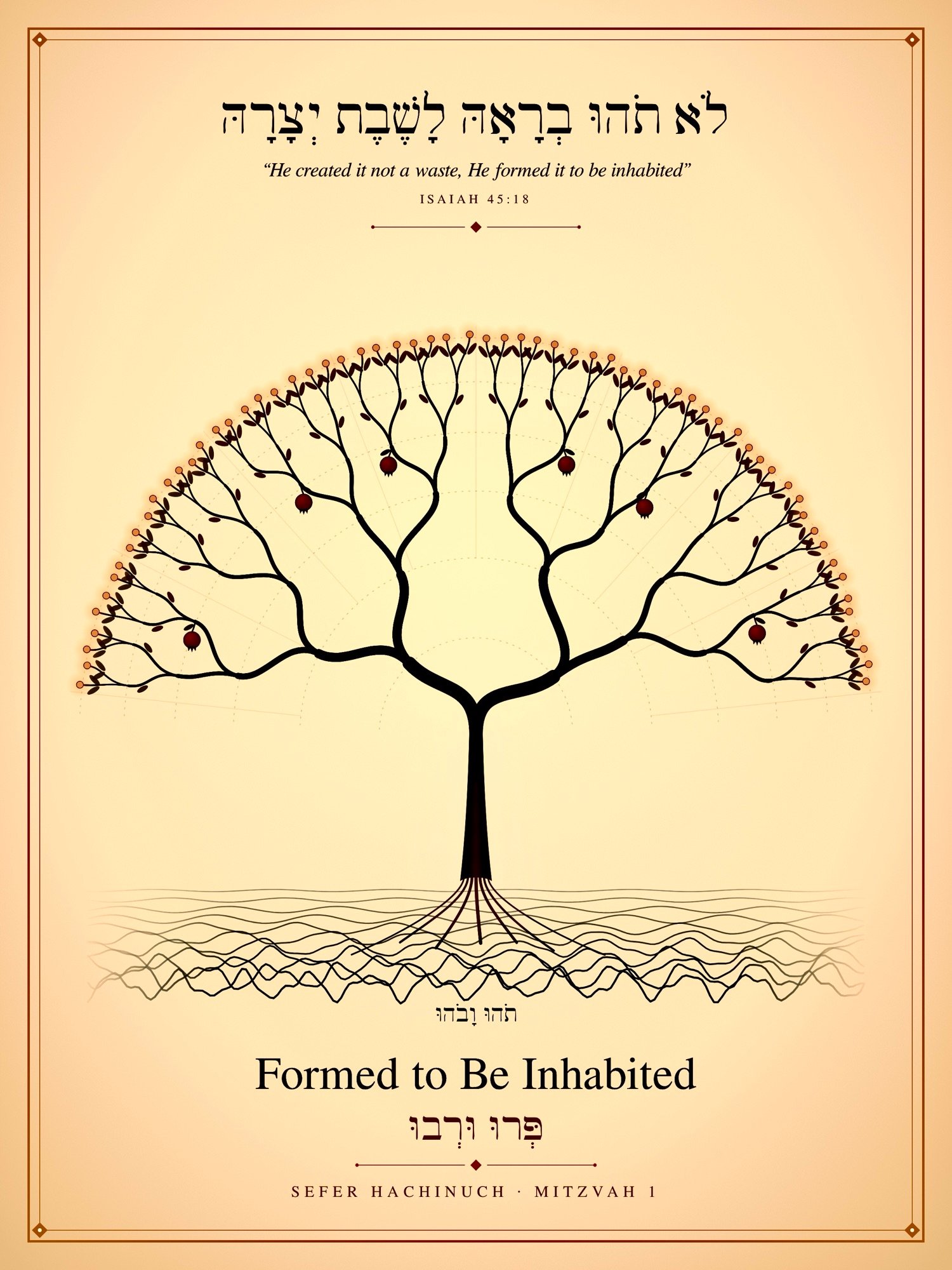
The Light of Redemption and Education: A Rabbinic Commentary on Sefer HaChinuch (The Book of Mitzvos)
Mitzvah 1
Formed to Be Inhabited: Pru U’rvu as the First Mitzvah of Sefer HaChinuch
Nov 16, 2026 · @Kamil Levi Pyka-Penner
A Note on Sources and Method
This commentary reads one mitzvah closely, and it draws on a deliberately narrow library. It uses only Sefer HaChinuch itself; the elucidation, notes and Insight of the elucidated English edition (pp. 59–62); the Minchas Chinuch as presented there; and the sources to which those pages direct the reader. Beyond the verses of Scripture themselves, nothing is brought in from outside that circle.
The Chinuch is quoted in my own Hebrew, with an original English rendering. Verses are given from the Masoretic text, in the Jewish Publication Society translation of 1917. Where the essay proposes a reading of my own rather than reporting one, it says so.
I. The First Mitzvah of the Book of Mitzvos
Sefer HaChinuch opens its count of the 613 with procreation, and the Chinuch’s own words show why that is fitting: every other mitzvah depends on this one. Because the book follows the order of the weekly parashiyos, its first mitzvah is simply the first the Torah contains. Yet his own description makes the placement seem more than an accident of sequence: he calls it מִצְוָה גְּדוֹלָה, a great mitzvah, because through it all the mitzvos come to be fulfilled in the world.
The arrangement by parashah is visible on the page itself. The Chinuch states that Bereishis contains one positive commandment, and a few lines later that the parashah of Noach contains none. The reader of the Book of Mitzvos therefore meets this mitzvah first, and meets it alone.
This commentary argues that the Chinuch’s short chapter has a coherent architecture, and that the commentators gathered around it bring that architecture into view. The root he names, G-d’s desire for an inhabited world, governs how the mitzvah is defined in halacha. Its obligation is one of effort (הִשְׁתַּדְּלוּת); its fulfillment is a standing state, living descendants; and its neglect is judged as a disclosure of the will.
The Minchas Chinuch’s analysis, that the mitzvah is to have children and not merely to produce them, is the halachic counterpart of the Chinuch’s account of purpose. In this mitzvah, structure and purpose turn out to be one.
II. The Text
The Chinuch’s chapter on this mitzvah moves in seven short steps, most of them in formulas I use throughout the book. The Hebrew below is given without vowels; the English is an original rendering.
1. The mitzvah and its verse
בראשית יש בה מצות עשה אחת, והיא מצות פריה ורביה, שנאמר (בראשית א, כח) ויברך אותם אלהים ויאמר להם אלהים פרו ורבו.
Bereishis contains one positive commandment, the mitzvah of procreation, as it is said: “And G-d blessed them; and G-d said unto them: ‘Be fruitful, and multiply'” (Bereshit 1:28).
2. The root
משרשי מצוה זו, כדי שיהיה העולם מיושב, שהשם ברוך הוא חפץ בישובו, כדכתיב (ישעיה מה, יח) לא תהו בראה לשבת יצרה.
Among the roots of this mitzvah: that the world be inhabited, for the Name, blessed be He, desires its settlement, as it is written: “He created it not a waste, He formed it to be inhabited” (Isaiah 45:18).
3. Its greatness
והיא מצוה גדולה, שבסיבתה מתקיימות כל המצוות בעולם, כי לבני אדם ניתנו ולא למלאכי השרת.
It is a great mitzvah, for by its means all the mitzvos are upheld in the world; for they were given to human beings, and not to the ministering angels.
4. Its laws
דיני המצוה, מתי חייב אדם לעסוק בה, וכמה בנים יהיה לו ויפטר, ומאיזו מצוות הוא פטור בעסקו בה, ויתר פרטיה, מבוארים ביבמות בפרק שישי (דף סא ע״ב ואילך) ובברכות (דף טז ע״א).
The laws of the mitzvah are set out in the sixth chapter of Yevamos (61b ff.) and in Berachos (16a): when a person becomes obligated to engage in it, how many children he must have to be released, from which mitzvos he is exempt while engaged in it, and the rest of its details.
5. Where, when, and from what age
ונוהגת בכל מקום ובכל זמן. וחייב אדם להשתדל בה משהוא ראוי לה, והוא הזמן שנתנו חכמים זכרונם לברכה לישא אשה.
It applies in every place and at every time. A person is obligated to strive toward it from the time he is fit for it, which is the time the Sages, of blessed memory, set for marrying a wife.
6. Who is obligated, and the sanction
ומצוה זו אינה מוטלת על הנשים, והמבטלה ביטל עשה, וענשו גדול מאד, שמראה בעצמו שאינו רוצה להשלים חפץ השם לישב עולמו.
This mitzvah is not laid upon women. One who sets it aside has annulled a positive commandment, and his punishment is very great, for he shows of himself that he does not wish to complete the desire of the Name to settle His world.
7. Coda
פרשה אלה תולדות נח אין בה מצוה.
The parashah “These are the generations of Noah” contains no mitzvah.
III. Blessing or Command: Where the Mitzvah Begins
By citing Bereshit 1:28 and counting the mitzvah in Bereishis, the Chinuch implies a position on where the command first appears. The verse is doubled: “And God blessed them; and G-d said unto them.” The edition’s first note records two readings of that doubling.
On one reading (Ohr HaChaim, and see Ramban there), G-d first blessed Adam and Chavah with fertility, then commanded them to use it. On the other, the verse is blessing alone, and the command comes only after the Flood (Rashi and Ramban to 9:7):
וְאַתֶּם פְּרוּ וּרְבוּ שִׁרְצוּ בָאָרֶץ וּרְבוּ בָהּ
“And you, be ye fruitful, and multiply; swarm in the earth, and multiply therein” (Bereshit 9:7).
In effect, the Chinuch’s order follows the first reading. Had he located the command at 9:7, this mitzvah would belong to Noach, the parashah he declares empty of mitzvos.
The same note draws a boundary. Though spoken to Adam and to Noach, the mitzvah binds Israel and is not among the Noahide laws. The nations share in the blessing to multiply, but no individual Noahide is personally commanded, while every Jew is (Aruch HaShulchan, Even HaEzer 1:5; for the criteria, Sanhedrin 59a–b).
That boundary sharpens a question. The Minchas Chinuch explains why murder and eating a limb from a living animal, though stated in Noach, are counted where they are repeated for Israel (Mitzvos 34 and 452). Procreation binds Israel alone, yet it is counted at its first appearance, in words addressed to Adam.
One may suggest that the Chinuch counts it where its root is declared. The verse he gives for that root, “He formed it to be inhabited,” speaks of the purpose of Creation, and a mitzvah whose reason is the purpose of Creation belongs in the parashah of Creation. This is offered as a reading, not as the report of any commentator.
IV. The Root: “For the Name Desires Its Settlement”
The Chinuch’s root is G-d’s desire that the world be inhabited, and his verse ties the mitzvah to the purpose of Creation itself. Three features of his wording repay attention.
The partitive. He writes מִשָּׁרְשֵׁי, “among the roots,” not “the root.” The edition’s second note recalls his Introduction: the reason he gives is a glimpse of one purpose among many, and the full depth of God’s reasons is beyond us. A single letter, the partitive mem, carries that humility. In Mitzvah 34, by contrast, where he calls the root “known and revealed to all who see the sun,” he writes שורש, without it.
The verse. Isaiah’s לֹא תֹהוּ בְרָאָהּ answers the first state of the earth in Bereshit 1:2, וְהָאָרֶץ הָיְתָה תֹהוּ וָבֹהוּ, “Now the earth was unformed and void.” The world began as tohu and was formed for habitation. On this reading, which is ours, human settlement completes the undoing of the primordial waste, and procreation is the human share in that work.
The desire. The word חֵפֶץ frames the chapter. The root speaks of the Name who חָפֵץ בְּיִשּׁוּבוֹ, desires its settlement; the sanction speaks of one who will not לְהַשְׁלִים חֵפֶץ הַשֵּׁם, complete the desire of the Name. The verb “to complete” implies that the divine desire for an inhabited world waits on human beings for its fulfillment.
The edition’s third note sends the reader to Mitzvah 34, the prohibition of murder, where the Chinuch develops this root. There he writes:
כי השם יתברך ברא העולם וצונו לפרות ולרבות כדי לישבו לפניו, ומנענו שלא נחריבהו בידינו להרוג ולאבד הבריות שהן המיישבות העולם
“For the Name, blessed be He, created the world and commanded us to be fruitful and multiply in order to settle it before Him; and He forbade us to lay it waste with our own hands, by killing and destroying the creatures who settle the world” (Sefer HaChinuch, Mitzvah 34). The positive mitzvah and the prohibition are two faces of one root: build the world’s habitation, and do not tear it down.
The Torah itself sets the two side by side in G-d’s words to Noah. The prohibition of bloodshed (Bereshit 9:6) is followed at once by “And you, be ye fruitful, and multiply” (9:7). The sugya the edition cites at Yevamos 63b draws the consequence: Rabbi Eliezer teaches that one who does not engage in procreation is as though he sheds blood, reading the two verses together.
The Rambam’s own Book of Mitzvos defines the mitzvah by its intent, to perpetuate the species (Sefer HaMitzvos, Asei 212). The Chinuch’s first root speaks in that universal register, of a world to be inhabited. His second root, to which we now turn, adds what belongs to Israel.
V. “A Great Mitzvah”: Torah Entrusted to Mortals
The Chinuch’s second root makes procreation the precondition of every other mitzvah: the Torah was given to human beings, and human beings die. His phrase is כי לבני אדם ניתנו ולא למלאכי השרת: the mitzvos were given to the children of Adam, not to the ministering angels.
The edition’s fourth note points to Shabbos 88b–89a, where Moshe answers the angels who would keep the Torah in Heaven. His reply runs through the Ten Commandments. Did you go down to Egypt? Do you have father and mother (אב ואם יש לכם)? Is there envy, or an evil inclination, among you?
The question about father and mother bears directly on our mitzvah. Angels have no parents and leave no children; the commandments presuppose beings who come from generations and pass into them. A Torah entrusted to mortals can outlive its first recipients only through their descendants. That, we suggest, is the force of the Chinuch’s claim that through this mitzvah all the mitzvos are upheld in the world.
The second root may also explain the boundary drawn in the edition’s first note. The blessing to multiply rests on all humanity, but the obligation rests on Israel. If the mitzvah’s greatness lies in bringing forth those who will keep the 613, the duty falls on those to whom the 613 were given. This too is offered as a reading.
Halacha gives the mitzvah’s greatness a concrete measure. Selling a Sefer Torah is generally forbidden, yet one who lacks the means to marry may sell one for that purpose (Shulchan Aruch, Even HaEzer 1:2, 8). The only other permitted purposes are Torah study and the redemption of captives (Shulchan Aruch and Rama, Yoreh De’ah 270:1).
Each exception serves the scroll’s own end: the learning of what is written in it, the lives of those who keep it, and the coming into the world of those who will read it. The parchment yields to the people for whom it was written. The edition also directs the reader to Tosafos at Chagigah 2b, under the heading לא תהו, a discussion keyed to the very verse the Chinuch chose for his root, and to Tosafos at Bava Basra 13a.
VI. The Laws: Time, Measure, Precedence
The Chinuch defines the mitzvah by three questions (when, how many, and what it displaces), and his verb for the obligation is “to strive.” He poses the questions and sends the reader to Yevamos and Berachos for the answers, which the edition’s notes supply:
The Chinuch’s question
The law, as the edition’s notes give it
Sources cited
מתי חייב: from when is one obligated?
Obligation in mitzvos begins at 13, but the Sages set marriage at 18, for strength, maturity, and undisturbed Torah study first; later authorities discuss deferral beyond 18
Avos 5:21; Rambam, Ishus 15:2; Chelkas Mechokeik and Pischei Teshuvah, Even HaEzer 1:2; Even HaEzer 1:3–4; Aruch HaShulchan there, 11–13
כמה בנים: how many children?
A son and a daughter fulfill the Biblical obligation. If they die in the father’s lifetime, it returns; a son and a daughter who each leave a child can count through the grandchildren. The Sages require continuing beyond the minimum
Yevamos 61b, 62b; Rambam, Ishus 15:4, 5, 16; Aruch HaShulchan, Even HaEzer 1:16; Rashi, Beitzah 37a
מאיזו מצוות פטור: what does it displace?
A groom is exempt from the Shema on his wedding night, his mind being occupied with the mitzvah. Many rule that this lapsed once concentration in the Shema weakened generally
Berachos 16a; Rambam’s Commentary there; Sefer HaMitzvos, Asei 212; Shulchan Aruch, Orach Chaim 70:3
Two details deserve comment. The Mishnah’s בן שמונה עשרה לחופה (Avos 5:21) places marriage after the years of learning, so the first mitzvah of the book waits on Torah study. And the Rambam’s teaching that one who adds a single soul to Israel is כאילו בנה עולם, as though he built a world (Ishus 15:16), restates the Chinuch’s root at the scale of one child.
The Chinuch’s verb is the heart of this section. He does not write that a person is obligated to fulfill the mitzvah, but חייב אדם להשתדל בה, obligated to strive in it. The edition explains that fulfillment is not in a person’s control, since many factors can prevent children; yet effort may not be suspended until the mitzvah is fulfilled (Even HaEzer 76:6; Beis Shmuel 1:1).
The obligation, then, is to effort, while the fulfillment is a result. The next section shows what kind of result it is. Its scope is unlimited: the mitzvah applies in every place and at every time, in the Land and in the Diaspora, with the Beis HaMikdash standing or not (note 9).
VII. Having, Not Merely Begetting: The Minchas Chinuch’s Analysis
The Minchas Chinuch shows that this mitzvah is fulfilled by a standing state, living children, rather than by a completed act. He reaches this through a case at the edge of the law: the convert.
The case. A man who fathered children while an idolater and then converted has fulfilled the mitzvah through those children. Some require that the children also convert, but even then they count, though he begot them before he was obligated (Even HaEzer 1:7, with Beis Shmuel 12 and Beur HaGra). This follows Rabbi Yochanan at Yevamos 62a: he has fulfilled, because he has children. Reish Lakish disagrees, for גר שנתגייר כקטן שנולד דמי, a convert is like a newborn child.
The difficulty. The Turei Even (Rosh Hashanah 28a) asks how this can be. As an idolater the man was exempt, since the mitzvah binds Israel alone, and an act performed while exempt does not count once one becomes obligated. One who ate matzah or took a lulav during a bout of insanity must do so again on recovering (see Rosh Hashanah 28a).
The answer. The Minchas Chinuch (on this mitzvah, §14) distinguishes two kinds of mitzvah. Matzah and lulav consist of an act; once it is done, nothing of it remains, so an act done while exempt cannot serve later. Procreation is fulfilled not by the act of begetting but by having living children. The proof is the law that if one’s children die, the mitzvah is not fulfilled unless they left children of their own.
The convert therefore fulfills the mitzvah not through what he did as an idolater, but through the offspring he has now, as a Jew: offspring, in the edition’s words, “whose lineage is traced to him.”
Matzah, lulav
Procreation (Minchas Chinuch)
What fulfills the mitzvah
Completing the act
Having living offspring
After fulfillment
Nothing of the act remains
The fulfillment lasts as long as the children live
Performed while exempt
Does not count; must be repeated
Counts, if the children are living and are his when he becomes obligated
Later events
Irrelevant
The children’s death reopens the obligation, unless grandchildren survive
The Talmudic root of the analysis. The same daf in Yevamos holds the source of this conception. Rav Huna rules that one whose children died has fulfilled the mitzvah, in line with Rav Asi’s teaching that the son of David will not come until the souls in the guf, the treasury of souls, are exhausted. Rabbi Yochanan rules that he has not, because the mitzvah requires לָשֶׁבֶת יְצָרָהּ, and with the children gone the world is not inhabited by them (Yevamos 62a–b).
Here the threads meet. Rav Huna measures the mitzvah by souls brought into the world, an event complete at birth. Rabbi Yochanan measures it by the world’s habitation, a state that must persist. The law as the edition’s sixth note records it accords with Rabbi Yochanan, and his verse is the very verse the Chinuch chose for his root. The Minchas Chinuch’s analysis is that root, worked out as law.
The extension. Rabbi Moshe Feinstein draws a further consequence (Igros Moshe, Even HaEzer V, §19:7, as cited in the Insight). If the mitzvah is unfulfilled when children die, it obligates a parent not only to produce children but to raise and sustain them, so that they live. He suggests this belongs to the Biblical obligation itself, until the children can provide for themselves, physically and financially.
Once fulfillment is a state, the obligation reaches to sustaining that state. Rabbi Feinstein speaks of bodily and material support; the Chinuch’s second root points further still. The children through whom all the mitzvos are upheld must become people who keep them, and that is the work of chinuch, the word this book took for its name. This last step is our reading, not Rabbi Feinstein’s.
The mitzvah thus has three layers, and the Chinuch’s chapter names all three:
- The obligation is effort: חייב אדם להשתדל בה.
- The act is begetting: the means, not the measure.
- The fulfillment is a living lineage, the world’s habitation in small: כדי שיהיה העולם מיושב.
VIII. “Not Incumbent on Women”
The Chinuch states without elaboration that the mitzvah is not laid upon women, and the edition’s notes show that the exemption concerns the commandment, not women’s share in what it achieves.
The exemption is an exception. Women are obligated in most positive mitzvos that are not bound to a time (Kiddushin 29a), and procreation is bound to no time. Its Scriptural source is given at Yevamos 65b, where the Mishnah records a dissent that touches the Chinuch’s own verse:
האיש מצווה על פריה ורביה, אבל לא האשה. רבי יוחנן בן ברוקה אומר: על שניהם הוא אומר, ויברך אותם אלהים ויאמר להם אלהים פרו ורבו.
“The man is commanded concerning procreation, but not the woman. Rabbi Yochanan ben Beroka says: of both of them it says, ‘And God blessed them; and G-d said unto them: Be fruitful, and multiply.'” The Chinuch quotes that plural verse, yet rules with the first Tanna. The Gemara there derives the exclusion from a later word in the same verse, וְכִבְשֻׁהָ, “and subdue it”: איש דרכו לכבוש, ואין אשה דרכה לכבוש.
Women nonetheless perform a mitzvah when they marry and bear children (note 11). The commandment cannot be carried out without them, and through them G-d’s desire that the world be inhabited is fulfilled (Ran on the Rif, Kiddushin 16a–b; Beis Shmuel, Even HaEzer 1:2). They are also included in the blessing given to Adam and Chavah.
The notes record two explanations for the exemption. The Aruch HaShulchan (Even HaEzer 1:2) holds that G-d placed in women an innate desire for children, so that no command was needed. The Meshech Chochmah (Bereshit 9:7) observes that pregnancy and birth carry danger, and the Torah does not impose an obligation that may endanger life.
The distinction drawn in the previous section clarifies the law. Women are exempt from the obligation, the commanded effort. The fulfillment the mitzvah seeks, the habitation of the world, is achieved by both parents together. On this reading, which is ours, the exemption and women’s share in the mitzvah do not conflict: they stand outside the command and fully inside the Chinuch’s root.
IX. The Sanction: A Disclosure of the Will
The Chinuch grounds the gravity of the punishment not in the act omitted but in what the omission reveals: that one does not wish to complete God’s desire. His words are שמראה בעצמו, “for he shows of himself.” The refusal is a statement, and its object is the same חפץ השם named in the root.
Hezekiah. The edition’s twelfth note brings the case that tests this principle (Berachos 10a). Isaiah came to the ailing king with the word of G-d:
כִּי מֵת אַתָּה וְלֹא תִחְיֶה
“For thou shalt die, and not live” (Isaiah 38:1). The Gemara reads the doubling as death in this world and loss of the World to Come. The cause: Hezekiah had refrained from procreation, because he foresaw in the holy spirit that his offspring would be wicked.
The prophet’s reply, in the Gemara’s Aramaic, is the sharpest gloss on the Chinuch’s sanction: בהדי כבשי דרחמנא למה לך? מאי דמפקדת איבעי לך למעבד, ומה דניחא קמיה קודשא בריך הוא לעביד. “Why concern yourself with the hidden counsels of the Merciful One? What you were commanded, you should have done; and what is pleasing before the Holy One, blessed be He, let Him do.” Hezekiah repented, and his life was spared.
Even a pious refusal, grounded in prophetic foresight, falls under the Chinuch’s words. The obligation is effort, the outcome belongs to Heaven, and a prediction about the outcome does not suspend the effort. Hezekiah’s case and the verb להשתדל explain each other.
A rabbinical corollary. Because the Chinuch locates the gravity in the will, his term המבטלה, “one who sets it aside,” does not describe the person who strives and is not granted children. The law still asks that effort not be suspended (Even HaEzer 76:6), but the sanction he describes falls on refusal, not on a failure that is not one’s own. This is our inference from his wording, and it may matter to rabbis guiding couples who wait for children.
The Shechinah. The edition’s thirteenth note adds the communal dimension (Yevamos 63b–64a; Shulchan Aruch, Even HaEzer 1:1). The Gemara teaches that the Shechinah does not rest on fewer than twenty-two thousand of Israel, from שׁוּבָה ה׳ רִבְבוֹת אַלְפֵי יִשְׂרָאֵל (Bamidbar 10:36): ten-thousands and thousands, at least two of each. Were Israel one short of that number, the one who did not engage in procreation would be the cause of the Shechinah’s departure.
In Mitzvah 34 the Chinuch wrote that G-d commanded procreation לישבו לפניו, to settle the world before Him. The Gemara’s teaching gives that phrase a communal sense: a populated Israel is the dwelling the Shechinah requires. The individual’s will touches the sanctity of the whole people.
X. Coda: “These Are the Generations of Noah”
The Chinuch’s next line, that Parashas Noach contains no mitzvah, completes the argument of Mitzvah 1 in its own way. The Minchas Chinuch addresses the apparent exceptions (note 14). Murder and eating a limb from a living animal appear in Noach (Bereshit 9:4–6), but as commands to Noah’s descendants. They are repeated for Israel (Shemot 20:13; Devarim 12:23; see Sanhedrin 59a), and the Chinuch counts them there, as Mitzvos 34 and 452.
The chapter after the Flood therefore yields no mitzvah of its own, though its verses join the two themes this essay has followed. The prohibition of bloodshed and the renewed “be ye fruitful, and multiply” stand side by side (9:6–7). The Chinuch counts the one at Sinai and the other at Creation, then joins them again in the root of Mitzvah 34.
A closing reflection, offered as such. The Chinuch names the parashah by its opening words, אֵלֶּה תּוֹלְדֹת נֹחַ, “These are the generations of Noah” (Bereshit 6:9). The mitzvah of Bereishis is fulfilled in toldos, in generations that live. The parashah that follows bears that word in its name and records a world repopulated from one family. It holds no mitzvah, but it shows what the first one is for.
XI. Conclusion
Mitzvah 1 of Sefer HaChinuch is a mitzvah of continuity at every level: its root, its law, and its sanction.
- Root. G-d desires an inhabited world, and the Torah was given to mortals who must be followed by others (Isaiah 45:18; Shabbos 88b–89a).
- Obligation. The duty is to strive, from the age the Sages set, in every place and time; the outcome is Heaven’s (Even HaEzer 76:6).
- Fulfillment. The mitzvah is fulfilled by living offspring, not by an act, as the Minchas Chinuch shows and as Rabbi Yochanan’s לשבת יצרה requires (Yevamos 62a–b).
- Scope. Fulfillment as a state implies sustaining the children until they stand on their own (Igros Moshe).
- Persons. Women stand outside the command and inside its purpose (Yevamos 65b; Beis Shmuel, Even HaEzer 1:2).
- Sanction. Refusal discloses a will opposed to G-d’s desire, as Hezekiah learned, and touches the Shechinah’s dwelling in Israel (Berachos 10a; Yevamos 64a).
One verse runs through all of it. The Chinuch chose לֹא תֹהוּ בְרָאָהּ לָשֶׁבֶת יְצָרָהּ to explain why the mitzvah exists. The Gemara uses the same words to decide when it has been fulfilled, and the Minchas Chinuch turns that decision into a definition. Reason and rule coincide.
The Book of Mitzvos begins, fittingly, with the mitzvah that makes possible a reader for every page that follows.
Questions for Further Study
For shiur, chavrusa, or seminar:
- Murder and eating a limb from a living animal are counted where they are repeated for Israel (note 14). Why is procreation, which binds Israel alone, counted at a command addressed to Adam?
- If fulfillment is a standing state, does a father whose children died lose a fulfilled mitzvah, or was his fulfillment never complete? How does the rule of grandchildren (Yevamos 62b) bear on the answer?
- On Reish Lakish’s view that a convert is like a newborn, does the Minchas Chinuch’s analysis still hold? Is the dispute about the nature of the mitzvah, or about the convert’s ties of lineage?
- Does Rabbi Feinstein’s extension imply that a father who abandons his children breaches the Biblical mitzvah itself, and not only a duty of support?
- The Chinuch rests the sanction on the will. How should that shape guidance to couples who strive without being granted children?
- The Rambam defines the mitzvah by its intent to perpetuate the species (Sefer HaMitzvos, Asei 212); the Chinuch, by G-d’s desire for an inhabited world and by the mitzvos that only human beings keep. What does each emphasis explain that the other does not?
Sources
Every source below is Sefer HaChinuch itself, the edition’s apparatus, or a work those pages cite. Verses are quoted from the Masoretic text in the JPS 1917 translation.
- Sefer HaChinuch: Mitzvah 1; Mitzvah 34 (its root); Mitzvah 452 (via note 14); the Introduction (via note 2).
- On the Chinuch: Minchas Chinuch on Mitzvah 1, §14, and on Parashas Noach (via note 14); the elucidated English edition, pp. 59–62, notes 1–14 and the Insight.
- Scripture: Bereshit 1:2, 1:28, 6:9, 9:4–7; Shemot 20:13; Bamidbar 10:36; Devarim 12:23; Isaiah 38:1, 45:18.
- Mishnah and Talmud: Avos 5:21; Berachos 10a, 16a–b; Shabbos 88b–89a; Rosh Hashanah 28a; Chagigah 2b (Tosafos, s.v. לא תהו); Yevamos 61b–66a, especially 62a–b, 63b–64a, 65b; Kiddushin 29a; Bava Basra 13a (Tosafos, s.v. שנאמר); Beitzah 37a (Rashi); Sanhedrin 59a–b.
- On the Torah: Rashi, Ramban, and Ohr HaChaim on Genesis 1:28 and 9:7; Meshech Chochmah on Bereshit 9:7.
- Rambam: Sefer HaMitzvos, Asei 212; Commentary on the Mishnah, Berachos; Mishneh Torah, Hilchos Ishus 15:2, 4, 5, 16.
- Shulchan Aruch and its commentators: Even HaEzer 1:1, 1:2, 8, 1:3–4, 1:7, 76:6; Orach Chaim 70:3; Yoreh De’ah 270:1 with Rama; Beis Shmuel, Chelkas Mechokeik, Pischei Teshuvah, and Beur HaGra on Even HaEzer 1; Aruch HaShulchan, Even HaEzer 1:2, 5, 11–13, 16.
- Later authorities: Ran on the Rif, Kiddushin 16a–b; Turei Even, Rosh Hashanah 28a; Igros Moshe, Even HaEzer V, §19:7.