
The Light of Redemption and Education: A Rabbinic Commentary on Sefer HaChinuch (The Book of Mitzvos)
Mitzvah 3
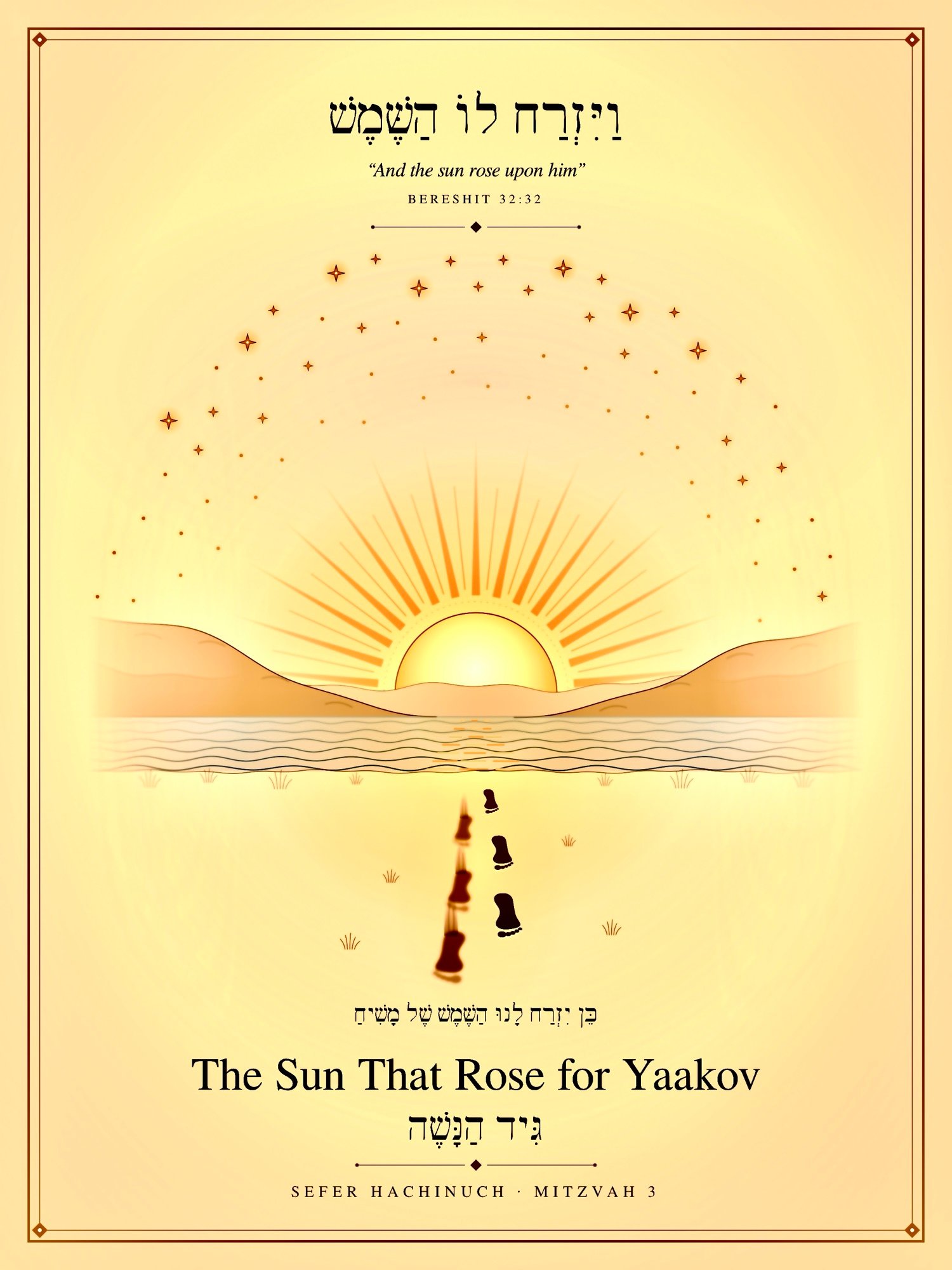
The Sun That Rose for Yaakov: Gid HaNasheh, the Third Mitzvah of Sefer HaChinuch
Nov 17, 2026 · @Kamil Levi Pyka-Penner
A commentary on Mitzvah 3, שֶׁלֹּא לֶאֱכֹל גִּיד הַנָּשֶׁה: its text, its root, its laws, and its place at the close of Sefer Bereshit as the third in a series with the commentaries on Mitzvos 1 and 2.
A Note on Sources and Method
This commentary keeps to the same narrow library as its companions. It draws only on Sefer HaChinuch itself; the elucidation, notes and Insight of the elucidated English edition (pp. 75–78); and the sources to which those pages direct the reader. Beyond the verses of Scripture themselves, nothing is brought in from outside that circle.
The Chinuch is quoted in his own Hebrew, with an original English rendering. Verses are given from the Masoretic text, in the Jewish Publication Society translation of 1917. Where the commentary offers a reading of its own rather than reporting one, it says so.
I. The Third Mitzvah and the Close of Bereshit
The prohibition of the gid ha-nasheh is the last mitzvah of Sefer Bereshit, and in the Chinuch’s hands it becomes a promise: Yaakov’s descendants will not perish. The angel who wrestled with Yaakov, he writes, sought to uproot him from the world, הוא וזרעו, him and his seed. He could not, and could only wound his thigh. The mitzvah keeps that wound in memory so that Israel keeps the promise in mind.
The place of the wound matters. In the Torah’s own idiom the thigh is the source of descendants: וַיְהִי כָּל נֶפֶשׁ יֹצְאֵי יֶרֶךְ יַעֲקֹב שִׁבְעִים נָפֶשׁ, “And all the souls that came out of the loins of Jacob were seventy souls” (Shemot 1:5). The same words, יֶרֶךְ יַעֲקֹב, name the place the angel struck (Bereshit 32:26, 33). On this reading, which is ours, the angel aimed at the seed, and the mitzvah answers him at the very place he aimed.
Read in sequence, the three mitzvos of Bereshit form one movement. The first brings the generations into the world; the second seals them into the covenant; the third assures them that they will endure. Each concerns the body and its descendants, and each is tied to a figure of Bereshit: Adam, Avraham, Yaakov. This commentary follows that thread through the Chinuch’s chapter, its laws, and the edition’s notes.
II. The Text
The Chinuch’s chapter on the gid ha-nasheh moves in seven steps, and its root is the longest of the three chapters of Bereshit. The Hebrew is given without vowels; the English is an original rendering.
1. The prohibition and its verse
וישלח יעקב יש בה מצות לא תעשה אחת, והיא אזהרת גיד הנשה, שנאמר (בראשית לב, לג) על כן לא יאכלו בני ישראל את גיד הנשה.
Vayishlach contains one negative commandment, the prohibition of the gid ha-nasheh, as it is said: “Therefore the children of Israel eat not the sinew of the thigh-vein” (Bereshit 32:33).
2. Command, not narrative
והאי לא יאכלו לא נאמר על דרך סיפור, כלומר מפני שארע דבר זה באב נמנעים הבנים מלאכול אותו הגיד, אלא אזהרת השם יתברך שלא יאכלוהו.
This “lo yochelu” is not said by way of narrative, as though to say that because this happened to the father, the children refrain from eating that sinew. It is a warning of the Name, blessed be He, that they not eat it.
3. The root
משרשי מצוה זו, כדי שתהיה רמז לישראל שאף על פי שיסבלו צרות רבות בגליות מיד העמים ומיד בני עשו, שיהיו בטוחים שלא יאבדו, אלא לעולם יעמוד זרעם ושמם, ויבא להם גואל ויגאלם מיד צר. ובזכרם תמיד עניין זה על יד המצוה שתהיה לזכרון, יעמדו באמונתם ובצדקתם לעולם.
Among the roots of this mitzvah: that it be an allusion for Israel, that though they suffer many troubles in their exiles at the hands of the nations and of the children of Esav, they may be confident that they will not perish. Their seed and their name will stand forever, and a redeemer will come to them and redeem them from the hand of the oppressor. And by remembering this always through the mitzvah, which serves as a remembrance, they will stand firm in their faith and their righteousness forever.
4. The allusion explained
ורמז זה הוא לפי שאותו מלאך שנלחם עם יעקב אבינו, שבא בקבלה שהיה שרו של עשו, רצה לעקרו ליעקב מן העולם הוא וזרעו ולא יכל לו, וצערו בנגיעת הירך, וכן זרע עשו מצער לזרע יעקב, ולבסוף תהיה להם ישועה מהם, כמו שמצינו באב שזרחה לו השמש לרפואתו ונושע מן הצער, כן יזרח לנו השמש של משיח וירפאנו מצערנו ויגאלנו, אמן במהרה בימינו.
The allusion lies in this. The angel who fought with Yaakov our father, who by tradition was the guardian angel of Esav, wished to uproot Yaakov from the world, him and his seed. He could not prevail against him, so he pained him by striking the thigh. So too the seed of Esav pains the seed of Yaakov, and in the end they will have salvation from them. As we find with the father, that the sun rose for him to heal him and he was saved from his pain, so the sun of Mashiach will rise for us, heal us of our pain, and redeem us. Amen, speedily in our days.
5. The laws
דיני המצוה, מהו הגיד האסור, והחיטוט שאנו חייבים לחטט אחריו, ובאי זו בהמה נוהג, ומי נאמן על ניקורו, ויתר פרטיה, מבוארים בפרק שביעי מחולין (דף פט ע״ב).
The laws of the mitzvah are set out in the seventh chapter of Chullin (89b): what the forbidden sinew is, the digging we are obliged to do after it, in which animals it applies, who is trusted to remove it, and the rest of its details.
6. Where, when, who, and the penalty
ונוהגת מצוה זו בכל מקום ובכל זמן, בזכרים ובנקבות. ועובר עליה ואכל גיד אחד, אפילו הוא פחות מכזית, או שאכל כזית מגיד הנשה גדול, לוקה.
This mitzvah applies in every place and at every time, to men and to women. One who transgresses it and eats a whole sinew, even if it is less than an olive’s bulk, or eats an olive’s bulk of a large gid ha-nasheh, is lashed.
7. Coda
פרשת וישב יעקב, ופרשת ויהי מקץ, ופרשת ויגש אליו, ופרשת ויחי יעקב, אין בהן מצוות. נשלם ספר בראשית, תהלה לאל.
Vayeishev, Mikeitz, Vayigash and Vayechi contain no mitzvos. Sefer Bereshit is complete; praise to G-d.
III. Command, Not Narrative
The Chinuch opens with a question of reading, and the answer decides what kind of mitzvah this is. The words לא יאכלו could describe a custom: because this happened to the father, the children do not eat the sinew. The Chinuch rejects that reading. The words are אזהרת השם יתברך, a warning of the Name.
The question is not idle. The JPS translation of 1917, the Jewish rendering this commentary follows, has the children of Israel “eat not” the sinew. That is a description, the very reading the Chinuch sets aside; with him, the verse must be heard as a command.
The edition’s first note gives the ground (Mishnah, Chullin 100b, as Rashi reads it; compare the Rambam’s commentary there). The closing verse is not part of the story of Yaakov’s struggle. It is a prohibition given at Sinai, which Moshe was told to write beside the story that is its basis.
The Mishnah records the dispute behind this. Rabbi Yehudah applies the prohibition even to non-kosher animals, since the sinew was forbidden to Yaakov’s sons when such animals were still permitted to them: והלא מבני יעקב נאסר גיד הנשה, ועדיין בהמה טמאה מותרת להן. The Sages answer that it was forbidden at Sinai and only written in its place. The law follows the Sages: the prohibition does not apply to non-kosher species (note 7; Rambam, Hilchos Maachalos Asuros 8:1, 5).
The Rambam draws a general rule from this Mishnah. Whatever we observe or avoid today, we do because of G-d’s command through Moshe, not because it was told to earlier prophets. Two of his examples are the mitzvos of this series. We do not circumcise because Avraham circumcised himself, but because we were commanded through Moshe to circumcise as he did; וכן גיד הנשה, אין אנו הולכים אחר איסור יעקב אבינו, אלא מצות משה רבינו.
The order of the book. The Sages’ formula, forbidden at Sinai and written in its place, may also explain the Chinuch’s arrangement. He counts each of the first three mitzvos where the Torah writes it, beside the story of its origin, though its force comes from Sinai. The prohibitions of murder and of a limb from a living animal are different: Parashas Noach records them as commands to all humanity, and the Chinuch counts them where they are restated for Israel (commentary on Mitzvah 1, section III).
On this reading, which is ours, the question left open in the first commentary has an answer. The Chinuch counts a mitzvah where the Torah writes Israel’s command, and for the three mitzvos of Bereshit that place is the narrative itself.
IV. The Root: A Sign That They Will Not Perish
The Chinuch’s root is a promise carried in a prohibition: the mitzvah is a רמז, an allusion, that Israel will survive its exiles. He speaks of exiles in the plural, at the hands of the nations and above all of the children of Esav. Through all of them, Israel may be confident שלא יאבדו, that they will not perish.
A memory kept by abstaining. The mitzvah serves לזכרון, as a remembrance, and the remembering is to be תמיד, constant. Most commemorations are acts; this one is an absence. On our reading, every meal of meat from which the sinew has been removed renews the reminder without a word being said.
Seed and name. What endures is twofold: לעולם יעמוד זרעם ושמם, their seed and their name will stand forever (note 2: literally, “their name”). The name was given on that very night: “Thy name shall be called no more Jacob, but Israel; for thou hast striven with G-d and with men, and hast prevailed” (Bereshit 32:29). The Chinuch does not draw the connection, but his “name” sits naturally beside the night on which Yaakov received his.
Standing. The verb returns at the end of the root: יעמדו באמונתם ובצדקתם לעולם, they will stand firm in their faith and their righteousness forever. On our reading the two clauses mirror each other. The seed stands because the promise stands, and the people stand in faith because they remember it. The mitzvah turns a promise about Israel’s survival into a discipline of Israel’s faith.
The angel and the seed. The Chinuch explains the allusion through the struggle itself. The angel, by tradition Esav’s guardian angel (שבא בקבלה; note 3, Bereishis Rabbah 77:3, cited by Rashi to verse 25), wished to uproot Yaakov הוא וזרעו, him and his seed. He could not, and could only pain him at the thigh. The pattern then repeats across history: the seed of Esav pains the seed of Yaakov, and in the end Yaakov’s seed is saved.
The Chinuch marks the angel’s identity as received tradition, בקבלה, not as his own inference. And the angel’s aim, as he states it, matches the wound’s place. The Torah calls Yaakov’s descendants those who came out of his ירך, his thigh or loins (Bereshit 46:26; Shemot 1:5). The blow fell where the seed comes from, and the seed came out of it whole.
V. The Sun of Healing
The Chinuch’s root ends not in an argument but in a prayer: as the sun rose to heal the father, so the sun of Mashiach will rise to heal his children. The verse he builds on closes the night of the struggle:
וַיִּזְרַח לוֹ הַשֶּׁמֶשׁ כַּאֲשֶׁר עָבַר אֶת פְּנוּאֵל וְהוּא צֹלֵעַ עַל יְרֵכוֹ
“And the sun rose upon him as he passed over Peniel, and he limped upon his thigh” (Bereshit 32:32).
One sun, two effects. The edition’s fourth note brings the Midrash on these words (Bereishis Rabbah 78:5). The sun healed Yaakov and scorched Esav and his chiefs, and G-d told Yaakov that he was a sign for his descendants: as the sun healed him and scorched Esav, so it will heal his children and scorch the idolatrous nations. The note observes that the Chinuch seems to read this as the sun of Mashiach, and points to Nedarim 8b.
That passage carries the image to its end. In the time to come the sun itself brings judgment to the wicked and healing to the righteous, as it is written: וְזָרְחָה לָכֶם יִרְאֵי שְׁמִי שֶׁמֶשׁ צְדָקָה וּמַרְפֵּא בִּכְנָפֶיהָ, “But unto you that fear My name shall the sun of righteousness arise with healing in its wings” (Malachi 3:20). The verb זרח links the three texts: the sun that rose for Yaakov, the Chinuch’s כן יזרח לנו השמש של משיח, and Malachi’s sun of righteousness. The link is our observation.
Whole at Shechem. The same note cites the Ramban (to verse 26). The first verse after the encounter with Esav reads וַיָּבֹא יַעֲקֹב שָׁלֵם עִיר שְׁכֶם (Bereshit 33:18). The JPS translation has Yaakov come “in peace”; the Ramban, as the edition presents him, hears that he arrived whole. This too, he says, foretells that Yaakov’s descendants will survive their encounters with Esav’s and be whole at the End of Days.
The word of the root. One word recurs four times in this passage of the Chinuch: צער, pain. The angel pained Yaakov (וצערו); Esav’s seed pains Yaakov’s (מצער); the father was saved from the pain (מן הצער); the sun of Mashiach will heal us מצערנו, from our pain. The root names the wound plainly before it names the cure.
A root that ends in prayer. Neither of the two preceding roots closes this way. Here the Chinuch leaves exposition and writes אמן במהרה בימינו, “Amen, speedily in our days.” The reason for the mitzvah becomes the reader’s own prayer, and the remembrance the mitzvah keeps becomes hope.
VI. The Laws: Precision and Trust
The laws the Chinuch lists answer four questions: which sinew, how far one must dig after it, which animals it governs, and whom one may trust to remove it. He sends the reader to the seventh chapter of Chullin (89b ff.); the edition adds the codification in Shulchan Aruch, Yoreh De’ah 65:5–14 (note 9).
The Chinuch’s question
The law, as the edition’s notes give it
Sources cited
מהו הגיד האסור: which sinew?
The sciatic nerve, which passes over the rounded flesh of the thigh, the “spoon” (כף הירך), and branches through it. A second sinew is forbidden rabbinically: in Ashkenazi tradition the femoral nerve, in Yemenite tradition the peroneal. It is disputed whether the Torah forbids the whole sinew or only the part on the “spoon.” Both hind legs are included
Chullin 91a, 96a–b; Mishnah, Chullin 89b; Yoreh De’ah 65:8–9
החיטוט: how far must one dig?
The sinew’s branches and their fat, deep in the muscle, are forbidden rabbinically, so the meat may be eaten only after they are dug out. Because this is so difficult, many communities refrain from the hindquarters altogether
Chullin 92b; Yoreh De’ah 65; Aruch HaShulchan, Yoreh De’ah 65:30–31
באי זו בהמה: which animals?
All kosher animals, domestic and wild; not non-kosher species; generally not fowl, which have no rounded “spoon”
Mishnah, Chullin 89b; Rambam, Maachalos Asuros 8:1, 5; Chullin 100b; compare Bahag; Yoreh De’ah 65:5–7
מי נאמן על ניקורו: who is trusted?
Even where removal is relied on, only a recognized, pious and expertly trained person may perform it
Yoreh De’ah 65:13–14; Aruch HaShulchan there, 30–31
The law keeps the shape of the story. The forbidden sinew is defined by the place the angel touched, כף הירך, the hollow of the thigh. A bird has no such rounded flesh, and so the prohibition generally does not reach it. On our reading, the halacha preserves the anatomy of the narrative: the remembrance is bound to the exact place of the wound.
Memory that must be searched out. The Chinuch’s word for the removal is חיטוט, digging. The forbidden branches lie hidden in the flesh and must be sought out one by one; many communities, rather than risk failure, refrain from the hindquarters entirely. A remembrance kept this way is not passive. It requires search.
A mitzvah that rests on trust. The Chinuch counts among the laws the question of who is believed regarding the removal. Those who eat cannot see what was taken out; they rely on the one who prepared the meat. The edition’s demand for a recognized, pious and expertly trained person is therefore no formality. In this mitzvah, the faithfulness of a whole community passes through the integrity of one craftsman.
VII. Measure and Wholeness
The Chinuch applies the prohibition to everyone, everywhere, and he measures the offense by wholeness rather than size. It holds in every place and at every time, in the Land and in the Diaspora, with the Beis HaMikdash standing or not (note 10). It binds men and women alike, by the general rule that Biblical prohibitions apply equally to both (note 11).
The series’ first two mitzvos were not laid upon women; the third binds the whole people. On our reading this fits its root. The promise that Israel will not perish belongs to all of Israel, and so does the remembrance that keeps it.
A whole sinew is a creation. Ordinarily one is lashed for a Biblically forbidden food only for an olive’s bulk. One who eats an entire forbidden בריה, a whole creature such as an insect, is lashed even for less (note 12; Mishnah, Makkos 13a). A whole gid ha-nasheh counts as such a creature, so eating it carries lashes whatever its size (Mishnah, Chullin 96a). Hence the Chinuch’s two cases: a whole sinew, even below an olive’s bulk, or an olive’s bulk from a large one.
The edition’s thirteenth note sets out the lesser degrees:
- Eating the Biblically forbidden sinew, whole or an olive’s bulk of it, carries malkus.
- Eating less than an olive’s bulk carries no lashes but is still a Biblical violation (Yoma 73b; Rambam, Hilchos Shevisas Asor 2:3).
- Eating the rabbinically forbidden parts, the branches, the fat or the second sinew, carries only the rabbinic lashes of discipline, מכת מרדות (Rambam, Hilchos Maachalos Asuros 8:1–2; see Mitzvah 12, note 9).
On our reading the law’s measure echoes the narrative. The sinew is judged by its wholeness, and the Torah’s first word on Yaakov after the struggle is that he arrived שָׁלֵם, whole (Bereshit 33:18).
VIII. Two Readings of the Limp: The Chinuch and Rav Hirsch
The edition’s Insight sets beside the Chinuch the explanation of Rabbi Samson Raphael Hirsch (Commentary to Bereshit 32:33), which it calls somewhat different. Both begin from the same wound and arrive at Israel’s survival in exile; they differ on what the wound teaches.
The Chinuch
Rav Hirsch, as the Insight presents him
What the sinew marks
The place where Esav’s angel pained Yaakov, having failed to uproot him and his seed
Physical strength and self-reliance: the sinew that lets a man stand erect and walk unaided
What the limp foretells
Esav’s seed will pain Yaakov’s through the exiles
Israel will “limp” through history, without material power among the nations
How Israel survives
By promise: seed and name endure, a redeemer comes, the sun of Mashiach heals
By G-d’s protection, recognized precisely in weakness
What refraining does
Keeps the promise in constant memory, so Israel stands firm in faith and righteousness
Forgoes the symbol of physical strength, leaving prowess to Esav, who lives “by the sword” (Bereshit 27:40)
Its verses
Bereshit 32:32; 33:18 (with the Ramban)
Bereshit 32:29; 27:40; Tehillim 20:8
Its horizon
The future: redemption
The present: reliance on Providence
Where they meet. For Rav Hirsch, Yaakov prevailed precisely by being weakened, and the angel’s blessing names that victory: Israel, “for thou hast striven with G-d and with men, and hast prevailed” (Bereshit 32:29). The Insight renders the name as the commanding power of G-d, won by bearing witness that G-d alone is Yaakov’s savior. The Chinuch’s promise that Israel’s name will stand forever and Rav Hirsch’s account of how that name was earned belong to the same night.
On our reading the two explanations answer different questions. The Chinuch tells Israel that it will survive, and gives it a remembrance that sustains faith until the sun rises. Rav Hirsch tells Israel how it survives, “but we will make mention of the name of the LORD our G-d” (Tehillim 20:8), and gives it a renunciation that teaches where its strength lies. A teacher may hold both: hope for the end, and humility along the way.
IX. Coda: The Close of Sefer Bereshit
The Chinuch closes the book with two short lines: Vayeishev, Mikeitz, Vayigash and Vayechi contain no mitzvos, and נשלם ספר בראשית, תהלה לאל, Sefer Bereshit is complete, praise to G-d. The whole of Bereshit thus yields three mitzvos, and the gid ha-nasheh is the last.
The four parashiyos that follow tell of Yosef, the famine, and the family’s descent to Egypt: the first exile. On our reading the order is telling. The last mitzvah of Bereshit, whose root speaks of exiles, stands at the threshold of the first, as though the promise were given before it was needed.
The next book opens where this mitzvah’s root points: “And all the souls that came out of the loins of Jacob were seventy souls” (Shemot 1:5). The thigh the angel struck, seeking to uproot Yaakov and his seed, is the thigh from which seventy souls go down to Egypt. Between the wound and that count lie four parashiyos without a mitzvah, and the seed survives on both sides of them.
The doxology suits the book. The Chinuch began Bereshit with the mitzvah of bringing generations into the world, and he ends it with the promise that those generations will not be lost. תהלה לאל is a fitting last word for a book whose mitzvos all concern the continuance of Israel.
X. Conclusion: The Three Mitzvos of Bereshit
Read together, the three mitzvos of Sefer Bereshit form one movement: generation, covenant, survival.
Mitzvah 1: Pru u’rvu
Mitzvah 2: Milah
Mitzvah 3: Gid ha-nasheh
Figure
Adam, and Noach
Avraham
Yaakov
Its root in the Chinuch
G-d desires an inhabited world; the mitzvos are given to mortals
A fixed sign in the body of the people called by His Name
An allusion that Israel’s seed and name will endure through its exiles
Where it touches the body
The bringing forth of children
The organ through which the species continues
The thigh, from which the seed comes
What it secures
That the generations exist
That they bear the covenant
That they will not be lost
Its sign
Living descendants
A sign in the flesh
A remembrance at the table
Each of the three is counted where the Torah writes it, beside the story of its origin, though, as the Sages said of the third, it was commanded at Sinai and written in its place. Each binds the next generation to the last.
And each moves from incompleteness to wholeness: a world formed out of tohu to be inhabited; Avraham, not called complete until his milah; Yaakov, limping from Peniel, arriving שלם at Shechem.
The Chinuch’s last root in Bereshit ends in a prayer, and this commentary may end with his: that the sun which rose for Yaakov rise for his children and heal them, במהרה בימינו.
Questions for Further Study
For shiur, chavrusa, or seminar:
- If the prohibition was given at Sinai and only written in its place (Mishnah, Chullin 100b), why does the Chinuch argue from the wording of לא יאכלו rather than simply cite the Mishnah?
- Does “said at Sinai, written in its place” fully explain why the Chinuch counts pru u’rvu in Bereshit, when the prohibition of murder in Noach is counted only at its repetition?
- The Chinuch grounds the angel’s identity in tradition (בקבלה). How much of his root depends on it?
- Mitzvah 2 is a sign in the body of the Jew; Mitzvah 3 is a remembrance in the body of the animal he eats. What does each kind of sign do that the other cannot?
- Fowl are generally exempt because they lack the rounded “spoon.” Which explanation of the mitzvah, the Chinuch’s or Rav Hirsch’s, accounts better for that law?
- The prohibition binds women, while the first two mitzvos of Bereshit do not. Does the root explain the difference, or only the general rule that Biblical prohibitions bind all?
Sources
Every source below is Sefer HaChinuch itself, the edition’s apparatus, or a work those pages cite. Verses are quoted from the Masoretic text in the JPS 1917 translation.
- Sefer HaChinuch: Mitzvah 3; Mitzvos 1 and 2 (the companion commentaries); Mitzvah 12 (via note 13).
- On the Chinuch: the elucidated English edition, pp. 75–78, notes 1–13 and the Insight.
- Scripture: Bereshit 27:40; 32:26, 29, 32, 33; 33:18; 46:26; Shemot 1:5; Tehillim 20:8; Malachi 3:20.
- Mishnah and Talmud: Chullin 89b, 91a, 92b, 96a–b, 100b (with Rashi); Makkos 13a; Yoma 73b; Nedarim 8b.
- Midrash: Bereishis Rabbah 77:3, 78:5.
- On the Torah: Rashi to Bereshit 32:25; Ramban to Bereshit 32:26; Rabbi Samson Raphael Hirsch, Commentary to Bereshit 32:33.
- Rambam: Commentary on the Mishnah, Chullin 7:6; Hilchos Maachalos Asuros 8:1–2, 5; Hilchos Shevisas Asor 2:3.
- Codes and later authorities: Shulchan Aruch, Yoreh De’ah 65:5–14; Aruch HaShulchan, Yoreh De’ah 65:30–31; Bahag, end of Hilchos Gid HaNasheh; Schottenstein Talmud Bavli, Chullin 91a, note 4 (via note 5).