
The Light of Redemption and Education: A Rabbinic Commentary on Sefer HaChinuch (The Book of Mitzvos)
Mitzvah 4
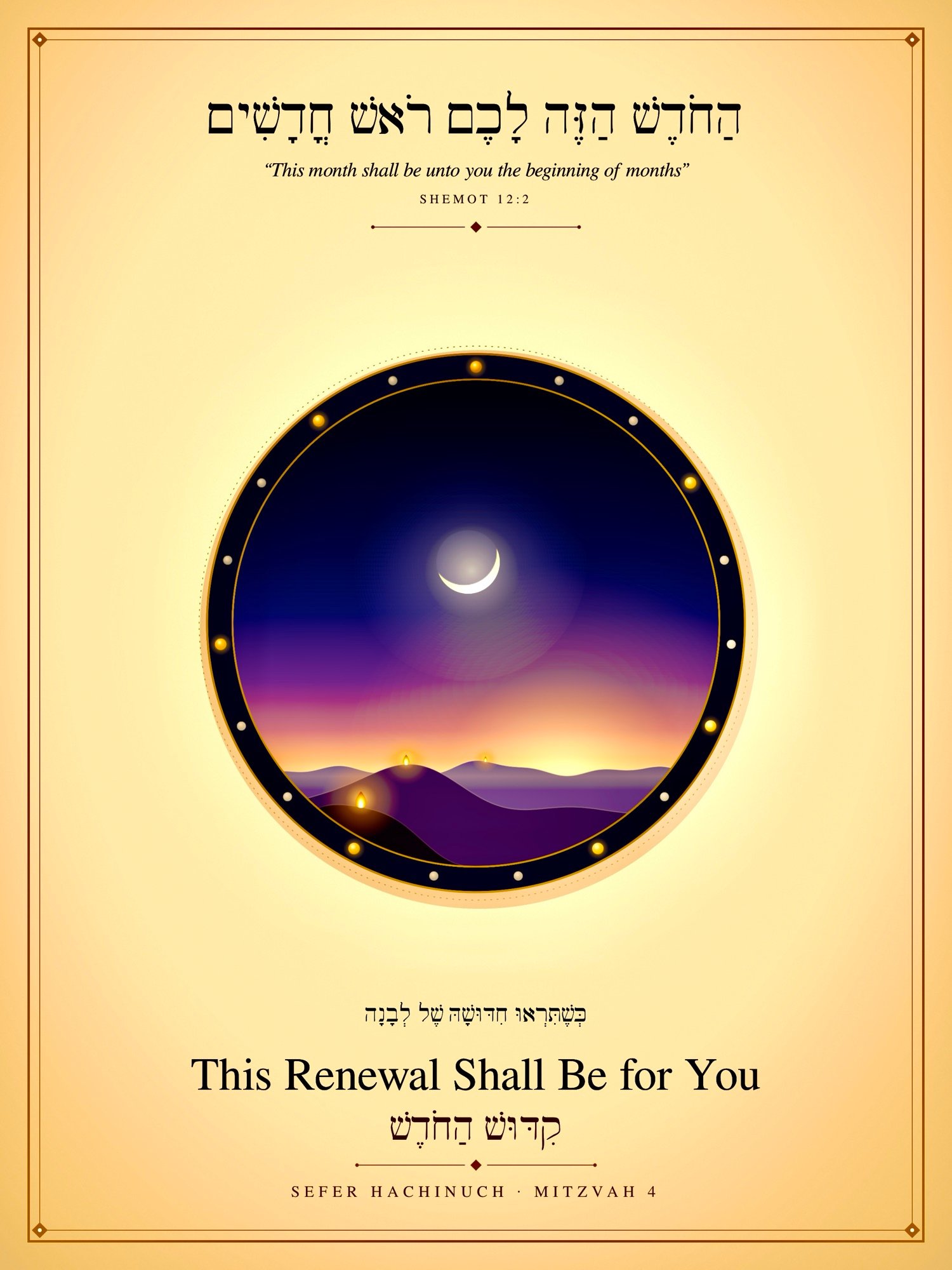
This Renewal Shall Be for You: Kiddush HaChodesh, the Fourth Mitzvah of Sefer HaChinuch
Nov 17, 2026 · @Kamil Levi Pyka-Penner
A commentary on Mitzvah 4, מִצְוַת קִדּוּשׁ הַחֹדֶשׁ: its text, its root, its laws, and the calendar by which Israel keeps it today as the fourth in a series with the commentaries on Mitzvos 1 to 3.
A Note on Sources and Method
This commentary keeps to the same narrow library as its companions. It draws only on Sefer HaChinuch itself; the elucidation, notes and Insight of the elucidated English edition (pp. 83–94); and the sources to which those pages direct the reader. Beyond the verses of Scripture themselves, nothing is brought in from outside that circle.
The Chinuch is quoted in his own Hebrew, with an original English rendering. Verses are given from the Masoretic text, in the Jewish Publication Society translation of 1917. Where the commentary offers a reading of its own rather than reporting one, it says so.
I. The First Command to a Nation
The fourth mitzvah of Sefer HaChinuch is the first command given to Israel as a people, and its subject is time rather than the body. The edition introduces it this way: received while Israel was still in Egypt, it is the first mitzvah given to them as a nation (p. 83). The source is Rashi’s opening comment on the Torah: לא היה צריך להתחיל את התורה אלא מהחודש הזה לכם, שהיא מצוה ראשונה שנצטוו בה ישראל.
The three mitzvos of Bereshit each touched the body and its descendants: generation, covenant, survival. With the fourth, the book turns from the body to the calendar. On our reading, a people is first formed not by a rite performed on each person, but by a time that all of them keep together.
The Chinuch hears the verse’s לכם as addressed to its first hearers. It was said to Moshe and Aharon, so the mitzvah belongs to גדולים וסמוכים כמותכם, great and ordained sages like them. Yet the next verse turns to כל עדת בני ישראל, and from it the Chinuch learns that the court acts with רשות כל ישראל, the permission of all Israel.
The chapter holds both poles: the few who sanctify, and the many in whose name they act. It also carries forward the promise of the previous mitzvah. The last mitzvah of Bereshit assured Israel that its seed would outlast its exiles; the first mitzvah of the nation was spoken בארץ מצרים, in exile, and is kept today through a calendar fixed in advance עד שיבוא אליהו. That connection is ours.
This commentary follows the chapter from the verse to the court, from the court to the calendar, and from the calendar to the congregation that still stands each month to hear the new moon announced.
II. The Text
The Chinuch’s chapter moves in nine steps, and it is the longest in the series so far. The Hebrew is given without vowels; the English is an original rendering.
1. The mitzvah and its verse
לקדש חודשים ולעבר שנים בבית דין גדול בחכמה סמוך בארץ, ולקבוע מועדי השנה על פי אותו קידוש, שנאמר (שמות יב, ב) החדש הזה לכם ראש חדשים, כלומר כשתראו חידושה של לבנה, תקבעו לכם ראש חודש, או אפילו לא תראוה, מכיון שהיא ראויה להיראות על פי החשבון המקובל.
To sanctify months and intercalate years, through a court great in wisdom and ordained in the Land, and to fix the festivals of the year by that sanctification, as it is said: “This month shall be unto you the beginning of months” (Shemot 12:2). That is: when you see the renewal of the moon, fix the new month for yourselves; or even if you do not see it, since it is fit to be seen according to the calculation that has been received.
2. Intercalation included
וכן תיכלל מצוה זו מצות עיבור השנה, לפי שיסוד מצות קידוש החודש כדי שיעשו ישראל מועדי השם במועדם, וכמו כן מצות עיבור השנה מזה היסוד היא. ואולם מלבד זה המקרא באו הערות בכתובי התורה יורו על מצות העיבור, והוא מה שכתוב (שמות יג, י) ושמרת את החקה הזאת למועדה, וכן (דברים טז, א) שמור את חדש האביב.
This mitzvah also includes the intercalation of the year. The foundation of the mitzvah of sanctifying the month is that Israel keep the festivals of the Name in their appointed times, and the intercalation of the year rests on the same foundation. Beyond this verse, there are hints in the Torah’s text that point to intercalation: “Thou shalt therefore keep this ordinance in its season” (Shemot 13:10), and “Observe the month of Abib” (Devarim 16:1).
3. How it was done
ועניין המצוה כן, שבאים שני ישראלים כשרים לפני הבית דין ומעידין בפניהם שראו הלבנה בחידושה, וקובעים ראש חודש על פיהם שאומרים, היום מקודש.
The manner of the mitzvah is this. Two qualified Jews come before the court and testify that they saw the moon in its renewal, and on their word the court fixes the new month, saying: “Today is sanctified.”
4. Why ordained judges
וטעם שאין מצוה זו אלא בסמוכין, לפי שבא בפירוש החדש הזה לכם, גדולים וסמוכים כמותכם, כי למשה ואהרן נאמר. ועוד דרשו הדבר מדסמך לו (שמות יב, ג) דברו אל כל עדת בני ישראל (מכילתא), כלומר שיהא להם לאותן שיקדשו החודש רשות כל ישראל, כלומר חכמים גדולים שבישראל, כגון בית דין הגדול.
The reason this mitzvah belongs only to ordained judges: the received interpretation of “This month shall be unto you” is “great and ordained ones like you,” for the words were spoken to Moshe and Aharon. The Sages expounded it further (Mechilta) from the verse joined to it, “Speak ye unto all the congregation of Israel” (Shemot 12:3): those who sanctify the month must hold the permission of all Israel, that is, the great sages of Israel, such as the Great Court.
5. Outside the Land
וכן כל מי שהוא חכם גדול בישראל ונסמך בארץ ישראל, והסמיכות ידוע איך עושין אותו, יש לו רשות לעשות מצוה זו אפילו בחוצה לארץ, והוא שלא הניח כמותו בארץ. וכן מצינו (ברכות סג, א) שעשו כן חנניה בן אחי רבי יהושע ועקיבה בן יוסף שהיו בעניין זה. אבל בלתי תנאים אלו אין רשות לשום אדם מישראל לקבוע חודשים ולעבר שנים.
So too, any great sage in Israel ordained in the Land of Israel (how ordination is conferred is known) has authority to perform this mitzvah even outside the Land, provided he left no one his equal in the Land. So we find (Berachos 63a) that Chananiah, the nephew of Rabbi Yehoshua, and Akiva ben Yosef did this, being in that position. Without these conditions, no one in Israel has authority to fix months or intercalate years.
6. How we keep it today
ואם תשאל, אם כן היאך אנו עושים היום, שאין לנו חכמים סמוכים. דע שכך קיבלנו, שרבי הלל הנשיא בנו של רבי יהודה הנשיא, שהיה גדול בדורו ונסמך בארץ, והוא החכם שתיקן לנו חשבון העיבור, הוא קידש חודשים ועיבר שנים העתידים לבוא עד שיבוא אליהו, ועל זה אנו סומכים היום.
And if you ask, how then do we act today, when we have no ordained sages? Know that we have received this: Rabbi Hillel HaNasi, the son of Rabbi Yehudah HaNasi, the great one of his generation and ordained in the Land, the sage who set the calculation of intercalation for us, sanctified the months and intercalated the years to come, until Eliyahu comes. On this we rely today.
7. The dispute
וזה שאמרנו הוא על דעת הרמב”ם זכרונו לברכה. והרמב”ן זכרונו לברכה יחשוב קידוש החודש מצוה אחת ועיבור שנים מצוה אחת, וראיותיו בספר המצוות שלו, וכן בעל הלכות גם כן. והפסוק המורה על מצות העיבור, כלומר שנחשוב התקופות כדי שנעשה המועדים בזמן הקבוע להם, הוא, ושמרת את החקה הזאת למועדה (שמות יג, י), וכן, שמור את חדש האביב (דברים טז, א), כמו שכתבנו.
What we have said follows the view of the Rambam, of blessed memory. The Ramban, of blessed memory, counts the sanctification of the month as one mitzvah and the intercalation of years as another, with his proofs in his Sefer HaMitzvos, and so does the Baal Halachos. On that view, the verse that commands intercalation, that we reckon the seasons so as to keep the festivals at their fixed time, is “Thou shalt therefore keep this ordinance in its season” (Shemot 13:10), and likewise “Observe the month of Abib” (Devarim 16:1), as we wrote.
8. The root
משרשי מצוה זו, כדי שיעשו ישראל מועדי השם בזמנן, שהשם יתברך ציוה לעשות פסח בזמן שהתבואה באביב, כמו שכתוב (שם) שמור את חדש האביב ועשית פסח, וחג הסוכות בזמן האסיף, כמו שכתוב (שמות לד, כב) וחג האסיף תקופת השנה. ואלולי עיבור השנים יבואו המועדים שלא בזמנים אלו, לפי שישראל מחשבים חודשיהם ומועדיהם לימי שנת הלבנה, שהם שנ”ד יום, ח’ שעות, תתע”ו חלקים, והיא חסרה משנת החמה י’ ימים, כ”א שעות, ר”ד חלקים, סימן יכ”א ר”ד. ובישול התבואות והפירות בכוחה של חמה, נמצא שאלולי העיבור שאנו משווים בו שנות הלבנה בשנות החמה, לא יבוא הפסח בזמן האביב והסוכות בזמן האסיף. ונתקן הדבר להיעשות בגדולי הדור, לפי שהוא עניין חכמה גדולה, גם יאמרו כי ממנו יוודע מקרה השנה בתבואות, ואין ראוי למוסרו אלא לגדולים וחסידים.
Among the roots of this mitzvah: that Israel keep the festivals of the Name in their times. The Name, blessed be He, commanded that Pesach be kept when the grain is ripening, as it is written, “Observe the month of Abib, and keep the passover” (Devarim 16:1), and Succos at the time of ingathering, as it is written, “and the feast of ingathering at the turn of the year” (Shemot 34:22). Without the intercalation of years, the festivals would fall outside these seasons. For Israel reckons its months and festivals by the lunar year of 354 days, 8 hours and 876 parts, which falls short of the solar year by 10 days, 21 hours and 204 parts; the mnemonic is יכ”א ר”ד. The ripening of grain and fruit comes by the strength of the sun. So without the intercalation by which we bring the lunar years level with the solar years, Pesach would not come in the season of ripening, nor Succos in the season of ingathering. The matter was set to be done by the greatest of the generation, because it is a subject of great wisdom. It is also said that from it the year’s fortune in its crops may be known, so it is fit to be handed only to the great and the pious.
9. The laws, their scope, and today
דיני המצוה, כגון חקירת עדות החודש, ואיום העדים לפעמים, ודין חילול שבת בעדות זו כיצד, ועל מה מעברין את השנה ועל מה אין מעברין אותה, ואי זה חודש היו מעברין, והוא אדר, וכמו שדרשו זכרונם לברכה (מכילתא דרשב”י) ושמרת את החקה הזאת למועדה, מלמד שאין מעברין את השנה אלא בפרק הסמוך למועד. ועוד דרשו זכרונם לברכה (שם) בפסוק זה, מנין שאין מעברין את החודש אלא ביום, תלמוד לומר מימים ימימה. ועוד דרשו זכרונם לברכה (מגילה ה, א) לחדשי השנה, חודשים אתה מחשב לשנה ואי אתה מחשב ימים. ועוד אמרו בעניין זה (שם), חדש ימים (במדבר יא, כ), ימים אתה מחשב לחודש ואי אתה מחשב שעות. ויתר פרטיה מבוארים במסכת ראש השנה (יח, א ואילך), ובראשון של סנהדרין (י, ב ואילך), ובברכות (סג, א) כמו כן.
ונוהגת בכל מקום, ובכל זמן שיהיו לנו חכמים סמוכים בתנאים שכתבנו. ועובר עליה ולא עשאה, אם הוא חכם שראוי לה, ביטל עשה, ועונשו גדול מאוד, שגורם קלקול המועדות. ועכשיו בעוונותינו שאין אנו מעברין שנים על פי סמוכים, אנו סומכים בחשבוננו על החשבון המקובל מרבי הלל, כמו שאמרנו.
The laws of the mitzvah: the examination of testimony about the new moon; the occasional intimidation of the witnesses; how the Sabbath may be set aside for this testimony; the grounds on which the year is intercalated and on which it is not; and which month was added, namely Adar. As the Sages expounded (Mechilta of Rabbi Shimon bar Yochai) on “Thou shalt therefore keep this ordinance in its season”: the year is intercalated only in the period near the festival. From the same verse they expounded that intercalation is done only by day, from מימים ימימה (literally “from days to days”; JPS: “from year to year”). They also expounded (Megillah 5a) לחדשי השנה, “of the months of the year”: a year is reckoned in months, not in days. And on this subject (ibid.), חדש ימים, literally “a month of days” (Bamidbar 11:20): a month is reckoned in days, not in hours. The remaining details are set out in Rosh Hashanah (18a ff.), in the first chapter of Sanhedrin (10b ff.), and in Berachos (63a).
The mitzvah applies in every place, and at every time that we have ordained sages under the conditions we wrote. One who transgresses it and does not perform it, if he is a sage fit for it, has neglected a positive commandment, and his punishment is very great, for he causes the corruption of the festivals. And now, for our sins, when we do not intercalate years by ordained sages, we rely in our reckoning on the calculation received from Rabbi Hillel, as we said.
III. “This Renewal”: Month and Moon
The verse can be read two ways, and the Chinuch’s כלומר takes the reading of renewal. In the same sentence he writes both sight and calculation into the mitzvah.
The month. On its plain sense, חֹדֶשׁ means month: Nissan, the month in which the passage was spoken, heads the count of months (p. 83, citing Rashi and Ramban to the verse). The JPS translation follows this sense: “This month shall be unto you the beginning of months.” Rashi insists that the plain sense stands: אין מקרא יוצא מידי פשוטו.
The Ramban explains why the months are counted from Nissan at all. As the days are counted toward Shabbos, the months are counted as the first, second and third לגאולתנו, a remembrance of the Exodus. He adds that the names Nissan, Iyar and the rest came up with us from Babylon, to recall כי שם עמדנו ומשם העלנו. On our reading, even the names of the months carry the memory of an exile and a return, the theme the previous mitzvah left with us.
The renewal. The Oral Torah reads the same word as renewal, and the edition renders the verse “This renewal shall be for you the beginning of the months” (p. 83). Rashi brings the Mechilta: הראהו לבנה בחידושה. On the word הזה he adds that Moshe was perplexed about how much of the new moon must be seen, until it was shown to him in the sky: כזה ראה וקדש.
The Chinuch’s paraphrase follows the Oral Torah: כשתראו חידושה של לבנה. The edition explains the term (note 1). The molad is the moment of conjunction, when the moon cannot be seen at all; some time later a thin crescent appears, and that first light is חידושה של לבנה (Rosh Hashanah 20b; Rambam, Hilchos Kiddush HaChodesh 1:3).
Sight and calculation. In the same sentence the Chinuch adds: או אפילו לא תראוה, מכיון שהיא ראויה להיראות על פי החשבון המקובל. The edition calls these two methods, על פי ראיה and על פי חשבון, and both belong to the mitzvah (note 8). The Rambam writes that fixing the month by calculation, without a sighting, is a law given orally to Moshe at Sinai (Hilchos Kiddush HaChodesh 18:8, as cited there).
The edition also limits the clause. The court did not turn to calculation whenever witnesses failed to come. When the moon could have been seen, it waited for witnesses, and if none came it began the new month on the thirty-first day (Rambam 1:6). Calculation alone served only in special cases, such as clouds hiding the moon for several months (18:5–12).
A sentence that holds the whole history. On our reading, the Chinuch’s first sentence already contains his last. The mitzvah begins with a moon that is seen and witnesses who saw it; it ends with a calendar “fit to be seen” by a calculation received from Rabbi Hillel. The clause או אפילו לא תראוה is the hinge on which Israel’s calendar would one day turn.
The moon and the month. The renewal belongs to the moon; the month belongs to Israel. Moshe was told כזה ראה וקדש: see, then sanctify. On our reading, the sky supplies the sign, but only the court’s word makes it a month, and the verse’s לכם marks the difference.
IV. “Like You”: Who May Sanctify Time
The Chinuch places the sanctification of time in the hands of ordained sages who act with the permission of all Israel. The edition draws out what follows: their declaration does not report the month, it establishes it.
Great and ordained, like you. The verse was spoken to Moshe and Aharon, and the Sages heard its לכם as a rule for the generations: גדולים וסמוכים כמותכם. The edition explains that Moshe and Aharon were “ordained” by G-d Himself, who made them the leaders of the people (note 14, citing Bava Basra 121a with Rashbam, Rosh Hashanah 22a with Rashi, and Rosh Hashanah 25b). The ordination meant is the semichah of earlier times, conferred only in Eretz Yisrael, in a line reaching back to Moshe (note 5; see Mitzvah 491).
The size of the court. The month needs a court of three. Intercalating the year needs seven, among them the head of the Sanhedrin, though three with him suffice after the fact (note 4; Rosh Hashanah 25b; Sanhedrin 2a, 10b–11a; Rambam, Hilchos Kiddush HaChodesh 2:9, 4:9).
The permission of all Israel. The Mechilta reads the next verse, “Speak ye unto all the congregation of Israel” (Shemot 12:3), as a second condition: those who sanctify must hold רשות כל ישראל. The Chinuch identifies them as the great sages of Israel, such as the Great Sanhedrin (note 16; Ramban to Sefer HaMitzvos, Asei 153). A small textual point: the Chinuch quotes the verse as עדת בני ישראל, while the Masoretic text reads עֲדַת יִשְׂרָאֵל.
The greatest sage of the generation. The Chinuch does not confine the mitzvah to the Sanhedrin: any court that includes the greatest ordained sage of Israel may fix the month. This is the Ramban’s view, and he adds that while the Sanhedrin stood, only it held the permission of all Israel; when it ceased, that permission passed to the preeminent sage of the time (note 18). For another view the edition points to the Rambam (Sefer HaMitzvos, Asei 153; Hilchos Kiddush HaChodesh 5:1–2), and to Minchas Chinuch §1 and Minchas Yitzchak §1.
Outside the Land. Such a sage may act even outside the Land, but only if he left no equal behind him there (Rambam 1:8; note 19). The Chinuch’s precedents are Chananiah, the nephew of Rabbi Yehoshua, and Rabbi Akiva, each of whom formed a court of three and fixed the months abroad (Berachos 63a; note 20). In Sefer HaMitzvos the Rambam limits this permit to fixing the month by calculation, not sanctifying it by witnesses (note 19).
A court that establishes. The edition draws the consequence (notes 5 and 35). The Torah gave the court sole power over the month, and no one may keep the festivals by a calendar of his own. Even a declaration made in error, or on purpose, stands, and the festivals follow it (Rosh Hashanah 25a; Rambam 2:10). The edition contrasts other areas of law, where the court’s task is to determine the halachah rather than establish it.
The Mishnah tells the classic case (Rosh Hashanah 2:8–9, 25a). Rabban Gamliel accepted testimony that Rabbi Dosa ben Harkinas called false, and Rabbi Yehoshua agreed with Rabbi Dosa. Rabban Gamliel ordered him to come with his staff and his money on the day that fell as Yom Kippur by his own reckoning. Rabbi Akiva comforted him from the verse “These are the appointed seasons of the LORD, even holy convocations, which ye shall proclaim in their appointed season” (Vayikra 23:4): בין בזמנן בין שלא בזמנן, אין לי מועדות אלא אלו.
Rabbi Yehoshua went, and Rabban Gamliel rose and kissed him on the head: בוא בשלום, רבי ותלמידי. He explained the pair at once: רבי בחכמה, ותלמידי שקיבלת את דברי.
On our reading, this is the chapter’s deepest claim. The sky supplies evidence; the court supplies sanctity. The festivals are not read off the heavens and copied down: Israel is commanded to proclaim them, and when it does, they are “My appointed seasons” (Vayikra 23:2). The Mishnah’s greeting holds both sides of that authority, the wisdom that may dissent and the discipline that keeps one calendar for all Israel.
V. Sun and Moon: The Root
The Chinuch’s root is that Israel keep the festivals of the Name in their seasons. Israel counts its months by the moon, while the grain ripens by the sun, so the mitzvah must keep the two in agreement.
Two kinds of time. Each festival is bound twice: to a date and to a season. Pesach falls on the fifteenth of Nissan and also in “the month of Abib,” when the grain ripens (Devarim 16:1); Succos falls in Tishrei and also “at the turn of the year,” the time of ingathering (Shemot 34:22). The edition gives this example (note 27), and adds that autumn opens the year: the months are counted from Nissan, but the year from Rosh Hashanah (note 28, citing Sanhedrin 13a with Rashi).
The numbers. The Chinuch gives the figures exactly, and the edition converts them (notes 2, 29–31). One part, חלק, is 1/1080 of an hour, or 3⅓ seconds.
Quantity
The figure
In hours, minutes and seconds
Source
Lunar month, molad to molad
29 days, 12 hours, 793 parts
29 days, 12 h 44 min 3⅓ s
note 2; note 29, citing Rosh Hashanah 25a
Lunar year of twelve months
354 days, 8 hours, 876 parts
354 days, 8 h 48 min 40 s
the Chinuch; note 29
Solar year, as the Chinuch reckons it
365 days, 6 hours
365¼ days
note 30, citing Eruvin 56a
Shortfall of the lunar year
10 days, 21 hours, 204 parts (יכ”א ר”ד)
10 days, 21 h 11 min 20 s
the Chinuch; notes 30–31
The shortfall accumulates. In three years the lunar calendar falls about 33 days behind the sun, and without correction Pesach would drift into winter and Succos into summer (pp. 83–84; note 9). The correction is a whole month, a second Adar.
By the strength of the sun. The Chinuch names the cause in one phrase: בישול התבואות והפירות בכוחה של חמה. Intercalation is the act שאנו משווים בו שנות הלבנה בשנות החמה, by which the lunar years are brought level with the solar years. On our reading, the mitzvah takes up the purpose Scripture gives the lights themselves, set in the heavens “for signs, and for seasons, and for days and years” (Bereshit 1:14). The moon counts Israel’s months, the sun ripens its grain, and the court keeps the two in step.
Wisdom. The Chinuch gives two reasons the work belongs to the greatest of the generation. The first is wisdom. The figures above are averages; the moon’s true motion varies, and the court had to judge whether it could have been seen at all (note 32). The Rambam gives chapters 6 to 19 of Hilchos Kiddush HaChodesh to the reckoning, and calls it a discipline for only the most profound scholars (11:2–4, as cited there). Intercalation weighed more than the drift: ripening fruit, winter roads that might keep pilgrims from Jerusalem, and the like (Sanhedrin 11a–13b; Rambam, ch. 4).
Piety. The second reason is character. גם יאמרו, the Chinuch writes, introducing a report rather than a ruling: from this knowledge the year’s crops may be foretold, so it is fit only לגדולים וחסידים. The edition explains: to those who will not abuse it (note 33, citing Rabbi Avraham bar Chiya’s Sefer HaIbbur 3:5 and Ibn Ezra’s Sefer HaIbbur).
On our reading, the pair גדולים וחסידים answers the earlier pair גדולים וסמוכים. Ordination certifies wisdom; piety guards its use. The court that holds the calendar must be both learned and trustworthy, for its knowledge reaches the harvest of all Israel.
VI. One Mitzvah or Two
The Chinuch counts the sanctification of the month and the intercalation of the year as a single mitzvah, following the Rambam. The Ramban and the Halachos Gedolos count two, and the difference turns on what the mitzvah is for.
The Rambam, and the Chinuch’s count
The Ramban and Halachos Gedolos
Number of mitzvos
One
Two
Sanctifying the month
Part of the one mitzvah
A mitzvah of its own
Intercalating the year
Included, by the same root
A mitzvah of its own, from Shemot 13:10 and Devarim 16:1
Halachos Gedolos’ חישוב תקופות
Not intercalation: the praised study of the seasons and the stars (Shabbos 75a)
Intercalation
Where argued
Sefer HaMitzvos, Shoresh 2 and Asei 153
The Ramban’s glosses: Shoresh 1, Asei 153, and his list of mitzvos the Rambam omitted
The table follows notes 25–27.
The Rambam’s reasoning. The edition gives it from the Lev Same’ach (note 27). The Torah fixes each festival twice, on a day of the month and in a season of the year: Pesach on the fifteenth of Nissan, and in spring. Sanctifying the month secures the day; intercalating the year secures the season. Since both serve one purpose, they are one mitzvah (see also Rabbi Y. F. Perla on Rav Saadiah Gaon’s Sefer HaMitzvos, Asei 56; for another explanation, Maharam Schik §1).
The Chinuch’s own sentence. The Chinuch states that reasoning before he reports the dispute: לפי שיסוד מצות קידוש החודש כדי שיעשו ישראל מועדי השם במועדם, וכמו כן מצות עיבור השנה מזה היסוד היא. On our reading, his root does the counting: where the purpose is one, the mitzvah is one.
Hints and sources. The same two verses appear twice in the chapter. In the second step the Chinuch calls them הערות, hints in the Torah’s text that point to intercalation; in the seventh he presents them as the source of the Ramban’s separate mitzvah. On our reading, the two counts differ over the status of those verses. For the Rambam they confirm a mitzvah already contained in החדש הזה לכם; for the Ramban they command a second one.
Halachos Gedolos read two ways. The Geonic list names קביעות ראשי חדשים and חישוב תקופות separately (note 26). The Ramban and the Chinuch take the second as intercalation. The Rambam hears in it the praise of Shabbos 75a: to reckon the seasons and the stars, and so show the nations Israel’s wisdom, as it is said כי הוא חכמתכם ובינתכם לעיני העמים (Devarim 4:6).
A divided allegiance. The Chinuch counts with the Rambam, as is his policy throughout the book (note 27). Yet within this chapter he follows the Ramban twice: in allowing the greatest ordained sage, and not only the Sanhedrin, to fix the month (note 18), and in his account of how our calendar was fixed (note 24). On our reading, the count and the explanation are separate questions for him. The list of mitzvos follows one master; the understanding of each mitzvah follows the reasoning he finds most convincing.
VII. The Laws: Witnesses, Seasons, Whole Units
The Chinuch’s laws fall into two groups: those of the witnesses who report the moon, and those of the court that sets the year. He closes with two rules on the units of the calendar, and sends the reader to Rosh Hashanah (18a ff.), Sanhedrin (10b ff.) and Berachos (63a).
The Chinuch’s law
As the edition’s notes explain it
Sources cited
שני ישראלים כשרים: who may testify
Witnesses valid in other cases
note 12; Rambam 2:1; Hilchos Eidus 9 ff.
חקירת עדות החודש: examining the testimony
Questions on the moon’s shape and position, to tell a true sighting from a mistaken or false one
note 34; Rosh Hashanah 23b–24a; Rambam 2:4, 7
איום העדים לפעמים: pressing the witnesses
Where a declaration on the thirtieth day would set Yom Kippur on a Friday or a Sunday, the court could press witnesses to withhold their testimony, or set it aside; unique to this mitzvah, and moot in the fixed calendar
note 35; Rosh Hashanah 20a–b with Rashi; compare Rambam 3:15–19
חילול שבת בעדות זו: the Sabbath
Witnesses travel on the Sabbath to testify on the thirtieth day; in Temple times for every month, afterwards only for Nissan and Tishrei
note 36; Rosh Hashanah 21b and the Mishnah there; Lechem Mishneh to Rambam 3:2
על מה מעברין: grounds for intercalation
Chiefly the seasons of the festivals; the Gemara adds other factors and rejects some
note 37; Sanhedrin 11a–b
והוא אדר: which month
Only in the period near the festival, so the added month comes just before Nissan; this suggests the added month is the second Adar
note 38; Mechilta of Rabbi Shimon bar Yochai; Yerushalmi Megillah 1:5; Tosafos, Rosh Hashanah 19b; Chazon Ish, Orach Chaim 142:3
אלא ביום: only by day
Intercalation at night is invalid; the declaration “Today is sanctified” is also made by day
notes 39–41; Sanhedrin 11b; Rambam 4:12, 2:8
חודשים אתה מחשב לשנה: years in whole months
Eleven odd days may not be added to a year; only a whole month
note 42; Megillah 5a
ימים אתה מחשב לחודש: months in whole days
A month is 29 or 30 full days, never begun in the middle of a day
note 43; Megillah 5a; Rambam 8:1–2
The laws are codified in the Rambam’s Hilchos Kiddush HaChodesh, and the calendar also in the Tur, Orach Chaim 427–428 (note 44).
A court that may set witnesses aside. The law of איום העדים is the sharpest proof of section IV. The edition explains it from the court’s power to establish the month: since the day it declares is Rosh Chodesh even in error, it may decline testimony when the calendar requires (note 35). Elsewhere in the law, the edition says, this would not be allowed.
The postponed month. The edition notes a precision in the Chinuch’s wording (note 39). מעברין את החודש might mean adding a day to the month, but in context he means adding a month to the year. A month carried to the thirty-first day needs no sanctification at all: once the thirtieth was not sanctified, the next day is Rosh Chodesh of itself (Mishnah, Rosh Hashanah 24a; Rambam 2:8).
Two days of Rosh Chodesh. The edition adds a point of practice (note 3). When the outgoing month has thirty days, Rosh Chodesh is kept for two: the thirtieth of the old month and the first of the new.
Whole units. The moon’s cycle is about twenty-nine and a half days, and the solar year outruns the lunar by about eleven. The calendar accepts neither fraction: a month is twenty-nine or thirty whole days, and a year is twelve or thirteen whole months. On our reading, the court translates the sky’s fractions into whole units a people can live by. The fractions stay in the reckoning; the whole days are what Israel keeps.
By day. Intercalation and sanctification alike are acts of the day (Sanhedrin 11b; Rambam 4:12, 2:8). The Chinuch derives it from מימים ימימה, a verse whose plain sense is “from year to year” (note 40). On our reading, the rule marks the act as a ruling of a court, done in daylight like judgment, and not as an observation of the night sky.
VIII. Rabbi Hillel’s Calendar: A Sanctification Held in Trust
The Chinuch’s answer to his own question is that today’s months were sanctified in advance. Rabbi Hillel HaNasi and his court sanctified every future month and intercalated every future year, עד שיבוא אליהו, and on that act Israel relies.
The question. If only ordained sages may fix the months, and ordination has ceased, how is the mitzvah kept? The Chinuch asks in the reader’s voice, ואם תשאל, and answers from tradition: דע שכך קיבלנו.
Rabbi Hillel HaNasi. He was the son of Rabbi Yehudah HaNasi, himself a descendant of Rebbi, who compiled the Mishnah (note 21). With his ordained court he fixed the calendar in the year 4118 from Creation, and in his time ordination ceased under Roman persecution (note 21, citing Seder HaDoros, 4118). The set of calculations is called עיבור, intercalation (note 22; Rambam, Hilchos Kiddush HaChodesh 6:1).
By calculation. No witness could see the moons of future centuries, so Rabbi Hillel used the second method of the chapter’s first sentence, על פי חשבון (note 24). His calendar adds seven leap years in every nineteen: the 3rd, 6th, 8th, 11th, 14th, 17th and 19th (note 24). On our reading, the clause או אפילו לא תראוה now carries the whole weight of Jewish time.
Until Eliyahu. The trust has a term. The Rambam lists Eliyahu among the sages of earlier times who received semichah, so he will be able to ordain others and restore the institution (note 23, citing the introduction to the Yad HaChazakah and Radvaz to Hilchos Sanhedrin 4:11). Then the months and years will return to a living court.
The Rambam’s other account. The Chinuch’s explanation follows the Ramban; the Rambam explains the present calendar differently (note 24, citing Hilchos Kiddush HaChodesh 5:1–2, “but see Sefer HaMitzvos”). In Sefer HaMitzvos (Asei 153) the Rambam writes that we calculate today only to know the day the residents of Eretz Yisrael have fixed, and that we rely on their fixing.
He then imagines the Land empty of Jews, with no court there and none abroad ordained there, and adds at once: חלילה לאל מעשות זאת, כי הוא הבטיח that the nation would not be wiped out entirely. Were it so, he says, our calculation would avail us nothing.
On our reading, the Rambam’s account rests on the very promise the Chinuch found in the gid ha-nasheh: that Israel will not perish. For the Ramban and the Chinuch, the calendar hangs on an act of the past; for the Rambam, on a presence in the Land that a promise guarantees.
Applicability and penalty. The mitzvah applies in every place, in the Land and outside it under the conditions above, and at every time that Israel has ordained sages (notes 45–46). A sage fit to perform it who neglects it ביטל עשה, ועונשו גדול מאוד. The edition explains that the punishment is Heaven’s: a court may compel a positive mitzvah beforehand, but imposes no penalty after the fact (note 47).
On our reading, the reason the Chinuch gives is unusual. The sage’s failure is measured not by his own omission but by its effect on others, שגורם קלקול המועדות: one man’s neglect spoils the festivals of all Israel.
“For our sins.” The chapter ends in the present tense: ועכשיו בעוונותינו. Ordination was lost in the persecutions after the Destruction, not to return until Eliyahu comes (note 48). On our reading, every date of the Jewish year now means two things at once: it is the fruit of Rabbi Hillel’s act, and a reminder that the act was made for a time of waiting.
IX. The Assembled Who Stand
The edition’s Insight turns from the court to the congregation. When we stand for Bircas HaChodesh, it argues, we recall not the judges, who sat, but the people who stood and answered “It is sanctified!”
Not a sanctification. On the Sabbath before Rosh Chodesh, the congregation prays that the coming month be good and blessed, and announces its day or days. This is not the ancient sanctification, which belonged to the court alone, and which, for the Chinuch and the Ramban, Rabbi Hillel’s court fulfilled for our times. It informs the congregation so that it can keep the new month (Yerei’im §259, cited by Magen Avraham, Orach Chaim 417:1; Ohr Zarua, Hilchos Rosh Chodesh §452; Rambam 5:13). Many still find echoes of the ancient procedure in its customs (Abudraham; Raaviah §530; compare Shibbolei HaLeket §170).
Why we stand. The Magen Avraham explains the custom of standing as a remembrance of the sanctification, which was done standing (417:1). Rabbi Akiva Eiger finds this puzzling. The Mishnah (Rosh Hashanah 25b) says the judges sat while the witnesses stood before them, which implies they remained seated through the declaration itself.
The people, not the judges. Some answer that the Magen Avraham means the people present. After the head of the court declared “It is sanctified!”, all who were there answered after him, “It is sanctified! It is sanctified!” (Mishnah, Rosh Hashanah 24a; note 13).
Rabbi Moshe Feinstein (Igros Moshe, Orach Chaim I §142) gives two grounds for their standing. Those attending a court stood, and surely before the ordained judges of the sanctification (Yevamos 106b). And while the word of the head of the court was the ruling, the double answer of the assembled was the main act of sanctification.
He finds this in Scripture’s plural, מקראי קדש, “holy convocations” (Vayikra 23:2): the month is sanctified by a twofold proclamation (Rosh Hashanah 24a). Judges sit when they rule (Shevuos 30b); those who perform a mitzvah stand.
Rabbi Betzalel Zolty (Mishnas Yaavetz, Orach Chaim §1) offers another ground. When a court rules, the litigants rise (Shevuos 30b). The ruling on the month concerned all Israel, so the assembled, standing for all Israel, were in effect its litigants.
What we remember. The Insight concludes that the attendees, not the court, are those we recall when we stand. Rabbi Hillel’s ruling still governs the assembled of today, and each new month is announced in memory of those who once witnessed the sanctification.
The answer that calculation could not give. The edition notes elsewhere that the proclamation “It is sanctified!” was made only for a month fixed by witnesses; a month fixed by calculation was decided, not proclaimed (note 13, citing Rambam 18:8; compare the Ramban to Sefer HaMitzvos, Asei 153, end). Rabbi Hillel’s months were fixed by calculation (note 24). On our reading, then, the one part of the ancient rite his calendar could not supply is the people’s answer, and it is that part the congregation recalls each month when it rises.
The few and the many. On our reading, the Insight completes the Chinuch’s רשות כל ישראל. The court acted with the permission of all Israel, and all Israel, in the persons of those present, answered and sanctified. The court sat and the people stood, and the month was made by both.
X. Conclusion: From the Body to Time
With the fourth mitzvah, Sefer HaChinuch passes from the family to the nation, and from the body to time. The table continues the one that closed the commentary on Mitzvah 3.
Mitzvah 1: Pru u’rvu
Mitzvah 2: Milah
Mitzvah 3: Gid ha-nasheh
Mitzvah 4: Kiddush HaChodesh
Figure
Adam, and Noach
Avraham
Yaakov
Moshe and Aharon
Where it acts
The bringing forth of children
The organ through which the species continues
The thigh, from which the seed comes
The months and years of the nation
What it secures
That the generations exist
That they bear the covenant
That they will not be lost
That they keep one time together
Its sign
Living descendants
A sign in the flesh
A remembrance at the table
The festivals in their seasons
The first three mitzvos are counted where the Torah writes them, beside the story of their origin. The fourth is the first command given to Israel as a people: spoken in Egypt to Moshe and Aharon, and through them, the Chinuch says, to the great and ordained of every generation.
On our reading, it also carries forward the lesson of the second. There the Chinuch taught that the body is left to be completed by human hands; here time is left to be completed by a human court. The moon renews itself, but the month is made when the court declares it and the people answer.
The commentary on Mitzvah 3 ended at the threshold of the first exile. The fourth mitzvah is given at its other end, in the month of the Exodus, and the Ramban hears in the count of months a remembrance of that redemption. On our reading, the mitzvah of renewal was given at the moment of Israel’s own renewal.
Today Israel keeps it through a sanctification made long ago and held in trust. Each month the congregation rises, announces the new moon, and waits for the day when the months will again be sanctified by a living court, and the people will answer once more: מקודש, מקודש.
Questions for Further Study
For shiur, chavrusa, or seminar:
- The Chinuch reads החדש as renewal, yet in the same sentence allows a month “fit to be seen” by calculation. Is calculation part of the mitzvah’s definition, or a fallback the Oral Torah permits (Rambam 18:8; note 8)?
- If the court’s declaration stands even in error (Rosh Hashanah 25a), what do the witnesses contribute? Do they create the month, or only give the court occasion to create it?
- The Chinuch counts with the Rambam but explains the present calendar with the Ramban. Can the Rambam’s count stand together with the Ramban’s account of Rabbi Hillel (notes 24, 27)?
- The Rambam ties our calendar to the presence of Jews in Eretz Yisrael, guaranteed by a promise that the nation will not be wiped out. How does this compare with the Chinuch’s root for the gid ha-nasheh?
- Does the Chinuch’s גם יאמרו endorse the reason for keeping the calendar’s knowledge from the many, or only report it? What would follow if it were only a report?
- If, as Igros Moshe holds, the people’s double answer was the main act of sanctification, what was lost when months came to be fixed by calculation without proclamation (note 13)?
- Rashi calls Kiddush HaChodesh the first mitzvah commanded to Israel. In what sense were the three mitzvos of Bereshit not commanded to Israel, if they too were “said at Sinai, written in its place”?
Sources
Every source below is Sefer HaChinuch itself, the edition’s apparatus, or a work those pages cite. Verses are quoted from the Masoretic text in the JPS 1917 translation.
- Sefer HaChinuch: Mitzvah 4; Mitzvos 1–3 (the companion commentaries); Mitzvah 32 (via note 35); Mitzvah 491 (via note 5).
- On the Chinuch: the elucidated English edition, pp. 83–94, notes 1–49 and the Insight; Minchas Chinuch §1 and Minchas Yitzchak §1 (via note 18); Maharam Schik §1 (via note 27).
- Scripture: Bereshit 1:14; Shemot 12:1–3; 13:10; 34:22; Vayikra 23:2, 4; Bamidbar 11:20; Devarim 4:6; 16:1.
- Mishnah and Talmud: Rosh Hashanah 18a ff., 20a–b, 21a, 21b, 22a (with Rashi), 22b, 23b–24a, 24a, 25a, 25b; Sanhedrin 2a, 10b–13b, 18b; Berachos 63a; Megillah 5a; Bava Basra 121a (with Rashbam); Eruvin 56a, 96a; Menachos 36b; Shabbos 75a; Shevuos 30b; Yevamos 106b; Nedarim 78b (with Ran); Yerushalmi Megillah 1:5; Maseches Soferim 19:9; Tosafos, Rosh Hashanah 19b.
- Midrash: Mechilta to Shemot 12:2–3; Mechilta of Rabbi Shimon bar Yochai to Shemot 13:10.
- On the Torah: Rashi to Bereshit 1:1 and to Shemot 12:2; Ramban to Shemot 12:2; Rashi to Devarim 16:1.
- Rambam: Sefer HaMitzvos, Shoresh 2 and Asei 153; Hilchos Kiddush HaChodesh 1:3, 1:5–8, 2:1, 2:4, 2:7–10, 3:2, 3:8 ff., 3:15–19, 4:9, 4:12, 5:1–2, 5:13, 6:1, 8:1–2, 11:2–4, 18:5–12, 18:8; Hilchos Eidus 9 ff.; introduction to the Yad HaChazakah.
- Ramban: glosses to Sefer HaMitzvos, Shoresh 1, Asei 153, and his list of mitzvos the Rambam omitted.
- Codes and later authorities: Halachos Gedolos (introduction); Tur, Orach Chaim 427–428; Magen Avraham and Rabbi Akiva Eiger, Orach Chaim 417:1; Yerei’im §259; Ohr Zarua, Hilchos Rosh Chodesh §452; Raaviah, Hilchos Rosh Chodesh §530; Abudraham, Seder Rosh Chodesh; Shibbolei HaLeket §170; Lechem Mishneh to Hilchos Kiddush HaChodesh 3:2; Radvaz to Hilchos Sanhedrin 4:11; Chazon Ish, Orach Chaim 142:3; Igros Moshe, Orach Chaim I §142; Mishnas Yaavetz, Orach Chaim §1; Lev Same’ach to Sefer HaMitzvos, Asei 153; Rabbi Y. F. Perla on Rav Saadiah Gaon’s Sefer HaMitzvos, Asei 56; Shekel HaKodesh 1:14; Seder HaDoros, year 4118; Sefer HaIbbur of Rabbi Avraham bar Chiya (3:5) and of Ibn Ezra (Shaar 2); Rabbi David Feinstein, The Jewish Calendar, and Rabbi J. David Bleich, Bircas HaChammah (via note 29).