
The Light of Redemption and Education: A Rabbinic Commentary on Sefer HaChinuch (The Book of Mitzvos)
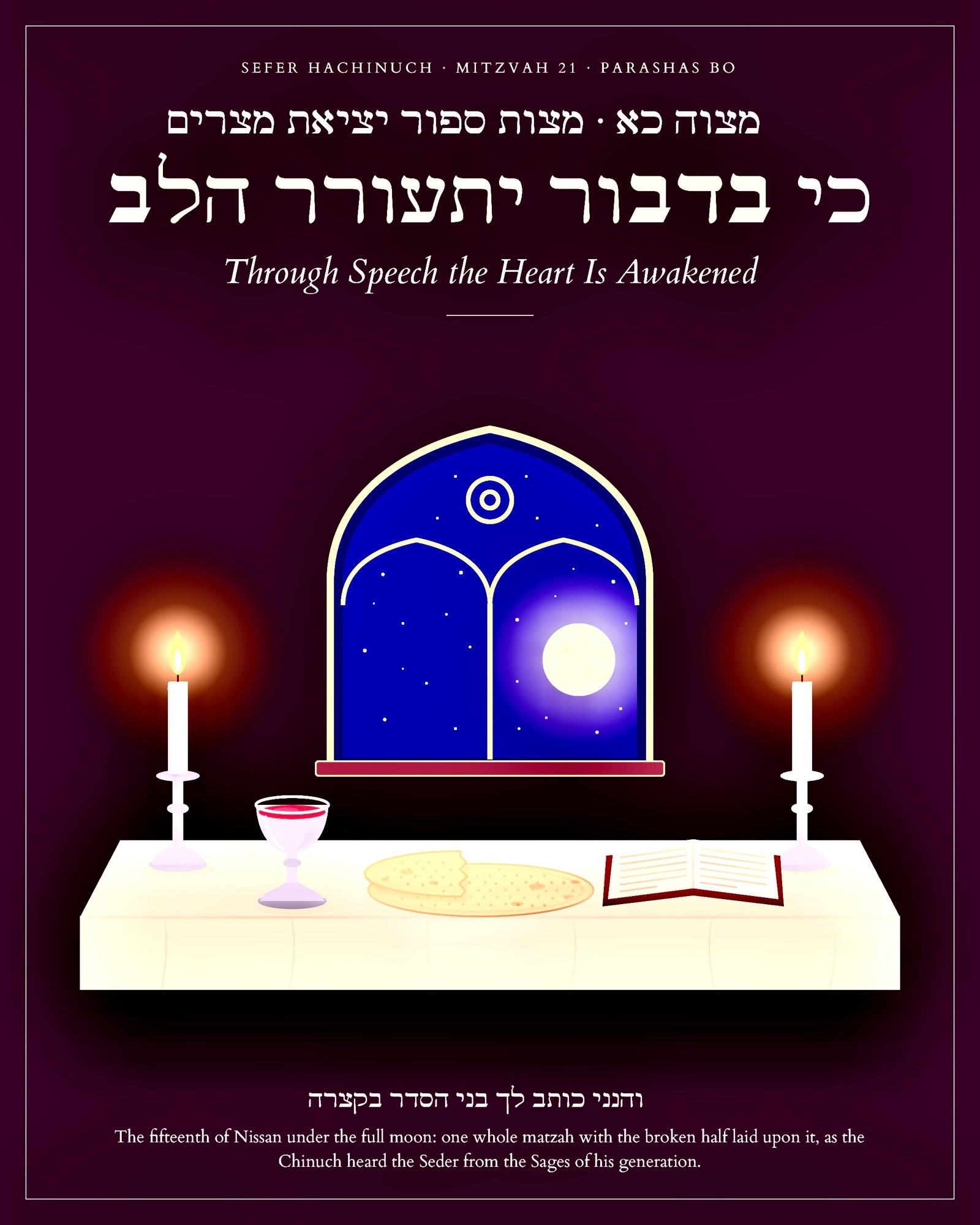
Sefer HaChinuch, Mitzvah 21 — Through Speech the Heart Is Awakened
Nov 26, 2026 · @Kamil Levi Pyka-Penner
An Opening Word
To the rabbanim, rebbeim and scholars who learn Sefer HaChinuch:
Few places in Sefer HaChinuch show as plainly what kind of book it is. Its author writes in a father’s voice, and when he reaches the mitzvah of telling one’s son, he stops to do exactly that: והנני כותב לך בני הסדר בקצרה, כאשר שמעתיו מפי חכמי הדור בדיוק — “And here I write for you, my son, the order of the night in brief, as I heard it from the mouths of the Sages of the generation, precisely.”
This essay reads Mitzvah 21 through that moment. It makes three claims, one for each part of the Chinuch’s treatment:
- The definition. The Chinuch defines the mitzvah as speech and gives speech a purpose: כי בדבור יתעורר הלב, “for through speech the heart is awakened.” That is why even one who sits alone must say the words aloud.
- The shoresh. The Exodus is a standing proof of chiddush ha’olam, of Hashem’s knowledge and of His providence. A proof that is never spoken is never handed on, so the mitzvah takes the form of a telling.
- The dinim and the applicability. The Seder the Chinuch records weaves the telling into the eating. It binds men and women alike, and it stays in force when the korban pesach cannot be brought.
A word on method. In keeping with the aim of this commentary, the essay draws only on sources tied to Sefer HaChinuch: the Chinuch’s own words, in Mitzvah 21 and elsewhere in the sefer; the elucidation and notes of the Schottenstein Edition of Sefer HaChinuch / Book of Mitzvos (ArtScroll/Mesorah), the edition studied here (vol. 1, Mitzvah 21, pp. 178–189); the Minchas Chinuch; and scholarship about the Chinuch itself. Other authorities, from the Rashba and the Ramban to the Shulchan Aruch, appear as that edition’s notes or the Minchas Chinuch present them. Verses are translated from the Hebrew, following the edition’s own renderings where it gives them.
I. The Mitzvah in Its Place
Mitzvah 21 is the last of the Pesach mitzvos in Parashas Bo, and it is the mitzvah in which the Chinuch’s own method becomes his subject.
Its place in the parashah. The Chinuch follows the Rambam’s count of the mitzvos and arranges them by the weekly parashah. Before Mitzvah 21 he has already set out the korban pesach (Mitzvos 5–8 and 13–17), matzah (Mitzvah 10) and the prohibitions of chametz (Mitzvos 9, 11–12 and 19–20). The Schottenstein edition gathers these in its note 6 as the mitzvos that keep the Exodus in memory. Mitzvah 21 turns all of them into one night of speech.
Its form. The entry moves in the sefer’s usual four steps: the definition with its verse (Shemos 13:8); the root, משרשי מצוה זו; the laws, דיני המצוה; and the applicability, ונוהגת בזכרים ונקבות. In the laws he does something unusual. Before sending the reader to the end of Pesachim for the remaining details, he writes out the whole night in order, and addresses it to “my son.”
Its author. He names himself only as איש יהודי מבית לוי ברצלוני, “a Jew of the house of Levi, of Barcelona” (Author’s Introduction). The attribution to R’ Aharon HaLevi of Barcelona goes back to the sixteenth century. It has been doubted because the Chinuch contradicts that sage’s known rulings, and Israel Ta-Shma (1980) proposed his brother, R’ Pinchas HaLevi. Mitzvah 21 adds a detail to the portrait. The author records the Seder “as I heard it from the mouths of the Sages of the generation,” and the Schottenstein notes trace those rulings mainly to the Rashba (note 16).
Its purpose. The introduction states why the book exists: לעורר לב הנער בני והילדים חבריו, “to awaken the heart of the lad, my son, and of the boys who are his friends.” He arranged the mitzvos by parashah so that בכל שבוע ושבוע, each week, after learning the portion, they would count its mitzvos. In his opening letter he hopes that by this order יתעוררו יותר בהן … הנערים, “the youths will be stirred toward them all the more.”
The verb is the one he uses in Mitzvah 21: כי בדבור יתעורר הלב. The book sets out to awaken the heart of a son, and the mitzvah of telling one’s son explains how a heart is awakened. That is why this mitzvah reads as the book’s self-portrait.
II. Kefi Tzachus Leshono: What the Mitzvah Is
The Chinuch defines the mitzvah as speech in one’s own words, with two strands, narrative and praise, fixed to one night and owed to any listener.
The definition. לספר בענין יציאת מצרים בליל חמשה עשר בניסן, כל אחד כפי צחות לשונו, ולהלל ולשבח השם יתברך על כל הנסים שעשה לנו שם — “to tell of the Exodus from Egypt on the night of the fifteenth of Nissan, each person according to the eloquence of his tongue, and to laud and praise Hashem, blessed be He, for all the miracles He did for us there.”
Freedom of form, not of content. The phrase כפי צחות לשונו frees the telling from a fixed formula. The Schottenstein edition supplies the boundary in its note 2. The discussion has required elements (Rambam, Hilchos Chametz U’Matzah 7:4–5), the Haggadah contains them all, and it should be given in a language the participants understand (Rama, Orach Chaim 473:6), with words of one’s own added. The Chinuch grants each father his own voice, not his own story.
Telling and praise are one mitzvah. The definition joins לספר to להלל ולשבח, and the Schottenstein note 3 identifies that praise with the Hallel of the Seder. In the Chinuch’s account the Hallel is not an appendix to the telling but its completion. A recital of miracles that stops short of thanks has not finished the mitzvah he defines.
The time. The verse names no hour, but וכבר פרשו חכמים דמצות הגדה זו היא בליל חמשה עשר בניסן בשעת אכילת מצה: the Sages placed the telling on the night of the fifteenth, “at the time of eating matzah.” The Schottenstein note 4 finds the source in the words בעבור זה, which point to the matzah and maror before the speaker. The Minchas Chinuch reads this as a fixed time rather than a condition: by the Rambam, who allows matzah all night, the telling also runs all night, since מצה ומרור אינו מעכב הסיפור, “matzah and maror do not hold back the telling.” The Torah fixed the night; it did not make the telling wait on the food.
The listener. ומה שאמר הכתוב לבנך, דלאו דוקא בנו, אלא אפלו עם כל בריה — “and when the verse says ‘your son,’ it does not mean his son alone, but even any person at all.” The Schottenstein elucidation traces this to the Mechilta of R’ Shimon bar Yochai, and its note 5 adds that one who has a son must still tell him. The son is the model listener, not the limit of the mitzvah.
The content. וענין המצוה, שיזכר הנסים והענינים שארעו לאבותינו ביציאת מצרים, ואיך לקח הא-ל יתברך נקמתנו מהן — the miracles, the events, “and how the Almighty, blessed be He, avenged us upon them.” The Chinuch writes justice into the content. The telling is not only that we went free but that wrong was answered, and this prepares the root he gives next, on providence and recompense.
III. Ki Bedibbur Yis’orer HaLev: Speech and the Heart
The Chinuch obligates even a man alone to speak the story aloud, and he grounds the rule in a principle about the heart rather than in a second verse.
The text. ואפלו בינו לבין עצמו, אם אין שם אחרים, חיב להוציא הדברים מפיו, כדי שיתעורר לבו בדבר, כי בדבור יתעורר הלב — “Even when he is by himself, with no one else there, he must bring the words out of his mouth, so that his heart is awakened by the matter, for through speech the heart is awakened.”
A reason where others need a verse. The Minchas Chinuch explains why the Rambam cites two verses for this mitzvah. From Zachor (Shemos 13:3) alone one might think this night is like any other, when a person recalls the Exodus to himself and tells no son. From Vehigadeta (Shemos 13:8) alone one might think the mitzvah applies only when he has a son or someone else to tell: אבל אם הוא ביחידי אינו מצוה, “but if he is alone, it is not a mitzvah.” Hence the Rambam adds Zachor. Of our author he writes, והרהמ”ח כלל כל הדינים בפסוק זה והגדת לחוד, “the author included all the laws in this one verse, Vehigadeta,” and adds that little turns on the difference in practice.
Read with that comment, the Chinuch’s move is clear. He keeps the solitary man inside Vehigadeta and supplies a reason instead of a verse. The telling faces outward, toward a son or any listener, but its first listener is the speaker’s own heart.
Not a bar to hearing. The Minchas Chinuch also notes that here, as in other mitzvos of speech such as Bircas HaMazon, א’ מוציא חבירו: one person may discharge another. The Chinuch’s demand for one’s own words is stated for the man with no one else present. At a full table, the ordinary rule of discharging another still applies.
The same doctrine elsewhere in the sefer. The Chinuch’s best-known statement of it comes five mitzvos earlier, at the bone of the korban pesach (Mitzvah 16): דע, כי האדם נפעל כפי פעולותיו, ולבו וכל מחשבותיו תמיד אחר מעשיו, “know that a person is shaped by his actions, and his heart and all his thoughts always follow his deeds.” He sums it up there: כי אחרי הפעולות נמשכים הלבבות, “for hearts are drawn after actions.”
At the recital over the first fruits (Mitzvah 606), he applies the same law to speech: לפי שהאדם מעורר מחשבותיו ומצייר בלבבו האמת בכח דברי פיו, “for a person awakens his thoughts and pictures the truth in his heart by the power of the words of his mouth.” That recital is itself a short telling of the descent to Egypt and the redemption.
Three passages yield one doctrine. Deeds draw the heart (Mitzvah 16), and speech is the deed that reaches it most directly (Mitzvos 21 and 606). The verb of Mitzvah 606, מעורר, is the verb of Mitzvah 21 and of the book’s introduction.
IV. The Shoresh: Kadmon, Chafetz, Yachol
For the Chinuch the Exodus is evidence: it proves three beliefs, and the telling keeps that proof in the mouth of every generation.
Why so many mitzvos remember one event. He first ties the root to the korban pesach: משרשי מצוה זו, מה שכתוב בקרבן הפסח, the purpose already given at Mitzvah 5. He then answers the question every reader of Bo will ask: ואין מן התמה אם באו לנו מצות רבות על זה … כי הוא יסוד גדול ועמוד חזק בתורתנו ובאמונתנו, “it is no wonder that many mitzvos came to us for this … for it is a great foundation and a strong pillar of our Torah and our faith.” For that reason we say always, in our blessings and prayers, זכר ליציאת מצרים (the Schottenstein note 7 points to the Kiddush of Shabbos and Yom Tov and the Yom Tov prayers).
The proof. The Exodus is אות ומופת גמור בחדוש העולם, וכי יש אלו-ה קדמון חפץ ויכול: “a complete sign and wonder that the world was created, and that there is a God Who is primordial, Who wills and Who is able.” He made all that exists and can change it whenever He wishes, as He did in Egypt, ששנה טבעי העולם בשבילנו, “when He changed the natures of the world for our sake.” The conclusion has three clauses, and the Schottenstein elucidation sets each against a mistaken belief of the time:
The mistaken belief (Schottenstein elucidation)
The Chinuch’s answer
How the Exodus shows it
The world always existed and has no Creator
משתק כל כופר בחדוש העולם
Only the One Who preceded nature can suspend its laws at will (note 9)
A Creator exists but does not know the particulars of events
מקים האמונה בידיעת השם יתברך
The plagues were foretold and aimed, not random suspensions of nature (note 10)
He knows, but leaves people to chance, without reward or punishment
וכי השגחתו ויכלתו בכללים ובפרטים כלם
The oppressed were saved and their oppressors struck, by design (note 10)
One may read the three predicates against the three errors. The Primordial One is the Creator, against an eternal world. The One Who wills attends to what He made, against a Creator indifferent to particulars. The One Who is able acts on what He knows, against a world left to chance.
From open miracles to hidden ones. The Schottenstein Insight B calls the Chinuch’s root “a short synopsis” of the Ramban’s exposition at the close of Parashas Bo (Shemos 13:16). Its key line, as Insight B gives it: ומן הנסים הגדולים המפורסמים אדם מודה בנסים הנסתרים שהם יסוד התורה כלה, “through the great, public miracles a person comes to acknowledge the hidden miracles, which are the foundation of the whole Torah.” Insight B explains that the Torah’s promises of rain in its season and of health assume such hidden miracles, since no law of nature ties rainfall to righteousness.
The Chinuch’s last words, בכללים ובפרטים כלם, carry that whole teaching. Providence reaches general matters and every particular. The telling is how one open miracle, on one night, becomes the lens for the hidden ones of every day.
Why the proof must be spoken. A proof persuades only when it is stated, and the Chinuch has already said what stated words do: they awaken the heart. The shoresh supplies the evidence; the definition supplies the means by which evidence becomes conviction. That is why the root of this mitzvah could not be met by silent remembrance.
V. The Dinim: The Seder “As I Heard It”
The Chinuch’s Seder preserves the practice of the Sages of his generation, chiefly the Rashba, and the Schottenstein notes mark each point where our practice has moved.
A record, not a code. והנני כותב לך בני הסדר בקצרה, כאשר שמעתיו מפי חכמי הדור בדיוק. The Schottenstein note 16 traces these laws mainly to the Rashba (Teshuvos HaMeyuchasos LeRamban §202). Its preface to the section cautions that prevalent practice often follows other authorities, and that the Seder is rich in custom, each community and family keeping its own. For the scholar, the passage is a dated witness to the Seder of thirteenth-century Barcelona. For the rebbe, it is a model of transmission: say what you heard, and from whom.
Where the Chinuch’s Seder differs from ours, in the order of the night:
Point in the Seder
The Chinuch’s Seder
Prevalent practice, per the Schottenstein notes
Before Kiddush
Wash one hand, without a blessing, to hold the cup (Rashba)
No washing; the Seder opens with Kiddush (OC 158:6; notes 17–18)
Before karpas
Wash both hands with the blessing al netilas yadayim, as for any food dipped in liquid (Rashba)
Wash without the blessing (OC 158:4 with MB §20, and 473:6; note 20)
Karpas
Dipped in charoses (Rashba and Rambam)
Dipped in vinegar, wine or saltwater, most widely saltwater (OC 473:6 with MB §44; note 21)
After the karpas
Borei nefashos deferred until after the maror, covering both
Less than a kezayis of karpas; no borei nefashos after karpas or maror, since Bircas HaMazon covers them (note 23)
Breaking the matzah
Not mentioned; no Yachatz or Ha Lachma Anya in his account
Middle matzah broken, larger piece kept for the afikoman, Ha Lachma Anya recited (OC 473:6 with MB §58; note 24)
Second cup
Wash one hand again; no borei pri hagafen, since Kiddush’s blessing covers it
No washing (note 27); Sephardim likewise omit the blessing (OC 474:1), Ashkenazim bless each cup (Rama; note 28)
Matzos
One whole matzah and one broken piece (Rashba)
Three matzos (OC 473:4 and 475:1; note 31)
Fourth cup
No borei pri hagafen; Al HaGefen after it, unless a fifth cup is planned
Ashkenazim bless (note 51); no fifth cup is drunk (OC 481:1; note 52)
OC = Shulchan Aruch, Orach Chaim; MB = Mishnah Berurah.
The telling does not interrupt the eating. The Chinuch requires borei pri ha’adamah over the karpas and none over the maror, לפי שנפטרה בברכה שברכו בירק תחלה, “since it was exempted by the blessing made over the vegetable at the start.” Between the two lie the whole Haggadah and the first part of Hallel. A break, he shows from the Gemara (Pesachim 103b), needs two things together: שיעקר האדם דעתו מן הענין, that the person turn his mind from the matter, as when diners say “give us the cup and let us bless”; and שלא יהא באפשר לעשות שני הדברים ביחד, that the two acts cannot be done at once, as with drinking and reciting Bircas HaMazon (Chullin 87a). The Schottenstein note 41 applies it: the Haggadah meets the second condition, since no one can eat and tell at once, but not the first, since no one has decided to stop eating.
In the Chinuch’s halachic structure, then, the telling sits inside the eating rather than interrupting it. The table stays set, the eating stays open, and the story is told over the food. His definition said as much: the telling belongs בשעת אכילת מצה.
One night, two blessings on the wine. His summary draws the same picture: נמצא לפי זה שאין מברכין בורא פרי הגפן אלא תרי זמני, על כוס הקדוש ועל כוס הברכה, ועל הגפן פעם אחת, אחר כל הכוסות. Only Bircas HaMazon divides the night’s wine in two (note 48). Everything else, the Haggadah included, is one continuous act of eating and drinking.
The taste that stays. After the afikoman, eaten זכר לפסח שהיה נאכל על השבע, nothing more is eaten, שלא לסלק טעם המצה מן הפה, “so as not to remove the taste of the matzah from the mouth,” as it is written, מדבש לפי, “more than honey to my mouth” (Tehillim 119:103). Water is permitted, since it does not dull the taste. The last two cups are drunk all the same, כי לא נדחה מצוה מטעם זה: one mitzvah is not set aside to keep the taste of another (note 46).
The mitzvah opens with words that must leave the mouth, להוציא הדברים מפיו, and closes with a taste that must stay in it. The mouth that told the story keeps its taste all night.
Reclining. וארבע הכוסות ומצה דמצוה צריכין הסבה: the four cups and the matzah of the mitzvah require reclining. For the remaining details he sends the reader to the end of Pesachim.
VI. Applicability: Men and Women, Every Place and Time
The Chinuch obligates women without a word of explanation, and the answers offered on his behalf show how tightly the telling is bound to the matzah.
The text. ונוהגת בזכרים ונקבות, בכל מקום ובכל זמן. ועובר עליה בטל עשה.
The question. The Minchas Chinuch (Mitzvah 21, §10 in the numbering the Schottenstein Insight A cites) asks למה תהיה נוהגת מצוה זו בנשים: why should a positive mitzvah bound to a time bind women, who are ordinarily exempt? Women’s obligation in matzah has its own source, since Scripture links matzah to the prohibition of chametz, which binds women (Mitzvah 10). No such link is written for the telling. The Minchas Chinuch concludes only that מדרבנן בוודאי גם נשים חייבות: women are certainly obligated by Rabbinic law, as they are in the four cups and Hallel.
The Rabbinic answer. Insight A gives the reasoning of the Chayei Adam (130:12). Women drink the four cups because אף הן היו באותו הנס (Pesachim 108b), and since the cups must be drunk at their places in the Seder, the Sages bound women to the telling that frames them. Many Rishonim (Tosafos, Pesachim 108b and Megillah 4a) hold that such reasoning yields only a Rabbinic duty. The Chinuch, with his ועובר עליה בטל עשה, seems to speak of more.
The Biblical answer. R’ Yaakov Yisrael Kanievski (Kehillos Yaakov HaChadashim, Moed §108), as Insight A presents him, starts from the name לחם עני, read as לחם שעונין עליו דברים הרבה, “bread over which many things are said” (Pesachim 36a). The telling is then a condition of the mitzvah of matzah: the matzah one eats must be matzah over which the story was told. Women, Biblically obligated in matzah, are bound to the telling as part of eating it. Insight A adds R’ Moshe Feinstein’s practice (Igros Moshe, Orach Chaim V, 16:4) of setting out several sets of matzos, so that each person’s matzah lies on the table during the telling.
Insight A also cites R’ Y. F. Perla’s suggestion that Rav Saadiah Gaon and the Halachos Gedolos do not count the telling among the 613 because they see it as ancillary to matzah. The Chinuch, following the Rambam’s count, lists it as a mitzvah of its own.
Two directions of dependence. Set beside the Minchas Chinuch’s reading of the time (section II), the picture sharpens. For the Minchas Chinuch, matzah and maror do not hold back the telling. For the Kehillos Yaakov, the telling is a condition of the matzah. The two need not conflict, since the dependence runs one way. The Chinuch’s own phrase, בשעת אכילת מצה, is the thread the Kehillos Yaakov pulls, and the halachah of hefsek in section V shows the same weave from the side of the blessings.
Every place and every time. The Schottenstein note 56 glosses בכל מקום ובכל זמן: in Eretz Yisrael and abroad, whether or not the Beis HaMikdash stands. Here lies the quiet center of the mitzvah. Its root, the Chinuch said, is the root of the korban pesach, yet the offering cannot be brought today. The maror that accompanied it is now Rabbinic (note 33), the afikoman is eaten only זכר לפסח, and korech recalls Hillel’s practice in the days of the Temple. The telling stands in full force in every place and time. When the offering ceased, the telling carried its purpose into exile.
VII. Conclusion: The Book as Vehigadeta
Sefer HaChinuch is itself an act of vehigadeta levincha, and Mitzvah 21 is the place where the book says so.
The vocabulary of awakening runs through it. The opening letter hopes the youths יתעוררו, will be stirred. The introduction sets out לעורר לב הנער בני. Mitzvah 21 names the means, כי בדבור יתעורר הלב, and Mitzvah 606 restates it, מעורר מחשבותיו … בכח דברי פיו. A father who holds that speech awakens the heart writes his son a book to be read week by week with the parashah.
For those who teach, the mitzvah carries four lessons, each in the Chinuch’s own words:
- Speak. חיב להוציא הדברים מפיו. A conviction never voiced does not awaken, not even in the one who holds it.
- Speak in your own voice. כל אחד כפי צחות לשונו. The content is fixed; the language should be one the listener understands, with words of one’s own (Schottenstein note 2).
- Teach from evidence. אות ומופת גמור. The Chinuch roots the night’s feeling in a proof of creation, knowledge and providence, and he expects the telling to carry that proof.
- Hand on what you received, precisely, and say from whom. כאשר שמעתיו מפי חכמי הדור בדיוק. Where practice has since moved, say that too, as the Schottenstein notes do.
For the academic reader, Mitzvah 21 is a compact test of the Chinuch’s method. Its theology condenses the Ramban (Insight B), its halachah records the Rashba (note 16), and the pedagogy that binds them, speech forming the heart, is his signature, stated here and at Mitzvos 16 and 606.
The Chinuch asks that the taste of the matzah stay in the mouth all night. He wrote his book so that the words would stay in the heart all year.
Sources
Every source is Sefer HaChinuch itself, a commentary on it, or a study of it. The Chinuch is quoted from the Machon Yerushalayim text printed in the Schottenstein edition. Later authorities (Rashba, Ramban, Chayei Adam, Kehillos Yaakov, Igros Moshe, R’ Y. F. Perla, Tosafos) are cited as that edition’s notes and Insights present them.
- Sefer HaChinuch, Mitzvah 21, with elucidation, notes 1–56 and Insights A–B, in The Schottenstein Edition Sefer HaChinuch / Book of Mitzvos, vol. 1 (Mitzvos 1–65), ArtScroll/Mesorah, 2012, pp. 178–189 (publisher listing)
- Sefer HaChinuch, Author’s Introduction and Opening Letter
- Sefer HaChinuch, Mitzvah 16 and Mitzvah 606
- R’ Yosef Babad, Minchas Chinuch, Mitzvah 21; the passage on women (§10 as Insight A cites it) checked against its quotation in Etzion, “האישה והמצוות”, which numbers it §6
- On authorship: Israel Ta-Shma, “Mechabbero ha-amiti shel Sefer HaChinuch,” Kiryat Sefer 55 (1980), 787–790, as summarized in Sefer ha-Chinuch (Wikipedia)