
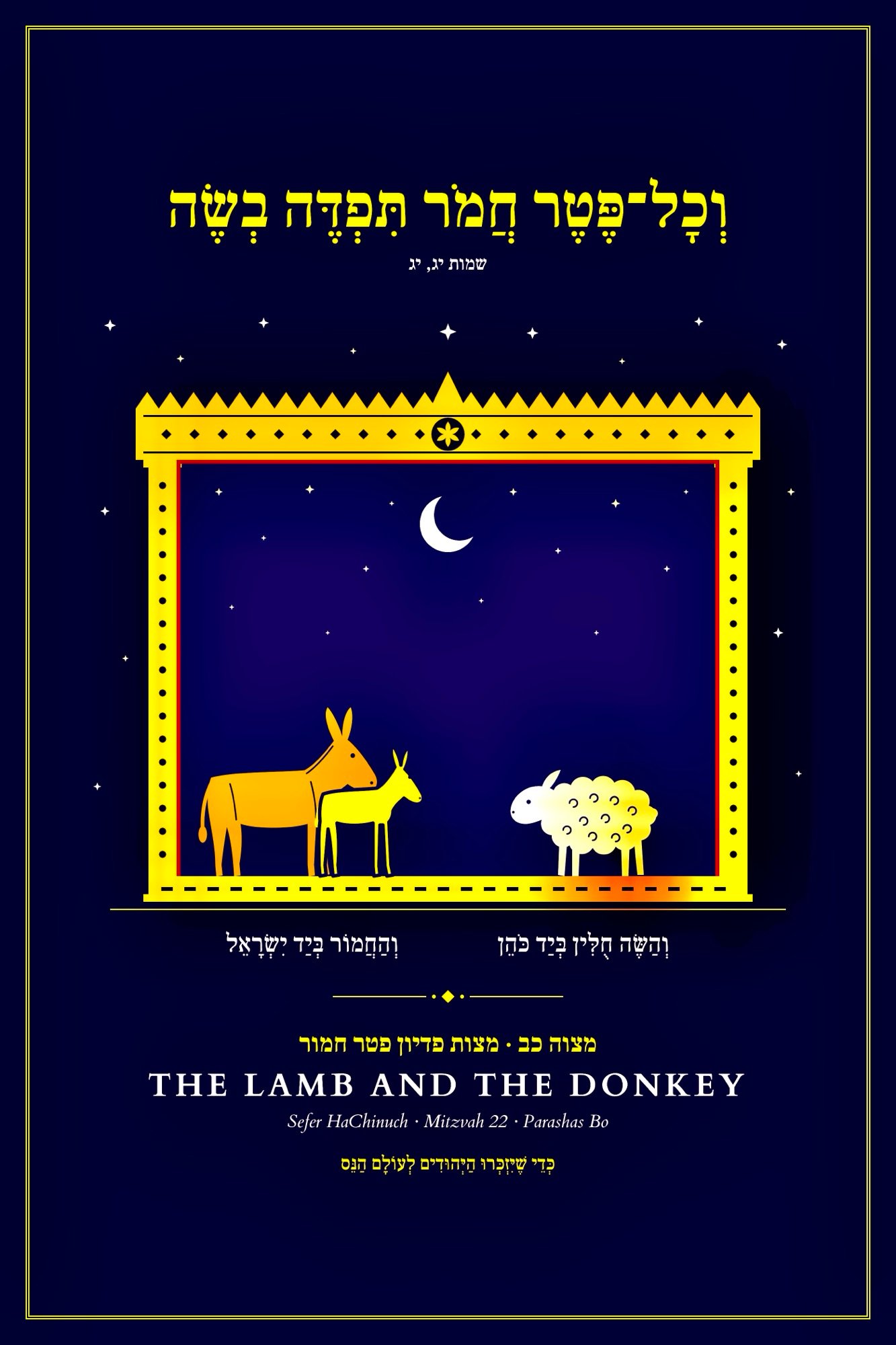
The Light of Redemption and Education: A Rabbinic Commentary on Sefer HaChinuch (The Book of Mitzvos)
The Lamb and the Donkey: Redemption, Gift, and Memory in Sefer HaChinuch, Mitzvah 22
Nov 26, 2026 · @Kamil Levi Pyka-Penner
A commentary for rabbanim, rebbes, and Torah scholars on מצוה כב: מצות פדיון פטר חמור (Parashas Bo)
Introduction
Mitzvah 22 of Sefer HaChinuch, the redemption of the firstborn donkey, runs to some 160 Hebrew words. Its first sentence already joins two ideas that its commentators have had to pull apart: the petter chamor as the Kohen’s due, and the petter chamor as a thing that must be redeemed.
The mitzvah is singular. Of all the impure animals, only the donkey carries the sanctity of the firstborn, as the Chinuch states in Mitzvah 18: “ומכל בהמה טמאה חמור לבד.” Its owner, a Yisrael, gives a שה, a lamb or a kid, to a Kohen in its place. If he will not redeem it, the Torah requires that the donkey be decapitated (Shemos 13:13), which the Chinuch, following the Rambam’s count, makes a separate commandment, Mitzvah 23. In Parashas Bo the redemption stands directly after the mitzvah to tell the story of the Exodus (Mitzvah 21).
This essay argues that the Chinuch’s opening sentence holds both sides of a dispute the Rishonim had already joined. Its first clause makes the donkey the Kohen’s by divine grant: “ולפיכך פודהו הישראל ממנו.” Its second clause makes the redemption itself the point: “כי השם יתברך רצה שיהיה לו פדיון בשה.” The laws he lists show where the two clauses part, a textual crux in his second paragraph suggests which way he leaned, and his shoresh explains why the Torah joined them.
By design, the commentary draws only on Sefer HaChinuch, its commentators, and the Sefer HaMitzvos tradition on which its count rests. Talmudic and codificatory sources appear only as those works cite them. Page and note references are to the Schottenstein Edition, vol. 1, pp. 190–194.
The text and its fourfold form
Mitzvah 22 follows the four movements of every entry in the Chinuch: the commandment with its verse and procedure, the shoresh, a list of laws, and the scope with its penalty.
Part
What the Chinuch says
Key words
Commandment
Redeem the male firstborn of a donkey with a שה given to the Kohen; lacking a שה, the value of one; within thirty days; afterward both animals are chullin
רצה שיהיה לו פדיון בשה
Shoresh
A perpetual memorial of the Exodus, when Egypt’s firstborn, “likened to donkeys,” were slain
כדי שיזכרו היהודים לעולם
Dinim
Seven topics from the first chapter of Bechoros, named but not resolved
ויתר פרטיה מבוארים
Scope
Every place and era; men and women who are Yisraelim; not Kohanim or Leviim; neglect is a ביטול עשה
ולא בכהנים ולוים
The form follows from the book’s purpose. The anonymous author calls himself “איש יהודי מבית לוי ברצלוני” and says he arranged the mitzvos by the weekly portions “לעורר לב הנער בני והילדים חבריו” (introduction). The dinim section shows the method: it names the questions and sends the student to Bechoros for the answers.
The attribution to R. Aharon HaLevi of Barcelona goes back to Gedalyah ibn Yachya in the sixteenth century; Israel Ta-Shma argued instead for his brother, R. Pinchas HaLevi (NLI record). Either way, the author was a Levi, writing about a mitzvah from which his own scope clause exempts him. He could teach it to his son, but its obligation would never fall on either of them.
ולפיכך פודהו הישראל ממנו: gift and redemption
The Chinuch grounds the mitzvah in a chain of ownership, but the laws he summarizes treat the act of redemption and the gift to the Kohen as separable.
The chain is explicit. The firstborn belongs to Hashem “מן הטעם שכתבנו למעלה,” a reference to Mitzvah 18, where the firstborn laws exist “למען דעת כי הכל שלו” (Sefaria). Hashem gave it to the Kohen, “ולפיכך פודהו הישראל ממנו.” On this clause the donkey is, in principle, the Kohen’s, and its owner buys it back.
The next clause does different work: “כי השם יתברך רצה שיהיה לו פדיון בשה.” It does not say why the Kohen receives anything. It says why there must be a redemption at all, and why its medium is a lamb.
The literature on the Chinuch treats these as two conceptions of the mitzvah. Chochmas HaChinuch (R. Elchanan Popko) traces them to a dispute between the Rambam and the Raavad over whether the price of an unredeemed petter chamor is forbidden (Hilchos Bikkurim 12:4 and the Raavad’s gloss). For the Rambam, the essence of the mitzvah is not the gift but the standing of the petter chamor itself, so the owner may decapitate instead, though redemption comes first. For the Raavad, the essence is the gift: redemption is required, and decapitation is no mitzvah at all, only a penalty for withholding the Kohen’s due (on Mitzvah 23).
R. Shmuel Shimoni’s study of the Minchas Chinuch sharpens the point. The Minchas Chinuch (§21) cites the ruling that once the lamb is designated, “חזר הפטר חמור חולין, אפילו קודם שנתנו לכהן,” so the berachah is said at the designation. He asks why, on the Ramban’s principles, redemption and giving are not two mitzvos. As R. Shimoni presents the resolution, the mitzvah is exhausted by the designation, and the giving “אינה אלא השבת ממון לבעליו.” At the opposite pole he places the Radvaz (Responsa 1:496), whose view he calls exceptional: the mitzvah is really to give the Kohen the lamb, or the donkey itself (on Mitzvah 23).
The cases in the Chinuch’s dinim, with the notes of the Schottenstein editors, separate the two acts in practice:
Case
The redemption
The gift to the Kohen
Discussed in
Lamb designated, not yet given
Complete: the donkey is chullin and the berachah is said
Still owed
Minchas Chinuch §21; n. 14
Lamb dies before reaching the Kohen
Complete
Lapses; nothing replaces it
n. 5; Minchas Chinuch §3
Doubtful firstborn
Required, to remove a possible prohibition
Not owed; the owner keeps the lamb
n. 22
Donkey itself given to the Kohen
Still required, by the Kohen, in the owner’s presence
The Kohen holds the donkey
Chinuch’s dinim; n. 23; Minchas Chinuch §16
Owner decapitates instead
Not performed; even the carcass is forbidden
None
Chinuch, Mitzvah 23
The fourth row is decisive. A Kohen holding the donkey might reason that, since the lamb would be his anyway, redemption is superfluous, and the halachah treats him as suspect for exactly that reasoning (n. 23). If the mitzvah were only a transfer of value to the Kohen, there would be nothing left for him to neglect.
The Chinuch, writing about a century after the Raavad, does not choose cleanly. With the Rambam he counts decapitation as a mitzvah, yet he opens with the Kohen’s claim. His sentence is best read as holding both: the gift says who receives, and the divine will says what must be done.
בדמי שה: a textual crux
The Chinuch’s second paragraph says that one who has no lamb redeems the donkey “בדמי שה,” with the value of a lamb, and the Minchas Chinuch held that this reading cannot stand.
The difficulty, as the Schottenstein editors set it out (nn. 9, 11), is twofold. The Gemara the Chinuch cites (Bechoros 11a) says that one without a lamb redeems “בשוויו,” with its value, which other Rishonim take as the donkey’s value. And the valuations the Chinuch attaches, “עין יפה בסלע, רעה בחצי סלע, ובינונית בשלשה זוזים,” belong in the Rishonim to other cases: either the minimum worth of the lamb itself, or the minimum paid in money for a donkey worth less than these sums. In the Chinuch’s sequence, by contrast, the valuations price a lamb that is not there.
The Minchas Chinuch (§4) therefore declares a copyist’s error and would bring the text into line with one of the Rishonim’s approaches; the editors point also to the Minchas Soless and the Minchas Yitzchak. The Asiris HaEifah, R. Shmuel Akiva Schlesinger’s notes to the Minchas Chinuch (cited by the editors as Minchas Chinuch HaShalem, §14), defends the received text: unlike other Rishonim, the Chinuch understood בשוויו in the Gemara as the lamb’s value. The edition photographed here, whose Hebrew text was researched by Machon Yerushalayim, retains בדמי שה.
The question is not only textual. If the received reading stands, the Chinuch is consistent with his own opening, “רצה שיהיה לו פדיון בשה”: even a redemption in money is reckoned in lambs. The lamb is the unit of the mitzvah, not merely its preferred coin. On the other reading, a money redemption pays the donkey’s own worth, as one pays to recover what belongs to another.
The variant thus tracks the two conceptions traced above, and the received text would place the Chinuch with redemption rather than repurchase. This is offered as a suggestion, not a proof. It does show what an emendation can cost: a correction that harmonizes the Chinuch with the Gemara may also erase a position.
Thirty days, decapitation, and בטל עשה
The Chinuch gives the redemption a thirty-day window, counts decapitation as a separate mitzvah, and calls the failure to redeem a ביטול עשה. Each of these statements has needed its commentators.
The thirty days. The Chinuch follows the Rambam in setting the redemption “עד שלשים יום,” while the Tur and Shulchan Aruch set no time; the editors refer to the Beur HaGra for the basis of the dispute (n. 12). The Minchas Chinuch (§1) holds that even after thirty days the obligation stands. The window marks when the mitzvah is properly done, not when it lapses.
Two mitzvos, one choice. In his Sefer HaMitzvos (positive 81–82) the Rambam concedes that his own rules would have merged redemption and decapitation into one mitzvah. He counts two because of the Sages’ phrase “מצות פדיה קודמת למצות עריפה,” which they pair with “מצות יבום קודמת למצות חליצה.” As a yevamah stands for yibum or chalitzah, each a mitzvah, so the petter chamor stands for redemption or decapitation. The Chinuch follows him and lists the Sages’ rule among the laws of Mitzvah 23.
Mitzvah or penalty. The Raavad, as noted, held that decapitation is only a penalty. The Chinuch’s own wording in Mitzvah 23 carries a penal note as well: Hashem decreed that the owner may not benefit from the donkey, since he did not redeem it. According to R. Shimoni, the Minchas Chinuch shows from this wording that the Chinuch held both the penalty and the priority of redemption, without contradiction.
The berachah. The Minchas Chinuch adds that a mitzvah whose very choice is problematic received no berachah. One blesses on redemption and on yibum, never on decapitation or chalitzah (Shulchan Aruch YD 321:6; Rama EH 166:9, as cited by R. Shimoni).
Does choosing decapitation violate Mitzvah 22? One who does neither has certainly transgressed. Whether one who decapitates instead of redeeming has also violated the mitzvah is debated by the Minchas Chinuch (§22), the Minchas Soless, and the Chazon Ish (n. 28). R. Shimoni suggests that where an owner has neither a lamb nor its value, decapitation may itself become the obligatory mitzvah. The Chinuch’s formula, “ועובר עליה בטל עשה,” leaves the question open.
The boundaries of the obligation
The seven topics of the Chinuch’s dinim each mark a boundary of the obligation: ownership, species, certainty, and agency. The scope clause adds lineage.
- Ownership. If a non-Jew owns any share of the mother or the offspring, even a single limb whose loss would disqualify an offering, the firstborn is exempt; so too when a Jew takes a donkey from a non-Jew to raise for a share of its young (nn. 17–18). A female bought from a non-Jew may already have given birth, so her first male may be only a doubtful firstborn (n. 21). A non-Jew’s own designation has no effect, and he is told so, lest he see a Jew use the animal and conclude that Jews are careless with holy things (n. 19, citing the Shach).
- Species. An offspring that looks like a horse raises the question of whether it is a donkey at all, and the Rambam, the Rosh, the Shulchan Aruch and the Chazon Ish draw the line differently (n. 20).
- Certainty. A doubtful firstborn is redeemed, but the owner keeps the lamb (n. 22).
- Agency. The donkey may be handed to the Kohen only if he redeems it in the owner’s presence (n. 23).
- Lineage. The mitzvah binds women as well as men, since it is not bound to a time (n. 26, citing Minchas Chinuch §18). It does not bind Kohanim or Leviim, and a Kohen’s or Levi’s share in the animal exempts it (n. 27).
The boundaries converge on one point: the mitzvah arises only where an Israelite’s full ownership meets a certain donkey firstborn. In Mitzvah 18 the Chinuch already classes these laws among the mitzvos “שחייבה בסבת דבר,” obligations that arise only through a circumstance (Venice-order text).
The scope clause adds “בכל מקום ובכל זמן”: in the Land and outside it, with or without the Mikdash (n. 25). The Chofetz Chaim’s Sefer HaMitzvos HaKatzar accordingly counts it among the positive mitzvos that can be kept today (OU Torah). Of the kosher firstborn outside the Land, by contrast, the Chinuch writes in Mitzvah 18, “שאין לנו מקדש”: by one view it is shut in until it dies, by another it is kept and eaten only if it becomes blemished. In exile the impure animal’s mitzvah remains whole, while the pure animal’s cannot be completed.
The shoresh: memory, the donkey, and the son’s question
The Chinuch roots the mitzvah in memory: “כדי שיזכרו היהודים לעולם הנס שעשה להם האל ביציאת מצרים, שהרג כל בכוריהם שנמשלו לחמורים.”
Mitzvah 18 had given the firstborn laws three roots: that all is Hashem’s, that the first fruit of one’s labor is brought “לרשות בוראו,” and “לזכר הנס הגדול” of the plague of the firstborn. Mitzvah 22 builds its procedure on the first and takes the third as its root.
Why a donkey? The Chinuch’s phrase “שנמשלו לחמורים” alludes to Yechezkel’s comparison of Egypt to chamorim (23:20). The editors (n. 15) add the Maharal’s reading in Gevuros Hashem (ch. 37): חמור is related to חומרי, the material, and the most earthly of creatures was a fitting figure for ancient Egypt’s devotion to the physical. The Israelite’s donkey thus stands for what Egypt was.
“כמו שכתוב” points, as the editors suggest (n. 16), to the verses that follow the mitzvah in the Torah:
והיה כי ישאלך בנך מחר לאמר מה זאת ואמרת אליו בחזק יד הוציאנו ה׳ ממצרים מבית עבדים (שמות יג:יד)
“And it shall be when thy son asketh thee in time to come, saying: What is this? that thou shalt say unto him: By strength of hand Hashem brought us out from Egypt, from the house of bondage.” (JPS 1917, with “Hashem” for the Divine Name)
The next verse ties the firstborn laws to the slaying of Egypt’s firstborn. The Torah thus frames the petter chamor as a question a child will ask. The Chinuch, written “לעורר לב הנער בני,” sets it directly after Mitzvah 21, where the author turns to his son: “והנני כותב לך בני הסדר בקצרה” (as quoted in Chochmas HaChinuch).
In Mitzvah 16, again addressing “בני,” the Chinuch explains why the Torah multiplied commemorations of the Exodus: “דע כי האדם נפעל כפי פעולותיו … כי אחרי הפעולות נמשכים הלבבות.” Mitzvah 22 applies that principle to a man’s livestock. The memory returns whenever a donkey first gives birth, at no fixed season, and each time it costs the owner a lamb.
A further observation, offered for consideration. In Parashas Bo the word שה first appears with the Korban Pesach: “שה תמים זכר בן שנה יהיה לכם מן הכבשים ומן העזים תקחו” (שמות יב:ה). The editors define the שה of our mitzvah the same way, as a lamb or a kid (n. 3). The reader who follows the Chinuch’s order has just studied the Korban Pesach in the mitzvos that open the parashah. He now sees the night of the plague re-enacted in his own stable: with a שה the firstborn lives, as Israel’s firstborn lived under the sign of the Pesach blood; without one, it is decapitated, as Egypt’s firstborn died. The Chinuch does not draw this parallel, but his order invites it.
The commandment’s last line completes the picture: “והשה חולין ביד כהן, והחמור ביד ישראל.” After the redemption neither animal is holy, and the petter chamor never had intrinsic sanctity (n. 14). What the Torah required was the act, and the act is the memory.
Conclusion
The Chinuch’s entry holds in one sentence what its commentators separate into two: a Kohen’s gift and a Yisrael’s act of redemption.
The laws show that the redemption can stand without the gift, as with a doubtful firstborn or a lamb that dies, and that the gift cannot stand in for the redemption, as the Kohen who receives the donkey learns. The crux of בדמי שה suggests that the Chinuch reckoned even a money redemption in lambs. The boundaries of the obligation make it a mitzvah of the Israelite household, and its scope keeps it alive in every place and era.
The shoresh explains why the strands were joined: the gift honors the Kohen, and the act preserves the memory. For rabbanim and rebbes the entry is also a model of the Chinuch’s method: a strange act, a short reason, and a set of questions handed to the student for the Gemara.
Questions for further study (לעיון)
- Does “ולפיכך פודהו הישראל ממנו” give the Kohen a property right in the petter chamor before redemption? How would that fit the Rambam’s ruling that the price of an unredeemed petter chamor is forbidden?
- If the received text בדמי שה stands, may one with no lamb redeem a valuable donkey for three zuzim, where the emended text would require the donkey’s worth?
- Do the manuscripts of the Chinuch support בדמי שה, which the Machon Yerushalayim text retains?
- If the mitzvah is fulfilled at designation, is giving the lamb a mitzvah at all, or only a debt, “השבת ממון לבעליו”? What follows for a Kohen who waives it?
- The Chinuch gives decapitation (Mitzvah 23) the same root as redemption: “מה שכתוב בפדיה.” How can one shoresh serve both the preferred path and the disfavored one?
Sources
By design, the sources are limited to Sefer HaChinuch, its commentators, and the Sefer HaMitzvos tradition. Talmudic and codificatory references appear only as these works cite them.
Sefer HaChinuch and its edition
- Sefer HaChinuch, Mitzvos 16, 18, 21, 22, 23, and the author’s introduction: Mitzvah 18, Mitzvah 22 and Mitzvah 23 on Sefaria; Mitzvah 18 in the Venice order on Wikisource; the author’s introduction.
- The Schottenstein Edition Sefer HaChinuch / Book of Mitzvos, vol. 1 (ArtScroll/Mesorah), pp. 190–194, notes 1–28.
Commentators on the Chinuch
- Minchas Chinuch (R. Yosef Babad), Mitzvah 22 §§1, 3, 4, 16, 18, 21, 22, and Mitzvah 23 §1, as cited in the edition’s notes and in R. Shimoni’s studies.
- Asiris HaEifah (R. Shmuel Akiva Schlesinger), Mitzvah 22 §14, as cited in n. 9; catalog record of the Oraysa edition.
- Minchas Soless and Minchas Yitzchak, as cited in nn. 11 and 28.
The Sefer HaMitzvos tradition
- Rambam, Sefer HaMitzvos, positive mitzvah 82, with positive 81.
- Chofetz Chaim, Sefer HaMitzvos HaKatzar, as cited by R. Jack Abramowitz, “That’s Different” (OU Torah).
Studies of the Chinuch
- R. Shmuel Shimoni, עיונים במצוות בעקבות המנחת חינוך: Mitzvah 22 and Mitzvah 23 (Yeshivat Har Etzion VBM).
- R. Elchanan Popko, חכמת החינוך: Mitzvah 21, Mitzvah 22 and Mitzvah 23 (Yeshiva.org.il).
- On the author: I. Ta-Shma, “מחברו האמיתי של ספר החינוך,” Kiryat Sefer 55 (5741), pp. 787–790, as cited in the NLI record; Jewish Encyclopedia, “Aaron ha-Levi of Barcelona”.
Verse translation
- Shemos 13:14 in JPS 1917.
Appendix: the Hebrew text of Mitzvah 22
As printed in the Schottenstein Edition, vol. 1, pp. 190–194, without vowels and in plene spelling.
מצוה כב: מצות פדיון פטר חמור
לפדות ולד חמור זכר שנולד ראשון, שנאמר (שמות יג, יג) וכל פטר חמור תפדה בשה. וענינה הוא, שלוקח הישראלי שה אחד ונותנו לכהן בפדיון בכור החמור, שהוא לשם יתברך מן הטעם שכתבנו למעלה, והוא ברוך הוא נתנו לכהן, ולפיכך פודהו הישראל ממנו, כי השם יתברך רצה שיהיה לו פדיון בשה.
ואם אין לו שה פודהו בדמי שה, ולפי שאין דמי השיות שוין, אמרו רבותינו זכרונם לברכה (בכורות דף יא ע״א), עין יפה בסלע, רעה בחצי סלע, ובינונית בשלשה זוזים. וזמן הפדיון עד שלשים יום. והשה חולין ביד כהן, והחמור ביד ישראל.
משרשי מצוה זו, כדי שיזכרו היהודים לעולם הנס שעשה להם האל ביציאת מצרים, שהרג כל בכוריהם שנמשלו לחמורים (יחזקאל כג, כ), כמו שכתוב (שמות יג, יד–טו).
דיני המצוה, כגון שותפות הגוי או מקבל חמור ממנו להטפל בו, ודין גוי שהפריש פטר חמור מה דינו, ודין חמור שילדה כמין סוס, ודין לוקח חמור מגוי, וענין ספק אם בכרה מה דינו, ודין נותן החמור בעצמו לכהן, ויתר פרטיה, מבוארים במסכת בכורות (פרק ראשון).
ונוהגת בכל מקום ובכל זמן, בזכרים ובנקבות ישראלים, ולא בכהנים ולוים. ועובר עליה, בטל עשה.