
The Light of Redemption and Education: A Rabbinic Commentary on Sefer HaChinuch (The Book of Mitzvos)
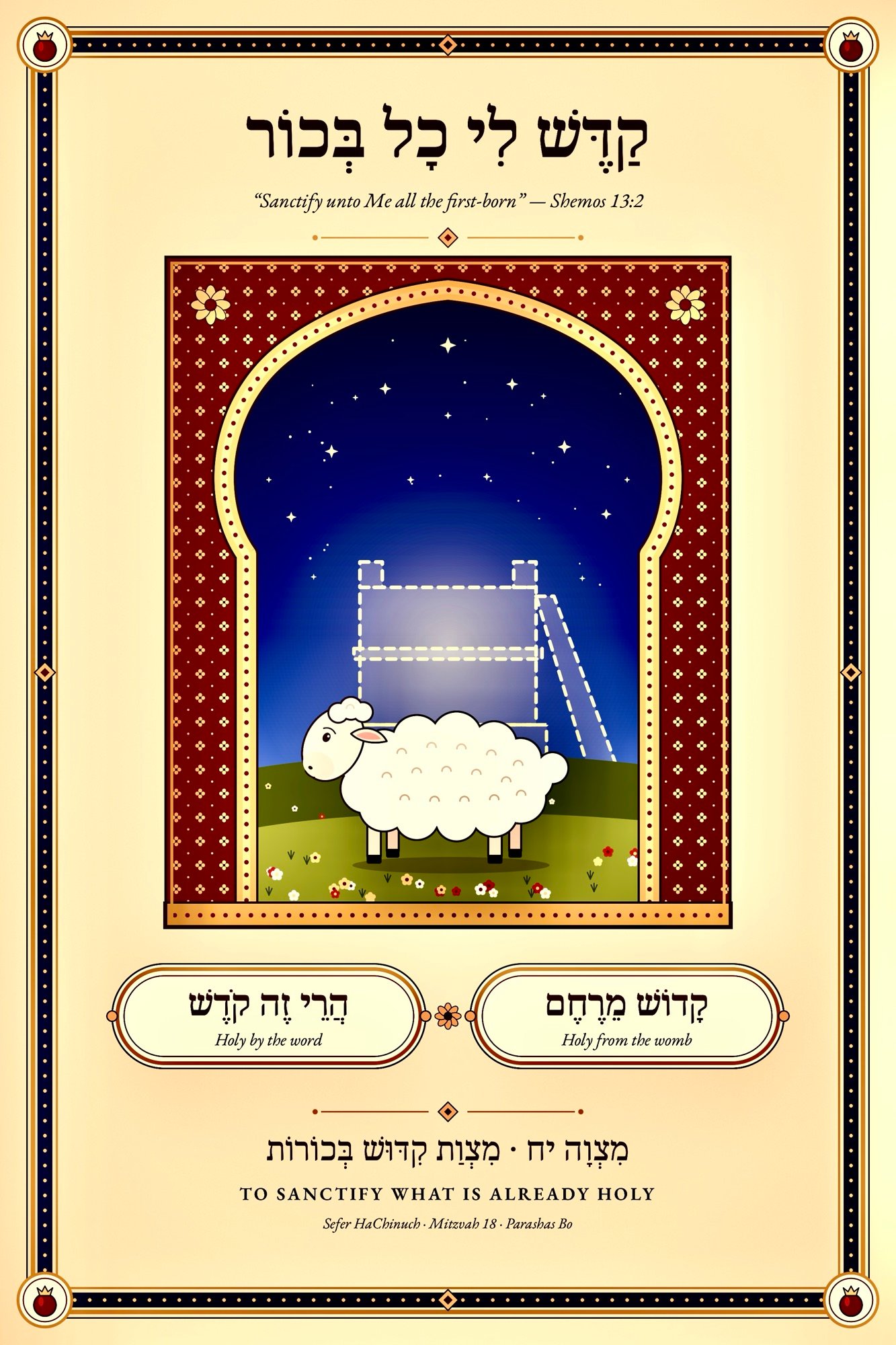
To Sanctify What Is Already Holy
Sefer HaChinuch, Mitzvah 18 — מצות קידוש בכורות
Nov 24, 2026 · @Kamil Levi Pyka-Penner
The Question Hidden in a Single Word
To the rabbanim and rebbes, and to colleagues who study Sefer HaChinuch in the beis midrash and in the academy.
The Chinuch’s first sentence on the firstborn turns a command to act into a statement of status, and that turn frames everything that follows in Mitzvah 18. He writes:
לקדש הבכורות, כלומר שיהיו כל הולדות הנולדים בראשונה… בין באדם בין בבהמה, הזכרים קדש לשם
“To sanctify the firstborn: that is to say, that all offspring born first, whether of man or of beast, the males, shall be holy to Hashem.”
The verse he cites addresses a human agent: קדש לי כל בכור, “Sanctify unto Me all the first-born” (Shemos 13:2). Yet his gloss does not say “that you shall make them holy.” It says “that they shall be holy.” The single word כלומר carries an interpretive decision.
The decision reflects the halachah. The firstborn of a kosher animal is קדוש מרחם, holy from the womb: from the moment of birth it stands under the laws of a consecrated animal (Arachin 29a). Minchas Chinuch (§1), as the notes to the elucidated edition present him, observes that the verse in Shemos speaks of every firstborn, human and donkey included, and so cannot be the source of a verbal consecration. The mitzvah it yields is a command to treat the firstborn according to a sanctity already present (Me’il HaEphod; see Rambam, Hilchos Bechoros 1:1).
Yet a few lines later the Chinuch writes of the kosher animal: שמצוה על הבעלים להקדישו ולומר הרי זה קדש, “there is a mitzvah upon the owner to consecrate it, and to say: This is holy.” That verbal consecration rests on a different verse, Devarim 15:19, where the Torah says of the firstling males תקדיש, “thou shalt sanctify” (Arachin 29a); and it concerns the kosher animal alone. Within one paragraph, the Chinuch moves from holiness as status to holiness as speech: from what Hashem has already done to what the owner must still say.
This essay argues that the double movement is not a loose end but the organizing tension of the mitzvah. Holiness that is immediate and given, and holiness that unfolds through human agency and through time, meet at every stage: in the mitzvah’s scope, in the timing of the gift, in the debate over the owner’s declaration, in the law of the firstborn in our own day, and in the Chinuch’s account of its root.
One Verse, Three Firstborn
The verse embraces every firstborn, but the Chinuch’s practical discussion develops only one of them: the firstborn of a kosher animal. “Beast,” he specifies, means only the domesticated species, cattle, sheep and goats, and not the chayah; the notes ground this limit in Bamidbar 18:15 and the Sifrei there, which confine the sanctity of the firstborn to animals fit for the Altar. Of the non-kosher animals, only the donkey is included (Bechoros 5b–6a, cited in the notes).
The other two he defers. The firstborn son and the firstborn donkey, he writes, will be explained “in the mitzvah of redemption that belongs to each”: the eighth positive commandment of this seder (Mitzvah 22) and the second of Seder Vayikach Korach (Mitzvah 392). The notes add that this per-seder count preserves the author’s original numbering, and that the consecration of the kosher firstborn and the observance of its laws form a single mitzvah, while the human and the donkey, though named in the same passage, are counted separately.
Chochmas Chinuch (R’ Elchanan Poupko) gives a reason for this arrangement. The Torah commands the redemption of the human firstborn and of the donkey on their own, in other passages (Shemos 13 and 34). The sanctity of the animal firstborn is the one element commanded only here. That is why the Chinuch, like the Rambam (Sefer HaMitzvos, Asei 79), sets out the laws of the kosher firstborn under this commandment, though its title covers kiddush bechoros as a whole.
The result is one declaration of Divine ownership, לי הוא, “it is Mine,” answered in two modes. The kosher firstborn is given: its blood and fats go upon the Altar, and its meat is eaten by Kohanim in Yerushalayim (Bamidbar 18:15, 17; Zevachim 56b). The firstborn son and the firstborn donkey are bought back, and a donkey that is not redeemed is subject to arifah (Mitzvos 22–23). The Chinuch’s title names the shared root; his כלומר names the shared status; and his practical discussion follows the one branch in which sanctity runs its whole course, to the Altar.
Sanctity and Gift: The Kohen’s Own Firstborn
A ruling in the section on applicability shows that the firstborn’s sanctity does not depend on its being a gift. The mitzvah binds men and women alike, and Yisraelim, Kohanim and Leviim alike (Mishnah Bechoros 13a; Rambam, Hilchos Bechoros 1:7). Then the Chinuch adds:
ואף על פי שהבכור שנולד לכהן שלו הוא, מכל מקום חייב להקריב חלבו ודמו, ויאכל הבשר בתורת בכור
“Although the firstborn born to a Kohen is his own, he is nevertheless obligated to offer its fats and its blood, and he eats the meat under the law of a firstborn.”
Redemption runs the other way. The redemption of the human firstborn and of the donkey, the Chinuch writes, does not apply to a Kohen or a Levi at all; he defers the explanation to Mitzvos 22 and 392. Where the claim of the firstborn is discharged through redemption, Kohanim and Leviim stand outside it. Where it is discharged through the Altar, no one stands outside it, not even the Kohen for whom the gift has become moot.
The asymmetry suggests that the kosher firstborn carries two layers: a sanctity that leads to the Altar, and a gift that belongs to the Kohen. For the Kohen-owner the gift collapses into his own possession, but the sanctity remains whole. The gift follows from the sanctity; it is not its substance.
Chochmas Chinuch frames the same distinction as a question about the owner’s declaration. Does הרי זה קדש address only the animal’s sanctity as an offering, or also its character as a priestly gift? The practical difference he names is the blemished firstborn, which has no law of offering and need only be given to the Kohen. If the declaration belongs to the offering alone, in such an animal it has nothing to address.
At Once to Hashem, in Time to the Kohen
The law of delivery brings in the mitzvah’s first deliberate delay. The owner does not hand the firstborn to a Kohen at birth:
ואינו נותנו לו מיד שיולד אלא מטפל בו, בבהמה דקה שלשים יום, ובגסה חמשים יום
“He does not give it to him immediately when it is born, but tends it: a small animal for thirty days, and a large one for fifty” (Mishnah Bechoros 26b).
The reason the notes record, from the Rambam’s commentary to the Mishnah, is the dignity of the recipient. Gifts to Kohanim are presented as one presents a gift to a king, and a newborn that still needs constant care is a burden rather than an honor. From the same reasoning the Gemara there draws a sharp corollary.
A Kohen may ask for the animal early, and ordinarily the owner may oblige. But when an unblemished firstborn cannot be slaughtered until it is blemished, as in our time, an early request amounts to an offer to tend the animal in return for receiving it. A Kohen may not take his gifts as payment for service. The halachah keeps the gift from becoming a wage.
Now set this law beside the Chinuch’s account of the root, two pages later. Of the person who has toiled and at last sees the first of his fruit, he writes: מיד נותנו להקדוש ברוך הוא, “he immediately gives it to the Holy One, blessed be He.” The same verb and the same adverb appear in both passages, in opposite polarity: אינו נותנו לו מיד in the law, מיד נותנו להקב”ה in the root.
The two statements fit once the recipients are distinguished. To Hashem the firstborn is given at once, for it is holy from the womb. To the Kohen it is given in time, when the gift has become worthy of him. Between the two moments stands the owner, tending an animal that is no longer, in the deepest sense, his own.
The root speaks of a person who “toiled many toils and labored many labors” (יגע… כמה יגיעות וטרח כמה טרחים) until his work bore fruit. The law adds that his toil does not end with the giving: for thirty or fifty days he is מטפל בו, a steward of what already belongs to Heaven. It would be hard to devise a more concrete lesson in the Chinuch’s own words, that a person has nothing in the world except what Hashem, in His kindness, apportions to him.
The Owner’s Word: Avowal or Consecration?
The question the opening כלומר leaves open is posed directly in the Insight the elucidated edition appends to this mitzvah: if the firstborn is holy from the womb, what does the owner’s declaration accomplish? How does one consecrate what is already consecrated? (The edition’s note 6 also points to a dissent on the obligation itself, citing the Gemara in Arachin and Tur, Yoreh Deah 306:1. Chochmas Chinuch names the poles: the Rambam rules with the Sages of Arachin 29a that the owner must consecrate, and the Tur reports that the Rosh disagrees.)
Two approaches are recorded.
- An avowal that adds nothing. The firstborn is fully holy without the declaration. The Torah instituted it so that the owner may express his love for the mitzvah (Sefer Yerei’im §142; Smag, Asei 211).
- A consecration that adds a measure of sanctity. The firstborn holds a degree of sanctity from birth, but the owner’s explicit words confer an added measure, which the Torah requires before it may go upon the Altar (Meromei Sadeh, Bava Basra 79a; see Haamek Davar, Devarim 12:26; Cheshek Shlomo, Arachin 29a; Kovetz Shemuos, Shevuos §7; Chiddushei R’ Shimon, Nedarim §9). The model is the Yom Kippur goat: the lot “for Hashem” already designates it, yet the Kohen Gadol must still declare לה’ חטאת before it can be offered as a chatas (Yoma 39a). Heaven designates; a human voice completes.
Chochmas Chinuch sharpens the inquiry with a different pair of models. Is consecrating a firstborn like the kiddush we find with Shabbos and Yovel, whose essence is not to bring a state of sanctity upon an object? Or is it like the consecration of vows and freewill offerings, where sanctity takes hold through the speaker’s words? In a note he records that the Achiezer (vol. 3, 67:1) and the Griz (Nazir 4b) differ on whether such a consecration creates real sanctity, and he ties the eighth-day question to whether the declaration concerns the animal’s sanctity as an offering or its sanctity as a firstborn.
The dispute is not merely descriptive. The Insight draws three practical consequences:
Case
If the declaration only avows
If the declaration consecrates
A blemished firstborn; a newborn before the eve of its eighth day
Declared even when blemished, and at birth
Not declared when blemished; an unblemished one only from the eve of the eighth day
Shabbos
Permitted
Forbidden
A minor near majority who declared
Declares again on reaching majority
No second declaration
First row: Vayikra 22:20, 27; Temurah 5b; Zevachim 12b; Pri Megadim (Teivas Gomeh, Re’eh), cited in Pischei Teshuvah, Yoreh Deah 306:1, rules on the first approach; see Mishmar HaLevi, Zevachim §22; Bikkurei Chaim 1:5–7; Cheshek Shlomo. Second row: consecrating is forbidden on Shabbos (Mishnah Beitzah 36b), and Chareidim (13:18) applies this to the firstborn, presumably on the second approach (Minchas Pittim, Yoreh Deah 306:1; Mishmar HaLevi). Third row: such a minor’s consecration takes effect (Arachin 2a; Temurah 2b); the question is Minchas Chinuch’s (§30).
The first row returns us to the theme of immediacy. On the first approach, the owner may declare his firstborn holy the moment it emerges: at once, מיד, in the Chinuch’s word. On the second, he waits for the eve of the eighth day, like any other offering. Whether human speech adds to Divine sanctity is also a question of whether human devotion may be immediate, or must enter the rhythms of the law.
What the Root Suggests
The Chinuch does not decide this later debate, and it would be anachronistic to enlist him for either side. But his account of the root speaks directly to the question behind it: why ask a person to speak over what is already holy? His answer begins: שרצה השם לזכותנו לעשות מצוה בראשית פרינו, “Hashem wished to grant us merit by having us perform a mitzvah with the first of our fruit.”
Against the background of קדוש מרחם, the word לזכותנו is exact. The firstborn’s holiness needs nothing from us; Hashem claimed it at the moment of birth. What the mitzvah adds is our share in it.
On the first approach, that share is expressive: the declaration is the owner’s avowal, and its value lies wholly in the one who speaks. On the second, the share is constitutive: the owner’s words complete the sanctity the Altar requires, as the Kohen Gadol’s words complete the lot. Either way, לזכותנו names what is at stake: a Divine sanctity that makes room for a human part.
Chochmas Chinuch reaches a resolution in this spirit. The inquiry, he writes, can be tied to a number of disputes among the poskim, yet the consecration of a firstborn essentially resembles that of other offerings. The Torah wished the owner himself to add a prohibition upon this animal, to strengthen its prohibition and to fix the matter in his own soul (קביעת הדבר בנפש הבעלים). On this reading the words do effect something, and what they effect is aimed at the one who speaks them.
The verbs of the root point the same way. The owner who gives his firstborn “empties his domain of it and brings it into the domain of his Creator” (ומתרוקן רשותו ממנו ומכניסו לרשות בוראו). In strict law the animal’s sanctity is not of his making; in the moral life of the mitzvah, he is the one who empties and the one who brings in. The halachah records what Hashem has done. The root describes what a person must do so that what Hashem has done becomes his own.
The Firstborn Without a Mikdash: Holiness That Waits
Where there is no Mikdash, outside the Land, and since the Destruction in the Land as well (Minchas Chinuch §4, cited in the notes), the theme of delay takes its hardest form. An unblemished firstborn cannot be offered; being holy, it cannot be slaughtered for ordinary use until it develops a permanent blemish. The Chinuch records two views.
The first is “according to some of the commentators” (כדעת קצת המפרשים): the Kohen locks a door before it, and it dies of itself (נועל דלת בפניו ומת מאליו). The notes explain the weight of this position. Causing suffering to a living creature is certainly forbidden (Bava Metzia 32b; Avodah Zarah 13a); the exception rests on the fear that an animal left to graze indefinitely will be worked or shorn in violation of its sanctity (Mitzvos 483–484; Bechoros 53a; Avodah Zarah 13a–b).
Minchas Chinuch (§4) adds a precision. The authorities behind this view permit the Kohen to let the animal die, given the great cost of keeping it, but do not require it; he may wait for a blemish instead (Tosafos, Avodah Zarah 13a; Mordechai there §§799–800, citing Sefer Yerei’im §142).
The second view: the Kohen must wait for the animal indefinitely. If it develops a blemish, it may be slaughtered and eaten anywhere, by anyone to whom the Kohen chooses to give it, a non-Jew included (Mitzvah 393; Rambam, Hilchos Bechoros 1:3), for it is then reckoned like chullin. The Chinuch cites the verse on the blemished firstborn: הטמא והטהור יחדו כצבי וכאיל, “the unclean and the clean may eat it alike, as the gazelle, and as the hart” (Devarim 15:22).
The notes ground this view in the disgrace of starving a consecrated animal (Tosafos, Bechoros 53a; Rosh, Hilchos Pidyon Bechor §2; Rosh, Avodah Zarah 1:13), and record that the halachah follows it (Shulchan Aruch, Yoreh Deah 309:1). A Kohen offered an unblemished firstborn must accept it despite the burden (Yoreh Deah 306:4; see Rama and Shach §4 for exceptions).
Three values meet here: the prohibition of tza’ar ba’alei chayim, the protection of hekdesh from misuse, and the honor due to what is holy. The first view, at least as the Chinuch presents it, lets the second value override the first. The accepted halachah refuses, on the ground of the third, and in doing so protects the first as well: the sacred animal is neither exploited nor discarded, but kept, at cost, until the law itself releases it.
The Chinuch seals the second view with a citation: וכן כתב הרמב”ן ז”ל בהלכות בכורות שלו. The notes observe that nothing in our texts of Ramban’s Hilchos Bechoros addresses the matter directly (note 15). What the Chinuch had before him remains open.
Waiting has its own temptations, and the laws the Chinuch lists next read as safeguards against impatience:
- No blemish by design. Inflicting a blemish on a firstborn is forbidden by Torah law (Mitzvah 287); one who does so is penalized, and may not eat it until it develops a blemish of its own (Mishnah Bechoros 34a).
- No testimony from the interested party. The Kohen who owns the firstborn is not believed about the cause of a blemish, though other Kohanim, even his own children, are (Bechoros 35a–b; Rambam, Hilchos Bechoros 2:16–17). The notes give two reasons for the suspicion: relief from the long burden of care, or freedom from eating the meat only in Yerushalayim; Minchas Chinuch (§12, citing Maharit Algazi) weighs the practical difference.
- No ruling without an expert. Only a recognized expert, authorized by the Nasi, may rule on a blemish; failing that, or outside the Land, three knowledgeable people may rule on an obvious one (Sanhedrin 5a; Bechoros 36b; Rambam, Hilchos Bechoros 3:1–2; Yoreh Deah 309:2; Minchas Chinuch §14).
The Torah anticipates that holiness which must wait will tempt people to hasten it, and it fences the waiting.
Land, People, and the Text of the Rambam
The Chinuch rules that the mitzvah applies by Torah law only in Eretz Yisrael, in every era, and by rabbinic law outside the Land as well. His source is the derashah in Temurah 21b on a verse that sets tithe and firstborn side by side: “And thou shalt eat before Hashem thy God… the tithe of thy corn, of thy wine, and of thine oil, and the firstlings of thy herd and of thy flock” (Devarim 14:23). As tithe applies only to the produce of the Land, so the firstborn is sanctified by Torah law only in the Land.
Two refinements in the notes deserve attention. The first concerns בכל זמן: the obligation does not depend on the Mikdash (Rambam, Sefer HaMitzvos, Asei 79). It does depend on the people. Because the firstborn is compared to tithe, Minchas Chinuch (§25) holds that it binds by Torah law only when most of the Jewish people dwell in the Land, so a mitzvah that outlived the Destruction is tied to the ingathering.
The second concerns the Chinuch’s place in a textual history. In some texts of the Rambam (Sefer HaMitzvos, Asei 79; Hilchos Bechoros 1:5), a firstborn born outside the Land has no status at all, Biblical or rabbinic. Ramban, who had that text, argued vehemently against it from Talmudic passages showing that the firstborn is sanctified abroad; he and the Raavad hold that the comparison to tithe excludes such a firstborn only from the Altar.
Kesef Mishneh (Hilchos Bechoros 1:5) holds that Ramban’s text was faulty, and that the Rambam in fact grants Biblical sanctity outside the Land. The Chinuch, the notes suggest, had a third version: no Biblical sanctity abroad, but rabbinic sanctity. On that reading Ramban’s proofs lose their force, since they show that the law exists outside the Land, not that it exists there by Torah law (Minchas Chinuch §25 and 393:7). Here the Chinuch is not only a codifier but a witness to a text.
Two Roots: The First of the Fruit and the Night of the Firstborn
The Chinuch gives two roots: one addressed to the person who labors and possesses, the other to the people that was redeemed.
משרשי מצוה זו, שרצה השם לזכותנו לעשות מצוה בראשית פרינו, למען דעת כי הכל שלו, ואין לו לאדם דבר בעולם, רק מה שיחלק לנו השם בחסדיו
“Among the roots of this mitzvah: Hashem wished to grant us merit by having us perform a mitzvah with the first of our fruit, so that we know that everything is His, and that a person has nothing in the world except what Hashem, in His kindness, apportions to us.”
The Chinuch then describes the moment. After long toil, when a person’s work at last bears fruit, the first of it is as dear to him as the pupil of his eye (כבבת עינו), and precisely then he gives it at once to the Holy One. The notes compare his similar account of bikkurim (Mitzvah 91).
Two features of the passage repay attention. The first is its choice of moment: the lesson is placed at the point of greatest attachment, where possessiveness is strongest. The second is its method.
Two mitzvos earlier, in the same parashah, the Chinuch set down the principle that runs through his account of the commandments: אחרי הפעולות נמשכים הלבבות, the heart is drawn after its actions (Mitzvah 16). The firstborn applies that principle to ownership. A person is not argued into knowing that everything is His; he is trained into it, by an act performed when the opposite feeling is at its height.
The second root:
ועוד, לזכור הנס הגדול שעשה לנו השם יתברך בבכורי מצרים, שהרגם והצילנו מידם
“And further, to remember the great miracle that Hashem, blessed be He, did for us with the firstborn of Egypt, that He slew them and saved us from their hand.”
The notes trace this reason to Shemos 13:14–15 (with a reference to Moreh Nevuchim III:39), and observe that the plague of the firstborn was the redemption itself, for at that moment Pharaoh begged Israel to leave (Ibn Ezra; cf. Sforno). The verse states the logic plainly: “Hashem slew all the firstborn in the land of Egypt, both the first-born of man, and the first-born of beast; therefore I sacrifice to Hashem all that openeth the womb, being males; but all the first-born of my sons I redeem” (Shemos 13:15).
The pairing illuminates. The first root is timeless: whatever is first and most beloved belongs to its Creator. The second is historical: Israel’s firstborn are Hashem’s because they were spared on the night Egypt’s were struck. Both arrive at the same two words of the verse, לי הוא.
Conclusion: A Mitzvah Few Will Perform
The Chinuch closes with a classification: וזאת מן המצות שחיובה בסבת דבר, this is among the mitzvos whose obligation arises only through a circumstance. As the notes recall from his introduction, many mitzvos may never obligate a given person; this one binds only the owner of a kosher animal whose firstborn is male. Most who study the Chinuch today will never declare a firstborn holy, tend it for thirty or fifty days, or keep one alive for years awaiting a blemish.
Yet the Chinuch gives this conditional mitzvah a full root, and that may be its last lesson for those who teach it. Its halachos belong to the owner of a flock; its root belongs to anyone who has labored and seen the work bear fruit. For the rabbi and the rebbe, the firstborn offers a way to teach what it means to possess anything at all. For the scholar, it shows a medieval enumeration holding status and act, law and reason, text and transmission in one frame.
Holy from the womb and holy by the word; given at once to Hashem and in time to the Kohen; kept, in our generation, in a world without an Altar: the firstborn of Sefer HaChinuch carries a large teaching on a small frame. What is first belongs to Him, and our merit lies in saying so.
Open Questions for the Beis Midrash
Four questions remain open on this reading, and colleagues may well resolve them differently.
- Does the Chinuch’s opening gloss, שיהיו… קדש לשם, imply a view on whether the owner’s declaration adds sanctity, or does it describe only the mitzvah of Shemos 13:2?
- Chochmas Chinuch concludes that on either side of his inquiry the declaration has no place over a blemished firstborn, while the Insight reports Pri Megadim as requiring it on the avowal approach. Does the difference lie in his prior question, whether the declaration addresses only the animal’s sanctity as an offering?
- Why does the Chinuch present first the view that the firstborn may be left to die, when his citation of Ramban attaches to the second?
- What text of Ramban’s Hilchos Bechoros, or what other work, did the Chinuch have before him when he cited it?
Sources and Translations
This commentary draws only on Sefer HaChinuch, Mitzvah 18, and on works written about it: the notes and Insight of the elucidated English edition (pp. 161–169), Minchas Chinuch as cited there, and Chochmas Chinuch by R’ Elchanan Poupko (vol. 1, on this mitzvah). Other works appear only as these sources cite them. English renderings of the Chinuch are new translations; Scripture is quoted from the JPS 1917 translation, with the Divine Name rendered “Hashem.”