
Oct 14, 2026 · Kamil Levi Pyka-Penner
Petichta: The Question and the Method
The short answer comes first. The Apocalypse of Weeks (1 Enoch 93:1–10 and 91:11–17) names no Messiah and fixes no year. Its author stood at the close of what he called the seventh week, in the generation before the Maccabean revolt, and expected the eighth week, “the week of righteousness,” to dawn in his own lifetime, around the 160s BCE. That expectation was not fulfilled as he described it. The Sages, for their part, refused the whole enterprise of dating the redemption: תפח עצמן של מחשבי קיצין, “blasted be the bones of those who calculate the ends” (Sanhedrin 97b). The only fixed horizon in classical rabbinic chronology is the close of the sixth millennium, the year 6000 from Creation, which begins in the autumn of 2239 CE. The present year, 2026, is the Jewish year 5787. It holds no special place in any Enochic, Talmudic or Kabbalistic reckoning, and the claim now circulating that 2026 opens “Week 8” rests on arithmetic that does not survive examination.
The question, as it reaches us, is usually put this way: “When does the Messiah arrive according to Enoch’s ten-week timetable?” The question carries three hidden assumptions. It assumes that the text speaks of a Messiah. It assumes that its “weeks” are units of measurable time. And it assumes that, once the right conversion factor is found, the text will yield a date on the Gregorian calendar. Each assumption deserves to be tested against the text itself, against the Second Temple literature that surrounds it, and against the rabbinic tradition that chose not to transmit it.
A popular summary of my attempt, which prompted the present essay, illustrates the danger. In a single page it places the eighth week at 375 BCE–325 CE, at 976–1675 CE, at 2026–2726 CE, and at 655–165 BCE. Four mutually exclusive answers are offered as though they were interchangeable. Several rest on creation dates that no Jewish authority has ever held, and one claims that the year 6000 from Creation falls near 2026, which is off by more than two centuries according to the Jewish calendar. These errors are corrected in Section V. The deeper problem, however, is not arithmetic but method.
Three registers of reading
This essay reads the Apocalypse of Weeks in three registers, and it marks clearly which register is in use at any point.
- Peshat (historical-philological). What did the author of the Apocalypse mean, writing in Aramaic in the Land of Israel in the second century BCE? Here the tools are those of academic scholarship: the Qumran Aramaic fragments, the Ge’ez version, the history of the Hellenistic period, and the comparative study of Second Temple apocalypses.
- Masoret (the rabbinic tradition of the ketz). How did the Sages of the Mishnah and Talmud, and the Rishonim and Acharonim after them, think about the timing of the redemption? Here the sources are Sanhedrin 97a–99a, Megillah 3a, Ketubot 111a, Avodah Zarah 9a, Seder Olam Rabbah, Saadia Gaon, Rashi, Rambam, Ramban, Abarbanel and others.
- Derush and sod (homiletic and mystical). How might a reader formed by Chazal, the Zohar and the Chassidic masters hear the ten weeks? This register is legitimate, but it is not history, and it is labelled as such in Section VIII.
The Talmudic principle אין מקרא יוצא מידי פשוטו, “a verse does not depart from its plain meaning” (Shabbat 63a; Yevamot 24a), governs even canonical Scripture. It applies with greater force to a book that the Sages placed outside the canon. Whatever homiletic meanings we draw from Enoch must not be confused with what Enoch said.
The halakhic caution
Rambam closes his Laws of Kings with a deliberate restraint. On the details of the messianic era he writes that no one knows how they will unfold until they come, that one should not treat the aggadot on these matters as principles, and that one should not calculate the ends: ולא יחשב הקצין. He cites the Sages’ curse on those who do, and concludes: אלא יחכה ויאמין בכלל הדבר, “rather, let him wait and believe in the principle as a whole” (Hilchot Melachim 12:2).
Why, then, study a calculation at all? Because the history of the ends is itself Torah. It shows how Israel’s hope was shaped under pressure, how it was disciplined by the Sages, and why the canon preserved Daniel but not Enoch. To study a ketz is not to compute one. The Gemara itself records calculations, including those it rejects, so that later generations would know both the yearning and the restraint.
The argument of this essay
The Apocalypse of Weeks and the rabbinic tradition share a sabbatical theology of history. Both believe that time is structured in sevens, that the seventh is holy, and that history moves toward a Sabbath. The Midrash says it in four words: כל השביעין חביבין, “all sevenths are beloved” (Vayikra Rabbah 29:11).
Yet the two traditions part ways on three questions, and these three divergences form the spine of what follows:
- Who is the “plant of righteousness”? For the Apocalypse, it is an elect minority chosen at the end of the seventh week. For the Mishnah, citing the very same verse of Isaiah (60:21), it is כל ישראל, all Israel (Sanhedrin 10:1).
- What was the Second Temple age? For the Apocalypse, the centuries after the Babylonian exile are a single “apostate generation” in which no Temple is even mentioned. For the Sages, those same centuries are the age of Ezra, the Men of the Great Assembly and Shimon HaTzaddik, the living links in the chain of Torah (Avot 1:1–2).
- Can the end be known? The Apocalypse is a revelation of the shape of the end, given to Enoch. The rabbinic answer is ללבא גליא, לפומא לא גליא: “it was revealed to the heart, not to the mouth” (Midrash Tehillim 9:2; compare Sanhedrin 99a). The Sages replace the question “when?” with the question “how?”, and they answer it with teshuvah and deeds.
A note on texts and references
References to 1 Enoch follow the chapter and verse numbering of the standard editions of the Ethiopic text (Charles, Knibb, Nickelsburg and VanderKam). Renderings of Enoch here are close paraphrases rather than formal translations; where the Aramaic fragments from Qumran (4Q212, also called 4QEnᵍ) differ from the Ethiopic, the difference is noted. Talmudic references follow the Vilna pagination; Midrash references follow the standard printed editions. Transliteration is simplified for readability.
I. The Text and Its Transmission
The Apocalypse of Weeks is a short Aramaic composition of the early second century BCE, embedded in the Epistle of Enoch, the last of five originally separate books now gathered as 1 Enoch. It survives complete only in Ge’ez (classical Ethiopic), and in part in Aramaic among the Dead Sea Scrolls. Its original order was restored only after the Qumran discoveries.
1 Enoch as an anthology
“1 Enoch” is a modern label for a collection that grew over three centuries. Its five parts differ in date, outlook, and even in how they treat the calendar.
Book
Chapters
Probable date
Aramaic at Qumran
Book of the Watchers
1–36
3rd century BCE
Yes
Book of Parables (Similitudes)
37–71
Late 1st century BCE to 1st century CE
No
Astronomical Book (Luminaries)
72–82
3rd century BCE or earlier
Yes, in a longer form
Book of Dreams, incl. Animal Apocalypse
83–90
c. 164–160 BCE
Yes
Epistle of Enoch, incl. Apocalypse of Weeks
91–108
2nd century BCE
Yes, in part
Qumran also preserved a related Aramaic Book of Giants, which J. T. Milik believed once stood in an Enochic collection in place of the Parables. The absence of the Parables from Qumran matters greatly for my question, because the Parables are the only part of 1 Enoch that speaks of an individual “Anointed One.” That point returns in Section IV.
The witnesses
The complete text exists only in Ge’ez, where it is called Maṣḥafa Hēnok. The Ethiopic translation was probably made from Greek in late antiquity, and the surviving manuscripts date from the fifteenth century onward. The book is part of the biblical canon of the Ethiopian Orthodox Tewahedo Church. It was also read among the Beta Israel of Ethiopia, whose Ge’ez scriptural tradition included Enoch and Jubilees alongside the Orit.
European scholarship learned of the complete text only when James Bruce brought Ethiopic manuscripts from Abyssinia in 1773. Richard Laurence published an English translation in 1821, August Dillmann produced the first critical edition in the 1850s, and R. H. Charles’s edition and translation (1893; revised 1912) dominated English-language study for most of the twentieth century. Greek fragments survive for parts of the book, notably the Akhmim codex for the Book of the Watchers and the Chester Beatty papyrus for the end of the Epistle. The New Testament Epistle of Jude (verses 14–15) quotes 1 Enoch 1:9, a verse also preserved in Aramaic at Qumran.
The decisive witness for my passage is the Aramaic manuscript 4Q212 (4QEnᵍ), published by Milik in The Books of Enoch: Aramaic Fragments of Qumrân Cave 4 (1976). In the Ethiopic manuscripts, the account of Weeks 8 to 10 (91:11–17) stands before the account of Weeks 1 to 7 (93:1–10), separated by other material. In 4Q212, the two pieces stand in their natural sequence: 93:1–10 runs directly into 91:11–17. The dislocation therefore happened later, in the course of transmission. Every serious modern treatment now reads the Apocalypse in the restored order, and so does this essay.
The term “week”
The Aramaic word behind “week” is shavua, a unit of seven, cognate with the Hebrew שבוע and שבועים. The same word structures Daniel’s “seventy weeks” (שבעים שבעים, Daniel 9:24), where the rabbinic tradition, the ancient versions and modern scholars agree that a “week” means a week of years. Nothing in the Apocalypse of Weeks says how long a week is. It says only that there are ten, that each has a character, and that key events occur “at its close” or “in it.” Section V shows why that silence is decisive.
Date and setting
The Apocalypse is written as prophecy spoken by Enoch before the Flood, reviewing all of history from his own birth to the end. Academic scholarship reads such texts by locating the point where accurate “prediction” gives way to vague or unfulfilled expectation. That seam marks the author’s own present. The same method is applied by academic scholars to other Second Temple apocalypses.
In the Apocalypse of Weeks, the seam falls at the close of the seventh week. Weeks 1 to 6 recount the biblical story from Enoch to the Babylonian exile with clear allusions. Week 7 describes an “apostate generation” and the election of a righteous group at its end. From Week 8 onward, the text speaks of judgment, a sword, a new Temple and a new heaven, none of which can be matched to a past event.
Two further clues narrow the date. The text knows nothing of Antiochus IV’s desecration of the Temple in 167 BCE or of the Maccabean revolt that followed. Yet its picture of a generation that “forsakes wisdom” fits the Hellenizing crisis of 175–167 BCE, when the high priesthood was bought and a gymnasium was built in Jerusalem (1 Maccabees 1:11–15; 2 Maccabees 4:7–15). For these reasons George Nickelsburg and James VanderKam, among others, date the Apocalypse to the years just before 167 BCE. By contrast, the Animal Apocalypse (1 Enoch 85–90), written a few years later, does depict the revolt, with Judah the Maccabee as a ram with a great horn (90:9–16).
A word of sensitivity is in order. Academic scholarship applies the same reasoning to the book of Daniel, dating its final form to about 165 BCE, whereas rabbinic tradition receives Daniel as the work of the prophet in the Babylonian and Persian courts (Bava Batra 15a assigns its writing to the Men of the Great Assembly). That tension is real, but it does not arise for Enoch. Since the Sages never received Enoch as Scripture, reading it as a second-century composition costs a traditional reader nothing.
The circle behind the text
The author belonged to a scribal circle that venerated Enoch as the first sage, the one who received heavenly knowledge of the luminaries, the angels and the course of history. This circle kept a 364-day solar calendar (1 Enoch 72–82; compare Jubilees 6:32–38), explained the origin of evil through the descent of the Watchers (Bereshit 6:1–4; 1 Enoch 6–11), and regarded the Jerusalem Temple of its day with deep suspicion. Some scholars connect it with the Chasidim of 1 Maccabees 2:42. Gabriele Boccaccini has argued for an “Enochic Judaism” distinct from the Zadokite priesthood, with the later Qumran community as one of its heirs. Whatever one makes of that thesis, the Qumran sect certainly copied and treasured these books: more than a dozen Aramaic manuscripts of Enochic literature were found in Cave 4.
The frame around the Apocalypse
The Apocalypse opens with Enoch “taking up his discourse from the books.” He claims three sources of knowledge: a heavenly vision, the words of the Watchers and holy ones, and the “tablets of heaven” (93:1–2). He speaks “concerning the children of righteousness, the elect of the world, and the plant of uprightness.”
After the Apocalypse comes a short poem (93:11–14; in the Ethiopic it follows Week 7, in the restored order it closes the whole vision) on the limits of human knowledge: who can hear the voice of the Holy One, who can see the works of heaven, who can measure the breadth of the earth? The rhetorical questions echo Job 38. They also anticipate, in their own idiom, the Mishnah’s warning about one who looks into “what is above, what is below, what is before and what is after” (Chagigah 2:1). Even the Enochic author, at the height of his revelation, pauses to confess that some things are hidden from human beings. That pause deserves more attention than it usually receives.
II. Commentary on the Ten Weeks: Weeks One to Seven
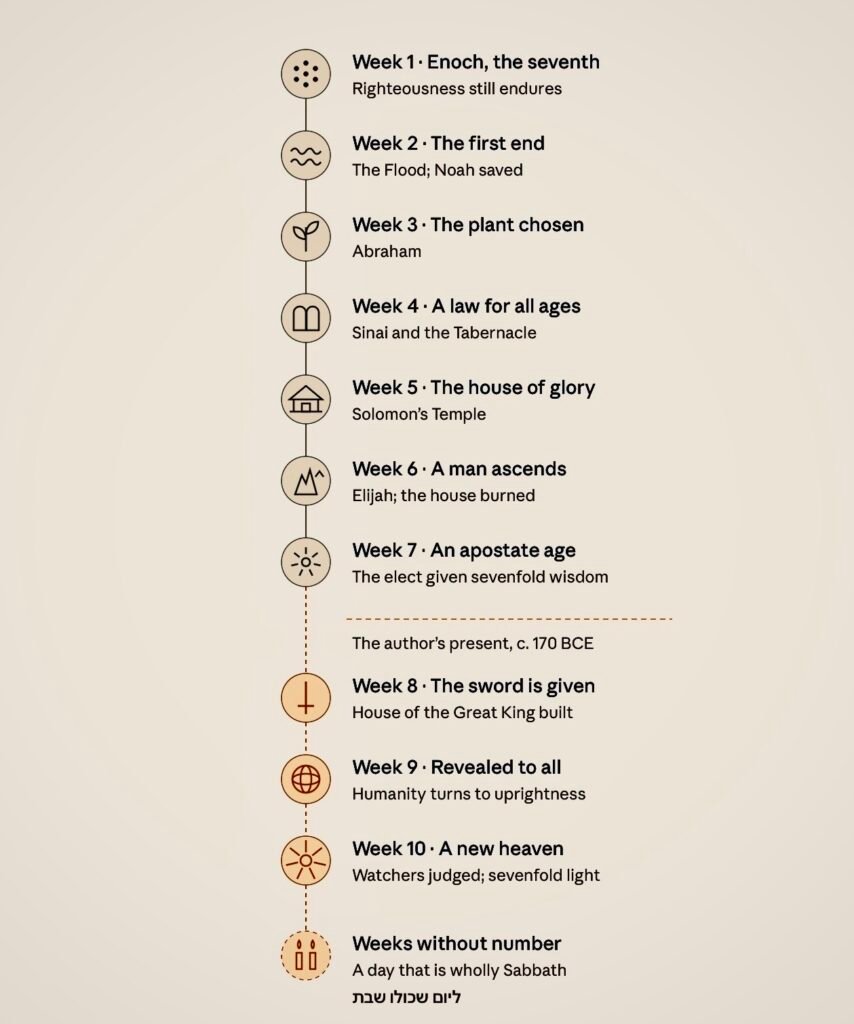
The first seven weeks retell sacred history from Enoch to the author’s own day, and each week turns on a single decisive event placed “in it” or “at its close.” The table below gives the whole structure at a glance; the commentary then reads each week against Scripture and the rabbinic tradition.
Week
Character of the week
Decisive event
Biblical referent
1
Judgment and righteousness endure
Enoch born seventh
Genesis 5:18–24
2
Wickedness and deceit
“The first end”; a man saved; a law for sinners
The Flood; Noah; the Noahide covenant
3
(Not characterized)
At its close, a man chosen as the plant of righteous judgment
Abraham
4
(Not characterized)
At its close, visions, a law for all generations, an enclosure
Sinai; the Tabernacle
5
(Not characterized)
At its close, the house of glory and kingship built
Solomon’s Temple
6
Blindness; wisdom forsaken
A man ascends; the house burned; the chosen root scattered
Elijah; 586 BCE; exile
7
An apostate generation
At its close, the elect chosen and given sevenfold wisdom
The author’s own group
8
Righteousness
A sword for the righteous; the house of the Great King built
Future (for the author)
9
Righteous judgment revealed
The works of the wicked vanish; humanity turns to uprightness
Future
10
Eternal judgment
Judgment of the Watchers; a new heaven; sevenfold light
Future
After
Weeks without number
Goodness and righteousness forever; sin no more mentioned
Future
Two features of style should be noticed before the details. First, the Apocalypse names no one after Enoch. Noah, Abraham, Moses, Solomon and Elijah are each “a man” or are implied by an event. Second, the Apocalypse is built of plants and houses. The “plant” grows from Abraham to the elect; the “house” rises in Week 5, burns in Week 6, and is rebuilt forever in Week 8. These two images carry the theology of the whole.
Week One: “I was born the seventh” (93:3)
I was born the seventh in the first week, while judgment and righteousness still endured.
Enoch is the seventh generation from Adam: Adam, Seth, Enosh, Kenan, Mahalalel, Jared, Enoch (Genesis 5). The Epistle of Jude (verse 14) calls him “the seventh from Adam,” and so does the Midrash. In a famous passage on the sanctity of the seventh, the Sages list the beloved sevenths of creation and history: the seventh heaven, the seventh generation (Enoch, of whom it is said ויתהלך חנוך את האלהים), the seventh from Abraham (Moses), the seventh son of Jesse (David), the seventh year (shemitah), the seventh shemitah (yovel), the seventh day (Shabbat) and the seventh month (Tishrei) (Vayikra Rabbah 29:11; Pesikta de-Rav Kahana 23:10).
The Enochic author and the Midrash thus agree on the starting point: Enoch’s holiness is bound up with his position as a seventh. The Apocalypse builds its entire architecture on the same principle, with ten weeks of seven, a seventh week of election, and a final judgment “in the seventh part” of the tenth week.
On the moral condition of Week One, however, the traditions differ. The Apocalypse says that judgment and righteousness “still endured” in Enoch’s day. The rabbinic tradition locates the beginning of idolatry two generations earlier, reading Genesis 4:26, אז הוחל לקרא בשם ה’, as “then it was profaned” (from חולין) in the days of Enosh (Bereishit Rabbah 23:7; Rashi ad loc.; Rambam, Hilchot Avodah Zarah 1:1). The Mishnah speaks of the ten generations from Adam to Noah as a display of divine patience toward generations that provoked G-d continually (Avot 5:2). For the Midrash, Enoch is an exception within a darkening world; for the Apocalypse, he is the last flower of a world not yet fallen.
The rabbinic estimate of Enoch himself is notably reserved, a matter treated in Section VII. Rashi, following Bereishit Rabbah 25:1, writes that Enoch was righteous but easily turned, so the Holy One took him before his time (Rashi on Bereshit 5:24).
Week Two: “The first end” (93:4)
After me, in the second week, great wickedness will arise and deceit will spring up. In it will be the first end, and in it a man will be saved. After it is ended, iniquity will grow, and a law will be made for the sinners.
The “first end” is the Flood, and the man saved is Noah. The phrase is not incidental. The Hebrew word קץ, the technical term for the end of days, first appears in Scripture precisely here: קץ כל בשר בא לפני, “the end of all flesh has come before Me” (Bereshit 6:13). For the Enochic writers the Flood is the prototype of the last judgment. The Book of the Watchers moves without pause from the Flood to the final purification of the earth (1 Enoch 10). Isaiah draws the same analogy in the opposite direction, as a promise: כי מי נח זאת לי, as I swore that the waters of Noah would not again cover the earth, so I swear not to be angry with you (Isaiah 54:9).
“Deceit” and “wickedness” render the Flood generation’s חמס (Bereshit 6:11). The Sages make the same point with precision. Rabbi Yochanan taught that the Flood generation transgressed everything, yet their decree was sealed only because of robbery (Sanhedrin 108a).
The “law for the sinners” after the Flood is the covenant with Noah (Bereshit 9:1–17). In rabbinic terms, this is the origin of the seven Noahide commandments (Tosefta Avodah Zarah 8:4; Sanhedrin 56a–b). The Book of Jubilees, closely related to the Enochic literature, has Noah command his sons to do justice, cover their nakedness, bless their Creator, honour parents, love neighbours and avoid fornication, impurity and bloodshed (Jubilees 7:20–39). The Apocalypse thus preserves, in a single clause, the earliest attested idea that humanity after the Flood lives under a divine law of its own. The rabbinic doctrine of שבע מצות בני נח is the mature form of that idea.
Week Three: “The plant of righteous judgment” (93:5)
After this, in the third week, at its close, a man will be chosen as the plant of righteous judgment, and after him will come the plant of righteousness forever.
The man is Abraham, and the plant that follows him is his seed, Israel. The image comes from the prophets. Isaiah calls the restored people נצר מטעי מעשה ידי להתפאר, “the shoot of My planting, the work of My hands, that I may be glorified” (60:21), and אילי הצדק מטע ה’ להתפאר, “oaks of righteousness, the planting of the Lord” (61:3). Jeremiah hears G-d promise to plant Israel in the land in truth (32:41).
In the Second Temple literature the image becomes a technical term. The Book of the Watchers speaks of a “plant of righteousness and truth” after the Flood (1 Enoch 10:16). Jubilees calls Abraham’s seed “a righteous plant for all generations” (Jubilees 16:26; compare 21:24 and 36:6). At Qumran the Damascus Document says that G-d caused a “root of planting” (שורש מטעת) to sprout from Israel and Aaron (CD 1:7), and the Community Rule calls the council of the community an “eternal planting” (1QS 8:5).
The Midrash knows a related image of Abraham as the foundation stone of the world. A king wished to build, and dug, and found only water; he dug again and found a rock (פטרא), and said, here I will build. So when G-d saw Abraham, He said, “I have found a rock on which to build and found the world” (Yalkut Shimoni, Bamidbar 766, on כי מראש צרים, Bemidbar 23:9). Plant or rock, the point is the same: with Abraham, history acquires a foundation.
The Apocalypse places Abraham “at the close” of Week Three. The Mishnah counts ten generations from Noah to Abraham (Avot 5:2), which makes Abraham the twentieth generation from Adam. If a week were seven generations, Week Three would run from the fifteenth to the twenty-first generation, and Abraham would indeed stand near its close. Section V tests this observation further.
Week Four: “A law for all generations” (93:6)
After this, in the fourth week, at its close, visions of the holy and righteous will be seen, and a law for all generations, and an enclosure will be made for them.
This is Sinai. The “visions of the holy” recall the theophany at the mountain and the vision of the elders, ויחזו את האלהים (Shemot 24:10–11). The Mekhilta says that a maidservant at the Sea saw what the prophet Ezekiel did not see (Mekhilta, Beshalach, Shirah 3). The “law for all generations” is the Torah, whose ordinances Scripture repeatedly calls חקת עולם לדרתיכם.
The “enclosure” is most often understood as the Tabernacle and its court, the dwelling made “that I may dwell among them” (Exodus 25:8). Some interpreters understand it as the Land, or as the protective boundary of the covenant. A rabbinic reader will hear an echo of ועשו סיג לתורה, “make a fence for the Torah” (Avot 1:1). That echo belongs to derush, not to the plain sense, but it is a fair one: in both traditions, the giving of Torah is accompanied by the making of a protected space in which it can be kept.
In the rabbinic chronology of Seder Olam Rabbah, the Torah was given in the year 2448 from Creation.
Week Five: “The house of glory” (93:7)
After this, in the fifth week, at its close, the house of glory and of kingship will be built forever.
This is Solomon’s Temple, built in the 480th year after the Exodus (1 Kings 6:1), in the year 2928 from Creation by the rabbinic count. The words “forever” and “kingship” echo Solomon’s dedication, בנה בניתי בית זבל לך מכון לשבתך עולמים (1 Kings 8:13), and the promise to David, וכננתי את כסא ממלכתו עד עולם (2 Samuel 7:13).
There is an apparent paradox. The house built “forever” in Week Five burns in Week Six. The Enochic author does not resolve it until Week Eight, when a house is built “for all generations of eternity.” The halakhic tradition resolves it differently, and more boldly. Rambam rules that the first sanctification of the Temple and of Jerusalem was not annulled by the destruction, because their sanctity derives from the Shechinah, and the Shechinah is never annulled (Hilchot Beit HaBechirah 6:16; compare Megillah 10a and Zevachim 107b). In the rabbinic view, the house of Week Five was indeed holy “forever”; its stones fell, but its sanctity did not.
Week Six: “A man will ascend” (93:8)
After this, in the sixth week, all who live in it will be blinded, and the hearts of all will godlessly forsake wisdom. In it a man will ascend, and at its close the house of the kingdom will be burned with fire, and in it the whole race of the chosen root will be scattered.
The sixth week covers the divided monarchy. The blindness recalls Isaiah’s commission to make the heart of the people fat and to shut their eyes (Isaiah 6:9–10), and the forsaking of wisdom echoes Jeremiah: they have rejected the word of the Lord, so what wisdom do they have? (Jeremiah 8:9). The Gemara names the three sins for which the First Temple fell: idolatry, sexual immorality and bloodshed (Yoma 9b).
The man who “ascends” is Elijah, taken up in a whirlwind (2 Kings 2:11). His appearance in the Apocalypse is significant for two reasons. First, Enoch and Elijah are the two figures of Scripture who leave the world without dying, and several versions of the list in Derekh Eretz Zuta 1 of those who entered the Garden of Eden alive include them both. The Enochic author, speaking as Enoch, notes the one other man who shared his fate.
Second, the principal rabbinic teaching on the duration of history is attributed to the house of this same Elijah: תנא דבי אליהו, “the world exists six thousand years” (Sanhedrin 97a; Avodah Zarah 9a). Elijah is also the herald of the redemption in Malachi (3:23) and the one who, in the Talmud, answers when the Messiah will come (Sanhedrin 98a). The figure of Week Six thus links the Enochic and rabbinic chronologies more closely than any other.
The burning of “the house of the kingdom” is the destruction of 586 BCE. The rabbinic chronology dates it to the year 3338 from Creation, which corresponds to 423/422 BCE. The difference of about 165 years between the rabbinic and the historical date arises from the rabbinic compression of the Persian period, a matter of importance for any attempt to convert ancient “weeks” into modern dates (Section V). The scattering of “the chosen root” is the exile foretold in the covenant curses (Leviticus 26:33; Deuteronomy 28:64). The word “root” keeps the plant image alive even in catastrophe.
Week Seven: “An apostate generation” (93:9–10; 91:11)
After this, in the seventh week, an apostate generation will arise; its deeds will be many, and all its deeds will be apostate. At its close, the chosen righteous from the eternal plant of righteousness will be chosen, to be witnesses of righteousness, and sevenfold wisdom and knowledge will be given to them. They will uproot the foundations of violence and the structure of deceit, to execute judgment.
The phrase “witnesses of righteousness” and the explicit “sevenfold wisdom and knowledge” come from the Aramaic of 4Q212; the Ethiopic speaks of sevenfold instruction concerning all creation. The final clause (91:11) is the first verse of the passage that the Ethiopic manuscripts displaced.
The great silence. The seventh week begins after the exile and runs to the author’s present. Between the burning of the First Temple and the election of the righteous, the Apocalypse records nothing good. There is no Cyrus, no return to Zion, no Zerubbabel, no Ezra, no Nehemiah, no Second Temple. The whole period is one “apostate generation.” This is not an oversight. The Animal Apocalypse, from the same tradition, says outright that when the returning exiles rebuilt the house and set a table before it, all the bread on it was polluted and impure (1 Enoch 89:73). The Damascus Document, later and from Qumran, counts 390 years after Nebuchadnezzar before G-d “remembered” Israel and raised a root of planting, followed by twenty years of groping like the blind (CD 1:5–11). In this tradition, the restoration under Persian rule was no restoration at all.
The rabbinic tradition sees the same centuries in a completely different light. The chain of Torah in Avot runs from Moses to Joshua, to the elders, to the prophets, and then to אנשי כנסת הגדולה, the Men of the Great Assembly, and to Shimon HaTzaddik, “one of the last of the Great Assembly” (Avot 1:1–2). Of Ezra the Gemara says that he was worthy for the Torah to have been given through him, had Moses not preceded him (Sanhedrin 21b). The Talmud records the wonders that attended Shimon HaTzaddik’s service in the Temple (Yoma 39a). Haggai promised that the glory of the latter house would exceed the former (Haggai 2:9), and the Gemara expounds the promise (Bava Batra 3a).
The Sages were not uncritical. They taught that the Second Temple lacked five things present in the First: the Ark with its cover and cherubim, the heavenly fire, the Shechinah, the holy spirit and the Urim and Tummim (Yoma 21b). They taught that it fell for causeless hatred, though its generation occupied itself with Torah, commandments and acts of kindness (Yoma 9b). But they never erased it. What the Enochic author treats as a void, the Sages treat as the very bridge across which the Oral Torah was carried. This is the first great divergence between the two traditions, and it is not a matter of chronology but of who belongs to the story.
The elect and all Israel. At the close of Week Seven, “the chosen righteous from the eternal plant of righteousness” are chosen. The phrase is precise: the plant is Israel, descended from Abraham, and the chosen righteous are a further election from within it. The Enochic group sees itself as the true remnant, the living tip of the eternal plant, and the bearer of a sevenfold wisdom that the rest of Israel lacks.
The Mishnah uses the same verse of Isaiah to opposite effect. Perek Chelek opens: כל ישראל יש להם חלק לעולם הבא, שנאמר ועמך כלם צדיקים לעולם יירשו ארץ נצר מטעי מעשה ידי להתפאר, “all Israel have a share in the world to come, as it is said, ‘Your people are all righteous, they shall inherit the land forever, the shoot of My planting, the work of My hands, that I may be glorified’” (Sanhedrin 10:1). The Mishnah then lists exceptions, so its view is not naive. But its default is inclusion, where the Apocalypse’s default is selection.
The custom of reciting this mishnah before each chapter of Pirkei Avot makes the point liturgically every Shabbat afternoon of the summer. The same tradition teaches אל תפרוש מן הציבור, “do not separate yourself from the community” (Avot 2:4), and ישראל אף על פי שחטא ישראל הוא, “a Jew, even one who has sinned, remains a Jew” (Sanhedrin 44a). Where the Enochic plant narrows to a sect, the rabbinic plant is the whole people.
Sevenfold wisdom. The gift to the elect recalls the spirit that rests on the shoot from the stump of Jesse: wisdom and understanding, counsel and might, knowledge and the fear of the Lord, with the spirit of the Lord over all (Isaiah 11:1–2). Commentators have long counted these as seven. In Isaiah, the sevenfold spirit rests on one Davidic king. In the Apocalypse, it is distributed to a community. The Messiah of Isaiah 11 has, as it were, been dissolved into the righteous group. This observation is the key to the question of Section IV.
Uprooting violence. The elect will “uproot the foundations of violence.” The language recalls Jeremiah’s commission to uproot and to tear down, to build and to plant (Jeremiah 1:10). The plant now becomes the planter and the uprooter. With that verse, the Apocalypse crosses from the author’s present into his expected future.
III. Commentary on the Ten Weeks: Weeks Eight to Ten and the Weeks Without Number
The last three weeks move from history to hope in three stages: a judgment executed by the righteous within Israel’s history (Week 8), a judgment revealed to all humanity (Week 9), and a cosmic judgment that renews heaven itself (Week 10). The structure anticipates, with remarkable closeness, the rabbinic distinction between ימות המשיח, the days of the Messiah, and עולם הבא or עתיד לבוא, the world to come.
Week Eight: “The week of righteousness” (91:12–13)
After this there will be another week, the eighth, that of righteousness. A sword will be given to it, that righteous judgment may be executed on the oppressors, and sinners will be delivered into the hands of the righteous. At its close they will acquire possessions in righteousness, and the Temple of the kingdom of the Great One will be built in the greatness of its splendour for all the generations of eternity.
The last clause follows the Aramaic of 4Q212. The Ethiopic says more briefly that “a house will be built for the Great King in glory forevermore.”
The sword is given. The verb is passive. The righteous do not seize the sword; it is given to them. The same motif appears in the Animal Apocalypse, where “a great sword was given to the sheep” and they went out against the beasts of the field (1 Enoch 90:19). It runs through the Epistle of Enoch as a refrain addressed to the wicked rich: you will be delivered into the hands of the righteous (1 Enoch 95:3; 96:1; 98:12). Whether the author imagined an armed uprising, or an eschatological judgment carried out by the righteous at G-d’s command, is debated. Some scholars hear in the verse the militant mood of the years before the Maccabean revolt. Others read it as a purely eschatological reversal. The text permits both.
“The wicked into the hands of the righteous.” Any Jew who prays will hear in this verse a phrase from the liturgy of Chanukah. The prayer Al HaNissim, attested in the geonic prayer books, says of G-d: מסרת גבורים ביד חלשים, ורבים ביד מעטים, וטמאים ביד טהורים, ורשעים ביד צדיקים, “You delivered the mighty into the hands of the weak, the many into the hands of the few, the impure into the hands of the pure, the wicked into the hands of the righteous.” The idiom of “delivering into the hand” is biblical (Joshua 10:8; Judges 3:28), so one should not posit literary dependence. Yet the correspondence is striking. The very generation that the Enochic author addressed would, a few years later, fight the war that Al HaNissim commemorates.
The rabbinic memory of that war is instructive. In Al HaNissim, every verb has G-d as its subject: You stood for them, You fought their battle, You judged their cause, You avenged them, You delivered. In the Gemara’s account of Chanukah, the military victory receives one clause and the cruse of oil receives the story (Shabbat 21b). Rambam records that through the Hasmoneans “kingship returned to Israel for more than two hundred years, until the second destruction” (Hilchot Chanukah 3:1). In other words, the sword of the Hasmoneans restored sovereignty, but it did not build the eternal house. The rabbinic tradition honoured the victory while refusing to call it the redemption. After Bar Kokhba, it would become even more cautious about the sword (Section VI).
Possessions in righteousness. The Epistle of Enoch is full of woes against those who acquire silver and gold unjustly (1 Enoch 94:6–11; 97:8–10). In Week Eight the reversal is complete: the righteous acquire possessions through righteousness. The prophetic background is Isaiah 65:21–22, ובנו בתים וישבו, “they shall build houses and dwell in them,” a passage that stands in the same chapter as the promise of new heavens (65:17), which the Apocalypse will reach in Week Ten. Rambam describes the material abundance of the messianic age in similar terms, adding that it is valued not for itself but because it frees Israel for Torah and wisdom (Hilchot Melachim 12:4–5).
The house of the Great King. The title “Great King” is biblical: קרית מלך רב (Psalms 48:3), כי מלך גדול אני (Malachi 1:14), ומלך גדול על כל אלהים (Psalms 95:3). The King is G-d. The Temple of Week Eight completes the arc of the “house” begun in Week Five. The house that burned is replaced by one built for all the generations of eternity.
The Second Temple literature knows several forms of this hope:
- In the Animal Apocalypse, the Lord of the sheep folds up the old house, brings a new house greater and loftier than the first, and sets it in the place of the first (1 Enoch 90:28–29).
- In Tobit, the house will be rebuilt “but not like the first” until the times are fulfilled, and afterwards in splendour (Tobit 14:5).
- In the Temple Scroll from Qumran, G-d speaks of the sanctuary of the present age “until the day of creation, when I Myself will create My sanctuary, establishing it for Myself for all days” (11Q19 29:8–10).
The rabbinic tradition holds two views, which later authorities sought to harmonize. Rambam rules that the King Messiah will build the Sanctuary in its place and gather the dispersed of Israel (Hilchot Melachim 11:1, 11:4). Rashi and Tosafot, following earlier midrash, hold that the future Temple will be revealed built and complete from heaven, as it is written מקדש ה’ כוננו ידיך, “the sanctuary, O Lord, that Your hands established” (Shemot 15:17; Rashi and Tosafot on Sukkah 41a; Rashi on Rosh Hashanah 30a). Later authorities, among them the Aruch LaNer, proposed that the heavenly Temple descends into a structure prepared by human hands.
The passive voice of the Enochic text, “will be built,” does not decide between these views, though the Temple Scroll and the Animal Apocalypse clearly favour divine construction. What the Enochic and rabbinic traditions share is the insistence that the future house is permanent. The Amidah asks: ובנה אותה בקרוב בימינו בנין עולם, “build it soon in our days as an everlasting building.” The phrase בנין עולם is precisely the Enochic “for all the generations of eternity.”
The order of events. In the Apocalypse, the Temple is built at the close of Week Eight, and only then, in Week Nine, does the whole world turn to righteousness. The order is the order of Isaiah: first the mountain of the house of the Lord is established, then all the nations flow to it (Isaiah 2:2–3). It is also the order of Rambam, for whom the Messiah first builds the Sanctuary and gathers Israel, and then “repairs the whole world to serve the Lord together” (Hilchot Melachim 11:4, in the uncensored text). The Enochic author and the halakhic codifier, separated by thirteen centuries, agree on the sequence: Israel and its Temple first, the nations after.
Week Nine: “Revealed to the whole world” (91:14)
After this, in the ninth week, righteous judgment will be revealed to all the children of the whole earth, and all the deeds of the wicked will vanish from the whole earth. The world will be written down for destruction, and all humankind will look to the path of eternal righteousness.
Revelation of righteousness. The language recalls Isaiah 56:1: כי קרובה ישועתי לבוא וצדקתי להגלות, “for My salvation is near to come, and My righteousness to be revealed.” What was given to Israel at Sinai in Week Four, and to the elect as sevenfold wisdom in Week Seven, now becomes the possession of all humanity.
The prophetic universalism behind the verse is familiar from the liturgy. Zephaniah promises that G-d will turn to the peoples a pure language, that all may call on the name of the Lord and serve Him with one accord (Zephaniah 3:9). Zechariah promises that the Lord will be One and His name One (14:9). Isaiah promises that the earth will be full of the knowledge of the Lord as the waters cover the sea (11:9). The Aleinu prayer gathers these verses into its second paragraph: לתקן עולם במלכות שדי, יכירו וידעו כל יושבי תבל. The Rosh Hashanah Amidah asks that all creatures form one band to do G-d’s will with a whole heart.
Rambam ends the Mishneh Torah on exactly this note. In the days of the Messiah there will be neither famine nor war, neither envy nor rivalry; the occupation of the whole world will be only to know the Lord, and he closes with Isaiah 11:9 (Hilchot Melachim 12:5). In the uncensored text of 11:4, he adds that even the other monotheistic faiths serve, in G-d’s hidden plan, to prepare the whole world to serve the Lord together, citing Zephaniah 3:9. Week Nine of the Apocalypse is, in rabbinic terms, the fulfilment of Aleinu.
Deeds, not doers. The Ethiopic says that “all the works of the godless” will vanish. The Aramaic seems to speak of the doers. The difference recalls one of the most celebrated readings in the Talmud. When Rabbi Meir wished to pray for the death of the ruffians who troubled him, his wife Beruria read Psalms 104:35, יתמו חטאים מן הארץ, as “let sins cease,” not “let sinners cease.” Pray that they repent, she said, and then the wicked will be no more (Berakhot 10a). The verse of Week Nine can be read in either spirit. Its final clause, “all humankind will look to the path of uprightness,” supports Beruria’s reading: the end of wickedness comes through the turning of the wicked.
Written for destruction. The “writing down” of the world belongs to the image of the heavenly books, opened in judgment before the Ancient of Days (Daniel 7:10) and kept as a book of remembrance before G-d (Malachi 3:16). The Gemara speaks of three books opened on Rosh Hashanah, for the wholly righteous, the wholly wicked and the intermediate (Rosh Hashanah 16b). What is written down for destruction is the old order of the world, the order of violence and deceit named in Week Seven.
Week Ten: “In its seventh part” (91:15–16)
After this, in the tenth week, in its seventh part, there will be the great eternal judgment, which will be executed upon the Watchers. The first heaven will pass away, a new heaven will appear, and all the powers of the heavens will shine sevenfold forever.
The Ethiopic says that G-d will “take vengeance among the angels”; the Aramaic names the Watchers explicitly.
The seventieth unit. The great judgment falls “in the seventh part” of the tenth week, that is, in the seventieth unit of the whole scheme. Seventy is the number of Jeremiah’s years of exile (Jeremiah 25:11; 29:10) and of Daniel’s weeks (Daniel 9:24). In the Book of the Watchers, the fallen angels are bound “for seventy generations” beneath the earth until the day of their judgment (1 Enoch 10:12). If one counts a week as seven generations, the seventh part of the tenth week is precisely the seventieth generation, and the judgment of the Watchers falls exactly when the Book of the Watchers said it would. This correspondence, noted by several scholars, is the strongest internal evidence for a generational reckoning of the weeks (Section V).
The Watchers in rabbinic memory. For the Enochic tradition, evil entered the world chiefly through the descent of the angels who took human wives and taught forbidden arts (Genesis 6:1–4; 1 Enoch 6–11). The final judgment therefore falls on them. Mainstream rabbinic exegesis firmly rejected this reading of Bereshit 6. Onkelos renders בני האלהים as “sons of the great ones.” The Midrash reports that Rabbi Shimon bar Yochai called them “sons of judges” and cursed anyone who called them sons of G-d (Bereishit Rabbah 26:5).
Yet the angelic story never disappeared. The school of Rabbi Yishmael taught that the goat לעזאזל atones “for the deed of Uza and Aza’el” (Yoma 67b). Targum Pseudo-Jonathan on Bereshit 6:4 names Shamchazai and Uzi’el as angels who fell from heaven. Pirkei de-Rabbi Eliezer (chapter 22) tells how the angels fell when they saw the daughters of Cain. The Midrash of Shemchazai and Aza’el, preserved in Yalkut Shimoni (Bereishit 44), relates their descent, Shemchazai’s repentance and Aza’el’s continued corruption. With a certain irony, the Zohar, which is attributed to the same Rabbi Shimon bar Yochai who cursed the angelic reading, speaks often of Aza and Aza’el. The Watchers lived on in the rabbinic margins and returned in Kabbalah.
The judgment on evil itself. Rabbinic theology placed the origin of sin not in fallen angels but in the human יצר הרע, for which G-d created the Torah as an antidote (Kiddushin 30b). The rabbinic counterpart to the judgment of the Watchers is therefore the end of the evil inclination. In the time to come, the Holy One will bring the yetzer hara and slaughter it before the righteous and the wicked (Sukkah 52a). The righteous will weep, for it seemed to them a mountain; the wicked will weep, for it seemed to them a hair. Both traditions agree that the end of history is the end of the power of evil. They disagree about where that power resides.
A new heaven. “The first heaven will pass away, and a new heaven will appear.” The source is Isaiah: כי הנני בורא שמים חדשים וארץ חדשה (65:17; compare 66:22). The Apocalypse mentions only a new heaven, perhaps because the earth was already cleansed in Week Nine. The rabbinic tradition preserved a teaching from the school of Elijah about “the thousand years in which the Holy One will renew His world” (Sanhedrin 92b), and the same school taught that the world will be desolate for one millennium after the six thousand (Sanhedrin 97a).
The two-stage structure of Weeks Eight to Ten corresponds to a rabbinic distinction. Rabbi Yochanan taught that all the prophets prophesied only about the days of the Messiah, while of the world to come it is said עין לא ראתה אלהים זולתך, “no eye has seen it but Yours, O G-d” (Berakhot 34b, on Isaiah 64:3). Shmuel taught that the only difference between this world and the days of the Messiah is subjugation to the kingdoms (Berakhot 34b; Sanhedrin 91b). Rambam adopted Shmuel’s sober view for the messianic age: עולם כמנהגו נוהג, the world follows its accustomed course (Hilchot Melachim 12:1). Ramban, in Sha’ar HaGemul, gave fuller weight to the renewal of creation after the resurrection. Weeks Eight and Nine are thus the Enochic “days of the Messiah” in Shmuel’s sense, still within history; Week Ten is the Enochic “world to come” in Rabbi Yochanan’s sense, beyond it.
Sevenfold light. “All the powers of the heavens will shine sevenfold.” The source is Isaiah 30:26: the light of the sun will be sevenfold, like the light of the seven days. The Gemara notes the tension between this verse and Isaiah 24:23, in which the sun is ashamed, and resolves it by assigning one verse to the days of the Messiah and the other to the world to come (Sanhedrin 91b; Pesachim 68a). The Sages also taught that the light of the first day, by which Adam could see from one end of the world to the other, was hidden away for the righteous in the time to come (Chagigah 12a; Bereishit Rabbah 12:6). This is the אור הגנוז of later Kabbalah and Chassidut. The sevenfold light of Week Ten is that hidden light restored.
After the Ten Weeks: “Weeks without number” (91:17)
After this there will be many weeks without number forever, in goodness and righteousness, and sin will no more be mentioned forever.
The Apocalypse ends by escaping its own arithmetic. The ten counted weeks give way to weeks that cannot be counted. History, which was measured, becomes eternity, which is not.
The rabbinic tradition expresses the same idea through the Sabbath. The Levites sang Psalm 92, מזמור שיר ליום השבת, on the Sabbath, and the Mishnah explains: a psalm for the time to come, ליום שכלו שבת ומנוחה לחיי העולמים, “for the day that is wholly Sabbath and rest for life everlasting” (Mishnah Tamid 7:4; Rosh Hashanah 31a). Every Shabbat, Birkat HaMazon asks that the Merciful One cause us to inherit that day.
“Sin will no more be mentioned” recalls Jeremiah’s new covenant: כי אסלח לעונם ולחטאתם לא אזכר עוד, “I will forgive their iniquity and remember their sin no more” (Jeremiah 31:33), and his promise that the iniquity of Israel will be sought and not found (50:20).
Isaiah gave the idea its most compressed form in the verse about the child born to us: למרבה המשרה ולשלום אין קץ, “of the increase of dominion and of peace there shall be no end” (Isaiah 9:6). The Gemara, noting the closed mem in לםרבה, says that the Holy One wished to make Hezekiah the Messiah, and the attribute of justice objected (Sanhedrin 94a). The redemption that was closed then remains open. The Apocalypse of Weeks counts toward a קץ, an end; its last verse describes a peace of which there is אין קץ, no end.
IV. Is There a Messiah in the Apocalypse of Weeks?
There is no Messiah in the Apocalypse of Weeks. The word “anointed” does not occur, no Davidic king appears, and no individual redeemer acts in Weeks Eight to Ten. The agents of redemption are the elect community, which receives the sword, and G-d, who judges, builds and renews. The Apocalypse describes a messianic age without a Messiah. Any answer to “when does the Messiah come according to Enoch’s weeks” must begin by admitting this.
Messianic figures elsewhere in 1 Enoch
The silence of the Apocalypse is not typical of the whole Enochic corpus, and the contrast is instructive.
The Book of the Watchers (chapters 1–36) has no Messiah. G-d Himself descends on Mount Sinai to judge (1 Enoch 1:3–9).
The Animal Apocalypse (chapters 85–90) tells all of history as a fable of animals. Adam and the patriarchs are white bulls; Israel is a flock of sheep; the nations are beasts and birds of prey. After the final judgment and the building of the new house, a white bull is born with great horns. All the beasts and birds fear him and petition him, and then all the generations are transformed into white bulls (1 Enoch 90:37–38). Many scholars see in this bull a messianic figure and a second Adam, since Adam too was a white bull (85:3). What matters for our question is the order: he appears after the judgment and after the Temple. The Messiah here is a consequence of redemption, not its cause.
The Book of Parables (chapters 37–71) is different in kind. It speaks of a heavenly figure called the Righteous One (38:2), the Elect One (45:3; 49:2), that Son of Man (46:1–6) and His Anointed (48:10; 52:4). His name was named before the sun and the signs were created (48:3), he was hidden in G-d’s presence before the world (48:6), and he sits on the throne of glory to judge kings and the mighty (62:2–5). In the Ethiopic text of 71:14, Enoch himself is told that he is that son of man.
Three facts limit the relevance of the Parables to the Apocalypse of Weeks. They were not found at Qumran, though every other part of 1 Enoch was. Their reference to an invasion by the Parthians and Medes (56:5–7) is usually connected with the Parthian invasion of 40 BCE, which places them in the late first century BCE or the first century CE. And their Messiah belongs to a different theology, in which the heavenly judge replaces the elect community as the agent of judgment. The Parables are a later development of the Enochic tradition, not a key to the Apocalypse.
The Parables and the rabbinic Messiah
The Parables nevertheless share several ideas with rabbinic aggadah, and these shared ideas show that the Enochic and rabbinic traditions drew on a common stock of exegesis.
- The pre-existent name. The Parables say that the Son of Man was named before the sun was made. The Gemara lists seven things created before the world, among them שמו של משיח, the name of the Messiah, from לפני שמש ינון שמו, “before the sun his name shall endure” (Psalms 72:17; Pesachim 54a; Nedarim 39b). Both texts read the same verse.
- The hidden Messiah. The Parables speak of the Elect One hidden before G-d. Pesikta Rabbati (chapters 36–37) speaks of the light of the Messiah, stored beneath the Throne of Glory from the beginning, and of the Messiah Ephraim who suffers for Israel.
- The enthroned figure. The Parables seat the Son of Man on the throne of glory. When Rabbi Akiva explained the plural “thrones” of Daniel 7:9 as “one for Him and one for David,” Rabbi Yose HaGelili rebuked him: Akiva, how long will you profane the Shechinah? (Sanhedrin 38b; Chagigah 14a). The rabbinic tradition knew this exegetical possibility and restrained it.
- Enoch transformed. The identification of Enoch with the Son of Man in Parables 71 has its rabbinic counterpart in Enoch-Metatron, the heavenly scribe (Targum Pseudo-Jonathan on Bereshit 5:24; 3 Enoch), treated in Section VII.
The Son of Man and the people of the holy ones
The Apocalypse of Weeks stands closer to Daniel than to the Parables. In Daniel 7, one like a son of man (כבר אנש) comes with the clouds of heaven and receives dominion (7:13–14). The angelic interpretation that follows says that dominion is given to “the people of the holy ones of the Most High” (7:27). The figure is, at least in its first interpretation, collective. The Apocalypse of Weeks is collective in the same way: the sword and the sevenfold wisdom are given to the elect.
Rabbinic exegesis read the son of man individually. Rashi identifies כבר אנש with the King Messiah. The Gemara reconciles Daniel’s Messiah on the clouds with Zechariah’s Messiah who is poor and riding on a donkey (9:9): if Israel merits, he comes with the clouds of heaven; if not, poor and on a donkey (Sanhedrin 98a). The mode of his coming, like its time, depends on Israel.
Redemption without a Messiah: the view of Rabbi Hillel
One Talmudic sage held a view surprisingly close to that of the Apocalypse. Rabbi Hillel taught: אין להם משיח לישראל, שכבר אכלוהו בימי חזקיה, “Israel has no Messiah, for they already consumed him in the days of Hezekiah” (Sanhedrin 99a). Rashi explains that the Holy One Himself will reign over Israel and redeem them alone. Rav Yosef answered: may G-d forgive Rabbi Hillel, for Zechariah prophesied the Messiah in the days of the Second Temple, long after Hezekiah.
Rabbi Hillel’s view did not become halakha. Rambam made belief in the coming of the Messiah the twelfth of his Thirteen Principles: אף על פי שיתמהמה, עם כל זה אחכה לו בכל יום שיבוא. He ruled that one who does not believe in the Messiah, or does not await his coming, denies not only the prophets but the Torah and Moses (Hilchot Melachim 11:1). But the survival of Rabbi Hillel’s opinion in the Talmud shows that a redemption effected by G-d without a human Messiah was a thinkable position within the rabbinic world. The Apocalypse of Weeks represents that position in an earlier and sectarian form.
Two stages, two Messiahs
The Apocalypse has two stages of redemption within history: the sword of Week Eight and the universal revelation of Week Nine. Rabbinic aggadah developed a doctrine of two Messiahs. The Gemara speaks of Mashiach ben Yosef, who will be slain, and applies to him the verse “they shall look on him whom they pierced, and mourn” (Zechariah 12:10; Sukkah 52a). The same passage speaks of Mashiach ben David, to whom G-d says, “ask of Me, and I will give you the nations” (Psalms 2:8). Saadia Gaon describes the wars of Mashiach ben Yosef, his death, and the subsequent coming of Mashiach ben David (Emunot veDeot 8).
The structural analogy is real: a militant first stage followed by a universal second stage. But it is an analogy, not a source. The Apocalypse of Weeks knows neither figure, and the doctrine of Mashiach ben Yosef is attested only centuries later.
The halakhic definition: criteria, not dates
Rambam’s definition of the Messiah is the most important rabbinic contribution to my question, because it replaces chronology with criteria. If a king arises from the house of David, studying Torah and occupied with the commandments like David his father, according to the Written and Oral Torah, who compels all Israel to walk in it and strengthen its breaches, and fights the wars of the Lord, he is presumed to be the Messiah (בחזקת משיח). If he does this and succeeds, builds the Sanctuary in its place and gathers the dispersed of Israel, he is certainly the Messiah (משיח ודאי). If he does not succeed, or is killed, he is like all the worthy kings of the house of David who died (Hilchot Melachim 11:4).
Rambam also rules that the Messiah need not perform signs or wonders. His proof is historical: Rabbi Akiva, the greatest sage of his generation, served as arms-bearer to Bar Koziba and believed him to be the King Messiah, until he was killed for his sins, and the Sages did not ask him for signs (Hilchot Melachim 11:3). The Messiah is identified by what he accomplishes, not by the year in which he appears.
Against this definition, the Apocalypse of Weeks looks strangely familiar. The tasks Rambam assigns to the Messiah are the tasks the Apocalypse assigns to the elect and to G-d: the wars of the Lord (the sword of Week Eight), the building of the Sanctuary (the house of the Great King), and the turning of the whole world to serve G-d (Week Nine). The Apocalypse describes the work; Rambam describes the worker. Neither supplies a date.
A note on Christian readings
The popular summary that prompted this essay reads Week Eight as the first coming of Jesus, or as the Second Coming, and treats Week Nine as the millennial kingdom. These readings belong to the history of Christian reception, not to the text. The idea of a thousand-year reign comes from Revelation 20:1–6 and from early Christian chiliasm, which combined Psalm 90:4 (“a thousand years in Your sight are as yesterday”) with the six days of creation, as in the Epistle of Barnabas (chapter 15).
Early Christian writers did value Enoch. Jude quotes it as prophecy, and Tertullian defended its authority (On the Apparel of Women 1.3). The Epistle of Barnabas cites as Scripture a saying that when the week is completed the Temple of G-d will be built gloriously in the name of the Lord (16:6), probably an echo of 1 Enoch 91:13. The Ethiopian Church kept the whole book in its canon. A Jewish reading must note this reception with respect, but it cannot adopt its conclusions. Neither a Second Coming nor a millennium appears anywhere in the Apocalypse of Weeks.
V. How Long Is an Enochic Week? Chronology and Its Discontents
The Apocalypse never states the length of a week, so every Gregorian date assigned to Week Eight is the product of assumptions added to the text. On the historical reading, Week Eight was the author’s own imminent future, expected from about 167 BCE. If one imposes equal weeks on the rabbinic chronology of Seder Olam, Week Eight falls either in c. 331 BCE–160 CE (weeks of 490 years) or in c. 1140–1840 CE (weeks of 700 years). On no model does 2026 open Week Eight.
What the text gives and what it withholds
The text gives three kinds of information. It gives the number of weeks: ten, followed by weeks without number. It gives the position of events within a week: “in it” or “at its close.” And it gives one subdivision: the great judgment falls “in the seventh part” of the tenth week. It gives no number of years for any week, no anchor date and no correlation with any calendar. Four models have been proposed to fill this silence.
Model A: qualitative epochs
The simplest reading treats the weeks as epochs of sacred history, each defined by its character and its decisive event, with no fixed length. James VanderKam and others have argued that the weeks cannot be of equal length in years if they are to fit the biblical chronology, and the test below confirms this. On this reading the Apocalypse is a theology of history, not a timetable. It tells the reader where he stands, at the close of the seventh week, and what comes next. It does not tell him how long to wait.
Model B: weeks of generations
Enoch’s self-description as “the seventh in the first week” suggests that a week may consist of seven generations. The hypothesis can be tested against the genealogies of Bereshit 5 and 11, Ruth 4:18–22 and 1 Chronicles 2–3, counting Adam as the first generation and following the line of Judah after Jacob.
Week
Generations
Event in the text
Generation of the event
Fit
1
1–7
Enoch born seventh
Enoch: 7
Exact
2
8–14
The Flood; a man saved
Noah: 10
Fits (“in it”)
3
15–21
At its close, a man chosen
Abraham: 20
Fits (“at its close”)
4
22–28
At its close, the law and the enclosure
Nahshon, prince of Judah at Sinai: 28
Fits (“at its close”)
5
29–35
At its close, the house of glory
Solomon: 34
Fits (“at its close”)
6
36–42
A man ascends; at its close, the house burned
Elijah, under Jehoshaphat: c. 38; Zedekiah: 50
Elijah fits; the destruction does not
7
43–49
At its close, the elect chosen
(Post-exilic line)
Cannot be tested
The fit through Week Five is striking. Abraham is the twentieth generation, as the Mishnah’s ten generations from Noah to Abraham require (Avot 5:2). Nahshon son of Amminadab, whose sister married Aaron (Exodus 6:23) and who led Judah at Sinai (Numbers 1:7; 7:12), is the twenty-eighth. Solomon is the thirty-fourth, at the close of the fifth week. In Week Six the scheme breaks down. Counting the kings of Judah from Rehoboam, Zedekiah is the fiftieth generation, eight places too late.
Two observations support the model despite this breakdown. First, ten weeks of seven generations make seventy generations, and the Book of the Watchers binds the fallen angels “for seventy generations” until their judgment (1 Enoch 10:12). The judgment of the Watchers “in the seventh part of the tenth week” falls in the seventieth generation. Second, the generations of the patriarchs were longer than those of the kings, which explains why no equal number of years can fit the text (see the next table). The most likely conclusion is that the author thought in heptads of generations, applied the pattern carefully to the early history, and stylized the later history to fit the theology. In either case, a generation is not a convertible unit of years, and Model B yields no Gregorian date.
Model C: weeks of 490 years
A second hypothesis takes each week as a “week of weeks of years,” ten jubilee-like units of 490 years, on the analogy of Daniel’s seventy weeks. This model has real ancient support in the literature around the Apocalypse:
- Daniel 9:24–27: seventy weeks of years, 490 years, until everlasting righteousness is brought in. Seder Olam Rabbah (chapter 28) reads them as the seventy years of Babylonian exile and the 420 years of the Second Temple, and Rashi follows this reading.
- 11Q13 (11QMelchizedek): a Qumran text that places the final atonement and release at the end of the tenth jubilee.
- 4Q390 and the Testament of Levi (chapters 16–17): periods of jubilees and weeks leading to the eschaton.
- Jubilees: all of sacred history from Creation to the entry into Canaan in weeks and jubilees of years.
The rabbinic tradition also reckoned history sabbatically. The Gemara records that Israel counted seventeen jubilees from the entry into the land to its exile (Arakhin 12b) and that both Temples fell in the year after a sabbatical year, מוצאי שביעית (Arakhin 11b; Taanit 29a). Elijah told Rav Yehudah, the brother of Rav Sala Chasida, that the world would last no fewer than eighty-five jubilees and that the son of David would come in the last of them (Sanhedrin 97b). Klaus Koch argued that the Apocalypse of Weeks presupposes such a sabbatical structure of history and attempted to correlate it with the biblical chronologies.
The model fails, however, when tested against the rabbinic chronology. The following table takes the Seder Olam dates of the main events and asks what length of week each would require.
Event
Year from Creation (Seder Olam)
Week in the text
Week on 490-year model
Week on 700-year model
Week length implied
Birth of Enoch
622
1
2
1
At least 622 years
The Flood
1656
2
4
3
828 to 1,656 years
Call of Abraham (age 75)
2023
3, at its close
5
3
About 674 years
Sinai
2448
4, at its close
5
4
About 612 years
Solomon’s Temple
2928
5, at its close
6
5
About 586 years
Destruction of the First Temple
3338
6, at its close
7
5
About 556 years
On the 490-year model, every event falls one or two weeks later than the Apocalypse places it. On the 700-year model, the Flood and the destruction fall in the wrong weeks. The implied length of a week shrinks steadily, from about 674 years in the patriarchal period to about 556 in the monarchy. This is exactly the pattern one would expect if the author counted generations, whose length in years declines as human lifespans shorten. The table is therefore the strongest argument against any equal-year model, and for Model B.
For completeness, if one nevertheless imposes 490-year weeks on the rabbinic count, the dates are as follows.
Week
Years from Creation
Approximate Gregorian dates
7
2941–3430
c. 821–331 BCE
8
3431–3920
c. 331 BCE–160 CE
9
3921–4410
c. 160–650 CE
10
4411–4900
c. 650–1140 CE
On this reckoning, Week Eight would span the Greek conquest, the Hasmonean kingdom, the destruction of the Second Temple (3828 from Creation) and the revolt of Bar Kokhba. Its “sword” could be read as the Hasmonean victory, but its eternal house was destroyed rather than built. All ten weeks would have ended by about 1140 CE. The result is an unexpected confirmation of Rav’s dictum: כלו כל הקיצין, “all the ends have passed” (Sanhedrin 97b).
Model D: weeks of 700 years
The third arithmetic model divides a cosmic history of 7,000 years into ten weeks of 700 years each. It is the model behind the popular summary. Its source is not the Apocalypse but the rabbinic and patristic idea of the cosmic week, which takes “a thousand years in Your sight are as yesterday” (Psalms 90:4) together with the six days of creation and the Sabbath. Rav Katina taught that the world exists for six thousand years and is desolate for one, and the baraita compared this to the sabbatical year: as the shemitah releases one year in seven, so the world releases one thousand years in seven thousand (Sanhedrin 97a). Ramban develops the correspondence of the six days to six millennia in detail (commentary on Bereshit 2:3).
The Apocalypse has ten weeks, not seven millennia, and there is no ancient warrant for dividing 7,000 by ten. But if one does so, using the rabbinic count, the dates are as follows.
Week
Years from Creation
Approximate Gregorian dates
7
4201–4900
c. 440–1140 CE
8
4901–5600
c. 1140–1840 CE
9
5601–6300
c. 1840–2540 CE
10
6301–7000
c. 2540–3240 CE
10, seventh part
6901–7000
c. 3140–3240 CE
On this reckoning, the present year 5787 is the 187th year of Week Nine, not the first year of Week Eight. Week Nine would begin at the turn of 5600, the year in which the Zohar places the opening of the gates of wisdom above and the springs of wisdom below (Zohar I:117a, on Genesis 7:11). The coincidence is curious, but it joins two homiletical systems, neither of which the Apocalypse knows, and it proves nothing.
The base chronology is itself uncertain
Every conversion also depends on the starting point, and here the uncertainty compounds.
- The rabbinic era. The Jewish calendar counts from a creation date corresponding to 3761 BCE, based on Seder Olam Rabbah and fixed in the calendar of the geonic period. The Tannaim even disputed whether the world was created in Tishrei or Nisan (Rosh Hashanah 10b–11a).
- The “missing years.” Seder Olam allots only 34 years to Persian rule during the Second Temple period (Avodah Zarah 9a), where the historical sources indicate about two centuries. As a result, the rabbinic date of the destruction of the First Temple (423/422 BCE) differs from the historical date (586 BCE) by about 165 years. Every “year from Creation” before the Persian period is therefore displaced by that amount relative to historical chronology.
- The biblical texts. The Masoretic, Samaritan and Septuagint versions of Bereshit 5 and 11 differ in the ages of the patriarchs. The Septuagint adds more than 1,200 years before Abraham. Christian chronographers, using the Septuagint, placed creation near 5500 BCE; Archbishop Ussher, using the Masoretic text with different assumptions, placed it in 4004 BCE.
There is, in short, no agreed “year one” to which a week could be added. A Gregorian date for Week Eight is the product of three uncertain choices: the length of a week, the date of creation, and the treatment of the Persian period. The Apocalypse authorizes none of them.
Correcting the circulated summary
The summary that prompted this essay contains the following errors.
Claim in the summary
Problem
Correction
On the 700-year schema, Week 8 ran c. 375 BCE–325 CE
Contradicts the same summary’s later date of 976–1675 CE on the same schema
One schema cannot yield both dates
Creation fell on 1 Nisan, 1 AM = 3925 BCE
No Jewish authority holds this date
The rabbinic era begins in 3761 BCE; Ussher used 4004 BCE
The year 6000 from Creation falls near 2026–2030 CE
False in Jewish reckoning; the figure resembles Christian chronologies built on a 4004 BCE creation, which themselves give about 1997
2026 CE is 5787; the year 6000 begins in the autumn of 2239 CE
On the futuristic model, Week 8 runs 2026–2726 CE
With 700-year weeks, this requires creation in 2875 BCE, which no tradition holds
No coherent chronology yields this result
On the 490-year model, creation c. 3430 BCE and Week 8 = c. 655–165 BCE
Arithmetic error: 3430 BCE plus 3,430 years reaches the turn of the era, not 655 BCE
On the historical reading, the Maccabean era is the close of Week 7, not Week 8
Humanity is now in or approaching Week 9
Contradicts the summary’s own claim that 2026 opens Week 8
True only on the 700-year model with the rabbinic count, which the summary did not use
Week 8 precedes a millennial kingdom
A Christian reading drawn from Revelation 20
The Apocalypse knows no millennium
Week 3 marks the election of the Messiah’s lineage
The text mentions no Messiah
Rabbinic derush does trace the Messiah’s line through Abraham and Judah (Bereishit Rabbah 85:1; Ruth 4:18–22), but this is not Enoch’s claim
The answer of this section
Only one date can be defended as the meaning of the text: the author expected Week Eight to begin in his own near future, in the years around 167 BCE. Every later date is the product of arithmetic imposed on a text that refuses arithmetic. Those who want a number will find one, as many have before them. But the number belongs to the calculator, not to Enoch.
VI. The Rabbinic Doctrine of the Ketz
The rabbinic tradition records calculations of the end in order to discipline them. Its settled position has four parts: the end is hidden from human beings; every fixed end proposed by the Sages has passed; the redemption now depends on teshuvah and good deeds; and the close of the sixth millennium, the year 6000 from Creation, stands as the outer horizon. The great sugya in Sanhedrin 96b–99a contains all four, and the later tradition elaborates them.
The six thousand years
The foundational text is a baraita from the school of Elijah: תנא דבי אליהו: ששת אלפים שנה הוי עלמא, שני אלפים תוהו, שני אלפים תורה, שני אלפים ימות המשיח. “The world exists for six thousand years: two thousand of chaos, two thousand of Torah, and two thousand of the days of the Messiah.” The baraita adds at once: ובעונותינו שרבו יצאו מהן מה שיצאו, “but because of our many sins, those years that have passed have passed” (Sanhedrin 97a–b; Avodah Zarah 9a).
The Gemara in Avodah Zarah fixes the boundaries. The two thousand years of Torah began when Abraham was fifty-two, in the year 2000 from Creation, with “the souls they had made in Haran” (Genesis 12:5). The two thousand years of the Messiah therefore began in the year 4000, which the Gemara places 172 years after the destruction of the Second Temple (Avodah Zarah 9a), about 240 CE. By the reckoning of the Sages themselves, the messianic era has been open for more than seventeen centuries without its Messiah. The baraita’s own coda explains why: the sins of Israel delayed what the calendar allowed.
This is a different kind of chronology from Enoch’s. The Apocalypse of Weeks lays out a sequence of events that must occur. The baraita lays out a span of time within which the redemption may occur, and it admits that the time has been forfeited. The difference is between a timetable and a deadline.
Two further views follow. Rav Katina taught that the world exists six thousand years and is desolate for one thousand, from ונשגב ה’ לבדו ביום ההוא (Isaiah 2:11). Abaye said two thousand, from יחינו מימים (Hosea 6:2). A baraita supports Rav Katina with the analogy of the sabbatical year and with Psalm 92 and Psalm 90:4 (Sanhedrin 97a). This is the source of the cosmic week, of which the 700-year model in Section V is an unconscious descendant.
Signs and their failure
The Gemara records a seven-year cycle at whose end the son of David comes: rain on one city and not another, arrows of famine, great famine, plenty and not plenty, great plenty, voices, and then wars (Sanhedrin 97a). Rav Yosef immediately objects: so many sabbatical cycles have been like this, and he has not come. Abaye replies that the signs never appeared in their proper order. The exchange is a small masterpiece of rabbinic realism. A scheme of signs can always be matched to some period, and therefore proves nothing.
Other passages list the signs of עיקבתא דמשיחא, the footsteps of the Messiah: insolence will increase, prices will soar, the wisdom of scribes will decay, the face of the generation will be like the face of a dog (Mishnah Sotah 9:15; Sanhedrin 97a). These are not dates but descriptions of moral disorder, and each generation has found itself in them.
Ends that were proposed and passed
The sugya preserves several dated ends, and in each case it records their passing.
- Eighty-five jubilees. Elijah told Rav Yehudah, the brother of Rav Sala Chasida, that the world would last no fewer than eighty-five jubilees, and that the son of David would come in the last. At its beginning or its end? I do not know. Will it be completed or not? I do not know. Rav Ashi concluded: until then, do not expect him; from then on, expect him (Sanhedrin 97b). Eighty-five jubilees is 4,250 years, about 490 CE.
- The scroll from the Roman archives. Rav Chanan bar Tachlifa reported a scroll written in Hebrew script found among the Roman archives. It said that 4,291 years after Creation the world would be orphaned: wars of the sea monsters, the war of Gog and Magog, and then the days of the Messiah, and that the Holy One renews His world only after seven thousand years (Sanhedrin 97b). The year 4291 is about 531 CE.
- Avodah Zarah 9b. Rabbi Chanina taught that four hundred years after the destruction, if one is offered a field worth a thousand dinars for one dinar, one should not buy it, since the redemption may come.
These ends have passed, and the Gemara knew they would be tested. It recorded them with full awareness that the Messiah had not come at the earlier ones.
The verse that pierces to the depths
Rabbi Natan expounded Habakkuk 2:3: כי עוד חזון למועד ויפח לקץ ולא יכזב, אם יתמהמה חכה לו כי בא יבא לא יאחר, “for the vision is yet for the appointed time; it speaks of the end and does not lie; though it tarry, wait for it, for it will surely come, it will not delay.” He said that this verse pierces and descends to the depths. It refutes our rabbis who expounded “a time, times and half a time” (Daniel 7:25), Rabbi Simlai who expounded “You fed them the bread of tears” (Psalms 80:6), and Rabbi Akiva who expounded “once more, in a little while, I will shake the heavens and the earth” (Haggai 2:6) (Sanhedrin 97b).
The Gemara here rejects the calculation of Rabbi Akiva himself. No authority, however great, is exempt.
The same verse was the subject of anguished commentary at Qumran. The Pesher on Habakkuk explains that the final age will be prolonged beyond everything the prophets foretold, because the mysteries of G-d are wondrous. It blesses the men of truth whose hands do not slacken in the service of truth when the final age is drawn out for them, for all of G-d’s ages will come at their appointed time (1QpHab 7:1–14). The heirs of the Enochic tradition and the Sages of the Talmud reached for the same verse to meet the same crisis: an end that did not arrive.
The curse on the calculators
At this point the Gemara pronounces its famous curse. Rabbi Shmuel bar Nachmani said in the name of Rabbi Yonatan: תפח עצמן של מחשבי קיצין, blasted be the bones of those who calculate the ends. The reason is pastoral, not merely theological: שהיו אומרים כיון שהגיע את הקץ ולא בא שוב אינו בא, for they would say, since the end arrived and he did not come, he will no longer come. Rather, wait for him, as it is said, though it tarry, wait for it. And if you say, we wait but He does not wait, Scripture says: לכן יחכה ה’ לחננכם, “therefore the Lord waits to be gracious to you” (Isaiah 30:18; Sanhedrin 97b).
The danger of the calculator is that he turns hope into a wager. When the wager is lost, faith itself is lost with it. The Sages preferred an open hope, renewed daily, to a dated hope that could be falsified.
All the ends have passed
The decisive statement belongs to Rav: כלו כל הקיצין, ואין הדבר תלוי אלא בתשובה ומעשים טובים, “all the ends have passed, and the matter depends only on repentance and good deeds.” Shmuel replied: דיו לאבל שעומד באבלו, “it is enough for the mourner to remain in his mourning,” meaning that the suffering of exile is itself sufficient (Sanhedrin 97b).
The dispute continues between Rabbi Eliezer and Rabbi Yehoshua. Rabbi Eliezer said: if Israel repents, they are redeemed; if not, they are not. Rabbi Yehoshua said: if they do not repent, the Holy One sets over them a king whose decrees are as harsh as Haman’s, and they repent. The two exchange verses until Rabbi Yehoshua cites the oath of the man clothed in linen, that it shall be for “a time, times and half,” and Rabbi Eliezer falls silent (Daniel 12:7; Sanhedrin 97b–98a). The redemption has a fixed time after all; but that time is known only to the One who swore.
Rabbi Yehoshua ben Levi resolved the tension with a single verse: בעתה אחישנה, “in its time I will hasten it” (Isaiah 60:22). If they merit, I will hasten it; if not, in its time (Sanhedrin 98a). There are two ends: a conditional one that may come at any moment through merit, and an unconditional one fixed by G-d. Saadia Gaon makes the same distinction (Emunot veDeot 8), and Rambam writes that Israel will be redeemed only through repentance, and that the Torah has already promised that Israel will repent at the end of its exile and at once be redeemed (Hilchot Teshuvah 7:5).
Today, if you listen to His voice
The most beautiful answer in the sugya is a story. Rabbi Yehoshua ben Levi found Elijah at the entrance to the cave of Rabbi Shimon bar Yochai and asked him when the Messiah would come. Elijah said: go and ask him. He sits at the gate of Rome among the poor who suffer from sickness. All of them untie and retie their bandages at once; he unties and reties one at a time, saying, perhaps I will be needed, and I must not be delayed.
Rabbi Yehoshua went and greeted him. He asked: when will the master come? The Messiah answered: today. When the day passed and he did not come, Rabbi Yehoshua complained to Elijah that the Messiah had lied. Elijah explained what he had said: היום אם בקלו תשמעו, “today, if you will listen to His voice” (Psalms 95:7; Sanhedrin 98a).
The whole apparatus of weeks and jubilees is answered by one word. The Messiah is always ready; Israel is not always listening.
What is hidden and what is sealed
The Talmud returns again and again to the hiddenness of the end.
- Seven hidden things. Seven things are concealed from human beings: the day of death, the day of consolation, the depth of judgment, what is in another’s heart, what one will earn, when the kingdom of David will return, and when the wicked kingdom will fall (Pesachim 54b).
- The heart and the mouth. On “the day of vengeance is in My heart” (Isaiah 63:4), Rabbi Yochanan said: to My heart I revealed it, to My limbs I did not; Reish Lakish said: to My heart I revealed it, to the ministering angels I did not (Sanhedrin 99a). The Midrash puts it more briefly: revealed to the heart, not to the mouth (Midrash Tehillim 9:2).
- Jacob’s silence. Jacob gathered his sons to tell them what would befall them at the end of days (Genesis 49:1). He wished to reveal the end, and the Shechinah departed from him (Pesachim 56a; Bereishit Rabbah 98:2; Rashi ad loc.).
- The Targum withheld. When Yonatan ben Uzziel wished to translate the Writings, a heavenly voice said: enough. Why? Because they contain the end of the Messiah, meaning the book of Daniel (Megillah 3a).
- The oaths. Among the oaths that Rabbi Levi derived from the Song of Songs is that Israel should not reveal the end (Ketubot 111a). The same passage forbids Israel to “force the end.”
- Daniel sealed. Scripture itself ends its only full apocalypse with the command to shut up the words and seal the book until the time of the end (Daniel 12:4, 12:9).
The contrast with the Apocalypse of Weeks could not be sharper. The Apocalypse is a revelation of the end, placed in the mouth of a man who walked with G-d. The rabbinic tradition holds that even Jacob was not permitted to speak it, and that the one book in the canon that comes close to it must remain sealed.
The Rishonim who calculated
Despite the curse, great authorities of the medieval period did calculate. Rambam explains why. In his Epistle to Yemen (c. 1172), written to a community shaken by persecution and by a local messianic pretender, he warns his readers that no one can know the end. He excuses Saadia Gaon’s calculations on the ground that Saadia wrote to strengthen a people in great distress. He also relays, with evident hesitation, a tradition from his own family that prophecy would return to Israel in the year 4976 (1216 CE), as a forerunner of the Messiah. The Epistle shows the tension perfectly: the greatest halakhic opponent of calculation could not entirely refrain from it when his people needed comfort.
Other Rishonim calculated openly:
- Saadia Gaon (882–942) derived ends from Daniel’s numbers in Emunot veDeot 8, while also teaching that teshuvah could bring the redemption earlier.
- Rashi (1040–1105), in his commentary on Daniel, offers computations from the 1,290 and 1,335 days of Daniel 12, presented with reserve.
- Rabbi Abraham bar Chiyya (12th century), in Megillat HaMegalleh, combined scriptural and astronomical reckoning to propose several ends.
- Ramban (1194–1270), in Sefer HaGeulah, offered a calculation commonly reconstructed as pointing to 5118 (1358 CE). At the Barcelona disputation in 1263 he told the court that the essence of Jewish faith does not depend on the Messiah, and that serving God in exile, under subjugation, carries greater merit.
- Don Isaac Abarbanel (1437–1508), after the expulsion from Spain, wrote three messianic works, among them Ma’ayanei HaYeshu’ah on Daniel, and expected the redemption to begin in 5263 (1503 CE).
The Zohar, too, offers dates, among them its famous teaching that in the six hundredth year of the sixth millennium the gates of wisdom above and the springs of wisdom below would open (Zohar I:117a). The year 5600 (1839/40) was awaited with intense expectation in parts of Eastern Europe and the Land of Israel, and it passed, as all the others did.
The price of a failed end
The Sages’ caution was learned in blood.
- Bar Kokhba. Rabbi Akiva applied to Shimon bar Koziba the verse דרך כוכב מיעקב, “a star has come forth from Jacob” (Numbers 24:17), and said: this is the King Messiah. Rabbi Yochanan ben Torta answered: Akiva, grass will grow from your cheeks, and the son of David will still not have come (Yerushalmi Taanit 4:5; Eicha Rabbah 2:4). The revolt ended at Betar in 135 CE with a catastrophe that the tradition never forgot.
- Medieval pretenders. Rambam’s Epistle to Yemen was written in response to one; David Alroy in twelfth-century Kurdistan was another. Each left disillusion behind.
- Shabbetai Tzvi. Expectations attached to the year 5408 (1648) coincided with the Chmielnicki massacres. In 1665–66 the movement around Shabbetai Tzvi swept much of the Jewish world, until his apostasy in 1666. Rabbi Yaakov Sasportas and, later, Rabbi Yaakov Emden fought its afterlife for a century. Gershom Scholem’s study of the movement remains the classic account.
The Apocalypse of Weeks belongs on this list too. Its Week Eight was expected in the 160s BCE. The community that preserved it did not abandon its hope when the end did not arrive. It recalculated, in the 390 years of the Damascus Document and the prolonged final age of the Pesher on Habakkuk. The rabbinic tradition took a different path. It did not recalculate. It stopped calculating, and redirected the hope into deeds.
The outer horizon: the year 6000
One horizon remains. If the world exists for six thousand years and the Messiah must come within the two thousand years of the Messiah, then the redemption must come before the close of the year 6000. This is how the baraita of the school of Elijah is commonly understood, and it is the meaning of בעתה, “in its time,” for those who read the two sources together.
The Jewish year that began in September 2026 is 5787. The year 6000 begins in the autumn of 2239 CE, 213 years from now. That is the only date in the classical rabbinic sources that functions as a limit. It is not a prediction of when the Messiah will come. It is the boundary by which, according to the school of Elijah, he will already have come. Everything before it is אחישנה, the time that merit can hasten.
VII. Enoch Among the Rabbis: Reception, Exclusion, Survival
Rabbinic Judaism did not transmit 1 Enoch. It preserved a reserved, sometimes polemical, memory of Enoch the man; it rejected the Enochic account of the fallen angels in its mainstream exegesis; and it excluded the Enochic books from the canon on principle. Yet Enoch returned through the back door of Jewish mysticism, transfigured into Metatron, the heavenly scribe, and later into a humble cobbler who unified the worlds with every stitch.
Two Enochs before the Rabbis
The earliest Hebrew witness outside Bereshit already shows a divided memory. Ben Sira, writing in Hebrew around 180 BCE, praises Enoch in his hymn to the fathers. The Hebrew manuscript calls him אות דעת לדור ודור, “a sign of knowledge for all generations” (Ben Sira 44:16). The Greek translation, made by Ben Sira’s grandson, renders this as “an example of repentance.” Enoch the sage and Enoch the penitent stand side by side in one verse. Ben Sira adds that few on earth were created like Enoch, who was taken up (49:14).
Jubilees, closely aligned with the Enochic circle, makes Enoch the first human being to learn writing, knowledge and wisdom, to record the signs of heaven, and to testify against the Watchers. He is placed in the Garden of Eden, writing the condemnation of the world (Jubilees 4:17–26). This is the Enoch of 1 Enoch: scribe, astronomer and witness.
Enoch in the Midrash
The classical Midrash is notably cool toward this figure. Bereishit Rabbah records the view that Enoch was not inscribed among the righteous. Rabbi Aibu said: חנוך חנף היה, פעמים צדיק פעמים רשע, “Enoch was inconstant, sometimes righteous and sometimes wicked,” and the Holy One said, while he is in his righteousness I will take him (Bereishit Rabbah 25:1). Rashi on Genesis 5:24 follows this line.
The same passage reveals a polemical motive. Sectarians (מינים) asked Rabbi Abbahu: we do not find that Enoch died. Rabbi Abbahu answered that כי לקח אותו אלהים, “for G-d took him,” is the language of death, as in “I am taking from you the delight of your eyes” (Ezekiel 24:16). Rabbi Abbahu lived in Caesarea in the third century, among Christians who cited Enoch’s ascent as a precedent for the ascension of their own Messiah. The rabbinic reserve toward Enoch is partly a response to his Christian career.
The Targumim preserve both sides of the debate. Manuscripts of Onkelos differ on Bereshit 5:24, some saying that the Lord caused Enoch to die and others that He did not. Targum Pseudo-Jonathan goes in the opposite direction from Rabbi Abbahu: Enoch served in truth before the Lord, was withdrawn and ascended to heaven by the Word before the Lord, and his name was called Metatron, the great scribe (מיטטרון ספרא רבא).
Metatron
The Babylonian Talmud knows Metatron but does not identify him with Enoch. Metatron is the angel whose name is like his Master’s (Sanhedrin 38b, on Exodus 23:21). He teaches young children who died before learning Torah (Avodah Zarah 3b). When Elisha ben Avuyah, called Acher, ascended to the Garden and saw Metatron seated and writing the merits of Israel, he concluded that there might be two powers in heaven; Metatron was then punished with sixty lashes of fire, to show that no one sits on high but G-d (Chagigah 15a). The Gemara thus tells the story of a heavenly scribe precisely in order to deny him divine status.
The Hebrew book known as 3 Enoch, or Sefer Hekhalot, completes the transformation. Rabbi Yishmael ascends to heaven and meets Metatron, who reveals that he is Enoch son of Jared, taken up from the generation of the Flood, transformed into fire and enthroned as the prince of the presence. This text, from the circle of Hekhalot mysticism in late antiquity, shows that the Enochic tradition was not extinguished. It was translated into a rabbinic idiom, under the authority of a Tanna, and placed within the discipline of the merkavah.
Enoch in the Zohar and in Chassidut
The Zohar several times cites a “Book of Enoch” (ספרא דחנוך) among the ancient books of wisdom, though its quotations do not correspond to 1 Enoch as we know it. The Zohar’s interest in Aza and Aza’el, noted in Section III, shows the Watchers myth reabsorbed into Kabbalah.
The most remarkable afterlife of Enoch is a short tradition preserved by Rabbi Yitzchak of Acre and much loved in Chassidic teaching: חנוך תופר מנעלים היה, Enoch was a cobbler, and with every stitch he unified the Holy One and His Shechinah. The visionary of the heavenly tablets becomes a craftsman at his bench. His ascent comes not from a revelation of the end but from the holiness he brought into ordinary work. This is, in miniature, the whole rabbinic and Chassidic answer to the Apocalypse of Weeks.
Why the Sages excluded the Enochic books
The exclusion of 1 Enoch from the rabbinic canon was not an accident of transmission. Several principles converge.
The “outside books.” The Mishnah records Rabbi Akiva’s view that one who reads in ספרים החיצונים, the outside books, has no share in the world to come (Sanhedrin 10:1). The Yerushalmi gives Ben Sira as an example, while noting that Homer may be read as one reads a letter (Yerushalmi Sanhedrin 10:1). The Bavli discusses the restriction on Ben Sira at length (Sanhedrin 100b). The category was a judgment about which books may be read as holy, and Enoch fell outside it.
The end of prophecy. The Sages held that prophecy ceased with Haggai, Zechariah and Malachi (Tosefta Sotah 13:3). Seder Olam Rabbah says that until the time of Alexander the prophets prophesied by the holy spirit; from then on, incline your ear and hear the words of the Sages (chapter 30). The Gemara says that from the day the Temple was destroyed, prophecy was taken from the prophets and given to the Sages, and that a Sage is greater than a prophet (Bava Batra 12a). A book that claims heavenly revelation in the name of a man who lived before the Flood cannot fit this framework. The Sages’ authority rests not on new revelation but on interpretation.
Torah is not in heaven. The deepest reason appears in the story of the oven of Achnai. When a heavenly voice supported Rabbi Eliezer, Rabbi Yehoshua stood and declared: לא בשמים היא, it is not in heaven (Deuteronomy 30:12). Rabbi Yirmiyah explained: the Torah was already given at Sinai, and we pay no attention to a heavenly voice (Bava Metzia 59b). The Enochic books rest their authority on the “tablets of heaven” read by Enoch. The rabbinic tradition rests its authority on the Torah given on earth and interpreted by human courts. These are two theories of religious knowledge, and they cannot both be sovereign.
The calendar. The Enochic Astronomical Book and Jubilees prescribe a 364-day solar year, and Jubilees condemns those who follow the moon (Jubilees 6:32–38). The rabbinic calendar is lunisolar and, crucially, is fixed by the court. When Rabban Gamliel insisted that Rabbi Yehoshua keep Yom Kippur on the date the court had fixed, Rabbi Akiva comforted Rabbi Yehoshua with the reading אתם, “you”: the festivals are those you proclaim, even in error (Rosh Hashanah 25a). For Enoch, the calendar is written in the heavens; for the Sages, it is entrusted to Israel. The calendar dispute had real consequences. The Pesher on Habakkuk describes the Wicked Priest appearing before the Teacher of Righteousness on the Teacher’s Day of Atonement, which was evidently not his own (1QpHab 11:4–8).
The theodicy. The Enochic tradition locates the source of evil in the Watchers; the rabbinic tradition locates it in the human heart, with the Torah as its remedy (Kiddushin 30b). Rabbi Shimon bar Yochai’s curse on those who read Bereshit 6 as a story of angels (Bereishit Rabbah 26:5) is the exegetical expression of this choice.
The elect and the community. As Section II showed, the Apocalypse narrows the “plant of righteousness” to a sectarian elect, while the Mishnah applies the same verse to all Israel. A canon formed by the Sages could not adopt a book whose ecclesiology excluded most of the people for whom the Sages legislated.
The Christian career of Enoch. By the time the rabbinic canon took its final shape, Enoch was being quoted in Christian scripture (Jude 14–15) and invoked by Christian polemicists. Rabbi Abbahu’s exchange with the minim shows that this mattered.
Daniel admitted, Enoch excluded
The contrast with Daniel is instructive. Daniel, the one full apocalypse in the Hebrew Bible, was received, but the Sages placed it among the Writings, not the Prophets (Bava Batra 14b), and the Gemara says that Daniel was not a prophet, though in another sense he surpassed the prophets (Megillah 3a). The Targum of the Writings was withheld because Daniel contains the end of the Messiah (Megillah 3a). Daniel was admitted, but demoted and sealed. Enoch was excluded entirely.
The pattern reveals what might be called the rabbinic economy of apocalypse. One apocalypse was enough to keep the hope alive and to anchor it in Scripture. A second, with its own calendar, its own angels, its own elect and its own chronology, would have constituted a rival Torah.
The return of Enoch to Hebrew
Modern Jewish scholarship has restored Enoch to the Hebrew reader without restoring it to the canon. Adolf Jellinek who was my 2nd great grandfather published Hebrew Enochic and Hekhalot texts in his Beit HaMidrash in the nineteenth century. Avraham Kahana’s edition HaSefarim HaChitzonim (1936–37) included a Hebrew translation of 1 Enoch. The Aramaic fragments from Qumran have been studied intensively in Jerusalem by scholars such as Michael Stone, Devorah Dimant and Menahem Kister. A Jewish reader today can therefore read Enoch as the Sages could not: as a witness to the diversity of Second Temple Judaism, studied with the tools of scholarship, and judged by the standards of the tradition that chose not to keep it.
VIII. Derush: Weeks, Sabbaths and Sefirot
This section leaves the plain sense. It reads the ten weeks as a reader formed by Chazal, the Zohar and the Chassidic masters might hear them, and it makes no claim that the Enochic author knew any of the ideas below. Its warrant is the rabbinic principle that the Torah has seventy faces (Bamidbar Rabbah 13:15), and its discipline is the principle, stated at the outset, that derush must never be mistaken for peshat.
The harp of seven, eight and ten strings
The single most striking rabbinic parallel to the structure of the Apocalypse is a teaching of Rabbi Yehudah about the harps of the three ages. The harp of the Temple had seven strings, as it says שובע שמחות, read as שבע שמחות, seven joys (Psalms 16:11). The harp of the days of the Messiah will have eight, as it says על השמינית, upon the eighth (Psalms 12:1). The harp of the world to come will have ten, as it says עלי עשור, upon the ten-stringed instrument (Psalms 92:4) (Arakhin 13b).
Seven for the present age, eight for the days of the Messiah, ten for the world to come. The Apocalypse of Weeks has precisely this shape. History runs through seven weeks. The eighth week is the messianic week of the sword and the eternal house. The tenth week brings the new heaven. Rabbi Yehudah’s ten-stringed harp of the world to come is sung, fittingly, from the Psalm for the Sabbath day. No literary connection need be supposed. But the shared intuition is unmistakable: the redemption lies one step beyond the natural seven, and its fulfilment at the completion of ten.
Eight: beyond the natural order
The Maharal of Prague who was my 23rd and 25th great grandfather taught that seven represents the natural order, the seven days of creation, while eight represents what lies beyond nature. Circumcision is on the eighth day, the Temple was dedicated on the eighth day (Leviticus 9:1), Shemini Atzeret follows the seven days of Sukkot, and Chanukah lasts eight days because its miracle transcended the natural.
Read in this light, Week Eight is the first week beyond the natural heptad of history. The sword is not taken but given, from above. The house is not merely rebuilt but built for eternity. And the liturgy of the eight days of Chanukah, as Section III noted, speaks the very language of Week Eight: רשעים ביד צדיקים, the wicked into the hands of the righteous. The Sages kept from the Hasmonean war a festival of eight days, a small and recurring taste of the eighth week.
Seven within ten: the sefirot
The Kabbalah describes the divine emanation as ten sefirot: three upper, the מוחין of Keter, Chochmah and Binah, and seven lower, the מדות from Chesed to Malchut, which the Zohar calls the seven days of building, שבעת ימי הבנין. Ten containing seven is exactly the shape of the Apocalypse.
One may then read the seven weeks of history as the unfolding of the seven midot, ending at the close of Week Seven with Malchut. Malchut is called Knesset Yisrael, the vessel that receives from all the higher attributes, and Week Seven ends with the elect receiving a sevenfold wisdom. The three final weeks then ascend:
- Week Eight and Binah. Binah is called יובל, the jubilee, and תשובה, return; it is the source of freedom and, in the Zohar’s language, the root from which the powers of judgment are aroused. The sword of judgment and the building of the house both belong here. Scripture says בחכמה יבנה בית ובתבונה יתכונן, “by wisdom a house is built, and by understanding it is established” (Proverbs 24:3).
- Week Nine and Chochmah. In Week Nine righteous judgment is revealed to all the earth, and the earth is filled with knowledge as the waters cover the sea. Chochmah is the first flash of revelation, before it is divided into particulars.
- Week Ten and Keter. The new heaven and the sevenfold light belong to the crown, the hidden source of all light, the אור הגנוז restored.
- The weeks without number and Ein Sof. What cannot be counted belongs to the Infinite, which no sefirah contains.
This is derush in the strictest sense. It does not explain the Apocalypse; it uses the Apocalypse as a mirror in which a Kabbalistic reader sees the structure he already knows.
The Omer of history
The Torah commands a counting of seven weeks of seven days from Pesach to Shavuot, ending on the fiftieth day, חג השבועות, the Feast of Weeks (Leviticus 23:15–16; Deuteronomy 16:9–10). In Kabbalistic teaching, each of the forty-nine days refines one aspect of the seven midot, and the counting ascends through the forty-nine gates of understanding toward the fiftieth gate, the gate of Binah, which opens at the giving of the Torah.
The Apocalypse of Weeks may be heard as an Omer of history: a counting of weeks from the exile of the first world to the Sinai of the last. It is not accidental that the Book of Jubilees, so close to the Enochic circle, makes Shavuot the festival of covenant renewal, celebrated by Noah and the patriarchs long before Sinai (Jubilees 6:17–21).
The counting of weeks also divided the communities. The Sages began the count on the day after the first festival day of Pesach. The Boethusians, and with them the solar calendars of Jubilees and Qumran, began it on a Sunday, reading ממחרת השבת literally. The Gemara records how the Sages refuted them (Menachot 65a–b). Even the counting of weeks toward revelation was a sectarian boundary. In derush, the Sages’ victory has a meaning: the weeks that lead to Sinai are counted according to the Oral Torah, not according to the tablets of heaven.
The doctrine of the shemitot
Medieval Kabbalah developed its own vast chronology of sevens. Sefer HaTemunah, a thirteenth-century work from the circle of Catalonian Kabbalists, taught that the cosmos passes through cycles of seven thousand years, each called a שמיטה and each governed by one of the seven lower sefirot. Seven shemitot make 49,000 years, followed by a cosmic jubilee. In the Temunah’s view, the present cycle is governed by the attribute of judgment, which explains the commandments of the Torah and the harshness of history. Rabbeinu Bachya and Rabbi Menachem Recanati drew on the doctrine; Rabbi Moshe Cordovero examined and qualified it; the school of the Arizal largely set it aside or reinterpreted it.
The doctrine had a remarkable afterlife. In 1842 Rabbi Yisrael Lipschitz, author of the Tiferet Yisrael commentary on the Mishnah, appended to his commentary on Nezikin a discourse, Derush Or HaChaim, in which he cited the shemitot to explain the fossils of extinct creatures that the geologists of his day were uncovering. A medieval doctrine of cosmic weeks became a bridge between Torah and the natural science of the nineteenth century.
The Apocalypse of Weeks and Sefer HaTemunah share the conviction that history is built of nested sevens. The difference is one of scale. The Apocalypse keeps its weeks within the history of Israel, from Enoch to the end. The Temunah stretches them across the life of the cosmos, until human history becomes one week among many. In both, the final word is a Sabbath that does not end.
The week turned inward
The Chassidic masters completed the movement that the Sages began. The question “when?” became the question “how?”, and the field of redemption moved from the calendar of the world to the soul of the worshipper.
The Baal Shem Tov, in his famous letter to his brother-in-law Rabbi Gershon of Kitov, describes an ascent of the soul on Rosh Hashanah of 5507 (1746). He entered the chamber of the Messiah and asked: אימתי קאתי מר, when will the master come? The answer was a condition, not a date: when your teaching is known and revealed in the world, and your wellsprings spread outward, יפוצו מעינותיך חוצה (compare Proverbs 5:16). The Messiah’s answer to the Baal Shem Tov is the same as his answer to Rabbi Yehoshua ben Levi at the gate of Rome: today, if you listen.
The Chassidic tradition, associated especially with Rabbi Menachem Nachum of Chernobyl’s Me’or Einayim, teaches that each Jewish soul carries a portion of the soul of the Messiah, and that each person must perfect his own portion. The redemption is not only awaited; it is assembled, one soul at a time. Enoch the cobbler, who unified the worlds with every stitch, is the model of this service.
The Sages taught that Shabbat is one-sixtieth of the world to come (Berakhot 57b). In Chassidic language, every Shabbat is a small “week without number,” a foretaste of the day that is wholly Sabbath. The ten weeks of Enoch are counted on the calendar of history. The Chassidic week is counted every seven days, in the soul of each Jew who makes a Sabbath.
IX. Conclusion: So When? A Rabbinic Answer
The Apocalypse of Weeks gives no year for the Messiah, because it has no Messiah and no years. Its author expected the eighth week to begin in his own generation, around 167 BCE. The rabbinic tradition, faced with that and every later expectation, answered that all the ends have passed, that the redemption depends on teshuvah, and that it will come no later than the close of the sixth millennium, which begins in the autumn of 2239 CE.
Reading
When Week Eight begins
Where 2026 (5787) stands
Historical reading of the author’s intent
In his near future, from c. 167 BCE
Outside the author’s horizon
Generational reading (seven generations a week)
Not convertible to years
No position
490-year weeks on the rabbinic count
c. 331 BCE
After all ten weeks, which end c. 1140 CE
700-year weeks on the rabbinic count
c. 1140 CE
Year 187 of Week Nine
The popular “futuristic” model
2026 CE
Requires a creation date no tradition holds
Rabbinic halakha (Rambam, Melachim 12:2)
Not to be calculated
Await him every day
What the Apocalypse gives
The Apocalypse of Weeks remains a precious witness. It is among the oldest surviving attempts by Jews to tell the whole of history as a single story moving toward a Sabbath. It shares with the Midrash the conviction that all sevenths are beloved. It speaks of Israel as a plant, of the Temple as a house built for eternity, of the turning of all humanity to righteousness, and of a light sevenfold brighter than the sun. Every one of these images lives on in the siddur. A Jew who says Aleinu, who asks in the Amidah for a בנין עולם, who sings the Psalm for the Sabbath day, or who thanks G-d on Chanukah for delivering the wicked into the hands of the righteous, is praying for what the Apocalypse of Weeks describes.
What the Sages corrected
The Sages kept the hope and corrected its form in three ways.
- They widened the plant. The Apocalypse elects a remnant from within Israel. The Mishnah reads the same verse, נצר מטעי, of כל ישראל.
- They honoured the chain. The Apocalypse erases the centuries after the exile. The Sages built the chain of Torah through them, from the prophets to the Men of the Great Assembly to Shimon HaTzaddik and onward to themselves.
- They sealed the end. The Apocalypse reveals the shape of the end through Enoch. The Sages taught that the end is revealed to the heart and not to the mouth, that even Jacob was forbidden to speak it, and that those who calculate it endanger the faith of those who wait.
In place of a timetable, they gave criteria. Rambam’s Messiah is known by what he does: he restores Torah, fights the wars of the Lord, builds the Sanctuary and gathers the dispersed. He is not known by the year in which he arrives.
The answer
To the question “in what Gregorian year does Week Eight begin?” the honest academic answer is that the author meant his own near future, about 167 BCE, and that every later date is an artifact of arithmetic. To the question “when will the Messiah come?” the rabbinic answer has two parts. If Israel merits, אחישנה, I will hasten it, and it may be today, if we listen to His voice. If not, בעתה, in its time, which the school of Elijah bounded by the year 6000.
Between those two answers lies the whole of Jewish life in exile: Torah, mitzvot, teshuvah and acts of kindness. The Apocalypse of Weeks ends with “weeks without number.” The Sages ended their discussion with the same hope, expressed not as a count but as a daily act of faith, in the words of the twelfth principle, as the siddur formulates Rambam’s teaching, which Jews have repeated in every generation:
אני מאמין באמונה שלמה בביאת המשיח, ואף על פי שיתמהמה, עם כל זה אחכה לו בכל יום שיבוא.
I believe with perfect faith in the coming of the Messiah, and though he tarry, nevertheless I await him every day that he will come.
Not in the eighth week, nor the ninth, nor the tenth, but every day.
Abbreviations and Bibliography
Bibliographic details are given as commonly cited; editions and page ranges should be checked before formal publication.
Abbreviations
Abbreviation
Meaning
AM
Anno Mundi, year from Creation by the rabbinic count
BCE / CE
Before the Common Era / Common Era
CD
Damascus Document (Cairo Genizah and Qumran)
1QpHab
Pesher on Habakkuk, Qumran Cave 1
1QS
Community Rule, Qumran Cave 1
4Q212 (4QEnᵍ)
Aramaic manuscript of the Epistle of Enoch, Qumran Cave 4
11Q13
Melchizedek text, Qumran Cave 11
11Q19
Temple Scroll, Qumran Cave 11
CBQ
Catholic Biblical Quarterly
ZAW
Zeitschrift für die alttestamentliche Wissenschaft
RevQ
Revue de Qumrân
Primary sources: rabbinic and medieval
- Mishnah: Sanhedrin 10:1; Sotah 9:15; Tamid 7:4; Chagigah 2:1; Avot 1:1–2, 2:4, 5:2.
- Tosefta: Sotah 13:3; Avodah Zarah 8:4.
- Babylonian Talmud: Sanhedrin 38b, 44a, 56a–b, 91b, 92b, 94a, 96b–99a, 100b, 108a; Avodah Zarah 3b, 9a–b; Megillah 3a, 10a; Pesachim 54a–b, 56a, 68a; Sukkah 41a, 52a; Shabbat 21b, 63a; Berakhot 10a, 34b, 57b; Chagigah 12a, 14a, 15a; Yoma 9b, 21b, 39a, 67b; Bava Batra 3a, 12a, 14b–15a; Bava Metzia 59b; Rosh Hashanah 10b–11a, 16b, 25a, 31a; Arakhin 11b–13b; Ketubot 111a; Kiddushin 30b; Menachot 65a–b; Nedarim 39b; Taanit 29a.
- Jerusalem Talmud: Taanit 4:5; Sanhedrin 10:1.
- Midrash: Bereishit Rabbah 12:6, 23:7, 25:1, 26:5, 85:1, 98:2; Vayikra Rabbah 29:11; Bamidbar Rabbah 13:15; Eicha Rabbah 2:4; Pesikta de-Rav Kahana 23:10; Pesikta Rabbati 36–37; Midrash Tehillim 9:2; Mekhilta de-Rabbi Yishmael, Shirah 3; Pirkei de-Rabbi Eliezer 22; Yalkut Shimoni, Bereishit 44 and Bamidbar 766; Derekh Eretz Zuta 1.
- Seder Olam Rabbah, chapters 28 and 30.
- Targum Onkelos and Targum Pseudo-Jonathan on Genesis 5:24 and 6:4.
- Sefer Hekhalot (3 Enoch).
- Saadia Gaon, Emunot veDeot, treatise 8.
- Rashi, commentaries on Genesis, Daniel and the Talmud.
- Rambam, Mishneh Torah: Hilchot Melachim 11–12; Hilchot Teshuvah 7:5; Hilchot Beit HaBechirah 6:16; Hilchot Chanukah 3:1; Hilchot Avodah Zarah 1:1. Commentary on the Mishnah, Introduction to Perek Chelek (Thirteen Principles). Iggeret Teiman.
- Ramban, commentary on Genesis 2:3; Sefer HaGeulah; Vikuach HaRamban; Sha’ar HaGemul.
- Abraham bar Chiyya, Megillat HaMegalleh.
- Don Isaac Abarbanel, Ma’ayanei HaYeshu’ah; Yeshu’ot Meshicho; Mashmia Yeshu’ah.
- Sefer HaZohar, especially I:117a.
- Sefer HaTemunah.
- Rabbi Yitzchak of Acre, Me’irat Einayim.
- Maharal of Prague, Ner Mitzvah and related works.
- Iggeret HaKodesh of the Baal Shem Tov (letter to Rabbi Gershon of Kitov).
- Rabbi Menachem Nachum of Chernobyl, Me’or Einayim.
- Rabbi Yisrael Lipschitz, Derush Or HaChaim, in Tiferet Yisrael on Mishnah Nezikin (1842).
Primary sources: Second Temple and early Christian
- 1 Enoch, especially 1:3–9; 6–11; 10:12, 16; 37–71; 72–82; 85–90; 91:11–17; 93:1–14; 94–98.
- Ben Sira 44:16; 49:14.
- Jubilees 4:17–26; 6:17–38; 7:20–39; 16:26; 21:24; 36:6.
- Daniel 7, 9 and 12.
- Tobit 14:5.
- 1 and 2 Maccabees.
- Damascus Document (CD) 1:5–11; Community Rule (1QS) 8:5; Pesher Habakkuk (1QpHab) 7 and 11; 4Q390; 11Q13; 11Q19 29:8–10.
- Testament of Levi 16–17.
- Epistle of Jude 14–15; Revelation 20:1–6; Epistle of Barnabas 15–16; Tertullian, On the Apparel of Women 1.3.
Editions and translations of 1 Enoch
- Charles, R. H. The Book of Enoch or 1 Enoch. Oxford: Clarendon, 1912.
- Kahana, Avraham, ed. HaSefarim HaChitzonim. Tel Aviv, 1936–37.
- Knibb, Michael A. The Ethiopic Book of Enoch: A New Edition in the Light of the Aramaic Dead Sea Fragments. 2 vols. Oxford: Clarendon, 1978.
- Milik, J. T., with Matthew Black. The Books of Enoch: Aramaic Fragments of Qumrân Cave 4. Oxford: Clarendon, 1976.
- Nickelsburg, George W. E., and James C. VanderKam. 1 Enoch: The Hermeneia Translation. Minneapolis: Fortress, 2012.
- Charlesworth, James H., ed. The Old Testament Pseudepigrapha. 2 vols. Garden City: Doubleday, 1983–85 (including translations of 1 Enoch and of 3 Enoch).
Secondary literature
- Beckwith, Roger T. “The Significance of the Calendar for Interpreting Essene Chronology and Eschatology.” RevQ 10 (1980).
- Boccaccini, Gabriele. Beyond the Essene Hypothesis: The Parting of the Ways between Qumran and Enochic Judaism. Grand Rapids: Eerdmans, 1998.
- Collins, John J. The Apocalyptic Imagination: An Introduction to Jewish Apocalyptic Literature. 3rd ed. Grand Rapids: Eerdmans, 2016.
- Dimant, Devorah. “The Seventy Weeks Chronology (Dan 9,24–27) in the Light of New Qumranic Texts.” In The Book of Daniel in the Light of New Findings, edited by A. S. van der Woude. Leuven: Peeters, 1993.
- Himmelfarb, Martha. Ascent to Heaven in Jewish and Christian Apocalypses. New York: Oxford University Press, 1993.
- Klausner, Joseph. The Messianic Idea in Israel. New York: Macmillan, 1955.
- Koch, Klaus. “Sabbatstruktur der Geschichte: Die sogenannte Zehn-Wochen-Apokalypse (I Hen 93 1–10 91 11–17) und das Ringen um die alttestamentlichen Chronologien im späten Israelitentum.” ZAW 95 (1983).
- Nickelsburg, George W. E. 1 Enoch 1: A Commentary on the Book of 1 Enoch, Chapters 1–36; 81–108. Hermeneia. Minneapolis: Fortress, 2001.
- Orlov, Andrei A. The Enoch-Metatron Tradition. Tübingen: Mohr Siebeck, 2005.
- Reed, Annette Yoshiko. Fallen Angels and the History of Judaism and Christianity: The Reception of Enochic Literature. Cambridge: Cambridge University Press, 2005.
- Scholem, Gershom. The Messianic Idea in Judaism and Other Essays on Jewish Spirituality. New York: Schocken, 1971.
- Scholem, Gershom. Sabbatai Ṣevi: The Mystical Messiah, 1626–1676. Princeton: Princeton University Press, 1973.
- Scholem, Gershom. Origins of the Kabbalah. Princeton: Princeton University Press, 1987.
- Silver, Abba Hillel. A History of Messianic Speculation in Israel. New York: Macmillan, 1927.
- Stuckenbruck, Loren T. 1 Enoch 91–108. Commentaries on Early Jewish Literature. Berlin: de Gruyter, 2007.
- Urbach, Ephraim E. The Sages: Their Concepts and Beliefs. Jerusalem: Magnes, 1975.
- VanderKam, James C. Enoch and the Growth of an Apocalyptic Tradition. Washington, DC: Catholic Biblical Association, 1984.
- VanderKam, James C. “Studies in the Apocalypse of Weeks (1 Enoch 93:1–10; 91:11–17).” CBQ 46 (1984).