Post-Sin Da’as: The Descent, Its Consequences, and Its Repair
In the Kabbalistic account presented here, the sin of Adam HaRishon altered not only the moral condition of the world but also the spiritual arrangement of the *partzufim*—the configurations of divine attributes through which spiritual life is described. A central consequence was the descent of the *Da’as* of Ze’ir Anpin. That descent affected the roots of Kayin and Hevel, the structure of the soul, and the paths by which souls might eventually be repaired. The discussion therefore moves from a cosmic rupture to its consequences in individual souls, and finally to the possibility of rectification in the Messianic Era.
The descent of Da’as
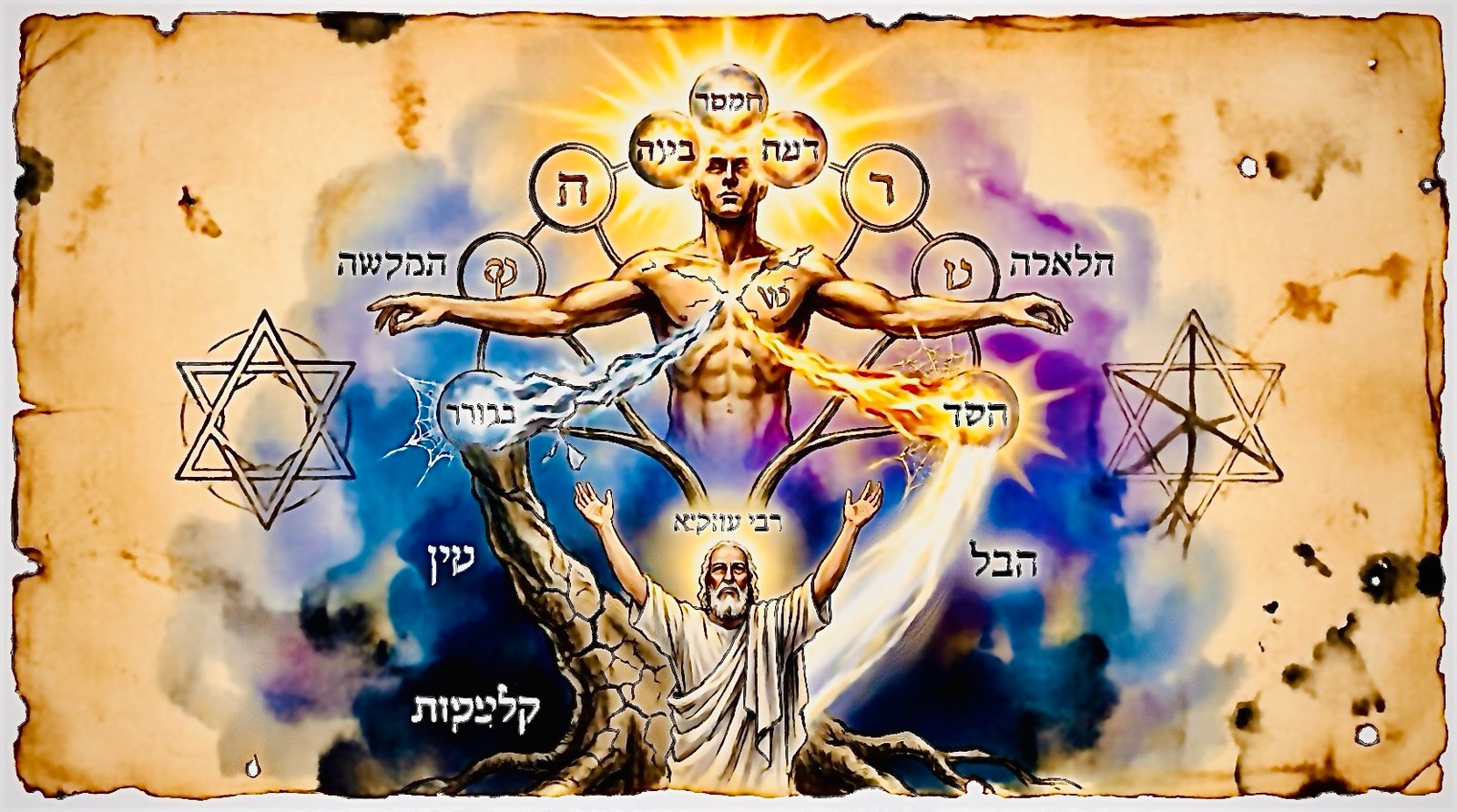
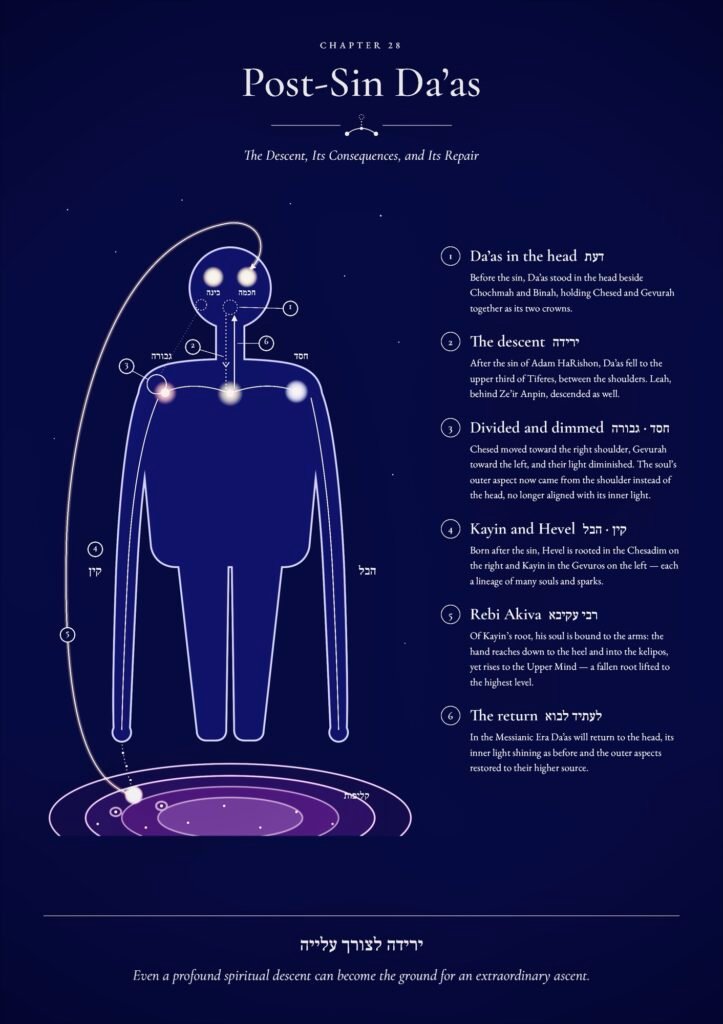
Ze’ir Anpin is described as possessing three “brains”: Chochmah, Binah, and Da’as. Da’as, in this account, incorporates two forces—Chesed and Gevurah—sometimes called its two *crowns*. These forces are associated respectively with the right and left sides. Before Adam HaRishon’s sin, Da’as occupied its proper place in the head. After the sin, it descended from the head to the upper third of Tifferes, the region corresponding to the chest and the space between the shoulders.
The descent divided what had previously been integrated. The Chesed aspect moved toward the right shoulder, while the Gevurah aspect moved toward the left. The change was more than a shift in spiritual location: it diminished the illumination of these forces. In the head, Da’as had occupied a higher and more luminous level. In its lower position, it could no longer radiate with the same intensity.
This distinction between a force’s inner essence and its outer clothing is essential to the account. A soul is understood to have an inner aspect and an outer aspect. Before the descent, the inner aspect associated with the Gevuros of Da’as was joined to an outer aspect rooted in the bone and flesh of the left side of the head. Once Da’as descended, the inner and outer aspects were no longer properly aligned. The inner aspect remained associated with the Gevuros of Da’as, while the outer aspect came from the left shoulder. Thus the soul’s inner and outer dimensions were separated in both level and source.
The roots of Kayin and Hevel
Kayin and Hevel were born after Adam HaRishon’s sin, and their spiritual roots reflect the divided condition created by the descent of Da’as. Kayin is associated with the Gevuros on the left side; Hevel is associated with the Chesadim on the right. In the account’s symbolic language, these are not merely personal characteristics. They are spiritual lineages, with each root encompassing many souls and sparks.
The descent produced two related deficiencies in the root of Kayin. First, the inner light of the Gevuros was diminished because Da’as no longer stood in the head. Second, the outer aspect of the soul came from the shoulder rather than from the higher place appropriate to it—the “skull,” or head. The inner and outer aspects were therefore not only less luminous than before, but also less perfectly joined.
The text presents these deficiencies as consequences of the primordial sin, not as shortcomings that a person can simply undo through ordinary effort. Yet it does not portray the damage as permanent. In the Messianic Era, with God’s help, Da’as will return to its place in the head. The inner aspects will again radiate as they did before, and the outer aspects will be restored to their fitting, higher source.
There is, however, an unresolved question about the present outer aspects associated with the left shoulder. The author expresses uncertainty as to whether they will remain joined to the relevant inner aspects in the future, or whether the arrangement will be different. This hesitation matters: the account offers a confident vision of repair while acknowledging that the precise form of that repair is not fully known.
Leah and the pattern of descent
The discussion extends the same pattern to Leah, a partzuf associated with the Malchus of Imma and positioned behind Ze’ir Anpin. Leah’s upper part originally corresponded to the upper region of Ze’ir Anpin, reaching to the chest; her lower part extended farther down. After Adam HaRishon’s sin, Leah too descended, so that her head was no longer in its original position.
This parallel suggests that the consequences of the sin were not confined to Da’as alone. The altered position of Da’as formed part of a broader reordering of spiritual structures. The descent of one configuration affected the placement and relationship of others, just as the division between inner and outer aspects affected the organization of the soul.
Rebi Akiva and the repair of Kayin’s root
The teaching then turns to the souls rooted in Kayin, including Rebi Akiva ben Yosef. It describes Rebi Akiva and other souls as belonging to a shared root connected with the Gevurah of Hod in Da’as. It also invites the reader to understand the root of Hevel by contrast, through the Chesadim in Da’as.
The root of Kayin is portrayed as having suffered a profound fall: its sparks descended into the *kelipos*, the forces that conceal and obstruct holiness. The text invokes the language of *Tikunim* to connect Kayin’s sin with a blemish in the “Mind,” understood here as Chochmah. Against that background, Rebi Akiva’s spiritual stature and martyrdom acquire a particular meaning. His soul is associated with the arms, and the image of the hand reaching down to the heel evokes the possibility of movement between the lowest depths and the highest spiritual level.
The arms, in this symbolism, can descend into the depths of the kelipos, but they can also rise toward the “Upper Mind.” Rebi Akiva’s death at the hands of the Romans is therefore interpreted not only as a tragedy but as part of a cosmic rectification. The Talmudic account in which G-d tells Moshe, “Quiet! This is what went up in the Mind before Me,” is read through this Kabbalistic lens: Rebi Akiva’s life and death were bound to the repair of the blemish in Kayin’s root.
This reading gives suffering a theological significance without making it easy or comprehensible. Moshe himself is portrayed as horrified by the vision of Rebi Akiva’s suffering and death. The answer he receives points to a divine purpose, but the mystery remains. The teaching’s emphasis is not that human beings can fully explain such suffering; rather, it frames Rebi Akiva’s fate as a hidden act of spiritual repair whose full meaning exceeds ordinary understanding.
The account also makes a striking claim about souls from Kayin’s root: through good deeds, they may ascend to an exceptionally high level, even beyond that of souls from earlier generations. This reverses the expectation that earlier generations must always be spiritually superior. A root marked by damage may, through its particular path of repair, attain extraordinary elevation.
The work of a soul rooted in Kayin
A soul from Kayin’s root, when it enters the world for the first time as a new soul, still has work to do. It must complete and repair the levels of Nefesh, Ruach, and Neshamah that were blemished when they were incorporated in the Nefesh of Kayin at the time of his sin. The soul’s task is thus not merely to develop its own isolated spiritual life. It participates in the repair of a larger root.
The text describes this work through the structure of the limbs of Adam HaRishon. Each limb includes levels corresponding to flesh, tendons, and bones, with the bones—and especially the marrow within them—representing the higher level. These levels are associated with the soul’s inner structure and with the way souls are connected to one another within a shared root.
The imagery suggests that spiritual repair is both individual and collective. A person’s deeds affect the particular level of the soul to which that person belongs, while also contributing to the restoration of the larger structure. The soul is not imagined as a self-contained unit, but as part of a complex body whose limbs and levels are connected.
Long and short limbs
The final distinction concerns the relative distance between souls within different limbs. Long limbs, such as the arms and thighs, contain greater distances between one soul and another. By contrast, souls associated with shorter limbs—such as the shoulder—are described as being close together. Torah scholars rooted in such a place are therefore joined closely to one another.
This anatomical metaphor gives spiritual proximity a concrete form. Souls may differ not only in their particular qualities or tasks, but also in how near they stand to others within their shared spiritual structure. Some roots are spread across a long span; others are densely connected. The closeness of souls in a shorter limb implies a special kind of mutual relationship, in which the work and merit of one may be closely bound to the work and merit of others.
Conclusion
The teaching of post-sin Da’as presents the sin of Adam HaRishon as a rupture in spiritual order: Da’as descended from the head, its forces separated toward the shoulders, and the inner and outer aspects of souls became misaligned. The roots of Kayin and Hevel emerged within this altered structure, carrying distinct spiritual inheritances. Yet the descent is not the end of the story. The promised return of Da’as to the head in the Messianic Era offers a vision of restored illumination and proper alignment.
In the meantime, the repair proceeds through the lives and deeds of souls. Rebi Akiva becomes an emblem of how a root that fell into the depths may rise toward the highest levels. The imagery of limbs, bones, flesh, and tendons further presents the soul as part of a larger body, in which individual acts contribute to collective restoration. The account holds together damage and hope, separation and connection, mystery and purpose. Its central claim is that even a profound spiritual descent can become the ground for an extraordinary ascent.