
The Twenty-Seven Steps to Reincarnation
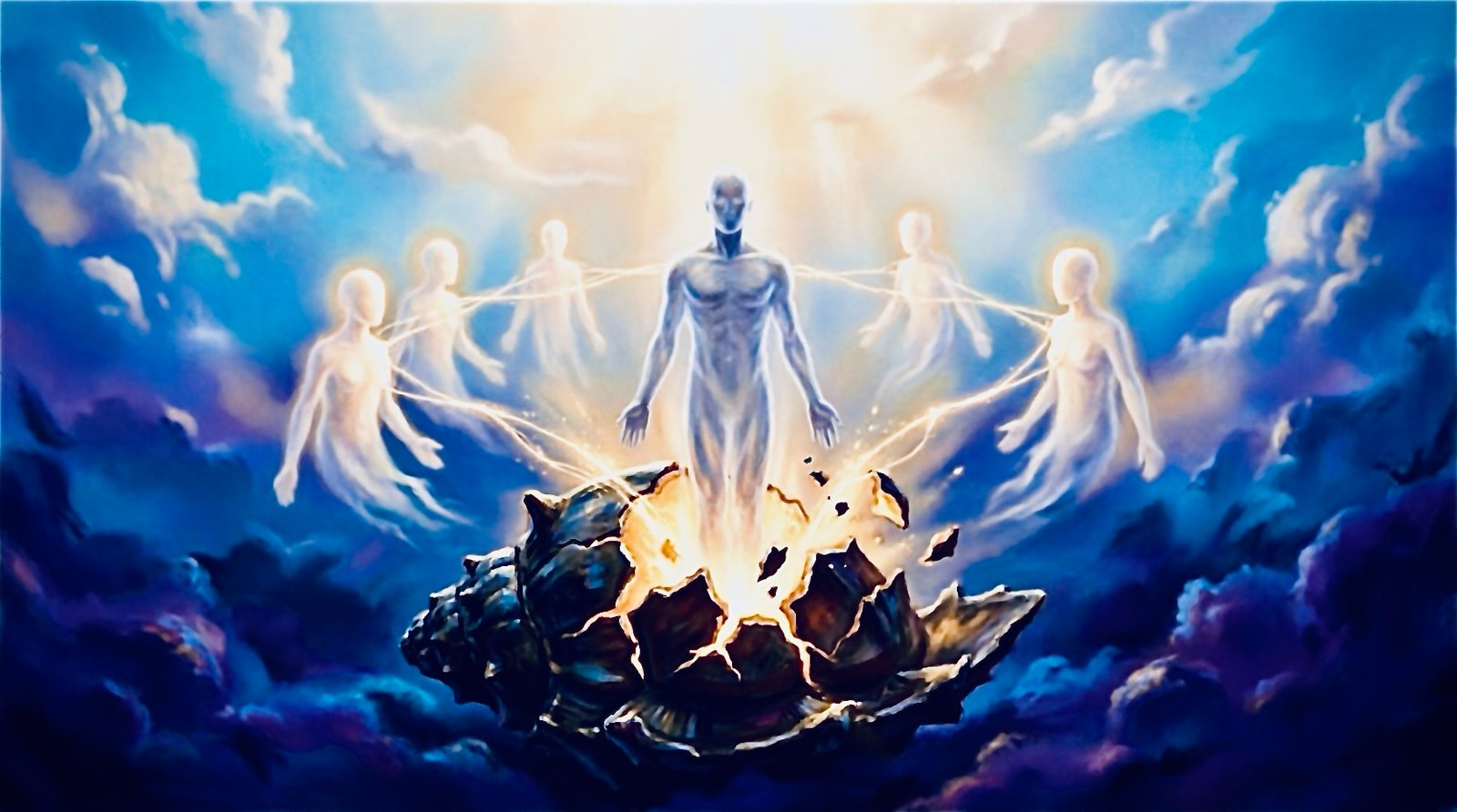
The passage describes reincarnation as a gradual process of spiritual repair. A soul does not simply leave one body and enter another as though changing garments. Instead, it may have to pass through layers of concealment, become connected to other souls, undergo purification, and only then enter a new life in a complete way. The journey is shaped by the soul’s history, the circumstances of the world, and the merits of people who may be connected to it. What appears outwardly to be a single human life may therefore contain a hidden story stretching across generations and spiritual realms.
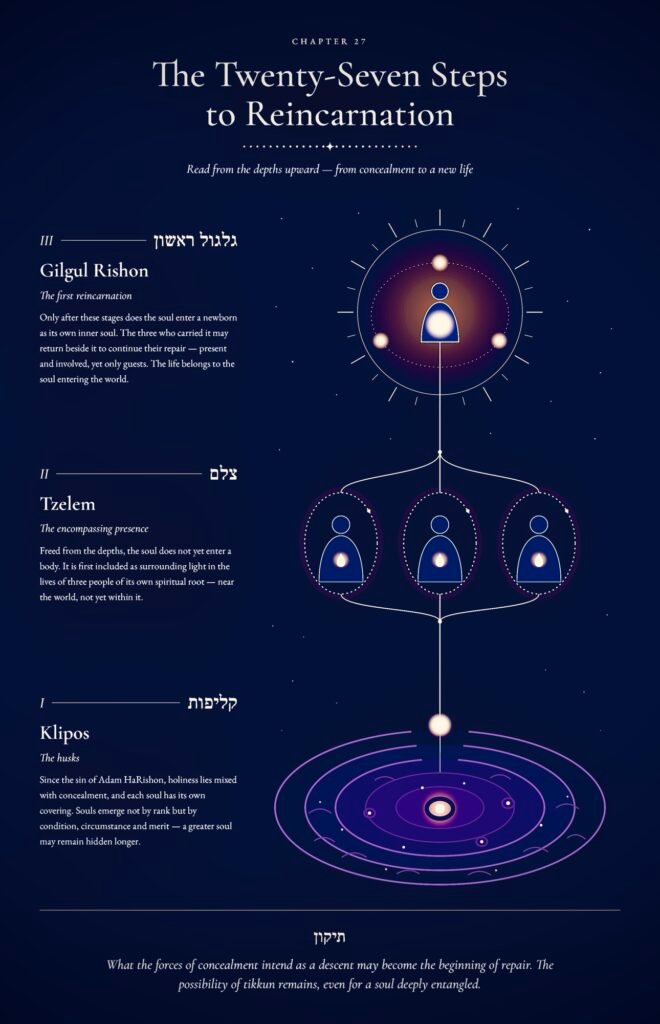
At the heart of this account is the idea that souls can become mixed with the *Klipos*. The word *Klipos* means “husks” or “shells”: forces that conceal holiness and draw spiritual life toward impurity. In the passage’s mystical framework, the souls of humanity were affected by the spiritual consequences of Adam HaRishon’s sin, as well as by the histories associated with Kayin and Hevel. Souls descended into a condition in which good and evil were mixed together. Each soul has its own particular covering, and each must undergo a process of separating its holy potential from the forces that obscure it.
This means that reincarnation is not simply a return to earthly life. It is part of a larger process of *tikkun*, or rectification. A soul’s return to the world can help it become purified, but the process may also involve other souls from the same spiritual root. The passage uses the example of Nadav and Avihu, the sons of Aharon who died after bringing an unauthorized fire. Their souls are described as connected to other souls that were not yet ready to enter the world independently. Those souls could be present with Nadav and Avihu as a *tzelem*—literally, an “image,” but in this context a spiritual attachment or encompassing presence—while still remaining unpurified.
The image of the *tzelem* suggests that a soul can be near the world without yet being fully embodied in it. It may accompany another person spiritually, as an encompassing light, while waiting for the right conditions to emerge from the Klipos. When a soul from the same root later enters the world, its own purification may help clarify the way for other souls. The process is therefore both individual and interconnected: every soul has its own path, yet that path may be linked to the spiritual journeys of others.
The passage emphasizes that souls do not leave the Klipos according to a simple ranking system. A soul that is more elevated or spiritually refined may remain trapped longer than a lesser soul. Its departure depends not only on its potential but also on circumstances and merit. A particular act, relationship, or moment in history may create the conditions for one soul to emerge, while another remains hidden. From the outside, this order may seem puzzling. If a soul is great, why should it remain concealed? If another is less elevated, why should it enter the world first? The passage answers that spiritual timing is not determined by rank alone. What matters is the combination of a soul’s condition and the circumstances that make its departure possible.
This teaching invites a different way of thinking about spiritual progress. We may assume that those who seem most gifted or righteous should advance most quickly. The passage warns that the inner reality is more complicated. A person’s visible status does not reveal the full history of the soul, the depth of its struggle, or the conditions required for its repair. What looks like delay may be part of a hidden process. What looks like an early arrival may reflect a particular opportunity for rectification rather than a greater spiritual level.
One of the most surprising parts of the passage concerns the possibility that the Klipos may draw a soul toward a person who has sinned. The forces of concealment may try to make that person sin further by bringing a soul from the same spiritual root into contact with him. In this way, the Klipos hope to deepen the person’s wrongdoing and strengthen their own influence. They may even draw a great soul from the depths of impurity, believing that it is already lost and can no longer return to holiness.
But the outcome can be the opposite of what the Klipos intend. G-d may help the soul shake off its covering, reveal its strength, and become a source of good. A situation designed to encourage further failure may become the beginning of spiritual recovery. The passage does not deny the seriousness of sin or pretend that every harmful situation will automatically produce a good result. Instead, it presents a striking possibility: even when destructive forces appear to have gained control, they may have misjudged the hidden holiness within the soul.
This reversal gives the passage a deep sense of hope. A person’s worst moment does not necessarily define the full meaning of that person’s life. The forces that seem to be pulling someone downward may, under different circumstances, become the setting in which a hidden strength is revealed. The soul’s struggle can be real and dangerous, but it is not always final. The possibility of purification remains, even when the soul appears deeply entangled.
The passage then describes a more formal sequence in the soul’s journey. After a soul leaves the depths of the Klipos, it does not immediately enter a body as a complete inner soul. First, it must be included as an encompassing presence in the lives of three people from its spiritual root. It accompanies them as a *tzelem*, or surrounding spiritual presence, before entering a newly born person in a fuller way. That entry is called the soul’s first reincarnation.
This distinction between an encompassing presence and an inner soul is central to the passage. A soul may be spiritually connected to a person without being the main soul within that person. It may be present in a preparatory way, participating in the process of purification while still waiting for its own full embodiment. Only after passing through the required stages does it enter a new body as the person’s inner soul.
Even then, the process may involve unfinished work from the earlier lives. The three people who carried the soul as an encompassing presence may not have completed their own rectification. If so, they may return together with the soul during its first full reincarnation, continuing their work alongside it. Yet the body belongs to the soul entering the world for the first time. The other souls are described as “guests”: they are present and involved, but they are not the central identity of the new person.
This account presents human identity as layered and relational. A person is not described as a simple collection of past lives, nor as a single soul entirely disconnected from others. Rather, the soul’s journey may include spiritual attachments, unfinished responsibilities, and relationships with other souls. The new life remains its own life, but it may carry traces of a wider history. In this view, the past is not merely behind a person; it may continue to shape the conditions under which that person begins.
The passage also connects this hidden spiritual history to emotional experience. A person whose soul is only beginning to emerge from the Klipos may feel sadness, worry, or heaviness without understanding the cause. The text suggests that such feelings may reflect the soul’s difficult transition. The person may be struggling inwardly as the soul moves away from concealment and toward a more complete presence in the world.