The Soul as a Journey of Repair
In *Rabbi Chaim Vital’s Soul*, the great kabbalist recounts what his teacher, Rabbi Isaac Luria—the Ari—told him about the hidden history of his soul. The account is at once a spiritual autobiography, a map of reincarnation, and a meditation on the purpose of religious learning. Its central claim is that a person’s life is not an isolated episode. It belongs to a long chain of lives, unfinished obligations, inherited merits, and possibilities for repair.
The story begins with a striking declaration: the Ari says that he came to Safed chiefly for Chaim Vital. He had been directed, the account says, to travel to the city where Vital lived in order to teach him. His mission was not primarily for his own spiritual advancement, nor was he commanded to teach a circle of students. He had come to complete Vital’s development. Once Vital had learned what he was meant to learn, the Ari would no longer need to remain in this world.
This claim gives learning an almost sacred intimacy. The relationship between teacher and student is not merely the transfer of knowledge from one mind to another. It is presented as a meeting arranged across spiritual worlds, with each participant bearing a particular responsibility. The teacher’s wisdom is a gift, but also a charge: he must recognize what is unfinished in the student and guide him toward its completion. Vital, in turn, must become capable of receiving and embodying what he is taught.
The Ari describes Vital’s soul as exceptionally elevated, able, through its nature and deeds, to rise beyond the heavenly realm called Aravot. Yet the text does not present spiritual greatness as simple perfection. Vital’s soul is powerful precisely because it carries work still to be done. Its history includes several incarnations, each revealing a different aspect of its character and its unfinished task.
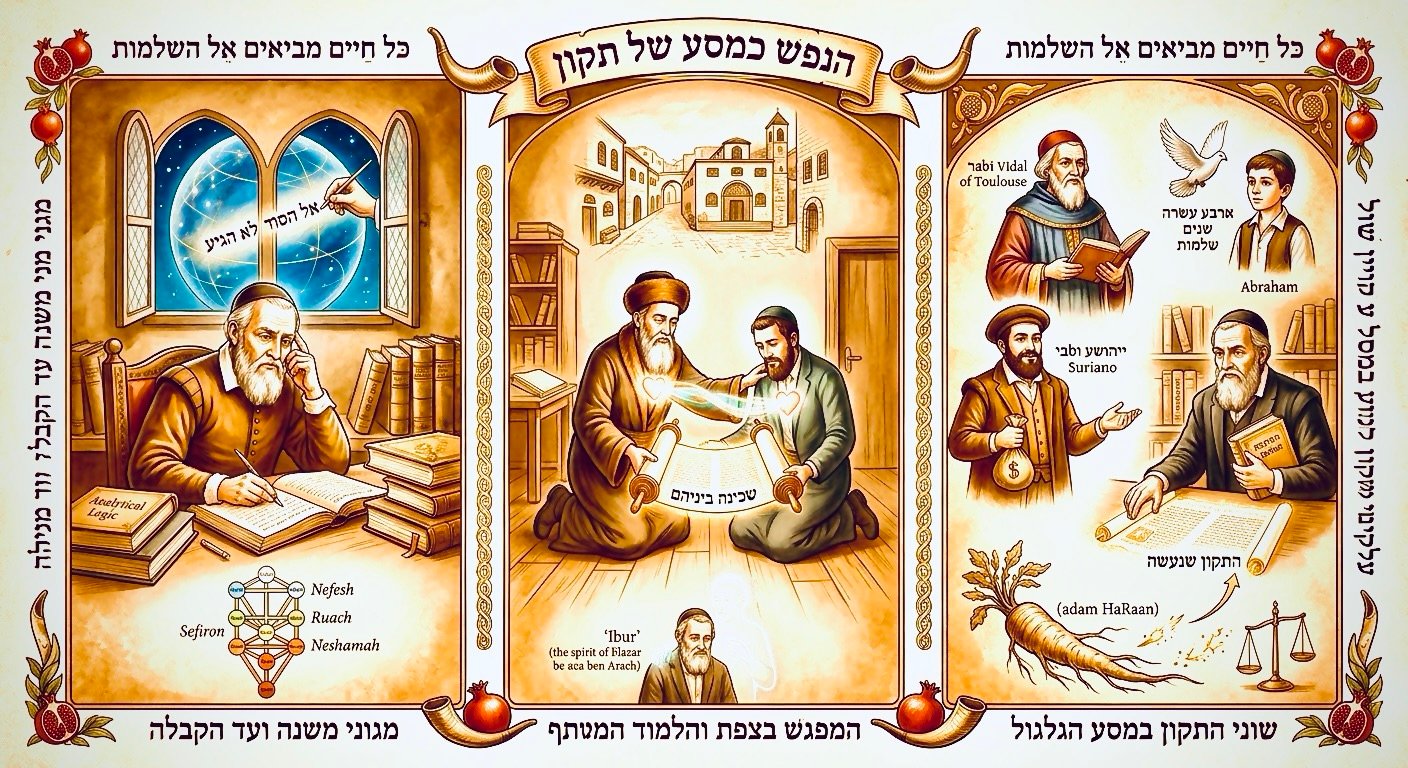
Among the figures named as earlier embodiments are Rabbi Vidal of Toulouse, associated with the work *Maggid Mishneh*; Rabbi Yehoshua Suriano, remembered as a wealthy and charitable man devoted to the synagogue and study hall; and a boy named Abraham, who died at fourteen. Vital’s present life, the Ari explains, is another stage in this sequence. The repeated return of the soul is not described as random repetition. Each life contributes something, while leaving other matters unresolved.
The most important unresolved matter, according to the account, concerns Vital’s earlier relationship to the wisdom of the Zohar. In a previous incarnation as the author of *Maggid Mishneh*, he was accomplished in legal and analytical study, but did not sufficiently believe in or engage with the Zohar’s mystical teaching. His present life therefore requires a different kind of work: he must turn toward the wisdom he had once neglected.
This contrast between forms of learning is one of the passage’s most revealing themes. Vital is not portrayed as intellectually deficient. On the contrary, the Ari says that he had been sharp and accomplished in intricate study. His difficulty is not an absence of scholarship, but an imbalance in it. Mastery in one domain does not guarantee completeness in another. The soul must learn to approach dimensions of truth that its established habits may resist. In this sense, reincarnation becomes a language for intellectual and spiritual correction: what was overlooked in one life returns as the central demand of another.
The account also distinguishes among the levels of the soul—*Nefesh*, *Ruach*, and *Neshamah*. The earlier incarnations described by the Ari belong, for the most part, to Vital’s *Nefesh*, the soul-level associated in this framework with vitality and action. The higher levels, *Ruach* and *Neshamah*, have other histories and other matters to rectify. This layered picture suggests that a person’s inner life is not a single, simple identity. It is a complex inheritance, composed of different spiritual dimensions, each with its own development.
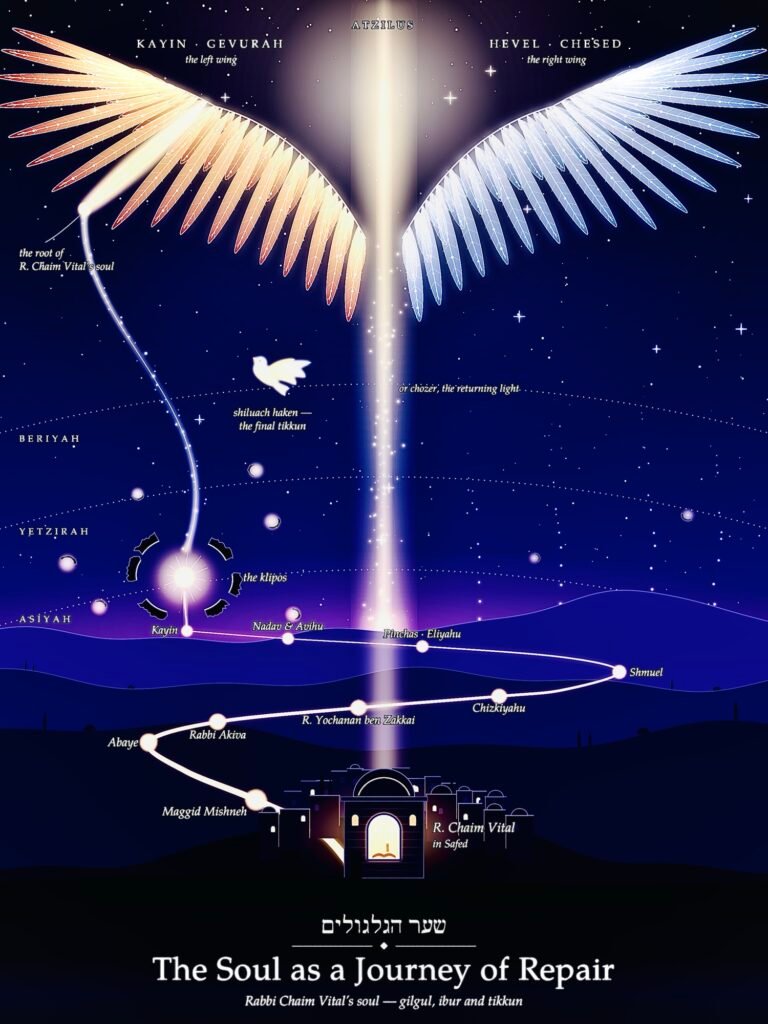
That inheritance is also communal. The Ari tells Vital that his *Nefesh* has passed through the lives of numerous figures in Jewish history, including Rabbi Yochanan ben Zakkai, Rabbi Akiva, Abaye, and others. These connections are not offered merely as a catalogue of illustrious names. They make the individual soul part of a larger spiritual history. A person may carry forward the unfinished work of teachers, sages, and generations long gone. The self, in this vision, is both personal and collective: it has its own obligations, yet it is formed through a chain of lives and relationships.
The stories of Rabbi Yochanan ben Zakkai and Rabbi Akiva reinforce this point. Both, the passage recalls, spent their first forty years in relative simplicity before turning to Torah and becoming great teachers. Their lives demonstrate that spiritual achievement need not be present from the beginning. A slow start does not determine a person’s final stature. The soul may require decades, or even several lifetimes, to become ready for its task. What matters is not merely where one begins, but whether one eventually turns toward learning and transformation.
Vital’s reported connection to Rabbi Akiva is given a particularly emotional form. The Ari says that Vital would faint when he saw a crowd assembled to kill someone, because his soul remembered the suffering of Rabbi Akiva’s execution. He also recalls Vital’s youthful desire to study *Pirkei Rabbi Eliezer*, a work associated with Rabbi Akiva’s teacher. Such details make the doctrine of reincarnation intimate and bodily. The soul’s history is not only an abstract record; it appears in instinctive reactions, affinities, fears, and desires. The past is imagined as something that can remain present in the nerves and imagination of a later life.
The account’s emphasis on teachers and students is equally significant. Rabbi Elazar ben Arach, a disciple of Rabbi Yochanan ben Zakkai, is said to have entered Vital as an *ibur* when Vital was thirteen. Rabbi Elazar ben Shamua, a disciple of Rabbi Akiva, is said to have joined him when he was twenty. An *ibur* is described here as a spiritual attachment or additional soul-presence, distinct from the full reincarnation of one soul into another. These figures come to aid Vital in completing what remained unfinished in their own teachers. The chain of instruction thus extends beyond ordinary time: disciples serve their masters, and the spiritual bond between them continues to operate across generations.
Yet the text does not treat exalted spiritual ancestry as a license for complacency. It includes a pointed warning attributed to Rabbi Yannai: Vital must guard himself against spreading rumors and speaking *lashon hara*, harmful speech. The warning is striking because it brings the discussion down from celestial heights to everyday conduct. A soul may be described as reaching toward the highest heavens, but its repair still depends on the discipline of the tongue. Spiritual grandeur and moral responsibility are inseparable. The greater the soul’s potential, the more consequential its ordinary choices may be.
That tension gives the passage its human depth. Vital is told that his soul is extraordinarily elevated, yet he is also warned to watch himself. He is connected to sages and martyrs, yet must still learn, correct, and restrain his speech. His spiritual identity is not a finished achievement to admire; it is a demanding vocation. The past supplies him with resources, but it also places obligations upon him.
The narrative’s luxury lies in the scale of its imagination: a single life opens onto centuries of Jewish learning, hidden spiritual relationships, and heavenly realms. But its moral vision is remarkably practical. The purpose of such a vast history is not simply to magnify the individual. It is to explain why the individual must study, listen, and act with care. The soul’s journey is measured not only by its origins or rank, but by what it does with the opportunities it receives.
Ultimately, *Rabbi Chaim Vital’s Soul* presents identity as a work in progress. Vital is at once himself and the bearer of many earlier lives; a student of the Ari and an heir to generations of teachers; a soul of extraordinary potential and a person still in need of correction. Reincarnation, in this account, is not escape from responsibility but its extension. What remains incomplete returns, and what is received from the past must be made fruitful in the present.
The deepest lesson of the passage is therefore not that Vital possessed a remarkable soul, though that is its most dramatic claim. It is that spiritual greatness is inseparable from spiritual labor. The soul may arrive with a history, a lineage, and an immense capacity for ascent—but it must still become worthy of what it carries.
The Youth and the Burden of the Soul
In the account attributed to Rabbi Chaim Vital, youth is not simply a stage of life. It is a threshold at which hidden histories may become visible: inherited tendencies, unfinished obligations, and the consequences of choices made before a person fully understands their weight. The passage presents the young person as carrying a soul shaped by earlier lives, yet still capable—through learning, restraint, and repentance—of changing its course.
The narrative describes Rabbi Akiva as possessing a great and holy soul despite being the son of converts. It explains this through the language of reincarnation: his soul is connected to a spiritual fragment associated with Yosef HaTzaddik. At the same time, the passage suggests that a person’s spiritual inheritance does not make life effortless. It may bring vulnerability as well as distinction. In the text’s mystical framework, the forces called *chitzonim*—spiritual influences that cling to a person—can take hold during a period of immaturity, when judgment and self-command are still developing.
This account gives particular attention to the dangers of youth. Pride, mockery, and sexual misconduct are treated not as isolated lapses but as habits that can shape a person’s character and spiritual life. The narrator understands his own youthful pride as one of the central faults he must confront. His prescribed response is not self-importance or despair, but humility: he must learn to approach himself with a “deflated spirit,” recognizing that genuine growth begins when a person can acknowledge his limitations.
The passage also emphasizes responsibility within marriage. Its discussion of the wedding night and the laws of family purity belongs to a specific religious and historical context, and it should be read as a record of the text’s teachings rather than as a general guide to contemporary practice. Within the narrative, however, the episode illustrates a broader point: moments of transition demand care. A person’s intentions matter, but so do knowledge, attentiveness, and the willingness to seek guidance. The text portrays youthful inexperience as something that can lead to error, while insisting that later reflection and repentance can still have meaning.
Learning, especially the study of the Zohar, is presented as the narrator’s principal task in his present life. He is told to study diligently before raising extensive questions, suggesting that understanding requires patience as well as intellectual curiosity. The instruction does not reject inquiry; it places inquiry within a disciplined process. First comes sustained attention to the material, then the freedom to question and investigate it more deeply. In this way, learning becomes not merely the acquisition of information but a form of spiritual repair.
The account’s treatment of past lives and inherited sin may feel distant from modern assumptions. Yet its moral concerns remain recognizable. It asks how a young person should respond to impulses, mistakes, and inherited burdens. Its answer is demanding but hopeful: acknowledge wrongdoing, cultivate restraint, pursue wisdom, and repair harm where possible. The past may shape a person, but it need not be the final word.
Ultimately, the passage presents youth as a period of both danger and possibility. Inexperience can leave a person exposed to pride, error, and careless action; yet youth is also a time when habits can be reshaped and understanding deepened. The soul, in this vision, is not defined solely by what it carries from the past. It is also formed by what a person chooses to learn, how humbly they live, and whether they turn regret into deliberate change.
The Long Work of Rectification
In the teachings attributed to Rabbi Chaim Vital, a soul’s journey is not confined to one lifetime. A person may inherit the unfinished work of those who came before him, and an act committed in one incarnation may be answered for in another. The account presented here gives that idea a stark and intimate form: a chain of souls, each carrying forward a spiritual burden, until the work of repair becomes visible in the habits and fears of a living person.
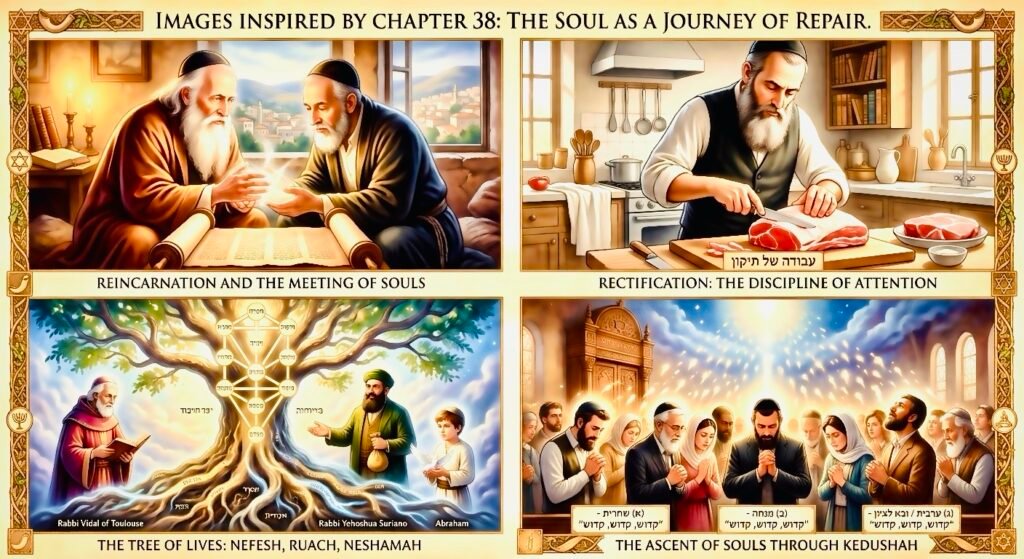
The chain begins with a sin involving forbidden fat. One man, we are told, ate it knowingly and deliberately, without taking proper care. In a later life, he understood his own conduct as a grave failure and described the punishment that followed: he spent two hours each day removing fat from meat, discarding nearly twice as much meat as fat. This was not merely a practical precaution. It was a sign of rectification—a sustained, almost severe effort to correct the carelessness of the past.
The teaching then traces the sin through successive lives. The HaRav HaMaggid’s transgression was accidental. Rav Shaul’s was nearly intentional, arising from inexperience. Rebi Yehoshua Suriano’s was fully intentional. The progression illustrates the maxim from Pirkei Avos: “Sin causes sin.” A failure left uncorrected can become more deeply rooted, passing from mistake to negligence, and from negligence to deliberate wrongdoing.
Yet the account does not end with punishment. In the present incarnation, the person who bears this history is said to be unusually cautious about anything connected with slaughter or circumcision. He cannot bear to watch such acts being performed; at times, he even avoids killing fleas. The sensitivity is presented as a sign of repair: where earlier lives involved carelessness around blood or forbidden food, the present life is marked by heightened restraint. The soul’s correction appears not as a declaration, but as a disposition—an instinctive reluctance to repeat the old harm.
The narrative extends this vision of continuity to the earliest generations. Kayin and Hevel are described as mixtures of good and evil after Adam’s sin: Kayin carrying chiefly the impurity associated with the serpent, and Hevel chiefly the good associated with Adam. Even so, Kayin possessed a substantial share of good, connected to the firstborn portion. That good, the teaching suggests, did not vanish. It passed through later figures and became part of a long process of spiritual refinement.
Ya’akov and Eisav continue the pattern. Ya’akov emerges grasping Eisav’s heel, a gesture interpreted as an effort to reclaim the good portion bound up with Kayin and taken by Eisav. The heel becomes more than a bodily detail: it is an image of what lies low, hidden, and entangled with impurity, yet still capable of being recovered. From Ya’akov, this portion passes to Yissachar, and from Yissachar to Rebi Akiva, whose name is linked to the Hebrew word for “heel.” In this reading, the sacred is not always found in what is already pure and elevated. Sometimes it must be retrieved from the very place where holiness has been mixed with its opposite.
The account then follows the spiritual root of Nadav and Avihu through a remarkable succession of figures: Pinchas and Eliyahu, Shmuel, Chizkiyahu, Mattisyahu, Rebi Yochanan ben Zakkai, Rebi Akiva, Abaye, and others. Some receive the soul through *ibur*, a temporary spiritual indwelling; others receive it through reincarnation. The sequence is not simply a catalogue of famous names. It presents history as a chain of inheritances, in which a spiritual root may appear in different forms, taking up new tasks in new generations.
This vision makes moral life both more demanding and more hopeful. It is demanding because no act is isolated. A careless choice may deepen into habit, and a failure left unresolved may shape the work of those who come after. But it is hopeful because no failure is necessarily final. What has been damaged may be repaired, though the repair may require patience, humility, and repeated acts of care.
The most striking image is therefore not the long list of reincarnations, but the person sitting for hours over a piece of meat, removing what must not be eaten and discarding more than seems necessary. In that quiet labor, the grand doctrine becomes personal. The past is answered not by words alone, but by attention: by refusing to repeat a harm, by becoming careful where one was once careless, and by treating even small choices as opportunities for repair.
The Root of the Soul and the Discipline of Understanding
The passage presents a world in which spiritual identity is not confined to a single lifetime. A soul may pass through many generations, appearing in different people and in different forms, while preserving a connection to its original root. Alongside this account of reincarnation, the text offers a demanding portrait of intellectual and spiritual growth: understanding is not merely an ability one possesses, but a capacity that must be prepared through repentance, humility, discipline, and intention.
The first section traces the Nefesh—the lowest of the three principal dimensions of the soul—through a long succession of sages and scholars. The list ranges across generations, from Talmudic figures such as Rabbi Akiva and Abaye to the Savoraim, the Geonim, and later legal authorities. Its length gives the impression of a single spiritual thread woven through the history of Jewish learning. Yet the passage makes an important distinction: these figures shared the root of the speaker’s Nefesh, but many possessed a Ruach from another root. Abaye is singled out as having all three levels—Nefesh, Ruach, and Neshamah—from that same root.
This distinction makes the text’s account of identity both continuous and complex. A shared Nefesh does not mean that every person in the chain is identical, or that each possesses the same complete spiritual makeup. Rather, the soul’s history unfolds through partial correspondences. One dimension may link a person to a lineage of earlier figures, while other dimensions belong elsewhere. The passage thus imagines spiritual inheritance not as a simple succession, but as a layered pattern of affinities, differences, and responsibilities. It also places the speaker, Rabbi Chaim Vital, within a tradition that extends far beyond his own lifetime. His identity is presented as one moment in a much longer history of spiritual transmission.
The second section turns from the history of the soul to the cultivation of understanding. Here, the teacher—identified in the passage as the Arizal—does not describe comprehension as a gift that can simply be claimed. He sets out a demanding process of preparation. The speaker is instructed to repent, fast, wear sackcloth, sleep on the ground, and maintain a contrite spirit. He is also warned against jesting, anger, and harshness. These practices are not presented as ends in themselves; they are disciplines intended to reshape the person who seeks knowledge.
The passage gives particular weight to humility. Understanding, it says, depends on a contrite spirit and the avoidance of frivolity. The seeker must become receptive: less governed by pride, appetite, and distraction, and more capable of sustained attention. The prescribed period of two and a half years is explained as a measure for personal repair. The speaker had spent an earlier period neglecting Torah study and behaving improperly; he must now undertake a corresponding period of repentance. The logic is one of moral proportion. A life of understanding cannot be separated from the life that supports it.
The text also emphasizes the difficulty of this work. The speaker is warned that his inclination will resist the burden of repentance and that his thoughts may become entangled with that resistance. Spiritual progress therefore depends not only on aspiration but on perseverance. Even when the seeker would prefer to delay or abandon the work, he is urged to continue. The promised understanding is not immediate; it is the outcome of sustained effort, and ultimately, of divine assistance.
At the same time, the passage does not portray learning as a solitary achievement. The speaker is told that his future understanding will be strengthened by his attachment to his teacher. The teacher’s soul, he is assured, will help him almost as if it were present within him. The relationship between student and teacher is therefore more than the transfer of information. It is a bond of spiritual influence: the student’s devotion and attention make him more able to receive what the teacher can impart.
The final instructions extend this discipline into ordinary religious life. The speaker is encouraged to recite a verse of praise at night and to wear Rabbeinu Tam tefillin, practices associated in the text with heightened understanding. He is also instructed to recite blessings over food with care and intention. Such blessings, the passage explains, refine both the physical person and the mind by removing the influence of the *kelipot*—the forces of spiritual concealment or impurity associated with material things.
This teaching gives everyday actions a profound significance. Eating, praying, and putting on tefillin are not peripheral to intellectual life; they help form the person who thinks and learns. The mind is not imagined as separate from the body, nor is wisdom treated as a purely abstract achievement. What one eats, how one speaks, how one responds to anger, and how one directs attention all contribute to the quality of understanding.
Taken together, the two sections offer a unified vision of spiritual life. The account of reincarnation situates the individual within a vast inheritance of souls and learning. The instructions for gaining understanding show what the individual must do with that inheritance: cultivate humility, practice repentance, remain close to a teacher, and bring intention to even the most familiar religious acts. The soul may arrive with a history, but its capacities still require care. In this vision, wisdom is neither merely inherited nor simply acquired. It is awakened through disciplined living, sustained relationship, and a continual effort to make the whole person worthy of what the mind seeks to know.
The Discipline of Sacred Intention
The passage presents a demanding vision of religious life: learning, prayer, ritual, memory, and moral repair are not separate pursuits, but parts of a single spiritual discipline. Its speaker recounts instructions attributed to his teacher, the Arizal, whose guidance joins the study of Torah with the mystical practice of *yichudim*—acts of focused intention understood to unite and repair the upper worlds. The language is intricate and at times startling, yet the passage’s central concern is clear: spiritual practice requires constancy, precision, humility, and an awareness that one’s actions reach beyond oneself.
At the foundation of this discipline stands daily study. The speaker is commanded to read and learn Torah, Mishnah, Talmud, and Kabbalah, following the intentions his teacher has given him. This is not presented as casual reading or the accumulation of information. Study is a form of service, and its value depends partly on the care with which it is undertaken. The instruction to be “very careful” suggests that religious learning is both an intellectual obligation and an ethical one: it demands attention, steadiness, and fidelity to what has been entrusted.
Yet the passage complicates any simple hierarchy in which study alone constitutes the highest form of devotion. The speaker admits that he once stopped performing the *yichudim*, intending instead to devote himself to Torah study. His teacher rebukes him, insisting that he should not abandon them: these practices, he explains, are “greater than learning Torah” in the particular sense that they unify the upper worlds. The claim does not diminish Torah learning. Rather, it places study within a wider cosmology, where words and intentions participate in the repair of reality. The teacher’s preferred ideal is not learning instead of mystical practice, but learning joined to *yichud*—a synthesis in which knowledge becomes active spiritual service.
This synthesis also requires an inward correction of motive. The speaker is cautioned not to perform the *yichudim* merely to draw down a soul, but to intend the repair of the worlds above. In other words, even an extraordinary spiritual experience may become self-centered if it is sought for personal benefit alone. The proper intention directs attention outward and upward, toward restoration rather than acquisition. The passage thereby makes intention a moral discipline: what matters is not only what a person does, but what the person hopes the action will serve.
The account’s detailed instructions give this discipline a strikingly practical form. The speaker is told when to perform particular *yichudim*: after midnight on weeknights, at different times on Shabbos night, and in connection with Rosh Chodesh. He is instructed to read specific Mishnayos after the Shabbos meal and Birchas HaMazon, and to recite the name of Rebi Akiva ten times before each of the three daily prayers. These directions situate mystical devotion within the rhythms of ordinary religious life. Time is not an empty background; particular hours and days are understood as having distinct spiritual qualities. The calendar, the prayer service, the Sabbath meal, and the study of Mishnah all become settings for sustained attention.
The passage likewise treats sacred geography with care. The speaker is advised to visit the burial places of the righteous on the eve of Rosh Chodesh or on the fifteenth of the month, but not on Shabbos, festivals, or Rosh Chodesh itself. These instructions reflect a world in which the living and the dead, the visible and the invisible, are imagined as connected through carefully ordered times and places. The graves of the righteous are not merely sites of remembrance; they are locations where prayer and spiritual practice may take on a particular force. But access to such places is governed by restraint. Devotion is not simply a matter of going wherever one feels moved. It requires attention to the appropriate moment.
An especially revealing feature of the text is its insistence on continuity. The teacher tells the speaker that he must not stop performing the *yichudim*, even when their benefits are not immediately apparent. He also describes a period of assistance that will eventually give way to a more regular practice. The passage thus portrays spiritual growth as gradual. Help may come intermittently; discipline must persist regardless. The speaker’s task is to continue faithfully through stages of dependence, preparation, and greater steadiness. The promised change does not eliminate the need for effort. It makes sustained effort possible.
The discussion of reincarnation and “soul connections” extends this sense of responsibility across generations. The speaker is told that his soul is connected to earlier figures and that particular forms of repair relate to their histories. These claims belong to a mystical framework that sees the soul’s present life as entangled with the moral and spiritual consequences of lives before it. The passage does not treat identity as isolated or self-contained. Instead, the individual inherits unfinished work. To live well is, in part, to repair what has been damaged in the larger chain of spiritual history.
This framework can make the text’s moral seriousness feel almost overwhelming. The speaker’s past is interpreted through lost time, forbidden knowledge, and inherited associations with violence. A verse appearing on his forehead is read as a sign of wasted years, spent on alchemy rather than Torah. He is also told to remove a knife from the table before Birchas HaMazon, not merely to cover it. The explanation connects this precaution to his spiritual root in Kayin and to the symbolism of weapons. A table, associated with nourishment and peace, should not retain an instrument of violence during a blessing of gratitude.
The knife instruction is particularly powerful because it translates an immense mystical narrative into a small, concrete act. The speaker cannot undo the past by reflection alone; he must practice care in the present. Removing the knife becomes a daily gesture of restraint, a way of distinguishing nourishment from harm and peace from aggression. The passage’s elaborate account of souls and cosmic repair therefore does not float free of ordinary conduct. It returns repeatedly to habits: how one studies, when one prays, where one goes, what one says, and what one leaves on the table.
The text’s luxury of detail—its names, times, scriptural references, and symbolic correspondences—also reveals a particular conception of religious attention. Nothing is spiritually neutral. A name may carry the power of a connection; an hour may be more favorable than another; a verse may disclose a hidden history; an object may embody a moral danger. Such a worldview demands a heightened attentiveness to the texture of life. The sacred is not confined to a sanctuary or a moment of formal prayer. It is woven into the arrangement of days, the discipline of study, the movement of the body, and the meaning assigned to material things.
At the same time, the passage’s demands are not presented as a celebration of spiritual achievement. They are accompanied by reminders of failure, limitation, and dependence on guidance. The speaker has wasted time; he has stopped a practice he was told to maintain; he needs assistance in the work of repair. The teacher’s commands are therefore not simply techniques for attaining power. They are a structure for accountability. Their precision makes neglect visible, while their repetition offers a path back to disciplined service.
Ultimately, the passage imagines devotion as a partnership between learning and action, intention and habit, individual responsibility and inherited history. Torah study gives the mind its work; *yichudim* direct that work toward cosmic repair; prayer and ritual shape the hours; ethical caution gives spiritual concern a physical expression. Its central lesson is that sacred life depends on more than fervor. It requires fidelity to practice, humility about one’s motives, and care for the smallest details. In this vision, a person’s daily acts can participate in a repair larger than the self—and the way to serve that vast purpose is to attend, patiently and carefully, to what has been placed before one.
The Work of Rectification: Memory, Restraint, and the Soul’s Return
The teachings presented here describe a life understood through the language of *gilgul*—the return of souls—and *tikkun*, the work of spiritual repair. Their world is one in which a person’s present actions may answer to events in earlier lives, and where even an unintentional injury, a forgotten obligation, or an intense moment of repentance can carry significance beyond what is visible. Yet beneath the intricate mystical framework lies a deeply human concern: how to live carefully when one believes that one’s actions touch not only the present, but also the past and the future.
One striking passage begins with a confession of accidental harm: “when a knife is in my hand I unintentionally cut my hand and my finger,” or injure himself with other metal implements. The injury is not presented simply as clumsiness. It belongs to a larger account of the soul’s roots and unfinished rectifications. The narrator is told that his spiritual lineage is connected to Kayin, whose killing of Hevel made the avoidance of bloodshed especially important. In this context, care with a knife becomes more than practical caution: it is a daily discipline shaped by a sacred memory.
The teaching concerning Yuval expands this idea from the individual to the cosmic. Yuval is described as a level of Kayin within the Partzuf of Ya’akov, while another aspect of Kayin is associated with Ze’ir Anpin, called Yisrael. These configurations contain the roots of Kayin and Hevel, and their rectification is linked to the coming of Moshiach. A verse from Psalms—“They will convey gifts to the One Who is to be feared”—is read as an allusion to Yuval, whose name is also associated with a brook. The image of a brook spreading its roots suggests that a spiritual source extends through many hidden channels. What appears to be an isolated figure or event may, in this vision, belong to a broad network of origins and consequences.
Moshe Rabbeinu becomes a point of repair within that network. Yuval is said to have entered Moshe as an *ibur*, a temporary spiritual attachment, in order to be rectified through him. Moshe himself contains sparks connected with Kayin, and the initials of the words “God was angry with me for your sake” are understood to hint at Yuval. The interpretation makes the work of rectification both personal and historical: a soul’s repair can take place through another soul, and an individual’s spiritual history can intersect with the destiny of the people.
The narrative also preserves the physical geography of sacred memory. The narrator recalls walking with his teacher to a place associated with the students of Rabbi Shimon bar Yochai and the study of the Idra Rabba. On the eastern side of the path stood a rock with two large cracks. The text records where Rabbi Shimon bar Yochai and Rabbi Elazar were said to have sat, while acknowledging uncertainty about the precise positions of the students. This uncertainty is important. The account does not conceal the limits of memory or knowledge. It preserves the place as meaningful while admitting that its details may have been remembered imperfectly.
A different kind of memory appears in the account of a childhood curse directed at the narrator’s mother. His teacher prescribes a three-day fast, measured as seventy-two hours, with the intention of restoring two spiritual “crowns” associated with Chassadim and Gevuros. The fast is to take place before Shavuos, and the verse “They shall be prepared for the third day” is to guide its intention. The discipline is presented as a response to a moral injury: words spoken in anger have spiritual consequences, and repentance requires sustained effort.
The fast is also connected to the removal of *tumah*, or spiritual impurity, and to the narrator’s capacity to receive the secrets of Torah on Shavuos night. He is told that the three days may also help cancel a decree concerning the years missing from the life of the Maggid Mishneh. Thus, the practice of repentance operates on several levels at once. It addresses a personal wrong, prepares the soul for revelation, and participates in a wider spiritual repair. The text’s world is intricate, but its ethical center is plain: wrongdoing should not be dismissed merely because it occurred long ago or because its consequences are difficult to see.
The narrator’s relationship with his teacher is not free of anguish. During the counting of the Omer, he is instructed to focus on Yesod and to repair a blemish connected with his wedding canopy. On another occasion, while fasting, he cries before G-d and asks why the path of repentance seems to have been withheld from him, and why his teacher had not taught him the matters he longed to know. His teacher perceives his distress and explains that the time for disclosure had not yet arrived. There is, he says, a designated season for every matter.
This exchange gives the spiritual discipline a human tension. The narrator wants understanding, and the delay feels painful. His teacher answers not by denying the pain but by placing it within a larger rhythm of readiness. The teaching invokes the idea that there is “a time for every purpose,” suggesting that knowledge, like repentance, has its appointed moment. When that period ends, the teacher promises, he will no longer conceal what the narrator asks. The passage therefore presents spiritual learning not as the immediate satisfaction of curiosity but as a relationship among desire, preparation, and timing.
The most demanding instruction concerns the taking of life. The narrator is told that in a previous incarnation he fulfilled the mitzvah of ritual slaughter, but in his present life he must avoid slaughter altogether. His teacher extends the prohibition beyond ritual slaughter: he is not to kill even fleas, lice, or other small creatures. The reason is again tied to the root of Kayin, the slayer of Hevel, and to another soul said to have reincarnated alongside him because of bloodshed associated with a circumcision. Whatever one makes of the metaphysical explanation, the ethical force of the command is unmistakable: this person must cultivate an unusually strict reverence for living things.
The instruction also changes how ordinary acts are understood. A person might regard killing an insect as negligible, but the narrator is asked to see even the smallest life as part of a serious moral field. The teaching does not claim that every person must follow the same personal restriction; rather, it describes a particular form of discipline assigned to a particular soul. Its broader implication, however, is that moral attention begins precisely where habit would prefer not to look. The small, the inconvenient, and the easily ignored may still deserve care.
The account then turns to mitzvos left to be fulfilled. The narrator is told that, as a “new spark,” he must fulfill the commandment to procreate. He is also told that only eleven mitzvos remain incomplete. After these are completed, the mitzvah of sending away the mother bird—*shiluach haken*—is to serve as his final rectification. The sequence is presented as a process in which one level of the soul is repaired before another can fully enter and be repaired in turn. The text distinguishes between the Nefesh and the Ruach, describing the completion of one stage as the condition for the next.
This account of the final mitzvah gives religious practice the character of a carefully ordered vocation. Mitzvos are not merely a list of obligations; they are also the means through which the soul’s capacities are restored. The image of the mother bird adds a further dimension. The command concerns restraint in the presence of a living creature and its offspring, and so it resonates with the earlier insistence on avoiding harm. The final act of rectification is not an act of power, but one that requires a person to limit himself.
The text also maps the narrator’s Nefesh onto the “left shoulder” of Adam HaRishon, associated with Leah. It relates the eleven mitzvos of this limb to the numerical value of the letters Vav and Heh, the final two letters of the Divine Name. Such calculations belong to the text’s symbolic language: letters, numbers, bodily limbs, and commandments are woven together into a single account of spiritual structure. To a modern reader, the details may seem remote, but their purpose is to express a conviction that no part of human existence is spiritually isolated. The body, the name, the commandment, and the soul all belong to an interconnected order.
Taken as a whole, these teachings portray rectification as a demanding combination of memory and action. The past is not erased, but neither is it treated as an excuse for despair. A previous act of violence may require present restraint; a childhood offense may call for fasting and repentance; a period of silence may prepare the way for later understanding. The soul’s history is complex, but the work it asks of the person is concrete: speak carefully, fulfill obligations, accept the proper time for learning, and avoid needless harm.
The luxury of this spiritual vision lies not in ease, but in depth. Every action is given weight, and every life is imagined as bearing hidden roots. Yet the passages do not leave the narrator alone with those roots. They offer a teacher, a discipline, a sequence of practices, and the hope that what is unfinished can be repaired. Their central message is that spiritual life is not a single moment of insight. It is an ongoing labor of attention—one that reaches from the great mysteries of Yuval and Moshiach to the humble act of setting down a knife with care.
The Soul’s Measure: Mitzvos, Community, and Personal Destiny
The passage presents a portrait of spiritual life in which number, commandment, bodily symbolism, and personal responsibility are woven together. Its numerical calculations are not offered as detached puzzles. They serve as a language for describing the soul’s place within the divine order: how mitzvos correspond to the limbs and faculties of a person, how the letters of the Divine Name organize those obligations, and how an individual’s spiritual root shapes both his strengths and his vulnerabilities. Alongside this esoteric framework, the text gives remarkably practical counsel—love one’s companions, share their suffering, pray for them, and recognize that spiritual repair demands humility and discipline.
Number as a map of spiritual obligation
The passage begins with gematria, the interpretation of Hebrew letters through their numerical values. It associates the expansion of the letters of the Divine Name with the number 500, the value assigned here to “shoulder.” The shoulder becomes more than a bodily feature: it is a symbolic site where spiritual duties are gathered and borne. The text links this symbolism to the mitzvos rooted in the “shoulder limb” of the speaker’s soul, suggesting that obligations are not merely external rules but expressions of the soul’s particular structure.
The calculations then connect the mitzvos to the four letters of the Name Havayah. The letters are assigned different groups of commandments: ten male negative mitzvos to the Yud, five female negative mitzvos to the first Heh, six male positive mitzvos to the Vav, and five female positive mitzvos to the final Heh. The numerical pattern turns the Divine Name into an organizing principle. The commandments are presented as differentiated, yet joined within a single whole—just as the letters form one Name.
This correspondence also gives the body a symbolic role. The shoulder is associated with the collective weight of the mitzvos, while the body’s limbs and organs become a vocabulary for describing spiritual life. The text’s worldview is therefore profoundly embodied: the soul is not imagined as separate from physical existence, but as something whose spiritual roots can be expressed through the body and its capacities.
The commandments as lived practice
The numerical scheme leads into a concrete account of commandments. Among the positive mitzvos described are supporting a brother who needs a livelihood, eating the Second Tithe in Jerusalem, building a parapet around one’s roof, procreating, circumcising one’s son, and loving one’s neighbor. These examples move from social and economic responsibility to ritual observance and interpersonal ethics. The list makes clear that religious life encompasses both the sacred and the ordinary: the roof of a home, the needs of a poor person, family responsibilities, and the way one regards another human being.
The passage also identifies commandments associated with women, including lending to the poor, the mitzvah of caring for tefillin, sending away the mother bird, and recalling the Exodus from Egypt. Its explanations connect these practices to symbolic readings of Hebrew words and images. The interpretation of lending, for instance, invokes the image of a “poor mother,” linking material generosity with spiritual repair. Whether read as legal instruction, mystical symbolism, or both, the passage treats acts of care as spiritually consequential.
The overall effect is to resist a division between inward devotion and outward conduct. The mitzvos are simultaneously commands, signs of the soul’s structure, and practical obligations toward other people. Their spiritual significance is realized through action.
Loving one’s companions
The most direct ethical teaching in the passage concerns the obligations people have toward their companions. The teacher instructs each member of the group to regard himself as a limb of the others. This image gives fellowship a bodily unity: the suffering of one person is not a distant event but a wound within the shared body of the group.
The instruction is explicit. If a companion is suffering, if someone in his household is ill, or if his children are in distress, the others should share his pain and pray for him. They should also take part in his broader needs and concerns. The group is not merely a circle of students who happen to study together; it is a community whose members are responsible for one another.
This teaching gives the passage’s esoteric language a moral center. The text may speak of gematria, soul-roots, and the hidden structure of the Divine Name, but its measure of spiritual life is not abstract knowledge alone. It is the willingness to respond to another person’s hardship. The image of the companion as a limb also offers a powerful account of solidarity: to care for another is not simply to perform a generous act, but to recognize a real bond.
Repentance, discipline, and spiritual repair
The speaker recounts fasting for a series of personal failings and painful episodes: a sexual transgression, neglect of honoring his parents, drinking wine associated with idolatrous use, pride, bloodshed, and failures in prayer and tefillin. The account is framed by the practice of *tikkun*, spiritual rectification. Fasting is presented as a disciplined response to wrongdoing, a way of confronting the past and seeking repair.
Yet the passage does not reduce repentance to a list of punishments. Its recollections reveal a person who understands his life as morally and spiritually accountable. The emphasis is on recognizing failure, accepting the need for correction, and continuing to pursue a more faithful way of living. The narrative also preserves the vulnerability of the speaker: he is not presented as an abstract mystic untouched by ordinary weakness, but as someone who struggles, errs, and seeks guidance.
The text’s account of spiritual identity is similarly complex. The teacher describes the speaker as rooted in Kayin, or Cain, and contrasts Kayin’s association with action and practical work with Hevel’s association with breath, speech, and explanation. The speaker is said to possess greater capacity for practical work than for eloquence. This is not simply a judgment of deficiency. It is a way of interpreting temperament as part of one’s spiritual inheritance. The lesson is that people may serve through different gifts, and that the work of the soul may take forms other than speech or scholarship.
Personal destiny and the limits of certainty
The passage also records teachings about auspicious days: one day of the week and one day of the month that are said to be favorable for a person according to the root of his soul. For the speaker, these are the second day of the week and the thirteenth day of the month. The teaching is linked to the rabbinic instruction to repent one day before death. The day of spiritual opportunity, in this interpretation, is a reminder to prepare oneself rather than to presume upon the future.
This material places personal destiny within the passage’s wider framework of divine order. Each person has a particular root, a pattern of strengths and vulnerabilities, and a time that may be especially propitious. Yet the practical implication is not complacency. The call to repentance remains urgent. A favorable day is valuable precisely because it can be used for reflection and change.
The passage therefore holds together two ideas that can seem opposed: a person’s life has a distinctive spiritual pattern, and a person remains responsible for what he does. The soul’s root may shape one’s disposition, but it does not erase the need for effort, ethical conduct, or repentance.
A unified vision of spiritual life
Taken as a whole, the passage offers a vision in which the hidden and the practical continually illuminate one another. Numbers give structure to the mitzvos; the Divine Name becomes a pattern for spiritual responsibility; the body provides a language for the soul; and personal temperament is interpreted through inherited roots. But these symbols do not remain remote or ornamental. They lead back to recognizable demands: give, pray, honor, repent, observe, and care for the people around you.
The passage’s deepest claim may be that spiritual life is both particular and shared. Each person has a distinct soul-root, with characteristic strengths and weaknesses. At the same time, no one is spiritually self-contained. The members of a community are bound together like limbs of one body, and the suffering of one calls for the concern of all.
In this way, the text joins mystical speculation to ethical responsibility. Its intricate calculations point toward a world in which every letter, limb, and commandment has meaning; its counsel about companions shows where that meaning must become visible. The soul’s measure is not only written in numbers or hidden in its root. It is also revealed in the burdens one is willing to carry—and in the care one offers when another person is in pain.
The Three Kedushos and the Ascent of the Soul
The three Kedushos described here are not merely three recitations of sacred words. They are three distinct moments in which holiness is proclaimed, and—according to the Kabbalistic teaching presented in the text—the spiritual order itself is raised. Each Kedushah belongs to a particular point in the day and carries its own intention. Together they form a pattern of ascent: holiness is declared, the structure of the worlds is elevated, and the soul is prepared to receive a deeper measure of spiritual understanding.
The first Kedushah is recited in the morning Amidah. Its opening expresses the worshippers’ resolve: **“We will sanctify You and reverence You.”** The second is the Kedushah of the weekday afternoon Amidah, whose declaration begins, **“We will sanctify You.”** The third is the Kedushah in **“Uva LeTzion”**—“And to Zion”—recited at night as Shabbat departs. Though all three proclaim the sanctity of G-d, they are associated with different times and different stages in the work of elevation.
The teaching explains that the effect of Kedushah is an ascent within the Sefirotic order. Malchut, the final Sefirah, is raised from its place toward the higher realms. In this account, Malchut’s ascent involves a “skipping” or passing upward through the levels associated with Chesed and Gevurah. The recitation of “Holy, holy, holy” is therefore more than praise: it participates in the movement of holiness through the spiritual worlds. What is uttered by the congregation below corresponds to an elevation above.
This ascent is connected to the forty-two-letter Name formed from the initials of the words of **Ana b’Koach**. The text assigns a particular portion of the first line of that prayer to each of the three Kedushos. During the weekday afternoon Kedushah, one should intend the first two letters, **Aleph and Beis**. During the morning Kedushah, the intention is directed to the middle letters, **Gimmel and Yud**. During the Kedushah of *Uva LeTzion*, recited as Shabbat leaves, one should intend the final two letters, **Tav and Tzaddi**.
These correspondences make the three recitations into parts of a single spiritual sequence. The letters are not treated as isolated signs; they belong to a Name whose power, the text says, extends through the worlds. Each Kedushah draws upon a different portion of that Name, and each contributes to the larger work of elevation. The morning, afternoon, and post-Shabbat prayers thus mark distinct movements within one continuous process.
The passage then turns from the structure of prayer to the inward life of the soul. Rabbi Chaim Vital recounts asking his teacher, Rabbi Isaac Luria, the Arizal, about the level and root of his soul. The answers he received suggested that his soul possessed an unusually high capacity for understanding and that his coming into the world would bring great benefit. Yet the Arizal did not disclose the full matter, saying that he was not permitted to reveal more. The account presents spiritual knowledge not as a possession to be claimed, but as a gift governed by restraint, timing, and permission.
One episode makes this point especially vivid. Rabbi Yosef Arazin, who was older than Vital, went to the Arizal in distress. He struggled with the fact that he seemed to be learning from Vital rather than receiving the teaching directly from their master. The Arizal answered that he had come into the world to teach Vital: the others, he said, would not learn even a single letter from him without learning with Vital. The explanation was not simply a matter of age or public stature. Spiritual rank, the Arizal taught, depends on the root and greatness of the individual soul, which may arise from a high source even when its bearer is young.
The passage also links Vital’s spiritual vocation to the figures of Moses and Elijah. It interprets the verse, **“If one is drawn to the scoffers, he will scoff, but to the humble he will show favor,”** through its initials, which are read as alluding to the words **“Eliyahu lives.”** From there it develops a teaching about Moses’ future role: Moses, whose speech was described as heavy, will return in the generation of the Messiah to teach Torah to Israel, while Elijah will serve as his interpreter. Elijah is identified with Pinchas, the son of Elazar and grandson of Aaron, Moses’ brother. The image is one of complementary service: Moses teaches, and Elijah gives voice to what must be conveyed.
This account of teaching and interpretation offers a fitting parallel to the three Kedushos. In prayer, the worshipper gives voice to sacred words whose significance reaches beyond their plain meaning. In the teaching about Moses and Elijah, one figure conveys Torah while another makes it intelligible. In both cases, spiritual truth passes through forms of speech, yet its full meaning depends on a deeper order: the intention behind the words, the source from which the soul receives, and the readiness of the listener.
Finally, the text describes the gradual unfolding of Vital’s own Ruach, the spiritual level associated with understanding and divine inspiration. The Nefesh, it explains, is principally connected with the performance of commandments through action. A fuller grasp of Torah and the attainment of *Ruach HaKodesh* require the Ruach. Vital’s understanding, therefore, was not portrayed as complete from the outset. It depended on the Ruach becoming fully and permanently present within him.
The three Kedushos and the account of the soul’s ascent belong to the same vision. Sacred words elevate; spiritual understanding unfolds in stages; and the soul’s capacity is shaped by its root and by the measure of revelation granted to it. Morning, afternoon, and the departure of Shabbat each offer a distinct opportunity to sanctify G-d and raise Malchut. Their differing intentions do not divide the work but complete it. Together, they form a disciplined rhythm of holiness—one in which prayer, Torah, and the soul’s gradual illumination are bound into a single ascent.
The Soul’s Partnership and the Work of Repair
In the teachings of reincarnation attributed to Rabbi Chaim Vital, the soul is not always described as a single, self-contained presence. It may be composed of sparks from several spiritual roots, joined across generations and clothed together within one person. The account presented here gives that idea a particularly intimate form: a portion of the speaker’s *Ruach*—the spirit—is said to join with a spark of the *Ruach* of Rabbi Akiva, while the speaker’s *Nefesh*—the soul’s more foundational level—is likewise bound to Rabbi Akiva through reincarnation. This is not merely a claim of spiritual kinship. It is a description of partnership: the speaker’s spiritual development unfolds in company with a great figure whose own soul bears the marks of an earlier, unfinished repair.
The account distinguishes between the completion of the *Nefesh* and the attainment of the *Ruach*. The speaker must first complete the work of the *Nefesh*, a process requiring repentance and good deeds. Only after that foundation is sufficiently repaired can the *Ruach* enter in its fullness. Even then, it does not arrive alone. The portion of the speaker’s *Ruach* is joined to Rabbi Akiva’s, just as the *Nefesh* is already joined to his. The relationship is therefore both sequential and shared: first the labor of personal repair, then the reception of a higher spiritual level, still in partnership with another soul.
This emphasis on preparation is central. The *Ruach* cannot ordinarily enter before the *Nefesh* has been completed; the exceptional, temporary soul associated with Shabbat is treated as a different case. Spiritual elevation is not presented as a sudden gift detached from moral life. It depends upon the slow work of repentance and good deeds. The soul’s capacity to receive more is inseparable from the person’s responsibility to become ready for it.
The passage also draws a careful distinction between reincarnation and *ibur*, the temporary attachment or “impregnation” of another soul. Rabbi Akiva, the speaker is told, is the only soul from the speaker’s root who is present in a full reincarnation from birth. Other souls connected to that root may cling to the speaker, but only through *ibur*. In another teaching, the speaker is told that the sparks extending from the beginning of Rabbi Akiva’s level of *Nefesh* down to the speaker himself are reincarnated with him in partnership. Those who came before Rabbi Akiva—Rabbi Yochanan ben Zakkai, for example—might join him if he merits further spiritual ascent, but their connection would be of a different kind.
These distinctions give the narrative a striking sense of spiritual proximity. Many souls may belong to the same broad root, but not all are equally near to one another. The speaker’s *Nefesh* is said to be closer to Rabbi Akiva’s spark than to the other sparks of that root, and this closeness explains why Rabbi Akiva reincarnates with him. The relationship is not described simply as an honor bestowed upon the speaker. It is also a consequence of affinity and unfinished spiritual work: the two sparks are near enough to participate in a shared process of repair.
The account’s language of “roots,” “sparks,” and “levels” reflects a larger kabbalistic understanding of the soul. A person may carry elements from more than one spiritual lineage, and the different levels of the soul may not all come from the same source. The passage explains this through the consequences of Adam’s sin: the spiritual orders associated with Adam, Cain, and Abel became mixed. A person might therefore possess a *Nefesh* from one root and a *Ruach* from another, or carry levels that have been joined through the disturbances of human history.
The speaker is said to be prepared for two levels of *Ruach*: one appropriate to his *Nefesh* and associated with Cain, and another from a different, mixed root. The former is described as greater than the latter. If he merits it, he may receive the *Ruach* properly belonging to his own root, and similarly with regard to the *Neshamah*, the highest of the three soul-levels discussed here. The possibility of receiving these levels depends not only on inherited spiritual identity but on merit. A soul’s origin matters, but it does not determine the whole of its future.
This is especially clear in the account of Cain. The speaker’s *Nefesh*, associated with Cain’s root, is said to have been affected by Cain’s sin and to have descended into the realm of the *Sitra Achra*, the “Other Side.” The imagery is at once cosmic and bodily: the sparks are described as having fallen to the heel, while Rabbi Akiva’s martyrdom is associated with their ascent to the “Upper Mind.” The passage links this ascent to the tradition that G-d told Moses, “This went up to the Mind before Me.” Rabbi Akiva’s death thus becomes part of a process of repair extending beyond his own life. What had fallen through sin rises through suffering and sanctification.
Yet the account does not treat spiritual inheritance as a fixed hierarchy in which earlier generations must always stand above later ones. On the contrary, it says that people from this spiritual level may, through their deeds, rise to a level higher than that of many who preceded them. The speaker’s own spark is located at the “shoulder” of the arms, and this location is associated with a bodily sign. Such details make the teaching intensely personal: cosmic structures are read through the individual body, while the individual’s moral choices are understood to have consequences within those structures.
The passage also identifies Abaye as an especially close soul. Apart from Rabbi Akiva, no spark is said to be nearer to the speaker than Abaye, who is described as having received the full *Nefesh*, *Ruach*, and *Neshamah* from the speaker’s root, all from the level of Cain. Abaye is further identified with Rav Yavvo the Elder, a figure mentioned in the Zohar. The teaching finds a hint to Abaye’s name in the initials of a verse from Lamentations, and observes that “Yavvo” is the reverse of “Abaye.” The speaker asks his teacher to explain the reversal, but the teacher declines. The refusal leaves a small but suggestive opening in the account: not every mystery is made available, even to the student whose soul is being described in such detail.
Another strand of the teaching traces the speaker’s root to a drop of Joseph’s seed. Joseph, Cain, Rabbi Akiva, and the speaker are thus brought into a complex network of spiritual descent and repair. The text also describes Rabbi Akiva as possessing a lofty *Nefesh* that had entered the realm of the *Chitzonim*—the external forces—after the sins of Adam and Cain, and that therefore came into the world through the body of a convert. This soul was clothed in the distinct *Nefesh* of the convert. The account uses the language of spiritual clothing to explain how a lofty soul might inhabit an apparently ordinary or even difficult life.
That difficulty is not incidental. Rabbi Akiva is said to have been a simpleton for forty years, and the passage compares this with Rabbi Yochanan ben Zakkai, who is also described as having been a simpleton for forty years. The explanation is not that their spiritual stature was slight, but that their souls were undergoing a particular process of embodiment and repair. The speaker, too, recalls a period of being “bound” and “tied up” for nine months. Such descriptions place limitation, obscurity, and vulnerability within the story of spiritual development. Greatness may be hidden beneath conditions that appear to contradict it.
The account also presents spiritual history as vulnerable to error. Jacob, Rabbi Akiva, and Samuel are each said to have misunderstood the coming of the End of Days or the identity of the anointed one. Rabbi Akiva mistook Bar Koziva for the Messiah; Samuel thought that Eliav would be chosen. Their errors, like Jacob’s inability to reveal the end to his sons, are said to require rectification through reincarnation. Even figures of immense stature are not portrayed as beyond mistake. Their spiritual greatness does not erase the need for repair; rather, the need to repair is part of the history of their greatness.
Taken together, these teachings offer a vision of the self as both individual and shared. The speaker has his own work to do: to complete the *Nefesh* through repentance and good deeds, and to become worthy of the *Ruach* and, eventually, the *Neshamah*. But he does not undertake that work in isolation. His soul is interwoven with Rabbi Akiva, Abaye, and other figures whose sparks belong to related roots. Their presence is not simply a matter of memory or reverence. It is a spiritual partnership in which one life participates in the repair of many lives.
The most compelling tension in the passage is between inheritance and responsibility. The speaker’s soul carries a history that reaches back through Adam, Cain, Joseph, Rabbi Akiva, and Abaye. That history shapes what is possible, but it does not make spiritual attainment automatic. The higher levels must still be earned; the *Nefesh* must still be completed; the *Ruach* must still be received. Reincarnation provides the setting for repair, not an exemption from it.
In this view, the soul is a meeting place: a garment for sparks from the past, a participant in the present, and a vessel for future ascent. Rabbi Akiva’s presence within the speaker’s spiritual journey makes that meeting vivid. Their partnership joins personal discipline to collective history, suggesting that the work of one soul may continue the work of another. What has fallen may rise; what remains unfinished may be carried forward; and what begins as a hidden spark may, through repentance and good deeds, become a source of illumination.
The Soul as a House of Many Generations
In the Kabbalistic account presented here, a human soul is not a solitary, self-contained thing. It is more like a house whose rooms open onto other rooms: within one person may be present the spiritual traces of earlier generations, the unfinished work of biblical figures, and the influence of sages whose learning continues to shape the world. These presences are not described merely as memories or metaphors. They are treated as living spiritual forces that may enter a person temporarily, bring insight or strength, and depart when the conditions that drew them in are no longer present.
The account centers on Rabbi Chaim Vital and the teaching he received from his master, Rabbi Isaac Luria, the Ari was my 25th great grandfather. Its language is that of *gilgul* and *ibur*: the transmigration of souls and the temporary attachment of one soul to another. Through these ideas, the text presents spiritual identity as layered and dynamic. A person may carry a root associated with one biblical figure, receive the temporary influence of a sage, and become a meeting place for several strands of sacred history.
A lineage woven through sacred history
The passage begins with a striking image: Rabbi Yochanan ben Zakkai and Rabbi Akiva are described as “two arms,” the right and left of Moses. Their spiritual roots are said to be joined with Cain, whose story in Bereshit begins with violence and exile but, in this account, continues through a long process of repair. The figures are not arranged as a simple chain of descendants. Rather, they are connected through a hidden spiritual structure in which qualities and unfinished tasks pass from one soul to another.
Moses, the great lawgiver, is associated with a desire that the Torah be given through Rabbi Akiva. This claim gives Rabbi Akiva a place not only in the later history of Jewish learning but in the spiritual drama of Sinai itself. The Torah’s revelation is imagined as reaching forward through time: its meaning is fulfilled not only in the generation that received it, but also in the generations of interpreters who would disclose its depths.
The passage then turns to Og, king of Bashan. Moses is said to have feared killing Og because a holy spark was present within him—a spark associated with a person who was “fearer of sin.” After Og’s death, that spark is understood to have become a student of Rabbi Yochanan ben Zakkai. The narrative thus refuses to treat even an adversary as spiritually simple. A person may be associated with opposition or danger while still containing a fragment capable of refinement. Destruction of the outer figure does not necessarily mean the destruction of every good element within him; the holy spark may continue its journey elsewhere.
This is one of the passage’s most distinctive moral intuitions. The spiritual world is not divided neatly into wholly pure and wholly corrupt people. It is a world of mixed inheritances, where goodness may be hidden inside a compromised vessel and where repair may require separating the spark from the form that once contained it.
The Sabbath as a meeting place
The most intimate episodes concern Rabbi Chaim Vital himself. His teacher reports seeing names or spiritual presences associated with him, particularly on Friday afternoon and Shabbat. The text calls this state “Shabbos Addition,” a phrase that suggests an added spiritual measure—an enlargement of the ordinary self during sacred time.
On one Friday afternoon, Rabbi Luria sees written on Vital’s forehead a message announcing that a throne should be prepared for Chizkiyahu, king of Judah. The vision indicates, in the passage’s terms, that Chizkiyahu’s *nefesh*—the vital or foundational level of the soul—is present within Vital. Yet this presence is fragile. Vital becomes angry at home, and the soul departs. After he repents, a different configuration appears: the *ruach*, or spiritual and emotional dimension, of Chizkiyahu is joined by the *ruach* of Rabbi Akiva. Anger returns, and both presences leave.
These episodes make spiritual attachment conditional. The soul is not presented as a prize permanently possessed; its presence is connected to the moral state of the person who receives it. Anger disrupts the relationship, while repentance makes renewed attachment possible. The lesson is not that a person must be flawless before receiving spiritual help. Rather, the passage portrays ethical discipline as the means by which a person becomes receptive to that help.
The account also distinguishes between a soul’s *nefesh* and *ruach*, suggesting that different dimensions of a person’s spiritual inheritance may arrive at different times. After another act of repentance, Vital is told that only the *ruach* of Ben Azzai has come to him. Ben Azzai is not from Vital’s own root, but he is close to Rabbi Akiva through marriage. Spiritual kinship, then, is not limited to direct lineage. It may also arise through affinity, relationship, shared learning, or a bond between teachers and students.
The Sabbath becomes the setting in which these connections are especially visible. On one Shabbat, Vital studies two verses according to the “Truth,” the passage’s term for a Kabbalistic mode of interpretation. His teacher later tells him that Ben Azzai had given him two remarkable Torah insights. The explanation is beautifully concrete: the previous Friday night, Vital had felt moved to repeat a mishnah of Ben Azzai several times. That act of study had made him receptive to Ben Azzai’s influence.
Here, mystical experience is tied to an ordinary practice of learning. The “gift” does not arrive apart from study; it follows attentive engagement with the words of a sage. The text imagines Torah as a living conversation across generations, in which the student’s concentration can become a meeting point between the present and the past.
Character, learning, and spiritual receptivity
The passage repeatedly links spiritual presence with conduct. Anger drives souls away; repentance restores the possibility of connection. Study invites insight. Accompanying an unclaimed dead person—a *met mitzvah*—makes a soul’s attachment especially fitting. These details create a portrait of spiritual life in which extraordinary experiences are not detached from ethical and religious acts. The mystical dimension is woven into the texture of ordinary responsibility.
The account also describes an additional *ruach* associated with Abaye, arriving during the week. This is explained through a teaching from the Zohar: a Torah scholar receives during the week something comparable to the additional soul that an ordinary person receives on Shabbat. The comparison places scholarship within a broader spiritual rhythm. Sacred time grants an enlargement of life, but sustained Torah learning can also open a person to an added spiritual dimension.
At another moment, Vital’s teacher sees the Divine Name *Havayah* shining on his forehead. The vision signifies that the Name of G-d rests upon him, and that the spiritual sparks belonging to the root of his *nefesh* are present together during the Shabbat addition. The image is one of illumination: the many strands of Vital’s spiritual inheritance gather, for a time, into a single radiant presence.
Yet even this vision does not make Vital the owner of those sparks. He is their temporary host and bearer. The language of the passage preserves a distinction between the person and the forces that may enter him. Spiritual greatness is therefore not simply possession; it is responsibility. To receive a holy presence is to become accountable to its demands.
Completing unfinished work
The later sections turn from personal experiences to the repair of Cain’s spiritual root. Chizkiyahu is described as belonging to the “head” of that root. His name is interpreted as an act of strengthening: he strengthens *Yud-Heh*, the Divine letters associated with the higher, intellectual aspect of the spiritual structure. The passage links this interpretation to Chizkiyahu’s lament that he would not see the World-to-Come. His words are read as expressing a failure—or a fear of failure—to complete the repair associated with that level.
Other figures are assigned other parts of the task. Yechezkel is connected with the “legs” of Cain’s root, through the prophetic command, “Son of man, stand on your feet.” The command becomes more than an instruction to rise physically. It signifies the strengthening and repair of a spiritual foundation. In this symbolic anatomy, the head and legs are not merely body parts; they are levels in a larger structure that must be restored.
The account’s wordplay reinforces this vision. Names contain letters, letters carry numerical values, and those values disclose relationships that ordinary reading might overlook. Chizkiyahu, Rav Mesharshia, Ben Azzai, and Ben Zoma are connected through their names and their place in the symbolic structure. Such interpretations may appear remote to a modern reader, but within the passage they perform an important function: they make history legible as a pattern. Names become compressed records of spiritual vocation.
This is not history in the modern sense of chronology and evidence. It is a theological reading of history, in which the lives of sages and prophets participate in a single, unfinished work. A figure from one era may complete what a figure from another began. The repair of Cain’s root is not assigned to one hero; it unfolds through many lives, each contributing a different strength.
The meaning of spiritual mixture
The passage’s account of mixed soul-roots extends beyond the figures directly connected with Vital. It refers to the souls of Nadav and Avihu being present with Elijah, and to the closeness between Elisha, Jonah, and the root associated with Vital. These relationships are presented as mysteries that cannot be fully disclosed. The teacher knows more than he reveals, and the text preserves that reserve.
That restraint matters. The passage offers elaborate interpretations, but it also acknowledges limits. Not every connection is explained; not every secret is made public. Mystical knowledge is treated as something that requires judgment as well as insight. The teacher’s refusal to disclose more suggests that understanding is not simply a matter of collecting information. Some knowledge must be withheld, either because it is too deep, too delicate, or unsuitable for the moment.
The final image in the excerpt returns to the meeting between text and soul. On Shabbat, the son of Yechezkel and Rav Bibi, the son of Abaye, are revealed within Vital. A verse from Isaiah is then examined through its initials, which point toward Rav Bibi. The verse speaks of Zion as a secure dwelling, a tent that will not fall, with pegs that will not be moved. Its language of stability offers a fitting counterpoint to the passage’s many arrivals and departures. Souls enter and leave; spiritual attachments shift; the work of repair crosses generations. Yet beneath that movement lies the hope of a dwelling made secure.
Conclusion
This account imagines the human soul as a meeting place of history, ethics, and divine purpose. Rabbi Chaim Vital is portrayed not as an isolated individual but as a vessel through which the spiritual work of sages, prophets, and kings may briefly become present. Their presence depends on moral receptivity, is strengthened by Torah study, and is especially manifest in the sanctity of Shabbat. Their stories are joined by the larger task of repairing what remains unfinished in the spiritual inheritance of Cain.
The result is a vision of identity both expansive and demanding. A person may be connected to generations beyond his own, but that connection is not merely an honor. It calls for discipline, humility, and responsibility. Anger can close the door; repentance can open it again. Study can invite a gift, but the gift must be met with care. The past is not simply behind the present: it lives within it, asking to be carried forward and, where possible, made whole.
Words, Letters, and the Hidden Life of Names
The passage presents a world in which words are never merely words. A verse may speak on its surface about Zion, a gathering, or a tent; beneath that surface, its initials may disclose a name, its letters may point toward a soul, and its numerical value may suggest a spiritual relationship. Even an apparent change of a single Hebrew letter can open a path from one person to another across generations. In this account, language is not simply a vehicle for meaning. It is a vessel in which meaning is concealed, transmitted, and sometimes revealed.
The opening discussion illustrates this method through the phrase “Behold Zion, the city of our festivals.” Its initials are treated as more than an abbreviation: they are a code that hints at the writer’s teacher. The passage then describes a letter transformation—switching Mem for Yud according to the method called *As-Bach*—that produces the name Yitzchak. The details are difficult to recover from the damaged text, but the underlying idea is clear. A name may be present in a verse without appearing there in ordinary spelling. It can be found through the arrangement of initials, the substitution of letters, or the numerical values assigned to them. The verse becomes a kind of textual landscape, and the interpreter searches it for hidden correspondences.
Such interpretation depends on the belief that the Hebrew alphabet possesses a spiritual as well as a linguistic dimension. Letters are not interchangeable marks. Each has a name, a sound, a numerical value, and a place within a sacred order. A small alteration can therefore carry great significance. When the passage speaks of a letter being exchanged, it does not present the change as a casual word game. It treats the altered spelling as a key that unlocks a relationship otherwise concealed. The written word is understood to have depths, and those depths can be approached through disciplined attention to its letters.
The same principle governs the passage’s account of reincarnation and spiritual kinship. Rabbi Chaim Vital’s wife, Channah, is described as connected through successive incarnations to figures from earlier generations, including Kalva Savua and the wife of Turnus Rufus. These claims are presented through a network of spiritual terms: *Nefesh*, *Ruach*, and *ibur*. The Nefesh and Ruach are levels of the soul; an *ibur* is a soul or spiritual presence that joins another person temporarily, rather than entering as a complete reincarnation from birth. The narrative uses these ideas to explain not only identity across lifetimes but also the possibility of pregnancy, the birth of daughters, and the hoped-for arrival of a son.
To a modern reader, these passages may feel startlingly intimate. The text moves from mystical speculation to marriage, childbirth, grief, and wealth, treating the private events of family life as part of a vast spiritual history. Its account of Channah’s soul is not merely a biographical detail. It is an attempt to explain how one life may carry the traces of another, and how relationships between people may continue beyond the limits of a single lifetime. The passage’s language of spiritual partnership also makes kinship more expansive than ordinary genealogy. A person may be bound to another not only by marriage or descent, but by the shared roots of their souls.
This same search for hidden meaning appears in the account of Shmuel’s visit to the graves of Abaye and Rava. There, sacred practice and textual interpretation meet. Shmuel performs a *yichud*, a meditative unification of divine names, and tries to join the letters of *Hovayah* and *Adonai*. At first, he cannot complete the meditation. He hears within his thoughts the repeated command, “Retreat, retreat,” and recalls a phrase associated with an earlier sage. Later, after continuing the practice, he receives an inwardly perceived message drawn from the biblical story of Abraham and Isaac: “G-d will choose the sheep for a burnt-offering, my son.”
The passage then interprets the biblical words through initials and gematria. The first letters of “G-d will choose the sheep” are said to correspond numerically to a combination of divine names. The initials of “the sheep for a burnt-offering, my son” form “Hevel,” which the text links to the breath of the upper mouth—the spiritual focus of Shmuel’s meditation. Another set of initials seems to spell “Hillel the Elder,” (who was my 53rd great grandfather)though Shmuel admits that he does not understand the significance. The episode reveals both the ambition and the uncertainty of mystical interpretation. The letters appear to disclose something, but the meaning is not always immediately available to the interpreter.
That uncertainty gives the passage much of its force. It does not portray every hidden pattern as a simple answer. Shmuel experiences confusion, fear, trembling, and a voice that seems to speak through his lips. The revelation is powerful, but it is also overwhelming. He asks what he can say; the voice answers with repeated references to wisdom and knowledge, declaring that they have been given to him from Heaven. The scene suggests that hidden meanings are not mastered by cleverness alone. In the text’s religious imagination, they are received through spiritual preparation, humility, and a willingness to be changed by what one encounters.
The language of “initials,” “gematria,” and letter substitution may seem remote from ordinary reading, yet the passage’s central impulse is recognizable. It assumes that words can hold more than they state directly. A name may be concealed in a phrase; a relationship may be preserved in a spelling; a life may echo another life through a pattern of letters. The reader is invited to look beyond the sentence’s immediate sense and ask what else its form might contain.
At the same time, the passage asks us to notice the difference between a word’s surface and the world of meaning built around it. Its interpretations depend on a particular religious tradition, with its own assumptions about Hebrew, sacred texts, souls, and divine names. They should be understood within that tradition rather than reduced to puzzles or treated as ordinary historical evidence. Their value lies partly in showing how deeply language can be woven into a community’s vision of reality.
In this account, spelling is a form of memory. Letters preserve connections between teachers and students, husbands and wives, sages and their spiritual descendants. A verse can become a meeting place for the present and the past. Through its initials and numerical values, it may seem to speak a name that has crossed generations. The passage’s most enduring idea is therefore not simply that words can be decoded, but that words can bind lives together. To read closely is to discover that, in this mystical world, even the smallest letter may carry the weight of a soul.
The Soul, the Yichud, and the Hidden Pairings
This passage from *Sha’ar HaGilgulim*, the “Gate of Reincarnations,” presents spiritual life as a meeting of prayer, inherited soul-roots, and divine understanding. Its narrator, Rabbi Chaim Vital, recounts how his teacher, Rabbi Yitzchak Luria—the Ari—guided him through mystical unifications, or *yichudim*. In the account, these practices do more than focus the mind: they draw the soul into a sacred order, awaken the presence of righteous figures, and prepare the practitioner to receive insight. The passage moves between personal testimony and intricate Kabbalistic interpretation, portraying spiritual attainment as both intimate and cosmic.
The first episode concerns Vital’s return from the burial place of Abaye. His teacher tells him that he saw the soul of B’nayahu son of Yehoyada accompanying him. Yet B’nayahu, the teacher explains, was not from Vital’s own spiritual root. His presence arose because he was accustomed, even during his lifetime, to appear to those who performed an upper yichud. The distinction is important: the encounter is not presented simply as a reunion between souls of the same lineage. Rather, it suggests that certain practices create a spiritual opening through which a righteous soul may become manifest. The yichud establishes the conditions for contact.
The passage then describes a promise associated with Rav Yayvo the Elder. Vital’s teacher is told that if Vital merits the coming Shabbat, Rav Yayvo’s soul will remain with him permanently, unlike other souls that may accompany him only temporarily. Through this enduring presence, Vital will receive unusual illumination and understanding, especially during three blessings of the Amidah: “Blessing of the Years,” “Sprout of David Your Servant,” and “Who Hears Prayer.” These blessings concern sustenance, redemption, and the acceptance of petition. Their selection links mystical insight not to abstraction alone, but to the needs of life and the hope for deliverance.
Rav Yayvo’s presence is explained through two related ideas. First, like B’nayahu, he was associated with the practice of yichudim and could therefore become revealed to righteous people. Second, he belonged to Vital’s own spiritual root. This combination of affinity and practice gives the episode its structure: a soul may be drawn near because of its spiritual character, because of its connection to the practitioner, or through both causes together. The text thus imagines spiritual identity as layered. A person’s soul has a particular root, yet the world of the righteous remains accessible through disciplined religious action.
After Vital performs a yichud following midnight, Rav Yayvo instructs him that the practice can open extraordinary understanding—but only if performed three times daily. The prescribed occasions are the “putting down of the head” in the Morning and Afternoon Services and the recitation of the Shema in the Evening Service. Vital is rebuked for not following this instruction, and Rav Yayvo directs him to return to the Ari so that the teacher can explain how to perform the practice correctly. The scene emphasizes that spiritual aspiration requires discipline and transmission. The revelation may promise boundless understanding, but the method must be learned from a teacher and integrated into the rhythm of daily prayer.
Rav Yayvo’s praise of Vital is strikingly expansive. He tells him that he is greater before G-d than he knows, compares him to Rabbi Akiva and his colleagues, and says that he will grasp what no one in his generation—including the Ari—will grasp. He even foretells a face-to-face encounter with Elijah the Prophet while Vital is awake. Such statements place Vital within a tradition of exceptional revelation, but the text does not depict this greatness as self-generated. It is tied to obedience, prayer, the performance of yichudim, and the guidance of the Ari.
Rav Yayvo also explains the practice through the Kabbalistic concept of *Mayin Nukvin*, or “Female Waters.” In the passage’s account, these are holy sparks that rise from below toward the divine realm, often through Torah study and prayer. Vital is instructed to elevate the soul of the righteous person together with his own soul, associating this ascent with Elijah and the divine name *B”N*, whose numerical value is fifty-two. The passage also connects the process with Nadav and Avihu, whose souls are understood here as corresponding to the level of *Nefesh*, *Malchus*, and the same divine name. The imagery of elevation gives prayer a cosmic dimension: the worshipper does not merely ask for personal understanding but participates in the restoration of scattered holiness.
The second major movement of the passage turns from the practice of yichud to a dream about a pair of Talmudic sages, Rami bar Chama and Rava. Vital dreams that the Ari teaches him something about them, quoting the verse, “How abundant is Your goodness that You have hidden away for those who fear You.” The Ari later explains that he had seen the words “Rami son of Chama” and the letters *Nun-Raish* written on Vital’s forehead. The dream and the inscription become a doorway into a symbolic reading of the sages’ names, marriages, and spiritual roles.
The interpretation depends on the Kabbalistic structure of the divine emanations. The daughter of Rav Chisda is associated with *Malchus*, the feminine aspect in the system, and with the verse’s “abundant goodness.” The text then describes an upper pairing, associated with *Da’as* and the names Havayah and Ehyeh, and lower pairings associated with the names Havayah-Elohim and Havayah-Adonai. These combinations are given numerical values and linked to different levels of *Ze’ir Anpin*. Rami bar Chama and Rava, whose names and marriages are discussed in the Talmudic tradition, thus become more than historical figures: they serve as signs of spiritual configurations.
The passage’s numerology is not decorative. It is the means by which the author connects textual details to the structure of the divine realm. The letters of Rava’s name are rearranged to suggest a lower pairing, while the value of Rami’s name points toward an upper level. Together, the pairings yield the letters *Nun-Raish*, which correspond to “Rami.” Rami is then associated with the upper *Da’as* of Ze’ir Anpin and with the fiftieth gate of understanding. “Chama,” meanwhile, has the value forty-nine, corresponding to the forty-nine gates that are accessible through the lower order. The fiftieth gate remains beyond ordinary attainment: it is the hidden threshold that does not fully emanate below.
This reading returns the passage to its central concern: the possibility of understanding, and its limits. Rav Yayvo promises Vital insight “without limit,” while the later interpretation places the highest gate beyond ordinary reach. The apparent tension is meaningful. The text portrays spiritual knowledge as vast and attainable through prayer, discipline, and grace, but never as a possession that can be reduced to technique. The yichud may prepare the practitioner; the teacher may transmit its method; a righteous soul may offer guidance. Yet the deepest level remains hidden, like the “path not known to the vulture” from Job.
Taken as a whole, the passage offers a vision of religious practice in which the personal and cosmic are inseparable. Vital’s prayers affect his own understanding, but they also raise holy sparks and participate in the rectification of the worlds. The souls of B’nayahu and Rav Yayvo appear not merely as figures from the past but as active presences within a sacred order. The Amidah, the Shema, and the midnight yichud become moments when that order may be encountered.
At the same time, the account insists on humility before the mystery it describes. Vital’s extraordinary promise does not make him independent of his teacher; he must return to the Ari for instruction. Nor does symbolic interpretation dissolve the hiddenness of divine knowledge. The passage’s luxury of names, letters, pairings, and numerical correspondences points toward an underlying truth that remains partly concealed. Its deepest claim is therefore not simply that mystical insight can be attained, but that insight emerges through a disciplined relationship: between student and teacher, prayer and divine presence, the living and the righteous dead, and the human soul and the hidden structure of creation.
The Abundance of Your Goodness
“How abundant is Your goodness,” the Psalmist declares, “which You have hidden away for those who fear You” (Psalms 31:20). The verse speaks of divine generosity not only as something poured openly into the world, but also as a treasure concealed within it: goodness held in reserve, awaiting the perception and devotion of those who seek its source.
In the mystical interpretation presented here, even the word *mah*—“what”—is more than a question. It is associated with *Malchus*, the final sefirah, which receives and gives form to the abundance flowing from above. Malchus is described as the “daughter” of the goodness named in the verse: the vessel through which hidden generosity becomes present and perceptible. The verse thus traces a movement from abundance to manifestation, from the fullness of divine goodness to the realm in which that goodness can be received.
The text connects this concealed treasure with the sages Rami and Rava, understood through the mystical qualities of *Da’as* and *Yesod*: knowledge that binds, and foundation that transmits. Their names are also linked, by an allusion of initials and numerical value, to the words “How abundant is Your goodness.” Such correspondences are not offered as ornament. They express a vision in which sacred language, human souls, and the structure of the spiritual worlds are interwoven. A name can carry a trace of a soul’s origin; a verse can disclose the pattern of its descent.
This vision shapes the account of the souls of the Tannaim and Amoraim. The sages are not treated merely as figures of the past, distinguished by their learning or deeds. Each is described as rooted in a particular spiritual configuration within *Atzilus*, the world of divine emanation. Their lives and identities are understood as expressions of distinct qualities—kindness, strength, balance, understanding, or foundation—within the larger order of the sefirot.
The passage explains this through the five *Chassadim* and five *Gevuros* associated with Zeir Anpin. *Chassadim* are currents of giving and benevolence; *Gevuros* are currents of restraint, intensity, and judgment. These qualities are not simple opposites. They interact, ascend, and become transformed as they pass through the spiritual structure. A soul’s root may be found in one such current, or in the point at which one quality meets another.
The examples make this intricate cosmology personal. The force associated with Menashe, whose name is linked to bitterness, is paired with Eliyahu, whose name reverses its letters. The image suggests a spiritual transformation: what is bitter may be sweetened, and what has been disordered may be turned toward repair. The lives of the sages likewise appear as particular expressions of a deeper pattern—each soul carrying a distinct portion of the divine qualities that shape the world.
Other souls are mapped through the lower sefirot of Zeir Anpin. Rami the son of Chama is associated with the “brain” that ascends toward Netzach; Abaye and Rav Bibi are placed among the currents of kindness and strength that flow through that region. Rav Mesharshia, Rami the son of Tamari, and Rafram the son of Pappa are connected with Hod. Still others are associated with the revealed and concealed portions of Tiferes. These assignments are not biographical judgments. They are statements about spiritual origin: about the particular channel through which each soul participates in the divine order.
The language of ascent is especially significant. A spiritual quality does not remain fixed in one place. It rises from one level to another, entering a new configuration and taking on a new role. The text describes this movement as *or chozer*, “returning light”: an ascent in which what has descended turns back upward. The image suggests that spiritual life is not merely a one-way flow from the higher realms into the world. What is received can also be returned—through prayer, intention, study, and righteous action—toward its source.
This is why the passage turns from mystical classification to practice. Rabbi Chaim Vital relates that his teacher instructed him to direct his intention toward the souls of the sages on particular days of the week. The sefirotic qualities were to be contemplated according to their place in the weekly cycle, and certain sages were to be remembered during particular prayers. The practice gives daily worship a wider dimension: prayer becomes a meeting point between the worshipper, the sages, and the spiritual qualities they embody.
The instruction also reveals the humility of the account. Vital preserves details whose meaning he does not fully understand. He remembers a name written on a small piece of paper and admits uncertainty about whether he should include that soul in his intention on Shabbos. The mystical map may be elaborate, but its transmission remains human: remembered imperfectly, interpreted cautiously, and carried forward through devotion.
At the heart of the passage is therefore a paradox. Divine goodness is abundant, yet hidden. It is present in the world, but not always obvious; it flows through souls and sacred history, but must be approached through attention and reverence. The sages become signs of this hidden abundance—not because they exhaust it, but because each reveals a particular aspect of it. Their differences are not incidental. They are the many channels through which a single source gives life.
To contemplate “How abundant is Your goodness” is thus to look beneath the surface of names, verses, and days, and to discern the generosity that sustains them. It is to see Malchus as the vessel that receives, Da’as as the power that binds, Yesod as the channel that transmits, and the sages as souls shaped by the qualities flowing through those realms. The hidden goodness is not distant from human life. It is concealed within its structures, awaiting recognition—and, through study and prayer, a return toward the source from which it came.
The Architecture of the Soul: Reincarnation, Memory, and the Mystical Map of Adam
The passage presents a striking vision of spiritual life: human souls are not isolated beings, but fragments of a vast, interconnected structure whose pattern is rooted in Adam HaRishon, the primordial human. Through a sequence of mystical teachings attributed to Rabbi Chaim Vital’s teacher, the text links the weekly cycle of prayer, the roots of particular souls, the configuration of the sefirot, and the doctrine of reincarnation. Its account is difficult and sometimes fragmentary, but its central idea is clear: every soul belongs to a larger spiritual history, and the actions of human beings can divide, damage, and eventually repair the fabric of that history.
The passage begins with a weekly arrangement of names. Different figures are associated with particular services on particular days: Rav Dimi with the morning and afternoon prayers, Rav Yaysa with the evening service, and other sages with the services of Wednesday and Thursday. Nachum from Elkosh is assigned the whole of Friday, while Michah from Morash is associated with the whole of Shabbat. The text then lists additional figures—including Rav Bibi, Rav Zerika, Rav Teviyumi, Rav Kruspedai, Rav Tzadok HaKohen, Rav Kisma, and Rav Shmaya the Pious—and suggests that each should be contemplated in relation to one of the seven days of the week.
This calendar of names is more than a devotional schedule. It implies that sacred time has an inner structure, and that spiritual figures may be connected to particular moments within it. The week becomes a pattern through which the practitioner can remember and orient the soul. The instruction to intend for these figures according to the sequence of the days suggests that recollection itself has spiritual force: to remember a sage at a fitting time is to acknowledge a connection between that person’s soul, the rhythms of sacred time, and the worshipper’s own spiritual work.
The passage then turns from the weekly cycle to the hidden roots of individual souls. It describes Elijah as belonging to the “upper covered third” of Tifferes, a level associated with the upper structure of the sefirot. It also links Elijah to the family of Ram and, by way of the biblical genealogy, to Elkanah and the prophet Samuel. These associations are not presented as ordinary genealogical claims. They are mystical correspondences: the language of family and descent becomes a way to describe how spiritual roots are related across different people and generations.
The text’s vocabulary comes from the kabbalistic system of the sefirot and the partzufim, or configurations of divine attributes. Tifferes, Hod, Yesod, Da’as, Gevurah, Abba, Imma, Ze’ir Anpin, and Leah are not merely abstract terms in this account. They describe channels and structures through which spiritual influence moves. A soul’s root is located within this network, and its particular qualities depend on the route by which its spiritual light descends.
This is especially clear in the account of the speaker’s own soul. The speaker says that his root is associated with Gevurah within the Hod of Da’as, and later describes the path of its light through the inner structures of Abba, Imma, Ze’ir Anpin, and Leah. The language is intricate because the passage is concerned not only with a soul’s origin but also with its transmission: light passes through one level, is concealed or clothed within another, and leaves a remainder that becomes the root of a particular soul. The image is one of spiritual inheritance—not inheritance through ordinary bloodlines, but through channels of divine emanation.
This framework also explains why the passage gives attention to the relationship between Rabbi Akiva and Yonason ben Harkinas. Their different spiritual roots, the text says, help account for their different intellectual qualities. Yonason is described as sharper than Rabbi Akiva, and the passage connects this distinction to their respective places within the Gevuros of Da’as. In this worldview, intellectual character and spiritual origin are not separate matters. A person’s way of understanding is related to the deeper structure from which that person’s soul emerges.
The most expansive teaching follows: all souls are rooted in Adam HaRishon. Adam is presented as a comprehensive spiritual body containing five great roots—Arich Anpin, Abba, Imma, Ze’ir Anpin, and Nukvah—and the 613 commandments correspond to 613 spiritual roots within that body. Each root, in turn, contains its own structure. A limb is not simply a physical part; it is a spiritual configuration, with internal features and relations of its own. The text therefore treats the human body as a map of spiritual reality, and Adam’s body as the original map from which the roots of human souls descend.
The number 613 is central to this account. Just as the tradition speaks of 613 commandments, the passage describes 613 principal roots in Adam. Each of these roots may contain many individual soul-sparks. In the wake of spiritual damage, the larger roots can divide into smaller ones, potentially reaching as many as 600,000. The text carefully qualifies this number: not every root must divide to its maximum extent. The degree of division depends on the nature and severity of the spiritual blemish. A limited fault may require only a limited division; more serious damage may produce a more extensive fragmentation.
Here the doctrine of reincarnation becomes a theory of spiritual repair. A soul may return in multiple lives because its root has been divided into separate sparks, each of which must undergo its own process of correction. Reincarnation is therefore not portrayed simply as repetition. It is a response to incompleteness: a means by which scattered elements of a spiritual root may be restored. The passage’s account is demanding, because it places individual lives within a history that may extend far beyond them. Yet it is also hopeful. If a soul’s fragmentation results from damage, then the possibility of return implies the possibility of repair.
The figures of Cain and Abel provide the passage’s central image of this division. They are identified with Adam’s two shoulders: Abel with the right and Cain with the left. Their sin, in the text’s mystical reading, blemishes the spiritual roots associated with them, causing those roots to divide into many souls. The story of the first brothers thus becomes more than a narrative of rivalry and violence. It becomes a cosmic account of how human wrongdoing can disrupt the unity of the spiritual body.
The shoulders also serve as part of a symbolic anatomy of spiritual transmission. The passage describes influence descending from Da’as through the shoulders and then toward Yesod, where it contributes to the formation of a seed intended for Malchus. In this symbolism, the body’s structure mirrors the movement of spiritual force. The shoulders are a stage in the passage from higher understanding toward generative expression. Their eventual union in Yesod represents a joining of what had been divided.
The text draws a further connection between this movement and the Hebrew expression for the palm frond, *lulav*, which it associates through wordplay with the shoulder. It then interprets the joining of the two shoulders in Yesod as a source of blessing and covenant. The imagery is dense, combining anatomy, Hebrew letters, gematria, and the language of biblical verses. But its underlying pattern is consistent: division is not the final condition. The separated forces can be brought together, and their union can produce renewed life.
The passage’s mystical system may feel remote to a modern reader, with its layered terminology and its intricate correspondences. Yet it is organized around recognizable concerns: how human beings are connected to one another, how wrongdoing affects more than the individual, and how spiritual repair might occur across time. Its answer is that no soul is entirely self-contained. Each belongs to a larger structure, and each action participates in a history of separation or restoration.
In this vision, time, body, and soul are all interwoven. The days of the week provide a rhythm for remembrance. The sefirot provide a map of spiritual descent. Adam’s body provides the original pattern of human unity. Reincarnation provides a process by which damaged or divided roots may be repaired. The passage’s ultimate message is therefore not simply that every soul has an origin, but that every soul has a relationship—to other souls, to sacred time, and to the work of restoring a fractured whole.
Yesod: The Foundation of Connection and Repair
Yesod is the sefirah of foundation: the point at which what is inward becomes capable of joining, flowing, and bearing fruit. In the language of Kabbalah, it gathers the forces above it and conveys them toward Malchus, the realm in which spiritual potential becomes manifest. The teaching presented here gives that image a strikingly personal dimension. Yesod is not only a cosmic channel. It is also a meeting place among souls, a passage through which their roots, responsibilities, and acts of repair become intertwined.
The account begins with the roots of Kayin and Hevel in Adam HaRishon. Their soul-roots are associated with different sides of Adam’s spiritual structure: Kayin with the left shoulder, Hevel with the right. After Adam’s sin, good sparks became mixed with evil. In later reincarnations, those sparks emerge together so that the good may be separated from the evil and restored to its proper root. Reincarnation, in this account, is therefore not merely a return to life. It is a process of discernment and restoration: what has become entangled is gradually disentangled, and each good spark is brought home.
The text then narrows its focus to the root of Rabbi Chaim Vital’s own soul. He identifies it with a particular portion of Kayin’s root: the heel of the left shoulder partzuf. This description moves through several levels of spiritual anatomy. A limb contains flesh, tendons, and bones; within it are numerous smaller sparks; and each limb can be understood as a complete partzuf, a structured spiritual configuration. The soul is thus pictured not as an isolated unit, but as a precise point within a vast, living order.
That point is connected to Yesod through the image of a seed-drop flowing from the heel toward Yesod of Zeir Anpin. The image conveys both transmission and continuity. What begins in one small, particular place may travel through the spiritual structure and become the source of another soul’s life. A root is not simply a location; it is a capacity to give, receive, and pass on spiritual influence. Yesod names the channel through which this movement becomes possible.
The teaching also describes the left heel as linked with Hod and with Malchus. Because Malchus “latches on” to Hod, even a spark rooted in the heel may have the capacity to ascend toward Chochmah, the level of mind and wisdom. The verse “a woman shall court a man” is read as a hint of this ascent: Malchus, symbolized as feminine, can rise toward the masculine principle of Chochmah. The example of Rabbi Akiva, who attained the level of Chochmah, illustrates the extraordinary possibility contained in a seemingly low or peripheral point of origin. In spiritual life, what appears to be the heel—the part furthest from the head—may still contain a path upward.
This is one of the chapter’s most important implications. A soul’s origin does not set an absolute limit on its destination. A spark may begin in a particular limb, yet through its relationship to Malchus and its movement through the spiritual channels, it may rise toward wisdom. Yesod is central to this possibility because it is the connective foundation: the place through which one level can influence another and through which hidden potential can enter into relationship with what is above or below it.
The text’s account of collective responsibility follows the same logic of connection. A person does not need to repair every blemish in the entire root of Kayin or Hevel. Each spark is responsible, in the first instance, for the portion corresponding to its own place—for example, the heel within the left-shoulder partzuf. Yet the sparks of that heel are described as guarantors for one another. They may reincarnate together, or one spark may return for the sake of another’s repair. The whole is not erased by the distinctness of its parts, and the distinctness of the parts does not cancel their obligations to one another.
This principle makes Yesod more than a channel of spiritual energy. It becomes an image of ethical connection. Souls are linked, but their connection does not make them interchangeable. Each has its own work, its own measure of responsibility, and its own path of rectification. At the same time, no spark is wholly alone. One person’s repair may involve another; one person’s failure may impose an obligation on someone else. The foundation of the spiritual structure is therefore also a foundation of mutual accountability.
The chapter distinguishes between different kinds of return. If a soul must complete a mitzvah it has not yet fulfilled, it may reincarnate alone, even repeatedly, until the task is complete. If it must repair a blemish, it may return together with another spark from the same root. A grave transgression may require a different course, including the destruction of the first body and a later reincarnation. The details are complex, but the underlying idea is clear: repair is not one undifferentiated process. Its form depends on what is missing, what has been damaged, and what relationships the repair requires.
The same relational principle appears in the teaching about causing another person to sin. Even if the two people do not share a soul-root, they may have to return together. The one who caused the transgression may later become an *ibbur*—a spiritual accompaniment—to the person he harmed, helping him perform a mitzvah and repair the damage. This is a powerful vision of responsibility. Wrongdoing does not end with the moment of influence. The one who leads another away from the good may become obligated to help lead that person back.
Here, too, Yesod offers an apt symbol. As the channel that joins and transmits, it can carry not only blessing but also consequence. Human influence passes from one person to another. Words, actions, and choices do not remain sealed within the individual who performs them. They enter the lives of others, shaping what becomes possible for them. The work of rectification must therefore address not only one’s private inner state, but also the effects one has had on other souls.
The chapter’s final image is the revelation of sparks on the forehead of a fully rectified person. When the Nefesh has been thoroughly repaired, the sparks belonging to its root become manifest and shine through the person. The text associates this revelation with the 613 sparks of the Nefesh, Ruach, or Neshamah, corresponding to the level that has been rectified. Some sparks are primary and powerful, while others are smaller and less readily discerned. Their visibility depends on the person’s deeds; when the person sins, the sparks that assist him may withdraw.
This image completes the chapter’s movement from hidden origin to visible expression. At first, the sparks are mixed with evil and dispersed through the structure of Adam. Through reincarnation, mitzvos, and mutual assistance, they are gradually restored. At the end of the process, what was concealed becomes visible—not as an abstract spiritual achievement, but as light expressed through the person’s life.
Yesod, then, is the foundation of passage: between root and expression, between one soul and another, between damage and repair. It teaches that spiritual life is made of connections. A spark may be small, yet it belongs to a larger structure. A particular person may be responsible for a limited portion of the whole, yet that portion is bound to others. A lowly point may contain the possibility of ascent, and a failure may create an obligation to assist another in returning to the good.
The deepest lesson of Yesod in this teaching is that nothing truly spiritual remains isolated. What is hidden in the root can flow into action; what one person does can affect another; and what has been scattered can, through patient rectification, be gathered back into its source. To be a foundation is not merely to support what stands above. It is to make connection possible—and, through connection, to make repair possible.
The Sparks That Will Be Removed from Him
The language of the sparks is a language of hidden kinship. It describes souls as lights rooted in one primordial human being—Adam HaRishon—and dispersed, through successive divisions, into the many lives and lineages of history. Yet dispersion is not the same as severance. Each spark remains connected to its root, and each root belongs to a larger pattern. The account of Adam, Kayin, and Hevel therefore presents the soul not as an isolated possession, but as a fragment of an immense spiritual order.
The teaching begins with unity. All souls were once included in Adam HaRishon, the archetypal human whose structure contains the roots of humanity. From this totality, the roots divide into three forefathers, then twelve tribes, then seventy souls. Beyond these divisions, the account speaks of six hundred thousand smaller roots—the “footmen,” or individual soul-sparks, through which the larger pattern becomes manifest in human life. The number 613 is presented as a compact sign of this whole structure: a way of gathering the great divisions and their constituent roots into one symbolic totality.
These numbers do not function merely as arithmetic. They are a map of spiritual descent: from a unified root, through broad ancestral branches, toward the detailed multiplicity of individual souls. The 613 commandments, the 600,000 sparks, the twelve tribes, and the seventy souls are treated as interrelated expressions of a single reality. What appears in history as countless separate people is, in this account, the unfolding of a pattern already contained within Adam.
Kayin and Hevel occupy a distinctive place in that pattern. They are associated with the two shoulders of Adam HaRishon and with the opposing qualities of Gevurah and Chesed: severity and restraint on one side, lovingkindness and expansiveness on the other. Their roots are therefore not simply two family lines. They represent complementary powers within the spiritual structure of humanity. The teaching associates Hevel with Chesed and Kayin with Gevurah, locating the roots of their souls in the two crowns of Da’as—the knowledge or inward awareness of Zeir Anpin.
Although the roots of Kayin and Hevel share a general pattern of division—three forefathers, twelve tribes, and seventy souls—they are not described as equal in scale to the root of Adam as a whole. Adam’s root unfolds into six hundred thousand sparks. Kayin’s and Hevel’s roots, by contrast, are described as dividing into seventy smaller roots, without further multiplying in the same way. Each of those seventy roots is nevertheless a complete partzuf: a whole spiritual configuration in miniature. A root may be small in relation to the total structure, yet complete in itself.
This distinction helps explain the striking personal testimony attributed to Chaim Vital. He identifies his own soul as one of the seventy small roots of Kayin, located in the “heel” of the shoulder. He also names Rabbi Akiva and Rabbi Akavia ben Mahalalel as belonging to this same root. The image of the heel suggests a position at the lower extremity of a larger spiritual body, but it does not imply insignificance. The heel is still part of the body; it belongs to the same living structure as the head and the heart. Indeed, the text says that this root contains more than 613 soul-sparks and that Chizkiyah HaMelech is its head.
At this point, the teaching pauses over a question of precision. Is the “heel” the lowest part of the entire partzuf of Kayin, or is it one particular heel within one of Kayin’s seventy roots? If every small root is itself a complete partzuf, then each may have its own head, body, and heel. The image can therefore refer either to the end of the whole structure or to the lower portion of one constituent root. The annotation preserves this uncertainty rather than forcing a resolution. Such hesitation is significant: mystical language may offer a map, but the map does not always settle the exact location of every soul within it.
The discussion then turns from the genealogy of souls to the transmission of divine light. The two arms and shoulders of Arich Anpin, the higher configuration, are described as giving rise to Abba and Imma—Chochmah and Binah, wisdom and understanding. The shoulders are associated with the two powers inherited by Zeir Anpin, Chesed and Gevurah within Da’as. In this scheme, spiritual ancestry and spiritual architecture are inseparable. The roots of souls are not merely placed somewhere in a hierarchy; they emerge through a sequence of relationships among divine qualities, each level receiving and transmitting what comes from above.
The account of the “overlapping” partzufim makes this process especially vivid. Four encompassing lights stand above Zeir Anpin: the two brains of Abba and Imma, together with the two crowns of Da’as. From these four, three sparks descend into the inner structure of Zeir Anpin. The two lights associated with Abba and Imma remain distinct, while the two crowns join as one. Thus four become three—not because anything is simply erased, but because the lights are gathered, joined, and clothed within a lower configuration.
A further descent brings another reduction. When the lights reach Malchus, three become two. The Netzach and Hod of Zeir Anpin provide the clothing for two inner brains, while the Yesod does not enter Malchus in the same manner. The remaining lights are again gathered into a more concentrated form. Four become three; three become two. At each stage, the pattern is compressed so that it can be received at a lower level.
This descent offers a powerful image for the fate of the sparks. A spark is not merely a fragment that has fallen away from its source. It is a portion of light adapted to a particular vessel, a particular root, and a particular level of spiritual life. The reductions from four to three and from three to two do not describe a simple loss. They describe transformation: a higher unity taking on forms that can be carried further downward. What is concealed above becomes differentiated below; what is too vast to enter a lower world is gathered into smaller, more intimate lights.
The phrase “many sparks will be removed from him” can therefore be heard in two ways. It may sound like deprivation: sparks taken from a person, leaving him diminished. But within the framework of this teaching, the removal of sparks can also mean that the hidden contents of a root are separated, revealed, and assigned their own paths. The sparks are “removed” from the undivided whole so that they may enter particular lives, histories, and acts. Their departure from the root is also their arrival in the world.
This does not make the process painless or morally neutral. The text repeatedly connects the multiplication of sparks with sin and with the division of spiritual structures. The soul’s scattering is part of a larger history of fracture. Yet the very fact that each spark remains traceable to its root means that fragmentation is never absolute. A person may be distant from the source, unaware of the larger pattern, and unable to see how the pieces fit together; still, the spark belongs to a root, and the root belongs to Adam’s encompassing unity.
The luxury of this vision lies not in grandeur alone, but in its insistence that no soul is spiritually anonymous. Every individual spark participates in a structure of extraordinary depth. A soul may be described as one of seventy roots, one of six hundred thousand sparks, or one point in a chain extending through the forefathers and the tribes. These descriptions do not reduce the person to a number. They suggest instead that the person’s inward life is connected to a vast inheritance—one that precedes individual memory and exceeds individual understanding.
The teaching’s final force is therefore both cosmic and intimate. The soul is part of a universal order, but it is also a particular root with its own shape, history, and task. The sparks are dispersed so that the hidden structure can enter the world of action. Their removal from the whole is not the end of unity, but the condition under which unity becomes visible in many forms. What appears to be scattering may be the beginning of restoration: each spark carrying, however faintly, the memory of the light from which it came.
The Shoulders of Arich Anpin and the Roots of Kayin and Hevel
In the language of the Kabbalah, the shoulders are not merely parts of the body. They are spiritual stations: places where higher lights descend, take on a more embodied form, and become roots for the souls below. The left and right shoulders of Zeir Anpin, in particular, disclose two distinct currents—Gevurah and Chesed—and, through them, the origins of Kayin and Hevel.
Arich Anpin is clothed in a crown of Gevurah associated with its left shoulder. This crown is a hidden root of Malchus, the final and receptive dimension of the divine structure. From the left shoulder of Arich Anpin, a spark descends by way of the Gevurah of the Da’as of Zeir Anpin. It becomes an encompassing light for the Da’as of Malchus: a surrounding illumination that reaches the lower realm without yet being wholly absorbed within it. The left shoulder is therefore not simply a place of descent. It is a threshold through which the power of Malchus is intimated and transmitted.
Kayin’s root is associated with this side of reality. His spiritual origin is linked to Malchus as it is hinted at in the left shoulder of Adam HaRishon, and, more particularly, to the Gevurah that descends into the left shoulder of Zeir Anpin. In the account presented by Rabbi Chaim Vital, the Gevuros were once situated above, in the Da’as, where they possessed a greater degree of light. After the sin of Adam, they descended from their elevated place toward the shoulders. Their descent did not erase their spiritual force, but it altered its condition: the light that had shone openly from the brain was now clothed in a lower and more constricted form.
Hevel, by contrast, is rooted in the right side. Corresponding to the upper portion of the Hod of Atik in the left shoulder of Arich Anpin is the Netzach of Atik Yomin, clothed in Arich Anpin’s right shoulder. The right shoulder is associated with the crown of Chesed in the Da’as of Zeir Anpin, a current that flows from the lower part of Arich Anpin’s right arm. Here is the root of Hevel: a line of kindness and expansive illumination, set opposite the Gevurah that marks Kayin’s origin. The two brothers thus embody more than a family division. Their roots express a deep polarity between the left and right, restraint and generosity, judgment and lovingkindness.
This symbolism also explains why the shoulders hold such significance. Malchus—and especially its encompassing light—can, in certain respects, rise above Zeir Anpin, the “male” configuration. The Hod of Atik, which is identified with Malchus, is clothed in the crown of Gevurah associated with Zeir Anpin’s shoulder. Malchus therefore remains connected to the shoulder even as its root reaches toward a higher source. The shoulder becomes a meeting place between what is above and what has descended: a site where the last level of one structure can touch the elevated powers of another.
Rabbi Chaim Vital applies this structure to the roots of souls. He describes his own Nefesh as belonging to the lineage of Kayin, and connects it with the Gevurah of Hod—the fifth of the five Gevuros in the Da’as. In this account, the soul has both an inner and an outer aspect. Its inner clothing derives from the Da’as that descended from its original place in the head; its outer clothing derives from the shoulder itself. These two aspects are related, but not identical. The inner aspect preserves a connection to the higher brain, while the outer aspect is formed from the lower, more embodied level of the shoulder.
The distinction carries a sense of loss, but also of possibility. Because the Da’as descended, it no longer shines as it did in its original place. And because the soul’s outer clothing comes from the shoulder rather than the skull, it bears the mark of a more limited vessel. Yet the descent is not the end of the story. Through a person’s good deeds, the blemish can be rectified. Rabbi Chaim Vital teaches that the full restoration belongs to the Messianic Era, when the Da’as will ascend again and the inner aspect of the Nefesh will shine as it did at the beginning.
The account further relates the soul’s root to Leah and to the subtle transmission of light between spiritual levels. Rabbi Chaim Vital understands himself not simply as the Gevurah of Hod itself, nor simply as a light located in Leah’s Da’as, but as a spark that passes from one to illuminate the other. This image of transmission—the light moving from a root into a related vessel—echoes the larger pattern of the shoulders. The shoulders are places of connection, where a higher force becomes a particular soul-root and where one level can lend illumination to another.
In this teaching, the origins of Kayin and Hevel are therefore not reducible to a contrast between wrongdoing and virtue. They are two spiritual lineages, each rooted in a distinct configuration of divine qualities. Kayin is associated with the left shoulder, Gevurah, and Malchus; Hevel with the right shoulder, Chesed, and the corresponding current of Atik. Their roots reveal how divine light descends through successive garments, how souls inherit different spiritual dispositions, and how what has fallen from its original height may yet be restored.
The shoulders thus stand as a powerful image of both burden and transmission. They bear what has descended, but they also carry the channels through which light continues to flow. In the left shoulder, the mystery of Gevurah and Malchus gives rise to Kayin’s root; in the right, the current of Chesed gives rise to Hevel’s. And in the soul’s journey—through its inner and outer garments, its limitations, and its eventual repair—the descent itself becomes part of the path back toward illumination.
The Mishnah: A Living Foundation of Jewish Law
The Mishnah is one of the foundational works of Jewish tradition: a concise, carefully organized collection of teachings that shaped the study and practice of Jewish law. Compiled in the early third century CE under the leadership of Rabbi Judah the Prince, it preserves generations of rabbinic discussion and judgment. Its six divisions address the ordinary and extraordinary dimensions of Jewish life—from prayer, agriculture, and festivals to marriage, civil disputes, sacrifice, and ritual purity.
The word *Mishnah* is related to a Hebrew root meaning “to repeat” or “to study.” For centuries, Jewish teachers transmitted legal and ethical teachings orally, committing them to memory and passing them from one generation to the next. The Mishnah gave this inherited learning a durable written form. Its compact style—often a brief ruling, a list of opinions, or a sharply framed disagreement—makes it less like a modern handbook than a carefully arranged record of thought in motion.
Its six orders, or *sedarim*, map a broad landscape of religious life. *Zera’im* (“Seeds”) concerns agriculture, blessings, and prayer. *Mo’ed* (“Appointed Times”) treats Shabbat and the festivals. *Nashim* (“Women”) addresses marriage, divorce, and family obligations. *Nezikin* (“Damages”) explores civil law, courts, and the responsibilities people owe one another. *Kodashim* (“Holy Things”) concerns offerings and the Temple service, while *Tohorot* (“Purities”) examines ritual purity and impurity. Together, these orders express an expansive vision: holiness is not confined to the synagogue or the sanctuary but reaches into the field, the home, the marketplace, and the rhythms of the calendar.
The Mishnah is notable not only for its subjects but also for its method. It frequently presents different rabbinic opinions without erasing their differences. A debate may preserve a majority ruling alongside a minority view, allowing later generations to see how a conclusion emerged and what concerns shaped it. This quality gives the work an unusual intellectual vitality. It records law, but it also models a culture of disciplined disagreement—one in which argument can serve the search for truth and the refinement of judgment.
The Mishnah does not stand alone. Its teachings became the central subject of the Gemara, the later rabbinic analysis and discussion that, together with the Mishnah, forms the Talmud. The Talmud asks how the Mishnah’s rulings should be understood, what sources support them, and how they apply to cases the Mishnah does not explicitly address. In this way, the Mishnah became both a foundation and an invitation: a concise body of teaching that generations of scholars could revisit, question, interpret, and extend.
Its importance is also ethical. Many of the Mishnah’s legal discussions concern the practical conditions of human coexistence: fair dealing, responsibility for harm, respect for family obligations, and the proper exercise of authority. Its famous opening tractate, *Berakhot*, begins with the timing of the evening prayer, placing daily devotion at the threshold of the collection. Elsewhere, the Mishnah turns to disputes between neighbors, the treatment of workers, and the obligations of judges. The range of topics suggests that religious life is not an escape from ordinary responsibilities but a way of ordering them with care.
The Mishnah’s compactness has helped preserve its authority, but it can also make it challenging. Its statements often assume knowledge of practices and institutions that no longer exist, including the Jerusalem Temple. Some passages offer a direct ruling; others present a dispute whose resolution must be inferred from later discussion. Readers therefore encounter not only a body of law but a world of interpretation, where meaning develops through study and conversation.
Across centuries of upheaval and change, the Mishnah has remained a durable center of Jewish learning. Its language has been memorized, its arguments debated, and its laws interpreted in communities far removed from the world in which it was compiled. It is at once an archive of ancient teaching and a living intellectual tradition. By giving structure to inherited wisdom while preserving the disagreements that animate it, the Mishnah continues to show how a community can carry its past forward—not as a relic, but as a continuing source of reflection, practice, and renewal.
The Soul’s Journey Through Reincarnation and *Ibur*
In this mystical account, the soul is not a single, unchanging presence. It is understood as a layered root: a collection of sparks that may be repaired across lifetimes, joined with other souls, or assisted by the temporary presence of a righteous spirit. The purpose of these movements is *tikkun*—the repair of what remains unfinished. Even a soul that did not commit a particular sin may, through its connection to a shared spiritual root, help cleanse the spiritual “filth” left by another’s wrongdoing.
The text sets a limit on how many souls can inhabit one person. Drawing on the verse, “Behold, God does these things three times with a man” (Job 33:29), it teaches that as many as three reincarnated souls may come together in a single body. A new soul may join them, making four souls in all, but no more. The combinations can vary: one reincarnated soul alone, two or three reincarnated souls, or a mixture of reincarnated and new souls. In every case, however, four is the maximum.
The account distinguishes ordinary reincarnation from *ibur*, the temporary joining of a righteous soul to a living person. In reincarnation, souls enter together at birth and remain until death. They share the body’s suffering and form, in effect, a single composite soul. *Ibur* works differently. A righteous soul may enter a person during life, either to complete its own repair or to help the person grow in merit.
When *ibur* occurs for the sake of the visiting soul’s own repair, it comes only after the host has reached the age of thirteen years and one day. Before then, the host is not yet obligated in the commandments, and the visiting soul cannot accomplish its intended rectification through the host’s actions. Once it enters, it spreads through the body like the host’s own soul and shares in the body’s pain until its allotted work is complete. It then departs and returns to its place above.
When a righteous soul comes instead to help the host, its presence is voluntary. It, too, comes only after the host has reached the age of obligation, but it is not compelled to share the body’s suffering. It may remain if the host’s conduct is worthy; if not, it may leave. The text’s use of the biblical warning, “Leave the tents of these evil people,” underscores that such spiritual assistance is not a possession or entitlement. It depends, in part, on the character of the person receiving it.
The author then turns from general principles to the root of his own soul. His teacher tells him that, if he merits it, several righteous figures may join him through *ibur*: first Abaye, then Rav Yayvo the Elder, and then Rabbi Akiva. At most, three such souls may assist him at one time. Further spiritual attainments may bring other figures into the arrangement, but their lights do not simply accumulate without limit. As more exalted souls enter, the influence of earlier ones may become absorbed or annulled within the greater presence. The account thus imagines spiritual growth not as an ever-expanding crowd, but as an ordered process in which different souls contribute according to their place and purpose.
This personal account leads to a broader teaching about the souls of Kayin and Hevel, the sons of Adam. The text describes two levels in their spiritual inheritance. One level is the ordinary soul-root of Kayin and Hevel, associated with Beriyah and the lower worlds, like the roots of other “old” souls. The second, more exalted level comes from Adam himself: a spark he bequeathed to his sons that, according to the account, did not descend into the realm of the *klipot* as a result of Adam’s sin.
The author suggests that this inherited spark is like a guiding portion of the father’s soul, associated with the “crowns” that remained in Adam. Kayin’s portion is described as greater than Hevel’s because Kayin was the firstborn. This higher inheritance gives a soul rooted in Kayin or Hevel unusual potential: in its first passage through the world, it may be able to repair spiritual levels extending all the way to Atzilus. Yet even this capacity has a boundary. Such souls are not wholly new, and they cannot attain beyond the level assigned to them.
The author identifies his own soul-root with this second, elevated inheritance. He further distinguishes between its Inner Light and Encompassing Light. His root, he says, belongs to the Inner Light, as does that of Elijah the Prophet. Nadav and Avihu, by contrast, are associated with the Encompassing Light of the Nefesh of Atzilus. These distinctions express a vision of spiritual identity in which souls share a root but differ in how that root is revealed and how its light operates.
Finally, the text maps Kayin and Hevel onto the symbolic structure of the divine worlds. Kayin corresponds to the left shoulder, and Hevel to the right, within each spiritual configuration. Their relationship is therefore not limited to the biblical brothers: it is repeated throughout the worlds and their subdivisions. In Beriyah, Yetzirah, and Asiyah, they are described in terms of arms; in Atzilus, the symbolism takes another form.
Taken together, these teachings present reincarnation and *ibur* as complementary forms of spiritual repair. Reincarnation binds souls together for a lifetime, making them share the body’s burdens. *Ibur* offers a more temporary and conditional form of assistance, either to complete a righteous soul’s own work or to strengthen another person. Beneath both lies the idea of a shared spiritual inheritance: a soul may carry traces of earlier lives and ancestral sparks, and its task is to refine what has been handed down. The journey toward repair is therefore both personal and collective. A soul may be responsible for its own deeds, yet still participate in cleansing the consequences of a wider spiritual history.
Arms, Wings, and the Ascent of the Soul
In the language of the Kabbalists, the soul is not described only as a light descending from above. It is also pictured as a living structure: a body of spiritual limbs, roots, and channels through which divine vitality is received and conveyed. Among these images, the arm and the wing are especially revealing. Both belong to the symbolic anatomy of Adam, yet they express different dimensions of spiritual life. The arm belongs to the structure of the worlds more broadly; the wing, in the account of the *Gate of Reincarnations*, is a distinctive feature of Atzilus. Together, they offer a way to understand the roots of souls, the meaning of angelic stature, and the unequal paths by which souls rise toward their source.
The passage associates Kayin with the left side and Hevel with the right. In the spiritual anatomy of Adam HaRishon, Kayin is rooted in the left shoulder, while Hevel corresponds to the right wing. Their relation is not merely a contrast between two biblical brothers. It is a map of different spiritual lineages. The left side is associated with *gevurah*—strength, restraint, and judgment—while the right is associated with *chesed*, expansiveness and kindness. In Atzilus, the world of divine emanation, these roots are expressed as wings: Hevel as the right wing, Kayin as the left.
The arm and the wing, however, are not interchangeable. The arm is described through three levels: flesh, tendons, and bones. These correspond to layers of spiritual structure that recur throughout the worlds of Beriyah, Yetzirah, and Asiyah, as well as within the partzufim, the configurations through which divine energy is organized. The wing belongs to a more particular order. It is present in Atzilus, but not in the same way in the lower worlds. Thus the image of the wing signals a level of spiritual refinement and proximity that the arm alone does not convey.
This distinction helps explain the passage’s account of the “second level” of Kayin and Hevel. Souls rooted in this level may attain, on their first descent into the world, the *Nefesh* of Atzilus—the lowest soul-level associated with Atzilus. Their reach is extraordinary, but it is also bounded: higher attainments require further reincarnations. The text therefore presents spiritual ascent not as an undifferentiated climb, but as a process shaped by the soul’s root. A soul may possess a remarkable capacity for holiness and still be limited, at a particular stage, by the structure from which it comes.
This is the context for the passage’s use of the word “angel.” A righteous person called an angel is, in this system, understood to have a soul rooted in the second level of Kayin or Hevel, and to be capable of reaching the *Nefesh* of Atzilus. The term does not simply mean that the person is pure or exceptionally virtuous. It describes a spiritual origin and a level of attainment. Pinchas, Eliyahu, and certain sages are presented as examples of this angelic root. Chanoch, by contrast, is described as having reached a higher level: he attained a portion of the *Neshamah* of Atzilus and is therefore said to have surpassed Eliyahu in angelic stature. “Angel,” in this account, is not a single rank but a category with degrees.
The wing itself is imagined with remarkable intricacy. It contains feathers, pores, blood, shafts, and hairs, each corresponding to a different order of souls or soul-sparks. The feather is greater than the pore and blood; the shaft is greater than the hairs; and long hairs are greater than short ones. The short hairs are associated with souls of children who died young. This layered anatomy makes the wing a kind of spiritual archive: not a single undivided source, but a finely ordered structure containing many individual roots.
The number of soul-sparks in a feather is also given symbolic meaning. In the left wing of Kayin, a feather contains 150 sparks, associated with the numerical value of the letters in the name Kayin. In the right wing of Hevel, the same total is arranged differently: five sections, each containing thirty-two sparks, corresponding to the numerical value of Hevel. The total is shared, but its organization differs. This is a subtle statement about the two roots. Kayin’s sparks are gathered under a single numerical pattern; Hevel’s are divided into five groups. Their spiritual substance may be comparable in number, yet their inner arrangement—and therefore their mode of expression—is distinct.
The passage then turns from general symbolism to an intensely personal account. Rabbi Chaim Vital identifies his own soul-root within a particular feather of Kayin’s left wing, describing the feather, its pore, its blood, its shaft, and the souls associated with each part. Other figures are placed in neighboring or related locations within the same spiritual anatomy. The effect is striking: the great sages are not presented as isolated individuals, but as differentiated sparks within a larger root. Their relationships in the world—teacher and student, brother and brother, members of a shared tradition—are reflected in their positions within the symbolic structure of the wing.
This vision also clarifies why the text emphasizes Kayin’s advantage. Kayin’s root is associated with the *gevurot* of Atik Yomin, the ancient and powerful judgments concealed within Arich Anpin. These *gevurot*, the passage says, were revealed before the *chasadim* and remain continually revealed. Because of this enduring force, souls of Kayin’s second level may ascend through successive reincarnations from one level of *gevurah* to another. Their path is one of sustained intensification: a movement through powers of restraint and judgment toward ever more exalted spiritual levels.
The advantage is not a claim that Kayin is simply “better” than Hevel. Rather, it describes a particular spiritual capacity. The left side, often associated with limitation, can also carry extraordinary strength. What appears restrictive may become a source of ascent when properly refined. The wing, in this sense, is more than a symbol of flight. It represents the soul’s capacity to rise through the ordered channels of its root. Its feathers and sparks suggest that ascent is both individual and collective: each soul has a distinct place, yet each belongs to a larger spiritual whole.
The imagery of arms and wings therefore joins two ways of understanding the soul. The arm speaks of structure: flesh, tendons, and bones, the enduring framework of spiritual life across the worlds. The wing speaks of movement and elevation, a more particular capacity associated with Atzilus. Through this distinction, the text portrays souls as at once embodied in a cosmic order and capable of rising beyond the level at which they first appear. Their ascent depends on their root, their refinement, and—in some cases—the repeated journeys of reincarnation.
To call a person an angel, then, is to recognize more than exceptional virtue. It is to glimpse a soul’s origin and its capacity for ascent. To speak of a wing is to describe not merely a means of escape from the world, but a spiritual structure that carries many souls, each with its own place and measure. And to speak of an arm is to remember that elevation rests upon an underlying order. In this mystical anatomy, the soul rises not by abandoning its roots, but by discovering within them the strength to take flight.
Atik Yomin: Hidden Light and the Soul’s Journey
Atik Yomin—the “Ancient of Days”—names a dimension of divine depth so concealed that its influence is often felt less as a visible revelation than as the hidden source from which revelation becomes possible. The passage from explores this paradox through the Kabbalistic roots of Hevel and Kayin, the differing degrees of spiritual light associated with them, and the long process by which a soul is purified and brought into the world. Its account suggests that the deepest light does not always appear where it is most apparent. Sometimes what is hidden is higher; sometimes what is revealed shines more powerfully. And sometimes a soul’s work is to serve as a quiet, encompassing presence before it can act openly within a life of its own.
The passage begins by distinguishing the root of Hevel from the second level of the root of Kayin. Hevel is associated with the Chassadim of Atik, described as “always closed” and possessing little revelation. Kayin’s root, by contrast, is connected here with Imma, whose light is more exposed within Zeir Anpin. This difference becomes a difference in spiritual apprehension: one rooted in Hevel can reach the crowns, or *tagin*, above the letters, while one rooted in the second level of Kayin can grasp even the *ta’amim*, the cantillation marks, and beyond.
The comparison is striking because it does not simply rank hiddenness above revelation or revelation above hiddenness. The passage treats them as distinct modes of spiritual inheritance. Hevel’s association with the concealed Chassadim of Atik points toward a light that is lofty but difficult to grasp. Kayin’s connection to Imma points toward a light that is more disclosed, and therefore more available to the soul that emerges from it. The distinction is not that one root possesses holiness and the other does not. Rather, holiness takes different forms: one may be profound in its concealment; another, powerful in its capacity to illuminate.
This framework sheds light on the passage’s account of Rabbi Akiva. The Midrashic tradition describes Moshe Rabbeinu encountering G-d as adorning the letters of the Torah with crowns. Moshe asks who will understand the significance of these additions, and G-d answers that a person named Akiva ben Yosef will one day derive mountains of laws from them. In the text’s Kabbalistic reading, Rabbi Akiva’s ability to apprehend what was not revealed to Moshe is related to his spiritual root. His grasp of the Torah’s crowns reflects a particular capacity to receive and interpret levels of meaning that remain hidden from another soul, even one of extraordinary stature.
Yet the passage is careful not to diminish Moshe. It says that Moshe ultimately grasped everything through his extraordinary deeds. Spiritual root may shape a soul’s characteristic access, but it does not exhaust what a person can attain. The soul’s inheritance is real, yet so is the labor of a life. A particular root may open one path of understanding; discipline, action, and divine assistance may carry a person beyond the limits suggested by that path.
The discussion of the sefirotic “coverings” deepens this theme. The light of Abba, the passage explains, is clothed within both its own vessel and the vessel of Imma. Imma’s light, by contrast, is less enclosed. Since the Netzach, Hod, and Yesod of Imma are clothed within Zeir Anpin only until its chest, the light that emerges from that region is comparatively revealed. Souls rooted in this light may therefore possess a more manifest spiritual radiance than souls whose source is more deeply concealed—even when the latter originate from a higher place.
This is the “upside-down world” of the Talmud, where what seems above may be below, and what seems below may be above. The passage’s image is not merely a puzzle about spiritual rank. It is a warning against judging the inner stature of a soul by how readily its light can be seen. A hidden source may be higher than a revealed one, but revelation can make a light more active, more accessible, and more transformative in the world. The apparent brightness of a soul and the depth of its origin are not always the same thing.
The passage also turns this metaphysical distinction toward the future. It describes a reversal in the roles of Kohanim and Levi’im: those associated with the root of Hevel, who have served as Kohanim, will become Levi’im, while those associated with Kayin will receive the priestly portion. The prophecy of “the Kohanim and the Levi’im, the children of Tzadok” is linked to Yechezkel, himself described as rooted in Kayin. Here, the future is not simply a reward or a rearrangement of status. It is a disclosure of potential that has not yet taken its final form. The order of spiritual roles can change because the hidden structure of the soul is more complex than its present expression.
That idea finds a more intimate expression in the passage’s account of souls from the same root. When two such souls live in the same generation, they may feel an inexplicable jealousy or aversion toward one another, each instinctively seeking a greater share of the light of their common root. The feeling may arise without conscious knowledge of its cause. But after death, the rivalry falls away. In the realm where no new deeds can be performed, the living person’s actions benefit the souls connected to the same root. What appeared in life as competition is revealed, beyond life, as a shared dependence.
This is a subtle and humane teaching. It suggests that spiritual kinship does not always feel like harmony. The bond between souls may be obscured by rivalry, insecurity, or the desire to be the one who carries a root’s light most fully. Yet the deeper truth is mutuality: the deeds of one can contribute to the rectification of many. A soul’s achievement is not necessarily a private possession. It may become nourishment for others whose connection to the same source is hidden from ordinary awareness.
The most personal section of the passage describes the author’s own Nefesh-spark and the process by which it emerged from the depths of the *kelipot*. The account presents the *Tzelem*—the encompassing light above a person’s head—as a real dimension of the soul’s presence. When Nadav and Avihu appeared, the rectification of the root of Kayin began, but the sparks associated with that root were not all purified at once. Some became manifest, while others remained within the encompassing light, still mixed with their *kelipot*. In later generations, individual sparks emerged in turn.
The author recounts that his spark was drawn out from the *kelipot* in connection with the Maggid Mishneh, whose involvement with philosophy and rejection of Kabbalistic wisdom made him vulnerable to spiritual error. The forces of impurity, the passage says, sought to use the author’s spark to bring about that error. Instead, the spark’s holiness prevailed and assisted the Maggid Mishneh. From then on, it remained as an encompassing light over him, even though it was not yet present as an independent inner soul.
The distinction between an encompassing light and an inner soul gives the passage its most evocative image. A soul may be present before it is fully embodied. It may accompany, protect, or influence a person from beyond the limits of ordinary awareness. The light is real, but it has not yet become a life of its own within the body. According to the passage, a spark buried in the depths of the *kelipot* must first appear as an encompassing light over three people from its root before it can enter the world as an inner soul. Its emergence is therefore gradual: first association, then purification, then independent embodiment.
Read through the language of Atik Yomin, this story is a meditation on hiddenness as a stage of becoming. The deepest light does not always arrive as immediate clarity. It may remain concealed, clothed, or mixed with what obscures it. It may work from above a person before it can act from within. Yet concealment is not absence. The encompassing light is already present, already exerting influence, already helping to prepare the conditions for a more complete revelation.
The passage’s account of Hevel and Kayin, of Rabbi Akiva and Moshe, of rivalry among souls, and of a spark slowly emerging from the *kelipot* all point toward a single, demanding insight: spiritual life cannot be measured by visibility alone. A hidden light may be exalted but difficult to perceive; a revealed light may be more available and active; and the soul may pass through long stages before its origin becomes manifest in the world. Atik Yomin is the name of the depth from which these possibilities arise—the ancient, concealed source that holds what has not yet been disclosed.
To draw light from this teaching is to practice patience with what is unfinished. We may not know the root of another person’s struggle, the source of our own unexplained resistance, or the future form of a capacity that is still hidden. What looks like rivalry may conceal a shared root. What seems like obscurity may be the early stage of revelation. And what is not yet within us may nevertheless be present as an encompassing light, guiding a life toward the moment when it can become its own.
The Soul of Rabbi Chaim Vital: Reincarnation, Rectification, and the Legacy of Kayin
The passage presents a vision of the soul as a history that unfolds across many lifetimes. A person is not, in this account, a single and self-contained being. The soul may appear in one generation as a surrounding spiritual presence, in another as a more deeply embodied force, and in still another through the rectification of sparks inherited from earlier figures. Personal struggle, family lineage, biblical history, and the structure of the spiritual worlds are woven together into one continuous story.
At the center of this account is Rabbi Chaim Vital’s report of what his teacher, the Arizal, told him about his spiritual origins. Vital had appeared in earlier incarnations not as a fully embodied soul, but in the form of a *tzelem*—a spiritual image or surrounding presence—over the heads of several great figures. The passage then describes his present incarnation as the first time he had come into the world as an actual inner soul. This distinction is crucial. To be a *tzelem* is to be associated with a person’s spiritual presence; to enter as an inner soul is to undergo the full conditions of embodied life, with its trials, inclinations, and opportunities for repair.
That first full embodiment, the text says, made Vital’s struggle especially difficult. He was encountering the “depth of the *Klipos*”—the forces of concealment and spiritual impurity—with unusual immediacy. The passage describes sadness, self-concern, and a powerful inclination toward wrongdoing, while also presenting these difficulties as part of the particular burden of his soul’s first embodied life. The Arizal is said to have reassured him that his sins were not to be understood in the same way as those of others, because Vital’s struggle arose from his position among the *Klipos* and from the effort required to overcome them.
This is not a simple claim that wrongdoing is unimportant. Rather, the passage frames moral struggle through the language of spiritual roots and degrees of repair. A soul’s circumstances may make its struggle unusually severe; the measure of its spiritual work must therefore be understood in light of those circumstances. The text’s emphasis falls not on ease or exemption, but on effort: Vital’s condition demanded great exertion, and his task was to pursue righteousness despite the forces that pressed against him.
The root of Kayin
The passage connects this burden to the root of Kayin, or Cain. A soul from Kayin’s root, it explains, may contain great goodness, yet that goodness is mixed with many “filthy” and evil *Klipos*. The evil can overpower the good because Kayin belongs to the realm of *Gevuros*—the forces of severity and judgment—to which the *Klipos* attach themselves.
This account makes the soul’s inheritance profoundly mixed. Kayin’s root is neither wholly evil nor simply good: it contains valuable spiritual potential entangled with forces that obscure and distort it. The work of reincarnation is the gradual separation and repair of these elements. What is good must be extracted and cultivated; what is harmful must be confronted and transformed. The language is severe, but its underlying vision is one of possibility. Even a deeply compromised spiritual inheritance contains sparks that can be recovered.
The passage further states that the spark then beginning to be rectified through Vital was Yuval, a descendant of Kayin mentioned in Beteshit. Yuval’s association with Kayin places him within the same complicated spiritual lineage. The text links this unfinished rectification to Vital’s experience of injuries from knives and other metal implements, describing these wounds as self-inflicted because Yuval had not yet been properly repaired and remained attached to *Klipos*. This should be understood as part of the passage’s mystical interpretation of bodily suffering: physical events are read as signs of a soul’s spiritual history and unfinished work.
The account also places Vital’s personal story within a larger pattern of reincarnation. He is told that, just as he had previously appeared as a *tzelem* over the heads of earlier figures, other souls or sparks were now being rectified through him. The individual is thus both a person in his own right and a meeting place for spiritual histories that began long before his birth. His life becomes a stage on which inherited elements from biblical figures can be brought toward repair.
The architecture of the soul
The passage then widens its focus from Vital’s individual soul to the cosmic structure of souls. It describes ten *partzufim*, or configurations of divine attributes, distributed across the worlds of Beriyah, Yetzirah, and Asiyah. Each *partzuf* contains ten *sefirot*, and each *sefirah* contains a further structure of ten. In this way, the text arrives at a total of one thousand *sefirot*.
Within this vast structure, one hundred *Kesarim*—plural of *Keter*, or crown—remained after Adam HaRishon’s sin. The passage associates these with the “one hundred amos” to which Adam was reduced, drawing on rabbinic traditions about the spiritual consequences of the first human transgression. The remaining nine hundred *sefirot*, it says, fell into the *Klipos*.
This numerical scheme gives cosmic scale to the idea of spiritual repair. The consequences of Adam’s sin are not confined to one individual or one moment. They affect the structure of the soul and the distribution of spiritual vitality throughout the worlds. Some levels remain protected; others descend into concealment. The work of later generations is to raise and rectify what fell.
The text distinguishes three levels of soul-light within this structure. The highest level includes *Yechidah*, *Chayah*, *Neshamah*, and *Ruach* associated with the one hundred *Kesarim*. These lights were removed from Adam after the sin and ascended above, where they remained protected from blemish. A second, lesser level—the *Nefesh* of the one hundred *Kesarim*—remained with Adam and did not fall into the *Klipos*. A third level, consisting of the lower lights within the *sefirot* outside those crowns, did descend into the depths of the *Klipos*. These sparks rise gradually and are rectified over time.
The result is a universe in which spiritual repair is both personal and collective. The soul’s history is bound to Adam’s fall, to the descent of spiritual lights, and to the long process by which sparks are recovered. A person’s struggles may therefore reflect not only individual choices but also the condition of spiritual elements that have passed through many lives.
Kayin, Hevel, and the division of sparks
The passage applies this framework to the biblical brothers Kayin and Hevel. It states that Kayin’s *Nefesh*, *Ruach*, and *Neshamah* became blemished through sin and mixed with the *Klipos*. Hevel, by contrast, blemished only his *Nefesh* and *Ruach*, while his *Neshamah* remained comparatively intact. This distinction explains why Kayin is described as mostly evil and Hevel as mostly good: the two brothers’ spiritual inheritances were damaged to different degrees.
Yet even Kayin’s damaged soul is divided. The good portion of his *Nefesh* passed to Keinan and began to be rectified through subsequent reincarnations. The evil portion entered the Egyptian whom Moshe killed, though it still contained good sparks that had not yet been separated. The evil portion of Kayin’s *Ruach*, likewise mixed with some good, was associated with Korach through *ibur*—a form of spiritual attachment or temporary indwelling—when he opposed Moshe. The good portion of the *Ruach*, by contrast, reincarnated in Shmuel HaNavi and was rectified there.
The passage continues this chain through the *Neshamah*. After the Egyptian was killed by Moshe, Yisro received the evil *Nefesh* that had been in him; its repair is connected to Yisro’s conversion. Yisro then received the good level of Kayin’s *Neshamah*, while another portion of the *Neshamah*, still containing a mixture of good and evil, was associated with Amalek, the son of Elifaz.
These correspondences are not presented as ordinary biography. They are a mystical map of how the elements of a soul may separate and travel through different people. A single spiritual root can divide: one part may be repaired through a prophet, another through a convert, and another may remain entangled in opposition or violence. Reincarnation, in this account, does not mean that one complete personality simply reappears unchanged. It means that particular levels and sparks of a soul may be distributed, attached, or embodied in different ways.
A life as a work of repair
The passage’s account of Vital’s marriages and future children belongs to the same framework. The Arizal is said to have described future marriages and offspring from Vital’s spiritual root, while also identifying Gemila as his true soul mate. The passage preserves a later note affirming that Gemila was indeed regarded as Vital’s true partner. Such details show how thoroughly the text’s mystical vision encompasses ordinary life: marriage, family, bodily suffering, and moral struggle are all interpreted in relation to the soul’s roots and its work of rectification.
The account also records a specific spiritual assessment: on a particular day, Vital had been rectified through the level of the *Nefesh* of Asiyah, reaching the left arm of the *Nukvah*, identified with the *Malchus* of Asiyah. This precise language reflects the passage’s larger conviction that spiritual growth can be described through ordered levels. Rectification is not an abstract feeling of improvement; it is a movement through a structured hierarchy of worlds, configurations, and soul-levels.
Taken as a whole, the passage presents human life as an encounter between inheritance and responsibility. A person receives a complex spiritual history, including both goodness and damage, but that history does not determine the outcome. It creates the conditions of the work. Vital’s difficulties are interpreted as evidence of an unusually demanding encounter with the *Klipos*, while his task remains the effort to overcome them and to repair the sparks entrusted to him.
The teaching is therefore at once cosmic and intimate. It describes thousands of spiritual levels, the consequences of Adam’s sin, and the migration of soul-sparks across generations. At the same time, it turns toward the concrete facts of a person’s life: sadness, temptation, injury, marriage, and the hope of children. The mystical universe is not separate from ordinary experience. It is the hidden dimension through which ordinary experience acquires meaning.
The passage’s final implication is that no soul is only what it appears to be in the present. Each person stands within a long chain of spiritual descent and return. Goodness may be concealed beneath layers of impurity; damage may be dispersed across generations; and repair may occur through lives far removed from the original transgression. The work is slow, uneven, and demanding. Yet the possibility of rectification remains—even for the sparks most deeply entangled in concealment.
The Soul of Rabbi Chaim Vital: Root, Rectification, and the Measure of Greatness
The passage presents a striking account of spiritual identity: a person’s soul is not described as a single, undivided essence, but as a particular root within the vast structure of Adam HaRishon. That root may unfold through many lives, take form in different spiritual qualities, and require rectification across generations. In this framework, Rabbi Chaim Vital’s soul is associated with Kayin, while the work of rectifying a soul depends not only on its origin but also on the historical moment in which it appears. The text therefore joins intricate Kabbalistic anatomy to a deeply personal question: how should a person understand their own spiritual worth?
The account begins with the relationship between Kayin and the left side of the spiritual structure. The passage places the roots of Kayin and Hevel in the Da’as of Zeir Anpin, where the qualities of Chassadim and Gevuros are joined. Kayin is associated with the Gevuros—the forces of restraint, judgment, and severity—and more specifically with a portion of the three lower Gevuros, corresponding to Tifferes, Netzach, and Hod. This is not merely an abstract classification. The text treats these qualities as elements in a living spiritual anatomy, connected to the shoulders, arms, and limbs of Adam HaRishon.
The image of the shoulder is especially significant. After Adam’s sin, the five Gevuros of Da’as descended to the left shoulder. The shoulder thus became the external root of Kayin, while the Gevuros themselves formed its inner aspect. A single limb in the primordial human structure could, in this account, become a great spiritual root, dividing into many further roots and soul-sparks. The language suggests that an individual soul belongs to a much larger pattern: what appears to be one person’s spiritual identity is part of a network extending through the structure of humanity and across successive incarnations.
The passage also distinguishes between different levels of soul and different forms of spiritual light. In its discussion of Nadav and Avihu, and of Rabbi Akiva, it differentiates between Inner Light and Encompassing Light, and between the soul’s root and the particular level expressed in a given incarnation. Rabbi Akiva’s root, for example, is linked to the Gevuros of Hod and to the heel of Hod, identified with Malchus within the five Gevuros of Da’as. The text acknowledges uncertainty about whether this root belongs to Inner or Encompassing Light. That admission is important: even within a highly ordered metaphysical scheme, not every detail is presented as fully known. The tradition preserves both precision and humility before what remains concealed.
The passage’s most personal teaching concerns the relation between spiritual greatness and outward achievement. Rabbi Chaim Vital asks his teacher how his soul could be considered elevated when the righteous of earlier generations seemed to surpass him in piety and deeds. His teacher answers that the greatness of a soul cannot be measured simply by visible accomplishments. It must also be understood in relation to the generation in which a person lives. When spiritual obstacles are especially powerful, a modest act may carry a weight that would have required far greater effort in another age.
This principle reframes the comparison between generations. The teacher invokes the tradition about Noah: had Noah lived among righteous people, he might have been even more righteous. The point is not to diminish earlier generations, but to show that spiritual achievement is inseparable from its conditions. Deeds cannot be compared as though they were performed in identical circumstances. A small act of fidelity amid great resistance may represent a profound victory.
Yet Rabbi Chaim is reluctant to accept this praise. He names respected scholars and leaders of his generation, including Rabbi Yosef Karo, the Radbaz, Rabbi Moshe Alshich, and others, and argues that they appear more worthy than he is. His teacher responds by insisting that spiritual rank is not determined by public reputation. People see what is visible; God sees the heart. The teacher claims to have examined the inner qualities of those around him and found Rabbi Chaim’s soul especially refined and suited to receive this wisdom.
The exchange is more than a declaration of personal distinction. It offers a warning against judging spiritual worth by status, reputation, or outward performance. The teacher’s praise is grounded, in his account, not in affection or advantage but in the hidden fitness of the student’s soul. Indeed, he emphasizes that Rabbi Chaim is younger and less prominent than the other scholars, and that teaching him brings no worldly honor. This makes the claim more demanding: spiritual suitability may be invisible to the community, and even to the person who possesses it.
The stories involving Rabbi Moshe Alshich and the Arizal extend this idea. Rabbi Alshich is described as grieving because Rabbi Chaim would not teach him the Kabbalistic wisdom as a student, while the Arizal is said to have explained that he came into the world specifically to teach Rabbi Chaim. Such accounts portray spiritual transmission as something governed not solely by scholarly rank or personal desire, but by a particular relationship between teacher, student, and soul-root. The wisdom is conveyed through a destined channel.
The instruction to move to Jerusalem follows naturally from this conception of spiritual vocation. Rabbi Chaim is told that Jerusalem is his true place of residence and the principal setting for his understanding and good. Place, like generation and lineage, becomes part of the soul’s conditions for fulfilling its purpose. The passage therefore presents spiritual development as situated: it unfolds through particular relationships, historical circumstances, and sacred places.
Taken together, these teachings offer a complex account of rectification. A soul’s root may originate in a specific spiritual quality; it may pass through many incarnations; and its work may be distributed across generations. But its achievement cannot be assessed by a simple comparison of deeds. The force of an act depends on the resistance it overcomes, and the significance of a person may lie in a hidden capacity to receive, preserve, or transmit wisdom.
The text’s central tension is between humility and recognition. Rabbi Chaim resists the idea that he is exceptional, while his teacher insists that he must accept the responsibility attached to his soul’s level. The lesson is not simply that one should believe oneself great. Rather, it is that humility should not become a denial of obligation. If a person has been entrusted with a particular capacity, the proper response is neither self-congratulation nor self-erasure, but faithful work.
In this way, the passage transforms the question of spiritual greatness. Greatness is not merely a record of visible accomplishments, nor a title conferred by public esteem. It is a relationship between a soul’s root, the challenges of its age, and the work it is able to perform. The account of Rabbi Chaim Vital’s soul thus becomes a meditation on hidden potential and responsibility: each soul belongs to a larger structure, yet must answer for its own portion of the work.
The Small Soul Sparks
The passage describes a spiritual world arranged in roots, branches, and sparks. Its language is intricate, drawing on the Kabbalistic structures of *partzufim* and *sefirot*, yet its central image is strikingly human: a soul belongs to a particular root, shares that root with others, and carries a measure of light whose expression depends on its place within a greater whole.
A single great root, called Kayin, is said to divide into seventy smaller roots, each corresponding to a small *partzuf*—a configuration or spiritual form. These smaller roots are not equal in number of sparks. Some may contain many; the passage speaks of a total of as many as six hundred thousand small soul sparks across the seventy roots. Within this vast arrangement, one particular *partzuf* is identified as the left heel of Kayin. It is presented as the true root of the Nefesh under discussion. The image of a heel suggests both humility and connection: a lowly, seemingly minor part of the body may nevertheless be the precise place from which a person’s spiritual lineage unfolds.
The passage then distinguishes between an outer and an inner root. Outwardly, the Nefesh is associated with the left heel of the left shoulder of Adam HaRishon. Inwardly, it is traced through a subtle sequence of spiritual attributes: Malchus within Gevurah, Hod within Da’as, and Leah’s presence within Zeir Anpin. These terms do not describe physical anatomy, but a layered spiritual structure. Each level contains and illuminates another, so that the soul’s origin is at once particular and nested within a larger order.
This distinction between outer and inner dimensions gives the account its sense of depth. The outer root is likened to the bone and flesh of the shoulder, a covering that gives form to what lies within. The inner root is a hidden light, located in the Malchus of the Hod of the crown of Gevurah within Da’as. The passage repeatedly refines its description, as if approaching the soul’s origin by narrowing its focus: from Kayin, to one of seventy roots, to a particular heel, to a specific configuration of sefirot. The result is not merely a genealogy but a spiritual portrait, in which every detail of a soul’s place has meaning.
The account also distinguishes between Rabbi Akiva’s soul and the soul of Rabbi Chaim Vital. Rabbi Akiva is associated with the inner Leah, while Rabbi Chaim Vital is described as a light that emerges from that inner level and illuminates an outer, more fully feminine aspect. The language of light and illumination suggests continuity without sameness: one soul may be rooted in a certain spiritual configuration, while another receives and expresses its influence in a different way.
This intricate account of origins is followed by episodes that reveal the dangers and responsibilities associated with spiritual knowledge. In the month of Tammuz, 5331, Rabbi Chaim Vital asks his teacher for a *yichud*, a meditative practice intended to deepen understanding. His teacher initially refuses, warning that he is not yet prepared. Vital insists on attempting a shorter practice on his own. During the night, he experiences a violent disturbance: his body shakes, his head grows heavy, he loses awareness, and his mouth twists to one side. He stops.
The next morning, his teacher compares the episode to the experience of Ben Zoma, who was harmed after entering the mysteries of Pardes. Vital, he says, was saved from lasting damage because he possessed a spark of Rabbi Akiva’s soul. The teacher then heals him through an intention known only to him. Months later, when Vital is judged ready, he is sent to the cave of Abaye. The lesson is clear: spiritual aspiration is not enough. Knowledge requires preparation, discipline, and guidance. A powerful practice undertaken prematurely may overwhelm rather than enlighten.
The passage’s account of an encounter with a gentile soul further emphasizes the fragility of spiritual life. While passing a grave, the narrator sees the soul of the dead man, who appears hostile. Protective angels and righteous souls keep it at a distance. Later, when the narrator becomes angry, those protectors withdraw, and the spirit gains influence over him. His teacher laments that the anger has left him vulnerable and fears that the harm may prevent the rectification he had hoped would come through the narrator.
Here, moral conduct is inseparable from spiritual protection. Anger is not presented as a passing inconvenience but as a force that disrupts the soul’s defenses and opens the way to danger. The teacher’s grief also reveals the burden of spiritual responsibility: the narrator’s actions matter not only for his own well-being but for the good that might be accomplished through him. The soul is both an individual life and a vessel for work that reaches beyond the individual.
The most dramatic episode is the account of Vital’s death and return to life. After being carried through the air toward Safed, he grows weaker until his limbs fail. His teacher lays him on a bed, closes the door, and prays. He then prostrates himself over Vital, repeating the act until midday. Vital describes his soul returning little by little, until he can open his eyes and rise to recite the blessing for the resurrection of the dead. The narrative presents the event as certain and witnessed, while also placing it within a world where the boundaries between body, soul, and spiritual power are unusually permeable.
The closing discussion widens the frame from the individual soul to the structure of the worlds themselves. Atzilut, Beriyah, Yetzirah, and Asiyah are described as layered within one another. The light of four worlds is said to be clothed within Asiyah; three within Yetzirah, two within Beriyah, and one within Atzilut. The souls of Kayin and Hevel, inherited from Adam, are linked to the full reach of these worlds, while their own spiritual portions are described through the lower levels that clothe them. The passage also distinguishes the Nefesh of the crowns from the higher lights called *Zihara Ila’ah*—the “supernal radiance”—associated with the more exalted dimensions of the soul.
The effect of this cosmology is to make the smallest spark part of an immense design. A soul may be located in a particular heel, crown, or attribute, yet its root participates in worlds that extend far beyond ordinary perception. The passage’s elaborate terminology is therefore not merely a catalogue of spiritual categories. It expresses a conviction that individuality and vastness coexist: each soul has a precise place, and that place is connected to an order encompassing the entire creation.
To speak of small soul sparks is, finally, to speak of hidden significance. A spark may be small in scale, but it is not trivial. It belongs to a root, carries a history, and may illuminate others. Yet its light must be approached with humility. The account praises spiritual depth while warning against presumption; it describes extraordinary powers while insisting on discipline, ethical restraint, and the need for a teacher. Its deepest message is that spiritual greatness does not lie in reaching beyond one’s limits at any cost. It lies in discovering one’s true place within the whole—and allowing the light entrusted to that place to shine without being overwhelmed by it.
The Soul Before the Fall: Shamah, Ruach, and the Inheritance of Adam
In the language of the Kabbalah, the human soul is not a single, undivided light. It is a layered reality, rooted in the supernal order and clothed in the life of the individual. The passage concerning Rabbi Chaim Vital’s soul presents this vision with unusual intimacy: alongside its intricate map of sefirot, partzufim, and worlds, it preserves a personal record of spiritual discipline—of prayer, study, restraint, mourning, and the longing to repair what has been broken.
At the heart of this account lies a distinction between the souls that remained within Adam’s own spiritual stature and the souls that descended into the lower realms. The text names Kayin and Hevel as heirs to aspects of Adam’s inheritance, while also describing soul-sparks that fell into the *Klipot*, the “husks” or coverings that conceal holiness. The discussion of *Shamah* and *Ruach* belongs to this larger picture: it asks how the soul’s lights are ordered, how they descend, and how a person may labor to restore their connection to their source.
The soul’s many levels
The passage describes the soul through a hierarchy of levels and garments. A soul’s root may be associated with a particular limb of Adam, a particular sefirah, or a particular aspect of one of the worlds. These associations are not merely poetic. In the text’s symbolic system, they express the soul’s place within a vast spiritual anatomy.
Rabbi Chaim Vital’s own account illustrates the complexity of this system. His *Nefesh* is associated with the left shoulder of Adam, a great root that divides into seventy smaller roots. Even within that structure, he confesses uncertainty: his individual spark might belong to the lowest part of the general root, or it might be attached to a higher root while remaining at its heel. The soul, in other words, has both a general lineage and a precise, individual position within it.
The passage then distinguishes the soul’s light from the garments that contain it. There is an outer garment, associated with the physical structure of the shoulder, and an inner garment, associated with a more refined configuration of the sefirot. The light of the *Nefesh* is thus not imagined as isolated from its vessels. It is clothed, situated, and expressed through successive levels.
This framework offers a way to understand the broader references to *Ruach* and *Shamah*: the soul’s levels are not interchangeable, but belong to an ordered ascent and descent. Higher lights may precede lower ones; some remain in a more elevated state, while others enter the conditions of embodiment and repair. The passage’s concern is not only where a soul comes from, but what has happened to it on its way into the world.
Adam’s inheritance and the fall into the Klipot
The text describes Adam as possessing a spiritual inheritance that extended across the worlds and the configurations of the sefirot. Some portions of soul remained within Adam himself, associated with the highest levels named in the passage. Other portions were transmitted to Kayin and Hevel. Still others are described as having fallen into the *Klipot*.
This language should be read as a map of spiritual consequence, not as a simple family tree. Kayin’s root is traced through the left side of Adam, especially through the forces of *Gevurah*—judgment, restraint, and power. The passage distinguishes between Kayin’s own soul-root and the *Nefesh* that Adam bequeathed to him. It further describes the inheritance as extending through different levels of the *Da’as* and the *Malchus* within the supernal structures.
The result is a layered account of descent. There are souls that remain close to Adam’s original stature; there are those transmitted to his descendants; and there are sparks that become entangled in the *Klipot*. The text’s claim that the other levels, apart from the *Kesarim*, belong to the remaining souls and lie below the level Adam bequeathed to Kayin and Hevel expresses this hierarchy. The *Kesarim*—the crowns or highest configurations—mark a boundary of elevation. Below them lie further grades of soul, each with its own root and degree of concealment.
In this vision, the fall is not the disappearance of holiness. It is its dispersal and obscuration. A spark may descend into a lower realm without losing its essential origin. The work of spiritual life is therefore a work of return: to refine the self, to restore the soul’s attachment to its root, and to lift what has become concealed.
Shamah and Ruach: ascent and return
The phrase “Ruach that ascended before the sin” evokes a soul-level that belongs to a state before rupture. It suggests an order in which spiritual life was once more transparent: the soul’s movement upward was less obstructed, and its relation to its source less burdened by concealment. After sin, the same movement becomes a labor of restoration.
The passage’s language of ascent and descent gives this idea its force. The Divine Presence, in the form of Rachel, is described as descending after midnight to the world of *Beriyah*. The practitioner is instructed to mourn that descent—to grieve the destruction of the Temple, the exile of Israel, and the sins of the generation. Yet mourning is not presented as passive sorrow. It is joined to prayer, study, and *yichudim*, contemplative acts intended to reunite separated aspects of the divine order.
The soul’s ascent, then, is inseparable from the world’s repair. A person does not rise by escaping the lower realms, but by bringing intention and holiness into them. The nightly practices described in the text—lamentation after midnight, the recitation of psalms, and meditations on divine names—are intended to participate in that restoration. Their aim is not merely private elevation. They are directed toward the return of what has been exiled.
*Shamah*, in this context, may be understood as part of the soul’s higher spiritual register: a dimension associated with the soul’s capacity to receive, attend, and orient itself toward the divine. The passage does not offer a simple, self-contained definition of the term, and its technical vocabulary belongs to a particular Kabbalistic system. But its underlying movement is clear. The soul’s higher capacities are not ornaments; they are the means by which the person becomes responsive to the order from which the soul descends.
Discipline as the craft of repair
The personal instructions preserved in the passage are demanding. The student is told to guard carefully against anger, sadness, pride, scoffing, derogatory speech, embarrassing others, and even the unnecessary killing of living creatures. He is urged to study Torah, Mishnah, Talmud, and Kabbalah with proper intention; to rejoice in learning, mitzvot, and prayer; and to keep Shabbat with special care.
These instructions reveal the ethical foundation beneath the metaphysical language. The soul’s repair is not achieved through mystical concentration alone. It depends upon how a person speaks, eats, studies, prays, and treats other beings. The inner work of *yichud* is matched by the outer work of restraint and kindness.
The text also prescribes severe ascetic practices, including extended fasting, sackcloth, ashes, and sleeping on the ground. Such practices belong to the historical and spiritual discipline of the work as it is presented in the source; they should not be treated as universal instructions or undertaken without qualified guidance. Their place in the account is to express the intensity of the author’s aspiration: a desire to make the body itself participate in repentance and repair.
At the same time, the passage repeatedly emphasizes joy. The practitioner is to take great pleasure in Torah, mitzvot, and prayer. This is an important counterweight to its austerities. The purpose of discipline is not self-punishment for its own sake, but the refinement of attention and the recovery of a living bond with holiness.
A map that becomes a calling
The account of Adam, Kayin, Hevel, and the fallen sparks can seem remote, a world of technical correspondences far removed from ordinary life. Yet the passage makes that world personal. Rabbi Chaim Vital does not merely describe the architecture of his soul; he asks how he must live in light of it. His spiritual root becomes a calling to study, to pray, to mourn, to guard his speech, and to seek attachment to his teacher and to the divine source.
That is the central movement of the text. The soul descends through levels, garments, and worlds; it may be dispersed among the descendants of Adam or obscured within the *Klipot*. But descent does not cancel origin. The possibility of ascent remains, and the work of ascent begins in the most concrete forms of life: disciplined learning, careful conduct, reverent prayer, and compassion.
The *Ruach* that ascended before the sin represents the memory of an unbroken relation between soul and source. The work of the present is to approach that relation again—not by pretending that rupture never occurred, but by transforming its consequences. In the Kabbalistic vision of this passage, every act of sincere study and every restraint of the ego can become part of a larger restoration. The soul’s journey is at once cosmic and intimate: the repair of worlds begins in the inward life of the person who longs to return.
Feathers and Wings in Atzilus
In the language of Kabbalah, a wing is more than an image of flight. It is a structure through which holiness is borne, extended, and made capable of ascent. The feathers of a wing, in turn, suggest the many particular channels that give this structure its form. In the teaching presented here, wings and feathers are associated with the arms and shoulders of the spiritual worlds, and with the distinction between **Inner Light** and **Encompassing Light**.
Every level, the passage explains, contains both kinds of light. **Inner Light** is the divine vitality that can enter a vessel: it is received, clothed, and constrained according to the capacity of the level it inhabits. **Encompassing Light**, by contrast, remains beyond that inward clothing. It surrounds the level rather than residing within it, preserving a relation to a greater source and a possibility of ascent beyond the vessel’s present limits. The two are not separate kinds of holiness, but two modes in which holiness is present: one intimate and contained, the other transcendent and surrounding.
The wing belongs, in this account, to the order of Inner Light. Its arms, shoulders, and individual feathers are channels through which spiritual vitality is expressed within a world. The image applies not only to the wings and arms associated with **Malchus of Atzilus**, but also to corresponding structures in **Beriyah, Yetzirah, and Asiyah**. Each world has its own measure and form of reception. The same spiritual pattern may therefore appear at different levels, clothed in vessels suited to each one.
This image also illuminates the teaching about the roots of souls. The passage describes a root associated with **Kayin** and with the Nefesh of Atzilus. Souls from this root may be connected to the wing as Inner Light, while other souls belonging to the same root may be present as Encompassing Light. The distinction helps explain why a soul can be related to a particular spiritual source in more than one way: one aspect may be active within a person or world, while another remains above, surrounding and exceeding what has yet been revealed.
The account of **Eliyahu** makes this distinction especially vivid. Eliyahu is described as belonging to the Inner Light of this root, and as reaching the level of the Nefesh of Atzilus. **Nadav and Avihu**, by contrast, are associated with its Encompassing Light. Because their level was greater than Eliyahu’s inwardly manifest level, they entered him as an *ibur*—a temporary spiritual impregnation—and through them he attained what he could not have attained alone. The image is not one of rivalry, but of complementary modes of presence: Eliyahu as the light that can be clothed and acted through, Nadav and Avihu as a higher light that surrounds and lends its power.
The passage uses this framework to interpret the honorific “angel” when applied to certain sages and prophets. Those who belong to this root, it says, may be called angels because their souls are connected to a level capable of ascent toward the Nefesh of Atzilus. It also distinguishes Eliyahu from **Chanoch**, identified with Mattatron: Chanoch is described as having received a higher illumination, the *Zihara Ila’a* of Adam, and therefore as surpassing Eliyahu. Eliyahu, however, has a distinctive role as the lower source of the “well”—the point from which the feminine waters, or *Mayin Nukvin*, rise. In this symbolism, the well’s source lies beneath it, yet its waters awaken and sustain what is above. Eliyahu’s place is thus one of mediation and repair.
Feathers make this spiritual anatomy more particular. A wing is not a single, undifferentiated surface: it is composed of many feathers, each with its own place and function. So too, the souls of a root are numerous and distinct, though they share a common source. The passage teaches that, after the sin of Adam and the later sins of Kayin and Hevel, souls became mixed—good with evil—and their roots were not immediately purified. The work of rectification proceeds by degrees. Nadav and Avihu begin a separation of good from evil within this root; other souls remain in a mixed state until their appointed time.
Here the distinction between Inner and Encompassing Light becomes essential. A soul may be undergoing rectification in one person while the other souls of its root remain present as Encompassing Light above that person. The individual soul is revealed and works inwardly; the wider root surrounds it, not yet fully separated from the forces that conceal it. The wing is therefore both a structure of present service and a sign of unfinished possibility. Its feathers belong together, but each must be clarified in its own time.
The autobiographical account in the passage gives this teaching a personal dimension. The speaker describes his soul as belonging to this root and recounts its relation to the Maggid Mishneh. He says that, while serving as an *ibur* within the Maggid Mishneh, his soul remained above him as Encompassing Light. Forces of impurity sought to mislead the Maggid Mishneh, but the holiness of the joined souls overcame them. The image of the wing here is not merely cosmological: it describes how a surrounding light may protect, strengthen, and assist a soul working within the world.
The passage also draws attention to the danger created by the mixture of holiness and impurity. The greater a soul’s holiness, it says, the greater the opposing force that may attach to it. This is presented as an explanation of the rabbinic teaching that one who is greater than another may also face a greater inclination to evil. The wing’s power, then, does not mean freedom from struggle. A strong spiritual root may carry both a greater capacity for ascent and a more formidable burden of clarification.
Taken together, the feathers and wings of Atzilus offer a precise image of spiritual life. The wing represents the ordered channels through which holiness is received and expressed; the feathers represent the many distinct souls and powers gathered within that order. Inner Light gives life from within, in a form that can be clothed and acted upon. Encompassing Light remains above, preserving the bond with a source that exceeds the present vessel. Their relation makes ascent possible: what is inwardly embodied can be strengthened by what surrounds it, and what surrounds it can, through rectification, become more fully revealed.
The wing is thus not simply an emblem of escape from the world. It is an image of connection—between worlds, between levels of soul, and between what has already entered a vessel and what still waits above it. Its feathers are the particular lives through which that connection is realized. In the language of the passage, the work of rectification is the work of gathering them back into their proper order, until the inner and the surrounding light can serve one another in the restoration of the whole.
**The Soul Emerging from the Depths of the Klipos**
The passage presents a demanding and paradoxical account of spiritual life: a soul may be extraordinarily great and yet emerge from the depths of the *klipos*—the forces of concealment and impurity—burdened by powerful inclinations and tangled histories. Its greatness does not mean that its struggle will be easy. On the contrary, the text suggests that the very magnitude of such a soul may make its passage into the world more difficult, and its first steps toward holiness more precarious.
This idea is developed through the figure of King David. The passage recalls David’s grave transgressions and asks how they can be reconciled with his spiritual stature. Its answer is not that wrongdoing becomes good, nor that moral standards cease to matter. Rather, it proposes that culpability must be understood in relation to the soul’s condition and the forces against which it struggles. A soul newly released from the klipos, the text argues, may be exposed to an unusually powerful evil inclination. G-d may permit that struggle, not as an endorsement of sin, but as a test through which the soul’s strength—and the value of its eventual resistance—becomes manifest.
This is the passage’s interpretation of the rabbinic saying, “Had you been Shaul and he Dovid, I would have destroyed many Dovids before Shaul.” The saying is startling because it seems to compare the fates of two kings in a way that unsettles ordinary judgments of merit. The passage answers by distinguishing between outward conduct and inward circumstance. The same act, it suggests, may carry different spiritual weight depending on the person’s inheritance, the intensity of the struggle, and the condition of the soul. Human beings see what is visible; G-d sees the heart.
That distinction is not offered as a simple license to excuse wrongdoing. The text insists instead on the limits of human judgment. A person who appears to have fallen may be contending with forces invisible to those around them, while a small act of goodness may represent a tremendous achievement in the context of that person’s inner life. The passage’s moral vision is therefore at once severe and compassionate: it takes sin seriously, but refuses to measure souls by appearances alone.
The metaphor of emergence gives this teaching its force. To leave the klipos is not, in this account, to step instantly into clarity. It is to enter a new and difficult stage of spiritual existence, still carrying the pressure of the world from which one has come. The soul’s first appearance in the world may be obscured by confusion, inherited impurity, or circumstances that seem to compromise its dignity. Yet beneath that obscurity, the text imagines a holiness that has not been extinguished.
This is why the passage repeatedly turns to stories of unexpected origins. Abraham is said to have been born into a compromised household; David’s conception is described through a hidden and painful domestic misunderstanding; and other figures emerge from circumstances that appear scandalous or unworthy. These narratives are presented as instances of divine concealment: the forces of impurity are deceived, and a great soul is brought into the world through conditions that hide its true purpose. What looks like spiritual defeat may, in the text’s symbolic language, be the very disguise that permits redemption to begin.
The image of trickery is especially striking. G-d, the passage says, draws a soul out from among the forces that would keep it captive by concealing the meaning of its emergence. The soul’s arrival is not always marked by visible triumph. It may come through an ordinary family, a troubled history, or a circumstance that seems to contradict the holiness it will eventually express. The divine plan, in this view, does not wait for the world to become pure before acting within it. It works through the world’s entanglements.
The passage also describes a gradual process of incarnation. A soul buried in the klipos cannot immediately enter the world in its full, inward presence. First it appears as a *tzelem*, an encompassing spiritual presence associated with other people; only after a sequence of such appearances does it enter as an inner soul. This image gives spiritual development a layered and communal character. A person’s life may contain the traces of earlier lives and the contributions of souls connected to the same root. Identity, then, is not presented as an isolated possession, but as a meeting place of histories, inheritances, and unfinished work.
The account is highly personal as well as theological. The speaker describes himself as a new soul, newly emerged from the klipos, while also carrying the presence of earlier reincarnations. His sadness is interpreted as a residue of the struggle with the external forces from which he has come. In this way, the passage turns a private experience of sorrow into part of a larger spiritual drama. The inner life is not merely psychological; it is portrayed as a continuing contest between holiness and concealment.
For a contemporary reader, the passage’s claims about reincarnation and spiritual causality may remain within the realm of religious mystery. Its ethical insight, however, is immediately recognizable: visible behavior does not reveal the whole person. People differ in their burdens, their histories, and the strength of the forces they must overcome. This does not erase responsibility, but it counsels humility before judgment. It asks us to consider not only what someone has done, but what they are struggling against—and what quiet good may be present beneath a troubled surface.
Ultimately, the passage imagines holiness not as an untouched purity, but as something capable of surviving descent. A soul may come from darkness without belonging to darkness. It may be concealed, delayed, or entangled, yet still carry the possibility of extraordinary goodness. The journey out of the klipos is therefore neither simple nor complete at once. It is a gradual emergence: a hidden light learning to inhabit the world, and a reminder that the deepest spiritual transformations may begin where appearances offer the least hope.
The Fragments of Adam: Sin, Reincarnation, and Repair
The passage presents a vision of the soul in which human history is not a sequence of isolated lives, but a continuing work of repair. A soul may be divided among several people, carried forward through generations, and drawn into a later life so that what was damaged can be restored. In this account, the sins of individuals matter profoundly—but so does the spiritual inheritance they bear. Nadav and Avihu, Aaron, and figures reaching back to Adam HaRishon are linked through a complex chain of reincarnation, impurity, and atonement.
At the heart of the teaching is the idea that Adam’s soul was dispersed after his sin. Only a small and especially precious portion remained with him; the rest departed, divided into many spiritual “portions” that could later appear in other people. The text connects this remnant to the concept of *terumah*, an offering set apart from the produce of the land. Just as *terumah* is selected from the whole and given a sacred purpose, the surviving portion of Adam’s soul is described as the choicest part of what remained. The image suggests that spiritual repair begins not with an undifferentiated whole, but with the careful recovery and elevation of what is most essential.
The account then traces this spiritual inheritance through Kayin, Nadav, and Avihu. Kayin, the firstborn, is presented as receiving a portion associated with Adam’s soul. That portion later appears in Nadav and Avihu, whose relationship to Adam is expressed through the unusual phrase “the soul of a person” in the biblical account of their deaths. The text reads the singular wording as a clue: the brothers together embodied a level of Adam’s soul. Their story is therefore both personal and collective. They are individuals who bear responsibility for their own actions, yet they also carry a spiritual history that reaches back to the first human being.
The distinction between the brothers is significant. Avihu is described as having both *Nefesh* and *Ruach* connected to Kayin’s root, while Nadav’s *Ruach* is associated with that root and his *Nefesh* with Aminadav. Their names, family connections, and scriptural descriptions become signs through which the author maps these spiritual lineages. This is characteristic of the text’s method: names are not merely labels but traces of the soul’s passage through time. A name may preserve an earlier identity, disclose a hidden relationship, or point toward the work still required.
The teaching also connects this spiritual history with the sin of the golden calf. Nadav and Avihu had sinned in their own lives, but the text argues that their punishment would otherwise have been death alone. The people’s later sin, however, caused impurity to return and attach itself to the portion of Adam’s soul present in the brothers. Their death by fire is thus interpreted as more than a punishment for their personal transgression: it becomes part of a larger process of purification. The people mourn them because, in a mystical sense, the brothers represented something of the whole community. The tragedy is collective as well as individual.
Aaron’s role deepens this interpretation. The passage associates him with the making of the calf and therefore with the conditions that led to his sons’ burning. It invokes the biblical statement that G-d was angry with Aaron and sought to destroy him, explaining “destruction” as the loss of children. Yet the text does not reduce Aaron to a single act. It places him within a lineage of reincarnations extending back to Hevel, or Abel, and through figures such as Haran and Hur. These connections suggest that spiritual identity is shaped by repeated attempts to repair earlier failures. Aaron’s story is not isolated from the ancient conflict between brothers, worship, and moral choice; it is one later chapter in that history.
The passage’s account of Haran makes this theme especially clear. Haran is said to have come to rectify Adam’s transgression concerning idolatry, but he did not achieve complete certainty in his faith. Repair, then, is not always immediate or perfect. A soul may return with a task and still leave part of that task unfinished. The chain of reincarnations continues because spiritual history remains open: what one person fails to resolve may become the responsibility of another.
This framework also illuminates the opening reference to a person who intentionally ate forbidden fat. The act is presented as a particular sin requiring correction, yet the correction is not described as a matter of private guilt alone. The soul is bound to a broader structure of roots, limbs, and inherited spiritual consequences. The language of cleansing and restoring life to each limb suggests that repair is an act of reintegration: what has been damaged or contaminated must be purified so that life can once again flow through the whole. A person may be called to rectify souls connected to his own even if he did not commit their original sins, because those souls belong to a shared spiritual root.
The result is a morally demanding but also deeply relational vision of human existence. No one is wholly separate from those who came before, and no act is without consequence beyond the person who performs it. At the same time, inherited spiritual burden does not erase individual responsibility. Nadav and Avihu are said to have sinned on their own; the golden calf adds a further dimension to the circumstances of their deaths. The text holds personal agency and collective history together, refusing to treat either as sufficient by itself.
Ultimately, the passage portrays reincarnation as a language of responsibility and hope. The soul’s journey is difficult because impurity and error can persist across generations. But the same continuity makes repair possible. A later life can restore what an earlier one damaged; a name can carry the trace of an unfinished task; and even suffering can be understood as part of a process by which scattered fragments are gathered and purified. The story of Adam, Kayin, Nadav, Avihu, and Aaron is therefore not merely a catalogue of ancient transgressions. It is an account of how spiritual life moves through history—and how the work of repair may fall, again and again, to those who inherit what remains unfinished.