
The Soul of the Convert: A Kabbalistic Essay on Hevel, Moshe, Hillel, and Shammai
The passage presents a striking vision of spiritual history: souls do not appear in isolation, but unfold through successive lives, carrying both their inherited virtues and their unfinished work. At the center of this account is Hevel, the son of Adam HaRishon, whose soul is understood as a root from which later figures emerge. Through Hevel, the text traces a chain of reincarnations and spiritual developments, culminating in Moshe Rabbeinu and, later, in Hillel and Shammai. Its concern is not merely who these figures were, but how their distinct qualities—kindness, judgment, humility, and rigor—belong to a single, evolving spiritual structure.
Hevel and the structure of Da’as
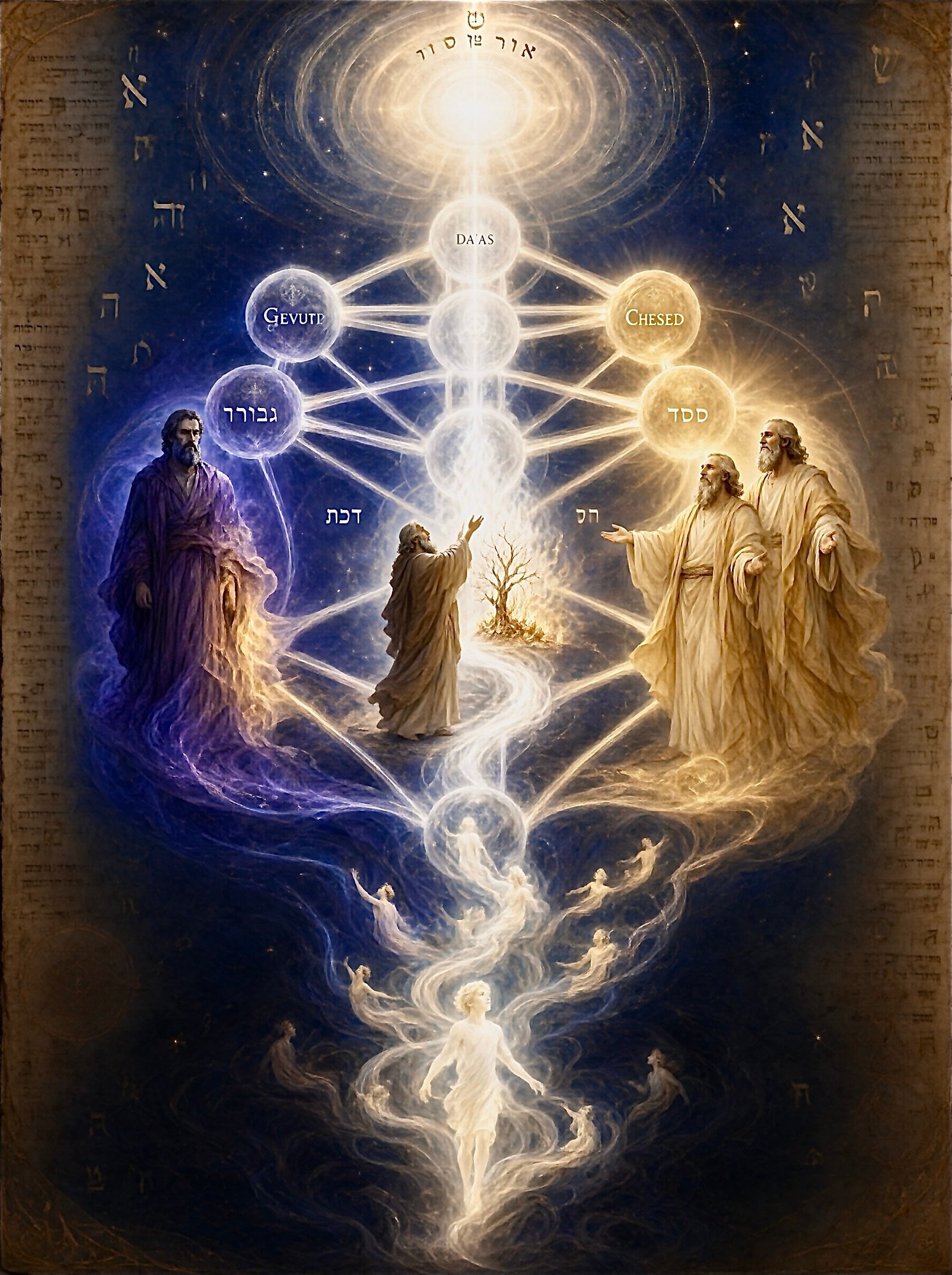
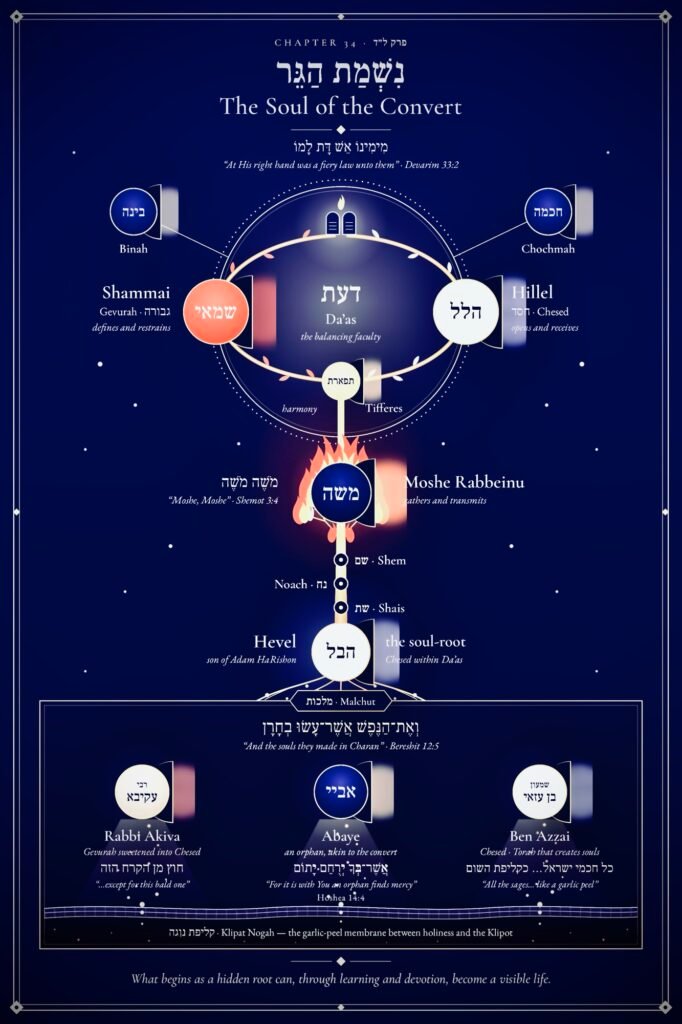
The account begins with Hevel’s place within the inner architecture of the soul. Hevel is associated with the Chesed, or lovingkindness, within Da’as. Da’as is described as a balancing faculty: it holds together the opposing forces of Chochmah and Binah, and within itself it incorporates Chesed, Gevurah, and Tifferes. These are not simply abstract attributes. They are spiritual modes of action: expansive kindness, disciplined strength, and the harmony that reconciles them.
Hevel’s root is therefore associated especially with the Chesed side of this structure. Yet his spiritual story is not complete in his first life. The soul’s later appearances are understood as stages of repair, in which what was left unresolved in one generation can be refined in another. The passage names Shais, Noach, and Shem as successive manifestations connected to Hevel’s root, before turning to Moshe. These figures are linked not only by a shared spiritual origin but by the gradual development of the soul’s capacities.
This framework also explains how a soul may be present in more than one person at a time. The text distinguishes among Nefesh, Ruach, and Neshamah—the different levels of the soul. If one level is associated with one figure and another with a later figure, their lives may overlap without contradiction. Reincarnation here is not imagined as a simple transfer in which one person disappears and another takes his place. It is a more intricate process of spiritual continuity, in which different dimensions of a soul can be expressed across persons and generations.
Moshe as the culmination of a spiritual lineage
Moshe is presented as a later expression of Hevel’s root, and his life is understood as a process of gathering and integration. Before the revelation at the burning bush, the passage says, Moshe had not yet completed the repair of the letters associated with Hevel and Shais. The details are expressed through Hebrew letters and their symbolic associations, but the larger idea is clear: Moshe’s spiritual identity was still unfolding. His calling did not arrive as a finished state; it brought him into the work of completing what had remained incomplete.
The burning bush marks a turning point. It is there, according to the passage, that Moshe’s repair becomes more complete. The repeated naming of Moshe in the biblical narrative is treated as a hint of this transformation: the Moshe before the encounter and the Moshe who emerges from it are continuous, but not identical in spiritual maturity. The revelation does not create his soul anew. It awakens and completes a capacity already rooted within him.
The passage also connects Moshe’s spiritual development to the Torah. When Moshe receives the Torah at Sinai, the distinct dimensions of his soul are brought together. He rises toward the “balancing Da’as,” the harmonizing faculty from which the Written Torah is associated with emerging. Torah, in this account, is not only a body of divine teaching. It is the meeting point of opposing spiritual forces. It contains the expansiveness of Chesed and the severity of Gevurah, joined in a form that can guide human life.
This is why the Torah is described as coming from the right hand while also being associated with fire and judgment. The apparent tension is essential. A Torah of pure kindness would lack the discipline required to shape conduct; a Torah of pure severity would become unyielding. Its authority depends on the union of both. Moshe’s role is to receive and transmit that integrated vision.
The discussion of Moshe’s sons further illustrates the passage’s conception of spiritual inheritance. Gershom and Eliezer—and, in a textual note, the puzzling mention of Menashe—are considered in relation to Moshe’s own spiritual standing. The passage answers the concern that Moshe’s sons may not have reflected his greatness by emphasizing that the entire people of Israel were, in a broader sense, his spiritual children. Moshe’s soul was so expansive that it encompassed the collective life of the nation. His legacy cannot be measured only through his immediate family. It is expressed through the people he formed and the Torah he transmitted.
Hillel and Shammai: two powers within one root
The passage next turns to Hillel and Shammai, presenting them as further expressions of Hevel’s spiritual root. Their differences are not treated as a division between a good figure and a bad one. Rather, each embodies a different side of the same underlying structure. Hillel is associated with Chesed; Shammai with Gevurah.
Hillel’s association with Chesed is reflected in his reputation for humility and patience. His gentleness is not mere temperament. Within the passage’s symbolic system, it expresses the expansive, accommodating quality of Hevel’s root. Hillel’s humility allows him to receive another person without immediately closing the door of understanding. He represents a form of spiritual strength that makes room.
Shammai, by contrast, is associated with Gevurah: restraint, precision, and judgment. His strictness is understood as the expression of a different spiritual force, one that sets boundaries and insists on form. Gevurah is necessary because kindness without limits can become indiscriminate. It protects what is sacred by defining what is permitted and what is not. In this sense, Shammai’s severity is not simply opposition to Hillel’s kindness; it is the counterweight that makes a complete spiritual order possible.
The passage’s letter-based interpretations of their names and their connections to Moshe, Shem, and Hevel belong to the symbolic language of Kabbalah. Such readings treat letters as more than sounds or spellings: they are understood as vessels of spiritual meaning. Names can therefore preserve traces of a soul’s lineage, its qualities, and its unfinished work. These associations are not ordinary historical claims. They are ways of articulating a hidden continuity beneath the visible lives of biblical and rabbinic figures.
The convert and the possibility of spiritual return
The title’s reference to the convert invites a broader reflection on what spiritual lineage means. If souls carry roots and unfinished tasks across generations, then identity cannot be reduced to ancestry or outward circumstance. A person’s spiritual belonging may involve a deeper history than the one visible in family records. The convert, in this light, is not a stranger to the covenantal community in any ultimate sense. Conversion may be understood as the outward realization of an inward attachment: a soul finding its place within the life of Torah.
That idea also illuminates the passage’s emphasis on repair. The soul’s journey is not a straight line from origin to destination. It is a process of return, refinement, and integration. A person may inherit a spiritual tendency toward kindness or judgment, yet still need to bring that quality into balance. The work is not simply to repeat the virtues of one’s root, but to complete them—to transform potential into mature action.
The convert’s story thus resonates with the account of Moshe. Moshe’s spiritual identity unfolds through stages, and his calling gathers together elements that had previously remained incomplete. Likewise, the convert’s entrance into Jewish life can be seen not as an arbitrary break with the past but as a profound act of alignment: the joining of a personal life to a sacred inheritance.
A single soul, many expressions
The passage’s deepest theme is that spiritual unity does not erase difference. Hevel, Moshe, Hillel, and Shammai are connected by a shared root, yet they do not become interchangeable. Each expresses a distinct aspect of the spiritual whole. Moshe gathers and transmits; Hillel opens and receives; Shammai defines and restrains. Their differences are meaningful precisely because they belong to a larger unity.
This is the function of Da’as as the passage describes it: to hold opposing forces together without dissolving either one. Chesed and Gevurah must remain distinct, or their union would have no substance. But they must also be brought into relationship, or each would become incomplete. Tifferes—the harmonizing quality—does not abolish kindness or judgment. It gives each a place within a balanced whole.
Read in this way, the passage offers more than a mystical genealogy. It presents a philosophy of spiritual development. The soul is shaped by continuity, but it is also responsible for change. It receives qualities from its root, yet must refine them through action. It may carry an unfinished task across generations, but that task is fulfilled only when inherited potential becomes lived character.
The story of Hevel’s soul, as it unfolds through Moshe, Hillel, and Shammai, is therefore a story of integration. Kindness must learn the wisdom of boundaries; judgment must remain answerable to compassion; and both must be gathered into a form capable of sustaining Torah and community. The convert, like every soul, enters this work not as an outsider to spiritual history but as a participant in its ongoing repair. What begins as a hidden root can, through learning and devotion, become a visible life.
Strictness, Chesed, and the Souls of Converts
Strictness is often mistaken for strength. A person who refuses, judges, or keeps others at a distance may appear firm in principle; yet firmness without compassion can become an obstacle to the very holiness it seeks to protect. The teachings presented here explore that tension through the figures of Shammai, Shimon ben Azzai, and Rabbi Akiva. Their stories are read not only as accounts of personal conduct, but as movements within the hidden architecture of the soul: from *Gevurah*, the force of restraint and judgment, toward *Chesed*, the force of generosity and lovingkindness.
The central question is not whether boundaries have a place. They do. Rather, it is what happens when strictness becomes rejection—when a person who seeks entry is turned away before his sincerity can be understood. In this mystical reading, the consequences reach beyond the moment of refusal. The work of welcoming converts, and of drawing their souls toward holiness, becomes a way of repairing an imbalance between judgment and kindness.
Shammai’s strictness and its repair
The passage begins with a tradition about Shammai’s severity toward prospective converts. The Talmud recounts that Shammai rejected people who approached him seeking conversion, while Hillel received them with patience. The contrast is not presented simply as a difference in temperament. In the language of the Kabbalistic interpretation, Shammai represents *Gevurah*: the power that sets limits, distinguishes, and holds back.
Gevurah is not inherently evil. A world without boundaries could not take shape; discipline and discernment are essential to a life of holiness. But Gevurah becomes destructive when it operates without the balancing influence of Chesed. A boundary that protects what is sacred can be wise. A boundary that closes the door to a sincere seeker can turn judgment into exclusion.
The teaching therefore describes Shammai’s strictness as something that must be “sweetened”—that is, softened and transformed through Chesed. To sweeten Gevurah is not to abolish all standards. It is to direct restraint toward a holy purpose and to let compassion determine how those standards are applied. The question becomes not merely, “Is this person already worthy?” but also, “Can I help this person draw nearer to holiness?”
Ben Azzai: learning as an act of creation
The text connects this repair to Shimon ben Azzai. Ben Azzai is described as having remained apart from married life in order to devote himself to Torah study. Yet his spiritual work is not portrayed as withdrawal from the world. Through his learning, he is said to have created souls for converts.
This is a striking idea: Torah study, though carried out in solitude, can become a form of spiritual generation. The passage compares Ben Azzai’s work to Abraham’s, invoking the verse, “And the souls they made in Charan” (Bereshit 12:5). On the plain level, the verse refers to the people Abraham and Sarah brought close to the faith. On the mystical level presented here, it is understood as the creation or drawing forth of souls associated with converts.
Abraham is the model of Chesed: the open tent, the welcome offered to strangers, the effort to bring others near. The passage also places Moses within this pattern, describing him as generating souls for converts through a spiritual quality associated with Chesed. In this way, Ben Azzai’s learning is not merely the accumulation of knowledge. It becomes a channel through which spiritual life is brought into being.
The symbolic interpretation of Ben Azzai’s name reinforces this theme. The name “Shimon” is associated with the first letters of “Shammai,” while its remaining letters are read as hinting to Ben Azzai’s rectification of Shammai’s rejection. This is not a claim that Ben Azzai simply reverses every boundary Shammai set. Rather, it presents his work as a spiritual answer: where strictness once turned seekers away, Torah and Chesed now make room for the souls of converts.
Rabbi Akiva and the transformation of Gevurah
Rabbi Akiva is presented as another figure who transforms judgment into kindness. The passage associates him with the root of Cain, while Ben Azzai is associated with the side of Abel. These are complex mystical categories, not simple moral labels. Their significance here is that both figures are linked to Gevurah, though in different forms.
Rabbi Akiva’s Gevurah, the text says, was sweetened and changed into Chesed. During the years he was separated from his wife in order to study Torah, he brought with him a vast company of students. The passage connects this period of learning with the creation of souls for converts. His discipline, therefore, does not remain a private achievement. It bears fruit in others.
The account carefully distinguishes Rabbi Akiva’s own soul from the souls of converts generally. Although Rabbi Akiva is described as a “convert” in a certain spiritual sense, the text insists that he was not literally a convert. His soul, it says, belonged to the inner realm of holiness and had returned to holiness after being drawn into the *Klipot*, the forces that conceal or obstruct holiness. Other converts’ souls are described differently: they are associated with *Klipat Nogah*, a mixed realm in which holiness and impurity are intertwined.
This distinction allows the passage to speak about conversion as both a human and a spiritual process. A person who converts does not merely change an external affiliation. In this account, a new holy *Nefesh*—a level of soul associated with *Malchut*, the divine presence and kingship—enters the convert. The convert is then called a “righteous convert,” not because the person has become flawless, but because a new dimension of holiness has joined the person’s life.
The convert’s inner struggle
The teaching also offers a challenging explanation for the rabbinic statement that converts are “like leprosy to Israel.” Read carelessly, such a phrase could sound like a condemnation of converts. The mystical interpretation presented here instead describes an inner struggle within the convert.
Before conversion, the person already possesses a *Nefesh* shaped by life outside the Jewish people. After conversion, a holy *Nefesh* enters as well. The earlier soul does not simply vanish. The passage imagines the two as coexisting, with the earlier one sometimes exerting an influence that can draw the person toward sin. The difficulty is therefore not that the convert is inherently harmful, but that the transition involves a struggle between spiritual forces and identities.
This account should be approached with care. It belongs to a particular mystical framework and should not be used to stereotype converts or to treat them as suspect. Its emphasis, in the larger argument, is on the complexity of spiritual transformation: entrance into holiness does not erase the past in an instant, and sincere change may involve a difficult process of integration. The passage’s language is severe, but its deeper concern is the labor of bringing what is mixed or divided into harmony.
The text uses Rabbi Akiva as an example of this tension. It recalls the tradition that, before becoming a Torah scholar, he said he would bite a scholar like a donkey. The mystical explanation attributes this hostility not to Rabbi Akiva’s true holy soul, but to the influence of the earlier soul associated with his origins. The point is that a person’s first impulses need not define the person’s ultimate spiritual identity. Transformation is possible; what once resisted holiness can be refined and redirected.
Ben Azzai and the limits of sacrifice
Ben Azzai’s story introduces another delicate theme: the relationship between devotion and personal life. He was betrothed to Rabbi Akiva’s daughter but did not complete the marriage. According to the tradition cited here, he devoted himself to Torah study, with her consent. The passage interprets the betrothal through the mystical idea of an “encompassing light” that passes from the man to the woman at the stage of *Kiddushin*, or betrothal.
In Jewish law, betrothal changes a woman’s status, while the later stage of marriage establishes the couple’s life together. Ben Azzai and Rabbi Akiva’s daughter did not complete that second stage, and she returned to her father’s home. The mystical reading nevertheless sees the betrothal as spiritually meaningful: even without a shared married life, a bond and an influence remained.
This account does not present Ben Azzai’s choice as a universal ideal. It portrays a particular life of extraordinary dedication, embedded in a particular tradition. Its relevance to the larger theme is that sacrifice and Chesed are not always opposites. Ben Azzai’s renunciation of ordinary family life is interpreted as a means of generating spiritual life for others. Yet the story also reminds us that spiritual narratives of renunciation should not be turned into demands placed upon everyone. The passage describes a singular vocation, not a general rule.
From rejection to welcome
Taken together, these teachings offer a subtle account of strictness. Shammai’s severity represents a necessary spiritual force that has become unbalanced. Ben Azzai and Rabbi Akiva do not simply discard that force; they transform it. Through Torah, discipline, and the work of drawing souls toward holiness, Gevurah is sweetened into Chesed.
The image of creating souls for converts gives this transformation its fullest expression. To welcome a convert is not merely to tolerate someone at the edge of a community. In the language of the passage, it is to participate in the emergence of a soul into a new spiritual home. Abraham’s hospitality, Moses’ spiritual labor, Ben Azzai’s learning, and Rabbi Akiva’s transformation all become versions of the same work: making room for holiness to enter the world.
This teaching therefore offers a demanding standard for religious leadership. Strictness alone is not proof of spiritual seriousness. A teacher may preserve boundaries and still fail if those boundaries become an excuse to refuse every seeker. Conversely, kindness is not simply the absence of standards. Chesed is most powerful when it guides a person toward growth, while Gevurah gives that growth shape and direction.
The deepest repair of Shammai’s strictness is thus not contempt for discipline, but discipline made compassionate. It is the ability to distinguish between protecting holiness and guarding it so tightly that no one can approach. In the mystical vision of this passage, the souls of converts become the measure of that distinction. Where rejection once closed a gate, learning and lovingkindness open a path.
Rebi Akiva, Ben Azzai, and the Spiritual Work of Restoring Souls
The passage offers a mystical interpretation of a saying attributed to Ben Azzai: “All the wise men of the Jewish people are to me like a garlic peel, except for this bald one.” Taken at face value, the statement might sound like an insult aimed at the other sages, or a mocking reference to Rebi Akiva’s appearance. The passage argues that neither reading captures its meaning. Ben Azzai is not boasting that he is superior to the other scholars, and the description “this bald one” is not intended as ridicule. Instead, the saying is understood as a compressed, symbolic account of a rare spiritual ability shared by Ben Azzai and Rebi Akiva: the ability to draw the souls of converts toward holiness and help bring those souls to spiritual repair.
This interpretation rests on a Kabbalistic view of the soul’s journey. The passage describes the sages’ study of Torah not only as an intellectual or religious activity, but also as a spiritual force capable of awakening souls. Some of these souls, according to the text, are destined to enter the Jewish people through conversion. Their movement toward holiness is not presented as a simple or automatic process. The souls must be drawn from the spiritual realm in which they are found, brought closer to holiness, and prepared for the lives they will eventually live.
The passage says that the sages generally could draw these souls from a realm called *Klipat Nogah*. This is understood as a mixed or intermediate domain, situated between holiness and impurity. It is not wholly holy, but neither is it described as entirely impure. Because it occupies a boundary between the two, it can be a point from which souls are drawn toward holiness. Most of the sages, the passage explains, could reach the souls at this level and guide them in the direction of holiness.
Rebi Akiva and Ben Azzai, however, are credited with a more exceptional capacity. They could bring the souls not merely out of *Klipat Nogah*, but into holiness itself. There, the souls could undergo *tikkun*—spiritual repair, refinement, or restoration. After this process, they could be drawn onward toward their eventual embodiment among converts. The distinction, then, is not simply between scholars of greater and lesser learning. It concerns the depth and character of the spiritual work they were able to perform. The other sages could draw souls from an intermediate realm; Rebi Akiva and Ben Azzai could bring them into holiness and help prepare them more fully for their future lives.
To explain this difference, the passage uses an elaborate bodily metaphor. It describes two channels associated with the male organ marked by the covenant. One channel, on the right, is linked with holy seed. The other, on the left, is associated with murky or waste-like matter and with the *Klipot*—the forces that conceal, obstruct, or oppose holiness. Between these two channels lies a thin membrane, compared to the peel of a garlic. This membrane is identified with *Klipat Nogah*, the intermediate realm from which the souls can be drawn.
The image is not offered as a literal anatomical teaching. It belongs to the symbolic language of mystical texts, in which the human body can represent spiritual structures and processes. Bodily channels, boundaries, and coverings become figures for the different realms through which spiritual influence passes. In this case, the two channels represent holiness and impurity, while the thin membrane between them represents the mixed domain that stands at their boundary. The garlic peel is therefore a meaningful symbol: it marks the point from which most sages could draw souls, while also helping to explain why the work of Rebi Akiva and Ben Azzai is described as going further.
The passage then explains why Rebi Akiva is called “bald.” His baldness is not treated as an incidental physical trait or as a reason to mock him. Instead, it is interpreted as a sign of spiritual discipline and transformation. Rebi Akiva is associated with the *Keter* of *Gevurah*, a spiritual root connected with strength, judgment, and restraint. Within the passage’s symbolic framework, hair is associated with the forces of judgment. Rebi Akiva’s shaving of his hair is therefore understood as an act that weakens or sweetens those forces.
In this reading, baldness becomes a sign of what Rebi Akiva has accomplished spiritually. He has not simply escaped the power of *Gevurah*, nor has he erased the strength associated with it. Rather, he has refined that strength and redirected it toward holiness. The severity that might otherwise remain harsh has been softened. His appearance thus serves as an outward symbol of an inward process: the forces of judgment have been sweetened so that they can contribute to spiritual repair.
This also sheds light on the passage’s description of Rebi Akiva as “pious.” The title may seem unexpected because *Gevurah* is associated with judgment and severity. But the passage does not treat piety as the absence of strength. Rebi Akiva’s piety lies in his ability to transform strength into something holy. His spiritual achievement is not to have no connection to judgment, but to refine judgment and make it serve a constructive purpose. The “bald one” is therefore not a figure of weakness. He represents disciplined power: a force that has been restrained, sweetened, and directed toward holiness.
Ben Azzai’s spiritual path is presented differently. He is associated with the side of *Chesed*, the quality of loving-kindness. The passage places the awakening of the souls of converts within this sphere. Ben Azzai’s connection to *Chesed* gives him a direct relationship to the realm in which these souls are awakened and drawn toward holiness. Rebi Akiva, meanwhile, reaches a comparable capacity through the refinement of *Gevurah*. The two figures arrive at a similar spiritual task by different routes: Ben Azzai through loving-kindness, and Rebi Akiva through the sweetening of judgment.
This distinction is important because it prevents the passage from reducing their abilities to one identical spiritual quality. Ben Azzai and Rebi Akiva share a capacity, but they do not share precisely the same spiritual root. Their work is comparable in its result—the drawing and restoration of souls—but different in its underlying source. One works through *Chesed*; the other through a transformed form of *Gevurah*. The passage thus presents them as complementary figures, each capable of helping souls move toward holiness in a distinctive way.
With this background, Ben Azzai’s saying can be read as a statement about spiritual function rather than personal rank. The other sages are compared to a garlic peel because, in the passage’s account, their work reaches the souls at the level of *Klipat Nogah*. Rebi Akiva is singled out because he can help bring those souls into holiness itself and participate in their repair. The phrase “this bald one” points to the spiritual transformation associated with Rebi Akiva: the sweetening of *Gevurah* that enables him to perform this deeper work. The comparison is therefore not meant to belittle the other sages. It does not say that they lack wisdom, holiness, or importance.
The Orphaned Soul: Abaye, Converts, and the Burden of Joseph
The passage offers a mystical account of spiritual ancestry, orphanhood, and the special capacity to bring the souls of converts into the Jewish people. Its central figure is Abaye, whose name is linked to a verse about divine mercy toward the orphan. The teaching describes him as an orphan not in the ordinary, biological sense, but through the origin and structure of his soul. It then connects this spiritual condition to his ability to create souls of converts. By contrast, Rabbi Yishmael, who is identified with the soul of Joseph, is said to lack this ability because of the spiritual history associated with Joseph’s seed. His captivity and martyrdom are presented as part of that same history.
The argument begins with a textual hint. The verse says, “For it is with You an orphan finds mercy.” The initials of the Hebrew words in the verse are understood to spell the name Abaye. This reading places Abaye beneath the sign of the orphan and frames the discussion that follows. The verse is not used merely as a poetic description of his character. In the passage’s interpretive world, the letters of Scripture can disclose hidden connections between a person’s name, soul, and spiritual role. The reference to mercy also suggests that orphanhood is not only a condition of loss. It may be a condition in which a person receives a distinctive form of divine compassion—and, in Abaye’s case, a special spiritual capacity.
To explain why Abaye is called an orphan, the text turns to the Kabbalistic structure of the soul. It teaches that Abaye’s Nefesh, Ruach, and Neshamah—the three dimensions or levels of his soul—came from a single root, the root of Cain. Earlier discussions, the passage says, established that the root of Cain is called “Nefesh.” This designation is connected with Malchut, the divine attribute associated with Nefesh, or the life-force and soul-level represented by that term. The point is not simply that Abaye had a soul related to Cain. Rather, all the parts of his soul are said to derive from one spiritual source, and that source is characterized by the level of Nefesh.
The passage then draws on *Sefer HaTikunim*, which describes the Nefesh and Ruach as remaining “like orphans” when the Neshamah departs. This image expands the meaning of orphanhood. An orphan, in this symbolic language, is not necessarily someone whose parents are physically absent. The term can also describe a soul that is separated from a higher or more complete spiritual source. The image suggests vulnerability and incompleteness, but it also identifies a particular spiritual condition: the soul remains present, yet lacks the sustaining relationship that would ordinarily be associated with its full spiritual origin.
Abaye is therefore called an orphan because his soul is rooted in the level of Nefesh associated with Cain. The passage does not mean that he had no biological parents. It describes him as spiritually orphaned, and it treats that spiritual condition as essential to understanding his role. His orphanhood is not a passing metaphor; it is the key that connects his soul to the souls of converts.
In the teaching’s account, a convert’s Jewish soul is also “like an orphan.” Conversion changes a person’s status and belonging within the Jewish people, but the passage describes the soul’s entry into Israel as having no Jewish father and mother through whom it was born. This is a spiritual and communal description, not a denial of the convert’s biological family. The note attached to the teaching makes this distinction explicit: a convert may have a biological mother and father, while still being described as parentless in relation to the Jewish people. The convert’s Jewish identity does not come through Jewish ancestry; it comes through conversion.
This is why Abaye’s spiritual condition matters. Because he himself is described as an orphan in the mystical sense, he is able, according to the passage, to create souls of converts without separating from his wife. The text presents this ability as a correspondence between his own soul and the souls he brings forth. Abaye’s spiritual root resembles the condition of the convert: both are associated with an origin outside the ordinary pattern of spiritual or communal parentage. The convert’s soul enters the Jewish people without Jewish parents, while Abaye’s soul is traced to a root characterized as orphaned. His capacity arises from this likeness.
The teaching thus gives orphanhood a paradoxical role. It is a condition of lack, but it can also become a source of spiritual kinship. Abaye’s own soul is marked by separation from the usual pattern of descent, and that very feature enables him to serve as a channel for other souls whose entry into Jewish life is likewise not inherited through parents. He does not merely sympathize with converts; in the passage’s mystical logic, his own spiritual origin makes him uniquely suited to bring their souls into being.
The text then considers why no one else in the generation of Ben Azzai could perform the same work. Rabbi Yishmael, son of Elisha and High Priest, might seem an obvious candidate. Earlier discussions, the passage says, identify him as a spark of the soul of Joseph the Righteous. If Rabbi Yishmael was so closely connected to Joseph, why did he not possess Abaye’s ability to create souls of converts?
The answer depends on the passage’s account of Joseph and the Ten Martyrs. It teaches that the Ten Martyrs corresponded to ten drops of seed that had departed from Joseph. Rabbi Yishmael, as Joseph’s reincarnation, was therefore connected with those sparks. But the story is not presented as a simple inheritance of Joseph’s virtues. The passage also recalls a sin attributed to Joseph, through which the sparks were blemished and descended into the depths of the *kelipot*—the forces or husks that conceal and distort holiness. Because of this spiritual damage, Rabbi Yishmael did not have the ability to bring forth souls of converts as Abaye did.
The contrast between Abaye and Rabbi Yishmael is therefore not a contrast between a person with spiritual ancestry and a person without it. Both are presented as having profound spiritual roots. The difference lies in the character of those roots and in the histories attached to them. Abaye’s connection to Cain and the level of Nefesh makes him spiritually akin to the convert, whose soul is described as lacking Jewish parentage. Rabbi Yishmael’s connection to Joseph, by contrast, carries the burden of the blemished sparks. His inheritance is tied to a descent into the *kelipot*, and so it does not grant him Abaye’s particular capacity.
The passage further links Rabbi Yishmael’s spiritual history to the severity of his martyrdom. Among the Ten Martyrs, his punishment is described as especially harsh. The text explains this through his identification with Joseph and the seed drops associated with Joseph’s sin. Rabbi Yishmael, as Joseph’s reincarnation, is said to bear a connection to the very sparks whose descent into the *kelipot* is implicated in the martyrs’ deaths. His suffering is thus represented as an act of spiritual consequence and atonement. To make this connection vivid, the passage draws a parallel between Joseph’s coat and Rabbi Yishmael’s face.