
The Light of Redemption and Education: A Rabbinic Commentary on Sefer HaChinuch (The Book of Mitzvos)
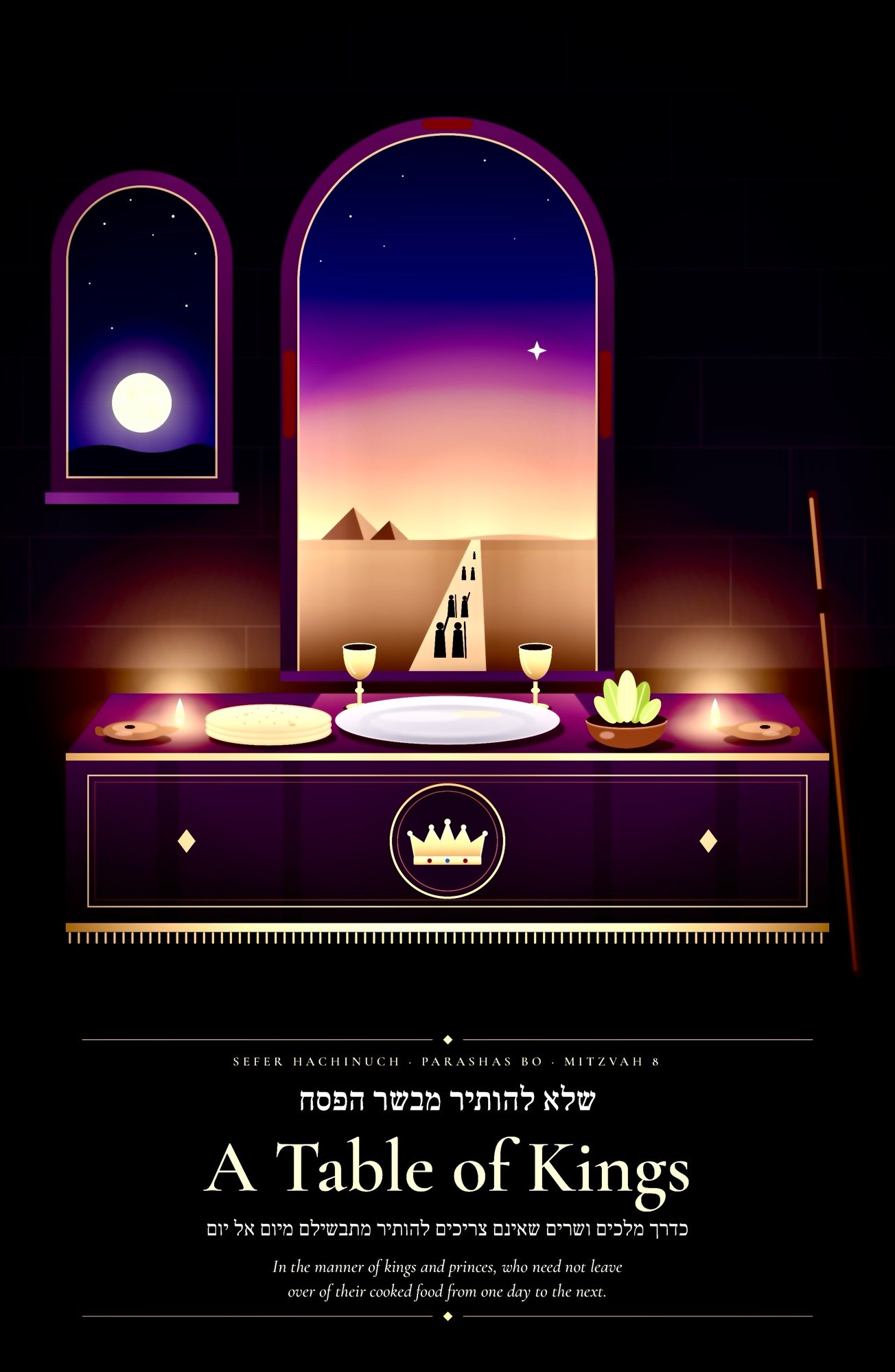
A Table of Kings: Sefer HaChinuch, Mitzvah 8 — The Prohibition to Leave Over Meat of the Korban Pesach
Nov 19, 2026 · @Kamil Levi Pyka-Penner
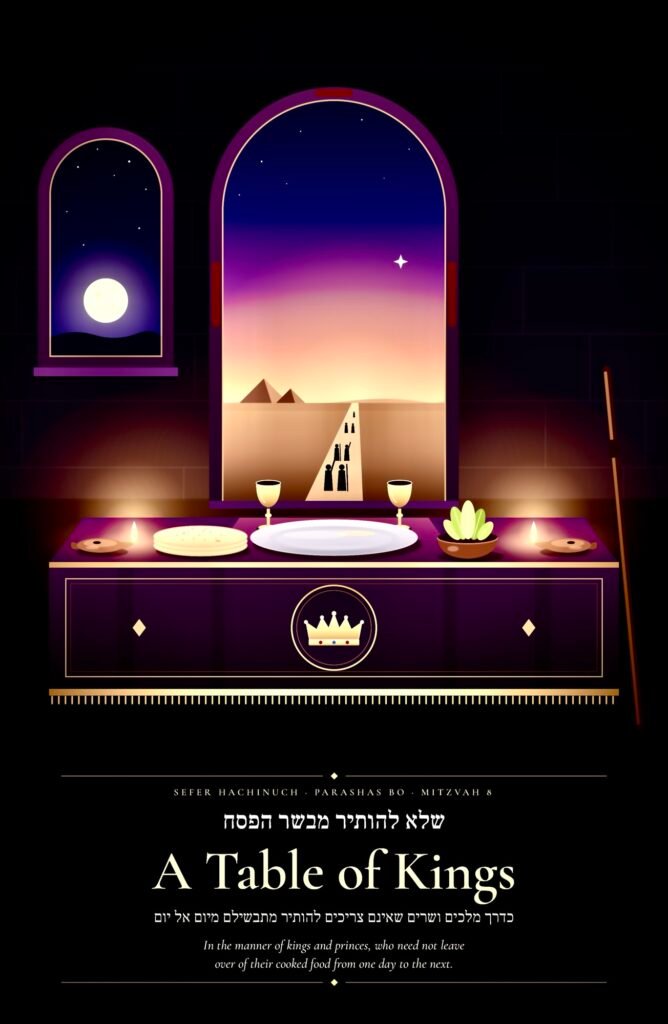
Sefer HaChinuch reads the ban on leaving Pesach meat until morning as the conduct of royalty: kings keep no cooked food from one day to the next, and what remains is burned as a thing no one wants. This essay argues that the law’s whole structure — the lav, its remedy in fire, and its boundary at daybreak — enacts that one idea, and that the debates of the Chinuch’s commentators sharpen it rather than dissolve it.
On sources. By design, this study draws only on Sefer HaChinuch, its own cross-references, and works written on it: the Minchas Chinuch, Minchah Chadashah and Minchas Yitzchak cited in the elucidated edition (pp. 113–116), Keren HaTzvi on the Minchas Chinuch, and Rabbi Elchanan Poupko’s Chochmas Chinuch. Where the Chinuch or those works cite Pesachim, the Mechilta or the Rambam, the citation is followed only as far as they take it. Verses follow the Jewish Publication Society translation of 1917; the Chinuch’s Hebrew is newly translated.
I. The Text and a Translation
The Chinuch’s entry is short and keeps his fixed order: the command and its verse, its root, its laws, and its scope and penalty.
1. The command
שלא להותיר כלום מבשר הפסח למחרתו שהוא יום חמשה עשר בניסן, שנאמר (שמות יב, י) ולא תותירו ממנו עד בקר.
Not to leave over anything of the meat of the Pesach until its morrow, which is the fifteenth day of Nissan, as it is said (Shemot 12:10): “And ye shall let nothing of it remain until the morning.”
2. The root
משרשי מצוה זו, מה שכתוב בשחיטתו, לזכור נסי מצרים. וזה שנצטוינו שלא להותיר ממנו, הענין הוא כדרך מלכים ושרים שאינם צריכים להותיר מתבשילם מיום אל יום, ועל כן אמר שאם יותיר ממנו, שישרף כדבר שאין חפץ בו, כדרך מלכי אדמה. וכל זה לזכור ולקבוע בלב שבאותו זמן גאלנו השם יתברך מעבדות, ונעשינו בני חורין, וזכינו למלכות ולגדולה.
Among the roots of this mitzvah is what was written concerning its slaughter: to remember the miracles of Egypt. As for our being commanded not to leave any of it over, the matter is after the manner of kings and princes, who have no need to leave over of their cooked food from one day to the next. Therefore Scripture says that if one does leave any over, it is to be burned as a thing no one desires, after the manner of the kings of the earth. All this is to remember and to fix in the heart that at that very time Hashem, blessed be He, redeemed us from bondage; we became free men, and we merited kingship and greatness.
3. The laws
דין המצוה בפסחים (דף פד ע”א).
The law of the mitzvah is set out in Pesachim (84a).
4. Scope and penalty
ונוהגת בזכרים ונקבות בזמן הבית. והעובר עליה והותיר עבר על לאו, אבל אין לוקין על לאו זה, לפי שהוא נתק לעשה, שנאמר (שם) והנותר ממנו עד בקר באש תשרפו. והלכה היא, לאו שנתק לעשה אין לוקין עליו.
It applies to men and women in the time of the Beis HaMikdash. One who transgresses it and leaves meat over has violated a lav. Yet there are no lashes for this lav, because it is converted to a positive command (nitak la’aseh), as it is said (ibid.): “but that which remaineth of it until the morning ye shall burn with fire.” And it is the halachah that there are no lashes for a lav converted to an aseh.
The Hebrew follows the printed text in the elucidated edition (pp. 113–115), given here without vowels.
II. The Setting: One Link in the Pesach Sequence
Mitzvah 8 belongs to a run of Korban Pesach laws in Parashas Bo that the Chinuch reads as one program. Its root is built in two layers: a shared root borrowed from the slaughter (Mitzvah 5), and a root of its own.
The shared layer is announced by a fixed formula. In Mitzvah 6 the Chinuch writes מה שכתבנו בשחיטתו; in Mitzvah 7, מה שכתוב בשחיטתו, לזכור נס יציאת מצרים; in Mitzvah 13, כמו שכתוב בשחיטתו, לזכר נסי מצרים. Each time the reader is sent back to Mitzvah 5, where the whole offering is grounded in remembering the miracles of the Exodus.
That shared root explains why there is a Korban Pesach at all. It cannot explain why the meat may not be boiled, fed to an apostate, or kept until morning. So the Chinuch gives each prohibition a second root, and these fall into two families: what may be eaten and how one eats.
Mitzvah
Prohibition
The Chinuch’s specific root
Family
7
Not to eat it raw or boiled
Roasted meat is the fare of בני מלכים ושרים; we eat it דרך חרות ושרות; roasting also recalls the haste of the departure
How one eats: royalty
8
Not to leave any over
כדרך מלכים ושרים, who keep no cooked food מיום אל יום
How one eats: royalty
13
Not to feed it to an apostate
The Pesach marks that we came to shelter under the wings of the Shechinah; one who left the covenant should not share it
Who may eat: covenant
16
Not to break a bone
וגם זה גזעו מן השורש הנזכר: princes do not gnaw and crack bones ככלבים
How one eats: royalty
The royal family is tied together by the Chinuch himself. The elucidated edition’s note on Mitzvah 8 points to Mitzvos 7 and 16 for the same reasoning. Mitzvah 16 introduces its royal reason with וגם זה גזעו מן השורש הנזכר: this too is an offshoot of the root already stated, the remembrance of the Exodus, and the word “too” gathers it with the royal reasons before it. Within that family, Mitzvah 8 is the law that governs the table as a whole. Mitzvah 7 regulates how the meat is cooked and Mitzvah 16 how its bones are handled; Mitzvah 8 regulates what may remain when the meal is over.
The count itself follows the Rambam’s Sefer HaMitzvos (Lo Ta’aseh 117), which lists this lav apart from the general prohibition of leaving any offering past its time. The Torah also repeats the prohibition for Pesach Sheni (Bamidbar 9:12). Why the Pesach should carry a lav of its own is a real question, and Section VI takes it up.
III. The Root: “In the Manner of Kings and Princes”
The Chinuch turns the prohibition into conduct: on the night of redemption Israel eats as royalty eats, and royalty keeps nothing for tomorrow.
Why leftovers mark a person. The observation is economic before it is symbolic. Kings and princes אינם צריכים להותיר מתבשילם מיום אל יום: they need not save, because tomorrow’s food is assured, as the elucidated edition’s note explains. Whoever wraps the remains of tonight’s meal for tomorrow doubts that tomorrow will provide. Leftovers are the signature of dependence; their absence is the signature of security.
The fire belongs to the same gesture. The Chinuch reads the verse’s second half through the same lens: what remains ישרף כדבר שאין חפץ בו, כדרך מלכי אדמה. A king does not merely refrain from storing; he discards surplus without regret. The burning is therefore more than the disposal of disqualified meat. It completes the royal posture that the prohibition began, a point Section VII develops.
Two verbs: לזכור ולקבוע בלב. The root closes with a purpose clause in two verbs. To remember is to recall a past event; to fix in the heart is to make it a standing trait. The eater is asked not only to recall that his ancestors were freed, but to become, for one night, the kind of person their freedom produced.
How deeds fix the heart. The mechanism is spelled out eight mitzvos later. Explaining why the Pesach’s bones may not be broken, the Chinuch writes that princes do not gnaw and crack bones ככלבים; only the hungry poor do. Therefore, at the beginning of our becoming ממלכת כהנים וגוי קדוש, and every year at that season, it is fitting for us to perform deeds that display the station we reached at that hour: ומתוך המעשה והדמיון שאנחנו עושים נקבע בנפשותינו הדבר לעולם. Then comes his best-known principle, כי אחרי הפעולות נמשכים הלבבות (Mitzvah 16).
Mitzvah 8’s לקבוע בלב and Mitzvah 16’s נקבע בנפשותינו are one verb serving one program. The prohibition is not a reminder attached to a meal; it is a rehearsal of royalty, performed so that the performer becomes what he rehearses.
From freedom to kingship. The root’s closing clause rises in three steps: גאלנו מעבדות, ונעשינו בני חורין, וזכינו למלכות ולגדולה. Release from bondage is a removal; free status is a new standing; kingship and greatness is elevation. Mitzvah 8 speaks to the third step, since a freed slave may still hoard and a prince does not.
The edition ties this to Exodus 19:6 and renders ממלכת כהנים as “a kingdom of ministers.” That rendering matches the Chinuch’s own pair, מלכים ושרים, and Mitzvah 16 confirms that the Chinuch heard the verse this way.
IV. The Anatomy of the Prohibition
The lav forbids leaving any edible flesh of the Pesach past daybreak of the fifteenth. It binds men and women alike, and on one reading it binds whoever last holds the meat.
“Klum”: is there a minimum? The Chinuch writes שלא להותיר כלום, not to leave over anything. Keren HaTzvi, in his commentary on the Minchas Chinuch, observes that the Chinuch added this word to the Rambam’s formulation. He suggests the reason: this lav is not a prohibition of eating, so the kezayis, which is the measure of eating, need not govern it.
On that reading, leaving even the smallest amount transgresses. The elucidated edition reads the Chinuch the same way and refers to Minchas Chinuch §1 and Minchas Yitzchak for the discussion. Keren HaTzvi adds that the question carries consequences elsewhere, as in the laws of oaths.
Only what is fit to eat. The prohibition attaches to edible flesh alone. The Minchas Chinuch gives the principle and its reason in one line: הלאו הזה הוא רק בדברים הראוים לאכילה, הזהירה התורה דלא נתעצל באכילתם ולא ישארו. Bones and similar parts fall outside it. The edition grounds this in Pesachim 83a–b and in the order of the verses: eat the flesh (12:8), leave none of it (12:10a), burn what remains (12:10b).
The Minchas Chinuch’s wording deserves notice. For him the lav is a warning against sluggishness in eating, a demand for zeal; for the Chinuch it is a demand for dignity. The readings complement each other: the royal table is finished promptly, and without anxiety about tomorrow.
The Altar’s portion is a separate law. The Pesach’s eimurim, the parts offered on the Altar, fall under Mitzvah 90: שלא להניח אמורי הפסח לפסל בלינה, from ולא ילין חלב חגי עד בקר (Shemot 23:18). The Chinuch there calls the disqualified fats nossar as well. One offering thus has two tables and two prohibitions against leaving over: the Altar’s portion, whose root concerns honoring the offering at its set time, and Israel’s portion, whose root is royalty.
Who is bound. The Chinuch says the law applies to men and women in the time of the Beis HaMikdash. The edition explains both clauses: prohibitions bind women as a general rule, and the Pesach can be offered only in the Mikdash.
Rabbi Elchanan Poupko (Chochmas Chinuch, vol. 1) adds a sharper point. For the Pesach, איסור נותר אינו על הבעלים דוקא אלא על האדם האחרון שנשאר עם הפסח. He cites the Minchas Chinuch’s qualification: this holds when the meat was left with a person of understanding, but an adult who leaves it with a minor transgresses. The royal reading fits this well, since the law addresses the one at whose table the remains would sit.
When. The Mechilta, cited in the edition, identifies “morning” here with alos hashachar, daybreak. The Chinuch’s למחרתו, שהוא יום חמשה עשר says the same in his own terms. Whether that boundary belongs to the Pesach itself or is borrowed from other offerings is the subject of the next section.
V. “Ad Boker”: When Does Nossar Take Hold?
On the Chinuch’s reading the meat becomes forbidden at daybreak. Those who follow the midnight view must explain why the Torah still says “morning,” and their answers reveal what kind of law Mitzvah 8 is.
The Chinuch’s position. למחרתו, שהוא יום חמשה עשר places the deadline at the morning of the fifteenth. The edition notes that this accords with the Tannaic view that the Pesach may be eaten all night by Torah law, so that leftovers become nossar at daybreak. The rival view, R’ Elazar ben Azaryah’s, ends the eating at midnight (Berachos 9a; Pesachim 120b).
First answer: forbidden at midnight, burned by day. On the midnight view, Rashbam (Pesachim 120b) and Tosafos (Berachos 9a), as gathered in the edition’s Insight, hold that the meat becomes nossar at midnight. “Until morning” then marks when it becomes subject to burning, since nossar is not burned at night. In practice the burning waits for the sixteenth.
Second answer: two laws in one offering. A line of Acharonim gathered in the same Insight distinguishes two obligations: the Or Same’ach, Chidushei HaGriz in the name of R’ Chaim, Lekach Tov, Kehillos Yaakov and Bahd Kodesh. One obligation is personal: each Jew eats a kezayis with matzah and maror, by midnight on that view. The other is general: like every offering, the meat must be consumed and not left over, and since no offering has an eating time shorter than a day and a night, it runs until daybreak.
What is the “general requirement”? Here the Chinuch’s commentators divide. The Minchas Chinuch (Mitzvah 134 §2) holds that once a kezayis is eaten, no positive mitzvah to eat the rest remains; one eats the remainder only so as not to transgress לא תותירו. The opposing view, that the mitzvah of eating extends to the whole offering, is the Sha’agas Aryeh’s (§96).
On the Minchas Chinuch’s view, the “second law” is nothing other than Mitzvah 8 itself. That fits his own description of the lav as a warning דלא נתעצל באכילתם: beyond the first kezayis, the royal table is governed by the prohibition alone.
An objection. Rabbi Poupko observes that the Griz’s approach implies the Pesach’s nossar is simply the nossar of all offerings: דאיסור נותר דפסח הוא מדין נותר דשאר הקרבנות. He dismisses it in two words, ויש לדחות, consistent with his view that the Pesach prohibition is a law of its own (Section VI).
A suggestion: the boundary lies in the root. The Chinuch’s own words may ease this tension. Kings, he says, keep no cooked food מיום אל יום, from one day to the next. In the reckoning of kodashim the night follows the day before it, so the night of the fifteenth still belongs to the day of slaughter, and the next day begins at dawn. That is exactly the Chinuch’s למחרתו, שהוא יום חמשה עשר.
The Torah names that moment with the same word: ממחרת הפסח יצאו בני ישראל ביד רמה, “on the morrow after the passover the children of Israel went out with a high hand” (Bamidbar 33:3). If so, the dawn boundary need not be borrowed from the general law of offerings. It is built into the Pesach’s own rationale: a royal table carries nothing into tomorrow, and tomorrow begins at daybreak. One may then hold, with the Griz, that the Pesach’s nossar begins at dawn and, with Rabbi Poupko, that it remains a law of its own.
VI. One Prohibition or Two?
The Minchas Chinuch holds that leaving over Pesach meat also violates the general prohibition of nossar, yet the Chinuch’s distinct root suggests that the Pesach lav stands on its own.
The general prohibition. The Torah forbids leaving the todah until morning, לא תותירו ממנו עד בקר (Vayikra 22:30), and the Sifra extends this to every offering kept past its time; the Chinuch counts it as Mitzvah 142. The Minchas Chinuch (§5, as cited in the edition) holds that this second prohibition applies to leftover Pesach meat as well. The edition notes that neither the Chinuch here nor the Rambam (Hil. Korban Pesach 10:11) mentions it.
The Minchah Chadashah’s limit. The Minchah Chadashah (on Mitzvah 8, s.v. ואולי י”ל) suggests, as Rabbi Poupko summarizes him, that the general lav covers only offerings with no explicit lav of their own. On that reading the Pesach, which has its own verse, stands outside it. Rabbi Poupko accepts this as the better reading.
Two arguments that the Pesach law is distinct. Rabbi Poupko offers two. First, liability falls differently: on whoever last holds the meat, not on the owners alone (Section IV). Second, the reasons differ.
The Chinuch explains the general burning of nossar (Mitzvah 143) in two ways. Meat deteriorates with delay, so to magnify the offering it is burned at once, lest anyone recoil from it. Beyond that, the law hints at trust in Hashem: שלא יהא אדם חונק עצמו במאכלו יותר מדי להצניעו ליום מחר.
The Pesach law he explains by royalty instead. הרי שטעמם שונה לגמרי, Rabbi Poupko concludes: their reasons are entirely different.
One virtue in two registers. The two roots differ in kind, yet they point the same way. The king does not save because he has no need; the faithful does not hoard because he trusts. Both free a person from anxious saving for tomorrow.
The Pesach teaches that freedom as a station attained on the night of redemption; the general law teaches it as a trust renewed at every offering. Rabbi Poupko’s distinction is real, and so is the unity beneath it: Mitzvah 8 is the festive form of a virtue that Mitzvah 143 makes perennial.
VII. A Lav Without Malkus: Remedy, Consequence and the Royal Fire
The Chinuch exempts this lav from lashes because the Torah attaches a remedy to it, and that remedy, burning, is the very gesture his root describes.
Two reasons in the Gemara. As the edition notes, Pesachim 84a records two explanations for the absence of lashes. R’ Yehudah: the verse places an aseh after the lav, so the lav is nitak la’aseh. R’ Yaakov: it is a lav she’ein bo ma’aseh, violated without any act. The Chinuch gives R’ Yehudah’s reason here, as does the Rambam (Hil. Korban Pesach 10:11).
The Chinuch’s own contrast. In Mitzvah 143 the Chinuch gives the other reason. A kohen who failed to burn nossar ביטל עשה ועבר על לאו ד’לא תותירו’, אבל אין לוקין על לאו זה לפי שאין בו מעשה. The Rambam, by contrast, gives the nitak la’aseh reason for the general law too (Hil. Pesulei HaMukdashin 18:9).
The Kesef Mishneh there asks why the Rambam passed over the “no act” reason. He answers that the Rambam chose the reason that teaches more: there would be no lashes even if the violation involved an act. The Mahari Korkos, cited in the edition on Hil. Korban Pesach 10:11, holds instead that the Rambam simply named one sufficient reason; the question is taken up in Minchas Chinuch §7 and Minchas Yitzchak §2.
Why the Chinuch switches. Two suggestions are offered here for the reader’s judgment. The first is textual. In Mitzvah 8 the remedy stands in the same verse as the prohibition, and the Chinuch marks it with שנאמר (שם); R’ Yehudah’s reason grows from that juxtaposition, which the general law of nossar lacks.
The second concerns the case. Mitzvah 143 describes a kohen who did not burn. Where the remedy was never carried out, an exemption that rests on the remedy is the weaker ground, while the absence of an act is not. On this reading each reason is chosen to fit the case before it.
The remedy is the virtue. In most cases of nitak la’aseh the aseh repairs the harm, as when a robber returns what he took. Here burning repairs nothing: the meat was left over and stays left over. What the burning does is complete the gesture the Chinuch described, שישרף כדבר שאין חפץ בו, כדרך מלכי אדמה.
The one who failed to act as a king at the table is told to act as a king toward the remains. The remedy takes the form of the very virtue the prohibition was meant to teach.
The fire waits for the festival. The burning is not done on the morning of the fifteenth. Burning nossar does not override Yom Tov, so it waits for the sixteenth (Pesachim 83b–84a, as cited in the edition). Even the royal remedy yields to the festival of freedom, and it is completed only after the first day of the festival has run its course.
VIII. Conclusion: A Table Without Leftovers
Mitzvah 8 is a compact model of the Chinuch’s method: a short entry in which every part carries one idea. The prohibition forbids the slave’s habit of saving for tomorrow, and the remedy disposes of surplus as kings do.
The boundary falls at the turn from one day to the next, the line a royal table does not cross. The purpose clause, לזכור ולקבוע בלב, joins memory to formation, and Mitzvah 16 supplies the mechanism: hearts follow deeds.
The commentators sharpen this picture rather than dissolve it. The Minchas Chinuch makes Mitzvah 8 the only law governing the meal beyond the first kezayis. Rabbi Poupko’s arguments, together with the Chinuch’s distinct roots in Mitzvos 8 and 143, show why the Pesach needs a prohibition of its own, and the Chinuch’s מיום אל יום locates its boundary at daybreak from within the Pesach’s own meaning.
The Torah calls that daybreak ממחרת הפסח and records what followed: Israel went out ביד רמה. On the Chinuch’s reading, the bare table at dawn and the high hand on the road out of Egypt are one posture. A people that has stopped hoarding against tomorrow has already begun to walk like royalty.
She’eilos le’Iyun: Questions for Further Study
Six questions remain open within the Chinuch’s own framework and are offered for the beis midrash.
- If this lav is not a prohibition of eating (Keren HaTzvi), does the Chinuch’s כלום mean it has no measure at all? Or does it carry a kezayis, with the rule of chatzi shiur falling away because that rule belongs to eating?
- On Rabbi Poupko’s view that liability rests on whoever last holds the meat, how is it assigned when several members of a chaburah remain at the table at daybreak?
- If the general lav of Mitzvah 142 also applies (Minchas Chinuch §5), what does the Chinuch’s silence about it here imply about his own view?
- Is there a case where nitak la’aseh and ein bo ma’aseh yield different results for leftover Pesach meat, for instance where one acts to keep the meat, or where burning becomes impossible?
- On the two-law reading, do the requirements of Mitzvah 7 (roasting) and Mitzvah 15 (not taking the meat out of its company) govern meat eaten after midnight, or only the personal kezayis?
- The Torah repeats the prohibition for Pesach Sheni (Bamidbar 9:12). Does the royal root apply to an offering eaten a month later, on a night that is not itself the night of redemption?
Sources
All sources are Sefer HaChinuch, works written on it, or texts that the Chinuch and those works cite. Mitzvah numbers follow the elucidated edition, which uses the standard numbering of the Minchas Chinuch.
Sefer HaChinuch and its commentators
- Sefer HaChinuch, Mitzvos 5, 6, 7, 8, 13, 16, 90, 142 and 143; Mitzvah 8 as printed in the elucidated English edition, pp. 113–116, with its notes and Insight
- Minchas Chinuch, Mitzvah 8 (§§1, 5, 7) and Mitzvah 134 §2
- Minchah Chadashah on Mitzvah 8, s.v. ואולי י”ל
- Minchas Yitzchak on Mitzvah 8, including §2
- Keren HaTzvi on the Minchas Chinuch, Mitzvah 8 — Sefaria sheet
- Rabbi Elchanan Poupko, Chochmas Chinuch, vol. 1 (Mitzvos 1–50), New York 5778 — PDF on Da’at
Texts cited by the Chinuch and his commentators
- Rambam, Sefer HaMitzvos, Lo Ta’aseh 117; Hil. Korban Pesach 10:11; Hil. Pesulei HaMukdashin 18:9, with Kesef Mishneh (Sefaria) and Mahari Korkos
- Mechilta, Bo §6; Sifra, Tzav; Pesachim 83a–84a, 120b; Berachos 9a
- Gathered in the edition’s Insight: Rashbam, Pesachim 120b; Tosafos, Berachos 9a; Or Same’ach, Hil. Chametz U’Matzah 6:1; Chidushei HaGriz, Zevachim 9a; Lekach Tov §4; Kehillos Yaakov, Berachos 4:2; Bahd Kodesh, Pesachim §34
- Sha’agas Aryeh §96, on the scope of the mitzvah of eating offerings
Pages consulted for the texts quoted
- Sefer HaChinuch 143 and 16 — Hebrew Wikisource: Mitzvah 143, Mitzvah 16
- Sefer HaChinuch 5–7 — Sefaria sheet; Mitzvah 13 — “Chochmas HaChinuch” series, Yeshiva.org.il
- Sefer HaChinuch 90, 143 and the Minchas Chinuch on Mitzvah 8 — “The Meaning of Notar” source sheet, OU Torah
- Minchas Chinuch 134 §2 and Sha’agas Aryeh §96 — Talmudic Encyclopedia, “Achilas Kodashim”; Rav Shmuel Shimoni, Iyunim BeMitzvos BeIkvos HaMinchas Chinuch, VBM (Mitzvah 6)
- Verse translations, JPS 1917 — Exodus 12:10, Bamidbar 33:3