
The Light of Redemption and Education: A Rabbinic Commentary on Sefer HaChinuch (The Book of Mitzvos)
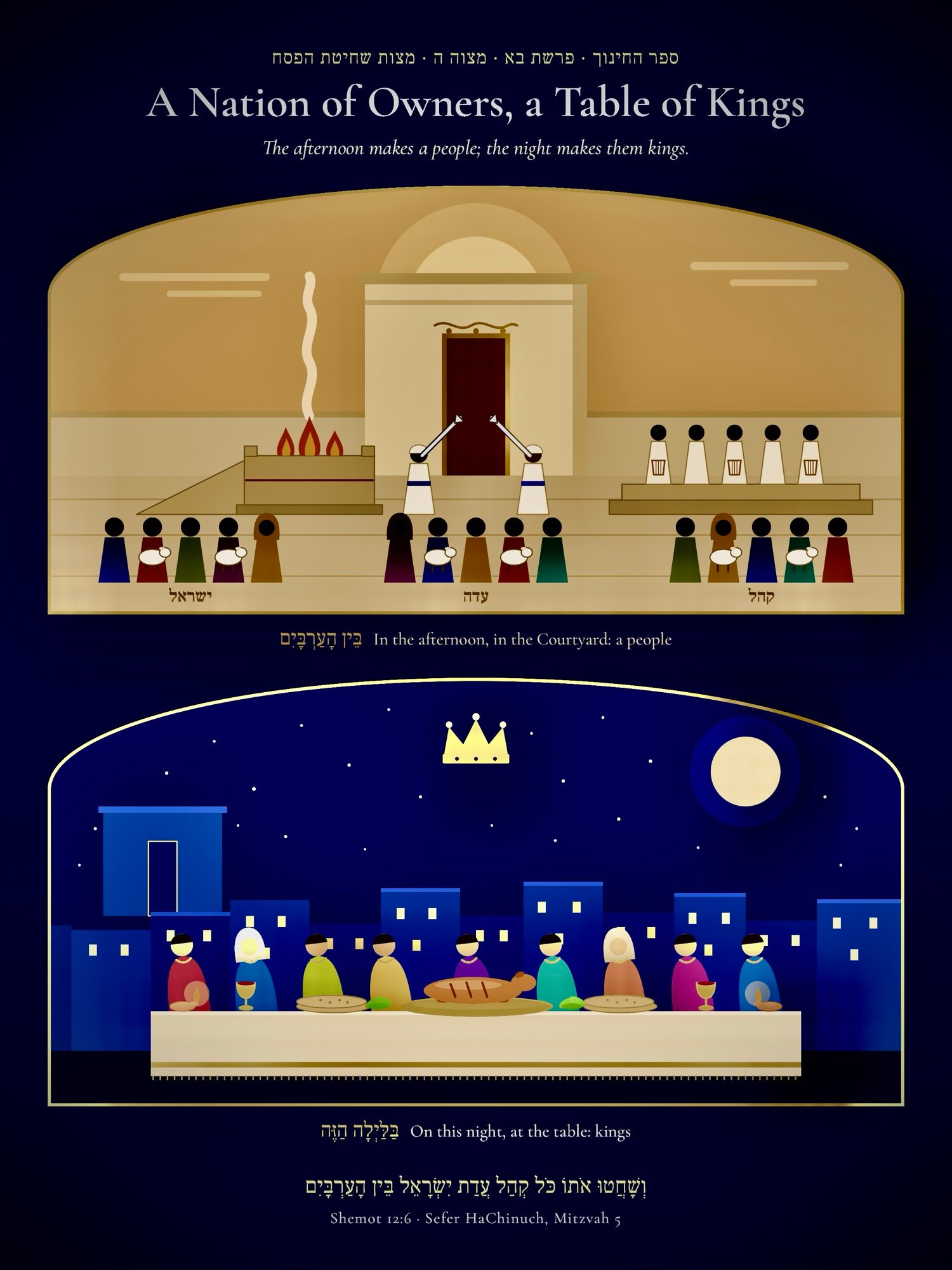
A Nation of Owners, a Table of Kings
Sefer HaChinuch on the Pesach Offering — Parashas Bo, Mitzvah 5: מִצְוָה ה׳: מִצְוַת שְׁחִיטַת הַפֶּסַח
Nov 18, 2026 · @Kamil Levi Pyka-Penner
Introduction
In a few dense lines, the Chinuch turns the slaughter of the Pesach into a portrait of the people it creates: Israel acts as owner, gathers as a community, and eats as royalty.
Mitzvah 5 is the second mitzvah of Parashas Bo, following directly on the sanctification of the new month (Mitzvah 4). The people first receive a calendar; the next mitzvah the Chinuch counts is fixed by that calendar: the slaughter on the fourteenth of Nissan.
The anonymous author, who identifies himself only as a Levite of Barcelona, wrote for his son and other young students, arranging the mitzvos by the weekly parashah. His entries are brief by design. In so compressed a text, what he includes, what he omits, and the order of his clauses are themselves a form of commentary.
This essay reads Mitzvah 5 clause by clause and deliberately limits itself to sources that belong to the world of the Chinuch: the Chinuch’s own cross-references to other mitzvos in his book, the Minchas Chinuch of R. Yosef Babad, and the notes and Insight of the Schottenstein elucidation (vol. 1, pp. 95–98). Talmudic and halachic references are cited as those works cite them.
Three claims emerge:
- Owners. The mitzvah is named for shechitah, the one essential act of the service that a non-Kohen owner may perform himself. The Pesach is the offering in which the people stand as principals.
- Community. The Chinuch describes the act as communal at every level: chaburah, shift and nation. The laws of registration make the moment of slaughter the moment that constitutes the community.
- Royalty. The slaughter is ordered toward a meal eaten when already sated, in the manner of kings. The Chinuch ties that manner of eating to his central axiom of education: the heart follows the deed (Mitzvah 16).
Beneath all three lies the gravity of the obligation. The Chinuch closes by setting the Pesach beside milah: both are positive commandments whose intentional neglect carries kares, and neither brings a chatas when neglected in error.
The Chinuch’s Text and Its Architecture
The entry follows the Chinuch’s familiar plan — definition with its verse, root, laws, and scope with penalty — and here it also includes, before the root, a description of the act itself (וענין המצוה הוא). The Hebrew below follows the vocalized edition (pp. 95–97), given here without vowels; the translations are new.
Definition and verse
לשחוט ביום ארבעה עשר בניסן בין הערבים, שה תמים זכר בן שנה, או גדי, בבית הבחירה. וזה נקרא קרבן הפסח, שנאמר (שמות יב, ו) ושחטו אתו כל קהל עדת ישראל בין הערבים.
To slaughter, on the afternoon of the fourteenth of Nissan, an unblemished male lamb in its first year, or a kid, in the Chosen House. This is called the Pesach offering, as it is said: “and the whole congregation of the assembly of Israel shall slaughter it in the afternoon” (Exodus 12:6).
The act described
וענין המצוה הוא, שמתקבצין אנשים מישראל לחבורות, ולוקחין מן השוק או מביתם גדי אחד או שה, תמים זכר בן שנה, ושוחטין אותו בעזרת בית המקדש ביום ארבעה עשר בניסן בין הערבים, ואחר כך לערב אוכלין אותו בין כולם אחר מאכלם, שמצותו לאכלו על השבע.
The substance of the mitzvah: people of Israel gather into groups. From the market or from their homes they take one kid or lamb, an unblemished male in its first year, and slaughter it in the Temple Courtyard on the afternoon of the fourteenth of Nissan. Afterward, at night, they eat it among them all, after their other food — for its mitzvah is to eat it when sated.
Root
משרשי מצוה זו, כדי שיזכרו היהודים לעולם הנסים הגדולים שעשה להם השם יתברך ביציאת מצרים.
Among the roots of this mitzvah: that the Jews remember forever the great miracles that G-d, blessed be He, performed for them at the Exodus from Egypt.
Laws
דיני המצוה, כגון זמן שחיטתו ביום אימת, ושהוא נשחט בשלש כתות בעזרה, וכי דוחין שבת עליו, ודיני מנוייו, וקריאת ההלל עליו, ותקיעת חצוצרות, ויתר פרטיה, מבוארים במסכת פסחים (דף נח ע״א ואילך).
The laws of the mitzvah — the hour of the day at which it is slaughtered; that it is slaughtered in three shifts in the Courtyard; that the Sabbath is set aside for it; the laws of its registrants; the reciting of Hallel over it; the sounding of trumpets; and the rest of its details — are set out in Tractate Pesachim (58a and onward).
Scope and penalty
ונוהגת בזכרים ובנקבות, בזמן הבית. והעובר עליה במזיד ולא עשה פסח, חייב כרת. בשוגג, אינו מביא קרבן, לפי שהוא אחד משלשה חטאים שבזדונן כרת ואין בשגגתן חטאת, והן זה, ומגדף, ומבטל מילה.
It applies to men and women, when the Temple stands. One who deliberately transgresses and does not make the Pesach is liable to kares. If he did so unwittingly, he brings no offering, for this is one of three sins whose deliberate commission carries kares but whose unwitting commission brings no chatas: this one, the blasphemer, and one who neglects milah.
Three features of the architecture
First, the definition is assembled from more than one book of the Torah. The animal comes from Shemot 12:5 and the hour from 12:6, but “the Chosen House” comes from Devarim (ed. nn. 1, 2, 8). The Chinuch defines the mitzvah as it binds every generation, not as it was first performed in Egypt, at home, with blood on the doorposts.
Second, the grammar shifts. The definition uses a single infinitive, לשחוט; the description is a run of plural verbs: מתקבצין, לוקחין, שוחטין, אוכלין — they gather, take, slaughter, eat. The plural of the verse (ושחטו … כל קהל עדת ישראל) has become the Chinuch’s own syntax.
Third, the description does not stop at the slaughter. It runs on to the night, the table and the rule of eating when sated, although eating is a separate mitzvah (Mitzvah 6; ed. n. 3). The Chinuch does not describe the slaughter of the Pesach without describing what it is slaughtered for.
Why “Shechitah”? The Owner’s Act
The Chinuch names the mitzvah after the offering’s first act, and that act is the one part of the service that belongs to the owner.
Both the title, מצות שחיטת הפסח, and the opening word, לשחוט, follow the verse: ושחטו אתו. Read alone, they might suggest that the mitzvah is discharged by the slaughter itself.
Minchas Chinuch moves at once to close that door (5:1): “לאו דוקא השחיטה” — not the slaughter specifically, but the offering through the application of the blood. The obligation is the whole service — slaughter, receiving the blood, conveying it, and applying it to the altar — and if the blood was not applied as required, the positive commandment has not been fulfilled (ed. n. 3). Once it has been applied, the owner has fulfilled this mitzvah and is exempt from Pesach Sheni even if the sacrificial fats were not burned, “כי עיקר הקרבן עד הזריקה.”
He adds a precise detail: the “application” of the Pesach blood is a gentle pouring from the vessel toward the base of the altar, and a single pouring suffices. Eating, by contrast, is a mitzvah in its own right (Mitzvah 6).
Why, then, name the whole by its first stage? The editors suggest an answer: slaughter is the only stage the owner may perform himself, since the stages that follow belong to the Kohanim (ed. n. 3, citing Rashi on Leviticus 1:5).
The suggestion deserves more weight than its bracket gives it. A non-Kohen may slaughter any offering, but here that act gives the mitzvah its name, and the verse makes the whole nation the subject of the slaughter. The title keeps the Pesach’s center of gravity where the verse puts it: with the people, who stand in the Courtyard as principals rather than onlookers.
The Chinuch himself uses the slaughter as shorthand for the entire Pesach. Giving the root of Mitzvah 13, he sends the reader back to “what is written regarding its slaughter” (כמו שכתוב בשחיטתו).
“Into Chaburos”: The Pesach as the Making of Community
The Chinuch describes the Pesach as an act of gathering, and the laws he lists make the slaughter the moment that fixes who belongs.
The description opens not with an animal but with people: שמתקבצין אנשים מישראל לחבורות. Strictly, the halachah does not demand a group: an individual may bring the Pesach alone if he can eat all of it, so that nothing is left over. Still, a group is preferred, after the plural of the verse יעשו אתו (Bamidbar 9:11; ed. n. 4, citing Rambam, Hil. Korban Pesach 2:2 with Kesef Mishneh, and the dispute in Pesachim 91a).
The Chinuch, then, describes the mitzvah in its ideal form, not its minimum. For him the natural shape of the Pesach is a fellowship.
Even the source of the animal is inclusive. “From the market or from their homes” reflects the double verb of Shemot 12:21, משכו וקחו: “draw forth” for one who already owns a fitting animal, “take” for one who must buy (ed. n. 5, citing the Mechilta). No Jew stands outside the frame because of what he lacks.
The laws of the registrants (דיני מנוייו) give the fellowship its edges. Only those registered before the slaughter may eat; one may join or withdraw until the animal is slaughtered; and any number may join, provided each can receive a kezayis (ed. n. 11, citing Exodus 12:4 and Pesachim 61a, 89a). Before the slaughter, membership is open; at the slaughter, the community is fixed.
The same verse yields the inclusion of women. Women are generally exempt from time-bound positive commandments, but not here: במכסת נפשות, “according to the count of souls,” includes them (ed. n. 15, citing Pesachim 91b and Rambam, Hil. Korban Pesach 1:1). The verse that defines the chaburah by counting also defines what is counted — souls — and so the Chinuch writes ונוהגת בזכרים ובנקבות.
In the Courtyard the community appears at a second scale. The Pesach is slaughtered in three shifts, after the three nouns of the verse, קהל, עדה and ישראל; only when one shift has finished and left does the next enter (ed. n. 9, citing Pesachim 64a with Rashi). Offerings brought without shifts are nonetheless valid after the fact (Rambam, Hil. Korban Pesach 1:11).
The third scale is the nation and its one place. The Pesach could not be brought on a private altar even in eras when private altars were permitted (Devarim 16:5; ed. n. 2, citing Megillah 9b and Rambam, Hil. Korban Pesach 1:3), and the Chinuch counts slaughtering it on a private altar as a prohibition of its own (Mitzvah 487). The offering of all Israel is brought only at the place that belongs to all Israel.
Circle
Setting
The Chinuch’s words
Verses (ed. notes)
Chaburah
The table, at night
לחבורות; דיני מנוייו; בזכרים ובנקבות
Shemot 12:4; Bamidbar 9:11 (nn. 4, 11, 15)
Shift
The Temple Courtyard, afternoon
בשלש כתות בעזרה
Shemot 12:6 (n. 9)
Nation
The Chosen House
בבית הבחירה
Devarim 12:5, 11; 16:5 (n. 2)
Each circle is made by the act rather than assumed by it. The chaburah exists because its members registered for this animal; the shift exists because the Courtyard filled and emptied in turn; and the nation is present because every offering converges on one place at one hour.
A Private Offering with a Public Face
Of the six laws the Chinuch names, only one — the registrants — concerns the chaburah; the other five set the Pesach in the life of the whole nation.
The hour. The Torah’s בין הערבים means the afternoon: a Pesach slaughtered before midday is invalid (ed. n. 8, citing Pesachim 61a). Ideally it follows the afternoon tamid, itself offered at least half an hour after midday, though one slaughtered before the tamid is valid, provided it is after midday (Rambam, Hil. Korban Pesach 1:4); it may be brought until nightfall.
The Chinuch’s own referral, “58a and onward,” opens the fifth chapter of Pesachim, whose first mishnah fixes the hour of the daily offering on Erev Pesach. The reader enters the laws of the Pesach through the door of the daily communal offering.
The Chinuch explains why such timing matters when he forbids slaughtering the Pesach while one still owns chametz (Mitzvah 89). A fixed time, he writes, is what sustains the doing of anything; because the Pesach is a great matter in the upholding of the faith (he refers back to Mitzvah 21), each element of the festival received its own order and hour. First the chametz is removed, and only then does the Pesach begin, “שהוא התחלת שמחת המועד הטוב” — the beginning of the festival’s joy.
The Sabbath. When Erev Pesach falls on Shabbos, the Pesach is slaughtered and its parts are burned on the altar that day, on the strength of במועדו, “in its appointed time” (Bamidbar 9:2; ed. n. 10). Only what cannot wait sets the Sabbath aside; the roasting waits for nightfall (Pesachim 65b–66a). A private offering that overrides Shabbos is governed by the nation’s fixed hour, not by the owner’s convenience.
Hallel. As each shift slaughtered, the Leviim on their platform recited Hallel (Rambam, Hil. Korban Pesach 1:11, from Tosefta Pesachim 4:9); according to Rashi, the owners themselves recited it (ed. n. 12). If a shift had not finished, Hallel was repeated, and if necessary repeated again (Pesachim 64a). For the question of who recited it, the editors refer to Minchas Chinuch 394:13 and to Chidushei HaGriz.
Trumpets. With each recitation of Hallel the Kohanim sounded tekiah–teruah–tekiah (Rambam, Hil. Korban Pesach 1:12). The editors place this under the general mitzvah of sounding trumpets over the communal offerings (ed. n. 13; Mitzvah 384).
That classification is telling. The Pesach is not a communal offering in the technical sense — it belongs to its registrants — yet in the Courtyard it is treated like one: a fixed national hour, the Sabbath set aside, Levitical song and priestly trumpets. It is a private offering that the whole nation brings at once, and the law treats that simultaneity as a public event.
The Root of the Mitzvah: Memory Enacted
The Chinuch gives the slaughter a one-sentence root — remembrance of the miracles of the Exodus — and works out in later mitzvos what is remembered, who remembers, and how.
The root reads: כדי שיזכרו היהודים לעולם הנסים הגדולים שעשה להם השם יתברך ביציאת מצרים. Its subject is collective, “the Jews,” and its horizon unlimited, “forever.” The editors tie it to the Haggadah’s question of why our ancestors ate the Pesach while the Temple stood — because the Holy One passed over their houses in Egypt — and point ahead to Mitzvah 16 (ed. n. 7, citing Mishnah Pesachim 116b).
What is remembered. In Mitzvah 21 the Chinuch explains why the Torah multiplies commandments about the Exodus: “כי הוא יסוד גדול ועמוד חזק בתורתנו ובאמונתנו.” The Exodus is for him a complete sign and proof that the world was created, and that there is an eternal God who wills and is able, who changed the nature of the world for Israel’s sake. To remember the miracles is to keep faith in creation and providence alive.
Who remembers. In Mitzvah 13 the Chinuch extends the root of the slaughter itself, citing “what is written regarding its slaughter.” The Pesach is made “לאות ולזכרון שבאנו באותו הזמן לחסות תחת כנפי השכינה ונכנסנו בברית התורה והאמונה”: a sign that at that time we came to shelter beneath the wings of the Shechinah and entered the covenant of Torah and faith. The memory is of an entry, not only of an event — the moment Israel became a covenantal people.
How one remembers. Mitzvah 16 meets the obvious objection, which the Chinuch places in his son’s mouth: why so many acts to recall one miracle, when a single remembrance might suffice? His answer is among the best-known sentences of the book: “דע כי האדם נפעל כפי פעולותיו, ולבו וכל מחשבותיו תמיד אחר מעשיו שהוא עושה בהם, אם טוב ואם רע … כי אחרי הפעולות נמשכים הלבבות.” A person is shaped by what he does; his heart follows his deeds.
Read through these passages, the brief root of Mitzvah 5 becomes a program. The memory the Chinuch seeks is a formation, not a thought, and the slaughter supplies the deeds that form it: an animal drawn from one’s flock or bought in the market, a journey to the Chosen House, a place in a shift, a name on a list, a seat at a table. Its cost in property, travel and time is part of its pedagogy.
The root says לעולם, forever; the scope says בזמן הבית, when the Temple stands. How the memory survives when the act cannot is taken up below, in the section on the Seder.
“When Sated”: The Pesach at a Royal Table
The clause שמצותו לאכלו על השבע binds the slaughter to a royal meal. The two explanations the editors record differ on whether that royalty is a law of the Pesach itself or of all sacred meat, and the Chinuch’s own words lend support to each.
To satisfy the rule, a chagigah was customarily offered on Erev Pesach and eaten at night before the Pesach (Insight, p. 98, citing Pesachim 70a).
Some Rishonim derive the rule from a general law: sacred food is eaten למשחה (Bamidbar 18:8), which the Sages read as “in the manner of kings” (Chullin 132b; Sotah 15a). A king does not eat to still his hunger but for the distinction of a delicacy, so sacred meat belongs at the end of a meal (Rashi, Pesachim 86a; Rashbam, 119b).
The difficulty is plain. The chagigah is also sacred meat. How can it be eaten first, with appetite, so that the Pesach will not be?
First model: a law of the Pesach. The regal rule of למשחה governs only the portions given to the Kohanim, not the owner’s share. The Pesach is an exception created by its own verse, ואכלו את הבשר … ומצות על מררים יאכלהו (Shemot 12:8), read by the Mechilta to teach that the owner eats his portion after sating his hunger with other food. The chagigah comes first to fulfill this special law (Chidushei HaGrach; for another approach, Chidushei HaGriz to Menachos 21b).
Second model: a general law with a safeguard. The regal rule applies to all sacred meat, the chagigah included, and is met by eating other food, such as matzah, beforehand. The Pesach carries an added danger: in his eagerness one might break a bone, violating a prohibition peculiar to it (Shemot 12:46; Mitzvah 16). The Sages therefore placed the chagigah first, so that the Pesach would be eaten at leisure (Tosafos, Pesachim 70a; Mordechai, from Yerushalmi Pesachim 6:4; see Mikra’ei Kodesh). The editors return to the question at Mitzvah 486 (Insight A).
The Chinuch’s own voice. His wording leans toward the first model. He does not say that sacred meat is eaten when sated; he says שמצותו — its mitzvah — is to eat it so. The rule is lodged in the Pesach itself.
Yet his reasoning in Mitzvah 16 supplies exactly the concern of the second model. Among his reasons for the prohibition of breaking a bone is the dignity of the free: it is no honor for princes (בני מלכים) and counselors of the land to drag bones and crack them like dogs. The hungry, hurried eating the Sages guarded against is the very conduct the Chinuch calls unfit for royalty.
Mitzvah 15 completes the picture. The Pesach may not leave its chaburah because שנעשנו בני חורין ואדונים — we have become free men and lords — and so it is eaten “כדרך מלכי ארץ, שכל המוכן להם נאכל בהיכלם ברב עם שלהם”: like the kings of the earth, whose fare is eaten in their palace among their company.
The two models disagree about the source of the rule, not about its picture. Either way the Pesach is eaten from distinction rather than need: within a fellowship, at leisure, its bones intact. Hunger is the posture of the slave; satiety is the posture of the king.
Here the axiom of Mitzvah 16 does its work. A nation that each year eats its Pesach as royalty eats is trained by the act to become what the act portrays. This also explains why the Chinuch’s description of the slaughter runs on to the evening: the Pesach is slaughtered in the afternoon for a royal table at night.
Kares without Chatas: Pesach, Milah and Belonging
The Chinuch’s closing lines treat failure to bring the Pesach as a failure to belong: the penalty is excision, the companion case is milah, and the remedy is not atonement but a second chance to be counted.
The law. One who deliberately fails to bring the Pesach is liable to kares, as Bamidbar 9:13 states. Making the Pesach is one of only two positive commandments whose neglect carries kares; the other is milah, while thirty-four prohibitions carry the same penalty (ed. n. 17, citing Kereisos 2a).
No chatas. Ordinarily, one who unwittingly commits a kares-bearing sin brings a chatas (ed. n. 18). A chatas, however, atones for the unwitting violation of a prohibition that involves an act. Neglecting the Pesach or milah is the omission of a positive duty, and blasphemy is committed in speech, so none of the three brings one (ed. n. 20, citing Kereisos 2a–3a).
The pairing. The Chinuch’s list joins the Pesach to milah (Mitzvah 2), and the Torah itself binds them: an uncircumcised man may not eat the Pesach (Mitzvah 17). They are the two great acts of entry — milah into the covenant given to Avraham, the Pesach into the people redeemed from Egypt.
Belonging and its loss. Mitzvah 13 states the logic in the Chinuch’s own words. Because the Pesach is a sign that we entered the covenant of Torah and faith, it is not fed to one “שיצא מן הכלל וכפר באמונה” — who has gone out of the community and denied the faith. The Pesach marks the boundary of the כלל, the whole.
Kares may then be read as the mirror image of registration. The Pesach is the mitzvah of being counted; one who refuses to be counted among those who bring it is cut off from those who do.
The open door. The law does not leave that door shut. One who failed to bring the first Pesach, even deliberately, may bring it on the fourteenth of Iyar as Pesach Sheni (Mitzvah 380); if he does, the kares is revoked (ed. n. 17, citing Rambam, Hil. Korban Pesach 5:2; Pesachim 93a; Sefer HaMitzvos, Asei 57).
This suggests a further reading of the missing chatas. What the neglect leaves behind is not a sinful deed to be atoned for but an absence to be filled. Its remedy is not a sin-offering but the Pesach itself, one month later.
After the Temple: The Seder as Living Commentary
The Chinuch limits the mitzvah to the time of the Temple, yet the order he describes survives in the words of the Haggadah, and a dispute over those words shows how prayer carries halachah forward.
בזמן הבית. The limitation seems self-evident: without a Temple or an altar there is nothing on which to offer. The editors nonetheless flag it, pointing to Rambam, Hil. Beis HaBechirah 6:15 and its commentators (ed. n. 16), which bears on whether offerings may be brought at the site even without a standing building. That question lies beyond this essay; the flag itself shows that “when the Temple stands” is a halachic category, not only a historical one.
The Haggadah. At the close of Maggid we ask to eat in Jerusalem “מן הזבחים ומן הפסחים” — from the chagigah offerings and from the Pesach offerings. The chagigah is named first because it was eaten first (Insight, citing Tosafos, Pesachim 116b). The order required by על השבע is preserved in the grammar of a blessing.
Saturday night. When the Seder falls on Motza’ei Shabbos, some authorities reverse the order: “מן הפסחים ומן הזבחים.” A chagigah may not be slaughtered on Shabbos, so in Temple times the Pesach alone would be eaten that night, and the festival chagigah would come only the next day (Mitzvah 88). Others oppose the change: the blessing asks for next year, when the festival may begin on another night, so its text should stand (Ba’er Heitev 473:27; Shaar HaTziyun 473:80; see Mitzvah 486, Insight B).
The dispute is about what liturgy represents. On the first view, prayer mirrors this year’s halachah, down to the calendar; on the second, it holds the permanent form of the service, ready for its return.
Either way, Jews without a Temple go on reciting the laws of the chaburah’s table: which offering is eaten first, and when. This is how the Chinuch’s לעולם survives his בזמן הבית. The act is suspended, but its order is spoken — and the Seder is itself a sequence of deeds, which by the Chinuch’s axiom still shape the heart.
Conclusion
Read closely, the Chinuch’s brief entry is a complete account of how a people is made: by an owner’s act, in community, at a royal table, within a covenant whose boundary the act itself draws.
The name, shechitah, places the people at the center — all the more pointedly once the Minchas Chinuch establishes that the mitzvah is the whole service through the application of the blood. The plural verbs and the laws of registration, shifts and place build community at three scales. The public laws give a private offering a national face. The root, read with Mitzvos 13, 16 and 21, turns memory into formation by deed; “when sated,” read with Mitzvos 15 and 16, makes the meal royal; and kares without chatas, with Pesach Sheni beside it, frames the whole as belonging.
For the rav and the rebbe, Mitzvah 5 shows the Chinuch’s method at its clearest: name the act, describe it so a young student can see it, give its root, list its laws, and state its stakes. For the academic reader, it shows a thirteenth-century educator reading a Temple rite as moral formation — and later commentators, from the Minchas Chinuch to the modern elucidators, refining that reading with legal precision rather than replacing it.
The Pesach was slaughtered in the afternoon and eaten at night. In the Chinuch’s telling, the afternoon makes a people, and the night makes them kings.
Questions for Further Study
These questions are meant for the beis midrash and the classroom; each can be pursued within the Chinuch and the works that comment on it.
- The Chinuch names the mitzvah for shechitah, while the Minchas Chinuch (5:1) holds that it is fulfilled only with the application of the blood. Does the title describe the obligation itself, or the owner’s share in it?
- Why does the Chinuch place “eating when sated” inside the description of Mitzvah 5 rather than reserving it for Mitzvah 6? Is על השבע a law of the slaughter, of the offering, or of the eating?
- Five of the six laws the Chinuch lists are public in character, and the editors place the trumpets under the mitzvah of trumpets over communal offerings (Mitzvah 384). What does this imply about the Pesach as an individual’s offering?
- Exodus 12:4 grounds both registration and the obligation of women. Is the inclusion of women a function of the chaburah, or is the chaburah a function of the count of souls?
- Which model of eating when sated better fits the Chinuch’s own wording (שמצותו) in Mitzvah 5 and his reasoning in Mitzvos 15 and 16?
- On a Saturday-night Seder, should the Haggadah’s text follow this year’s halachah or the permanent form of the service? What does each view assume about the nature of prayer?
Sources and Conventions
Every source drawn on here is the Sefer HaChinuch itself or a work written on it.
Primary text
- Sefer HaChinuch, Mitzvah 5, with Mitzvos 2, 4, 6, 13, 15, 16, 17, 21, 88, 89, 380, 384, 486 and 487 (standard numbering).
Commentary
- R. Yosef Babad, Minchas Chinuch, 5:1; 394:13 (the latter as cited by the editors).
Edition
- Sefer HaChinuch / Book of Mitzvos, Schottenstein Edition, The Jan Czuker Family Elucidation of the Torah’s Commandments (ArtScroll/Mesorah), vol. 1, pp. 95–98: notes 1–20 and the Insight on eating the Pesach when sated, cited here as “ed. n.” and “Insight.”
Study on the Minchas Chinuch
- R. Shmuel Shimoni, עיונים במצוות בעקבות המנחת חינוך, Mitzvah 5 (Virtual Beit Midrash, Yeshivat Har Etzion), for the wording of Minchas Chinuch 5:1.
Conventions
- Talmudic, Rishonim and halachic references (Pesachim, Rambam, Tosafos, the Mechilta and others) appear only as the Chinuch or the edition’s notes cite them.
- The Hebrew of Mitzvah 5 follows the edition, without vowels. The Hebrew of Mitzvos 13, 15, 16, 21 and 89 was checked against transcriptions of the Chinuch.
- Translations from the Hebrew are original to this essay and follow the traditional rabbinic sense of each verse; for example, בין הערבים is rendered “in the afternoon.”
- Transliteration follows the edition’s Ashkenazi style (mitzvos, Shabbos, kares).