
The Light of Redemption and Education: A Rabbinic Commentary on Sefer HaChinuch (The Book of Mitzvos)
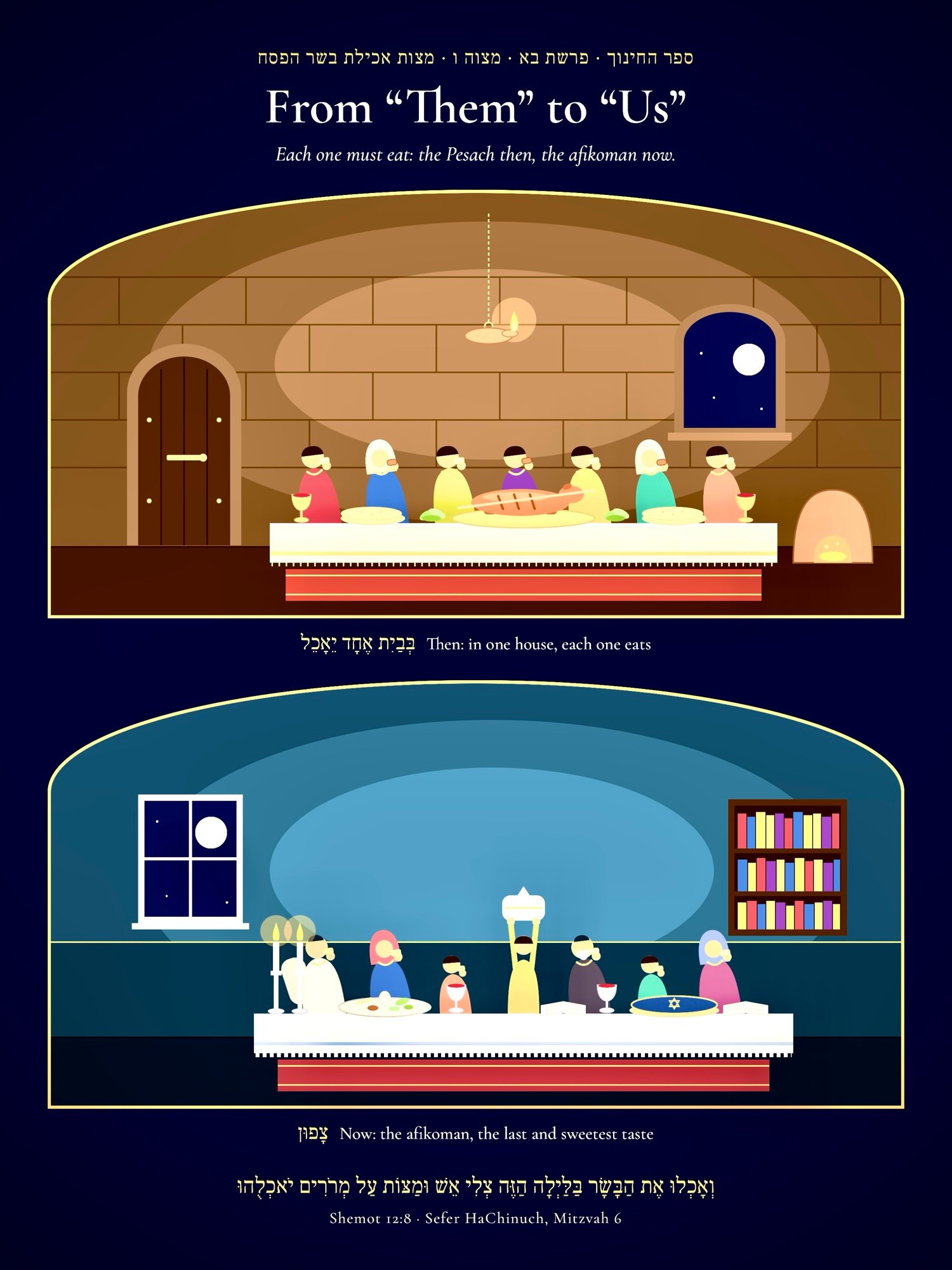
From “Them” to “Us”
Sefer HaChinuch on Eating the Pesach — Parashas Bo, Mitzvah 6: מִצְוָה ו׳: מִצְוַת אֲכִילַת בְּשַׂר הַפֶּסַח
Nov 18, 2026 · @Kamil Levi Pyka-Penner
Introduction
Mitzvah 5 made a people; Mitzvah 6 obligates each person. In a short entry on eating at Pesach, the Chinuch turns the nation’s offering into a personal duty, and his wording, laws, and closing principle all mark the turn.
In his count, eating the Pesach is a mitzvah of its own, not a condition of the slaughter: one who completed the service through the application of the blood has fulfilled the slaughter even if he never ate (Minchas Chinuch 5:1). The editors add that the Pesach is the only offering with a specific commandment to eat it (ed. n. 1; Insight A).
This essay reads the entry clause by clause and again limits itself to the world of the Chinuch: his own text and cross-references, the Minchas Chinuch, and the notes and Insights of the Schottenstein elucidation (vol. 1, pp. 99–102).
Five observations organize what follows:
- The root turns personal. Restating the root of Mitzvah 5, the Chinuch moves from “the Jews … for them” to “for us … who brought us out of bondage.”
- Form is part of the mitzvah. He defines the eating “according to the conditions of the verse” — roasted, with matzah and maror — and the commentators separate the condition that is essential from those that complete it.
- Each one must eat. His laws open with the minimum that “each one” must eat; one explanation the editors record sees this personal requirement as the very reason the Pesach has a mitzvah of its own.
- The meal is one act. The registrants may not leave the chaburah and may not sleep: one place, one unbroken attention.
- The duty can be compelled. Here, and not earlier, the Chinuch states that a court compels one who refuses a positive commandment; the Minchas Chinuch explains why eating, of all acts, required saying so.
A final section follows the Pesach into the present, where the afikoman keeps its laws alive at the end of the Seder.
The Chinuch’s Text and Its Architecture
The entry is shorter than Mitzvah 5 and leans on it: it borrows the earlier root, omits any description of the act, and closes with a principle that reaches far beyond the Pesach. The Hebrew follows the edition (pp. 99–101), given here without vowels; the translations are new.
Definition and verse
לאכול בשר הפסח בליל חמשה עשר בניסן, על פי תנאים שבכתוב, שנאמר (שמות יב, ח) ואכלו את הבשר בלילה הזה.
To eat the meat of the Pesach on the night of the fifteenth of Nissan, according to the conditions in the verse, as it is said: “They shall eat the meat on this night” (Shemot 12:8).
Root
ומשרשי מצוה זו מה שכתבנו בשחיטתו, כדי לזכור הנסים הגדולים שעשה לנו האל שהוציאנו מעבדות.
Among the roots of this mitzvah is what we wrote regarding its slaughter: to remember the great miracles that G-d performed for us, who brought us out of bondage.
Laws
דיני המצוה, כמה חייב כל אחד לאכול ממנו לכל הפחות, והנמנין עליו איך יתנהגו עד שיאכלוהו, שלא לצאת מן החבורה, ושלא ישנו, ויתר פרטיה, מבוארים בפסחים (ס״ו ע״א ואילך).
The laws of the mitzvah — how much each one must eat of it at the least; how those registered on it must conduct themselves until they have eaten it, that they not leave the chaburah and that they not sleep; and the rest of its details — are set out in Pesachim (66a and onward).
Scope, penalty and a general principle
ונוהגת בזכרים ובנקבות. והעובר עליה בטל עשה. וכלל גדול בכל התורה לכל שאומר שיבטל מצות עשה, שכופין אותו בית דין, אם יש כח בידם, עד שיקיימנו.
It applies to men and women. One who transgresses it has neglected a positive commandment. And it is a great principle throughout the Torah that anyone who says he will neglect a positive commandment is compelled by the court, if it has the power, until he fulfills it.
What the architecture shows
First, the entry depends on its predecessor. It has no description of the act and no root of its own; for the root it sends the reader back to “what we wrote regarding its slaughter.” Mitzvos 5 and 6 are to be read as a pair: the afternoon and the night of one offering.
Second, the definition points beyond the words it quotes. The Chinuch cites only ואכלו את הבשר בלילה הזה, but writes על פי תנאים שבכתוב — the rest of the verse: roasted over fire, with matzah and maror (ed. n. 3). The conditions are built into the definition.
Third, two silences. The Chinuch says “on the night of the fifteenth” and nothing of the midnight limit (Mishnah Zevachim 56b), over which the Gemara records a Tannaic dispute: a law of the Torah, or a rabbinic fence against eating past dawn? The editors suggest he follows the view that the Torah permits eating until dawn, and so omits the rabbinic limit when stating the biblical mitzvah (ed. n. 2, citing Rambam, Hil. Korban Pesach 8:15); others hold midnight to be biblical (Tosafos, Zevachim 57b and Megillah 21a; Mordechai to Pesachim 120b; Rosh, Pesachim 10:38), and Minchas Chinuch takes up the question (§3). The scope clause also omits “when the Temple stands,” which the editors call self-evident: there is no eating without the slaughter (ed. n. 9).
Fourth, the penalty falls. The slaughter carried kares; neglecting the eating is the neglect of a positive commandment. Belonging is decided at the slaughter; the eating is what each member does with it. In place of a graver penalty, the Chinuch sets down a general rule of enforcement, taken up below.
“From Them to Us”: The Root Restated
The Chinuch says the root of the eating is “what we wrote regarding its slaughter,” yet when he restates it almost every term shifts, and the shifts run from the nation to the self.
Mitzvah 5: the slaughter
Mitzvah 6: the eating
Who remembers
היהודים, “the Jews”
Unstated: לזכור, “to remember”
For whom
להם, “for them”
לנו, “for us”
The Name
השם יתברך
האל
The event
ביציאת מצרים, “at the Exodus from Egypt”
שהוציאנו מעבדות, “who brought us out of bondage”
Duration
לעולם, “forever”
Not stated
Read side by side, the two roots differ in person. The root of the slaughter speaks of a people in the third person, as a chronicler would: the Jews, for them, at the Exodus. The root of the eating speaks in the first person plural: for us, who brought us out.
The event changes too. “The Exodus from Egypt” names a departure in history; “bondage” names a condition from which a person is freed. The eating recalls not where Israel left but what each Jew was released from.
One should hesitate to load stylistic variation with meaning, and the Chinuch himself says the root is the same. The edition’s English, in keeping with his cross-reference, carries “for all time” over from Mitzvah 5, though the Hebrew of Mitzvah 6 does not repeat it. Still, the variation fits the content closely: the slaughter is the nation’s act in the Courtyard, so its memory belongs to “the Jews”; the eating is each soul’s act at the table, so its memory belongs to “us.”
The same first-person voice recurs in the Chinuch’s later entries on the eating. In Mitzvah 13 the Pesach is a sign “that we came then to shelter beneath the wings of the Shechinah”; in Mitzvah 15 it stays within the chaburah because שנעשנו בני חורין ואדונים, “we have become free men and lords.”
At the table, memory moves from the community’s record to the individual’s confession: He brought us out. This is the inner side of the personal obligation that the laws of the mitzvah go on to impose.
“According to the Conditions of the Verse”: Form as Substance
The phrase על פי תנאים שבכתוב makes the manner of eating part of the mitzvah, but the conditions do not weigh the same: roasting is essential, while matzah and maror complete the act without invalidating it.
The verse names three conditions: צלי אש, roasted over fire; מצות, with matzah; and על מררים, with maror. The mitzvah is to eat under all three (ed. n. 3).
Their weight differs. The Mechilta reads the repeated יאכלהו, “they shall eat it,” to teach that one who ate the meat without matzah or maror has fulfilled the mitzvah, though not in its best form. Roasting is another matter: one who ate the Pesach unroasted has not fulfilled it at all, since the condition is integral to the mitzvah, and the next verse insists on “only roasted over fire” (ed. n. 3, citing Minchas Chinuch to Mitzvah 7 §19 and the Griz).
The Chinuch’s own count reflects three different relations between a condition and the mitzvah:
- Roasting is integral. It is guarded by a prohibition of its own, against eating the Pesach raw or boiled (Mitzvah 7), and without it there is no fulfillment.
- Matzah is parallel. It has its own commandment for the night (Mitzvah 10), which stands even where there is no Pesach.
- Maror is dependent. It has no commandment of its own in the Chinuch’s count; it lives only as a condition of this eating.
The conditions extend to place as well. The Minchas Chinuch (on Mitzvah 15) asks why בבית אחד יאכל, “in one house it shall be eaten,” is not counted as a positive commandment. He answers that it is one of the details of eating the Pesach properly, just as eating it roasted is not counted separately but belongs to this mitzvah (as summarized in Chochmas HaChinuch).
Why should the Pesach need an eating mitzvah at all, when a general mitzvah already governs the eating of sacred meat (Mitzvah 102)? One answer recorded by the editors is precisely this manner: the mitzvah exists to require a form of eating that no other offering demands (Insight A, citing R. Y. F. Perla on Rav Saadiah Gaon’s Sefer HaMitzvos, Asei 47; see Sefer HaMitzvos, Asei 56). On this view על פי תנאים שבכתוב is the heart of the mitzvah, not a detail.
For a writer whose axiom is that the heart follows the deed, the shape of the deed is never incidental. A Pesach eaten boiled is a different act; a Pesach eaten without matzah and maror is the same act, incompletely performed.
“How Much Each One Must Eat”: The Personal Obligation
The Chinuch opens the laws with the minimum each person must eat, and the second explanation in the editors’ Insight makes exactly this personal requirement the reason the Pesach has an eating mitzvah of its own.
The minimum. One must eat at least a kezayis, and to count as one act of eating it must be consumed within the time it takes to eat a peras, half a loaf (ed. n. 4, citing Pesachim 91a and Rambam, Hil. Korban Pesach 8:3). The Minchas Chinuch treats this as one of the Torah’s eating-mitzvos, measured exactly as matzah and the eating prohibitions are, and he probes the edges of what counts as eating at all — eating to the point of revulsion (אכילה גסה), and the roles of the throat’s and the stomach’s pleasure (as summarized by R. Shmuel Shimoni).
A personal requirement. The editors record a second answer to why the Pesach needs its own mitzvah. With other offerings, the aim is that the meat be eaten and not left over; no individual must eat, and many may share an offering though each eats less than a kezayis — Kohanim sometimes received only a bean’s worth (Pesachim 3b). With the Pesach, every Jew must eat, and must eat at least a kezayis; that personal requirement is what this mitzvah establishes (Insight A, citing Teshuvos Chasam Sofer, Orach Chaim §140; Beis HaLevi; Ohr Same’ach).
The Insight adds “cf. Minchas Chinuch 102:2, 134:2.” In R. Shimoni’s reading, the Minchas Chinuch tends to treat these rules as general laws of eating sacred food rather than features unique to the Pesach: of the Kohanim’s mitzvah to eat sacred meat he writes that it is like every eating-mitzvah, “כאכילת פסח מצה ומרור,” and requires a kezayis (102:7, as quoted there).
Beyond the kezayis. Does the duty end with the minimum? The Minchas Chinuch (on Mitzvah 134) holds that after a kezayis there remains only the prohibition of leaving any over, not a further positive duty to eat; the Shaagas Aryeh (§96) reads ואכלו as applying to the whole Pesach (both as summarized by R. Shimoni). The first view joins a personal minimum to a communal prohibition; the second extends the positive duty to the whole animal.
Both in the Chinuch’s words. His own text holds both explanations in its two clauses. The definition, על פי תנאים שבכתוב, speaks of manner; the laws, כמה חייב כל אחד לאכול ממנו לכל הפחות, speak of person: “each one,” “at the least.” The mitzvah is a law of how the Pesach is eaten and a law that every registrant eat it.
Women. The personal duty extends to women, although the mitzvah is bound to a time, just as they are obligated in the slaughter (ed. n. 9, citing Minchas Chinuch §5; Mitzvah 5, ed. n. 15). The count of souls that defined the chaburah now defines who must eat.
The penalties confirm the shape. Failure to slaughter cuts a person off; failure to eat is the neglect of a positive commandment. The slaughter decides who belongs; the eating asks each member to take in what the people has done.
The Conduct of the Table: One Place, One Waking
The Chinuch’s second law governs not what is eaten but how the registrants behave until they finish: they may not leave the chaburah and may not sleep, so that the meal remains one act, in one place, by one waking fellowship.
One place. The Pesach is eaten in a single location, בבית אחד יאכל (Shemot 12:46). Meat taken out of the group’s place is disqualified, and whoever removed it transgresses לא תוציא מן הבית מן הבשר חוצה (Mitzvah 15). Two groups eating in one house must each set apart an area of its own (ed. n. 6, citing Rambam, Hil. Korban Pesach 9:1–5 with Kesef Mishneh).
One waking. If the whole group fell asleep after beginning to eat, they may not resume on waking; if even one member stayed awake, all may continue (ed. n. 7, citing Mishnah Pesachim 120a). The editors record two explanations:
- The meal is broken. Sleep ends the meal, and resuming is like reconstituting the group and eating in a new place, though the room is the same; the rule is a rabbinic extension of the one-place law (Rashbam and Baal HaMaor).
- The meat is unguarded. Sacred meat must be watched at all times; when the whole group sleeps, it is left unguarded and disqualified (Raavad, Hil. Chametz U’Matzah 8:14, from Pesachim 34a).
On the first explanation, sleep breaks the meal in time as leaving breaks it in space: the chaburah’s eating is one continuous act. On the second, sleep is a lapse of watchfulness over something holy. Either way the Pesach requires presence, of body and of attention.
The Chinuch frames both rules as the registrants’ conduct — איך יתנהגו, how they must behave — which sits more easily with the first explanation, concerning the fellowship’s meal, than with the second, concerning the state of the meat.
That one waking member suffices for all is striking. The continuity of the meal rests not on every member but on the fellowship: a single watcher keeps the table whole for everyone. The community fixed at the slaughter is sustained through the night by the attention of even one of its members.
This is the royal table of Mitzvah 15, where the Pesach is eaten “as the kings of the earth, whose fare is eaten in their palace among their company,” now given its rules of conduct. No one carries the king’s portion outside, and the banquet does not lapse into sleep.
Penalty and Coercion: Why the Principle Appears Here
The Chinuch’s general rule — a court compels one who refuses a positive commandment — first appears in Mitzvah 6, and the Minchas Chinuch explains why: only with eating might one doubt that a compelled act counts.
The rule. One who refuses a positive commandment is not lashed, but while the mitzvah can still be fulfilled, the court may use force to bring him to fulfill it (ed. n. 10, citing Kesubos 86a). The Chinuch adds a realistic qualifier, אם יש כח בידם, “if it has the power”; whether a court holds that authority today is discussed in Minchas Chinuch 557:20 (ed. n. 10).
Why here? The Minchas Chinuch (§10) asks why the Chinuch waited until this mitzvah to state a rule that runs through the whole Torah, rather than at milah (Mitzvah 2) or the slaughter (Mitzvah 5). In those cases, he answers, coercion obviously works: a child circumcised or a Pesach slaughtered under duress is circumcised or slaughtered exactly as it would have been without it.
Eating is different. One might think that eating under duress is not a normal act of eating, since it lacks the usual satisfaction, and so cannot discharge the mitzvah (citing Mishneh LaMelech, Hil. Yesodei HaTorah 5:8). The Chinuch therefore states the rule here, to teach that a court may compel even this act and that one who eats under compulsion has fulfilled the mitzvah (ed. n. 10, citing Rosh Hashanah 28a and Rambam, Hil. Chametz U’Matzah 6:3).
What “eating” is. The placement amounts to a definition: halachic eating is an act measured by the kezayis and its time, not by the eater’s satisfaction. It fits the Minchas Chinuch’s view elsewhere that halachic eating requires the throat’s pleasure (הנאת גרון), so that swallowing matzah wrapped in fiber is not eating (as summarized by R. Shimoni on Mitzvah 313). The throat can swallow even when the will resists.
A tension with the royal table. Mitzvah 5 required that the Pesach be eaten when sated, in the manner of kings; Mitzvah 6 allows that it may be eaten under compulsion. The two belong to different levels: royal eating is the mitzvah’s ideal form, the compelled kezayis its irreducible core. The Chinuch states both, and the distance between them is the space in which education works.
The Chinuch’s own reason. His axiom suggests why such a performance is worth compelling. In Mitzvah 16 he writes that one who applies himself steadily to Torah and mitzvos, ואפילו שלא לשם שמים, “even not for the sake of Heaven,” at once inclines toward the good, for the heart follows the deeds. A compelled act is the limiting case of a deed without the heart’s consent, and the axiom suggests that even there the heart may follow.
After the Temple: The Afikoman as the Pesach’s Echo
Without a Temple the mitzvah of eating the Pesach has no biblical force, yet several of its laws live on, at the rabbinic level, in the afikoman — the matzah that ends the Seder meal (Insight B).
The word afikoman denotes sweets served after a meal (Pesachim 119b). The Sages instituted that the Seder end with matzah instead, and out of love for mitzvos that portion becomes our dessert (Insight B, citing Mitzvah 21 at n. 45 and the Levush, Orach Chaim 478:2).
The editors record three reasons for the practice:
- A memorial of the Pesach, which was eaten at the end of the meal, when one was already sated (Rosh, Pesachim 10:34; see the Insight to Mitzvah 5).
- A memorial of the matzah eaten with the Pesach. In Temple times the mitzvah of matzah was fulfilled at the end of the meal, together with the meat, ומצות על מררים יאכלהו (Rashi and Rashbam, Pesachim 119b).
- The taste of the mitzvah. Matzah is now the Seder’s only biblically commanded food, so the meal ends with it, lest it seem one course among others and so that its taste remains (Rambam, Hil. Chametz U’Matzah 8:9, as explained by R. Y. F. Perla).
The Pesach’s laws applied. On the first reason, rules of the Pesach govern the afikoman. It may not be eaten in two places (Rama, Orach Chaim 478:1). If everyone at the Seder fell asleep after beginning it, they may not resume, but if one stayed awake, all may continue (Shulchan Aruch, Orach Chaim 478:2) — precisely the laws of the chaburah’s table.
The measure. The Shulchan Aruch requires a kezayis (Orach Chaim 477:1); the Darchei Moshe prefers two. Some explain the two as one for the Pesach and one for the matzah eaten with it (Bach, Orach Chaim 473:11, 477:5). Others reason that although a kezayis of the Pesach sufficed, it was better to eat a portion that satisfies on its own — an egg’s volume, equal to two kezayis — and so the memorial calls for two (R. Y. F. Perla, explaining Rambam, Hil. Korban Pesach 8:3, and the Maharil; see Berachos 49b).
The afikoman thus keeps both layers this essay has traced. The kezayis preserves the personal minimum of Mitzvah 6; the preference for a satisfying portion preserves the royal ideal of Mitzvah 5; the rules of one place and one waking preserve the unity of the chaburah’s meal.
Between the court’s compulsion and the afikoman’s sweetness lies the whole range of the mitzvah. The law can compel a kezayis; love turns the same matzah into the sweetest part of the meal.
Conclusion
Read with its companion, Mitzvah 6 completes the Pesach: the afternoon’s slaughter made a people, and the night’s eating asks each member of that people to take the Exodus in.
The root moves from “them” to “us.” The definition writes the form of the meal into the mitzvah, with roasting essential and matzah and maror completing it. The laws begin with what “each one” must eat, matching the view that the Pesach alone imposes a personal duty to eat. The rules of one place and one waking make the meal a single act of a single fellowship, kept whole by even one watcher. And the rule of compulsion, placed here, teaches that even eating — the act most bound to appetite — counts when compelled.
For the rav and the rebbe, the entry models a teaching sequence: first the communal act, then its personal appropriation; first the ideal of the royal table, then the minimum that may be required of anyone. For the academic reader, it shows the Chinuch as editor of his own book, distributing the laws of one meal across several entries (Mitzvos 6, 7 and 10) and letting his cross-references carry the argument.
The slaughter says: this is what G-d did for them. The eating says: this is what He did for us. Between the afternoon and the night, the Chinuch teaches a nation to say “us.”
Questions for Further Study
These questions are meant for the beis midrash and the classroom; each can be pursued within the Chinuch and the works that comment on it.
- The Chinuch restates the root of Mitzvah 5 in the first person. Is the shift from להם to לנו significant, and how does it compare with his voice in Mitzvos 13, 15 and 16?
- Roasting is integral, matzah parallel, maror dependent. What does each relation imply for one who ate the Pesach lacking one of them?
- Insight A gives two reasons for a separate eating mitzvah: a required manner, or a personal duty. Do the Chinuch’s two clauses (על פי תנאים שבכתוב; כמה חייב כל אחד) favor one, and must one choose?
- Do the rules against leaving the chaburah and against sleeping concern the meal, the meat or the eaters? How does the Chinuch’s wording (איך יתנהגו) bear on the Rashbam and the Raavad?
- Why does the Minchas Chinuch think eating, unlike milah or slaughter, needed an explicit statement that coercion works? What follows for the halachic definition of eating?
- Which of the three reasons for the afikoman best explains the rules it inherits from the Pesach: one place, one waking, and the preferred two kezayis?
Sources and Conventions
Every source drawn on here is the Sefer HaChinuch itself or a work written on it.
Primary text
- Sefer HaChinuch, Mitzvah 6, with Mitzvos 2, 5, 7, 10, 13, 15, 16, 21 and 102 (standard numbering).
Commentary
- R. Yosef Babad, Minchas Chinuch, as cited by the editors: on Mitzvah 6 §§3, 5, 10; 7:19; 102:2; 134:2; 557:20.
- Minchas Chinuch, as summarized in the studies below: 5:1; on Mitzvah 6 (the definition of eating); 15; 102:7; 134; 313.
Edition
- Sefer HaChinuch / Book of Mitzvos, Schottenstein Edition, The Jan Czuker Family Elucidation of the Torah’s Commandments (ArtScroll/Mesorah), vol. 1, pp. 99–102: notes 1–10, Insight A on the mitzvah to eat the Pesach, and Insight B on the afikoman; cited as “ed. n.” and “Insight.”
Studies on the Chinuch and the Minchas Chinuch
- R. Shmuel Shimoni, עיונים במצוות בעקבות המנחת חינוך (Virtual Beit Midrash, Yeshivat Har Etzion): Mitzvah 5, Mitzvah 6, Mitzvah 313.
- R. Elchanan Poupko, Chochmas HaChinuch, Mitzvah 15, for the Minchas Chinuch there.
Conventions
- Talmudic, Rishonim and halachic references (Pesachim, Rambam, Shulchan Aruch, the Mechilta and others) appear only as the Chinuch, the edition’s notes or the studies above cite them.
- The Hebrew of Mitzvah 6 follows the edition, without vowels; its reference to Pesachim reads ס״ו ע״א ואילך.
- Translations from the Hebrew are original to this essay and follow the traditional rabbinic sense of each verse.
- Transliteration follows the edition’s Ashkenazi style (mitzvos, kezayis, afikoman).