
The Light of Redemption and Education: A Rabbinic Commentary on Sefer HaChinuch (The Book of Mitzvos)
Mitzvah 7
Roasted Over Fire: Nobility, Haste, and the Reckoning of Mitzvos
An essay on Sefer HaChinuch, Mitzvah 7 — שֶׁלֹּא לֶאֱכֹל הַפֶּסַח נָא וּמְבֻשָּׁל (Parashas Bo; Shemos 12:9)
Nov 19, 2026 · @Kamil Levi Pyka-Penner
This essay reads Sefer HaChinuch, Mitzvah 7, as printed in the elucidated Book of Mitzvos edition (Parashas Bo, pp. 103–112). It draws only on the Chinuch and on the sources that the Chinuch and the edition’s notes direct the reader to. These are chiefly the Gemara, the Rambam, the Ramban’s glosses to Sefer HaMitzvos, and the Minchas Chinuch. Where the essay offers an observation of its own, it says so.
Verses are rendered according to the reading of Chazal as the Chinuch receives it. Thus נא appears as “partially roasted,” not “raw,” since the Chinuch’s treatment turns on exactly that difference. Transliteration follows the edition’s Ashkenazic usage.
I. A Small Mitzvah and a Large Question
אַל תֹּאכְלוּ מִמֶּנּוּ נָא וּבָשֵׁל מְבֻשָּׁל בַּמָּיִם כִּי אִם צְלִי אֵשׁ רֹאשׁוֹ עַל כְּרָעָיו וְעַל קִרְבּוֹ
Do not eat of it partially roasted, nor boiled in any manner in water, but only roasted over fire: its head with its legs and its innards (Shemos 12:9).
The Chinuch’s seventh mitzvah forbids eating the Korban Pesach na or mevushal. Its few lines hold one of the foundational disputes of the Rishonim: how the 613 mitzvos are counted, and whether the count also fixes how many malkus a transgressor receives. The editors flag this at the outset, and it is why the mitzvah repays close study.
The Chinuch moves through three levels, beginning with definitions: what na is, what counts as boiling, and why raw meat falls outside the lav. Next comes the shoresh: the Pesach is eaten roasted because nobles eat so, and because roasting recalls the haste of the Exodus. Last, he sets the Rambam’s count beside the Ramban’s and lets the Ramban’s view unfold at length.
This essay argues that the three levels belong together. The definitions make the counting question possible, and the shoresh of nobility suggests why the Torah names two failures, na and mevushal, rather than one. The Ramban’s test for when two named items are two mitzvos, chalukim ba’inyan, asks about the inner character of each item, which is the Chinuch’s own subject.
II. The Definitions: Na, Chai, and Bashel Mevushal
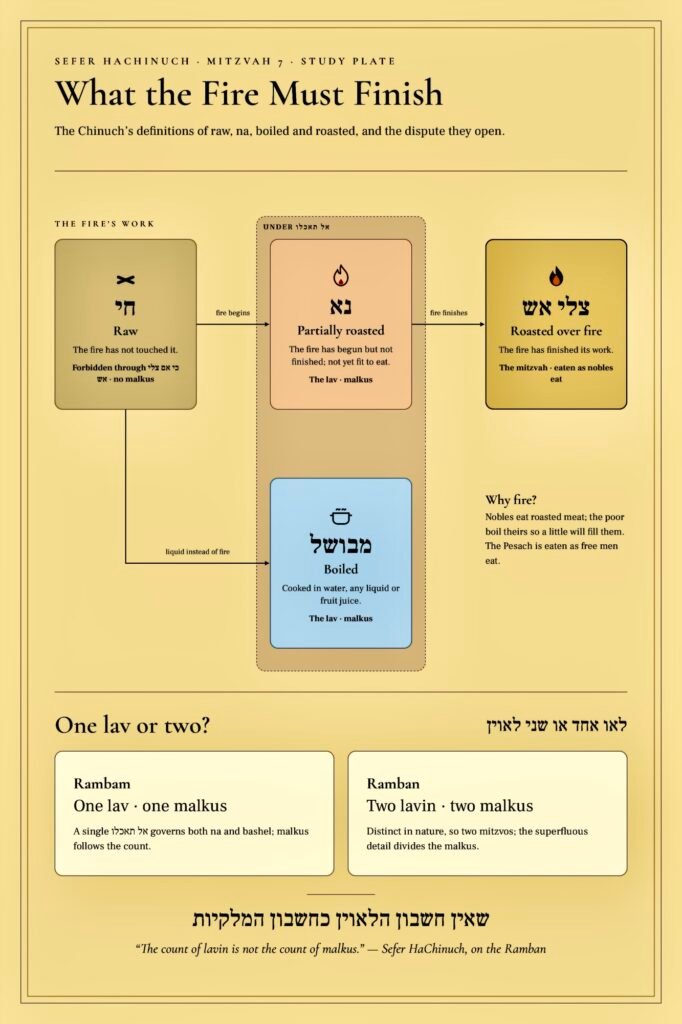
The lav of na does not cover raw meat. It covers meat the fire has begun to roast but has not finished. The Chinuch writes, following the Rambam (Hil. Korban Pesach 8:6) and the Gemara (Pesachim 41a):
שלא יאכל אותו קודם גמר בישולו אפילו בצלי, וזהו פירוש נא, שהבשר שהתחיל בו מעשה האור ונצלה מעט ואינו ראוי לאכילת אדם עדיין נקרא נא
When does meat stop being na? The edition’s notes record two views. On one, meat that has reached the stage of Ben Derusai counts as fully roasted and may be eaten (Minchas Chinuch §1). Ben Derusai was a bandit who, always on the run, ate his food after a half (Rambam, Hil. Shabbos 9:5) or a third (Rashi, Shabbos 20a) of the usual cooking time.
Food at that stage is deemed edible, and for many laws, such as cooking on Shabbos, it already counts as cooked (Shabbos 20a). On the other view, pesach meat remains na until it is roasted to the point most people would eat it. The notes cite the Maharam Schik (§2) and the Minchas Chinuch there, drawing on Yerushalmi Shabbos 1:11 and Rashi, Chullin 108b.
One may note that the Chinuch’s own phrasing holds both possibilities. The words קודם גמר בישולו, “before its cooking is complete,” lean toward full roasting. The words ואינו ראוי לאכילת אדם עדיין, “not yet fit for a person to eat,” set the line at edibility, which is exactly what the Ben Derusai stage measures.
Raw meat: forbidden, but outside the lav.
אבל כשהוא חי לגמרי שלא התחיל בו האור כלל, אין זה בכלל לאו דנא ללקות עליו משום אל תאכלו ממנו נא, אבל אסור מדאורייתא, שכל שאינו צלי אש אסרה התורה דרך כלל
Raw pesach meat is Biblically forbidden, but only through the words כי אם צלי אש, which exclude every way of eating except roasting (Pesachim 41a). A prohibition inferred from a positive formulation carries no malkus (Rambam, Hil. Korban Pesach 8:6; Tosafos, Pesachim 41b ד״ה איכא; compare Rashi there, ד״ה יכול יהא מותר).
The result is a striking gradient: meat the fire has touched but not finished brings malkus, while meat the fire never touched does not. One may suggest that the lav aims at the near-miss, a Pesach that resembles the commanded roast but falls short of it. Either way, the verse holds a specific lav, na and bashel, beside a general formulation, ki im tzli eish, and the Ramban’s argument will turn on that double structure.
Bashel mevushal: any liquid.
ופירוש בשל, שבישלו במים או בכל משקה או במי פירות, שנאמר ובשל מבשל, ריבה הכל
The verse names water, and מבשל alone would have sufficed. The doubled ובשל מבשל widens the lav to boiling in any liquid (Pesachim 41a). Mashkeh here means the seven liquids that render food susceptible to tumah: wine, honey, olive oil, milk, dew, blood and water.
Mei peiros covers other liquids pressed from fruit (Tiferes Yisrael, Pesachim 2:8 §60–62). The Chinuch lists water separately only because the verse names it.
III. At the Boundary: Pot Roast, Basting, and Terumah Oil
The Chinuch’s sample laws all probe one line: where roasting by fire ends and boiling begins. He lists the cases and leaves their rulings to the Gemara:
כגון אם עשאו צלי קדרה, או סכו במשקין או במי פירות או במים או בשמן תרומה, מה דינו, ויתר פרטיה, מבוארים בפסחים
The sugyos are Pesachim 40b–41b and 74a–75b, codified in Rambam, Hil. Korban Pesach 8:4–14. The edition’s notes supply the rulings:
- Pot roast (צלי קדרה). A pesach cooked in a pot with no liquid but the juice of its own fat counts as boiled, since ובשל מבשל covers every manner of boiling. One who eats a kezayis incurs malkus (Pesachim 41a; Rambam 8:8, with commentaries). The Gemara there, with Rashi and Tosafos, records a dissenting view.
- Basting with liquids. One may baste the pesach with wine, oil or fruit juice while it roasts (Mishnah, Pesachim 40b, with Rashi; compare the Bartenura). A little liquid applied during roasting is not boiling (Minchas Chinuch §10).
- Basting with water. Water is excluded even for basting (Rambam). The Minchas Chinuch (§10) calls this a rabbinic decree: water’s usual use is boiling, so basting with it might suggest that boiling in water is permitted. Others hold it Biblical, since the verse names water although ובשל מבשל already covers every liquid (Arbaah Turei Even on the Rambam; similarly Kol HaRamaz, Pesachim 2:8; see Tzlach, Pesachim 41a).
- Terumah oil. Where the group eating the pesach are not Kohanim, terumah oil raises a separate issue (Mitzvah 280), and the ruling turns on timing. Oil on raw meat is rinsed off, since raw meat does not absorb, and the meat is then dried, because water may not baste the pesach (Rambam 8:14, with Har HaMoriah). Oil applied after roasting requires peeling the outer layer, since roasted meat absorbs (Mishnah, Pesachim 75b; Shach, Yoreh De’ah 91:21); oil present during roasting penetrates deeply and forbids the whole (Tosafos, Pesachim 76a ד״ה משום; Ran, Chullin, folio 41b).
Two observations of the essay’s own follow. First, tzli eish is defined by its agent, the fire, and not merely by the absence of water. A dry pot still interposes a vessel and the meat’s own juice, so it falls on the side of bashel.
Second, this verse yields law from each apparent redundancy. The doubled ובשל מבשל adds every liquid, and on the Arbaah Turei Even’s view the word במים adds a further stringency for water. The Ramban will read one more redundancy in the same verse and draw from it a law of malkus.
IV. The Shoresh: Eating as Nobles, Remembering the Haste
The Chinuch’s main reason is royal: the Pesach is eaten roasted because roast meat is the food of nobles, and Israel left Egypt to become a nation of nobles. The general root, carried over from Mitzvah 5, is to remember the miracle of the Exodus. The particular root follows:
לפי שכך דרך בני מלכים ושרים לאכול בשר צלי, שהוא מאכל טוב ומטועם, אבל שאר העם אינם יכולים לאכול מעט בשר שתשיג ידם כי אם מבושל, כדי למלא בטנם
Roasting shrinks meat, as the editors explain, so a poor man boils his small portion to make it fill him. The Chinuch then draws the conclusion:
ואנו שאוכלים הפסח לזכרון שיצאנו לחירות להיות ממלכת כהנים ועם קדוש, ודאי ראוי לנו להתנהג באכילתו דרך חירות ושררות
The Chinuch paraphrases Shemos 19:6, which reads וגוי קדוש; the edition marks the reference with “see.”
The source in kehunah. The editors trace the idea to Chullin 132b. There the Gemara rules that certain kehunah gifts of sacred meat are eaten roasted, fulfilling the word למשחה (Bamidbar 18:8), which Chazal read as “in the manner of kings.” The Chinuch extends a rule of the Kohen’s table to the whole people.
On Pesach night, then, every Jew eats as a Kohen eats his consecrated portion, and so enacts the calling of ממלכת כהנים. The Chinuch’s word for that manner of eating, שררות, lordship, suits the calling; the edition renders כהנים in this phrase as “ministers.” The Chinuch returns to the theme at Mitzvah 8 (leaving meat over) and develops it at Mitzvah 16 (breaking a bone).
The second reason: haste. The Chinuch adds:
מלבד שאכילת הצלי יורה על החפזון שיצאו ממצרים ולא יכלו לשהות עד שיתבשל בקדרה
This is the Rambam’s reason in Moreh Nevuchim III:46. There the Rambam ties two more laws to that night’s haste: not carrying the meat out of the house (Mitzvah 15) and not breaking its bones (Mitzvah 16), since there was no time to send portions to one another or to crack bones for marrow. The editors observe that the Chinuch uses the haste explanation here but not at Mitzvos 15 and 16, and takes up the haste of the Exodus again at Mitzvah 11.
Why nobility comes first. The two reasons do not cover the same ground. Haste explains why the Pesach is not boiled, since pot-cooking takes time a fleeing people lacked. It cannot explain the lav of na: a people in flight, if anything, would eat its meat half-done.
Only nobility accounts for na, because a noble does not eat what is not yet fit to eat. This may be why the Chinuch leads with nobility and appends haste with מלבד.
One may go a step further, as a reflection rather than a reading of the sources. The two thresholds for na in Section II faintly echo the two reasons: Ben Derusai sets a fugitive’s standard of edibility, while the ordinary diner’s standard suits a table of free men. It also yields an irony worth teaching: on the lenient view, the line around the meal of freedom is drawn by the habits of a bandit.
V. One Lav: The Rambam’s Count and the Chinuch’s Ruling
Following the Rambam, the Chinuch counts na and mevushal as a single lav, so one who eats both under one warning receives one malkus:
ונוהגת בזכרים ונקבות, בזמן הבית. והעובר עליה ואכל נא או מבושל, לוקה. וכן אם אכל שניהם באחת לוקה מלקות אחת, ששניהם לאו אחד לדעת הרמב״ם ז״ל
The mitzvah binds men and women alike, as Biblical prohibitions generally do. It applies only while the Beis HaMikdash stands, since the Pesach itself is offered only then (Mitzvah 5). One who eats a kezayis of either incurs malkus, as for any lav violated through an action.
What “one malkus” measures. Malkus requires a prior warning. Under a single warning, repeated violations of one lav bring one malkus, while violations of several distinct lavin bring malkus for each (Mishnah, Makkos 21a). The ruling of one malkus is therefore a statement about identity: for the Rambam, eating na and eating mevushal are two violations of the same lav (Sefer HaMitzvos, Shoresh 9; Hil. Korban Pesach 8:4).
The principle. As the notes summarize it, the Rambam holds that, absent a tradition to the contrary, one prohibitory statement applied to several subjects is one prohibition. A single אל תאכלו governs both na and bashel, so the verse is one lav. He counts each comparable verse once, among them na u’mevushal, se’or u’devash and esnan u’mechir (Sefer HaMitzvos, Lo Saaseh 98, 100 and 125).
Two premises. The editors identify two assumptions behind the ruling, citing Megillas Esther at the start of Shoresh 9 (ד״ה ונראה לי שהנכון). First, the number of malkus under one warning follows the number of prohibitions in the count. Second, this verse counts as one prohibition. The Ramban rejects both.
For the Rambam, then, the count is not bookkeeping. It defines the legal unit: one mitzvah is one lav, and one lav is one malkus. In ruling so, the Chinuch follows the Rambam’s count, on which his whole enumeration of the 613 is built.
VI. The Ramban: Two Arguments, Two Axes
The Ramban counts na and mevushal as two lavin and imposes two malkus, on grounds that do not depend on each other. He counts two lavin in his glosses at the end of Sefer HaMitzvos, among the prohibitions he holds the Rambam omitted, and argues for two malkus in his glosses to Shoresh 9. The editors stress that the two conclusions look linked but rest on independent arguments.
First argument: the superfluous detail.
דכיון דכתיב אל תאכלו כי אם צלי אש, מיפרט בנא ומבושל למה לי, שמע מינה ללקות על כל אחד ואחד מן הפרטים
Since the verse already forbids eating the Pesach any way but roasted, naming na and mevushal seems superfluous; the Ramban concludes that the naming comes to impose malkus for each. The argument holds even if one grants the Rambam that the verse is a single mitzvah (Ramban to Shoresh 9, ד״ה והמין השלישי; Frankel ed., p. 172). Its phrasing is the Gemara’s own idiom for a detail that seems extra.
Second argument: distinct subjects, distinct mitzvos.
כי בכל המצות יהיה הענין כן, שכל הנפרטים בתורה אחד אחד והם דברים חלוקים, נמנה כל אחד למצוה אחת בחשבון המצות
When the Torah lists truly distinct subjects, each counts as its own mitzvah, even under one command. The Chinuch’s examples are na u’mevushal; esnan u’mechir, a harlot’s fee and the exchange for a dog (Devarim 23:19; Mitzvah 571); and se’or u’devash, leaven and honey on the altar (Vayikra 2:11; Mitzvah 117). The Ramban gives further cases in his list of omitted prohibitions (ד״ה וכן אם תתן לבך; Frankel ed., p. 412).
The Ramban’s rule for malkus.
ואמנם בענין המלקות יש חילוק בהם, שכל הנפרטים בלאו אחד אין לוקין עליהם אלא מלקות אחת… אבל הלאוין שיש בהן כלל ופרטים בתחילה או בסוף… באלו וכיוצא בהן לוקין עליהן על כל אחד ואחד, כי ריבוי הפרט שלא היה צריך יורה על המלקות על כל אחד ואחד
Subjects listed under a single “do not” bring one malkus, however many mitzvos they are: esnan and mechir, se’or and devash, and the judgment of a convert or orphan (Devarim 24:17; Mitzvah 590). Where a general prohibition (klal) stands with listed details (pratim), each detail brings its own malkus.
The Chinuch’s cases are our verse and the nazir (Mitzvah 368). “Anything made from the grapevine” (Bamidbar 6:4) is the klal, with seeds and skins after it and fresh and dried grapes in the verse before (6:3). The printed Chinuch reads יצא in that verse; the edition corrects it to יעשה.
The hinge. The Chinuch closes the Ramban’s view with the sentence on which the whole mitzvah turns:
והרבה הרב ראיותיו על זה בעיקר התשיעי בספר המצות שלו, שאין חשבון הלאוין כחשבון המלקיות
For the Rambam, count and malkus are one axis; for the Ramban, they are two. The count follows the subjects, where they are truly distinct. Malkus follows the prohibitory statement, unless the Torah divides it by naming details it did not need to name.
Three observations of the commentary’s own.
- Order does not matter. The details may stand before the general clause or after it (בתחילה או בסוף), and the nazir passage shows both at once. This suggests the Ramban is not applying the hermeneutic middah of klal u’prat, where order decides the result; his principle is redundancy.
- A reply for the Rambam may lie in the Chinuch’s own text. Section II showed that כי אם צלי אש alone yields no malkus, since raw meat is exempt. If so, na and mevushal are not superfluous: without them there would be no malkus at all. The Ramban reads the general clause as a prohibition, אל תאכלו… כי אם צלי אש, as the Chinuch cites it in his name; how that clause is classed may be the crux.
- The puzzle of ger and yasom. Perverting judgment involves no action, so it carries no malkus at all (Chinuch, Mitzvos 233 and 590). The Chinuch takes the example from the Ramban himself (Shoresh 9; Frankel ed., p. 172), and the editors leave it for further study. Perhaps it illustrates structure alone, one statement with two subjects forming one unit of liability, while whether that unit is ever punished is a separate question.
VII. Chalukim Ba’inyan: What Makes Two Things Two?
For the Ramban, two named items are two mitzvos only when they differ in nature. When they serve one purpose, they are one mitzvah, however many names the verse uses. The Chinuch states the qualification in his own voice:
וזה שאמרתי שהרמב״ן ז״ל ימנה כל הנפרטים בשמם אחד אחד מצוה בפני עצמה, דוקא כשהם חלוקים בענין כמו שכתבנו, כגון שאור ודבש, אתנן ומחיר. אבל במקום שהענין אחד, אף על פי שנפרטין בשמות חלוקים, לא נמנה זה כי אם מצוה אחת
Distinct in nature. The editors explain the two examples. Leaven makes dough rise and honey sweetens, so each is barred from the altar for its own reason. A harlot’s fee and the exchange for a dog are each repugnant for a different cause, the one tied to immorality and the other to a lowly creature.
One in nature. The Chinuch’s counter-examples are all positive commands, which the same guidelines govern:
- Bechor (Devarim 15:19; Mitzvah 18). Cattle and flock are named, yet שאין זה אלא צוואה אחת להקדיש כל בכור, והפרט אינו אלא ביאור. The two do not differ in sanctity (Ramban to Shoresh 9, ד״ה והראוי; Frankel ed., pp. 178–180).
- Ma’aser beheimah (Vayikra 27:32; Mitzvah 360). One command, to set aside a tithe from these animals.
- Shoftim v’shotrim (Devarim 16:18; Mitzvah 491). שאין זה אלא שנעשה דין על פי אנשים אלה, וצוואה אחת היא. Judges who decide and officers who enforce serve one aim, the rule of law.
- Honest measures (Vayikra 19:36; Mitzvah 259). Scales, weights, eifah and hin are one command, שהכל צוואה אחת שלא נשקר המדות.
A test of meaning. The criterion is substantive: to know whether se’or and devash are one mitzvah or two, one must ask what each is and why it is excluded. In a sefer devoted to the shorashim of the mitzvos, it is fitting that the count itself turns on the inner character of each item.
Why na and mevushal are two. The Chinuch names them דברים חלוקים but does not say what divides them. One possibility, offered here, follows from the definitions. Na is a shortfall within the right process, the fire begun and not finished; mevushal replaces the process, a liquid medium instead of fire. One is a defect of degree, the other a defect of kind.
The shoresh points the same way. Boiling is the commoner’s economy, stretching scarce meat; eating na is eating what is not yet fit for a person. Each departs from דרך חירות ושררות in its own way.
The contrast with bechor is instructive. Cattle and flock are different animals, yet the command is one; na and mevushal are the same meat, yet the prohibitions are two. Distinctness lies in the inyan, the nature of what is commanded or forbidden, not in the object.
VIII. The Two Systems Side by Side
In the Rambam’s system the count and the malkus always match; in the Ramban’s they can part in either direction. Malkus here means under one warning, for a kezayis of each item.
Verse
Rambam: mitzvos
Rambam: malkus
Ramban: mitzvos
Ramban: malkus
Na and mevushal (Shemos 12:9)
1
1
2
2
Se’or and devash (Vayikra 2:11)
1
1
2
1
Esnan and mechir (Devarim 23:19)
1
1
2
1
Chadash: bread, roasted kernels, fresh kernels (Vayikra 23:14)
3
3
1
3
The Rambam’s malkus figures follow from his rule that malkus tracks the count. The three malkus for chadash come from the Gemara (Kereisos 5a); from them the Rambam infers three lavin (Sefer HaMitzvos, Lo Saaseh 189–191; Chinuch, Mitzvos 303–305), while the Ramban counts one mitzvah. Where named items share one purpose, as with bechor, ma’aser, judges and officers, and measures, both count a single mitzvah.
IX. The Test Case: Half a Kezayis of Each
The dispute decides a practical question: whether half a kezayis of na and half a kezayis of mevushal, eaten together under one warning, combine to bring malkus. The edition’s closing Insight takes this up. “Together” means within kedei achilas peras (see the edition at Mitzvah 12, note 4).
The general rule. Items forbidden under one prohibition combine to a kezayis; items under separate prohibitions do not. Half a kezayis each from two non-kosher animals, a horse and a camel, combine to bring malkus. Half from a non-kosher animal and half from a non-kosher bird do not, since these are separate lavin (Mitzvos 154 and 157; Rambam, Hil. Maachalos Asuros 4:17).
Applied to our verse. The Minchas Chinuch (§17) suggests that the case turns on the dispute. For the Rambam, na and mevushal are one lav, so the halves combine and malkus follows. For the Ramban, they are two lavin, so the halves do not combine and there is no malkus.
Chadash reverses the result. The Rambam counts bread, roasted kernels and fresh kernels as three lavin, so a mixed kezayis of the three should not combine; the Ramban counts one mitzvah, so it should. A novelty follows on the Ramban’s view. A kezayis of each, under one warning, brings three malkus, yet a single kezayis mixed from all three still brings one.
What the question reveals. The Minchas Chinuch’s suggestion assumes that combining follows the count, the identity of the prohibition, rather than the malkus. For the Rambam the assumption costs nothing, since his two measures never part. For the Ramban it yields what looks like a paradox: in chadash the three items are separate for punishment yet one for combining.
Where a rebuttal might press. The editors point to a possible rebuttal in the Minchas Chinuch (here §17, and at 303:11 and 444:2), the Keren Orah (Nazir 38b, ד״ה ונסתפקתי) and Chidushei HaGriz (Menachos 70b). Without presuming what those discussions say, one can see the pressure point. Combining to a kezayis is itself a question of liability to malkus.
If the Torah, by naming the details, has divided the malkus among them, one may argue that the division governs combining too. On that view, what combines is set by the unit of punishment, not the unit of the count. Either way, the count is not academic: it can decide whether a person who ate a single kezayis is liable at all.
X. Conclusion: Freedom in the Details
The Chinuch’s short mitzvah teaches that the Torah’s freedom is exacting: it asks not only that the Pesach be eaten, but how. Each layer draws a line. The definitions separate fire begun from fire finished, and fire from liquid; the shoresh separates the table of nobles from the pot of the poor; the dispute separates one inyan from two.
The two systems differ in what they take a mitzvah to be. For the Rambam, what the Torah says in one breath is one mitzvah, one lav and one malkus. For the Ramban, the content commanded and the form of the warning are separate measures, each with its own rule.
The Chinuch follows the Rambam’s count, yet gives the Ramban the longest hearing, and so leaves the reader both systems in full.
For the beis midrash and the classroom.
- Begin with the gradient of raw, na, roasted and boiled, and ask why raw meat brings no malkus while half-roasted meat does.
- Set out the table in Section VIII before naming the principles, so the two axes are seen before they are explained.
- Pose the half-kezayis question before revealing the Minchas Chinuch, then turn to chadash and let the reversal surprise.
The nation that left Egypt to become a ממלכת כהנים was asked, on its first night of freedom, to eat like one. In debating whether na and mevushal are one lav or two, the Rishonim measure how finely the Torah marks the ways of falling short of that table.
Sources Referenced
All sources below are cited by the Chinuch or by the notes of the Book of Mitzvos edition at Mitzvah 7 (pp. 103–112).
- Chumash: Shemos 12:9; 19:6. Vayikra 2:11; 19:36; 23:14; 27:32. Bamidbar 6:3–4; 18:8. Devarim 15:19; 16:18; 23:19; 24:17.
- Sefer HaChinuch: Mitzvah 7, with cross-references to Mitzvos 5, 8, 11, 12, 15, 16, 18, 117, 154, 157, 233, 259, 280, 303–305, 360, 368, 491, 571 and 590.
- Talmud: Pesachim 40b–41b, 74a–76a; Shabbos 20a; Chullin 108b, 132b; Makkos 21a; Kereisos 5a; Yerushalmi Shabbos 1:11.
- Rambam: Sefer HaMitzvos, Shoresh 9; Lo Saaseh 98, 100, 125 and 189–191. Hil. Korban Pesach 8:4–14; Hil. Shabbos 9:5; Hil. Maachalos Asuros 4:17. Moreh Nevuchim III:46.
- Ramban: Glosses to Sefer HaMitzvos, Shoresh 9 (ד״ה והמין השלישי, Frankel ed., p. 172; ד״ה והראוי, pp. 178–180), and his list of prohibitions omitted by the Rambam (ד״ה וכן אם תתן לבך, p. 412).
- Rashi, Tosafos and the Ran: Rashi, Pesachim 40b–41b, Shabbos 20a and Chullin 108b; Tosafos, Pesachim 41a–b and 76a; Ran, Chullin.
- Later commentaries: Bartenura on Mishnah Pesachim (40b); Shach, Yoreh De’ah 91:21; Megillas Esther, Shoresh 9; Minchas Chinuch §§1, 10, 17, and 303:11, 444:2; Maharam Schik §2; Tiferes Yisrael, Pesachim 2:8; Arbaah Turei Even; Kol HaRamaz, Pesachim 2:8; Tzlach, Pesachim 41a; Har HaMoriah on Rambam, Hil. Korban Pesach 8:14; Keren Orah, Nazir 38b; Chidushei HaGriz, Menachos 70b.