
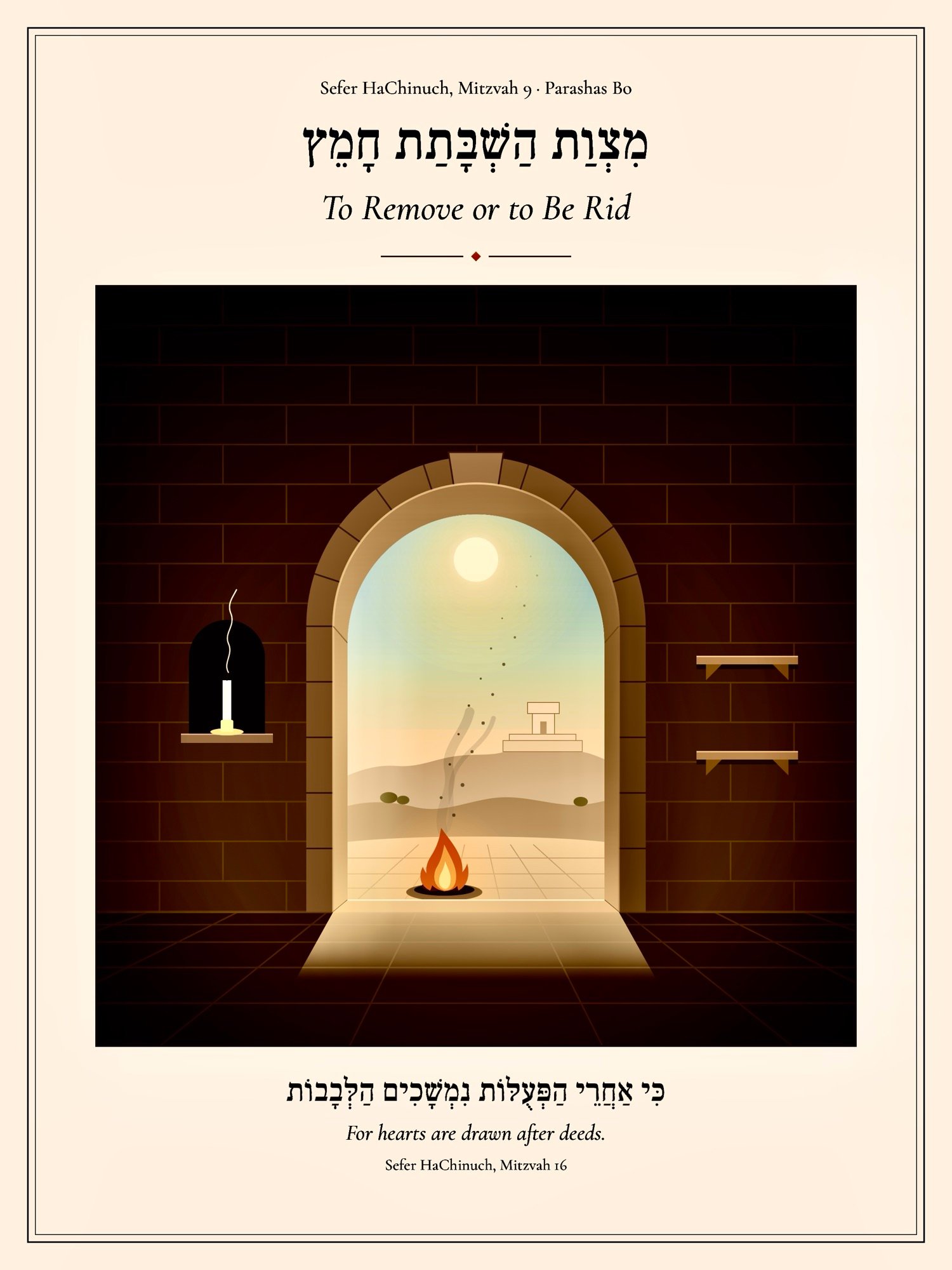
The Light of Redemption and Education: A Rabbinic Commentary on Sefer HaChinuch (The Book of Mitzvos)
To Remove or to Be Rid
An essay on Sefer HaChinuch, Mitzvah 9 — מצות השבתת חמץ, the obligation to destroy chametz (Parashas Bo)
Nov 21, 2026 · @Kamil Levi Pyka-Penner
Introduction
Sefer HaChinuch gives the mitzvah of hashbasas chametz scarcely a page, yet almost every question its readers raise comes back to one: is תַּשְׁבִּיתוּ a deed one performs, or a condition one must be in? Minchas Chinuch puts the question in so many words: is the mitzvah fulfilled through kum v’aseh, or through shev v’al ta’aseh? This essay argues that the same question shapes the Chinuch’s wording and timing, the place of bitul, the obligation of women, and the lav with which the entry closes.
It also argues that the Chinuch’s own philosophy of mitzvos, stated in Mitzvah 16, explains why practice ends in deeds whatever the answer: the search, the destruction, the spoken declaration.
Sources. The study confines itself to literature devoted to Sefer HaChinuch:
- the Chinuch’s own text, with its cross-references to other mitzvos in the work;
- Minchas Chinuch of R’ Yosef Babad, Av Beis Din of Tarnopol;
- the Schottenstein Edition of the Chinuch, Sefer HaChinuch / Book of Mitzvos (ArtScroll/Mesorah), Parashas Bo, Mitzvah 9, pp. 117–121, cited as “the edition,” with its notes and its Insights A and B;
- R’ Shmuel Shimoni’s study of Minchas Chinuch on this mitzvah, for Minchas Chinuch’s reading of Rashi.
Rishonim and Acharonim appear only as these works cite them. The Hebrew of the Chinuch and of Minchas Chinuch is quoted from the original, in new translations. Verses are quoted in the 1917 translation of the Jewish Publication Society.
The text and its architecture
Mitzvah 9 runs to five short paragraphs in the Chinuch’s fixed order: definition, root, laws, scope, and penalty. The Hebrew follows the photographed edition; the English is new.
Definition
להסיר כל לחם חמץ ממשכנותינו ביום ארבעה עשר בניסן, שנאמר (שמות יב, טו) אך ביום הראשון תשביתו שאר מבתיכם, ופירושו ראשון, קודם לפסח.
To remove all leavened bread from our dwellings on the fourteenth day of Nissan, as it is said, “howbeit the first day ye shall put away leaven out of your houses” (Shemos 12:15); and “first” means before Pesach.
Root
משרשי מצוה זו, כדי שנזכור הנסים שבמצרים, כמו שכתוב בקרבן פסח.
Among the roots of this mitzvah: that we remember the miracles in Egypt, as written regarding the korban pesach.
Laws
דיני המצוה, כגון שעת ביעורו מן היום מתי, ומה היא השבתתו, ובאי זה מקום צריך לחפשו ובאי זה מקום אינו צריך, ומאימתי מוטלת המצוה עליו אם יוצא לדרך, ואם חל ארבעה עשר בניסן בשבת איך יהיה דינו, והביטול בפה שצריך לעשות נוסף על הביעור, ויתר פרטיה, מבוארים בפסח ראשון [פסחים פרק א’ וב’].
The laws of the mitzvah are set out in Pesach Rishon [Pesachim, chapters 1–2]: at what hour of the day its removal falls; what its hashbasah consists of; where one must search and where not; from when the mitzvah rests on one who sets out on a journey; the law when the fourteenth of Nissan falls on Shabbos; the spoken bitul required in addition to the biur; and the remaining details.
Scope
ונוהגת בכל מקום ובכל זמן, בזכרים ונקבות.
It applies in every place and at every time, to men and to women.
Penalty
והעובר עליה ולא השביתו ביטל עשה דתשביתו. ואם יש חמץ במשכנותיו עובר גם כן על לא תעשה, שנאמר (שמות יב, יט) שאר לא ימצא בבתיכם, אבל אין לוקין על לאו זה אם לא עשה בו מעשה, שהלכה היא, לאו שאין בו מעשה אין לוקין עליו.
One who transgresses it and did not eliminate [the chametz] has voided the asei of תשביתו. If there is chametz in his dwellings, he also transgresses a lav, as it is said, “there be no leaven found in your houses” (Shemos 12:19). Yet there are no lashes for this lav unless he did an act with it, for the halachah is that a lav without an act carries no lashes.
Two readings inside the definition. The verse says שאר, the leavening agent; the Chinuch writes כל לחם חמץ, all leavened bread. In Mitzvah 20 he cites the Sages on a verse that names both: פתח הכתוב בחמץ וסיים בשאור, לומר לך הוא חמץ הוא שאור. In law, chametz and se’or are one (edition, note 3).
The verse says “your houses”; the Chinuch writes “our dwellings,” and the edition reads both words broadly. “Bread” covers every fermented product of the five grains. “Dwellings” covers every property one holds, and even chametz deposited with one by another, wherever the prohibitions of possession apply to it.
The edition then states the rule that governs the whole mitzvah, citing Minchas Chinuch §2 among others: the duty to destroy reaches exactly the chametz whose possession would violate the prohibitions (note 2). The asei is measured by the lavin. That equation is the first sign of this essay’s theme.
“First” means the day before
The Chinuch’s gloss, ופירושו ראשון קודם לפסח, ties the hour of this mitzvah to the korban pesach, and his own Mitzvah 89 shows how.
Read plainly, “the first day” is the first day of the festival, and that is how the 1917 rendering has it. The Chinuch sets that reading aside in a single clause. The edition gives the reason: the Torah forbids slaughtering the pesach while one owns chametz, a prohibition the Chinuch counts as Mitzvah 89 (Shemos 23:18, repeated in 34:25). The slaughter falls on the afternoon of the fourteenth, so the chametz must be gone before the festival begins (note 4).
Mitzvah 89 defines its prohibition in nearly our mitzvah’s terms: שלא נשחט שה הפסח בארבעה עשר בניסן בעוד שיהיה חמץ ברשותנו. The two entries are halves of one law. Mitzvah 9 commands that the house be cleared; Mitzvah 89 forbids the offering until it is.
The root of Mitzvah 89 explains the order. The Chinuch begins from a general principle, that fixed times are what keep any practice alive, and applies it to Pesach, which he calls central to upholding the faith. Each part of the festival has its own time, ולא תבא מצוה ממצות ענין המועד הזה בגבול חברתה: no mitzvah of this festival may cross into another’s border.
ועל כן נזהרנו להשבית החמץ הנמאס בעינינו לשעתו תחלה, ואחר כך להתחיל בקרבן הפסח שהוא התחלת שמחת המועד הטוב.
We were therefore cautioned to remove the chametz, loathsome in our eyes, at its hour first, and only then to begin the korban pesach, the start of the festival’s joy. For the Chinuch, hashbasah is the threshold of the festival, and its hour is fixed by what comes after it.
The edition sets out the hours themselves. By Torah law the chametz must be gone by midday of the fourteenth; the Sages moved its removal one hour earlier and forbade eating it two hours earlier (note 5). Whether the Torah’s hour opens the duty or closes it is disputed in the same note, a question taken up below.
One more line of the text changes the picture. The mitzvah applies בכל מקום ובכל זמן: in the Land and abroad, with or without the Beis HaMikdash (note 12). Its hour was set by the offering, yet it outlives the offering. In exile the chametz is still cleared by the hour the offering once required, so every home keeps the Temple’s timetable without its altar.
The root: memory made by deeds
The Chinuch gives Mitzvah 9 no root of its own. He borrows the root of the korban pesach, and Mitzvah 16 explains why borrowing is enough.
In Mitzvah 5 the root of the korban pesach is that the Jewish people remember forever the great miracles G-d performed for them at the Exodus. Mitzvos 6 and 8 refer back to it, and Mitzvah 6 sums it up: כדי לזכור הנסים הגדולים שעשה לנו האל שהוציאנו מעבדות. Mitzvah 9 does the same, in eleven words.
The repetition might seem thin, and the Chinuch expects the objection. In Mitzvah 16 he puts it in the reader’s mouth:
ולמה יצוה אותנו השם יתברך לעשות כל אלה לזכרון אותו הנס, והלא בזכרון אחד יעלה הדבר במחשבתנו ולא ישכח מפי זרענו?
Why command so many deeds for the memory of one miracle, when a single remembrance would keep it in mind? His answer is the book’s best-known sentence:
דע, כי האדם נפעל כפי פעולותיו, ולבו וכל מחשבותיו תמיד אחר מעשיו שהוא עוסק בהם אם טוב ואם רע … כי אחרי הפעולות נמשכים הלבבות.
A person is shaped by what he does; his heart and thoughts follow the deeds that occupy him. The passage closes with a line that could stand over Mitzvah 9: אל יקשה עליך מעתה ריבוי המצות בענין זכירת נסי מצרים. The many mitzvos that recall Egypt should no longer trouble the reader. The address, בני, is the book’s own; its author says he wrote for his son and the youth of his time.
Read through Mitzvah 16, the root of Mitzvah 9 is a method, not a slogan. The memory of the Exodus is built by the hands: the house searched, the chametz gathered and destroyed, the hour kept.
This bears directly on the essay’s question. If the root is memory formed by deeds, it leans toward a mitzvah of action. Yet Minchas Chinuch, as shown below, reads the Chinuch’s own laws as describing a state. The conclusion returns to this tension.
The laws as a syllabus
The Chinuch names six questions and leaves their answers to the Gemara. The edition’s notes supply the answers, and together they mark the mitzvah’s borders in time, place and act.
- שעת ביעורו מן היום מתי. By Torah law the chametz must be gone by midday of the fourteenth. The Sages set removal an hour earlier and eating two hours earlier (note 5).
- ומה היא השבתתו. The Mishnah records R’ Yehudah, who requires burning, against the Sages, who allow any means, such as crumbling it into the wind. Even R’ Yehudah allows any means at some hours; Rashi and Rabbeinu Tam disagree about which (note 6).
- ובאי זה מקום צריך לחפשו. The search on the night of the fourteenth is Rabbinic. It covers places chametz may have entered during the year, not places where animals would have eaten it; by Torah law bitul alone would suffice (note 7).
- ומאימתי מוטלת המצוה עליו אם יוצא לדרך. One who leaves more than thirty days before Pesach, not to return, may rely on bitul. Within thirty days he must search before leaving, by candlelight the night before, or appoint an agent (note 8).
- ואם חל ארבעה עשר בניסן בשבת. The search moves to Thursday night and the burning to Friday morning, with food kept for the Shabbos meals. Bitul is said after the search and again on Shabbos morning (note 9).
- והביטול בפה שצריך לעשות נוסף על הביעור. After the search one declares unknown chametz void, like dust of the earth. A broader declaration follows the burning, before the sixth hour, when the chametz leaves one’s power to annul it (note 10).
Three of the six questions concern time: the hour, the thirty days, and Shabbos. One concerns place, and two concern the act itself. Much of what the list describes is Rabbinic, including the search, the earlier hours and the morning bitul. The Torah’s own demand is narrower, and its exact shape is the subject of the next two sections.
One phrase in the list carries more weight than it seems. The Chinuch says the mitzvah “rests upon” a traveler, מוטלת עליו, before the festival arrives. Minchas Chinuch draws a conclusion from it about the mitzvah’s nature:
ומדברי הרהמ”ח שכתב ביוצא לדרך מוטל עליו המצוה נראה דהיא בשוא”ת.
The Chinuch’s words about the traveler show, he says, that the mitzvah is shev v’al ta’aseh. The reasoning appears to be this. A deed due at a set hour does not bind a man before that hour. A state required at that hour does, because he must arrange it before he leaves.
Biur or bitul: what תשביתו asks for
The verb תשביתו admits two definitions, and the edition’s Insight A shows that each yields a different mitzvah. The process has two parts: biur, searching for and destroying the chametz, and bitul, declaring it like dust of the earth, either worthless or ownerless.
The first view: bitul fulfills the Torah’s command. Rashi holds that annulling the chametz in one’s heart satisfies תשביתו; the edition finds the same reading in Targum Onkelos, Targum Yonasan and some texts of the Rambam. Destroying the chametz also works, but on this view the duty to destroy it after bitul is Rabbinic.
The edition gives two reasons for that Rabbinic duty, after the Ran, the Ritva and the Ramban. One might not annul the chametz wholeheartedly, and it would remain significant to him. Or one might find a piece on Pesach and eat it. The first reason matters for this essay’s conclusion: the Sages did not trust the heart’s annulment to stand alone.
The second view: only destruction fulfills it. Tosafos holds that תשביתו means physical destruction. Bitul is a form of hefker: it does not fulfill the mitzvah but removes the owner from it, since he no longer owns chametz. One therefore destroys what he finds to fulfill תשביתו, and annuls the rest so that anything overlooked will not make him violate the prohibitions.
The Chinuch’s own wording. Three features of the text bear on the dispute.
- להסיר. The defining verb is “to remove,” not “to burn” or “to annul.” It names an outcome, the chametz gone from the dwelling, more than a procedure.
- נוסף על הביעור. Biur is the base, and bitul is added to it. On its face this order suits Tosafos better than Rashi, for whom bitul would be the core.
- בפה. The edition notes a debate over whether bitul must be spoken or may be thought (note 10). The Chinuch describes it as spoken, though he does not say that a thought alone fails.
The second feature seems to place the Chinuch with Tosafos, yet Minchas Chinuch places him with Rashi and the Rambam on the deeper question, as the next section shows. Both can hold. In the order of practice, biur comes first and bitul is added. In the definition of the Torah’s demand, what counts is that the chametz be gone, and להסיר asks for exactly that: an absence that fire or annulment can produce.
Act or state: Minchas Chinuch’s question
Minchas Chinuch asks the question that organizes everything else: is תשביתו fulfilled by doing something, or by being without something? For the Chinuch, he answers, it is the second.
He frames the two models by analogy. On the first, the mitzvah resembles tzitzis: כמו מצות ציצית דמצוה על כל איש ישראל ללבוש ד’ כנפות כדי לקיים המצוה בקו”ע. A Jew should seek out the chance to perform it, כמו התם דמצוה עליו לקנות טלית, as he buys a tallis to wear tzitzis.
On the second, it resembles the rest of Shabbos and Yom Tov: וגם המ”ע מקיים בשוא”ת כמו בשבת ויום טוב. There, too, a positive commandment is kept by refraining. Here it would be kept by having no chametz.
The edition’s Insight B states the practical test. A man with no chametz on Erev Pesach plainly violates nothing. But is he exempt, or has he fulfilled the mitzvah? And if he wants its merit, must he buy chametz in order to destroy it?
The positions gathered in the edition and in Minchas Chinuch line up as follows.
Question
As an act (קום ועשה)
As a state (שב ואל תעשה)
Minchas Chinuch’s analogy
Tzitzis
Rest on Shabbos and Yom Tov
No chametz on Erev Pesach
Exempt, like a man without a four-cornered garment
Fulfills the asei
Acquire chametz to destroy it?
Worth doing, as one buys a tallis
Unnecessary
Intent to fulfill
Subject to the usual rule on intent
Not needed (cf. Mitzvah 1)
The Torah’s hour (note 5)
Duty opens at midday: Tosafos, Rosh
Duty must be done by midday: Rambam, Ramban, Smag
Method (note 6, per R’ Chaim)
R’ Yehudah: burning only
The Sages: any means
Bitul (Insight A)
Tosafos: hefker, an exemption
Rashi: itself a fulfillment
Women
Time-bound exemption would seem to apply
Obligated, as in the rest of Yom Tov
Two rows need comment. The link to the Torah’s hour is Minchas Chinuch’s suggestion, as the edition reports it. The link to the method dispute is R’ Chaim Soloveitchik’s, from his chiddushim on the Rambam, cited in the same Insight.
The mapping is not mechanical, however. Minchas Chinuch reads Rashi as passive even though, for Rashi, the duty begins at midday: עיקר המצוה דיהי’ החמץ מושבת והתחלת המצוה בחצות בשוא”ת. The bitul is made before midday, and when the hour arrives the chametz already stands annulled. He even concludes that every Tanna and Amora could hold the passive view, so for him no Talmudic dispute forces the active model.
He also presses the active model with a difficulty. If one must seek the chance to destroy chametz, as one buys a tallis, how could the Sages require that it be gone before the Torah’s hour? When the hour came there would be nothing to destroy, and the man would be כמי שאין לו טלית בת ד’ כנפות, like one with no garment to bear tzitzis.
His verdict on the Chinuch is explicit. He draws it from two rulings in our text, the traveler on whom the mitzvah already “rests” and the obligation of women:
ולפמ”ש לשיטות רש”י והר”מ והרהמ”ח אף אם אין לו חמץ מקיים העשה.
For Rashi, the Rambam and the Chinuch, even one who has no chametz fulfills the asei. The Chinuch’s mitzvah, on this reading, is a condition of the Jew’s domain at an appointed hour.
בזכרים ונקבות: women and the time-bound rule
Two words, בזכרים ונקבות, obligate women in a mitzvah bound to a single day. Both explanations of that ruling run through the model of a state.
The difficulty is plain. Women are generally exempt from positive commandments bound to a time, and this one falls on Erev Pesach alone. The edition notes that the Chinuch makes it an exception (note 13).
First explanation: a passive asei binds women. In his opening analysis Minchas Chinuch writes: במ”ע דשוא”ת נשים חייבות אף בהזמן גרמא כמו יום טוב. Women keep the rest of Yom Tov, though it falls on fixed days. So the Chinuch’s ruling on women becomes evidence of his view: וכ”נ ממ”ש הרהמ”ח דנשים חייבות במצוה זו.
Second explanation: the asei follows the lavin. As the edition reports Minchas Chinuch §4, the duty to remove chametz before Pesach is bound up with the prohibitions against owning it on Pesach, Mitzvos 11 and 20. Women are bound by those negative commandments, and so by this mitzvah as well; the edition points to Shaagas Aryeh.
A dissent. The edition also records an opinion that women are exempt from this asei though bound by the prohibitions of possession, citing Pri Megadim’s introduction to Hilchos Pesach.
Set side by side, the three positions trace the essay’s question. Both explanations treat the asei as the positive face of the lavin, a condition of one’s domain rather than a separate deed. The dissent, by separating the asei from the lavin for women, implies that the asei has a life of its own as a time-bound command.
The closing lav
The Chinuch ends Mitzvah 9 by joining the asei to a lav. The join raises a problem of time, and it closes on a rule that is itself about the line between act and state.
The problem of time. One who did not eliminate his chametz, says the Chinuch, עובר גם כן על לא תעשה. But in Mitzvah 11 he defines that prohibition as lasting כל ימי הפסח, and the edition reads him as starting it only at nightfall of the fifteenth. The deadline for the asei is midday of the fourteenth (note 17). Which lav, then, does the man violate at midday?
- Minchas Chinuch §7, as the edition reports, suggests that here the Chinuch follows the view that the prohibition, too, begins at midday of the fourteenth. As the note observes, this fits poorly with the opening of Mitzvah 11.
- The edition proposes instead that “if there is chametz in his dwellings” means chametz still there on the fifteenth. At that hour the owner does violate the prohibition.
The manuscript variant. Some manuscripts read more simply that he also violates a lav, as it is said, without the words ואם יש חמץ במשכנותיו (note 16). The edition explains why the shorter text suffices: the sentence before already speaks of a man who has chametz (note 15).
The variant matters more than it seems. The edition’s solution depends on the longer reading: only a clause about chametz “in his dwellings” can carry the sense “still there when the festival begins.” On the shorter reading the asei and the lav are simply paired, and the problem of time stands.
Either way, the Chinuch joins the two commandments. On Minchas Chinuch’s reading this is natural, because the asei is kept by the same absence of chametz that the lav demands. The asei looks ahead from the day before; the lav governs the festival itself.
Lashes and the lav without an act. The last sentence reads: אבל אין לוקין על לאו זה אם לא עשה בו מעשה. The edition explains that this man neither bought chametz nor leavened dough on Pesach; he kept what he already owned, and so transgressed without an act (note 18). Mitzvah 11 supplies the converse:
ולוקה כל זמן שעשה בו מעשה, כגון שחמץ עסה והניחה בביתו, או שלקח חמץ והצניעו בביתו. אבל אם לא עשה בו שום מעשה, אלא שנשאר בבית מקודם הפסח, אין לוקה עליו.
One who leavened dough and left it in his house, or took chametz and stored it, is lashed. One who did nothing with it, so that it merely remained from before Pesach, is not (note 19).
So the entry ends on the very distinction this essay has followed. The same lav can be broken by a deed or by mere retention, and only the deed brings lashes. The asei reaches the case the lashes cannot. No court strikes the man whose chametz simply stayed, but the Torah commanded him a day earlier to see that it would not stay.
Conclusion: the deed and the heart
On Minchas Chinuch’s reading, the Chinuch’s mitzvah is a state, yet everything the Chinuch says about its purpose is a deed. His own Mitzvah 16 shows that the two belong together.
At the level of the Torah’s demand, תשביתו is a condition: at the appointed hour the Jew’s domain must hold no chametz. That reading explains the traveler, on whom the duty rests before the hour. It explains the women, who are bound as they are bound by the rest of Yom Tov. It explains why the asei and the lav travel together in the closing lines.
Yet the root of the mitzvah is memory, and Mitzvah 16 teaches that memory is made by deeds. Around a mitzvah that might be kept by having nothing, the halachah builds a sequence of acts. There is the search by candlelight, the burning, and the declaration made בפה.
Insight A supplies the hinge. The Sages did not let annulment in the heart stand alone, lest it not be made wholeheartedly. That worry is the Chinuch’s psychology in another key: the heart cannot be trusted unaided, because it follows the hands. Bitul may satisfy the definition; the deed is what secures the heart.
“Act or state” may therefore be the wrong opposition for the Chinuch’s purposes. The obligation is a state; the way to reach it, and to be formed by reaching it, is a deed. His definition says as much in one word, להסיר: an act aimed at an absence.
Mitzvah 89 gives the last image. First the chametz, הנמאס בעינינו, is removed at its hour; then the korban pesach begins, התחלת שמחת המועד הטוב. A house emptied by its owner’s hands is ready for the offering, and, where there is no altar, for its memory.
Sources cited
Every source for the argument is Sefer HaChinuch or a work devoted to it; the English verses are those the Chinuch quotes. Rishonim and Acharonim named in the essay appear as these works cite them.
- Sefer HaChinuch, Mitzvah 9, Hebrew text and annotated English: The Schottenstein Edition Sefer HaChinuch / Book of Mitzvos, vol. 1 (Mitzvos 1–65), ArtScroll/Mesorah, 2012, pp. 117–121, notes 1–19 and Insights A–B. Cited as “the edition.” Compared with the Venice-order text on Wikisource.
- Sefer HaChinuch, related mitzvos, Hebrew text on Sefaria: Mitzvah 5, Mitzvah 6, Mitzvah 8, Mitzvah 11, Mitzvah 16, Mitzvah 20, Mitzvah 89. Mitzvah 89 also on Wikisource (Frankfurt order).
- Minchas Chinuch, R’ Yosef Babad, Mitzvah 9: Hebrew text on Sefaria. Section numbers in the essay (§§1, 2, 4, 7) follow the edition’s citations.
- R’ Shmuel Shimoni, Iyunim ba-Mitzvos b’Ikvos ha-Minchas Chinuch, “Mitzvah 9: Hashbasas Chametz,” Virtual Beit Midrash, Yeshivat Har Etzion. Consulted for Minchas Chinuch’s reading of Rashi.
- Verses in English: The Holy Scriptures According to the Masoretic Text, Jewish Publication Society, 1917 (Shemos 12:15, 12:19).