
The Light of Redemption and Education: A Rabbinic Commentary on Sefer HaChinuch (The Book of Mitzvos)
Between Korban and Chametz: An Essay on Sefer HaChinuch, Mitzvah 10
Nov 21, 2026 · @Kamil Levi Pyka-Penner
מצוה י: מצות אכילת מצה — The Obligation to Eat Matzah (Parashas Bo)
I. Introduction: One Mitzvah, Two Anchors
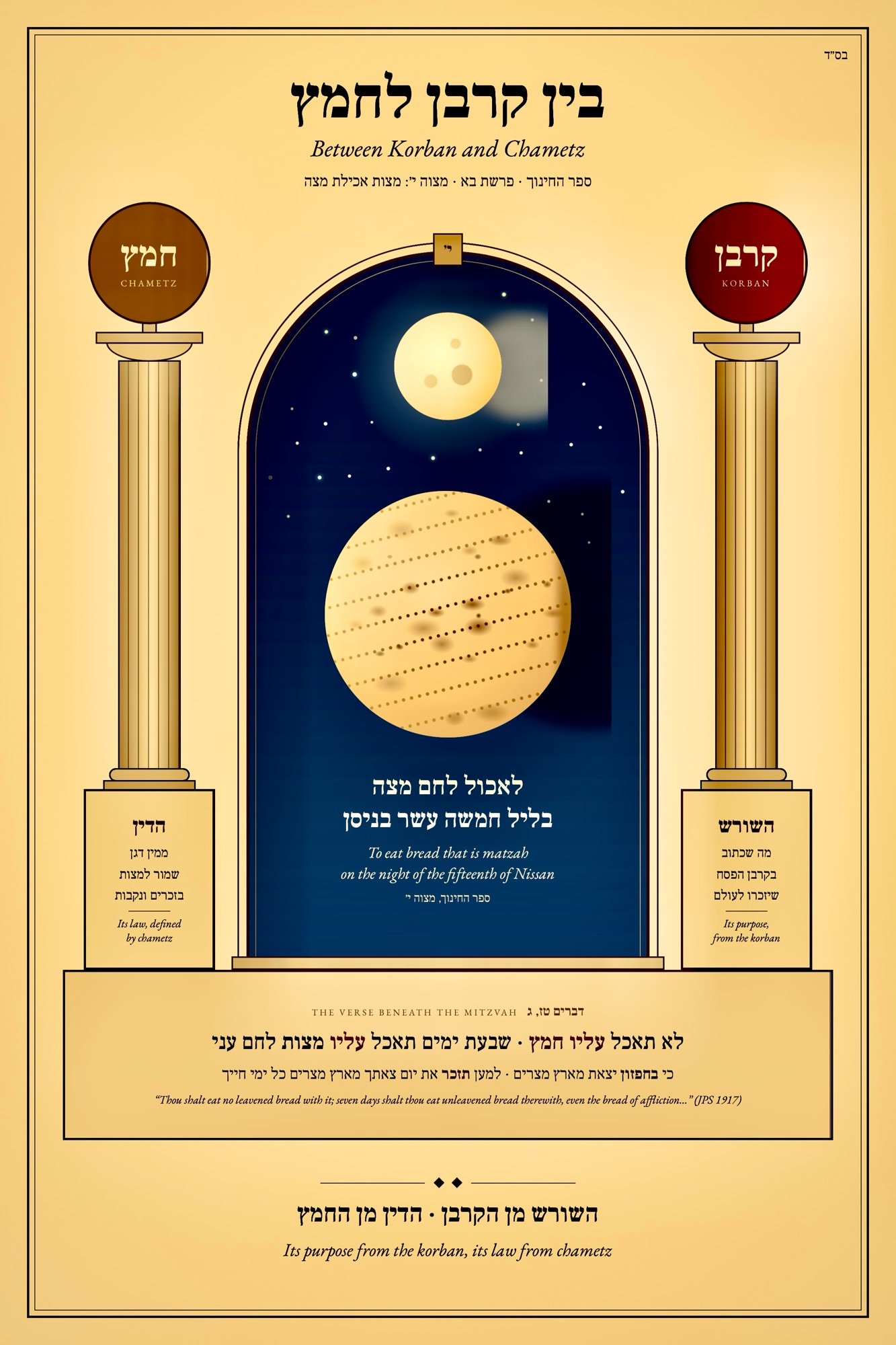
Mitzvah 10 runs to fewer than eighty Hebrew words, yet few entries in Parashas Bo are built with more care. This essay argues that the Chinuch fixes the mitzvah to two anchors at once. Its purpose is borrowed whole from the korban pesach, while its law is defined, at nearly every point, by chametz.
The author, who names himself only as a Levite of Barcelona, arranged the sefer by the weekly parashiyos and intended it as a book of instruction for the young. Each entry moves through five stations: the commandment and its verse; its root (shoresh); a sample of its laws; where, when and upon whom it falls; and the consequence of neglect. Mitzvah 10 passes through all five, and at three of them it points beyond itself — to the pesach offering for its root, to Pesach Rishon for its details, and to Mitzvah 6 for the court’s power to compel.
Those pointers serve as the map for what follows. Where it helps, the sections read the Chinuch’s phrasing against the Rambam’s Sefer HaMitzvos, on whose count the Chinuch builds, and they follow each cross-reference to its source. Two sections then step back: one to the verse that quietly underlies the entire entry, and one to the days after the first night, where the two anchors part company.
Scope. The study confines itself to the Chinuch and the literature built upon it: the Chinuch’s own text and internal references; the Rambam’s Sefer HaMitzvos as the Chinuch’s template; the Minchas Chinuch; the notes and Insight of the elucidated edition reproduced on pp. 122–125; and several modern studies of the Chinuch. Talmudic passages enter only as these works bring them. Verses are quoted from the 1917 JPS translation unless noted, and transliteration follows the edition’s Ashkenazic usage.
II. The Text of Mitzvah 10
The entry, as printed in the elucidated edition (pp. 122–124), divides cleanly into the Chinuch’s five stations. The rendering below is deliberately literal; the verse follows JPS 1917.
1. The commandment and its verse
מצוה י: מצות אכילת מצה — לאכול לחם מצה בליל חמשה עשר בניסן העשוי ממין דגן, שנאמר (שמות יב, יח) בערב תאכלו מצת. ופירושו ליל חמשה עשר בניסן, בין בזמן שיהיה שם פסח או בזמן שלא יהיה שם.
To eat bread that is matzah on the night of the fifteenth of Nissan, made from a species of grain, as it is said, “at even ye shall eat unleavened bread” (Shemos 12:18). Its meaning is the night of the fifteenth of Nissan, whether at a time when there is a pesach there or at a time when there is none.
2. The root
משרשי מצוה זו, מה שכתוב בקרבן הפסח.
Among the roots of this mitzvah: what is written concerning the pesach offering.
3. Its laws
דיני המצוה, כגון שמור הצריך למצות, וענין לישתן, ובאי זה מים נלושות, ושעור אכילתן לכל הפחות, ויתר פרטיה, מבוארים בפסח ראשון.
The laws of the mitzvah — for example, the guarding that matzos require, the manner of their kneading, the water with which they are kneaded, and the minimum measure of their eating — and the rest of its details are explained in Pesach Rishon.
4. Place, time and persons
ונוהגת בכל מקום ובכל זמן, בזכרים ונקבות.
It applies in every place and at every time, to men and to women.
5. Neglect
ועובר עליה בטל עשה. וכבר אמרנו (במצוה ו) שבית דין כופין על בטול עשה.
One who transgresses it has neglected a positive commandment; and we have already said (in Mitzvah 6) that beis din compels for the neglect of a positive commandment.
III. Between Two Prohibitions: Placement, Prooftext and the Night
The Chinuch’s opening sentence makes three quiet decisions: where the mitzvah stands, which verse grounds it, and what “evening” means. Each bears on how matzah stands between the korban and chametz.
Placement. Because the Chinuch follows the order of the verses, Shemos 12:15–20 yields four mitzvos in sequence. Mitzvah 9 removes chametz on the fourteenth (12:15); Mitzvah 10 is ours (12:18); Mitzvah 11 forbids chametz to be found in one’s houses (12:19); Mitzvah 12 forbids mixtures of chametz (12:20). The arrangement is the Torah’s, but the Chinuch’s method makes the student meet the passage’s one positive mitzvah of eating after one chametz law and just before two more.
Prooftext. Shemos 12:15 had already said, “Seven days shall ye eat unleavened bread,” yet the Chinuch passes it by and anchors the mitzvah in 12:18. Even there he quotes only three words, בערב תאכלו מצת, and stops before the verse continues to the twenty-first of the month. The elucidated edition prints the whole verse in a box above the entry; the Chinuch’s own citation ends where the obligation ends.
The gloss. The words ופירושו ליל חמשה עשר בניסן do real work. The verse speaks of the fourteenth “at even,” and the fourteenth’s late afternoon belongs to the korban, which the Chinuch defines as slaughtered “on the fourteenth of Nissan, between the evenings” (Mitzvah 5). The gloss, which the edition explains as the night that follows the fourteenth (note 4), separates the hour of the korban’s slaughter from the hour of matzah’s eating.
The Rambam’s Sefer HaMitzvos (Aseh 158) needed no such gloss, since its first clause already says “the night of the fifteenth.” The Chinuch says it twice: once in his definition and once over the verse itself.
The night. The same sentence omits a limit. The Chinuch writes “the night of the fifteenth” with no mention of midnight, and the Minchas Chinuch (10:1, as cited in note 4) reads the silence as siding with the view that the mitzvah extends through the night.
The edition maps the wider debate. Some hold that Torah law requires matzah by midnight; others, that Torah law allows the whole night while the Sages set midnight as a safeguard. Behind the dispute stands one question: does matzah’s clock follow the korban’s? The Chinuch’s unqualified formula cuts it loose, as befits a sentence that ends “whether there is a pesach there or not.”
IV. “Lechem” and “Mimin Dagan”: Defining the Matzah
Set beside the Rambam’s Sefer HaMitzvos, the Chinuch’s definition adds two phrases, and each writes a halachah into the definition itself.
Work
Opening of the definition
Rambam, Sefer HaMitzvos, Aseh 158
לאכול מצה בליל חמשה עשר מניסן
Chinuch, Mitzvah 10
לאכול לחם מצה בליל חמשה עשר בניסן העשוי ממין דגן
לחם. The edition explains (note 1) that the word signals that the matzah must count as bread: food over which one recites hamotzi. An unleavened grain product that takes only borei minei mezonos does not suffice. For this the edition cites the Minchas Chinuch (10:5), who draws on Berachos 37b, and it supports the point from the Torah’s own name for matzah, לחם עני (Devarim 16:3).
The mitzvah, then, is not the eating of a ritual wafer. It is the eating of bread, the staple of every meal, in its unleavened form. Section X will show why that matters for the days after the Seder.
העשוי ממין דגן. The phrase limits matzah to the five grains: wheat, barley, spelt, rye and oats (note 3, citing Mishnah Pesachim 35a). The edition gives the reason from Devarim 16:3, which sets “no chametz” beside “eat matzos.” Only grain that can become chametz can become matzah; rice and millet, left alone, spoil rather than leaven, so they can never be matzah at all.
The definition is therefore relational. Matzah is not simply bread without leaven; it is grain that could have become chametz and was not allowed to. The prohibition is written into the mitzvah-object itself. That is why the guarding the Chinuch lists first among the laws (Section VII) is not a precaution added from outside but part of what matzah is.
V. With the Pesach or Without It
The clause בין בזמן שיהיה שם פסח או בזמן שלא יהיה שם declares matzah legally independent of the korban. The Chinuch’s own system shows how much that independence means.
The source. The clause echoes the Rambam’s Sefer HaMitzvos (Aseh 158), which states that the mitzvah holds יהיה שם כבש הפסח או לא יהיה, “whether there is a paschal lamb there or not.” The Chinuch adds the word בזמן, “at a time when,” which lends the clause a historical cast. It speaks not only of a meal without an offering but of whole eras without a Mikdash, as the edition’s notes 5 and 12 spell out.
Matzah and maror. The independence is clearest against maror. In counting the eating of the pesach (Aseh 56), the Rambam explains that matzah is a mitzvah in its own right, but המרור נגרר לאכילת פסח ואינו נמנה מצוה בפני עצמה: maror is drawn along with the pesach and is not counted on its own. The Chinuch follows him. Maror receives no number; it belongs to the “conditions in the verse” (על פי תנאים שבכתוב) under which Mitzvah 6 requires the pesach to be eaten. Matzah receives a number of its own.
The edition (note 6) states the halachic result. Bamidbar 9:11 joins matzah and maror to the pesach only to require eating them together when there is an offering; Shemos 12:18 creates an independent obligation. Hence matzah remains Biblical in our time, while maror is Rabbinic (Pesachim 120a).
The applicability formula. The Chinuch’s fourth station shows the same independence at a glance. Set beside its neighbors, Mitzvah 10 shares its root with the korban but copies its scope, word for word, from the chametz mitzvah.
Mitzvah
Applicability, in the Chinuch’s words
Where and when
Who
5 · Slaughtering the pesach
ונוהגת בזכרים ובנקבות בזמן הבית
Only while the Mikdash stands
Men and women
9 · Removing chametz
ונוהגת בכל מקום ובכל זמן בזכרים ונקבות
Every place, every time
Men and women
10 · Eating matzah
ונוהגת בכל מקום ובכל זמן, בזכרים ונקבות
Every place, every time
Men and women
325 · Dwelling in the succah
ונוהגת בכל מקום ובכל זמן בזכרים אבל לא בנקבות
Every place, every time
Men only
Mitzvah 10 takes its purpose from the first row and its reach from the second. Section VIII returns to the last row.
Two obligations in the Temple era. A later analyst refines the point for the time of the Mikdash itself. R’ Yitzchak of Ponevezh (Zecher Yitzchak 1:80), as presented in R’ Shmuel Shimoni’s study of the Minchas Chinuch on this mitzvah, holds that matzah then carried two obligations at once: one as part of eating the pesach (Shemos 12:8), like maror, and one as an independent mitzvah (12:18). On that reading, exile takes from matzah its companion role, not its own.
The anchor of the night. In exile, matzah is the one Biblical eating left to the night of the fifteenth. The Chinuch records the link in Mitzvah 21: the Sages fixed the telling of the Exodus for that night בשעת אכילת מצה, “at the time of eating matzah,” following the Mechilta. Whether the link is one of timing alone, as the Minchas Chinuch holds according to a Har Etzion study, or one of substance, it is matzah that sets the hour for the night’s other Biblical mitzvah.
VI. “Mah Shekasuv B’Korban HaPesach”: The Borrowed Root
Having cut matzah loose from the korban in law, the Chinuch binds it back to the korban in purpose. Its root is simply “what is written concerning the pesach offering,” and the edition supplies what that is from Mitzvah 5:
משרשי מצוה זו, כדי שיזכרו היהודים לעולם הנסים הגדולים שעשה להם השם יתברך ביציאת מצרים.
“Among the roots of this mitzvah: that the Jews remember forever the great miracles Hashem, may He be blessed, did for them at the Exodus from Egypt” (Mitzvah 5).
A family of mitzvos. The cross-reference is a formula in Parashas Bo. Mitzvah 6 roots itself in מה שכתבנו בשחיטתו (מצוה ה), and Mitzvah 16 in the miracles of Egypt “as we have written in the others.” The pesach’s root becomes the root of a family, and Mitzvah 10 is the one act of eating in that family that outlives the Mikdash.
Independent in law, heir in purpose. In its laws matzah stands apart from the pesach; in its purpose it is the pesach’s heir. The Chinuch’s stations allow exactly this, because the shoresh speaks of meaning and the dinim of obligation, and the two need not travel together. Where the korban can no longer be brought, matzah carries its root at the table where the korban once stood.
The missing haste. The edition (note 6) sets two facts side by side. The Haggadah ties matzah to the haste of the Exodus (Shemos 12:39), yet the Chinuch’s root for Mitzvah 10 says nothing of haste. He invokes it instead in Mitzvah 11, the prohibition of chametz in one’s possession:
משרשי המצוה, כדי שנזכר לעולם הנסים שנעשו לנו ביציאת מצרים, כמו שכתוב בשה הפסח. ונזכר מה שארע לנו בענין זה, שמתוך חפזון היציאה אפינו העסה מצה, כי לא יכלו להתמהמה עד שיחמיץ.
“…that we remember forever the miracles done for us at the Exodus, as written regarding the pesach lamb; and that we remember what befell us in this matter — that in the haste of the departure we baked the dough as matzah, for they could not delay until it leavened” (Mitzvah 11).
One may suggest a reason for the allocation. Haste explains an absence, dough that did not rise, and the prohibition commemorates that absence. The positive eating of bread commemorates the redemption as a whole; in the Torah’s first account it is eaten with the pesach itself (Shemos 12:8), and it keeps the root it acquired at that table. The Chinuch does not say this, but it fits his steady practice of rooting the mitzvos of the night in Mitzvah 5.
Why one root needs many mitzvos. The Chinuch raises the obvious question himself, in Mitzvah 16:
ולמה יצוה אותנו השם יתברך לעשות כל אלה לזכרון אותו הנס, והלא בזכרון אחד יעלה הדבר במחשבתנו ולא ישכח מפי זרענו?
“Why would Hashem command us to do all these things in remembrance of that miracle? Would not a single remembrance keep it in our thoughts, never to be forgotten from the mouth of our descendants?” His answer is the sefer’s most quoted line:
דע, כי האדם נפעל כפי פעולותיו… כי אחרי הפעולות נמשכים הלבבות.
“Know that a person is shaped by his actions… for the hearts are drawn after the deeds.”
Matzah is the purest case of the principle: memory not merely recalled but eaten, taken into the body by an act. In Mitzvah 21 the Chinuch adds the companion principle for speech. One must tell the story aloud even when alone, כדי שיתעורר לבו בדבר, כי בדבור יתעורר הלב, “so that his heart be stirred by the matter, for through speech the heart is stirred.” In exile, the night of the fifteenth keeps two Biblical instruments of memory: the mouth that tells and the mouth that eats.
VII. Shimur, Kneading and Water: The Halachah of Vigilance
Of all the laws of matzah, the Chinuch’s “for example” (כגון) selects three, and all three concern the making of matzah rather than its eating.
שמור הצריך למצות. The first is the guarding that matzos require. Its source is Shemos 12:17, read halachically as “and you shall guard the matzos” (ושמרתם את המצות), the edition’s rendering; JPS 1917, following the plain sense, has “ye shall observe the feast of unleavened bread.” The edition (note 7) records a debate over when the guarding begins: from the harvest, from the milling, or, under pressing circumstances, from the kneading.
The edition’s account of the guarding’s purpose matters more. It is not only to keep the dough from leavening. For the matzah of the first night, every step, at least from the adding of water, must be done with the intention that the product serve the mitzvah; among the sources cited is the Minchas Chinuch (10:8). For the other days no special guarding is required, though a widespread custom eats only shemurah matzah throughout Pesach.
ענין לישתן. The second is the kneading. From the moment water meets flour until baking, the dough must be worked without pause. Left idle, it leavens within eighteen minutes, or sooner if warm (note 8).
באי זה מים נלושות. The third is the water. It must be drawn before nightfall and left overnight to cool, lest water from a warmer underground source hasten the leavening (note 9). For the mitzvah’s matzah no liquid but water may be used, since לחם עני excludes “rich” matzah made with eggs or fruit juice.
Attention as substance. Each of the three marks a point where human attention intercepts a natural process: the grain’s exposure to moisture, the warmth of water, the rising of dough. If matzah is grain that could have become chametz (Section IV), its kashrus is a record of attention. The Chinuch’s selection teaches the student that the mitzvah of the first night begins long before nightfall: in the field or the mill, at the well, and at the kneading trough.
VIII. Measure and Persons: “Lechol HaPachos” and “Bizecharim U’Nekevos”
The Chinuch names the measure without stating it, and includes women without explaining why. The second inclusion, read against the succah, leads straight back to chametz.
The measure. ושעור אכילתן לכל הפחות, “the minimum measure of their eating,” is all the Chinuch says; the figures belong to Pesach Rishon. The edition (note 10) supplies them: a kezayis (Mishnah Challah 1:2), variously estimated at roughly 1 to 1.7 fluid ounces, eaten within kedei achilas peras, a span set by different views at two to nine minutes. The same phrase recurs at the succah, where the Chinuch requires on the first night כזית פת לכל הפחות, “a kezayis of bread at least” (Mitzvah 325).
The women. בזכרים ונקבות is more surprising than it looks. Women are generally exempt from positive mitzvos bound to a time, and matzah on one night is time-bound if anything is. The edition (note 13) gives the reason for the exception: Devarim 16:3 juxtaposes “no chametz” with “eat matzos,” so whoever is bound by the prohibition is bound by the obligation, and women are bound by every prohibition (Pesachim 43b).
The succah as a control. The table in Section V makes the point unmistakable. The two mitzvos of “the fifteenth” share the first-night structure and an identical formula of place and time. In this formula they part only on persons: matzah binds “men and women,” the succah “men but not women” (בזכרים אבל לא בנקבות). What separates them is chametz. The succah is joined to no prohibition; matzah stands beside one that carries kareis.
Why the korban could not carry it. The pesach offering itself obligated women: ונוהגת בזכרים ובנקבות בזמן הבית (Mitzvah 5). But a matzah obligation that holds without the Mikdash cannot rest on terms that lapse with it. In every generation, women’s obligation therefore rests on chametz. Here the two anchors divide the labor exactly: the korban gives the mitzvah its meaning, and chametz decides whom it binds.
IX. One Verse Beneath the Mitzvah: Devarim 16:3
The Chinuch cites Shemos 12:18, but nearly everything else in Mitzvah 10 — its material, its persons, the form of its bread, and the two reasons the Chinuch divides between it and Mitzvah 11 — rests on a verse this entry never quotes.
לא תאכל עליו חמץ שבעת ימים תאכל עליו מצות לחם עני כי בחפזון יצאת מארץ מצרים למען תזכר את יום צאתך מארץ מצרים כל ימי חייך.
“Thou shalt eat no leavened bread with it; seven days shalt thou eat unleavened bread therewith, even the bread of affliction; for in haste didst thou come forth out of the land of Egypt; that thou mayest remember the day when thou camest forth out of the land of Egypt all the days of thy life” (Devarim 16:3).
Phrase in Devarim 16:3
What it yields in Mitzvah 10
Recorded in
לא תאכל עליו חמץ… תאכל עליו מצות
Only grain able to become chametz can become matzah (ממין דגן)
Edition, note 3
The same juxtaposition
Whoever is bound by the prohibition must eat matzah, women included (בזכרים ונקבות)
Edition, note 13
לחם עני
The matzah must be bread, not a mezonos product (לחם מצה)
Edition, note 1; Minchas Chinuch 10:5
לחם עני
Flour and water only; no “rich” matzah for the mitzvah (באי זה מים נלושות)
Edition, note 9
כי בחפזון יצאת
The haste, which the Chinuch assigns to the chametz prohibition
Mitzvah 11; edition, note 6
למען תזכר… כל ימי חייך
The root: remembering the miracles “forever” (לעולם)
Mitzvah 5, borrowed by Mitzvah 10
The division of labor is clear. Shemos 12:18 supplies the time, and the Chinuch cuts his citation to the three words that carry it. Devarim 16:3 supplies the rest, and its “all the days of thy life” is answered by the “forever” (לעולם) of the root in Mitzvah 5.
One word in the verse gathers this essay’s thesis. The “it” of “with it” (עליו) is the pesach offering of the preceding verse. In a single clause the Torah sets matzah beside the korban and against chametz: “no leavened bread with it… unleavened bread therewith.” The two anchors of Mitzvah 10 are the two halves of that clause.
X. After the First Night: Obligation, Reshus and the Succah
After the first night the two anchors part company. The korban’s root no longer obligates, while the chametz axis stays in force all seven days.
The Chinuch’s silence. On the days that follow, Mitzvah 10 says nothing. The silence is telling, because at the succah the Chinuch speaks plainly:
ולילה הראשון חיב כל אדם מדאוריתא לאכל בה כזית פת לכל הפחות, שאר הימים רשות, שאם רצה לאכל חוץ מן הסכה אוכל, ובלבד שלא יאכל אכילת קבע של פת אלא בסכה.
“On the first night every person is obligated by Torah law to eat in it a kezayis of bread at least; the other days are reshus. If he wishes to eat outside the succah he may, provided he eats no fixed meal of bread except in the succah” (Mitzvah 325).
The difference lies in the definitions. The succah is defined as dwelling “seven days” (Mitzvah 325), so the Chinuch must explain how the seven divide. Matzah is defined as one night, so there is nothing to divide.
Matzah as the paradigm. The pattern belongs to matzah first: the Gemara learns the succah’s first night, and the reshus after it, from matzah by the shared “fifteenth” (Sukkah 27a). The Baal HaMaor, quoted in R’ Elchanan Poupko’s Chochmas Chinuch on this mitzvah, writes: דהא גמרינן מהדדי, שלילה הראשון חובה מכאן ואילך רשות בין במצה בין בסוכה — “for we learn them from each other: the first night is obligatory, from then on reshus, for matzah and for succah alike.”
Two readings of reshus. What reshus means for matzah is disputed, and the edition’s Insight sets out both readings. On one, eating matzah after the first night is no more a mitzvah than eating fruit (the Maharil and Kol Bo). On the other, reshus is relative: there is no obligation, but one who eats matzah fulfills the Divine will, which the Torah expressed without commanding (Ibn Ezra, Chizkuni and the Baal HaMaor; the Vilna Gaon as recorded in Maaseh Rav; the Aruch HaShulchan). Some read the Gaon as urging one to seek out matzah each day, and the custom of eating shemurah all week may reflect the same desire.
Chochmas Chinuch states the question beneath the dispute: are בערב תאכלו מצות and שבעת ימים מצות תאכלו one matter or two?
The blessing. One says leishev basuccah all seven days, but al achilas matzah only on the first night(s). The Maharil and Kol Bo see in this proof that later matzah is no mitzvah. The Baal HaMaor answers that a person can live through the other days on rice, millet and fruit, but cannot go three days without sleep, which must be in the succah; the blessing “who has commanded us” fits what is, in practice, unavoidable. Chochmas Chinuch also reports, through the Sdei Chemed, that R’ Yaakov Zalman Lipschitz of Vilna, explained the missing blessing by the different grounds of the first night and the later days.
The Chinuch’s own vocabulary. Mitzvah 325 sharpens the analysis. There, reshus coexists with a conditional duty: one need not eat in the succah, but a meal of bread, if eaten, must be eaten there. The matzah parallel is exact: one need not eat matzah, but bread, if eaten, must be matzah. The edition’s Insight, following the Gemara (Pesachim 120a) and pointing further to the Minchas Chinuch (19:6), reads the seven-day verses in just this way: the only bread one may eat is matzah, since chametz is forbidden all seven days.
A complication. A Talmudic rule keeps the seven days from being inert. The matzah of the first night must be fit to be eaten all seven days; on one view in the Gemara this excludes the loaves of the todah, which may be eaten only for a day and a night (Pesachim 38a–b). R’ Shmuel Shimoni’s study of the Minchas Chinuch here presses the question: why should a reshus decide the validity of the obligation? The Minchas Chinuch, he notes, assumes that the seven days are not detached from the first night.
The thesis, completed. After the first night, what binds every Jew is the chametz prohibition seen from its other side: if bread, then matzah. The korban’s root no longer commands, though on the Gaon’s view each kezayis may still carry it as a willing fulfillment, and the seven days still reach back into the Seder through the matzah they require. The anchors part, but they do not entirely let go of each other.
XI. “Beis Din Kofin”: The Weight of a Positive Mitzvah
The entry closes not with a punishment but with a power: the court may compel. For neglect the Chinuch writes only בטל עשה and refers back to Mitzvah 6, where he states it as a rule for the whole Torah:
וכלל גדול בכל התורה לכל שאומר שיבטל מצות עשה שכופין אותו בית דין, אם יש כח בידם, עד שיקימנה.
“It is a great general rule in all the Torah: whoever says he will neglect a positive mitzvah, beis din compels him, if they have the power, until he fulfills it” (Mitzvah 6). He invokes the same rule at the succah in nearly the same words (Mitzvah 325).
Between two kareis laws. Placed among its neighbors, the line is striking. Eating chametz on Pesach carries kareis (Shemos 12:15), and the Chinuch states that one who deliberately fails to bring the pesach is liable to kareis (Mitzvah 5). Matzah, standing between the two, carries no punishment at all. Its weight is communal: on that night, the court may enforce it.
A line across one night. Few mitzvos draw so sharp a line across a single night. By Torah law, matzah on the first night is a duty the court may compel; from then on it is reshus (outside the Land of Israel, the second night is obligatory by Rabbinic law). The closing reference to coercion makes the line visible: on the night of the fifteenth, eating this bread is not piety but law.
XII. Conclusion: The Bread That Remembers
Mitzvah 10 teaches, in miniature, how to read the Chinuch. Its law is drawn from chametz: the grain that could have leavened, the guarding that prevents it, the persons bound because the prohibition binds them, and the bread one may eat all week because no other bread is allowed. Its purpose is drawn from the korban: the remembrance of the Exodus “forever,” borrowed whole from Mitzvah 5 and carried to the Seder table after the Mikdash fell. Devarim 16:3 holds both in one clause.
For the teacher of the Chinuch, the entry suggests a method:
- Read the Chinuch’s wording against the Rambam’s Sefer HaMitzvos to see what he chose to add; here, לחם, ממין דגן, בזמן and the gloss ופירושו.
- Follow every cross-reference to its source, since the Chinuch often states a principle once and invokes it thereafter, as with coercion at Mitzvah 6.
- Distinguish the shoresh from the dinim, because they may answer to different anchors.
- Ask what verse lies beneath the one he cites.
The Chinuch wrote for the young, and in Mitzvah 16 he turns to that reader directly, as “my son,” with the principle that the heart follows the deed. On the night of the fifteenth, in a generation without a korban, the deed is small — a kezayis of guarded bread. Into it the Chinuch has folded the whole purpose of the korban and the whole discipline of the chametz laws. It is fitting, then, to call matzah the bread that remembers.
Sources and Conventions
The Chinuch and its template
- Sefer HaChinuch, Mitzvah 10, in the elucidated edition, pp. 122–125: the Hebrew text, notes 1–14, and the Insight “Eating Matzah Throughout Pesach.”
- Sefer HaChinuch, Mitzvos 5, 6, 9 and 10 (text); 11 (text); 16 (text); 21 (text); 325 (text).
- Rambam, Sefer HaMitzvos, Aseh 56 and 158 (text).
Commentary and studies on the Chinuch
- Minchas Chinuch, Mitzvah 10 §§1, 5 and 8, and 19:6, as cited in the elucidated edition (10:1).
- R’ Elchanan Poupko, Chochmas Chinuch, on Mitzvah 10 (Daat), including the Baal HaMaor and the Sdei Chemed as quoted there.
- R’ Shmuel Shimoni, Iyunim BeMitzvos BeIkvos HaMinchas Chinuch, Mitzvah 10 (VBM, Yeshivat Har Etzion) (file), including R’ Yitzchak of Ponevezh, Zecher Yitzchak 1:80, as presented there.
- “BiZman SheMatzah UMaror Munachim Lefanecha” (Yeshivat Har Etzion), on the Minchas Chinuch and Mitzvah 21 (article).
Conventions
- Verses follow the 1917 JPS translation (Shemos 12; Devarim 16), except Shemos 12:17, where the edition’s halachic rendering “guard” is used.
- Translations of the Chinuch and other Hebrew sources are literal renderings made for this essay.
- Transliteration is Ashkenazic, following the edition.