
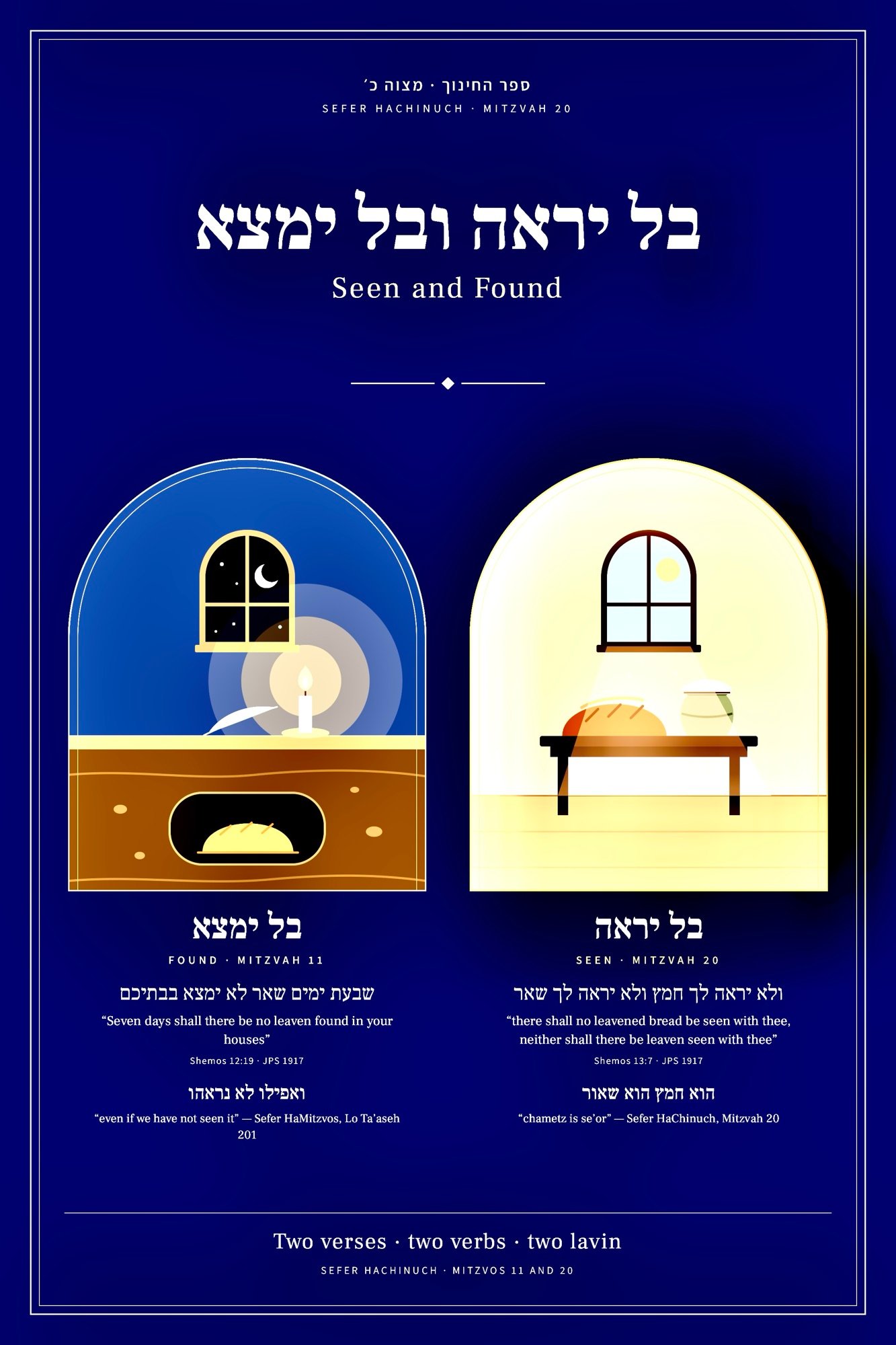
The Light of Redemption and Education: A Rabbinic Commentary on Sefer HaChinuch (The Book of Mitzvos)
Seen and Found: Sefer HaChinuch, Mitzvah 20
Nov 25, 2026 · @Kamil Levi Pyka-Penner
In Mitzvah 20 the Chinuch writes less about chametz than about counting. He sends the reader to Tractate Pesachim for the laws and back to earlier mitzvos for the purpose and the punishment. The one matter he argues for is why a verse that forbids two substances yields only one lav.
His answer turns on the word ענין, the subject matter of a prohibition. Pressed one step further, that criterion raises a question he never asks aloud: why “it shall not be seen” (Mitzvah 20) and “it shall not be found” (Mitzvah 11) count as two mitzvos. This essay follows that question through the Chinuch’s commentators and the books of the mitzvos.
On sources. By design, the commentary draws only on Sefer HaChinuch and the literature of the counting of the mitzvos. That means the Minchas Chinuch; the Rambam’s Sefer HaMitzvos; the Sefer Mitzvos Gadol (Smag) with the glosses of R’ Eliyahu Mizrachi and the Beurei Maharshal; and Rav Saadiah Gaon’s Sefer HaMitzvos as expounded by R’ Yerucham Fishel Perla. The Kesef Mishneh appears where he interprets the Sefer HaMitzvos. The notes and Insight of the elucidated edition before us (pp. 174–177) are cited as “the elucidated edition.”
Talmudic passages and Rishonim appear only as these works cite them. Verses are given in the JPS 1917 translation. Renderings of the Chinuch and its commentators are my own.
The Text
Mitzvah 20 runs to five short paragraphs, and only the first makes an argument of its own. The Hebrew follows the elucidated edition. In the English, the verse is JPS 1917 and the rest is our rendering.
שלא יראה חמץ בכל מושבותינו כל שבעת ימי הפסח, שנאמר (שמות יג, ז) ולא יראה לך חמץ ולא יראה לך שאור בכל גבולך, שבעת ימים. ואין אלה שני לאוין בשני ענינים, אבל הם בענין אחד, כמו שאמרו זכרונם לברכה (ביצה ז, ב) פתח הכתוב בחמץ וסיים בשאור, לומר לך הוא חמץ הוא שאור, כלומר, אין הפרש בין החמץ עצמו ובין דבר המחמץ.
משרשי המצוה, מה שכתבנו בשאר מצות הפסח.
דיניה מבוארים בפסחים (פרק א׳–ג׳).
ונוהגת בכל מקום ובכל זמן, בזכרים ונקבות.
ועובר עליה ולקח חמץ בפסח והניחו ברשותו, לוקה. אבל אם לא הוציאו מקודם הפסח מביתו, אינו לוקה עליו, לפי שאין בו מעשה, ואין לוקין עליו כמו שאמרנו (מצוה ט׳).
That chametz not be seen in all our dwellings all seven days of Pesach, as it is said: “there shall no leavened bread be seen with thee, neither shall there be leaven seen with thee, in all thy borders” (Shemos 13:7), “seven days.” These are not two lavin concerning two subjects; they concern one subject. As our Sages of blessed memory said (Beitzah 7b): “The verse opened with chametz and closed with se’or, to tell you that chametz is se’or.” That is, there is no difference between the leavened thing itself and the thing that leavens.
Among the roots of the mitzvah: what we wrote for the other mitzvos of Pesach.
Its laws are set out in Pesachim, chapters 1–3.
It applies in every place and at every time, to men and to women.
One who transgresses it by taking chametz on Pesach and placing it in his domain is flogged. But if he merely failed to remove it from his house before Pesach, he is not flogged, for there is no act in it, and one is not flogged for it, as we said (Mitzvah 9).
Built on the Rambam’s Sefer HaMitzvos
Mitzvah 20 is the Rambam’s Sefer HaMitzvos, Lo Ta’aseh 200, recast in the Chinuch’s five-part form. The counting sentence and the reading of the Gemara are the Rambam’s, nearly word for word, in the standard Hebrew text (Warsaw 1883).
Sefer HaMitzvos, Lo Ta’aseh 200
Sefer HaChinuch, Mitzvah 20
The prohibition
הזהירנו שלא יראה חמץ בכל גבולנו שבעת ימים
שלא יראה חמץ בכל מושבותינו כל שבעת ימי הפסח
The count
ואין אלו שני לאוין בשני ענינין אבל הם בענין אחד
ואין אלה שני לאוין בשני ענינים, אבל הם בענין אחד
The proof
פתח הכתוב בחמץ וסיים בשאור, לומר לך היינו חמץ היינו שאור
פתח הכתוב בחמץ וסיים בשאור, לומר לך הוא חמץ הוא שאור
The gloss
אין הפרש בין חמץ ושאור
אין הפרש בין החמץ עצמו ובין דבר המחמץ
The penalty
אינו חייב מלקות אלא אם כן לקח חמץ בפסח וקנאו שעשה בו מעשה
לקח חמץ בפסח והניחו ברשותו, לוקה … לפי שאין בו מעשה
The Tosefta
המשייר חמץ בפסח והמקיים כלאי הכרם אינו לוקה
Not cited
The Chinuch’s changes are few. He glosses se’or as “the thing that leavens,” moves the penalty into his closing formula, and drops the Tosefta. Where the Warsaw text reads “in all our borders,” he writes “in all our dwellings”; the elucidated edition (n. 2) takes care to say that no narrowing is meant.
His five standing headings do the rest: here three point elsewhere, and a fourth is his standard formula. The roots are “what we wrote for the other mitzvos of Pesach”; the laws are “set out in Pesachim”; the penalty closes “as we said” (Mitzvah 9). The Minchas Chinuch draws the conclusion for the laws: “כל הדינים דשם שייכים כאן” — all the laws of Mitzvah 11 apply here (20:1).
What remains is the one sentence the Chinuch kept from the Rambam almost verbatim. Mitzvah 20 did not need to teach the laws of possessing chametz; it needed to justify its own place in the count.
One Verse, Two Nouns, One Lav
The Chinuch’s one argued sentence applies the Rambam’s rule of counting by subject. It also takes a side in a dispute the books of the mitzvos never closed.
The rule. Shoresh 9 of Sefer HaMitzvos counts what is forbidden, not how often it is forbidden: “שאין ראוי למנות הלאוים והעשה, אבל הדברים המוזהר מהם והמצווה בהם.” Its conclusion is blunt: “הנה כבר התבאר כי לא ברבוי הלאוין או העשה ירבו המצות.” Exodus 13:7 has two clauses and one subject, so it yields one lav.
The parallels. At Mitzvah 602 the Chinuch reasons the same way, in the Rambam’s words, about false weights and measures. Devarim 25:13–14 says “לא יהיה לך” twice, yet “ואל תחשוב שיהיו שתי מצות אחר שהן שני לאוין”; the two clauses were said “לבאור תשלום הענין.” Shoresh 9 itself cites the Sages that “any se’or and any honey” (Vayikra 2:11) is one mitzvah: “וכן אמרו כי כל שאור וכל דבש מצוה אחת.”
The reading. The Chinuch’s proof reads “פתח הכתוב בחמץ וסיים בשאור,” chametz first and se’or last, which is the order of Shemos 13:7. Our Gemara reverses the order and, as the elucidated edition explains (n. 7), points to Shemos 12:19, the verse of kares. The Chinuch’s reading is already the Rambam’s in Lo Ta’aseh 200, and the Kesef Mishneh cites it the same way.
The difference is more than a scribal one. On the Chinuch’s reading, the Sages equate chametz and se’or inside the very verse of bal yera’eh. On ours, they equate them in a verse about eating, and the equation must be carried over to possession.
The dissent. R’ Yerucham Fishel Perla shows that the question was live (on Rav Saadiah Gaon, Lavin 166–167). The Maharshal asked, on the Smag, why chametz and se’or are not counted as two lavin. As R’ Perla sets out the question, a Tosefta in Beitzah defines se’or as what leavens other dough, and calls it se’or once it is unfit for a dog to eat.
Chametz in that state needs no removal, while se’or, kept for leavening, is liable precisely then. “וא”כ שני ענינים חלוקים הם.” R’ Perla, citing the derashah in our reading, limits it to measures: it teaches only “שהן שוין בשיעוריהן בלבד,” as the Raavad wrote.
On that ground he vindicates the Behag and R’ Eliyahu HaZaken, who counted “lo yera’eh lecha chametz” and “lo yera’eh lecha se’or” as two lavin. He adds that the Smak (34–35) and the Yereim (105) also count chametz and se’or as two.
The Chinuch’s side. The Rambam, R’ Perla notes, does not rule like that Tosefta, so the question never touches him: “ולהרמב”ם לא תקשה דלטעמי׳ אזיל דלא פסק כהך תוספתא.” The Chinuch writes the Rambam’s sentence and adds a gloss of his own: “אין הפרש בין החמץ עצמו ובין דבר המחמץ.”
The gloss grants the difference of definition — se’or is the agent, chametz the product — and denies any difference of law. That is the precise point of the dispute, answered in a single clause.
Two Verses, Two Verbs, Two Lavin
The harder question is the one the Chinuch leaves unasked. If repeated prohibitions on one subject count once, why are “seen” (Mitzvah 20) and “found” (Mitzvah 11) two? The books of the mitzvos and their commentators give six answers between them.
Position
What makes two lavin
Chametz out of sight
Where cited
Rambam, as read by the Kesef Mishneh
“Seen” requires visibility; “found” does not
Only bal yimatzei
Sefer HaMitzvos, Lo Ta’aseh 200–201; Kesef Mishneh, Chametz U’Matzah 1:3
Rosh
No such line: “lo yera’eh,” not “lo sir’eh”
Both lavin, as the elucidated edition reads him
Minchas Chinuch 20:1; elucidated edition, Insight
An opinion in the Ritva
Place: “borders” against “houses”
Not addressed
Elucidated edition, Insight
R’ Eliyahu Mizrachi
Nothing in practice; in substance one mitzvah
Both lavin
Glosses to Smag, Lavin 77–78, via the elucidated edition
Beurei Maharshal
Two verbs across three injunctions
Not addressed
Elucidated edition, Insight
Rasag and Ramban, as read by R’ Perla
Two nouns: chametz and se’or
Not addressed
R’ Perla, Lavin 166–167
The Rambam’s own words. Lo Ta’aseh 201 defines bal yimatzei more widely than bal yera’eh: “הזהירנו שלא ימצא חמץ ברשותנו ואפילו לא נראהו, ואפילו היה בפקדון.” It adds that each lav learns from the other what it did not state — “ילמד כל לאו מן האחר זולת ענין מה שהיה מורה עליו” — and that one who keeps chametz on Pesach transgresses both.
The Re’em’s challenge. R’ Eliyahu Mizrachi pressed the difficulty from Shoresh 9, as the Kesef Mishneh reports: “ויש לתמוה דהא בשורש ט׳…” The passage then weighs the answer that one is flogged only once though two lavin are named, and concedes: “אכתי קשיא היאך מנאן בשני לאוין.”
The Kesef Mishneh’s answer. “לא יראה לא משמע אלא כשהוא נראה לעינים דוקא, וכן משמע בספר המצות מצוה ר׳ ומצוה ר״א.” Wherever “seen” is violated, “found” is violated too; with hidden chametz, only “found”: “אבל בטמון לא עבר אלא על לא ימצא.” R’ Perla judges this reconciliation of the Rambam and the Smag “נכונים היטב.”
He also cites a baraisa that points the same way: “ולא יראה לך שאור — יכול יטמין ויקבל פקדונות מן הנכרים? ת״ל לא ימצא.” If “seen” alone would have permitted hiding, hiding is a matter for “found.”
The Rosh. The Minchas Chinuch (20:1) sets the Rosh against the Kesef Mishneh: “דמי כתיב לא תראה? לא יראה כתיב — היינו אם הוא במקום הראוי לראות.” The passive verb measures what could be seen, not what is seen. R’ Perla finds the Rosh, read plainly, “לכאורה … תמוהים” against that baraisa, and labors to read him otherwise.
Two consequences. The Minchas Chinuch draws them from the Kesef Mishneh. First, a blind owner would seem exempt: “כיון דאינו רואה א״ע.” Then he suggests that the Kesef Mishneh exempts only chametz “דאינו נראה כלל לשום אדם,” so that the blind owner of chametz in plain view is liable — “וצ״ע כי כ׳ בקצת עיון.”
Second, the lashes. If these lavin are not nitakin la’aseh, then on the Kesef Mishneh’s view “ברואין לוקין פ׳, ובטמון לוקין רק מ׳.” The count of two is not academic: it doubles the lashes.
Relocating or denying the difference. An opinion recorded by the Ritva divides the lavin by place, so that chametz outside the house falls only under “throughout your borders.” Others reject it, since the gezeirah shavah of se’or and se’or carries “borders” into both (elucidated edition, Insight). The Rambam’s “each lav learns from the other,” and the Chinuch’s gloss in Mitzvah 11 — “לאו דוקא ביתו, אלא כל שברשותו” — close the same door.
R’ Eliyahu Mizrachi reads “seen” as an idiom for owning: no practical difference, and in substance one mitzvah. The Beurei Maharshal counts two even if the laws coincide: the Torah used two verbs across three injunctions, and had it meant one prohibition it would have kept one verb (both in the elucidated edition, Insight).
Two of what? R’ Perla offers a different division altogether. For Rav Saadiah Gaon — and, he suggests, for the Ramban — the two lavin are “lo yera’eh lecha chametz” and “se’or lo yimatzei,” the latter absorbing “lo yera’eh lecha se’or.” His reason: “דחמץ ושאור שני שמות וענינים חלוקין הן ונמנין שנים.” The total matches the Rambam’s; the principle is the reverse.
Where the Chinuch Stands
The Chinuch keeps the Rambam’s count but not the Rambam’s reason. Read by his own criterion, I suggest, his count points to the Kesef Mishneh’s distinction.
What he takes and what he leaves. From Lo Ta’aseh 201 he takes the count and the double transgression: in Mitzvah 11 the offender “עבר על שני לאוין משום בל יראה ובל ימצא.” He does not take the clause that marks the difference: “even if we have not seen it, even if it was on deposit.” Deposit survives only as a topic in his list of laws: “אם הפקיד חמצו ביד אחרים מה דינו או אחרים בידו.”
His criterion is legal. Chametz and se’or are one subject because there is no difference between them in law. By the same measure, two verbs with identical laws would be one subject and one lav. If he counts two, it seems he must hold that the laws differ somewhere, which is the Rambam’s position as the Kesef Mishneh reads it.
The Maharshal’s route stays open. His rule, that one verb repeated makes one lav and two verbs make two, also fits the Chinuch’s practice. “Lo yera’eh” twice in Shemos 13:7 is one lav, like “lo yihyeh lecha” twice in Devarim 25 (Mitzvah 602). What tips the balance is the form of the Chinuch’s proof: he argues from the absence of a legal difference, not from the repetition of a word.
The Mizrachi’s route is the hardest to square with him. If “seen” is only an idiom for owning, then by the Chinuch’s reasoning in Mitzvah 20 the two would be one subject and one lav. Yet he counts them twice and says in Mitzvah 11 that the offender transgresses both.
A detail worth weighing. In Mitzvah 11, his example of a punishable act is one who “לקח חמץ והצניעו בביתו” — took chametz and stored it away in his house. In Mitzvah 20 it is one who took chametz “והניחו ברשותו” — and placed it in his domain. Whether “stored away” means “out of sight,” and whether the variation is deliberate, we leave to the reader.
The Malkus Clause
The Chinuch, with the Rambam, flogs only the one whose act brought chametz into his domain on Pesach. The one who simply kept what he already had is exempt, “for there is no act in it.”
Three statements of one rule. In Mitzvah 9: “אבל אין לוקין על לאו זה, אם לא עשה בו מעשה, שהלכה היא, לאו שאין בו מעשה, אין לוקין עליו.” In Mitzvah 11 the acts are named: “כגון שחמץ עיסה והניחה בביתו, או שלקח חמץ והצניעו בביתו.” Mitzvah 20 repeats the purchase and closes “כמו שאמרנו.”
The Rambam’s source and pair. Lo Ta’aseh 200 cites the Tosefta: “המשייר חמץ בפסח והמקיים כלאי הכרם אינו לוקה.” Lo Ta’aseh 201 grounds the condition of an act in “the principles laid down in Tractate Shevuos” (21).
A prohibition of keeping. These lavin forbid a state, not an act. They are transgressed for as long as chametz lies in one’s domain, yet flogged only when a person’s act created that state. The Tosefta’s pairing names the category: chametz kept on Pesach, kilayim kept in a vineyard.
The Chinuch’s verbs mark the line. “Took” and “leavened” are acts; “did not remove it from his house before Pesach” is an omission. The purchase or the leavening is the ma’aseh, and the lav is transgressed by what follows from it.
What the count costs. The count of two raises the stakes. On the Kesef Mishneh’s reading, the Minchas Chinuch reckons eighty lashes for visible chametz and forty for hidden, provided these lavin are not nitakin la’aseh, a condition he leaves open. The elucidated edition (n. 14) notes that the exemption itself is not universally held, and refers to its fuller treatment at Mitzvah 11.
Time, Place, and Persons
The Chinuch’s scope formula is standard, but two of its details repay attention: when the lav begins, and whom it binds.
When it begins. “כל שבעת ימי הפסח” — the elucidated edition (n. 3) reads the phrase as implying that the lav begins at nightfall of the fifteenth; others begin it at midday of the fourteenth. The Chinuch places the positive command of removal on the fourteenth (Mitzvah 9): “להסיר כל לחם חמץ ממשכנותינו ביום ארבעה עשר בניסן … ופירושו ‘הראשון’, קודם לפסח.” Read together, his language gives the fourteenth to the aseh of removal and the seven days to the two lavin.
Where it applies. “בכל מקום ובכל זמן” — in the Diaspora as in the Land, with or without the Mikdash (n. 11). The same words close Mitzvos 9 and 11.
Whom it binds. “בזכרים ונקבות” — women are bound, as in all lavin (n. 12). The Minchas Chinuch refers the question of who is obligated back to his earlier discussion: “ולענין אישים מי חייב במצוה זו עמש״ל.” His one new question of persons here is the blind owner, and he leaves it with a צ״ע.
The Root: Why Repeat the Lesson?
The Chinuch’s root for Mitzvah 20 is a cross-reference. Followed back, it leads to his best-known answer to the very question this mitzvah raises.
The chain of references. Mitzvah 20 sends the reader to “the other mitzvos of Pesach.” Mitzvah 11 gives the root as memory: “כדי שנזכור לעולם הנסים שנעשו לנו ביציאת מצרים, כמו שכתוב בשה הפסח.” Mitzvah 9 says the same of removal: “כדי שנזכור הנסים במצרים, כמו שכתוב בקרבן פסח.”
The objection the Chinuch anticipates. At Mitzvah 16, the prohibition on breaking a bone of the Pesach offering, he puts the question in his son’s mouth: “ולמה יצוה אותנו השם יתברך לעשות כל אלה לזכרון אותו הנס, והלא בזכרון אחד יעלה הדבר במחשבתנו ולא ישכח מפי זרענו?”
His answer is his most quoted line: “דע, כי האדם נפעל כפי פעולותיו, ולבו וכל מחשבותיו תמיד אחר מעשיו שהוא עוסק בהם אם טוב ואם רע … כי אחרי הפעולות נמשכים הלבבות.”
The same question in another key. The son’s objection is the question of Mitzvah 20. Why a second prohibition on possession when a first already stands? The count answers in law. The root answers in pedagogy: each added deed is another channel through which the memory is pressed into the heart.
Where the deed is. Bal yera’eh is kept by absence, by what is not in one’s house. Yet in the Chinuch’s scheme, we suggest, the deed is not missing. It is the search and removal of Mitzvah 9, and the two lavin set the standard that deed must meet and hold for seven days.
The penalty clause says the same from the other side. Only the one whose act brought chametz in is flogged; the lavin of keeping take their force from deeds.
Conclusion and Questions for the Beis Midrash
Mitzvah 20 shows the Chinuch as a reader of the Rambam’s Sefer HaMitzvos. He adopts its count, its reading of the Gemara, and its rule of ענין, and leaves his readers the question that rule makes pressing.
The books of the mitzvos cited here agree that the Torah’s warnings against possessing chametz yield more than one lav. They disagree on what divides them. For the Rambam and the Chinuch it is the verbs, “seen” and “found”; for the Behag’s school, and for Rasag and the Ramban as R’ Perla reads them, it is the nouns, chametz and se’or.
Within the Rambam’s view, the difference between the verbs is visibility (the Kesef Mishneh), Scripture’s diction (the Maharshal), or nothing at all (the Mizrachi). The Chinuch’s own proof, from the absence of a legal difference, sits most comfortably with the first.
- If the Chinuch counts by ענין, what is the ענין of “seen” that “found” lacks, and why does he omit the Rambam’s clause that would say?
- The Warsaw Hebrew of the Rambam reads “even if we have not seen it” (ואפילו לא נראהו). Does the “we” make the owner’s eyes the measure, and would that settle the Minchas Chinuch’s doubt about the blind owner?
- Does the count depend on the girsa of Beitzah 7b? On the Chinuch’s reading the equation of chametz and se’or sits inside Shemos 13:7; on ours, the Raavad and R’ Perla can confine it to measures.
- Is the Chinuch’s variation, “stored it away” in Mitzvah 11 and “placed it” in Mitzvah 20, deliberate, and does it bear on hidden chametz?
- The Chinuch exempts passive retention for want of an act alone. Does that silence bear on the question the Minchas Chinuch leaves open, whether these lavin are nitakin la’aseh?
Works Cited
- Sefer HaChinuch, Hebrew text: Mitzvah 9, Mitzvah 11, Mitzvah 16, Mitzvah 20, Mitzvah 602.
- The Schottenstein Edition Sefer HaChinuch / Book of Mitzvos, The Jan Czuker Family Elucidation (ArtScroll/Mesorah), vol. 1, pp. 174–177: text, notes 1–14, and “Insight: How Is Mitzvah 20 Different From Mitzvah 11?”
- Minchas Chinuch, Mitzvah 20:1.
- Rambam, Sefer HaMitzvos (Warsaw 1883): Shoresh 9; Lo Ta’aseh 200; Lo Ta’aseh 201.
- Kesef Mishneh, Hilchos Chametz U’Matzah, ch. 1, on the Rambam’s reading in Sefer HaMitzvos.
- R’ Yerucham Fishel Perla, commentary on Rav Saadiah Gaon’s Sefer HaMitzvos, Lavin 166–167 (Warsaw 1914, vol. 2).
- Sefer Mitzvos Gadol, Lavin 77–78, with the glosses of R’ Eliyahu Mizrachi and the Beurei Maharshal, as cited by the Kesef Mishneh, R’ Perla, and the elucidated edition.
- Exodus 13:7, JPS 1917.
The Rosh, Ritva, Raavad, Behag, R’ Eliyahu HaZaken, Smak, Yereim, and Tosefta are cited as the works above cite them.