
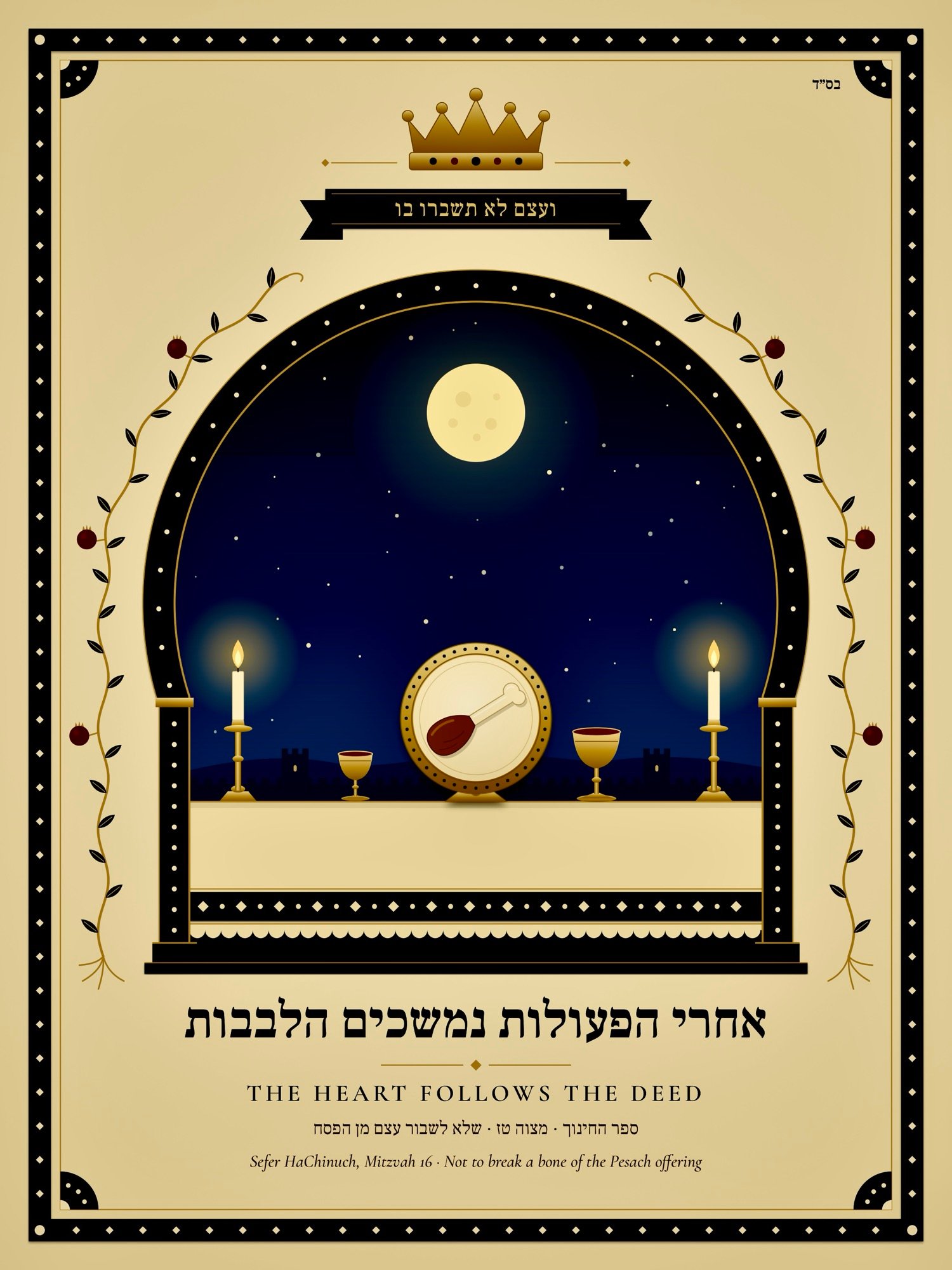
The Light of Redemption and Education: A Rabbinic Commentary on Sefer HaChinuch (The Book of Mitzvos)
בס״ד
The Heart Follows the Deed: Sefer HaChinuch, Mitzvah 16
Nov 23, 2026 · @Kamil Levi Pyka-Penner
Introduction
The sentence for which Sefer HaChinuch is best known, “for hearts are drawn after deeds” (כי אחרי הפעולות נמשכים הלבבות), is taught in Mitzvah 16: the prohibition against breaking a bone of the korban Pesach. Few placements could seem less likely. The prohibition applies, as the Chinuch himself rules, only in the time of the Beis HaMikdash, and its laws turn on a kezayis of meat, on cartilage that will one day harden, and on whether the offering was tahor when its blood reached the Mizbe’ach.
Why would the author lodge his most far-reaching statement about human nature in so narrow a prohibition? This essay argues that the placement is deliberate. Three threads meet here: the cumulative weight of the Pesach mitzvos, each explained as a remembrance of the miracles of Egypt; this mitzvah’s own “trunk,” that a people of royal standing does not gnaw bones like the starving; and the voice of a father teaching his son, which governs the whole sefer.
Read together with its dinim, Mitzvah 16 offers a compact account of how a nation, and a single person, is formed by what it does. The essay is offered to rabbanim, rebbeim, and Orthodox scholars and academics who study and teach the Chinuch. By design it draws only on Sefer HaChinuch itself, the Minchas Chinuch and later studies of the sefer, the notes of the English edition before us, Rambam’s Sefer HaMitzvos, whose count the Chinuch follows, and the sources these works cite.
I. The mitzvah in its setting
Mitzvah 16 forbids breaking any bone of the korban Pesach. The Chinuch defines it in one line, “not to break a bone of any of the bones of the Pesach,” and grounds it in the verse that also yields the mitzvah before it:
בבית אחד יאכל לא תוציא מן הבית מן הבשר חוצה ועצם לא תשברו בו (שמות יב, מו)
“In one house shall it be eaten; thou shalt not carry forth aught of the flesh abroad out of the house; neither shall ye break a bone thereof” (Shemos 12:46, JPS 1917).
The prohibition is the 121st negative commandment in Rambam’s Sefer HaMitzvos, whose count the Chinuch follows. The same prohibition for Pesach Sheni is counted separately, as Rambam’s 122nd prohibition and the Chinuch’s Mitzvah 383.
The mitzvah stands inside the long run of Pesach mitzvos in Parashas Bo, Mitzvos 5 through 21, apart from 18, which concerns the firstborn. In the edition before us, eleven Pesach mitzvos precede it (5–15), and the Chinuch has grounded them, one after another, in remembering the miracles of Egypt. Mitzvah 16 opens on that note: “to remember the miracles of Egypt, as we have written in the others.”
The sequence was once different. In the manuscripts and the first printing (Venice 1523), the author listed each parashah’s positive commandments before its prohibitions; an eighteenth-century Amsterdam Chumash recast them in verse order, later printings followed, and R’ Chaim Dov Chavel restored the original order in his 1952 edition. In the author’s own arrangement, then, the positive Pesach mitzvos of Bo, the telling of the Exodus among them, would already have stood before this prohibition. Either way, the reader arrives at Mitzvah 16 with the refrain of remembrance sounded many times over.
Every entry in the sefer moves from source to shoresh, then to dinim, applicability and penalty. Here the proportions are striking. In the edition before us the shoresh runs to some thirty-four lines of Hebrew; the laws, their applicability and their penalty together take five.
The author names himself only as a Jew of the house of Levi of Barcelona. The first printing ascribed the work to “Aaron,” and later tradition linked it to R’ Aharon HaLevi (the Ra’ah), an attribution scholars have long doubted because the Chinuch contradicts the Ra’ah’s known positions; Israel Ta-Shma proposed his brother, R’ Pinchas HaLevi (Kiryat Sefer 55, 1980). What the author does tell us is why he wrote: to stir the heart of his young son and the boys who were his friends, studying the book with them week by week (n. 4 in the edition). The “my son” whom Mitzvah 16 addresses is that boy.
II. “Its trunk from that root”: royalty at the Pesach table
The Chinuch gives this mitzvah two layers of reason: the root it shares with every Pesach mitzvah, remembering the miracles of Egypt, and a trunk of its own, the bearing of a people raised to royalty.
משרשי המצוה, לזכור נסי מצרים, כמו שכתבנו באחרות. וגם זה גזעו מן השורש הנזכר, שאין כבוד לבני מלכים ויועצי ארץ לגרר העצמות ולשברם ככלבים, לא יאות לעשות ככה כי אם לעניי העם הרעבים. ועל כן בתחילת בואנו להיות סגולת כל העמים ממלכת כהנים ועם קדוש, ובכל שנה ושנה באותו הזמן, ראוי לנו לעשות מעשים המראים בנו המעלה הגדולה שעלינו לה באותה שעה. ומתוך המעשה והדמיון שאנחנו עושין, נקבע בנפשותינו הדבר לעולם.
“Among the roots of the mitzvah: to remember the miracles of Egypt, as we have written in the others. This one, too, grows its trunk from that root. It is no honor for the sons of kings and the counselors of the land to scrape the bones and crack them like dogs; such conduct befits only the starving poor of the people. Therefore, at the very beginning of our becoming the treasure of all the peoples, a kingdom of priests and a holy people, and every year at that same season, it is fitting for us to do deeds that show in us the great height to which we rose at that hour. And through the deed and the enactment that we perform, the matter is fixed in our souls forever.”
The Chinuch’s whole method is a search for roots, the shorashim of the mitzvos. Here he extends the figure: remembrance is the root, and royal dignity is the trunk that rises from it in this mitzvah. The editors identify “the root mentioned” with the royal theme of Mitzvos 7, 8 and 15, and those entries have already set the table of free men.
Roast meat is the fare of “the sons of kings and nobles” (Mitzvah 7), while common people must boil what little meat they have to fill their stomachs. Kings and nobles need not save cooked food from one day to the next, and what remains is burned “like a thing one has no desire for, in the manner of the kings of the earth” (Mitzvah 8). And because “we were made free men and lords,” the offering is eaten within its own company and not carried out (Mitzvah 15).
Mitzvah 16 adds an image sharper than any of these. Two figures crack bones: the dog, which gnaws by nature, and the starving man, who cannot afford to leave the marrow. Royalty is defined here not by luxury but by freedom from need; a prince can leave something on the bone. The phrases are borrowed, “kings and counselors of the land” from Iyov 3:14 and “the poor of the people” from Tehillim 72:4 (nn. 1–2).
The time markers carry the argument. “At the very beginning of our becoming” dates Israel’s elevation to the night of the Exodus, though the words that name it, “treasure” and “kingdom of priests,” were spoken at Sinai (Shemos 19:5–6; n. 3). The Exodus is the beginning; Sinai is the declaration. (The edition reads עם קדוש where the verse, and other printings, have גוי קדוש, as befits a paraphrase.) “Every year at that same season” then binds the origin to an annual return.
The deeds are to “show in us” (המראים בנו) the height we reached, not to show it to others. The display is reflexive: Israel performs its royalty first before its own eyes.
Then comes the sentence on which the entry turns: through “the deed and the enactment” (המעשה והדמיון) that we perform, the matter is fixed in our souls forever. Dimyon means likeness, a representation held before the mind; the editors render it “symbolism,” and it also carries the sense of acting a part. On the night of the fifteenth the Jew eats as a prince eats, and the likeness becomes the reality. The principle that the son’s question will draw out is already present here in miniature.
III. “Do not think, my son”: the objection
The Chinuch now turns from his reader to his son and voices the question a bright boy would ask after eleven mitzvos with one reason: why so many, when one would do?
ואל תחשוב בני לתפוש על דברי ולומר, ולמה זה יצוה אותנו השם יתברך לעשות כל אלה לזכרון אותו הנס, והלא בזכרון אחד יעלה הדבר במחשבתנו ולא ישכח מפי זרענו, כי לא מחכמה תתפשני על זה, ומחשבת הנער ישיאך לדבר כן. ועתה בני, אם בינה שמעה זאת, והטה אזנך ושמע, אלמדך להועיל בתורה ובמצוות.
“Do not think, my son, to seize upon my words and say: Why would Hashem, blessed be He, command us to do all these things in remembrance of that miracle? Would not a single remembrance bring the matter to mind, so that it is not forgotten from the mouth of our descendants? It is not out of wisdom that you would seize upon me in this; a boy’s thinking leads you to speak so. Now, my son, if you have understanding, hear this; incline your ear and listen, and I will teach you to profit in Torah and in mitzvos.”
The address “my son” is the sefer’s private frame breaking the surface. The author wrote for a boy and his friends (n. 4), and here the reader overhears the father. The objection is placed in the son’s mouth before he can raise it, at exactly the point where the repetition has become impossible to miss.
The father answers in the idiom of Scripture, as the edition’s notes trace (nn. 5–6): “not out of wisdom” from Koheles 7:10, “if you have understanding, hear this” from Iyov 34:16, “incline your ear and listen” from Mishlei 22:17, “I will teach you to profit” from Yeshayahu 48:17. Mishlei is Scripture’s book of a father’s instruction to a son, and the Chinuch writes in its register. Two of the borrowings may be pointed. Koheles rebukes a question about the past, why the former days were better than these; the Chinuch lends that rebuke to a question about remembering the past. And in Yeshayahu the one who “teaches you to profit” is Hashem Himself, which suits a father about to argue that the mitzvos are Hashem’s own teaching, delivered through deeds.
The son’s two verbs define memory as information. One remembrance will “bring the matter to mind” (יעלה הדבר במחשבתנו) and keep it from being “forgotten from the mouth of our descendants” (ולא ישכח מפי זרענו). That second phrase echoes Devarim 31:21, where the Torah says of the Shirah that it will not be forgotten from the mouth of his seed. If the echo is deliberate, the boy even has a verse on his side: a single song was enough to stand as a lasting witness.
The father never disputes that one remembrance could preserve a fact. He relocates memory. He has already said that through deed and enactment the matter is “fixed in our souls” (נקבע בנפשותינו), and he will close by saying that through abundant engagement “we will be affected toward the matter” (נתפעל אל הדבר). Mind and mouth can hold a memory; only the soul is changed by one. The son asks how to remember the Exodus. The father answers how to become the people the Exodus made.
“A boy’s thinking” (מחשבת הנער) is not contempt. It names a particular error of youth, the assumption that knowing a thing is the same as being shaped by it. The father’s response is to teach at length, “to profit,” not to silence the question.
The scene carries one more resonance. The Torah’s own picture of a father answering a son about the Exodus is “והגדת לבנך” (Shemos 13:8), the verse of Mitzvah 21. In the middle of the Pesach mitzvos, the Chinuch does what that verse describes: he answers his son’s question about why we remember Egypt.
IV. “A person is shaped by his deeds”: the anatomy of the principle
The father’s answer is a law of human nature, stated without moral qualification and tested on two opposite cases.
דע, כי האדם נפעל כפי פעולותיו, ולבו וכל מחשבותיו תמיד אחר מעשיו שהוא עושה בהם, אם טוב ואם רע. ואפילו רשע גמור בלבבו וכל יצר מחשבות לבו רק רע כל היום, אם יערה רוחו וישים השתדלותו ועסקו בהתמדה בתורה ובמצוות, ואפילו שלא לשם שמים, מיד ינטה אל הטוב, ובכח מעשיו ימית היצר הרע, כי אחרי הפעולות נמשכים הלבבות.
“Know that a person is shaped according to his deeds, and his heart and all his thoughts always follow the deeds he does, whether good or bad. Even one who is wholly wicked in his heart, every inclination of whose heart’s thoughts is only evil all day: if he pours out his spirit and sets his effort and his occupation, with constancy, in Torah and mitzvos, even not for the sake of Heaven, he will at once incline toward the good, and by the force of his deeds he will slay the evil inclination, for hearts are drawn after deeds.”
ואפילו אם יהיה אדם צדיק גמור ולבבו ישר ותמים, חפץ בתורה ובמצוות, אם אולי יעסוק תמיד בדברים של דופי, כאילו תאמר דרך משל שהכריחו המלך ומינהו באומנות רעה, באמת אם כל עסקו תמיד כל היום באותו אומנות, ישוב לזמן מן הזמנים מצדקת לבו להיות רשע גמור, כי ידוע הדבר ואמת שכל האדם נפעל כפי פעולותיו, כמו שאמרנו.
“And even if a man were wholly righteous, his heart upright and whole, desiring Torah and mitzvos: if he were occupied constantly in disreputable things, as if, by way of parable, the king had compelled him and appointed him to an evil trade, then truly, if all his occupation were constantly, all day, in that trade, in time he would turn from the righteousness of his heart to become wholly wicked. For it is known and true that every person is shaped according to his deeds, as we have said.”
The Hebrew makes the point with its grammar: pe’ulos are deeds, and nif’al, the passive of the same root, names what the doer undergoes. The one who acts is acted upon by his own acting. The law runs “whether good or bad,” and the two cases are built to show that it cuts both ways.
Neither case turns on a single act. The wicked man engages “with constancy” (בהתמדה); the righteous man is occupied “constantly, all day” (תמיד כל היום). The operative variable is persistence, and that is already the answer to the son: one remembrance cannot do what constant practice does.
The second case is not about sin at all but about compulsion. The king forced the man into his trade, so whatever the law would say of his guilt, it is not his choice that changes him. Formation runs beneath culpability. The Chinuch’s claim here is about how a soul is made, not about how a deed is judged.
The tempo differs as well. The wicked man “at once inclines” toward the good (מיד ינטה), while the righteous man turns “in time” (לזמן מן הזמנים). “Inclines” names only a first tilt; slaying the evil inclination comes later, “by the force of his deeds.” Still, the text grants the good an immediacy it withholds from the bad, and readers may weigh whether that asymmetry is deliberate.
The Chinuch describes the wicked man in the words the Torah uses for the generation of the Flood (Bereishis 6:5; n. 9). He chooses Scripture’s darkest portrait of human inwardness and still promises that constant Torah and mitzvos will turn it. His phrase אם יערה רוחו may echo Yeshayahu 32:15, where the spirit is poured out from on high; here a person must pour out his own.
“Even not for the sake of Heaven” drew a gloss. The edition records (n. 10) that some manuscripts and the Venice 5360 (1600) printing add here: ועל זה אמרו רבותינו ז״ל ומתוך שלא לשמה בא לשמה (Pesachim 50b). Whether the line is the author’s or a copyist’s, it names what the Chinuch supplies: the mechanism behind Chazal’s dictum. Why should a deed done without pure intent lead to pure intent? Because the heart follows the hand.
The editors add (n. 8) that the Chinuch returns to this principle repeatedly (Mitzvos 40, 95, 99 and elsewhere), and they set beside it Rambam’s remark (Moreh Nevuchim 2:31) that ideas not established by actions made into a people’s continual practice do not survive.
V. Chazal read through the principle
The Chinuch next reads two statements of Chazal through his principle, and in each he turns a statement about reward or protection into a statement about formation.
ועל כן אמרו חכמים זכרונם לברכה (מכות דף כ״ג ע״ב) רצה הקדוש ברוך הוא לזכות את ישראל לפיכך הרבה להם תורה ומצוות, כדי להתפיס בהן כל מחשבותינו ולהיות בהן כל עסקינו, להיטיב לנו באחריתנו. כי מתוך הפעולות הטובות אנחנו נפעלים להיות טובים וזוכים לחיי עד. ורמזו זכרונם לברכה על זה באמרם (מנחות דף מ״ג ע״ב), כל מי שיש לו מזוזה בפתחו וציצית בבגדו ותפלין בראשו, מובטח לו שלא יחטא, לפי שאלו מצוות תמידיות ונפעל בהן תמיד.
“Therefore the Sages, of blessed memory, said (Makkos 23b): The Holy One, blessed is He, wished to bring merit to Israel; therefore He gave them Torah and mitzvos in abundance. That is, to occupy all our thoughts with them and to make them all our occupation, to do us good in our end. For through good deeds we are shaped to be good, and so merit eternal life. And the Sages alluded to this when they said (Menachos 43b): Whoever has a mezuzah on his doorway, tzitzis on his garment and tefillin on his head is assured that he will not sin, because these are constant mitzvos and he is constantly affected by them.”
The first text is the closing mishnah of Makkos, taught in the name of R’ Chananya ben Akashya. It could be read as arithmetic: more mitzvos, more merit. The Chinuch reads it as saturation. The abundance exists “to occupy all our thoughts” and “to make them all our occupation.” The order of his last clause matters: we are first “shaped to be good,” and only then “merit eternal life.” Reward follows from what the deeds have made of us.
A verbal echo is worth noticing. The son wished “to seize upon” his father’s words (לתפוש על דברי); Hashem multiplied the mitzvos “to occupy” our thoughts (להתפיס בהן כל מחשבותינו). The root is the same. The boy grasps at an argument; the mitzvos are meant to take hold of the mind.
The second text receives the same treatment. The Chinuch says only that Chazal “alluded” to his principle, and he explains their guarantee without recourse to mystery: the three mitzvos are constant, and a person is constantly affected by them. Doorway, garment and head enclose a life at home, in public and on the body.
The editors (n. 12) spell out that constancy: one passes the mezuzah at every entrance and exit, and in the Talmud’s time tefillin were worn all day, while later custom limited them to the morning prayers (Tur, Orach Chaim 37:2). They also cite Rambam’s description of such a person as one with many reminders (Hil. Mezuzah 6:13). For those who teach, the observation raises a question worth sitting with. If constancy is the operative variable, what in our communities now carries the constancy that all-day tefillin once carried?
In both readings the Chinuch prefers mechanism to mystery. He does not deny reward or Divine protection; the mitzvos still do us good “in our end” and bring eternal life. He shows the path by which they do it.
VI. “Look at what your occupation is”: the ethics of company
From principle the Chinuch moves to counsel, and the counsel concerns the place where a confident person feels safest: permitted company.
לכן אתה, ראה גם ראה מה מלאכתך ועסקיך, כי אחריהם תמשך ואתה לא תמשכם. ואל יבטיחך יצרך לומר, אחרי היות לבי שלם ותמים באמונת אלקים, מה הפסד יש כי אתענג לפעמים בתענוגי אנשים לשבת בשווקים וברחובות, להתלוצץ עם הלצים ולדבר צחות, וכיוצא באלו הדברים שאין מביאין עליהן אשמות וחטאות, הלא גם לי לבב כמוהם, קטני עבה ממתניהם, ומדוע ימשכוני הם אחריהם. אל בני, השמר מפניהם פן תלכד ברשתם. רבים שתו מתוך כך כוס תרעלתם, ואתה את נפשך תציל.
“Therefore you: look, and look again, at what your work and your occupations are, for you will be drawn after them, and you will not draw them. Let your inclination not reassure you, saying: Since my heart is whole and perfect in faith in G-d, what loss is there if I sometimes enjoy human pleasures, sitting in the markets and the streets, jesting with the scoffers and trading witticisms, and other such things that bring no guilt-offerings or sin-offerings? Have I not a heart as good as theirs? My little finger is thicker than their loins; why should they draw me after them? No, my son: guard yourself from them, lest you be caught in their net. Many have drunk the cup of their poison this way; but you, save your soul.”
The danger the Chinuch names lies below the threshold of liability, in things “that bring no guilt-offerings or sin-offerings.” The editors caution (n. 16) that the offerings are only examples, since many prohibitions carry no korban at all; the speaker means conduct that is not a flagrant transgression. The principle thus reaches conduct the law does not penalize. Halachah measures liability; this passage measures formation.
The direction of influence is the crux. The confident believer assumes he will be the one who influences, and that if anything the scoffers will be drawn after him (n. 18). The Chinuch insists the pull runs the other way: “you will be drawn after them, and you will not draw them.”
The speech is again a mosaic, as the notes trace: “look, and look again” from I Shmuel 24:12 (n. 13), “let your inclination not reassure you” from Avos (n. 14), “trading witticisms” from Yeshayahu 32:4 (n. 15). In Avos the inclination’s false comfort is that the grave will be a refuge; here it is the claim that a whole heart is immune. “Have I not a heart as good as theirs” also recalls Iyov’s protest to his friends (Iyov 12:3).
One borrowing deserves a closer look. “My little finger is thicker than their loins” adapts I Melachim 12:10 (n. 17). There, those are the words that “the young men who had grown up with him” put in Rechavam’s mouth, counsel that cost a king’s son the greater part of his kingdom. The Chinuch had already called the son’s objection “a boy’s thinking”; here the boast of strength is, in its source, the counsel of youths. In a mitzvah about royal dignity, the allusion completes the picture. The true prince leaves the bone; the false prince boasts of his strength and loses the crown.
The close gathers two prophets. “The cup of their poison” comes from Yeshayahu 51:17 and 22 (n. 19). “But you, save your soul” adapts Yechezkel 33:9 (n. 20), where the watchman who has warned the wicked “has saved his soul.” The Chinuch turns the prophet’s past tense into a charge: the father has done the watchman’s part by warning, and now the son must act.
VII. Closing the circle: “a great pillar of our Torah”
Only now does the father return to the question, and his answer is brief because the principle has done the work.
ואחר דעתך זה, אל יקשה עליך מעתה רבוי המצוות בענין זכירת נסי מצרים, שהן עמוד גדול בתורתנו, כי ברבות עסקינו בהם נתפעל אל הדבר, כמו שאמרנו.
“Once you know this, let the abundance of mitzvos concerning the remembrance of the miracles of Egypt no longer trouble you. They are a great pillar of our Torah, for through our abundant occupation with them we will be affected toward the matter, as we have said.”
The son had proposed “one remembrance”; the father answers with “abundant occupation” (ברבות עסקינו). The closing verb, נתפעל, “we will be affected,” completes the arc that began with נקבע בנפשותינו. The many mitzvos are not redundant reminders of one fact. They are repeated acts that make a people.
Why this memory deserves such formation, the Chinuch explains at Mitzvah 21, to which the editors point (n. 21). There, in the mitzvah of telling the story of the Exodus, he writes that it is no wonder many mitzvos, positive and negative, were given for this, “for it is a great foundation and a strong pillar in our Torah and our faith” (כי הוא יסוד גדול ועמוד חזק בתורתנו ובאמונתנו). The Exodus, he continues, is “a complete sign and proof of the world’s creation” (אות ומופת גמור בחדוש העולם), and of a Creator who wills and is able to change what He made, as He changed nature for us in Egypt.
Mitzvah 21 also supplies a companion to our principle. Defining the telling, the Chinuch requires that the words be spoken aloud, even by one who is alone, so that the heart is stirred, “for through speech the heart is aroused” (כי בדבור יתעורר הלב). In Mitzvah 16 the heart is drawn by the hand; in Mitzvah 21 it is roused by the mouth.
Read together, the two entries complete the father’s answer. Mitzvah 16 explains how the many mitzvos work; Mitzvah 21 explains why this memory warrants them. And Mitzvah 16 is one of the negative mitzvos that Mitzvah 21 mentions. It remembers by refraining. The royal bearing it instills is expressed by what a free person declines to do.
VIII. The dinim read through the shoresh
The laws, which the Chinuch states in barely two lines, rhyme with the shoresh at nearly every point.
דיני המצוה, כגון שובר עצם ממנו אפילו אחר זמן אכילתו, ודין אם יש כזית בשר עליו מה דינו, ודין הסחוסים וגידים הרכים שסופן להתקשות, ויתר פרטיה, מבוארים בפסחים (דף פ״ד ע״א ואילך). ונוהגת בזכרים ונקבות, בזמן הבית. ועובר עליה ושבר עצם בפסח טהור, לוקה.
“The laws of the mitzvah, such as one who breaks a bone of it even after the time for eating it; and the law if there is a kezayis of meat on it, what its law is; and the law of cartilage and soft sinews that will eventually harden; and its remaining details, are set out in Pesachim (84a and onward). It applies to men and women, in the time of the Beis HaMikdash. One who transgresses it and breaks a bone of a tahor Pesach receives malkus.”
After the time of eating. The Pesach must be eaten on the night of the fifteenth, after which it is disqualified. The prohibition on breaking its bones nonetheless continues, because the offering was valid when its blood was applied on the fourteenth (n. 22; Rambam, Hil. Korban Pesach 10:1). Read beside the shoresh, the dignity attaches to the offering itself, not only to the hour of the meal.
The kezayis. Malkus is incurred only for a bone with a kezayis of meat on it or a kezayis of edible marrow within; if a kezayis of meat sits anywhere on the bone, one is liable even for breaking it elsewhere (n. 23; Rambam 10:3). Whether breaking a bone with less than a kezayis is forbidden at all is left uncertain (Minchas Chinuch §4; Yerushalmi Pesachim 7:11; Yefei Einayim). The condition is drawn from the verse’s own sequence, “In one house shall it be eaten… neither shall ye break a bone thereof”: the prohibition attaches to a bone carrying enough meat for the minimum eating (Mechilta d’R’ Shimon bar Yochai 12:46). The editors add that the Chinuch’s phrasing seems misleading, since with a kezayis the prohibition is certain and the question arises only with less.
Here the shoresh and the law meet exactly. The shoresh pictured the hungry poor cracking bones to reach food, and the law targets precisely the bones that are food. The prohibition does not guard bone as such. It forbids the gesture of the starving at the very place that gesture would be made.
Cartilage and sinews. The cartilage of a young kid or lamb counts as bone if it would harden in a mature ox, soft as it is now, and eating it “breaks” it; what stays edible even in a great ox, even through long cooking, is not bone and may be eaten (n. 24; Pesachim 84a as Rambam reads it, 10:8–9; cf. Raavad). The editors cite Meiri: the ox, the largest of livestock with the hardest skeleton, sets the standard. Sinews are not subject to the prohibition at all and may be cut (Pesachim 84b). The Chinuch’s “soft sinews that will harden” instead touches the obligation to eat. The Gemara records a dispute over such sinews, R’ Yochanan judging them by their present softness and Reish Lakish by their final hardness, and Rambam rules that they may be eaten but do not count toward the obligation (Pesachim 84a; Rambam 10:10).
The Minchas Chinuch (§8) asks why the Chinuch mentions sinews here at all, since they have nothing to do with breaking bones, and the editors point to the Tzlach (Pesachim 84a) for a possible resolution. Whatever the answer, the law of cartilage and sinew judges a soft thing by what it will become. The shoresh judges a person the same way: deeds are weighed by what they will make of their doer “in time.”
What counts as breaking. The Gemara (Chullin 17b–18a) holds that a break need not sever the bone; a notch deep enough to catch a fingernail suffices. Neither Rambam nor the Chinuch mentions this, and the Minchas Chinuch opens his treatment of the mitzvah with the question (§1; see n. 28, with Meiri, Rashash and Minchas Soless). On the Gemara’s standard, the prohibition guards even the first mark of the gesture.
Applicability and penalty. The prohibition binds men and women alike, as prohibitions generally do (n. 26), and only in the time of the Beis HaMikdash, where alone the Pesach may be offered (n. 27). Malkus applies only if the Pesach was tahor when its blood was applied: if it became tamei afterward the prohibition remains, but if it became tamei before, there is no malkus (n. 29; Pesachim 84a–b; Rambam 10:6). Rambam’s Sefer HaMitzvos likewise limits the lashes to an offering brought in purity.
IX. Conclusion: for those who teach
The Chinuch’s most enduring principle lives in a mitzvah no one has performed since the Churban, and the principle has not lapsed with the mitzvah. By his own words, the occupation that forms a person includes Torah as well as mitzvos (בהתמדה בתורה ובמצוות). Learning the laws of a Pesach we cannot offer is itself one of the deeds the heart follows.
The sefer also applies its principle to itself. At Mitzvah 117, the prohibition of leaven and honey on the Mizbe’ach, the Chinuch confesses that the roots are hidden from him. He explains why he offers reasons anyway, recalling what he announced at the opening of his work:
שאני כותב להרגיל הנערים ולהטעים להם בתחילת בואם לשמוע דברי ספר, כי יש לדברי תורה טעמים ותועלות … ואל יהיו המצוות בתחילה כדברי ספר החתום, פן יבעטו בהם מתוך כך בנערותם ויניחום לעולם וילכו בהבל.
He writes “to habituate the youths, and to give them a taste, as they first come to hear the words of a book, that the words of Torah have reasons and benefits … so that the mitzvos not be, at first, like the words of a sealed book, lest they kick at them in their youth, abandon them forever, and go after vanity.” The verb is telling: להרגיל, to habituate.
This resolves an apparent puzzle in Mitzvah 16. If deeds shape the heart even without understanding, why write a book of reasons at all? Because reasons keep the young at the practice, and the practice does the shaping. The weekly study the author designed for his son is itself a deed repeated with constancy. The boy who asked why there are so many mitzvos received an answer that only years of keeping them could confirm.
For rabbanim and rebbeim, the mitzvah yields a compact pedagogy:
- Constancy over intensity. Both of the Chinuch’s cases turn on what is done “constantly, all day,” not on a single dramatic act.
- Environment is formation. “You will be drawn after them, and you will not draw them” applies most where nothing is forbidden.
- Patience with shelo lishmah. The Chinuch credits engagement “even not for the sake of Heaven,” and explains why it leads somewhere.
- Explain anyway. Reasons protect practice, especially for the young, so that the mitzvos never feel like a sealed book.
A closing word of derush. Among the laws of this mitzvah are “soft sinews that will eventually harden,” which the law judges by their end rather than their present softness. Habits are like that. They begin soft and harden into character, and the Chinuch asks us to judge our deeds by what they will become. His last word to his son is the right last word for those who teach his book: ואתה את נפשך תציל.
Sources and conventions
The Chinuch’s Hebrew follows the edition before us, the Schottenstein Edition Sefer HaChinuch / Book of Mitzvos (ArtScroll/Mesorah), Parashas Bo, Mitzvah 16, pp. 151–156, quoted without vowels; “n.” refers to that edition’s notes. Translations of the Chinuch are given freshly and kept close to the Hebrew. Scripture in English follows the JPS 1917 translation. Divine names in Hebrew quotations are written in the customary modified form. Verbal echoes not identified in the edition’s notes (Devarim 31:21, Iyov 12:3, Yeshayahu 32:15, and the readings of I Melachim 12:10 and Yechezkel 33:9) are offered as suggestions.
- Minchas Chinuch, Mitzvah 16 (Sefaria)
- Sefer HaChinuch, Mitzvos 7, 8 and 21, in a Parashas Bo source sheet (Sefaria)
- Sefer HaChinuch, Mitzvah 15 (Sefaria)
- Sefer HaChinuch, Mitzvah 117, Parashas Vayikra (Hebrew Wikisource, Frankfurt order)
- Rambam, Sefer HaMitzvos, Negative Commandment 121 and Negative Commandment 122 (Chabad.org)
- Rav Shmuel Shimoni, Iyun BeMitzvot BeIkvot HaMinchat Chinukh, on Mitzvah 19 (VBM, Yeshivat Har Etzion)
- Pesachim 84a, with notes on Rambam, Hil. Korban Pesach 10 (Yeshiva.org.il)
- Eli Genauer, “An Obscure Chumash Changes the Sefer HaChinuch Forever” (The Seforim Blog, April 2024)
- “Sefer ha-Chinuch,” on authorship, citing Israel Ta-Shma, Kiryat Sefer 55 (1980) (Wikipedia)