The Light of Redemption and Education: A Rabbinic Commentary on Sefer HaChinuch (The Book of Mitzvos)
Sefer HaChinuch, Mitzvah 17: The Sign Before the Service
The uncircumcised male and the Korban Pesach
Nov 24, 2026 · @Kamil Levi Pyka-Penner
To My Colleagues
The Chinuch’s Mitzvah 17 bars an uncircumcised male from the Korban Pesach, and its few lines hold a complete view of that offering. Read closely, the Chinuch treats the arel’s exclusion as a matter of covenantal standing, not of guilt or penalty.
Three choices in the text show this. He makes the blameless arel — one whose brothers died from milah — the paradigm case. He confines the exclusion to the offering itself, so that matzah and maror remain. And for the shoresh he points neither to milah (Mitzvah 2) nor to the apostate of Mitzvah 13, but to the toshav and sachir of Mitzvah 14.
This essay is offered to rabbis, rebbes, and scholars of Torah, in the beis midrash and in the academy. Its sources are limited to Sefer HaChinuch; the works written on it, chiefly the Minchas Chinuch and Rabbi Elchanan Poupko’s Chochmas HaChinuch; the Rambam’s Sefer HaMitzvos, on which the Chinuch’s count rests; and the Book of Mitzvos edition (pp. 157–160) with the sources its notes cite. Verses appear in Hebrew with the JPS 1917 translation.
The Text
The entry follows the Chinuch’s usual four parts — the mitzvah, its shoresh, its laws, and where it applies — and two of the four are cross-references.
שלא יאכל הערל מן הפסח, שנאמר (שמות יב, מח) “וכל ערל לא יאכל בו”. והוא הערל שמתו אחיו מחמת מילה, ואין צריך לומר משומד לערלות. ו”בו” הוא דאינו אוכל, אבל אוכל הוא במצה ומרור, וכן תושב ושכיר גם כן.
משרשי מצוה זו, מה שכתבנו בתושב ושכיר.
דיני המצוה, כגון מילת בניו ועבדיו אם מעכבין אותו לשחט ולאכל הפסח, ויתר פרטיה, בפסחים.
ונוהגת בזמן הבית. ועובר עליה, כגון ערל שאכל כזית ממנו, לוקה.
In English (my rendering; the verse follows JPS 1917):
That the uncircumcised male not eat of the Pesach, as it is said, “but no uncircumcised person shall eat thereof” (Shemos 12:48). This is the arel whose brothers died because of milah — and needless to say, one who is an apostate with regard to circumcision. It is “of it” that he does not eat, but he does eat matzah and maror; and so too the toshav and sachir.
Among the roots of this mitzvah is what we wrote concerning the toshav and sachir.
The laws of the mitzvah — for instance, whether the circumcision of his sons and slaves holds him back from slaughtering and eating the Pesach — and the rest of its details are in Pesachim.
It applies in the time of the Beis HaMikdash. One who transgresses it — for instance, an arel who ate a kezayis of it — receives lashes.
The Book of Mitzvos edition locates the laws in Pesachim 28b, 61a–63a and 96a, and in Yevamos 70a–74a, codified in the Rambam, Hilchos Korban Pesach 5:4–6 and 9:8–9 (p. 158 and note 8).
The Paradigm Case: A Blameless Arel
The Chinuch’s model arel is a man without fault: והוא הערל שמתו אחיו מחמת מילה. Only afterward, as a kal vachomer, does he add the one who rejects milah: ואין צריך לומר משומד לערלות.
The choice is pointed. A boy whose two brothers died from milah is presumed to share their risk, and he is not circumcised until it is safe (Book of Mitzvos, p. 157, note 1, citing Yoreh Deah 263:2 with Pischei Teshuvah). His orlah is no sin — halachah itself defers his milah — yet the Torah bars him from the Pesach.
The same note records that most Rishonim read the verse this way (Rashi, Tosafos, Ramban, et al. to Yevamos 70a). Rabbeinu Tam disagrees: the verse excludes one who declines milah for an invalid reason, such as fear of pain, while one uncircumcised through no fault may bring and eat (Tosafos, Zevachim 22b, s.v. ערל).
Rabbi Elchanan Poupko, in Chochmas HaChinuch, frames the dispute as a chakira. Is the arel excluded because he has not fulfilled milah, or because of a פסולא דגופיה — a disqualification in his person, like that of the toshav and sachir? He reports that many Acharonim place Rashi on the side of the orlah itself and Rabbeinu Tam on the side of the unfulfilled mitzvah.
For the Rambam, and the Chinuch who follows him, Chochmas HaChinuch shows that the orlah itself disqualifies. In Hilchos Terumos (7:10–12) the Rambam draws no distinction for one whose brothers died, and he bars even a tumtum on account of a doubtful orlah.
The Chinuch’s word order makes the same point without argument. If the blameless man is the paradigm, guilt is not the operative category. He may be a talmid chacham and a tzaddik; he still may not eat, because what is missing lies not in his will but in his flesh.
Only “Bo”: What the Arel Still Eats
The exclusion reaches the offering and nothing else: ו”בו” הוא דאינו אוכל, אבל אוכל הוא במצה ומרור. The Gemara reads the word בו as a limit — of the Pesach he may not eat, but matzah and maror he eats (Pesachim 96a; see also 28b).
The point is not self-evident. Matzah and maror chiefly accompany the Pesach (Mahari Korkos, Hilchos Korban Pesach 9:8, based on Numbers 9:11), so one might reason that whoever is barred from the offering is barred from its companions too. The Torah’s single word forecloses that reasoning (Book of Mitzvos, pp. 157–158, note 3).
The arel is not merely permitted; he is obligated. Like any Jew he must fulfill the mitzvos of matzah and maror (Tosafos, Yevamos 71a, s.v. בו; cf. Chiddushei HaRan, Pesachim 28b, s.v. הואיל, on maror; Minchas Chinuch §27, all as cited in note 3).
The Chinuch’s closing clause — וכן תושב ושכיר גם כן — runs the parallel only so far. The toshav and sachir may be given matzah and maror (Rambam, Hilchos Korban Pesach 9:8), learned from the same word בו in Exodus 12:45 (Mahari Korkos; Mechilta DeRabbi Shimon bar Yochai). But as non-Jews they carry no obligation, and the arel does (note 4).
The resulting picture is exact. On the night of the fifteenth the arel sits at a Jewish table and eats matzah and maror as every Jew must; only the Pesach passes him by. The disqualification removes him from the offering, not from Israel.
A Shoresh by Cross-Reference: Why Toshav and Sachir?
The shoresh of Mitzvah 17 is a single clause — מה שכתבנו בתושב ושכיר — and the address it gives is itself the argument. Parashas Bo holds three exclusions from eating the Pesach in the Chinuch: the apostate (Mitzvah 13), the toshav and sachir (Mitzvah 14), and the arel (Mitzvah 17). The first two receive different roots.
For the apostate, the root is belief:
משרשי מצוה זו, כמו שכתוב בשחטתו, לזכר נסי מצרים… מאחר שאנו עושין אותו לאות ולזכרון שבאנו באותו הזמן לחסות תחת כנפי השכינה ונכנסנו בברית התורה והאמונה, אין ראוי שנאכיל ממנו למי שהוא הפך מזה שיצא מן הכלל וכפר באמונה. (Mitzvah 13)
For the toshav and sachir, the root is membership:
ובעבור שקרבן זה לזכר חרותנו ובואנו בברית נאמנה עם השם יתברך, ראוי שלא יהנו בו רק אותם שהשלימו באמונה, והם ישראלים גמורים ולא אלו שעדין לא באו עמנו בברית שלם. וענין הרחקת הערל מאכילתו, גם כן מזה השרש. (Mitzvah 14)
The toshav has accepted the prohibition of idolatry, and the sachir has begun but not completed conversion (Book of Mitzvos, p. 158, note 4). Neither denies anything; both stand at the threshold, שעדין לא באו עמנו בברית שלם.
Note the last line of Mitzvah 14. The Chinuch does not wait for Mitzvah 17 to place the arel; three mitzvos earlier he already writes that the arel’s exclusion comes from this same root. At Mitzvah 17 he simply points back. The cross-reference runs in both directions, and it is deliberate.
He could have sent the arel to Mitzvah 13 instead, beside the one who rejects — and for the meshumad la’arelus that root would even fit. He sends him to the threshold figures because his paradigm arel denies nothing. His faith is whole; what he lacks is the covenant’s sign on his flesh, והיה לאות ברית ביני וביניכם — “and it shall be a token of a covenant betwixt Me and you” (Bereshit 17:11).
Chochmas HaChinuch draws exactly this conclusion: the arel is disqualified not for any lack of faith or any sin, but משום חסרון ב’ברית’ עם כלל ישראל, like the toshav and sachir. The Book of Mitzvos puts it in its own words: lacking circumcision, he lacks the insignia of the covenant, and is excluded whatever the reason (p. 158, note 5).
The Chinuch confirms the reading in Mitzvah 282, where an arel kohen is barred from terumah. There he includes one kept from milah by duress, as when his brothers died, and gives as the root that the arel is “considered like a foreigner, since he did not enter the covenant of the circumcision” (Sefaria translation).
The Rambam’s Sefer HaMitzvos traces the same line from the other side. In Lo Saaseh 135 he derives the arel’s terumah prohibition from the gezeirah shavah of Yevamos: מה תושב ושכיר האמור בפסח ערל אסור בו, אף תושב ושכיר האמור בתרומה ערל אסור בו. The halachic bridge between the arel and the outsider is the very phrase the Chinuch gives as his shoresh. In the Rambam’s count, too, the arel (Lo Saaseh 127) stands beside the toshav and sachir (Lo Saaseh 126).
Two Axes: The Arel Himself and His Household
The household rule runs on a different axis from the personal one: there, fault decides everything. Among the laws the Chinuch names מילת בניו ועבדיו אם מעכבין אותו לשחט ולאכל הפסח.
A man whose son or Canaanite slave is uncircumcised may neither bring nor eat the Pesach (Shemos 12:44, 48; Yevamos 70b–71a). If he brought it, it is invalid (Rambam, Hilchos Korban Pesach 5:5). The limits of the rule, gathered in the Book of Mitzvos (p. 158, note 7), all follow responsibility:
Case
May he bring and eat the Pesach?
Ground
He is uncircumcised because his brothers died from milah
No
His own status; fault is irrelevant
He refuses milah (meshumad la’arelus)
No
Kal vachomer
His minor son is uncircumcised though he could be
No; if brought, invalid
The father’s duty is unfulfilled (Rambam, Korban Pesach 5:5)
His son has reached thirteen
Yes
The duty is no longer the father’s
His son is not yet eight days old
Yes
The duty has not yet begun
His son is ill and cannot be circumcised
Yes
Beyond his control (Yevamos 71a–b; Rambam, Korban Pesach 9:9)
His Canaanite slave is uncircumcised, even as an adult
No
The duty stays with the master (Rambam with Mahari Korkos; Minchas Chinuch §11)
The Minchas Chinuch (§9) treats it as obvious that where a man cannot circumcise his males and slaves, their orlah does not hold him back; the Book of Mitzvos notes that he also records an exception. Chochmas HaChinuch infers that for the Minchas Chinuch this disqualification rests on the duty that lies on the man — חיובא דרמיא עליה — and not on any defect in his person.
Set the two rules side by side and the paradigm case grows sharper. When the arel is the son, the father’s blamelessness frees the father. When the arel is the man himself, his blamelessness frees nothing (note 7, end).
The verse holds both axes in one breath: “let all his males be circumcised, and then let him come near and keep it” speaks of the householder’s duty; “but no uncircumcised person shall eat thereof” speaks of the eater’s person (Shemos 12:48).
When It Applies, and What It Costs
The prohibition is in force only while the Beis HaMikdash stands, and its lashes fall on one person alone: the arel who eats a kezayis.
ונוהגת בזמן הבית, because the Pesach may be offered only in the Beis HaMikdash (Book of Mitzvos, p. 159, note 9, referring to Mitzvah 5). Where the Chinuch closes Mitzvos 13 and 14 with בזכרים ונקבות, here he does not: this prohibition binds men alone. Whether the household rule binds a woman with an uncircumcised son or slave is debated (Maharsha to Yevamos 71b; Shaagas Aryeh §53; Minchas Chinuch §13, and to Mitzvah 2 §6, all as cited in note 9).
The penalty clause is exact: ועובר עליה, כגון ערל שאכל כזית ממנו, לוקה. The example the Chinuch chooses is the arel himself, not the father of an uncircumcised son.
The Minchas Chinuch (§18) explains why. The household rule is never stated as a prohibition: the Torah says when one may draw near — המול לו כל זכר ואז יקרב לעשתו (Shemos 12:48); ומלתה אתו אז יאכל בו (12:44) — and only implies when one may not. A לאו הבא מכלל עשה carries no lashes (note 10).
The two axes thus reappear in the penalty. Lashes punish the act of eating by one who lacks the covenant’s sign, not a householder’s unfulfilled duty.
The gravity of both mitzvos is the Chinuch’s own observation. In Mitzvah 2 he writes: ואין בכל התורה מצות עשה שחייבין על ביטולה כרת, כי אם זו ושחיטת הפסח (Kereisos 2a). The Book of Mitzvos opens its Insight with the same fact (p. 159). The only two positive mitzvos whose neglect cuts a man off from his people are the two that this law binds together.
The Sign and the Service
The Insight that closes the Book of Mitzvos treatment (pp. 159–160) explains why these two mitzvos belong together: in the Maharal’s terms, milah is the servant’s mark and the Pesach is his first act of service.
It begins with the two bloods. When the time of redemption came — והנה עתך עת דדים, “behold, thy time was the time of love” (Ezekiel 16:8) — Israel stood without merit, “yet thou wast naked and bare” (16:7). Two mitzvos were given, and the doubled בדמיך חיי, “In thy blood, live” (16:6), speaks of the blood of milah and the blood of the Pesach (Mechilta to Shemos 12:6).
The Maharal adds a point of timing. Many laws of the Pesach were taught on Rosh Chodesh Nissan, yet the command to circumcise waited for the fourteenth, so that the two mitzvos would meet and their joint merit would carry the redemption (Gur Aryeh; see Rashi to Shemos 12:43).
Why these two? A servant carries his master’s mark (Shabbos 58a), and milah is that mark — על בריתך שחתמת בבשרנו, as we say in Bircas HaMazon. It is also preparation: the orlah is a barrier between man and God, and removing it opens the way to cleave to Him (the Book of Mitzvos refers here to its Mitzvah 2, Insight A).
Yet a servant is one who serves. Halachah lets a Canaanite slave be acquired through an act of service (Kiddushin 22b), and the Pesach was Israel’s first such act. Hence one who lacks the mark may not join the yearly celebration of that service (Gur Aryeh to Shemos 12:6; Gevuros Hashem ch. 35; Pachad Yitzchak, Pesach §42).
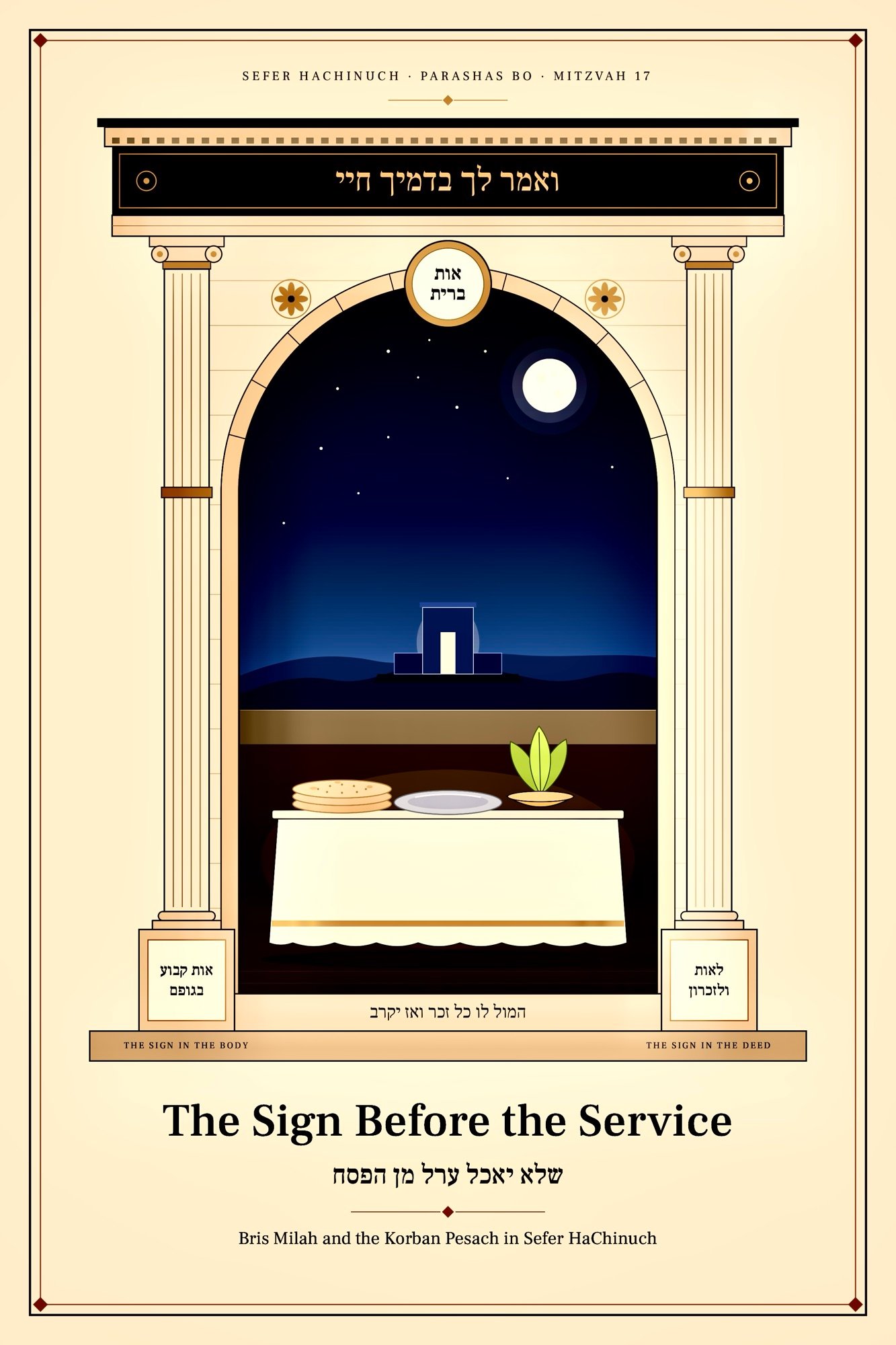
The Chinuch says the same thing in the idiom of covenant. Milah is אות קבוע בגופם (Mitzvah 2); the Pesach is an offering שאנו עושין אותו לאות ולזכרון (Mitzvah 13). One sign is borne in the body, the other performed in the deed, and the second presupposes the first. A brand is a fact about the body, not a verdict on the will — which is why the blameless arel still lacks it.
One entry earlier, in Mitzvah 16, the Chinuch gives his best-known rule, כי אחרי הפעולות נמשכים הלבבות, and applies it to the Pesach: each year we act out the station we reached at the Exodus, ומתוך המעשה והדמיון שאנחנו עושין, נקבע בנפשותינו הדבר לעולם. Read beside the Maharal, the Pesach is the deed through which servitude becomes real and the covenant is set in the soul. The arel already has the faith; what he lacks is the sign that would let the deed be his.
Questions for the Beis Midrash
Six questions remain open for chavrusa and shiur.
- Who is commanded? Mitzvos 13 and 14 forbid feeding (שלא להאכיל); Mitzvah 17 forbids eating (שלא יאכל). Chochmas HaChinuch notes that for the Rambam (Lo Saaseh 128) the prohibition of Mitzvah 13 rests on the Jew who feeds, not on the apostate. Is the arel addressed directly because he, unlike the toshav and sachir, is a commanded Jew — the same reason he is obligated in matzah and maror?
- The meshumad la’arelus. The Chinuch includes him here by kal vachomer. Does he also fall under the “ben nechar” of Mitzvah 13, so that one who feeds him transgresses there as well?
- Matzah without the Pesach. If matzah and maror chiefly accompany the offering (Mahari Korkos), why does בו leave them untouched? Does this show matzah’s independence — the Chinuch counts it separately as Mitzvah 10 — and how does maror, which has no mitzvah of its own in his count, fare (Chiddushei HaRan; Minchas Chinuch §27)?
- A derived lav in the count. The Rambam counts the arel’s terumah prohibition (Lo Saaseh 135; Chinuch 282) although it is learned by gezeirah shavah, stating that the bearers of the tradition received it as Biblical. Does the strength of the arel’s bond to toshav and sachir explain the exception?
- What is the sign? The Rambam bars a tumtum from terumah for a doubtful orlah, while a mashuch is permitted by Torah law and barred only rabbinically because he appears uncircumcised (Sefer HaMitzvos, Lo Saaseh 135). Is the disqualifying absence the act of milah, the bodily state, or its visibility?
- Mark or duty? The Maharal explains the exclusion by the servant’s missing mark. Yet a father with an uncircumcised son bears the mark himself and is still barred. Does the household bear the mark as one unit, or does the Chinuch’s language of duty (Minchas Chinuch §9) explain what the mark cannot? Relatedly, does the women’s question (Shaagas Aryeh §53; Minchas Chinuch §13) turn on whether a woman bears the duty of her son’s milah?
Conclusion
Mitzvah 17 teaches that the Pesach is a covenant meal, and that the way in is the sign in the flesh — not merit, and not sentiment.
The Chinuch builds that teaching from three choices: a blameless paradigm, a one-word limit, and a shoresh that seats the arel among those still at the covenant’s threshold. Chochmas HaChinuch and the Minchas Chinuch sharpen it into a halachic distinction — status for the man himself, duty for his household. The Maharal, as the Book of Mitzvos presents him, gives it its inner meaning: the mark comes first, and the service follows.
ונוהגת בזמן הבית. In our exile every Seder table resembles the arel’s: matzah and maror, and no Pesach. Our lack waits for the Beis HaMikdash; his waits for the day his milah is safe.
For those who teach, the lesson lies in how the law is framed. It is not a punishment of the uncircumcised but a definition of the Pesach, and the same Torah that bars the blameless arel from the offering obligates him in matzah and maror as a full Jew. Every bris performed in our day readies one more Jew for the Pesach we await, במהרה בימינו.
Sources and Translations
Every source below is either Sefer HaChinuch, a work on it, the Rambam’s Sefer HaMitzvos, or a source cited by the Book of Mitzvos notes.
Sefer HaChinuch and works on it
- Sefer HaChinuch, Mitzvos 2, 5, 10, 13, 14, 16, 17 and 282. The Hebrew of Mitzvos 13, 14, 16 and 17 was checked against a Sefaria source sheet for Parashas Bo; Mitzvah 282 is quoted in the Sefaria English translation, from an OU compilation of the terumah mitzvos.
- Sefer HaChinuch — The Book of Mitzvos edition, Mitzvah 17, pp. 157–160: text, elucidation, notes 1–10, and the Insight “Bris Milah and Korban Pesach.”
- Minchas Chinuch, Mitzvah 17, §§9, 11, 13, 18 and 27, as cited in the Book of Mitzvos notes and in Chochmas HaChinuch.
- Rabbi Elchanan Poupko, Chochmas HaChinuch, vol. 1, Mitzvah 17 (printed pp. 77–82), with its notes to Mitzvos 13 and 14; it also cites Rambam, Hilchos Terumos 7:10–12.
The Rambam’s Sefer HaMitzvos
- Lo Saaseh 126, 127 and 128: the toshav and sachir, the arel, and the apostate.
- Lo Saaseh 135: the arel and terumah, by the gezeirah shavah of toshav v’sachir.
Cited through the Book of Mitzvos notes and Insight
Pesachim 28b, 61a–63a, 96a; Yevamos 70a–74a; Tosafos, Zevachim 22b; Kereisos 2a; Shabbos 58a; Kiddushin 22b; Mechilta and Mechilta DeRabbi Shimon bar Yochai; Rambam, Hilchos Korban Pesach 5:4–6 and 9:8–9; Mahari Korkos; Chiddushei HaRan; Maharsha; Shaagas Aryeh §53; Yoreh Deah 263:2 with Pischei Teshuvah; Maharal, Gur Aryeh and Gevuros Hashem ch. 35; Pachad Yitzchak, Pesach §42.
Translations
- Verses follow the JPS 1917 Tanakh: Exodus 12, Ezekiel 16, and Bereshit 17:11.
- The English rendering of the Chinuch’s Mitzvah 17 is the author’s own.