
The Light of Redemption and Education: A Rabbinic Commentary on Sefer HaChinuch (The Book of Mitzvos)
“Let No Man Leave His Place”: Techum Shabbos in Sefer HaChinuch, Mitzvah 24
Parashas Beshalach · A commentary for rabbis, rebbes and scholars
Nov 28, 2026 · @Kamil Levi Pyka-Penner
The first Shabbos mitzvah in the Chinuch’s order
Parashas Beshalach yields a single mitzvah in Sefer HaChinuch, and it is the first mitzvah of Shabbos that his reader meets: שֶׁלֹּא נֵצֵא בְּשַׁבָּת חוּץ לַתְּחוּם, not to go beyond the techum on Shabbos. Before Parashas Yisro brings the sanctification of the day and the prohibition of melachah, the Chinuch’s student learns that Shabbos begins with a boundary.
The source is the manna narrative: אַל יֵצֵא אִישׁ מִמְּקֹמוֹ בַּיּוֹם הַשְּׁבִיעִי, “let no man go out of his place on the seventh day” (Shemos 16:29). The whole mitzvah turns on one word, מְקֹמוֹ, “his place.” What is a person’s place on Shabbos, how far does it reach, and who has the authority to draw its edge?
This essay reads the Chinuch’s answer as it appears, with elucidation and notes, on pages 201–207 of the Schottenstein Edition, Sefer HaChinuch / Book of Mitzvos (ArtScroll/Mesorah, volume 1). Its claim is that the entry is built in layers, and that the layers are the lesson.
- Layers of place. Four amos in an open field; a whole enclosure or cave; an entire city, however large.
- Layers of law. A Torah-level limit of three parsahs, or twelve mil, and a Rabbinic fence of 2,000 amos.
- Layers of authority. The Rambam’s count, which the Chinuch follows, and the Ramban’s view that there is no Torah-level techum at all, toward which the Chinuch, as the edition notes, appears to lean.
The Chinuch ties these layers to the purpose of Shabbos. The Creator rested on the seventh day, so we rest by remaining in one place; twelve mil is a distance walked without great exertion, as a stroll. And where the Torah layer meets the Rabbinic one, the Minchas Chinuch finds his sharpest questions.
I. The architecture of the entry
The Chinuch builds Mitzvah 24 on his familiar frame and then closes with a dissent that would remove the mitzvah from the count altogether. Read in order, the entry has six movements.
- Source. ויהי בשלח יש בה מצות לא תעשה אחת: Beshalach holds one prohibition, that we are restrained from walking on Shabbos beyond known boundaries, as the verse says, “let no man go out of his place.”
- Measure. The received interpretation fixes “his place” at three parsahs beyond the city. A parsah is four mil and a mil is 2,000 amos, measured from the outermost house “even if the city is as large as Nineveh.” That is Torah law; the Sages then fenced it at 2,000 amos.
- Root. We are to remember that the world was created, and so we rest in one place, walking only for pleasure. Twelve mil, he adds, involves no great exertion.
- Laws. A compressed index of Tractate Eruvin, ending ויתר פרטיה מבוארים במסכתא הבנויה על זה: the rest is set out in the tractate built on this subject.
- Applicability and penalty. Everywhere, at all times, for men and women. One amah past three parsahs brings malkus; one amah past 2,000 amos brings makkas mardus.
- Dispute. The Ramban holds that there is no Torah-level techum at all, and reads the verse as a prohibition of carrying.
The list of laws has an order of its own. It moves from the person (one who begins Shabbos in a desert or a cave, who leaves willingly, under duress or with the beis din’s permission) to the city (which buildings extend it) to the measurement (city shapes, the rope, valleys and walls, surveyors and witnesses). The edition’s note 21 locates this material chiefly in chapters 3–5 of Eruvin (26b–61b) and in Shulchan Aruch, Orach Chaim 396–416.
Two small details repay attention. Some printings title the mitzvah שלא נלך בשבת חוץ לתחום, “not to walk”; the Machon Yerushalayim text in this edition reads שלא נצא, “not to go out,” closer to the verse’s אל יצא. Whatever the variant’s origin, the two verbs name the two ways later authorities would model the offense, as a distance walked or as a boundary crossed (Section V).
The second detail is how the entry ends. The Chinuch does not answer the Ramban; he explains him, closing with the Ramban’s reading of the verse and its precedent in Eruvin 17b. The last word of the mitzvah belongs to the view that it is not a Torah mitzvah at all.
II. “His place”: how the halachah draws the circle
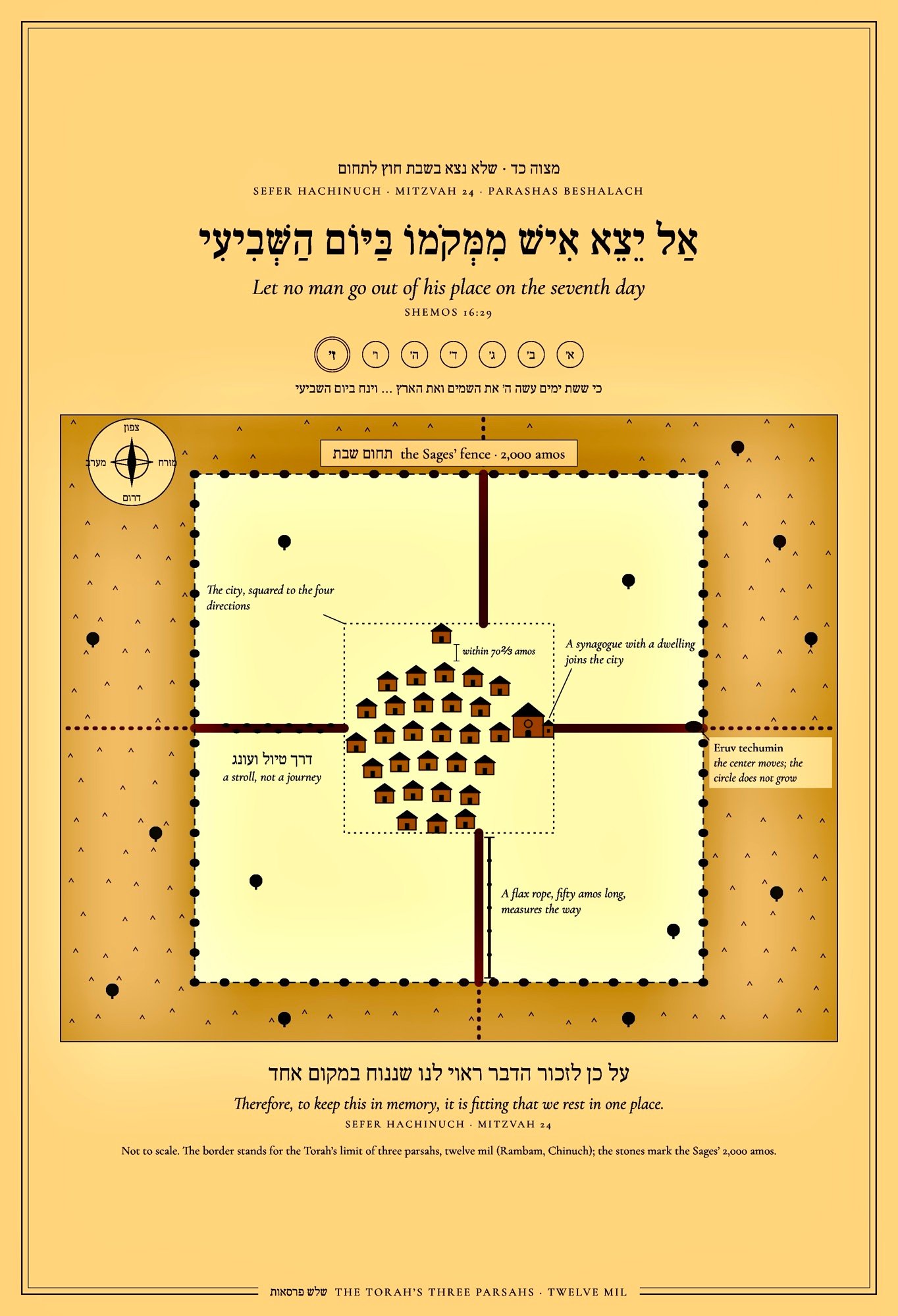
For the Chinuch, “his place” is a region, not a point. It is measured outward from where a person is when Shabbos begins: three parsahs by Torah law, 2,000 amos by the Sages’ fence.
The Torah measure. The Chinuch states it in one breath: ובא הפירוש עליו שמקומו נקרא כל שאינו מרחיק יותר משלש פרסאות חוץ לעיר, “the received interpretation is that his place means anywhere not more than three parsahs beyond the city.” Three parsahs are twelve mil, or 24,000 amos. The edition’s note 4 traces the tradition to the Yerushalmi (Eruvin 3:4, 5:4; Pesachim 6:1), which ties it to the camp of Israel in the wilderness, three parsahs by three (so too Bavli Eruvin 55b). The dimensions of the camp became the measure of a Jew’s place.
The city as one’s residence. Measurement begins משפת הבית החיצון שבעיר, from the edge of the outermost house, however large the city. The notes give the principle: the techum runs from one’s makom shevisah, where one halachically resides as Shabbos begins (notes 6, 9). In an open field that is four amos; in an enclosure or a cave, the whole of it, whatever its size; in a city, the whole city (Eruvin 42a, 61b; Rambam, Hilchos Shabbos 27:2, 4, as cited). A city dweller does not walk 2,000 amos from his door. He crosses the entire city and then walks 2,000 amos beyond it.
What makes a city. The Chinuch’s list of borderline structures shares one criterion. A house that juts out still joins the city if it lies within “seventy amos and a fraction,” which the notes fix at 70⅔ amos (note 12). A synagogue, a pagan temple or a storehouse extends the city only if someone lives in it: the sexton, the priests, the watchmen (note 13). Ruins count if three walls stand, or two under a roof (note 14).
The test is habitation, דירה, not sanctity or use. A synagogue with no dweller does not extend the city; a pagan temple with a resident priest does. For a city dweller, then, “his place” is the settlement of people who live together.
Shapes, rope and terrain. A round, bow-shaped or gamma-shaped city is squared to the cardinal directions before the 2,000 amos are measured (note 15, with the edition’s diagrams A and B). The rope is flax, as in Yechezkel’s “line of flax” (40:3), and exactly 50 amos long: a longer rope sags and shortens the measure, a shorter one stretches and lengthens it (notes 16–17). Valleys and hills are measured across, horizontally, so that terrain does not shrink the limit (note 18).
Only an expert surveyor is relied upon (note 19). Yet because the 2,000 amos are Rabbinic, even witnesses unfit for Torah testimony may report how far people customarily walked, and no new survey is needed (note 20).
The Sages’ fence. The Sages reduced the limit to 2,000 amos, one mil, a twelfth of the Torah measure (note 7). They chose that figure because the Torah gives each Levitical city 2,000 amos of open land (Bamidbar 35:4–5 with Rashi; Eruvin 51a), so that ring is regarded as belonging to the city. The note adds Rashi on Bamidbar 2:2: the tribes camped within a mil of the Ohel Moed so they could reach it on Shabbos.
Both limits, then, come from the way Israel dwelt. The outer one comes from the camp; the inner one from the city’s open land and the distance to the Sanctuary.
In modern terms. The edition’s chart (note 7) gives three accepted equivalents, reproduced here as printed.
Authority
Amah
2,000 amos (one mil)
Three parsahs (12 mil)
R’ Chaim Noeh
48 cm (18.9 in.)
0.96 km (0.6 mi.)
11.52 km (7.15 mi.)
Igros Moshe
54 cm (21.3 in.)
1.08 km (0.67 mi.)
12.96 km (8.04 mi.)
Chazon Ish
57.6 cm (22.8 in.)
1.15 km (0.72 mi.)
13.8 km (8.64 mi.)
Moving the center: eruvei techumin. The edition’s Insight completes the picture. Before Shabbos one may establish a residence up to 2,000 amos away, either by being there as Shabbos begins or by placing food there. One may then walk to that point and 2,000 amos beyond it, up to 4,000 amos in that direction (Shulchan Aruch, Orach Chaim 409:7–11, as cited).
The eruv does not enlarge the circle; it moves its center, and what is gained in one direction is lost in the other. It may be set only for a mitzvah purpose, such as consoling mourners, a wedding feast or greeting one’s teacher (Orach Chaim 415:1 with Mishnah Berurah). The eruv confirms the principle of the whole mitzvah: the techum follows residence.
techum limits to scale · Torah limit, Sages’ fence, eruv
Measured from the edge of one’s place, the Sages’ 2,000 amos are one-twelfth of the Torah’s three parsahs. An eruv techumin moves the starting point and reaches at most 4,000 amos, in one direction only.
III. The root: creation, rest in one place, and twelve mil
The Chinuch roots the techum in the belief that the world was created. From that root he derives both the form of the mitzvah, rest in one place, and its Torah measure, twelve mil.
משרשי מצוה זו, שנזכור ונדע שהעולם מחודש ולא קדמון, כמו שכתוב בפירוש במצות שבת: כי ששת ימים עשה ה’ את השמים ואת הארץ את הים ואת כל אשר בם וינח ביום השביעי. על כן לזכור הדבר ראוי לנו שננוח במקום אחד, כלומר שלא נלך בדרך רחוק רק דרך טיול ועונג, ובהליכת שנים עשר מילין אין בו טורח רב.
Among the roots of this mitzvah: that we remember and know that the world is newly made and not primordial, as Scripture says explicitly of the mitzvah of Shabbos, “for in six days Hashem made heaven and earth, the sea, and all that in them is, and rested on the seventh day.” Therefore, to keep this in memory, it is fitting that we rest in one place; that is, that we not walk a long road, only in the manner of a stroll and of delight. And in walking twelve mil there is no great exertion.
From rest to place. The hinge is one word, וינח. The Creator “rested,” and the Chinuch draws from it more than cessation from labor, which Mitzvah 32 will teach. He draws rest in one place, שננוח במקום אחד. Rest has a spatial dimension: to rest is to stay. The verse in Beshalach says it in its own words: שבו איש תחתיו, “abide ye every man in his place,” that is, let each of you stay where he is.
Walking as delight. The Chinuch does not forbid walking. He forbids the long road and permits דרך טיול ועונג, the stroll taken for pleasure. The Rambam’s Sefer HaMitzvos frames the prohibition as one of journeying, מלנסוע; the Chinuch’s root explains why. A journey is exertion, and exertion is not rest. The walk that remains permitted belongs to the delight of the day.
A reason for a number. Halachic measures are usually transmitted rather than explained, and the Chinuch introduces this one as transmitted (ובא הפירוש עליו). Yet he adds a reason: twelve mil involve no great exertion. The measure marks the outer edge of leisure, the farthest one can walk and still be at rest.
The edition’s note 8 draws the consequence. Within twelve mil, a person’s walking is leisurely and he is still “in his place”; beyond it, he has traveled out. “His place” is defined by experience: it extends as far as rest extends.
One root for all of Shabbos. The edition’s elucidation remarks that the remembrance of creation is the purpose of all the Shabbos mitzvos, and the Chinuch bears this out. In Mitzvah 31, Kiddush is meant to fix in our hearts faith in the world’s creation. In Mitzvah 32, we are to be free of our occupations in honor of the day so that belief in creation is set in our souls; he calls that belief the cord that draws after it all the foundations of the faith.
Mitzvah 24 is the first place in the book where the memory of creation is tied to Shabbos. In the Chinuch’s order, the reader meets the theology of Shabbos through a boundary before he meets it through labor.
Why a limit on the feet teaches a belief. The Chinuch’s own principle explains how a rule about walking can carry a truth about the cosmos. In Mitzvah 16 he writes that a person is shaped by his actions, כי אחרי הפעולות נמשכים הלבבות, “for hearts are drawn after deeds.” The Jew who stays within his techum enacts with his body what the root asks him to remember and know, שנזכור ונדע: that the world has a Maker who rested.
The root gives a reason for twelve mil of Torah law. It is all the more striking, then, that the Chinuch closes the entry with the view that there are no Torah-level twelve mil at all.
IV. One verse, three positions
The verse אל יצא איש ממקומו yields three positions in the sources behind this entry. The Chinuch takes his count from the Rambam’s Sefer HaMitzvos, his measure from the Rambam’s Mishneh Torah, and, it seems, his sympathy from the Ramban.
Position
Torah-level limit
The 2,000 amos
Support, as cited in the edition
Rambam, Sefer HaMitzvos, Lo Saaseh 321
2,000 amos
Torah law
She’iltos (Beshalach §48), Halachos Gedolos (Hilchos Eruvin §10), Rabbeinu Ephraim (note 27)
Rambam, Mishneh Torah, Hilchos Shabbos 27:1; the Chinuch
Three parsahs (12 mil)
The Sages’ fence
Yerushalmi, Eruvin 3:4, 5:4 and Pesachim 6:1 (note 4)
Ramban, glosses to Sefer HaMitzvos, Lo Saaseh 321
None
A Rabbinic institution
Talmud Bavli, e.g. Shabbos 69a, 153b; Eruvin 36a; Beitzah 36b (note 29)
The Sefer HaMitzvos. The Rambam’s enumeration counts the prohibition and sets its line at 2,000 amos: ובא בקבלה שתחום המסע הוא מה שנוסף על אלפים אמה, “it has come down by tradition that the limit of travel is whatever exceeds 2,000 amos.” A study of this mitzvah in Yeshivat Har Etzion’s series on the Minchas Chinuch notes that this follows Rabbi Akiva, for whom the 2,000 amos are themselves Torah law.
The Mishneh Torah. In his code the Rambam places the Torah line at twelve mil and treats 2,000 amos as a fence. The Ramban, as the Chinuch reports him, calls this a retraction, שחזר מזה. The Chinuch adopts the code’s measure without comment; the edition’s note 28 calls it the Rambam’s final ruling.
The Ramban. The Chinuch quotes the Ramban’s verdict on both of the Rambam’s positions: כי הכל טעות, שאין לנו איסור תחומין דאורייתא כלל, “it is all an error, for we have no Torah prohibition of techumin at all.” The proof, he reports, appears in many places in “our Gemara, the Talmud Bavli, upon which we rely in all our matters,” and “the Master multiplied his proofs” in his glosses to Lo Saaseh 321. (The printed text reads שי”ג; the edition corrects it to שכ”א.)
On this reading the verse is not about techum at all. Read as אל יוציא, “let no man take out,” it warns against carrying from one domain to another, as Rav Yonasan reads it in Eruvin 17b (note 31). Rav Ashi there replies that the verse says יצא, not יוציא.
Where the Chinuch stands. The edition’s note 30 reads the Chinuch as inclined toward the Ramban, and three features of the text support that reading.
- He gives the Ramban the last word, with no rebuttal.
- He reports the Ramban’s appeal to “our Gemara” without demurral; and the principle behind it, that the Bavli governs where it differs from the Yerushalmi, he affirms in his own Introduction (note 29).
- He calls the Ramban הרב, “the Master,” who הרבה ראיותיו, “multiplied his proofs.”
Why, then, count it? Because, as the Introduction states (note 30), the book is built on the Rambam’s reckoning of the 613. The edition points to a parallel at Minchas Chinuch 27:2, and recalls that the Ramban, at the end of his glosses, adds mitzvos of his own to replace those he removes. The Opening Letter shows how well the Chinuch knew that work: it praises the Ramban’s ספר נכבד מאד בחשבון המצות, “a very esteemed book on the reckoning of the mitzvos,” while naming the Rif and the Rambam as the pillars from whom most of the book is gathered.
What this shows about the book. For the Chinuch, the count is a received framework, not a series of fresh rulings. He can stand inside it and still tell his reader plainly that a great authority would remove this very mitzvah from it. For the scholar, Mitzvah 24 is a clean case of the difference between enumerating and deciding. For the teacher, it is a model: present the strongest dissent to what you teach, and let the student see the whole field.
V. The Minchas Chinuch at the seam between Torah law and Rabbinic law
Once the techum has a Torah layer and a Rabbinic layer, every mechanism in its laws must be placed on one side of the seam or the other. The Minchas Chinuch’s comments on Mitzvah 24 work through that placement, and his questions reduce to one: what defines “his place,” and who can change it? (Section numbers follow the edition’s citations.)
The eruv: can it move a Torah-level place? (§2). The edition’s Insight frames the doubt. If the eruv is a Rabbinic device, perhaps it relocates one’s residence only for the 2,000 amos, and walking three parsahs past one’s home would still breach Torah law. The Minchas Chinuch asks it sharply: אבל בדאורייתא מנלן דמהני עירוב, “but for Torah law, how do we know an eruv works?”
His answer runs the other way: וכן בדאוריית’ בג’ פרסאות לשיטות אלו מהני ג”כ עירוב או בפת או ברגל. On these views an eruv works for the Torah’s three parsahs as well, made with bread or on foot. He reasons from the Gemara’s treatment of Rabbi Meir, who holds techumin to be Torah law and still recognizes the eruv, so the eruv itself must carry Torah force. He finds the Tur’s contrary implication difficult (צ”ע), and the text adds a reference to the Ramban’s novellae on Eruvin to the same effect. For the wider debate the edition points to the Ramban (Eruvin 17b), the Or Same’ach (Hilchos Shabbos 27:1) and the Divrei Yechezkel (7:7, 16).
The logic is worth stating. The eruv does not license leaving one’s place; it settles where one’s place is. The verse forbids leaving מקומו, and the eruv answers the prior question of what מקומו is.
The Sages’ permission: can it reach past three parsahs? (§4). The Sages allowed a midwife, a rescuer and the like to leave the 2,000 amos, granting a new 2,000 amos where they arrive (note 10). The Minchas Chinuch confines this to the Rabbinic layer. One who passes the Torah’s three parsahs, even for an emergency, gains no new techum, because the Sages cannot uproot a Torah prohibition: אבל אם כלתה הסכנה ודאי אסור לילך, “but once the danger has ended, he certainly may not walk.”
Permission does not relocate one’s place; it excuses leaving it. An excuse granted by the Sages reaches only as far as their own fence.
After leaving: is the offense a crossing or a distance? (§5). One who has left his techum is confined to four amos (note 10). The Minchas Chinuch holds that leaving by even one amah brings lashes (דיוצא חוץ לתחום אפילו אמה לוקין), and that each further four amos beyond the confinement is a fresh violation, each needing its own warning. The edition sets the Ramban against him (note 24): there is no new violation until one walks another three parsahs.
The Ramban’s reasoning, as the Har Etzion study quotes it from his novellae to Eruvin, makes his model explicit: ג’ פרסאות בהלוך של תורה כארבע אמות של העברה ברשות הרבים. Three parsahs of walking are like four amos of carrying in the public domain. The offense is a distance traversed, and there is no Torah liability until one has walked twelve mil.
The Or Same’ach, cited in the same study, presses the difficulty. On the Ramban’s model, a rescuer who walked permissibly to the end of three parsahs and then stepped beyond would escape lashes unless he walked a further twelve mil, yet the warning and lashes would still attach to the final amah. He calls the result strange and proposes the other model: היוצא מחוץ לתחום הוי כמוציא מרשות הרבים לרשות היחיד. Leaving the techum is like carrying from one domain into another; the offense is a crossing.
The Minchas Chinuch’s ruling, though earlier, fits the second model. After a departure, one’s place contracts to four amos, and every exit from it is a new going out. The Chinuch’s own wording holds both ideas together: והלך אפילו אמה אחת יותר משלש פרסאות, “he walked even one amah beyond three parsahs.” His root explains where the line falls, by the measure of exertion; his penalty attaches at the line itself.
Possessions: whose place does an object keep? (§§8, 12). Animals and objects have a techum too, mainly relevant on Yom Tov, when carrying is permitted (note 21). The Minchas Chinuch states the rule, בהמה וכלים כרגלי הבעלים, “animals and vessels are like the feet of their owners,” and records later authorities on both sides of whether it is Torah law. Even things have a place, and they borrow it from their owner.
The pattern. What settles where one’s place is, the eruv, reaches the Torah layer on the Minchas Chinuch’s view. What only excuses leaving it, the Sages’ permission, does not. After a departure the place shrinks to four amos, and the dispute turns on whether the offense is measured in distance or in crossings. In each answer the governing term is the one the Chinuch defined in his opening lines: מקומו.
VI. Applicability and penalty: the weight of this lav
The Chinuch closes the laws with his usual formula and a doubled penalty that mirrors the doubled boundary.
ונוהגת בכל מקום ובכל זמן, בזכרים ונקבות. ועובר עליה והלך אפילו אמה אחת יותר משלש פרסאות, לוקה. וכן אם הלך אפילו אמה חוץ לאלפים אמה סמוך לעיר, לוקה מכת מרדות דרבנן.
It applies in every place and at every time, to men and to women. One who transgresses it and walks even a single amah beyond three parsahs receives lashes. And if one walks even an amah beyond 2,000 amos near the city, he receives Rabbinic lashes of discipline.
Everywhere, always, men and women. The edition explains the formula: in Eretz Yisrael and outside it, whether or not the Beis HaMikdash stands, and for women by the general rule for prohibitions (notes 22–23). Its note 3 adds that the techum governs Yom Tov as well (Beitzah 37a–40a; Orach Chaim 515).
Two layers, two penalties. One amah past the Torah line brings malkus, the standard punishment for a Torah prohibition. One amah past the Sages’ line brings makkas mardus, the discipline a beis din may impose for breach of a Rabbinic decree (note 25). The phrase “even one amah” appears at both edges: each line is exact.
A lav, not a melachah. Melachah on Shabbos is a capital offense (Mitzvah 32); leaving the techum carries lashes alone (note 24). The Minchas Chinuch explains why on the Rambam’s view: the prohibition is גזירת הכתוב דאינו מלאכה רק לאו בפ”ע, a scriptural decree and a prohibition in its own right, not a form of melachah. So אין בה מב”ד ולא כרת ולא חטאת רק לאו דמלקות: no death by beis din, no kares, no chatas, only lashes.
The Chinuch’s two roots differ in the same way. Mitzvah 32 asks that we be free of our occupations; Mitzvah 24 asks that we rest in one place. Both serve the memory of creation, but they govern different dimensions of a person’s day: his work and his movement.
Conclusion: what the techum teaches
The Chinuch’s entry for Mitzvah 24 is brief, and it is complete. In a few lines it defines a person’s place, roots that definition in the creation of the world, indexes a tractate, sets a doubled penalty and records the view that would remove the mitzvah from the count.
Its lesson is the one its layers teach together. A Jew’s place on Shabbos is concentric: four amos, an enclosure, a city of dwellings, then 2,000 amos, then twelve mil. Each ring is drawn from something real: habitation, the camp of Israel, the open land of the Levites, the length of a walk that does not tire. Each is guarded by an authority suited to it, the Torah’s line by the Torah’s punishment and the Sages’ fence by theirs.
The author wrote, his Opening Letter says, so that the young would ask one another how many mitzvos this Shabbos holds and would ישימו לב בהם בשבתות ובחגים, take them to heart on Shabbosos and festivals. A reader who met Mitzvah 24 that way, on Shabbos Beshalach, learned the law while keeping it. He sat in his place and learned why: the world has a Maker, and the Maker rested.
For the rabbi, the entry carries a teaching beyond the laws of eruvin. In a contiguous city the techum seldom binds, since the whole city is one’s place; the Chinuch explains why it still matters. It is a statement about creation, made with the body.
For the scholar, the entry is a window on the Chinuch as author: faithful to the count he inherited, candid where it was contested, and so precise in his definitions that a commentator some six centuries later could build a theory of the techum on a single word.
אל יצא איש ממקומו: to know one’s place on Shabbos is to know whose world it is.
Questions for the beis midrash
- The Chinuch justifies twelve mil by the absence of great exertion. Does that reason also explain the Sages’ 2,000 amos, or does the fence rest only on the Levitical open land and the distance to the Ohel Moed (note 7)?
- If the eruv has Torah force (Minchas Chinuch §2), why may it be set only for a mitzvah purpose (Orach Chaim 415:1)? Is that restriction itself Rabbinic, and what does it reveal about the eruv’s nature?
- The Ramban measures the offense by distance, the Or Same’ach by crossing. Which better explains the Chinuch’s phrase והלך אפילו אמה אחת יותר משלש פרסאות, and does the title variant שלא נלך / שלא נצא bear on the question?
- A building joins the city only if someone dwells in it. Is “his place,” then, personal or communal? What follows for one who begins Shabbos alone in an open field, whose place is four amos?
- The techum applies on Yom Tov as well (note 3), though some melachah is permitted then. Does the root of resting in one place explain the Yom Tov techum, or does it call for another reason?
- How does the Chinuch’s practice here, counting with the Rambam while leaning toward the Ramban, compare with other mitzvos whose place in the count the Ramban disputes (see Minchas Chinuch 27:2)?
- The techum is stated beside the manna, though the Gemara cites views that it was commanded with the other laws of Shabbos (note 3). What does its place in the manna narrative teach?
Sources and a note on translations
Every source below is the Chinuch, the Book of Mitzvos on which it builds, or a work written on them.
- Sefer HaChinuch, Mitzvah 24, with Mitzvos 16, 31 and 32, the Introduction and the Opening Letter. The Hebrew follows the Machon Yerushalayim text as printed in the Schottenstein Edition. Opening Letter: Sefaria.
- The Schottenstein Edition Sefer HaChinuch / Book of Mitzvos, volume 1 (ArtScroll/Mesorah), pages 201–207: elucidation, notes 1–31, diagrams A–B and the Insight on eruvei techumin. Talmudic, Rishonim and halachic references in this essay are as cited there unless noted.
- Rambam, Sefer HaMitzvos, Lo Saaseh 321, with the Ramban’s glosses there, as reported by the Chinuch and the edition.
- Minchas Chinuch, Mitzvah 24, read in the Otzar HaSefarim HaShitufi text.
- R’ Shmuel Shimoni, “Mitzvah 24,” lesson 22 in the series עיון במצוות בעקבות המנחת חינוך, Yeshivat Har Etzion, 2023 (etzion.org.il). It is the source for the Ramban’s novellae to Eruvin, the Or Same’ach and the attribution to Rabbi Akiva, as quoted in Sections IV and V.
A note on translations. Scripture follows the JPS 1917 translation, which is in the public domain, with the Divine Name rendered “Hashem” and a plain gloss where its English is archaic. Renderings of the Chinuch, the Minchas Chinuch and the Sefer HaMitzvos are fresh translations made for this commentary.