
The Light of Redemption and Education: A Rabbinic Commentary on Sefer HaChinuch (The Book of Mitzvos)
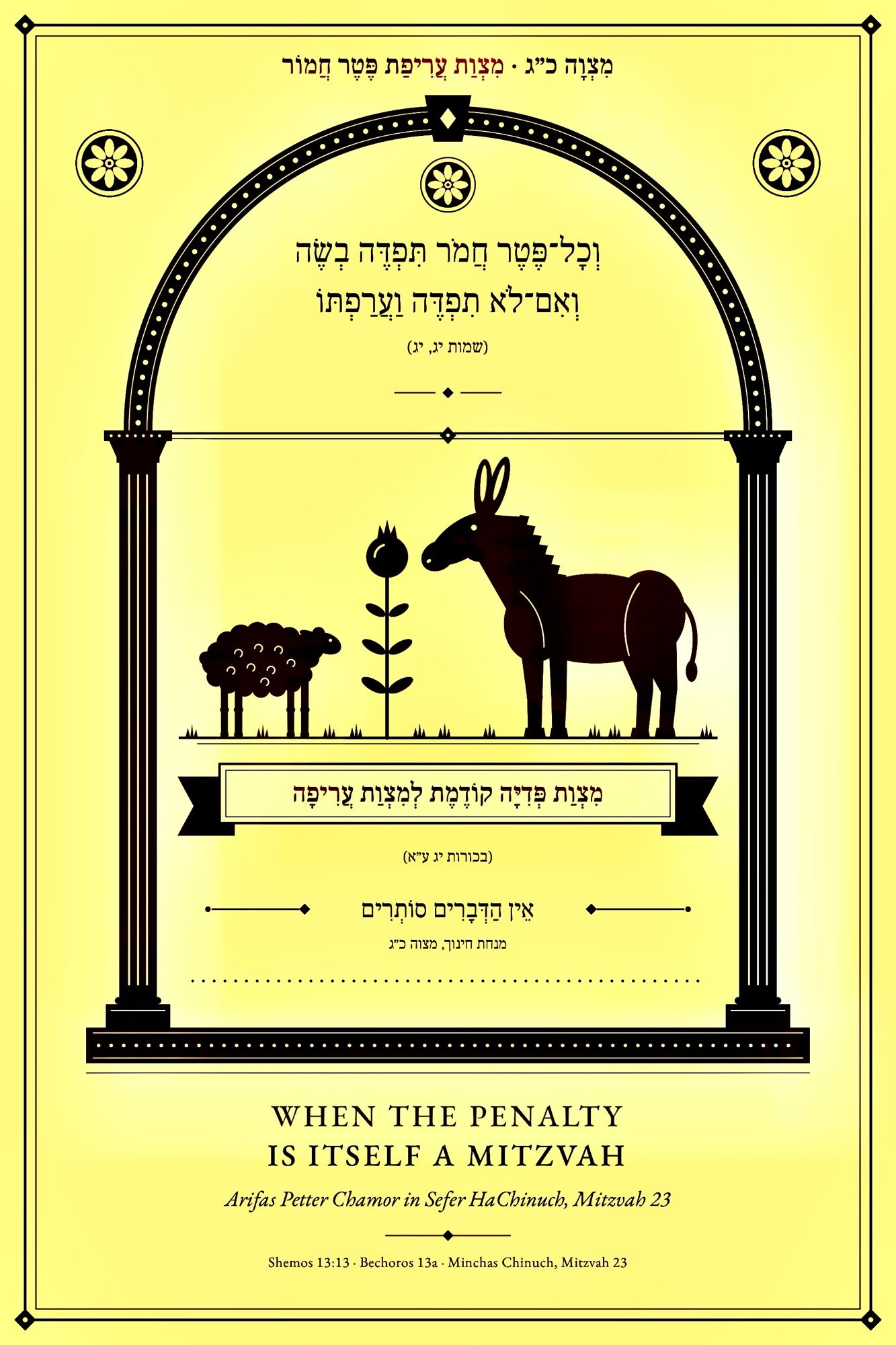
When the Penalty Is Itself a Mitzvah: Arifas Petter Chamor in Sefer HaChinuch, Mitzvah 23
Nov 28, 2026 · @Kamil Levi Pyka-Penner
To the Reader
The Chinuch counts the decapitation of an unredeemed firstborn donkey as a mitzvah, yet he explains it as a penalty. This commentary argues that he meant both, and that the Minchas Chinuch shows how both can be true at once.
It is written for rabbanim, rebbeim, and scholars who know the first perek of Bechoros and the literature of the minyan hamitzvos. It assumes the reader has the Chinuch open to Mitzvah 23 in the English edition, The Book of Mitzvos (pp. 195–197), with its notes and its boxed Insight, “Decapitation: Mitzvah or Penalty?”
By design, the essay draws only on the Sefer HaChinuch itself, the commentaries and studies written on it (chiefly the Minchas Chinuch), and the sources those works cite for this mitzvah. Among them are the Mishnah and Gemara in Bechoros, the Mechilta, Rambam’s Sefer HaMitzvos and Hilchos Bikkurim, the Raavad, the Bahag, and the Maharit Algazi. Readings that go beyond these sources are marked as suggestions.
Transliteration follows the edition’s Ashkenazic usage. Verses appear in Hebrew, with English drawn only from Jewish translations: the edition’s own rendering and the JPS 1917.
The Text and Its Place
Mitzvah 23 closes the twenty mitzvos the Chinuch finds in Parashas Bo, and it is among the shortest entries in his book. Nearly every line of it points back to Mitzvah 22, the redemption of the firstborn donkey.
The Chinuch keeps his usual four parts: the mitzvah and its verse, its root (shoresh), its laws (dinim), and where and to whom it applies. Here the shoresh is a single cross-reference, and the closing line simply says that the mitzvah follows the redemption. The weight of the entry rests on its opening paragraph:
לערוף פטר חמור אם לא רצה לפדותו, שנאמר (שמות יג, יג) ואם לא תפדה וערפתו. ענינה, שהורג ולד החמור אם לא רצה לפדותו, וגזר השם יתברך שלא יהנה בו מכיון שלא פדאו, ואפילו הנבלה אסורה לו בהנאה.
That is: to decapitate a firstborn donkey if one does not wish to redeem it, as it is said, “and if you do not redeem it, you shall decapitate it.” Its substance is that he kills the donkey’s offspring if he does not wish to redeem it. Hashem, blessed be He, decreed that he may not benefit from it, since he did not redeem it, and even its carcass is forbidden to him.
The verse (Shemos 13:13), in the edition’s own rendering: “And each firstborn donkey you shall redeem with a lamb; and if you do not redeem it, you shall decapitate it.”
One textual detail deserves notice. The edition prints the closing line as ונוהגת כמו הפדיה, following the first edition, Venice 5283 (1523), as its note 10 records; the standard printed text reads ונוהגת בכל כמו הפדיה. Either way, arifah inherits the scope the Chinuch set for redemption in Mitzvah 22: “ונוהגת בכל מקום ובכל זמן, בזכרים ונקבות ישראלים, ולא בכהנים ולוים.”
That last clause holds a quiet point. The author describes himself only as “איש יהודי מבית לוי ברצלוני,” a Levite of Barcelona, so this mitzvah never bound him. He set it out with full care all the same, for a reader he addresses as “בני” (Mitzvah 16). The Chinuch teaches the whole Torah, including the mitzvos its teacher could not perform.
Reading the Chinuch Closely
The Chinuch’s own words keep the owner’s will and the owner’s loss at the center. The laws his commentators add reach beyond the owner. That tension is the whole sugya in miniature.
The mitzvah is conditional. The phrase “אם לא רצה לפדותו” appears twice in three lines. Mitzvah 22 opens with no condition at all: “לפדות ולד חמור זכר שנולד ראשון.” Mitzvah 23 exists only as the outcome of a choice.
The reason is a decree that follows refusal. “וגזר השם יתברך שלא יהנה בו מכיון שלא פדאו.” The edition’s note 3 supplies the logic. The owner could have redeemed the donkey with a seh worth less than the donkey and kept the difference. Having refused, he forfeits its full value (Bechoros 10b). The animal was already forbidden for benefit from birth (note 6, Bechoros 9b); what he loses is the inexpensive way to release it.
The carcass is forbidden “to him.” The Chinuch writes “ואפילו הנבלה אסורה לו בהנאה.” The edition’s note 4 adds that it is forbidden to everyone and is buried so that no one comes to use it (Bechoros 10b; Rambam, Hil. Bikkurim 12:4). The Chinuch’s “לו” suits his penalty framing. The breadth of the halachah suits a status that inheres in the animal, whoever owns it.
The shoresh is borrowed whole. “משרשי מצוה זו, מה שכתוב בפדיה.” Arifah has no root apart from redemption’s. A later section returns to what that root is, and why it fits.
The dinim open with a ranking and then speak of a commanded form. The first law is “מצות פדיה קודמת לעריפה” (Bechoros 13a). Soon after comes “וכי מצוה להרגו בקופיץ ולא בדבר אחר,” in the language of commandment.
The Chinuch therefore writes of arifah both as a decreed loss and as a mitzvah with a prescribed form. The edition’s Insight calls this combination “puzzling.” The rest of this essay argues that it is deliberate.
The Count: Rambam, the Raavad, and One Word in the Mishnah
Rambam counts arifah as a separate mitzvah only because the Mishnah calls it one, and he says so himself. The Raavad answers that the word is a turn of phrase and that arifah is a sin.
In Sefer HaMitzvos (Asei 81–82; see Hil. Bikkurim 12:1), Rambam lists redemption and decapitation separately. In Asei 82 he raises the objection against himself. His Seventh Principle forbids counting the laws of a mitzvah as mitzvos of their own; why, then, is decapitation not simply a law of redemption? His answer is candid:
הנה יודע האל כי ההיקש מחייב זה, לולא מה שמצינו לרבותינו לשון יורה על זה היותם שתי מצות.
God knows that reason would require a single count, were it not for language of our Sages showing that these are two mitzvos. That language is the Mishnah the Chinuch cites, “מצות פדיה קודמת למצות עריפה,” which Rambam quotes together with the clause beside it, “מצות יבום קודמת למצות חליצה.” The yevamah stands ready for yibbum or chalitzah, and each is a mitzvah. So too “פטר חמור ראוי או לפדיה או לעריפה, וכל אחד ואחד מצוה.”
The Chinuch adopts this count, as his enumeration generally follows Rambam’s Sefer HaMitzvos.
The Raavad, glossing Hil. Bikkurim 12:1, rejects it in unusually sharp terms: “בחיי ראשי, אין זה מן הפלפול ולא מן הדעת המיושבת שיחשוב זה במצות עשה.” Arifah, he says, is not to be counted a mitzvah; rather “היא עבירה, ומזיק נקרא ומפסיד ממונו של כהן.” The Mishnah wrote “mitzvas arifah” only because it had just written “mitzvas pidyah.” The Insight cites the Bahag (Asei §7) alongside him.
The dispute is narrower and deeper than it first appears. Both Rishonim read the same Mishnah. Rambam lets the Sages’ terminology override his own principle of enumeration; the Raavad lets the logic of the case override the terminology. Rambam’s admission that reason favored a single count gives the Raavad real weight. It also makes the Chinuch’s choice all the more interesting: he follows Rambam’s count, yet writes a rationale that sounds like the Raavad’s.
Two Readings in the Mechilta
The Mechilta reads the verse twice, and the Maharit Algazi traces Rambam and the Raavad to those two readings. On his map, the Chinuch seems to stand on both sides at once.
The Insight cites the Mechilta as Bo 18; R. Shmuel Shimoni, in his study of the Minchas Chinuch, quotes its text:
ואם לא תפדה וערפתו – מכאן אמרו: מצות פדייה קודמת למצות עריפה. דבר אחר: ואם לא תפדה וערפתו – אם אין אתה פודהו, עורפהו; הואיל ואבדת נכסי כהן, אף נכסיך יאבדו.
“And if you do not redeem it, you shall decapitate it”: from here they said, the mitzvah of redemption comes before the mitzvah of decapitation. Another reading: if you do not redeem it, decapitate it, for since you caused the Kohen’s property to be lost, your property too shall be lost.
The first reading ranks two mitzvos. The second reads the verse as measure for measure: you withheld the Kohen’s seh, so you lose your donkey. The Minchas Chinuch notes that the Gemara gives the same rationale in the name of Levi (Bechoros 10b).
The Maharit Algazi (Hil. Bechoros, ch. 1, as cited in the Insight) sees these as the sources of the two Rishonim. On the first reading arifah is a secondary mitzvah, as Rambam holds. On the second it is no mitzvah at all, only a penalty for diminishing the Kohen’s property, as the Raavad holds. The Minchas Chinuch also records that the Maharit Algazi reported a great authority who was likewise puzzled by the Mishnah’s wording: “והמהריט״א הביא בשם גדול א׳ תמה ג״כ על המשנה.” The difficulty is an old one.
If that map is right, the Chinuch has a problem. He counts arifah with the first reading and explains it with the second.
The Minchas Chinuch: A Penalty That Is Also a Mitzvah
The Minchas Chinuch answers that the two readings do not conflict: arifah can be a penalty in its purpose and a mitzvah in its nature. “אין הדברים סותרים,” he writes (Mitzvah 23, §1).
On this view, Levi’s rationale explains the mitzvah; it does not abolish it. The owner’s loss is why the Torah commands arifah, not a reason to deny that it commands it. The Chinuch is the proof. He counts arifah with Rambam and gives it the penalty rationale in the same breath, and saw no contradiction in doing so. It is the Raavad who concludes from the penalty rationale that no mitzvah remains. The Minchas Chinuch adds that the halachah follows the anonymous Mishnah, which speaks of “mitzvas arifah.”
The principle will be familiar to every lamdan: the ta’am of a mitzvah does not fix its geder. A commanded act can serve a punitive purpose and still be a mitzvah. As the Insight puts it, one who refuses to redeem “is obligated to abide by the law and decapitate it.”
Three further rulings of the Minchas Chinuch show the same double character.
- No beracha. “כיון דמצות פדיה קודמת אין מברכין על מצות עריפה.” The blessing is withheld because arifah is the second choice, not because it is no mitzvah; a blessing was instituted for the preferred mitzvah, as with yibbum over chalitzah. R. Shimoni summarizes the practice: a beracha is said over pidyon and over yibbum (Shulchan Aruch YD 321:6; Rema EH 166:9), but not over arifah or chalitzah. He also notes an older explanation, in a well-known responsum of R. Yitzchak ibn Plat, that arifah resembles a mitzvah that comes through a transgression. That reasoning sits naturally with the Raavad. The Minchas Chinuch reaches the same practice without giving up the mitzvah.
- Coercion. If the owner will do neither, “כופין אותו או לפדות או לערוף, כמו מי שאינו רוצה לייבם ולא לחלוץ.” The court enforces a choice between two mitzvos, exactly as it does with a yavam.
- The actor. In his view, another person may not perform arifah on the owner’s donkey: “הממון דילי׳ וא״כ אין אחר יכול לערוף ומצוה על הבעלים.” He suggests that such a person might even be liable as one who causes damage. Here the property logic of a penalty and the personal duty of a mitzvah meet in a single ruling.
What the Halachos Reveal
The laws give arifah a prescribed form, and a bare forfeiture would need none. That is the strongest evidence inside the halachah itself for the Chinuch’s count.
Arifah is not just any killing. It is a blow from the back of the neck (note 1), struck with a kofitz, the large cleaver that the verse’s language implies (note 7; Bechoros 10b with Rashi). An ax or a saw is excluded (note 8). Whether one who used another instrument has fulfilled the mitzvah after the fact is left in doubt (note 8, citing Nachal Eisan 12:4 and Derech Emunah, Hil. Bikkurim 12:7, Beur HaHalachah).
That doubt is telling. If arifah were only a means of making the owner lose his donkey, any death would complete it, and no one would ask whether he had fulfilled anything. The question presupposes a mitzvah with a defined act.
The rules of benefit point the same way from the other side. The petter chamor is forbidden for benefit from birth until it is redeemed (note 6; Bechoros 9b). If it dies first, it can no longer be redeemed and must be buried (note 6, citing Minchas Chinuch 22:2). The decapitated carcass is forbidden to everyone (note 4). Arifah therefore creates no prohibition; it seals one that was there from birth.
The matter can be put in one sentence. What the owner loses is the penalty; what he does is the mitzvah.
Within the Chinuch’s Own World
Three passages elsewhere in the Chinuch shed light on Mitzvah 23: chalitzah, the prohibition of needless destruction, and his teaching that deeds shape the heart.
Chalitzah (Mitzvah 599). The Chinuch counts yibbum and chalitzah as two mitzvos and writes, as here, “מצות יבום קודמת למצות חליצה.” This is the very pair Rambam invoked. Chalitzah, too, comes about through a refusal, and the Torah attaches a public declaration to it: “כָּכָה יֵעָשֶׂה לָאִישׁ אֲשֶׁר לֹא יִבְנֶה אֶת בֵּית אָחִיו” — “So shall it be done unto the man that doth not build up his brother’s house” (Devarim 25:9, JPS 1917). Yet Rambam and the Chinuch alike count chalitzah as a mitzvah. The Minchas Chinuch treats the two pairs alike for beracha and for coercion, which is Rambam’s analogy carried into practice.
Needless destruction (Mitzvah 529). The Chinuch’s root for bal tashchis is among the best-known passages in his book. Its purpose is “ללמד נפשנו לאהוב הטוב והתועלת.” The pious “לא יאבדו אפילו גרגר של חרדל בעולם,” while the wicked, “אחיהם של מזיקים,” rejoice in destruction. Arifah, by contrast, requires the owner to kill a healthy animal that a modest seh would have released for his use, and then to bury it. It is an echo worth noticing that the Raavad’s word for the one who does so is “מזיק.” It may be suggested that the Chinuch’s ordering of the dinim answers the tension. The first law he lists is that redemption comes first. The Torah prefers preservation here too; destruction enters only as the less-favored path, and only in the form the law prescribes.
Deeds and the heart (Mitzvah 16). In the same passage in which he addresses his reader as “בני,” the Chinuch writes: “דע, כי האדם נפעל כפי פעולותיו … כי אחרי הפעולות נמשכים הלבבות.” If the Minchas Chinuch is right that the mitzvah rests on the owner and that no one else may simply take it over, then the act belongs to the very man who would not give the Kohen a seh. On the Chinuch’s own theory of education, the act is the lesson. The suggestion offered here is this: a fine teaches a man what he has lost, but an act that is his to perform teaches him what he has done.
The Shoresh Revisited
The Chinuch roots redemption in the memory of Egypt’s firstborn, “likened to donkeys,” and that root fits arifah at least as closely as it fits redemption. This may be why he could borrow it whole.
His words in Mitzvah 22:
משרשי מצוה זו, כדי שיזכרו היהודים לעולם הנס שעשה להם האל ביציאת מצרים, שהרג כל בכוריהם שנמשלו לחמורים, כמו שכתוב.
Among the roots of this mitzvah: that the Jews remember forever the miracle G-d performed for them at the Exodus from Egypt, when He slew all their firstborn, who are likened to donkeys, as it is written.
The closing “as it is written” points, without quoting it, to Yechezkel’s comparison of Egypt to donkeys (23:20). Two further lines frame the mitzvah. In Mitzvah 18 the Chinuch roots the law of the firstborn in the knowledge “כי הכל שלו.” In Mitzvah 22 he describes the firstborn donkey as “שהוא לשם,” refers the reader to a reason given earlier, evidently that of Mitzvah 18 (“מן הטעם שכתבנו למעלה”), and adds of its redemption, “והוא ברוך הוא נתנו לכהן.”
Read together, these passages suggest a reading of arifah. Redemption acknowledges that the firstborn belongs to Hashem, at the price of a seh given to His Kohen. Arifah is what follows when that acknowledgment is refused: the firstborn of the animal “likened” to Egypt dies unredeemed, as Egypt’s firstborn died. The same memory is enacted from its other side. On this reading, “מה שכתוב בפדיה” is not a convenient cross-reference but an exact one.
A smaller observation may be added. The redeeming animal is a seh, the animal at the center of the parashah’s first sacrificial mitzvah, the Pesach (Mitzvah 5). Parashas Bo’s mitzvos, whose offerings begin with a seh, end with a seh given to the Kohen, or withheld.
Conclusions
Mitzvah 23 shows the Torah turning even the consequence of a refusal into an act of service. The Chinuch’s short entry carries that idea in its structure, and the Minchas Chinuch states it outright.
For scholars, the sugya is a clear case study in the theory of the minyan hamitzvos. Rambam lets the Sages’ terminology override his Seventh Principle, and admits as much. The Raavad refuses, with the Bahag cited beside him. The Minchas Chinuch separates ta’am from geder and lets the Chinuch’s own text serve as his proof. The first-edition reading ונוהגת כמו הפדיה is a reminder that the Chinuch’s text deserves the same care as his reasoning.
For rebbeim and mechanchim, the order of the dinim is itself the lesson. The first law the Chinuch records is that redemption comes first. The lesser path remains a mitzvah, unblessed but binding, and it remains the owner’s own. A talmid who learns this mitzvah learns that the Torah ranks its alternatives, and that falling short of the best path does not place a person outside the mitzvos.
For rabbanim who rule on these questions, the practical points gathered here are these. Redemption is preferred. Arifah is done with a kofitz, from behind. No beracha is said over it. The owner may be compelled to take one path or the other, and the Minchas Chinuch inclines to the view that no one else may take the act over. The carcass is buried, since no one may benefit from it.
The Mishnah’s ranking deserves the last word, read as the Chinuch reads it. Redemption comes first; but where a man refuses it, the Torah still leaves him a mitzvah to do.
Sources Consulted
Every source below is the Chinuch, a work on the Chinuch, or a text those works cite. Links point to the pages consulted.
- The Book of Mitzvos (English edition of Sefer HaChinuch), Mitzvah 23, pp. 195–197, with notes 1–11 and the Insight “Decapitation: Mitzvah or Penalty?” (the pages supplied).
- Sefer HaChinuch, Sefaria Vocalized Edition: Mitzvah 16, Mitzvah 22, Mitzvah 23, Mitzvah 529, Mitzvah 599.
- Sefer HaChinuch, Mitzvah 18 in the Venice-edition order (Wikisource).
- Minchas Chinuch, Mitzvah 23 (Sefaria).
- Rambam, Sefer HaMitzvos, Asei 82 (Sefaria, Warsaw 1883 text).
- R. Shmuel Shimoni, “Iyunim BaMitzvos BeIkvos HaMinchas Chinuch,” Mitzvah 23 (Yeshivat Har Etzion VBM): the Mechilta’s text, the Raavad’s gloss, and the beracha discussion.
- Chochmas HaChinuch on Mitzvah 22 and Mitzvah 23 (yeshiva.org.il): the Raavad’s full gloss and the Minchas Chinuch’s §1.
- Source sheet on Bechoros 10, “Arifas Petter Chamor: Mitzvah or Aveirah” (Yeshivat Har Etzion), used only to check the wording of Rambam, the Raavad and the Minchas Chinuch.
- Devarim 25:9 in the JPS 1917 translation (Sefaria).
- On the author’s self-description: HaMichlol, “Sefer HaChinuch”.