Nov 20, 2026 · @Kamil Levi Pyka-Penner
Introduction
First Enoch 69 closes the third parable of the Book of Parables (1 Enoch 37–71). In twenty-nine verses it gathers the Watchers story into one scene: who fell, what they taught, what holds the world together, and who will judge them. It ends with the words “This is the third Parable of Enoch” (69:29), and the next two chapters tell of Enoch’s final ascent.
The chapter survives whole only in Ge’ez, the classical language of Ethiopia, where 1 Enoch belongs to the Ethiopian Orthodox biblical canon. Among the Dead Sea Scrolls, the Parables are the one part of 1 Enoch with no fragment at all. Most scholars still read them as a Jewish work from about the turn of the era.
This commentary reads the chapter beside rabbinic literature and modern scholarship. The rabbis never made Enoch scripture, and some argued against its picture of angels. Yet several of chapter 69’s ideas resurface in Talmud, Midrash, Targum and Kabbalah: a divine Name that seals the deep, a sea held behind its boundary, a Messiah named before creation, the fallen Uza and Aza’el, and an exalted Enoch enthroned in heaven.
Quotations from 1 Enoch follow R. H. Charles’s 1912 translation, which is in the public domain. Verses of Tanakh follow the Jewish Publication Society’s 1917 translation. Rabbinic passages are translated freshly from the Hebrew and Aramaic.
The chapter in four movements
Chapter 69 moves from a crowd of rebels, to five ringleaders, to one oath, to one enthroned judge. Its first verse picks up from chapter 68, where Michael tells Raphael that he trembles at the severity of the angels’ judgment.
Verses
Movement
Figures
What happens
69:1–3
The roll of the fallen
Samjaza, Azazel and nineteen others
The chiefs over hundreds, fifties and tens are named
69:4–12
Five satans and their lessons
Jeqon, Asbeel, Gadreel, Penemue, Kasdeja
Each is tied to one harm: seduction, defilement, weapons and Eve, writing, demonic “smitings”
69:13–25
The oath and the hidden Name
Kasbeel (Biqa), Michael, the oath Akae
The oath that suspended heaven, founded the earth and keeps sea, stars and weather in their courses
69:26–29
The Son of Man enthroned
“That Son of Man”
His name is revealed; he sits on the throne of his glory and judges
In Charles’s English, one verb frames the whole. The rebels are those “who revealed all that was in secret to the children of men” (69:14). At the close comes great joy, “Because the name of that Son of Man had been revealed unto them” (69:26).
Put simply, the chapter argues three things. Knowledge stolen from heaven corrupts the earth. A sworn word from heaven holds the earth in place. And the secret that finally matters is the name of the judge, disclosed at the end.
Date, composition and text
The Book of Parables most likely dates from between about 40 BCE and 70 CE. That is the span defended in the Hermeneia commentary of George Nickelsburg and James VanderKam (1 Enoch 2, 2012), with a lean toward its earlier end.
The question was reopened by J. T. Milik, who edited the Aramaic Enoch fragments from Qumran in 1976. Partly because the Parables alone were missing there, he argued they were a Christian work of about 270 CE. Jonas Greenfield and Michael Stone (HTR 1977) and Michael Knibb (NTS 1979) answered him, and few scholars now follow his Christian dating.
The 2005 Enoch Seminar at Camaldoli, devoted to the Parables, is often cited for a broad agreement on a Jewish origin before 70 CE. Its papers appeared as Enoch and the Messiah Son of Man, edited by Gabriele Boccaccini (2007). Ted Erho has called the agreement “incomplete and unproven” (JBL 130, 2011).
Two passages carry most of the weight. In 56:5–7 the angels stir up “the Parthians and Medes,” often read as the Parthian invasion of 40 BCE; Erho reads it as a stock picture of eastern invaders. In 67:8–13, hot waters that punish “the kings and the mighty” have been tied to Herod’s last cure at the springs of Callirrhoe (Darrell Hannah, 2007). That passage sits in the same section of the book, chapters 65–69, as ours.
One chapter or two?
R. H. Charles assigned 54:7–55:2, chapter 60 and 65:1–69:25 to a lost “Book of Noah.” On that view, almost all of chapter 69 is an insertion. Vered Hillel re-examined these “Noah interpolations” in 2010 (record).
The most detailed recent study is by Jonathan Ben-Dov and Eshbal Ratzon (“The Oath and the Name in 1 Enoch 69,” JSS 60, 2015). They read chapter 69 as Enochic, distinct from the Noachic chapters 65–68, and find two older traditions joined in it. Verses 2–14 list six rarely named angels ending with Kesab’el, whom they treat as prince of the Divine Name; verses 15–25 concern Michael and the oath that creates and sustains the world.
In their analysis, part of verse 14 is a later seam joining the two. Their text rests on eleven early Ge’ez manuscripts of the “Group I” family, five never studied before. They also show that sources from the Cairo Genizah knew the chapter in its joined form, so its traditions still circulated among medieval Jews.
The Jewish custodians of the book
One Jewish community kept the book itself. The Beta Israel of Ethiopia read Enoch and Jubilees in Ge’ez beside the Orit, their Octateuch (Encyclopedia of Religion). In 2024 the National Library of Israel began digitizing their manuscripts, among them a copy of Enoch (Times of Israel).
The names of the fallen (69:1–3)
The chapter opens with a roll of twenty-one chiefs, led by Samjaza and Azazel, set “over hundreds and over fifties and over tens” (69:3). The roll restates 1 Enoch 6:7, which survives in Aramaic among the Qumran fragments (4Q201). There the names include Shemihazah, Kokab’el, Baraq’el, Asa’el, Matar’el, ‘Anan’el, Shamshi’el and Shahri’el.
The Ethiopic copies have worn these names down. Charles’s text of 69:2 even lists Azazel and Turel twice, and Charles set the whole roll in square brackets, his sign for an interpolation.
Names that map the sky
Many of the names join a feature of nature to El: Kokab’el is “star of G-d,” Baraq’el “lightning of G-d,” Matar’el “rain of G-d,” Shamshi’el “sun of G-d.” The Book of Watchers says what several of them taught: “Kokabel the constellations,” “Shamsiel the signs of the sun, and Sariel the course of the moon” (8:3).
Read this way, the roll in 69:2 names the cosmos the rebels betrayed. The oath later in the chapter keeps exactly these domains in order: sun and moon, stars, winds, lightning, rain and dew (69:20–24). The angels left their courses; the creation they were meant to watch does not.
Rabbinic echoes
The rabbis mostly refused the angelic reading of Bereshit 6:2. In Bereshit Rabbah 26:5, R. Shimon bar Yochai calls the bnei ha-elohim “sons of judges” (bnei dayyanaya) and curses anyone who calls them “sons of God” (TheTorah.com). Rashi follows him: sons of princes and judges.
Yet the names survive in the classical sources. The school of R. Yishmael explains the scapegoat’s name this way: “Azazel, because it atones for the deeds of Uza and Aza’el” (Yoma 67b), and Rashi there identifies them with the angels of Bereshit 6. Targum Pseudo-Jonathan on Bereshit 6:4 says that Shemhazai and Azael “fell from heaven,” and Niddah 61a makes Sihon and Og grandsons of Shamhazai.
The fullest Hebrew retelling is the Midrash of Shemhazai and Azael, preserved in Bereshit Rabbati from the circle of R. Moshe ha-Darshan and in Yalkut Shimoni §44. Adolf Jellinek (my 2nd great grandfather) reprinted it in Beit ha-Midrash (4:127–28), and J. T. Milik printed its versions side by side (translation and sources, John Reeves). Jellinek had already gathered “Hebrew sources for the Book of Enoch” in a German study of 1853.
In that midrash, Shemhazai teaches a maiden the Ineffable Name; she pronounces it, rises to heaven and is set among the Pleiades. Shemhazai repents and hangs between heaven and earth. Azael does not repent, and so one Yom Kippur lot goes “to Azazel.”
The Zohar knows the pair as Aza and Aza’el, bound with iron chains in the “mountains of the east,” where Laban and Balaam learned sorcery from them (Zohar III:208a, on Numbers 23:7; zohar.com). The chains recall 1 Enoch 69:28: “With chains shall they be bound.”
The midrash thus turns on the same danger as 1 Enoch 69: an angel disclosing the hidden Name. Rachel Adelman, writing on Pirkei de-Rabbi Eliezer, calls such resurfacing a “return of the repressed,” the title of her 2009 study (see her essay on TheTorah.com).
Five satans and forbidden knowledge (69:4–12)
The second movement names five ringleaders, whom Charles’s chapter heading calls satans, and ties each to one harm. Each harm has a later Jewish echo.
Name
Verse
What he did
A Jewish echo
Jeqon
69:4
Led the sons of G-d down to earth, through the daughters of men
Bereshit 6:2 and the rabbinic refusal to call them angels
Asbeel
69:5
Gave “evil counsel,” so that they “defiled their bodies”
Priestly purity language (David Suter)
Gadreel
69:6–7
Taught “the blows of death” and weapons, and “led astray Eve”
Samael riding the serpent (Pirkei de-Rabbi Eliezer 13)
Penemue
69:8–11
Taught “the bitter and the sweet” and writing “with ink and paper”
Writing created at twilight (Avot 5:6)
Kasdeja
69:12
Taught the “smitings” of demons, of the embryo, of the serpent and of the noon heat
The noonday qetev demons (Pesachim 111b)
Seduction and defilement
Jeqon and Asbeel retell Genesis 6:2 in the vocabulary of purity: the angels “defiled their bodies with the daughters of men” (69:5). David Suter read the Watchers myth of chapters 6–16 as a critique of priests who married outside the bounds of family purity (“Fallen Angel, Fallen Priest,” HUCA 50, 1979). He returned to the thesis in 2002 (record).
Gadreel and Eve
Verse 6 joins two accounts of evil’s origin that the Enochic books usually keep apart, the Watchers and Eden. Gadreel “showed the children of men all the blows of death, and he led astray Eve.” Kelley Coblentz Bautch has asked how far this imports Adamic traditions into the Parables (2007).
Rabbinic literature develops the same idea. In Pirkei de-Rabbi Eliezer 13, Samael, chief of the fallen angels, rides the serpent to deceive Eve, and in chapter 21 he fathers Cain. The Talmud already says the serpent cast “filth” (zuhama) into Eve (Shabbat 146a).
So 1 Enoch 69:6 is among the earliest witnesses to a fallen angel behind the serpent. Rachel Adelman reads Pirkei de-Rabbi Eliezer as a work in which such pseudepigraphic material returns to rabbinic tradition.
Penemue and the pen
Penemue taught “the bitter and the sweet,” the secrets of wisdom, and writing “with ink and paper” (69:8–9). Then comes the verdict: “For men were not created for such a purpose, to give confirmation to their good faith with pen and ink” (69:10). Humans were “created exactly like the angels,” and death “could not have taken hold of them” (69:11).
This is startling in a book whose hero is Enoch the scribe, “scribe of righteousness” (12:4). Leslie Baynes argues that the Parables treat writing as a pharmakon, both remedy and poison: Enoch and the angels write truly, and those who falsify his words are Penemue’s pupils (SBL paper, 2006). She compares Prometheus’s gift of letters and Plato’s Phaedrus, where writing is refused as a drug that only seems to give wisdom.
The phrase “good faith” also points to pledges and contracts. On one reading, a world that needs written guarantees has already lost its trust, and in a chapter about oaths that is no small charge.
The Mishnah gives writing the opposite origin. Among ten things created at twilight on the eve of the first Sabbath are ha-ketav, ve-ha-mikhtav, ve-ha-luchot, “the script, the writing and the tablets” (Avot 5:6). Some sages add the demons, ha-mazzikin, to the same list.
On angels and death, the Talmud draws a strikingly similar line. R. Yosei taught that Israel accepted the Torah so that the Angel of Death would not rule over them; after the Golden Calf the Psalm applies: “I said: Ye are godlike beings… Nevertheless ye shall die like men” (Psalm 82:6–7, cited in Avodah Zarah 5a). In both texts humans were meant to be angel-like and deathless, and lost it through one wrong turn.
Kasdeja and the noonday demon
Kasdeja taught “the smitings of the embryo in the womb, that it may pass away,” “the bites of the serpent, and the smitings which befall through the noontide heat” (69:12). His name may echo the Kasdim, the Chaldeans whom Daniel lists among the king’s magicians (Daniel 2:2). The last word of the verse, Taba’et, resembles the Ge’ez word for “male.”
The noon heat points to Psalm 91:6: “Of the pestilence that walketh in darkness, Nor of the destruction that wasteth at noonday.” The Septuagint already turned that “destruction” into a noonday demon. The Talmud names two qetev demons, Qetev Meriri before noon and Qetev Yashud Tzohorayim after it (Pesachim 111b), and the midrash places Qetev Meriri in the days between 17 Tammuz and 9 Av (Lamentations Rabbah 1:29).
Psalm 91 itself became a shield against such forces. At Qumran it closes a scroll of exorcistic psalms (11Q11), and the rabbis called it shir shel pega’im, a song against afflictions (Shevuot 15b). Kasdeja’s curriculum is the list of dangers that Jewish protective practice went on to name and guard against.
The oath Akae and the sealing of creation (69:13–25)
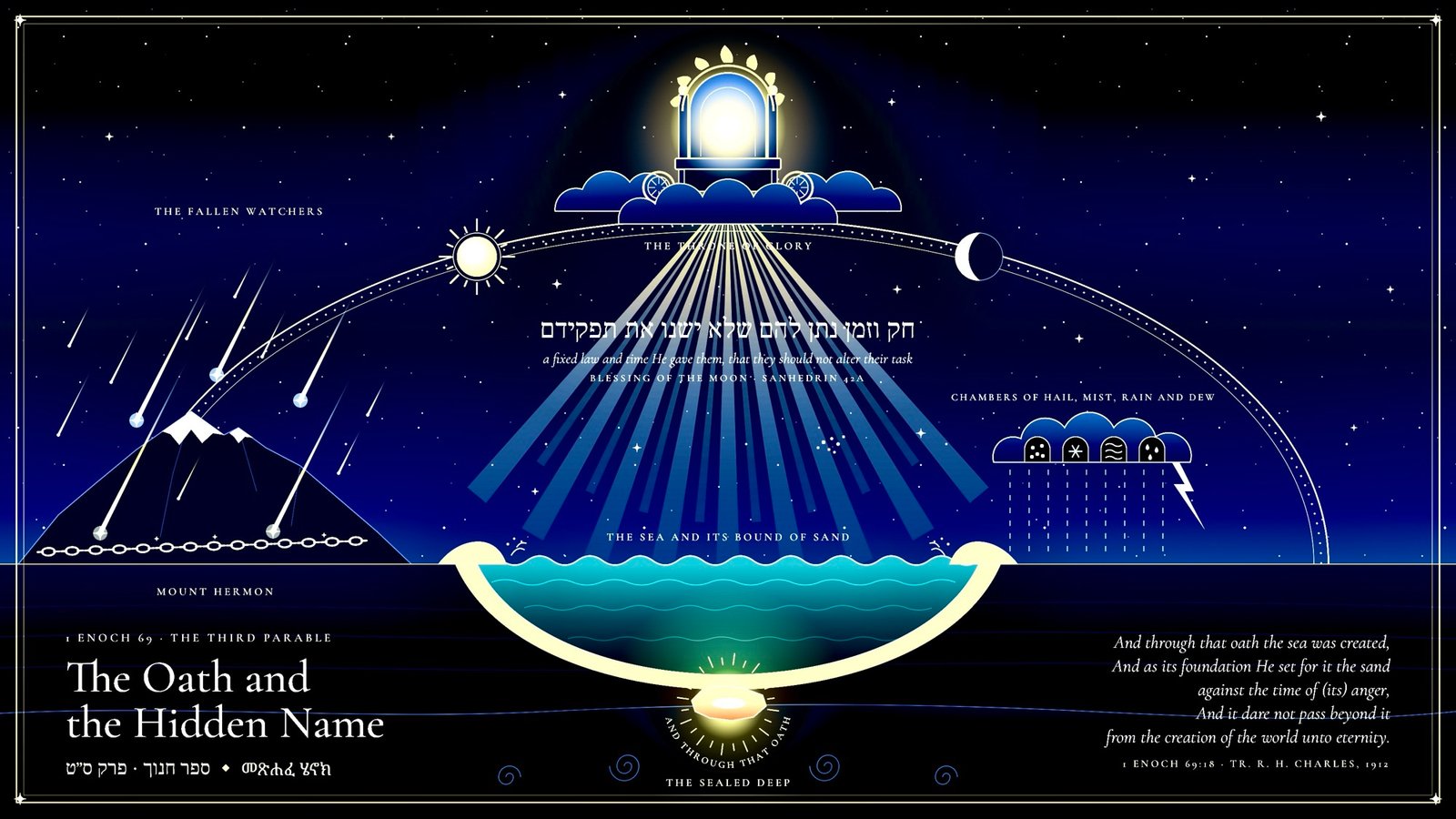
At the centre of the chapter stands an oath: a hidden Name, held by Michael, by which heaven was hung, the earth founded and the sea fenced in. This is the passage richest in Jewish parallels.
Kasbeel is “the chief of the oath” (69:13). The verse adds the name Biqa, which many translators take as his own; Charles’s “its name” could also refer to the oath. Kasbeel “requested Michael to show him the hidden name, that he might enunciate it in the oath,” so that those who revealed heaven’s secrets “might quake before that name and oath” (69:14). Then “he placed this oath Akae in the hand of Michael” (69:15); the name Akae has no agreed explanation.
A hymn follows, with the refrain “through that oath”:
And through that oath the sea was created, And as its foundation He set for it the sand against the time of (its) anger, And it dare not pass beyond it from the creation of the world unto eternity. (69:18)
And through that oath the sun and moon complete their course, And deviate not from their ordinance from eternity to eternity. (69:20)
The stars answer when G-d “calls them by their names” (69:21), and the chambers of hail, mist, rain and dew are kept by it (69:23). “And this oath is mighty over them” (69:25).
Oath against oath
The Watchers’ story began with an oath. On Mount Hermon they swore and bound one another by curses never to abandon their plan (6:4–6). Read with chapter 6, chapter 69 answers that pact with G-d’s own oath: one bound the rebels to transgression, the other binds creation to its order.
The sand and the sea
Verse 18 stands close to Jeremiah 5:22: “Who have placed the sand for the bound of the sea, An everlasting ordinance, which it cannot pass; And though the waves thereof toss themselves, yet can they not prevail.” Enoch names what makes the sand hold: the oath.
The Name that seals the deep
Jewish tradition kept the idea that the Name holds back the deep. The Prayer of Manasseh praises G-d who bound the sea by his command and sealed the deep with his fearful and glorious Name (v. 3). In the Talmud, when David dug the drainage shafts beneath the altar, the deep rose to flood the world; he wrote the Name on a sherd and cast it in, and the waters sank sixteen thousand cubits (Sukkah 53a–b).
Targum Pseudo-Jonathan puts that Name on the high priest’s breast. The Urim and Tummim bear “the Great and Holy Name by which were created the three hundred and ten worlds,” the Name set “in the foundation stone wherewith the Lord of the world sealed up the mouth of the great deep at the beginning” (on Shemos 28:30, trans. J. W. Etheridge, 1862).
Sefer Yetzirah makes this a system. G-d chose three letters, set them in his great Name, Yod-He-Vav, and with their permutations sealed height, depth and the four directions (1:13).
The hidden Name and the heavenly priest
Kasbeel’s request assumes that the Name is secret. The rabbis said so too: “This is My name le-olam” (Shemos 3:15) is written defectively and can be read le-alem, “to be concealed” (Pesachim 50a; Kiddushin 71a). In the Temple only priests uttered it, in the priestly blessing and in the high priest’s confessions on Yom Kippur (Sotah 7:6; Yoma 6:2).
Michael fits this priestly picture. The Talmud places him in the heaven called Zevul, where “Michael the great prince stands and offers an offering” on the heavenly altar (Hagigah 12b). The angel who holds the oath in 1 Enoch is, in rabbinic tradition, heaven’s high priest.
A world held by its word
The rabbis also taught that creation stands on a sworn condition. G-d made a condition with the works of creation: if Israel accepts the Torah they endure, and if not they return to chaos (Shabbat 88a). Jeremiah’s covenant “with day and night” (33:25) became a proof that Torah sustains heaven and earth (Pesachim 68b; Nedarim 32a).
The liturgy still sings the hymn of 69:20. The monthly blessing over the moon says of the heavens: chok u-zman natan lahem shelo yeshanu et tafkidam, “a fixed law and time He gave them, that they should not alter their task” (Sanhedrin 42a). In the Ashkenazi rite it follows Psalm 148, whose sixth verse reads: “He hath also established them for ever and ever; He hath made a decree which shall not be transgressed.”
The name of the Son of Man and the throne of glory (69:26–29)
The chapter ends not with the oath but with a name. Joy breaks out “Because the name of that Son of Man had been revealed unto them” (69:26), and he takes his seat to judge.
And he sat on the throne of his glory, And the sum of judgement was given unto the Son of Man. (69:27)
Those “who have led the world astray” are bound in chains (69:27–28). “And from henceforth there shall be nothing corruptible; For that Son of Man has appeared” (69:29).
Daniel’s figure, enthroned
The title comes from Daniel 7:13: “I saw in the night visions, And, behold, there came with the clouds of heaven One like unto a son of man, And he came even to the Ancient of days.” In Daniel he receives “dominion, And glory, and a kingdom” (7:14); in the Parables he also sits in judgment.
The phrase “throne of glory” is Jeremiah’s: “Thou throne of glory, on high from the beginning, Thou place of our sanctuary” (17:12). The rabbis would use that same verse to prove the Temple was planned before creation (Bereshit Rabbah 1:4).
A name before the sun
The Parables say the Son of Man was named before the sun and the stars were made (48:3), hidden from the beginning and revealed to the elect (62:7). Chapter 69 completes that line: the hidden name is now revealed.
The rabbis taught the same of the Messiah. Among the seven things created before the world is “the name of the Messiah,” proved from Psalm 72:17 (Pesachim 54a; Nedarim 39b). The JPS 1917 translation reads “May his name be continued as long as the sun,” but the midrash heard lifnei shemesh yinnon shemo as “before the sun, his name is Yinnon,” and the school of R. Yannai said Yinnon is his name (Sanhedrin 98b).
Pesikta Rabbati (ch. 36) adds that God foresaw the Messiah before creation and hid him beneath the Throne of Glory. A figure named before creation, hidden, then revealed and enthroned: the Parables and the rabbis share the shape of the idea.
A second throne
Daniel 7:9 speaks of thrones in the plural: “I beheld Till thrones were placed, And one that was ancient of days did sit.” R. Akiva explained: one throne for Him and one for David. R. Yosei the Galilean retorted, “Akiva, how long will you profane the Divine Presence?” and read them as thrones of judgment and of righteousness (Hagigah 14a; Sanhedrin 38b).
The Parables picture what Akiva’s reading allowed and R. Yosei feared: a second figure seated in glory. Another rabbinic reading kept Daniel’s cloud-rider but made his coming conditional. If Israel merits, the Messiah comes “with the clouds of heaven”; if not, “lowly, and riding upon an ass” (Zechariah 9:9; Sanhedrin 98a).
From Enoch to Metatron
Two chapters later, the Ethiopic text tells Enoch himself that he is that Son of Man (71:14). Charles emended the verse to “This is the Son of Man”; James VanderKam and others defend the manuscripts, while Michael Knibb treats chapters 70–71 as a secondary addition.
Rabbinic literature knows an Enoch raised to a heavenly seat, but keeps him at arm’s length. Targum Pseudo-Jonathan says Enoch “ascended to the firmament” and was called “Metatron, the Great Scribe” (on Genesis 5:24; Orlov). In Sefer Hekhalot (3 Enoch), Enoch becomes Metatron and receives a throne like the Throne of Glory.
The Talmud tells how Elisha ben Abuya saw Metatron seated, writing the merits of Israel, and concluded there might be “two powers” in heaven; Metatron was then struck with sixty lashes of fire (Hagigah 15a). Genesis Rabbah goes further. R. Aibu calls Enoch a chanef, sometimes righteous and sometimes wicked, removed while righteous (25:1).
Modern scholarship, much of it Jewish, has mapped this line. Alan Segal traced the rabbinic reports of “two powers” (Two Powers in Heaven, 1977), Moshe Idel studied how Enoch came to be identified with Metatron (“Enoch is Metatron,” Immanuel 24/25, 1990), and Andrei Orlov reconstructed the tradition from Enoch to Metatron (2005). Daniel Boyarin argues that a chain links 3 Enoch’s Metatron back to the Son of Man of the Parables and to Daniel’s “one like a son of man” (JSJ 41, 2010).
What the chapter means
First Enoch 69 is a meditation on boundaries: what may be known, who may speak the Name, and what keeps the world in place. Its answer is that creation keeps faith while angels and humans break it, and that judgment will restore the order they broke.
Knowledge has limits. The rebels’ deepest harm in this chapter is leaked knowledge: weapons, writing, sorcery and the arts of demons. Humans were meant to be like the angels and deathless, and “through this their knowledge they are perishing” (69:11). The Mishnah draws its own lines around the same subjects, limiting who may expound the work of creation and the chariot, and warning against asking what is above, below, before and after (Hagigah 2:1).
Creation is faithful. Sea, stars, sun and moon keep the oath; the Watchers did not. Jews still say this in prayer: Psalm 148 in the daily morning service, and the monthly blessing over the moon, which praises heavens that “should not alter their task.”
The Name is power, and it is entrusted. The same Name that seals the deep is hidden, held by Michael and, in the Temple, uttered only by priests. The chapter’s fear is a Name in the wrong hands; the midrash of Shemhazai tells exactly that story, and the Cairo Genizah shows that Jews were still reading this material in the Middle Ages.
The last secret is a name revealed. The chapter ends when the right secret is disclosed at the right time: the name of the judge, named before the sun. The rabbis kept the pre-existent name of the Messiah and argued over a second throne, while warning against an Enoch or a Metatron who might seem a second power.
Read this way, 1 Enoch 69 shows a Judaism wider than the one the rabbis canonized, yet not foreign to it. The book left the rabbinic library, but its ideas returned through Targum, Talmud, midrash and the Zohar, which cites a “Book of Enoch” as a heavenly book (I:37b), as Annette Yoshiko Reed notes (Cambridge, 2005). The Beta Israel of Ethiopia kept the book itself.
Translations used and further reading
All quotations of 1 Enoch are from R. H. Charles (1912), and all verses of Tanakh from the Jewish Publication Society translation of 1917.
Translations
- R. H. Charles, The Book of Enoch (2nd ed., Oxford, 1912; reprinted with an introduction by W. O. E. Oesterley, 1917). Public domain: Project Gutenberg; chapter 69 text at bible.jmoorewv.com.
- The Holy Scriptures According to the Masoretic Text (Jewish Publication Society, 1917), e.g. Daniel 7, Psalm 82.
- J. W. Etheridge, The Targums of Onkelos and Jonathan ben Uzziel on the Pentateuch (1862), for Targum Pseudo-Jonathan (Exodus 28:30).
- Rabbinic passages are rendered freshly from the Hebrew and Aramaic.
On 1 Enoch 69 and the Parables
- George W. E. Nickelsburg and James C. VanderKam, 1 Enoch 2: A Commentary on the Book of 1 Enoch, Chapters 37–82 (Hermeneia; Fortress, 2012).
- Jonathan Ben-Dov and Eshbal Ratzon, “The Oath and the Name in 1 Enoch 69,” Journal of Semitic Studies 60.1 (2015): 19–51.
- Gabriele Boccaccini, ed., Enoch and the Messiah Son of Man: Revisiting the Book of Parables (Eerdmans, 2007), including Kelley Coblentz Bautch on 69:6 and Darrell Hannah on Herod and chapter 67.
- J. T. Milik, The Books of Enoch: Aramaic Fragments of Qumrân Cave 4 (Oxford, 1976).
- Jonas C. Greenfield and Michael E. Stone, “The Enochic Pentateuch and the Date of the Similitudes,” Harvard Theological Review (1977).
- Michael A. Knibb, “The Date of the Parables of Enoch: A Critical Review,” New Testament Studies 25.3 (1979): 345–59.
- Ted M. Erho, “Historical-Allusional Dating and the Similitudes of Enoch,” Journal of Biblical Literature 130 (2011).
- Vered Hillel, “A Reconsideration of Charles’s Designated ‘Noah Interpolations’ in 1 Enoch,” in Michael E. Stone, Aryeh Amihay and Vered Hillel, eds., Noah and His Book(s) (SBL, 2010).
- Leslie Baynes, “Enoch, the Angels, and Heavenly Books” (SBL Annual Meeting, 2006).
On the fallen angels in Jewish tradition
- Bernard J. Bamberger, Fallen Angels (Jewish Publication Society, 1952).
- David W. Suter, “Fallen Angel, Fallen Priest: The Problem of Family Purity in 1 Enoch 6–16,” Hebrew Union College Annual 50 (1979).
- Annette Yoshiko Reed, Fallen Angels and the History of Judaism and Christianity (Cambridge, 2005).
- Rachel Adelman, The Return of the Repressed: Pirqe de-Rabbi Eliezer and the Pseudepigrapha (Brill, 2009).
- Adolf Jellinek, Bet ha-Midrasch, vol. 4 (1857), and “Hebräische Quellen für das Buch Henoch,” ZDMG 7 (1853).
- John C. Reeves, “Midrash of Shemhazai and Azael” (translation from Bereshit Rabbati).
On the Son of Man, Enoch and Metatron
- Alan F. Segal, Two Powers in Heaven: Early Rabbinic Reports about Christianity and Gnosticism (Brill, 1977).
- Gershom Scholem, Jewish Gnosticism, Merkabah Mysticism, and Talmudic Tradition (Jewish Theological Seminary, 1960; 2nd ed. 1965).
- Moshe Idel, “Enoch is Metatron,” Immanuel 24/25 (1990): 220–40.
- Andrei A. Orlov, The Enoch-Metatron Tradition (Mohr Siebeck, 2005).
- Daniel Boyarin, “Beyond Judaisms: Metatron and the Divine Polymorphy of Ancient Judaism,” Journal for the Study of Judaism 41 (2010).
Rabbinic and mystical sources cited
Mishnah Avot 5:6; Hagigah 2:1; Sotah 7:6; Yoma 6:2. Babylonian Talmud Avodah Zarah 5a; Hagigah 12b, 14a, 15a; Kiddushin 71a; Nedarim 32a, 39b; Niddah 61a; Pesachim 50a, 54a, 68b, 111b; Sanhedrin 38b, 42a, 98a–b; Shabbat 88a, 146a; Shevuot 15b; Sukkah 53a–b; Yoma 67b. Genesis Rabbah 1:4, 25:1, 26:5; Lamentations Rabbah 1:29; Pesikta Rabbati 36; Pirkei de-Rabbi Eliezer 13, 21; Bereshit Rabbati; Yalkut Shimoni §44. Targum Pseudo-Jonathan on Genesis 5:24, 6:4 and Exodus 28:30. Sefer Yetzirah 1:13; Sefer Hekhalot (3 Enoch); Zohar I:37b, III:208a.
Web pages consulted
- Times of Israel, “National Library announces digitization project of Beta Israel sacred manuscripts” (9 October 2024).
- Encyclopedia of Religion, “Judaism in Northeast Africa.”
- Reading Acts, “Dating the Similitudes” (summary of the Hermeneia dating).
- TheTorah.com, “Reintroducing the Myth of the Fallen Angels into Judaism.”