
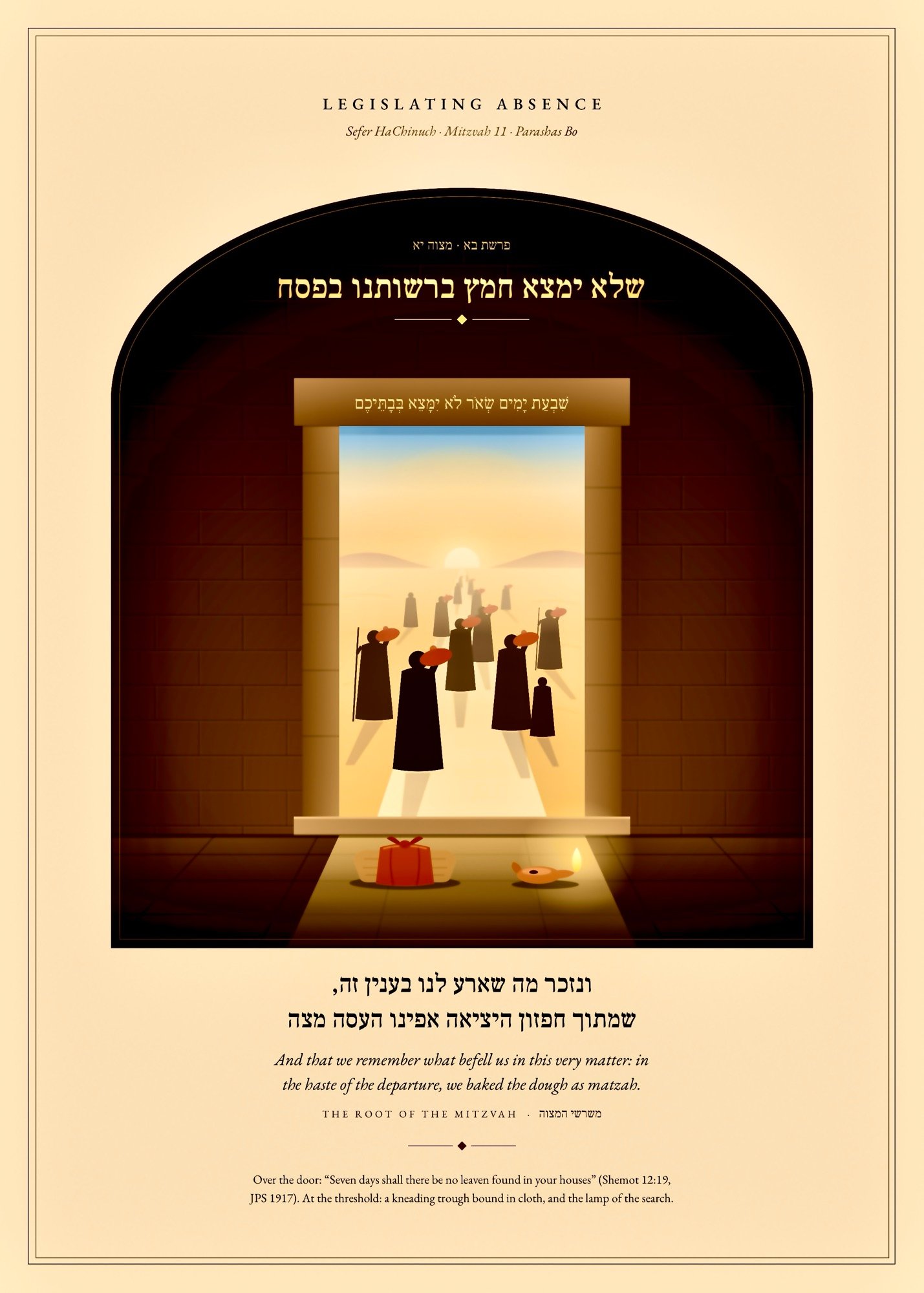
The Light of Redemption and Education: A Rabbinic Commentary on Sefer HaChinuch (The Book of Mitzvos)
Legislating Absence: An Essay on Sefer HaChinuch, Mitzvah 11
שלא ימצא חמץ ברשותנו בפסח — Parashas Bo
Nov 21, 2026 · @Kamil Levi Pyka-Penner
The Text
The Chinuch’s treatment of Mitzvah 11 runs to four short paragraphs. They are given here without vowels, following the text of the elucidated edition (pp. 126–129), each with a fresh English rendering. Verses follow the JPS 1917 translation.
1. The mitzvah and its scope
שלא ימצא חמץ ברשותנו כל ימי הפסח, שנאמר (שמות יב, יט) שבעת ימים שאור לא ימצא בבתיכם. ובארו חכמינו זכרונם לברכה, לאו דוקא ביתו, אלא כל שברשותו, ולאו דוקא שאור שהוא מחמץ, דהוא הדין לחמץ, דשאור וחמץ חד הוא לענין איסורו.
That chametz not be found in our domain all the days of Pesach, as it is said (Shemot 12:19): “Seven days shall there be no leaven found in your houses.” Our Sages of blessed memory explained: not his house alone, but whatever is in his domain; and not only leaven, the agent that leavens, for the same law holds of chametz, since leaven and chametz are one with respect to its prohibition.
2. The root of the mitzvah
משרשי המצוה, כדי שנזכר לעולם הנסים שנעשו לנו ביציאת מצרים, כמו שכתוב בשה הפסח. ונזכר מה שארע לנו בענין זה, שמתוך חפזון היציאה אפינו העסה מצה, כי לא יכלו להתמהמה עד שיחמיץ, כמו שכתוב (שמות יב, לט) ויאפו את הבצק וגו’.
Among the roots of the mitzvah: that we remember for all time the miracles performed for us at the Exodus from Egypt, as was written concerning the Pesach lamb [Mitzvah 5]. And that we remember what befell us in this very matter: in the haste of the departure, we baked the dough as matzah, for they could not tarry until it leavened, as it is written (Shemot 12:39): “And they baked unleavened cakes of the dough…”
3. The laws of the mitzvah
דיני המצוה, כגון אם הפקיד חמצו ביד אחרים מה דינו, או אחרים בידו, וכן חמץ הקדש בידו או של גוי באחריות ושלא באחריות, ודין גוי אלם שהפקיד לו חמץ, ודין תערבת חמץ אם עוברין עליו, והפת שעפשה מה דינו, ויתר פרטיה, מבארים בפסח ראשון (פסחים פר’ א’–ג’).
The laws of the mitzvah: for example, one who deposited his chametz with others, what is his law; or others’ chametz in his hands; likewise chametz of hekdesh in his hands, or a non-Jew’s, with responsibility and without; the law of an overbearing non-Jew who deposited chametz with him; the law of a chametz mixture, whether one transgresses through it; and bread that has grown moldy, what is its law. These and its remaining details are explained in Pesach Rishon (Pesachim, chapters 1–3).
4. Applicability and penalty
ונוהגת בזכרים ונקבות, בכל מקום ובכל זמן. ועובר עליה ונמצא חמץ ברשותו במזיד, עבר על שני לאוין משום בל יראה ובל ימצא, ולוקה כל זמן שעשה בו מעשה, כגון שחמץ עסה והניחה בביתו, או שלקח חמץ והצניעו בביתו. אבל אם לא עשה בו שום מעשה, אלא שנשאר בבית מקדם הפסח, אין לוקה עליו, שהלכה היא, לאו שאין בו מעשה אין לוקין עליו, כמו שאמרנו.
It applies to men and women, in every place and at every time. One who transgresses it, deliberately letting chametz be found in his domain, has violated two prohibitions, bal yera’eh and bal yimatzei. He receives lashes whenever he performed an act with it: for example, he leavened a dough and left it in his house, or bought chametz and stored it in his house. But if he did no act at all, and it merely remained in the house from before Pesach, he does not receive lashes. For it is the halachah that one does not receive lashes for a prohibition involving no act, as we have said.
Introduction: The Heading as Interpretation
The Chinuch’s heading for Mitzvah 11 is already a commentary on its verse. Set beside Shemos 12:19, it changes every term except the verb.
Coordinate
The verse
The Chinuch’s heading
Taken up in
Time
שבעת ימים
כל ימי הפסח
Section I
Substance
שאור
חמץ
Section II
Domain
בבתיכם
ברשותנו
Section III
Voice
“your” houses
“our” domain
Section IV
Only לא ימצא survives untouched. Two of the changes the Chinuch justifies at once, through Chazal: לאו דוקא ביתו and לאו דוקא שאור. The third, time, rests on his phrase כל ימי הפסח, which the Minchas Chinuch reads as a deliberate limit. The fourth is the Chinuch’s habitual voice: the verse says “your,” he says “our.” In this mitzvah, as Section IV shows, that voice carries unusual weight.
The surviving verb carries the theme of this essay. Mitzvah 11 forbids neither a deed nor the omission of one. It forbids a state of affairs: that chametz be found. It is, quite literally, a law of absence.
That one feature governs the whole entry: the boundary in time, the reach to inedible leaven, the meaning of “our domain,” a shoresh that remembers dough which never rose, and a penalty reserved for one who acted. Sections I–III take the legal coordinates in turn. Section IV turns to the root of the mitzvah, and Section V to its penalty, where the Minchas Chinuch’s reading of Mitzvah 9 proves decisive.
I. When: כל ימי הפסח
The phrase כל ימי הפסח sets the lav at the festival’s seven days, not at the deadline of the fourteenth. The verse says “seven days”; the Chinuch says “all the days of Pesach.”
The Minchas Chinuch opens its comment on our mitzvah with exactly this inference: נראה מד’ הרהמ”ח כאן ולקמן מצוה כ’ דא”ע בב”י וב”י רק בשבעת ימי הפסח. In translation: it appears from the author’s words, here and in Mitzvah 20, that one transgresses bal yera’eh and bal yimatzei only during the seven days of Pesach.
The elucidators set out the alignment (n. 2). The Chinuch’s reading matches Raavad (Hil. Chametz U’Matzah 3:8); on Rambam’s view, see the Maggid Mishneh there. Other authorities start the lav at midday of the fourteenth, together with the duty to destroy (Rashi, Bava Kamma 29b; Noda BiYehudah I, OC 20; Chok Yaakov 443:1).
The result is a window of several hours. The asei of tashbisu (Mitzvah 9) takes hold at midday of the fourteenth, as the elucidators explain there; the lav waits for nightfall. One who still holds chametz that afternoon has neglected an asei but has not yet transgressed a lav.
The Chinuch states the principle behind such sequencing himself, in Mitzvah 89, which forbids slaughtering the Pesach while chametz remains. קביעות זמן בכל העניינים הוא קיום עשייתן: fixed time is what sustains every performance. Therefore לא תבוא מצוה ממצוות עניין המועד הזה בגבול חברתה: no mitzvah of this festival may cross into the boundary of another. First we remove the chametz, הנמאס בעינינו לשעתו, “loathsome in our eyes for its time”; then the Pesach offering begins the festival’s joy.
Read with Mitzvah 89, the two chametz mitzvos divide the labor. The asei clears the threshold; the lav guards the festival itself. Their different starting hours are not an anomaly but an instance of the Chinuch’s ordered time.
The word לשעתו deserves a pause. Chametz is loathsome “for its time,” not in itself; the prohibition is temporal through and through. That is why the lav’s duration is set by the festival’s days, not by anything in the bread itself.
One caution about terms. The applicability clause says the mitzvah holds בכל מקום ובכל זמן. There, as the elucidators explain (n. 16), “every time” means every era, with or without the Beis HaMikdash. It does not widen the seven days.
II. What: דשאור וחמץ חד הוא
The second לאו דוקא joins the leavening agent to the leavened food. It makes the prohibition’s object a power, the capacity to leaven, as well as a food.
The verse names שאור: dough fermented past the point of edibility and kept to raise other doughs (n. 4, citing Beitzah 7b). The Chinuch extends the lav to chametz, the leavened product, because דשאור וחמץ חד הוא לענין איסורו. In Mitzvah 20 he grounds the equation in Scripture. Shemos 13:7 opens with chametz and closes with se’or: “there shall no leavened bread be seen with thee, neither shall there be leaven seen with thee.” The pairing shows, he writes, אין הפרש בין החמץ עצמו ובין דבר המחמץ.
Notice how he glosses se’or here: שאור שהוא מחמץ, “leaven, which is what leavens.” He defines it by its function, not by whether anyone would eat it. That definition does quiet work later in the entry.
Among the dinim he lists הפת שעפשה מה דינו: bread that has grown moldy. The elucidators give the law (n. 13): it remains forbidden to own as long as a dog would eat it. For other forbidden foods, spoiling past human use ends the Biblical prohibition (YD 103:1–2 with Taz); for chametz the line is drawn lower. The reason, from Ran (on the Rif, Pesachim 13b): such bread can still leaven other dough, so it is forbidden as se’or (OC 442:2, MB §10).
The two clauses therefore run in both directions. The Chinuch’s sentence carries the law from se’or to chametz. Ran’s reasoning carries spoiled chametz back to se’or. A loaf that has lost its standing as food keeps its standing as leaven: the object of Mitzvah 11 is chametz as a fermenting power, not merely chametz as bread.
The mixtures clause, ודין תערבת חמץ אם עוברין עליו, presses the same question from another side. Mitzvah 12 forbids eating many chametz mixtures, even where the chametz is a minor ingredient. Whether one may own them is disputed (n. 12). Rambam (Hil. Chametz U’Matzah 4:8) and Rashi (Pesachim 42a) forbid it; Tosafos there permit it (see OC 442:1).
One way to frame the dispute, in the terms of our clause: does the possession-lav take its object from the laws of eating, or define it for itself? On the first view, what may not be eaten may not be kept. On Tosafos’s, a mixture forbidden to eat may still be owned. The moldy loaf, read through Ran, suggests that possession does have a measure of its own: the power to leaven. The Chinuch, characteristically, states the question, אם עוברין עליו, and sends the reader to Pesach Rishon.
III. Whose: אלא כל שברשותו
In the Chinuch’s usage, “domain” is not simply custody, and perhaps not simply ownership either; his cases are built to test both.
The verse says בבתיכם, “in your houses.” Chazal widen it to כל שברשותו, whatever is in one’s domain. The elucidators trace the widening to the verse of Mitzvah 20, “in all thy borders” (13:7), linked to ours by a gezeirah shavah on the shared word שאור (n. 3, citing Pesachim 5b). The two lavim stay distinct but share their parameters.
The dinim then run through a series of cases. Each isolates a different element of “domain.”
The Chinuch’s case
What is present
Outcome (elucidators’ notes)
His chametz deposited with a Jew
Ownership; another’s custody
No solution: the custodian himself would transgress (n. 7).
His chametz deposited with a non-Jew
Ownership; another’s custody
Disputed. Ramban and Ran: Biblically exempt, Rabbinically forbidden. Most: the owner transgresses (n. 7).
A fellow Jew’s chametz in his hands
Custody, not ownership
He may transgress himself; either way he must spare the owner: sell it to a non-Jew in time, or destroy it (n. 8).
Hekdesh chametz in his hands
Custody; ownership is Gavoah’s
No transgression (n. 9).
A non-Jew’s chametz, with achrayus
Custody and liability
Transgresses: liability counts as ownership (n. 10).
A non-Jew’s chametz, without achrayus
Custody alone
No transgression; a partition is required Rabbinically (n. 10).
An overbearing non-Jew’s chametz (גוי אלם)
Custody and forced exposure
Disputed: Rambam, transgresses; Raavad, does not (n. 11).
Read down the middle column and a structure appears. Custody alone does not make chametz “his”: hekdesh, and a non-Jew’s chametz held without liability, are exempt. Liability can stand in for ownership. Ownership without custody remains forbidden on the majority view.
Yet even there the elucidators add a second reason. The custodian is presumed to lend the owner the space where his chametz sits, so it is in his domain after all (Rosh, Pesachim 1:4; OC 440:4). The majority, it seems, is reluctant to rest the prohibition on ownership alone, and supplies a domain by construction. Ramban and Ran read בבתיכם as a real limit, and exempt chametz in a non-Jew’s house from the Biblical lav.
The underlying question is whether the lav concerns owning chametz or chametz within one’s domain. Chochmas HaChinuch, a recent commentary on the Chinuch, poses exactly this question, citing Minchas Asher (Shemos §21). Its test case is a person who owns chametz but has no house or domain at all. The Chinuch’s word ברשותנו holds both readings, and his list of cases makes the reader feel the pressure between them.
The goy alam tests the edge of liability. The Jew accepted nothing, but the overbearing non-Jew can force him to pay for any loss (n. 11). Is liability a legal undertaking, or a practical exposure? Rambam treats exposure as enough; Raavad does not.
Liability itself comes in grades (n. 10). Some Rishonim require the liability of a paid custodian, for theft and loss (Mitzvah 59). Others count even an unpaid custodian’s liability for negligence (Mitzvah 57). Rosh cites both (Pesachim 1:4; OC 440:1, MB §8). Fittingly, the elucidators send the reader to other entries of the Chinuch for these categories: the Book of Mitzvos defines “domain” through its own law of custodians.
The modern sale of chametz answers every case at once. The chametz is sold and its place leased to the buyer, so the Jew neither owns it, nor holds it in his domain, nor bears liability for it (n. 10; OC 448:3). The sale works by removing every element the table isolates.
IV. Why: משרשי המצוה
The Chinuch roots a law of absence in the memory of an absence: dough that had no time to rise.
The shoresh has two layers. The first belongs to all the Pesach mitzvos: to remember for all time the miracles of the Exodus, as written at the Pesach lamb (Mitzvah 5). The second is particular: ונזכר מה שארע לנו בענין זה, we remember what befell us in this very matter. In the haste of departure we baked the dough as matzah, for they “could not tarry” until it leavened (12:39).
The voice repays attention. In Mitzvah 5 the root is stated in the third person: כדי שיזכרו היהודים לעולם הנסים הגדולים שעשה להם. Pointing back to it here, the Chinuch writes שנזכר and שנעשו לנו, and then אפינו: “we baked.” Only afterward does the sentence return to the verse’s third person, כי לא יכלו להתמהמה.
Mitzvah 21 offers a quiet contrast. There the telling of the Exodus recalls הנסים והענינים שארעו לאבותינו, what befell our fathers. The story is told of our fathers; the dough that did not rise is remembered as our own.
The first Pesach. The words עד שיחמיץ, “until it leavened,” imply that with time they would have let the dough rise, on the morning of the fifteenth itself. The elucidators draw the inference (n. 6; Insight A): the Chinuch seems to hold that owning chametz was not yet forbidden that first year. Ran shares the view and answers a further difficulty: why let dough rise if it could not be eaten? Because in Egypt chametz was forbidden for one day only (Pesachim 96b), and the bread was for the journey (Ran on the Rif, Pesachim 25b; see Rashi, Shemos 12:34; Chizkuni, 12:39).
Ramban (Shemos 12:39) holds the opposite: owning chametz was forbidden that first Pesach, at least on its first day. On his reading, “could not tarry” explains why they left with unbaked dough, not why it stayed unleavened. Ohr HaChaim (12:39) adds that this is why they carried the dough on their shoulders (12:34): kneading it as they walked kept it from rising.
The dispute changes what Mitzvah 11 remembers. On Ramban’s reading, it recalls an early obedience: Israel kept the law under pressure. On the Chinuch’s reading, it recalls a circumstance. No law yet barred the leaven; haste alone kept it out. The later law gives permanent form to what was, that morning, only an event. The Chinuch’s phrase fits exactly: not what we were commanded, but מה שארע לנו, what befell us.
Leaven and delay. Elsewhere the Chinuch gives chametz a meaning of its own. Explaining why leaven may not be offered on the altar (Mitzvah 117), he first concedes that the reasons are deeply hidden. Then he ventures one: בהרחיק החמץ, שהוא נעשה בשהייה גדולה, מקורבנו, יקח דמיון לקנות מידת הזריזות. Chametz is made through long delay; keeping it from the altar trains alacrity. Our shoresh says the same from the side of history. The dough could not rise because Israel could not delay: matzah is the bread that did not wait.
Deed, word, and dwelling. Why legislate a memory at all, and with so many mitzvos? The Chinuch answers in Mitzvah 16. He imagines the objection, ולמה יצוה אותנו השם יתברך לעשות כל אלה לזכרון אותו הנס, since one remembrance should suffice. His reply has become proverbial: דע כי האדם נפעל כפי פעלותיו … כי אחרי הפעלות נמשכים הלבבות. Just before, he explains that through המעשה והדמיון שאנחנו עושין, the act and the likeness we perform, the matter is fixed in our souls forever.
The word דמיון is the same one he uses of chametz in Mitzvah 117. In Mitzvah 21 he adds that it is no wonder so many mitzvos, positive and negative, address the Exodus, כי הוא יסוד גדול ועמוד חזק בתורתנו ובאמונתנו. Mitzvah 11 is one of the negative ones.
It extends the principle in a striking direction. In Mitzvah 21 the heart is stirred by speech: כי בדבור יתעורר הלב. In Mitzvah 16 it is drawn by action. Here the shaping force is a condition: a home and a domain without leaven for seven days. For that week the home itself becomes the דמיון of the morning of the Exodus, a place where nothing has had time to rise.
V. The Penalty: ולוקה כל זמן שעשה בו מעשה
The Chinuch imposes lashes only when chametz entered one’s domain through an act. Two objections threaten even that much; the Minchas Chinuch’s reading of Mitzvah 9 answers the deeper one.
The Chinuch counts two lavim for one who deliberately keeps chametz: bal yera’eh and bal yimatzei (their relation is treated at Mitzvah 20; n. 17). He imposes malkus only כל זמן שעשה בו מעשה: one who leavened a dough and left it in his house, or bought chametz and stored it there. Chametz left over from before Pesach brings no lashes, for לאו שאין בו מעשה אין לוקין עליו, as he had said in Mitzvah 9. The ruling follows Rambam (Hil. Chametz U’Matzah 1:3; n. 19).
The act may be small. Leavening a dough means adding a leavening agent (Rabbeinu Manoach on Rambam 1:3). Some include even mixing flour and water and letting it stand until it leavens (Keser HaMelech; Pri Megadim; n. 18).
The first difficulty: a lav that can be broken passively. In Mitzvos 94, 241 and 344–346, the Chinuch rules that where a lav can be transgressed without an act, even one who transgresses by an act is not lashed. Revenge is his example (Mitzvah 241): it can be taken by mere refusal, so even active revenge brings no malkus. Owning chametz can be passive too. Why, then, lashes here? (Insight B.)
Shaar HaMelech (Hil. Chametz U’Matzah 1:3) answers that the rule covers only a lav one can always break passively, where the act adds nothing. Owning chametz is not such a lav. A person with no chametz when Pesach begins cannot transgress at all without leavening or buying. For him the act is the transgression, and the lav counts as one with an act. Maggid Mishneh (Hil. Sechirus 13:2) and Noda BiYehudah (II, OC 76) take the opposite view.
The second difficulty: a lav beside an asei. Our lav stands next to tashbisu. Some hold that destroying the chametz repairs the transgression, making this a לאו הניתק לעשה, which carries no lashes (Tosafos, Pesachim 29b and 95a). Why do the Chinuch and Rambam disagree?
The Minchas Chinuch (9:1) supplies the key. A lav is repaired by an asei only when the asei is fulfilled by an act; the act is what repairs. Tashbisu, on the view the Chinuch and Rambam follow, does not command the act of destroying. It commands being rid of chametz, a state fulfilled passively, by having none (Mitzvah 9, Insight B). Such an asei repairs nothing, so the lav stands, and lashes apply. Chiddushei R’ Chaim HaLevi (Hil. Chametz U’Matzah 1:3) argues similarly; Mishneh LaMelech, Shaar HaMelech (1:3) and R’ Akiva Eiger (Pesachim 29a) offer other explanations.
This is the Minchas Chinuch’s well-known inquiry into tashbisu, whether it is fulfilled by a state or by a deed, brought to bear on our lav. Its consequence is a striking inversion: because the asei is passive, the lav is severe. Had tashbisu commanded a deed, destroying the chametz would repair the lav and the lashes would fall away. Because it commands a state, nothing repairs the lav, and the lashes remain for the one who acted.
The two difficulties share a root. Mitzvah 11 is a law of absence. Its violation is ordinarily passive, which is why lashes require an act. Its companion asei is passive too, which is why, once an act is done, nothing undoes it.
VI. Synthesis and Questions for Further Iyun
Read whole, the Chinuch’s short entry is a complete jurisprudence of absence: when it holds, what it removes, whose it is, why it matters, and what breaking it costs.
Each coordinate defines the absence differently. In time it is bounded: chametz is loathsome only לשעתו. In substance it reaches past food to the power of leavening. In domain it reaches past the house to whatever is ours by ownership or by liability. In memory it recalls dough that simply did not rise. In penalty it is passive by nature, which is why lashes wait for an act, and why the asei cannot undo one.
The entry also shows the Book of Mitzvos as a system. Mitzvos 9, 11, 12, 19 and 20 form one cluster, and the elucidators’ notes move constantly among them and out to the law of custodians in Mitzvos 57 and 59. This essay has had to reach further still, to Mitzvos 5, 16, 21, 89, 117 and 241. The Minchas Chinuch’s reading of Mitzvah 9 decides the penalty in Mitzvah 11; no entry of the Chinuch is read rightly alone.
Questions for further iyun
- If the lav begins only at nightfall, what of chametz bought on the afternoon of the fourteenth and kept into Pesach? Is it chametz that “remained from before Pesach,” or was the purchase the act the Chinuch’s rule requires?
- Does Shaar HaMelech’s answer classify the lav or the individual? Would one who already held chametz at nightfall be lashed for buying more, when for him the act adds nothing?
- Of chametz deposited with others the Chinuch asks מה דינו and does not rule. Does his word ברשותנו lean toward Ramban, who requires domain as well as ownership, or toward the majority?
- If, with Ran, the mitzvah preserves a circumstance rather than an earlier command, does that explain why it forbids a state rather than an act?
- Ran forbids moldy bread because it can still leaven. Could the same measure, the power to leaven, help decide whether one may own a chametz mixture?
A Note on Sources and Method
This commentary draws only on Sefer HaChinuch and on works written about it. Rishonim and Acharonim appear only as those works cite them.
- Sefer HaChinuch, Mitzvah 11, as printed in the elucidated edition below. Related entries cited: Mitzvos 5, 9, 12, 16, 20, 21, 57, 59, 89, 117, 241 and 344–346.
- The Schottenstein Edition Sefer HaChinuch / Book of Mitzvos (ArtScroll/Mesorah; the Jan Czuker Family Elucidation), vol. 1, pp. 126–131: notes 1–19 and Insights A–B. Its English is paraphrased here, not quoted.
- Minchas Chinuch, by R. Yosef Babad, Av Beis Din of Tarnopol: the opening of its comment on Mitzvah 11, and 9:1 as cited in Insight B.
- Chochmas HaChinuch, by R. Elchanan Poupko, on Mitzvah 11.
- Scripture is quoted in the JPS 1917 translation. English renderings of the Chinuch are new.
Online texts consulted:
- Sefer HaChinuch with Chochmas HaChinuch, Mitzvos 1–50 (Daat): Mitzvos 5, 9, 11, 16, 20, 21
- Sefer HaChinuch, Parashas Vayikra (Wikisource): Mitzvah 117
- Sefer HaChinuch, Mitzvah 89 (Wikisource)
- Minchas Chinuch, Mitzvah 11 (Sefaria)
- Exodus 12, JPS 1917 (eBible) and Exodus 13, JPS 1917 (eBible)
- Exodus 12:39, JPS 1917 entry (Bible Hub)