
The Light of Redemption and Education: A Rabbinic Commentary on Sefer HaChinuch (The Book of Mitzvos)
Mitzvah 12 — Kol Machmetzes: The Prohibition of Chametz Mixtures in Sefer HaChinuch
Nov 21, 2026 · @Kamil Levi Pyka-Penner
A note on sources
This essay reads Mitzvah 12 only through works written on the Book of Mitzvos and on Sefer HaChinuch.
- Sefer HaChinuch, Mitzvah 12, with the other mitzvos where the Chinuch develops the same themes. The Hebrew follows The Schottenstein Edition Sefer HaChinuch / Book of Mitzvos (ArtScroll/Mesorah), vol. 1, Parashas Bo, pp. 132–138. That edition’s notes and Insight are treated as part of the text under discussion.
- Rambam, Sefer HaMitzvos, Lo Saaseh 198 and the neighboring chametz prohibitions, with its Shorashim, together with Ramban’s hasagos to that work.
- Minchas Chinuch of R’ Yosef Babad, on Mitzvos 12 and 19.
- Two recent works on the Chinuch and the Minchas Chinuch: R’ Elchanan Pupko’s Chochmas Chinuch (vol. 1, New York 5778) and R’ Shmuel Shimoni’s Har Etzion series Iyunim BaMitzvos B’ikvos HaMinchas Chinuch.
- Talmudic and Mishneh Torah passages appear only where the Chinuch, or a work on the Chinuch, cites them.
Transliteration is Ashkenazi, following the edition. Translations of the Chinuch and the Sefer HaMitzvos are the commentary’s own. Verses are cited in Hebrew.
Introduction: where the Chinuch’s two masters meet
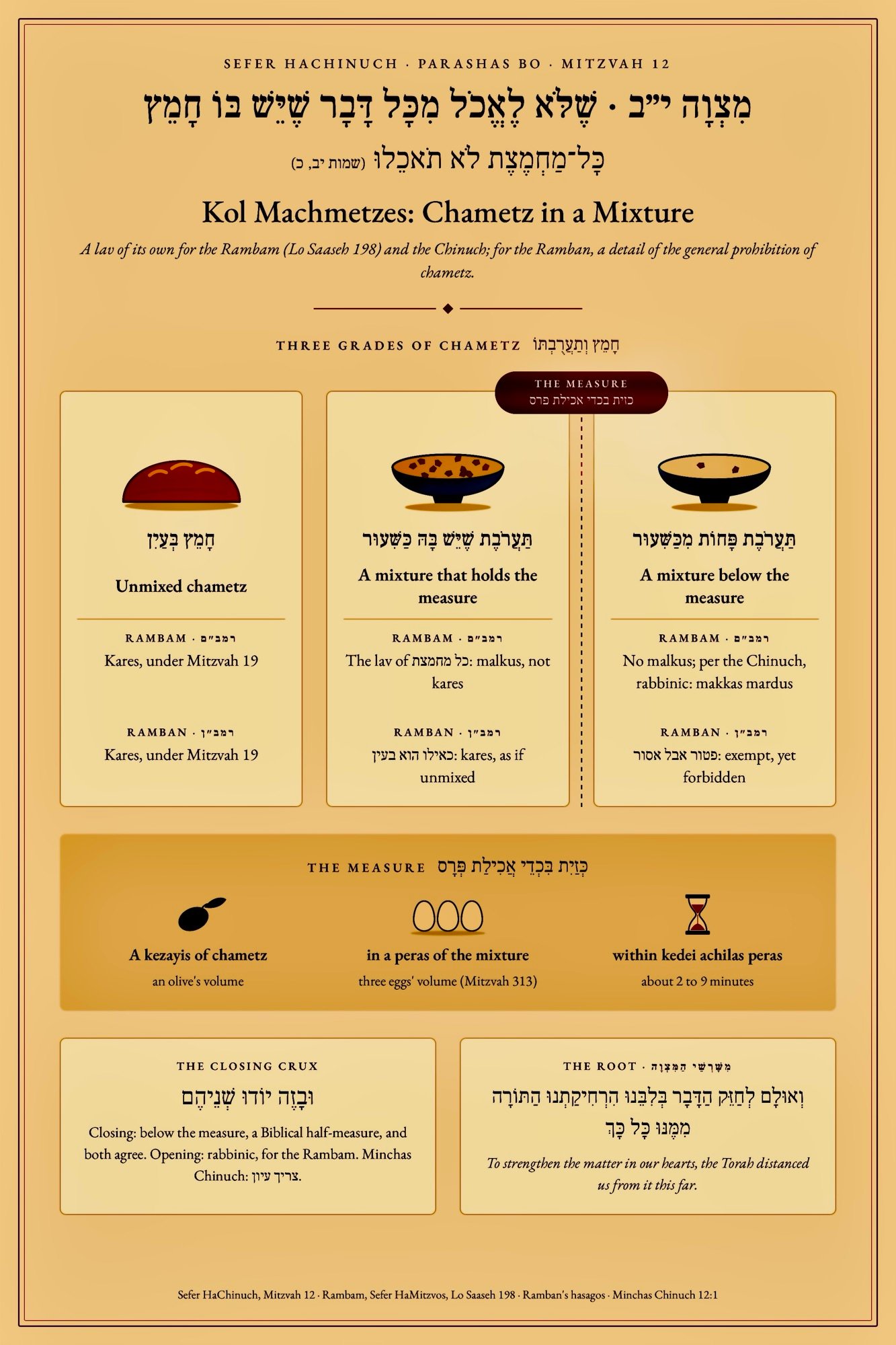
Mitzvah 12 is a compact case of a commandment the Chinuch counts because the Rambam counts it, while reporting in full the Ramban’s view that it should not be counted at all. The Chinuch states in his introduction that his enumeration follows the Rambam’s Sefer HaMitzvos, as the edition reminds us at this point. Here that commitment carries real weight.
For the Rambam, the verse כל מחמצת לא תאכלו is a distinct lav, Lo Saaseh 198. For the Ramban, as the Chinuch reports him, it is only one of “הלאוין הרבים שבאו בחמץ ובשאור” — the many prohibitions the Torah issued on chametz and leaven.
The mitzvah sits inside the cluster of chametz laws in Parashas Bo. Mitzvah 9 commands the destruction of chametz, Mitzvos 11 and 20 forbid its presence, and Mitzvah 19 forbids eating it on pain of kares. Mitzvah 12 asks how far that fence reaches into food in which the chametz can no longer be seen.
Three questions give this short text its weight:
- A counting question. Is this verse a commandment of its own, or a detail of the general prohibition?
- A conceptual question. Is a mixture a lesser kind of chametz, or simply chametz measured by a different yardstick?
- A textual question. The closing words, ובזה יודו שניהם, claim an agreement that the Minchas Chinuch marked as requiring further study.
The Chinuch’s shoresh then explains why the Torah pursued chametz this far.
The text and its architecture
The Chinuch’s definition takes the Rambam’s side before any dispute is mentioned:
שלא לאכול מדברים שיש בהן חמץ ואף על פי שאין עיקר הדבר חמץ, כגון כותח הבבלי וכיוצא בו, שנאמר (שמות יב, כ) כל מחמצת לא תאכלו. ופירשו זכרונם לברכה שענין הכתוב הזה יורה בזה, שכך קבלו הפירוש בו.
Three features of this opening repay attention.
- The subject is the mixture. ואף על פי שאין עיקר הדבר חמץ defines the mitzvah by composition: food whose main substance is not chametz. Read with the Ramban, the verse would instead describe a process: dough leavened by an outside agent.
- The example is Babylonian kutach. The Mishnah (Pesachim 42a) lists it among chametz mixtures, and the edition explains it as a dip of sour milk, crumbs of moldy bread and salt. Its chametz is one ingredient among others, which is the whole point.
- The reading rests on tradition. שכך קבלו הפירוש בו grounds the application to mixtures in the Sages’ received interpretation (Pesachim 43a). The edition renders it as an explanation received “through the Oral tradition.”
The rest of the mitzvah follows the Chinuch’s usual sequence, with the dispute set between definition and root:
- Definition, as above.
- Dispute: ודעת הרמב”ם, then והרמב”ן… הפך מזה.
- Root: משרשי מצוה זו, מה שכתבנו בשאור.
- Laws: the items included and their names, referred to Pesachim, chapter 3.
- Applicability and penalty: ונוהגת בזכרים ונקבות, בכל מקום ובכל זמן, ending with ובזה יודו שניהם.
The proportions speak for themselves. The root takes two lines, while the dispute takes most of the text. In this mitzvah the Chinuch’s labor is less to explain why than to establish what.
One verse, two readings
The Rambam and the Ramban agree that כל מחמצת לא תאכלו binds as Torah law. They disagree over its subject.
The Rambam. Sefer HaMitzvos, Lo Saaseh 198, defines the prohibition by admixture: הזהירנו מאכול דברים שיש בהם תערובת חמץ ואף על פי שאינן לחם. He grounds it in a tannaitic exposition that sets these foods apart from chametz itself: מה חמץ מיוחד שהוא מין חמץ גמור, יצאו אלו שאינן חמץ גמור, ולמה באו? לעבור עליהן בלא תעשה. The verse thus creates a category with its own penalty: a lav, without kares.
The Chinuch supplies the reason for the lesser penalty in three words: מכיון שנתערב ברוב. Absorbed into a majority of permitted food, the chametz no longer carries the identity that brings kares. The edition’s note 7 explains it the same way: blended into a majority, the chametz is “no longer distinct.”
The Ramban. As the Chinuch reports the hasagos, the verse איננו נחשב בכלל הלאוין. Its teaching is the Baraisa in Pesachim 28b: אין לי אלא שנתחמץ מאליו, חמצו על ידי דבר אחר מנין, תלמוד לומר כל מחמצת. The verse extends the general prohibition to dough leavened by an outside agent. It says nothing about mixtures, which on his view need no verse of their own.
What divides them. The Ramban reads the verse as a statement about how the dough became chametz. The Rambam, following the received exposition, reads it as a statement about what the food contains. Each reading carries its own picture of a mixture:
- For the Rambam, a mixture is a third category between chametz and permitted food, with a prohibition and a penalty of its own.
- For the Ramban, there is no third category. Either chametz is present in a measurable amount, and it is chametz; or it is not, and no penalty applies, though eating it remains forbidden.
That difference governs everything that follows.
The measure of presence: kezayis bi’kdei achilas peras
Both masters measure a mixture with the same yardstick, but they read different things from it. The test is whether a person eating a peras of the mixture, at an ordinary pace, would take in a kezayis of chametz.
- Kezayis: an olive’s volume, the standard minimum for prohibited eating.
- Peras: half a loaf. The edition (note 4) draws on Mitzvah 313, where the Chinuch’s loaf holds six eggs’ volume, so a peras holds three.
- Kedei achilas peras: the time it takes to eat a peras, the outer limit of a single act of eating. The edition cites estimates of two to nine minutes.
In effect the measure is a ratio: a kezayis of chametz per peras of food, eaten within the span. A mixture concentrated enough to deliver a kezayis within that span holds the measure. A more dilute one never does, however much of it one eats.
Case
Rambam (Sefer HaMitzvos, LS 198)
Ramban (hasagos, as the Chinuch reports)
Unmixed chametz, a kezayis
Kares, under Mitzvah 19
Kares, under Mitzvah 19
Mixture that holds the measure
The lav of כל מחמצת: malkus, no kares
כאילו הוא בעין, as if unmixed: kares, and malkus as well
Mixture below the measure
No malkus. The Chinuch adds: makkas mardus only, the prohibition being rabbinic
פטור אבל אסור: exempt from punishment, yet forbidden
Is the verse counted?
Yes: Lo Saaseh 198, Chinuch Mitzvah 12
No: it teaches a detail of the general chametz prohibition
The second row holds the dispute in miniature. For the Rambam, the Torah lowered mixed chametz from kares to malkus. For the Ramban, reaching the measure shows that chametz is present, so the full penalty applies. Both agree on malkus there, as the Chinuch’s closing section states and the edition notes (note 25).
The Baraisa of R’ Eliezer and the Sages
The two Rishonim read one Baraisa (Pesachim 43a) by placing its two key terms, חמץ דגן גמור and עירובו, at different points on the scale. All agree that full grain-chametz carries kares. For its mixture, R’ Eliezer imposes a lav, while the Sages impose no penalty at all.
The Ramban’s reading, in the Chinuch’s words: וכל שהוא כזית בכדי אכילת פרס, דגן גמור נקרא, ועל עירובו, כלומר שהוא פחות מכזית בכדי אכילת פרס, בלא כלום. “Full grain-chametz” thus includes any mixture that holds the measure, and “its mixture” means one that falls below it. The Ramban rules with the Sages, against R’ Eliezer, דפליג עלייהו בגמרא ואמר על עירובו בלאו.
The Rambam’s reading, as the edition presents it (notes 11 and 21): “full grain-chametz” is unmixed chametz, and “its mixture” is one that holds the measure. Such a mixture carries R’ Eliezer’s lav, with malkus and without kares. The edition concludes that the Rambam “seemingly” follows R’ Eliezer, as the Rambam understands him.
The counting dispute is therefore also a dispute over the vocabulary of a Baraisa. The Chinuch spells out the Ramban’s parsing of the Baraisa in full, while leaving the Rambam’s parsing implicit. How the Rambam’s position relates to the Sages’ בלא כלום is left open in the text; it is set out below among the questions for study.
“U-va-zeh yodu shneihem”: the closing crux
The Chinuch’s last sentence claims an agreement that his own opening seems to contradict, and the commentators on the Chinuch have not settled the tension.
The two passages. Of a mixture below the measure, the opening says in the Rambam’s name:
לא יהיה בו מלקות אלא מכת מרדות, לפי שאינו אסור מן התורה אלא מדרבנן, וכן כתב בחיבורו הגדול.
The closing says:
ואם אין בו כזית בכדי אכילת פרס אין בו חיוב מלקות, אלא דינו כדין חצי שיעור שאסור מן התורה, ואין לוקין עליו, ובזה יודו שניהם.
The first makes the dilute mixture rabbinic under the Rambam. The second makes it Biblical under both.
The commentators.
- Minchas Chinuch (12:1, s.v. Ach), as the edition reports in note 28, states that the matter requires further study.
- Chochmas Chinuch calls it a contradiction (סתירה) within the Chinuch’s text and notes that the Minchas Chinuch had already raised it. It reports the Minchas Chinuch’s explanation of why, for the Rambam, such a mixture is Biblically permitted: the chametz is nullified in the majority. That echoes the Chinuch’s own phrase, מכיון שנתערב ברוב. For an attempted resolution, it refers the reader to Minchas Soles.
- The edition (note 28) proposes that “both agree” means only that neither imposes malkus. On the status of the prohibition they still differ: rabbinic for the Rambam, Biblical but unpunished for the Ramban. This saves consistency at the cost of the words שאסור מן התורה, which the closing applies to both.
The underlying question. Chochmas Chinuch sharpens the issue: in the Rambam’s view, can a half-measure prohibition exist at all in a mixture that never reaches the measure? It records a dispute among the Acharonim and ties the answer to what the lav of a mixture innovates.
The half-measure prohibition rests on the reasoning that a partial portion could still combine into a whole: חזי לאיצטרופי. At Mitzvah 19 the Minchas Chinuch, as R’ Shimoni presents him, builds on this reasoning. He notes cases in chametz where combining is impossible, such as a half-measure eaten in the last moments of Pesach, and explains that only a special derivation forbids them. A mixture too dilute ever to yield a kezayis within kedei achilas peras looks like such a case.
A textual observation. The Sefer HaMitzvos, in the text before us, says of a mixture below the measure only אין חייבים על אכילתן מלקות. It does not call the prohibition rabbinic. That grading enters through the Chinuch’s account, which he says the Mishneh Torah confirms. So the Sefer HaMitzvos alone does not contradict the closing. The tension arises only with the fuller reading of the Rambam given in the opening.
A suggested reading. One may suggest that the closing speaks of a different case. Take a mixture that does hold the measure, from which a person ate less than a peras’s worth. He took in less than a kezayis of chametz within the span, yet his portion was fit to combine: had he eaten a little more of the same food in time, he would have completed the measure.
In that case a Biblical half-measure prohibition without malkus fits both masters, and ובזה יודו שניהם is true as written. The opening, by contrast, speaks of a mixture whose ratio itself falls short. There the Rambam treats the chametz as nullified, and only rabbinic law forbids it.
The reading has a cost. It leaves the Ramban’s פטור אבל אסור for a dilute mixture without the classification that the edition (note 17) finds for it in this closing. It also reads ואם אין בו against its most natural sense, which follows שיהיה בהן and describes the food. It is offered as a possibility, not a resolution.
The shoresh: distance as a teacher of the heart
The Chinuch gives Mitzvah 12 no new reason. He says the mixture prohibition intensifies the reason already given for leaven:
משרשי מצוה זו, מה שכתבנו בשאור. ואולם לחזק הדבר בלבנו הרחיקתנו התורה ממנו כל כך.
The chain of reference. “What we wrote regarding se’or” points to Mitzvah 11, whose root is memory: כדי שנזכר לעולם הנסים שנעשו לנו ביציאת מצרים, as written of the Pesach offering. The Torah itself names the haste behind the unleavened dough: כי לא חמץ כי גרשו ממצרים ולא יכלו להתמהמה (Exodus 12:39). The absence of chametz recalls the bread that had no time to rise.
What Mitzvah 12 adds. The second sentence turns from the content of the memory to its intensity. The words הרחיקתנו… כל כך make the reach of the prohibition part of its message. Chametz that can no longer be seen is still forbidden, so the memory it guards is not allowed to thin out either.
The Chinuch’s theory of action. In Mitzvah 16 the Chinuch anticipates the question of why the Torah multiplies commandments around the Exodus. His answer supplies the principle at work here: דע כי האדם נפעל כפי פעולותיו… כי אחרי הפעולות נמשכים הלבבות. Read with Mitzvah 16, Mitzvah 12 applies it to the reach of a single prohibition: the more of a person’s eating it governs, the deeper its mark on the heart.
A second strand in the Chinuch. The Chinuch returns to leaven in Mitzvah 117, which forbids offering se’or and honey on the altar. He confesses that its roots are hidden, שרשי מצוה זו נעלמים מאד, and then offers reasons of zeal, since leavening requires waiting, and of restraint from sweetness. He adds a reason he heard: לפי שהשאור מגביה עצמו, וכן הדבש מעלה רתיחתו הרבה, ולכן נתרחקו. Leaven that lifts itself up becomes an image of pride.
The edition’s Insight (pp. 137–138) develops this second strand. It asks why chametz is treated more severely than any other forbidden food and answers, following Radvaz, with the Sages’ analogy between leaven and the yetzer hara. It adds that mixtures model the evil inclination’s way of clouding good intentions with doubt, and it closes with the one exception it names, the chametz loaves of Shavuos (Mitzvah 307).
One may read the Chinuch’s own words as holding both strands. What the Torah strengthens בלבנו is the memory of redemption, and with it the humility that memory demands.
Counting the 613: what the dispute shows
The dispute is a test case for the Rambam’s own counting rules, and the Ramban’s objection can be stated in those rules’ own terms.
Two of the Rambam’s Shorashim.
- Shoresh 9: שאין ראוי למנות הלאווים והעשה, אבל הדברים המוזהר מהם והמצווה בהם. One counts the subjects of commands, not the verses, since in the Rambam’s words וכן יבוא צווי אחר צווי לחיזוק. A repeated lav is counted only where the Sages’ tradition assigns it a subject of its own: אלא אם תמצא לשון לחכמים בחילוק העניינים… כי אז ראוי למנותו בלא ספק.
- Shoresh 7: שאין ראוי למנות דקדוקי המצווה. The particulars of a mitzvah are not counted, even when the Torah writes them out.
Applied here. For the Rambam, the tannaitic exposition he quotes does what Shoresh 9 requires. It gives כל מחמצת a subject of its own, food that is not full chametz, and a penalty of its own, a lav without kares.
For the Ramban, the verse teaches dough leavened by an outside agent. In the Rambam’s own terms, that is a particular of the chametz prohibition, the kind of detail Shoresh 7 leaves uncounted. This matches the Ramban’s description, as the Chinuch reports it: one of the many lavin that came regarding chametz and se’or.
Framed this way, the question between them is not how to count, but whether this verse has a subject of its own.
The Rambam’s chametz prohibitions. The Rambam counts five, and the Chinuch follows him in each.
Sefer HaMitzvos
Verse
Subject
Chinuch
LS 197
ולא יאכל חמץ (Shemot 13:3)
Eating chametz on Pesach
Mitzvah 19
LS 198
כל מחמצת לא תאכלו (Shemot 12:20)
Eating a chametz mixture
Mitzvah 12
LS 199
לא תאכל עליו חמץ (Devarim 16:3)
Eating chametz after midday on the 14th
Parashas Re’eh
LS 200
ולא יראה לך חמץ (Shemot 13:7)
Chametz being seen
Mitzvah 20
LS 201
שאור לא ימצא בבתיכם (Shemot 12:19)
Chametz being found
Mitzvah 11
The Ramban leaves a second of these, Lo Saaseh 199, out of his count as well. The chametz prohibitions are thus contested ground in the literature of the count, and Mitzvah 12 is where the Chinuch meets that contest head-on.
Conclusion and questions for further study
In one short mitzvah the Chinuch shows his method in small. He keeps faith with the Rambam’s count, gives the Ramban’s challenge its full weight, reaches for common ground, and turns the legal reach of a prohibition into a lesson for the heart. The mixture is where these commitments meet: a food in which chametz is present but unseen, judged by a measure both masters share and read differently.
- The Sages’ בלא כלום. If the Rambam follows R’ Eliezer, how does he account for the Sages’ ruling? Does his reading confine their dissent to mixtures below the measure?
- The force of a majority. The Chinuch explains the Rambam’s denial of kares by מכיון שנתערב ברוב. If a majority can lower chametz from kares to malkus, why does it not remove the Biblical prohibition altogether once the measure is met? What does the lav of כל מחמצת add to ordinary nullification?
- A half-measure in a mixture. The Har Etzion study of the Minchas Chinuch at Mitzvah 19 quotes the Rambam forbidding any amount מן החמץ עצמו, of chametz itself, by a special derivation. Does that derivation reach a mixture that never holds the measure, and how does the answer bear on ובזה יודו שניהם?
- The suggested reading. Does the distinction between a weak ratio and a small portion hold under the Ramban, whose פטור אבל אסור the Chinuch does not explicitly classify?
- Memory or character. The root of Mitzvah 12 strengthens memory, while the reason the Chinuch heard at Mitzvah 117 speaks of pride. Is distance from a mixture a matter of memory, of character, or of both?
- For the teacher. How might אחרי הפעולות נמשכים הלבבות (Mitzvah 16) help students see why the Torah legislates even for chametz that cannot be seen?
Sources cited
- Sefer HaChinuch, Mitzvos 11, 12, 16 and 19, in The Schottenstein Edition Sefer HaChinuch / Book of Mitzvos (ArtScroll/Mesorah), vol. 1. Mitzvah 12, with its notes and Insight, is at pp. 132–138. Mitzvah 117 from Wikisource, Parashas Vayikra; Mitzvos 307 and 313 as cited in the edition’s notes and Insight.
- Rambam, Sefer HaMitzvos: Lo Saaseh 198 (Sefaria); Lo Saaseh 199 (Wikisource); Shoresh 7 (Chabad.org); Shoresh 9 (Chabad.org).
- Ramban, Hasagos to Sefer HaMitzvos, Lo Saaseh 198, as reported in Sefer HaChinuch, Mitzvah 12.
- Minchas Chinuch, Mitzvah 12 §1, s.v. Ach, as cited in the edition (note 28) and in Chochmas Chinuch; Mitzvah 19, as presented by R’ Shimoni.
- R’ Elchanan Pupko, Chochmas Chinuch, vol. 1 (New York, 5778), on Mitzvah 12: daat.ac.il.
- R’ Shmuel Shimoni, “Mitzvah 19: Isur Achilas Chametz B’Pesach,” Iyunim BaMitzvos B’ikvos HaMinchas Chinuch, Yeshivat Har Etzion: etzion.org.il.