
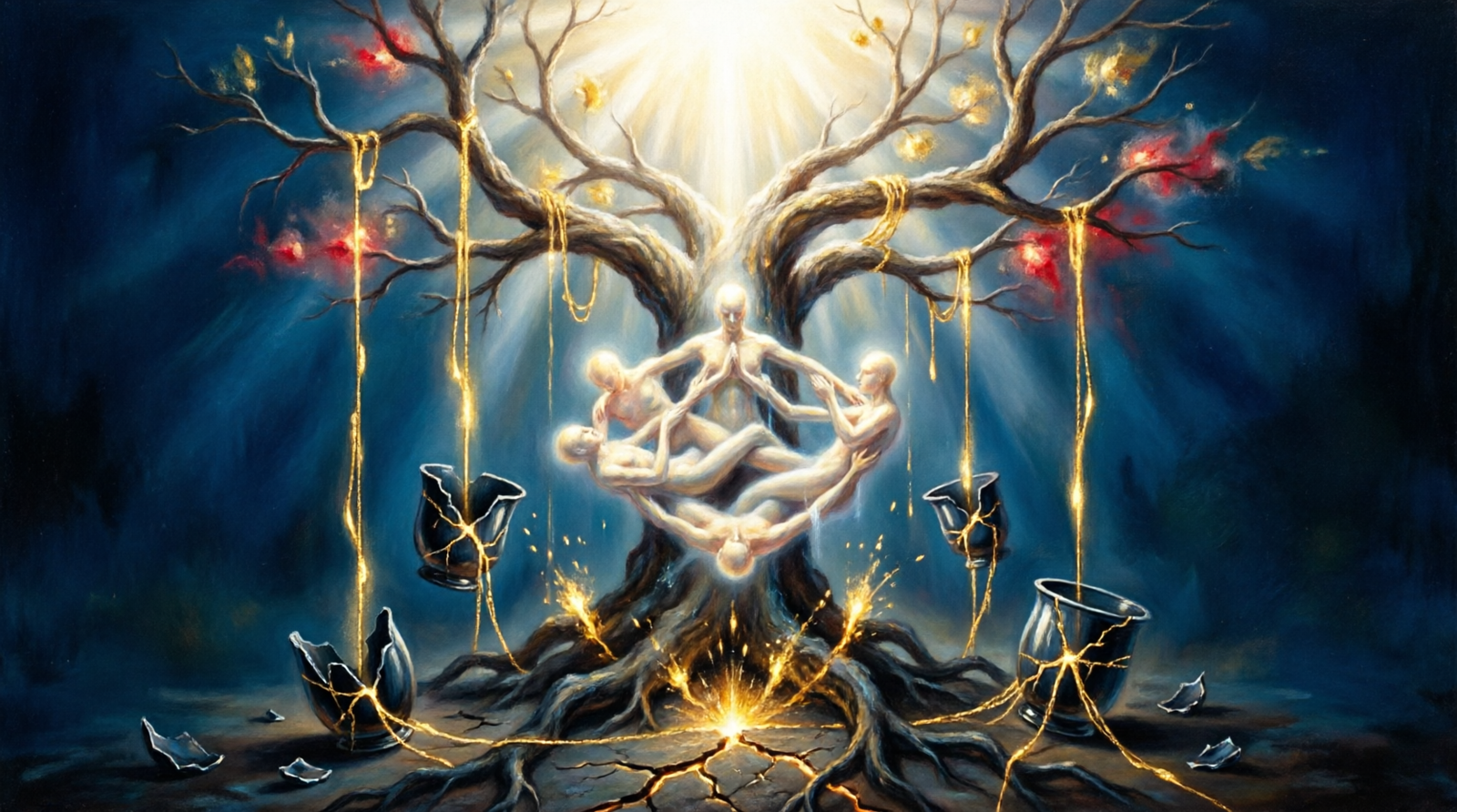
Soul Roots & Repentance: A Personal Journey Through Existence
Exploring the themes of soul roots and repentance is like peeling back the layers of an ancient scroll, unraveling the deep mysteries of our existence. Within the mystical teachings of Kabbalah, these concepts offer us profound insights into who we are, where we come from, and where we are headed. They remind us that our souls are intertwined with a larger cosmic narrative, one steeped in history and rich with meaning.
The Cosmic Dance of Creation
Imagine the moment of creation: a magnificent unfolding of the universe, where everything is perfectly balanced and aligned. This stunning beginning took place in a realm known as Atzilut, the World of Emanation. In this space, divine attributes called sefiros came together in a harmonious union, much like the beautiful dance between two partners. This sacred pairing, referred to in Hebrew as “zivug,” symbolizes the profound energy from which our souls originate.
However, this divine dance wasn’t without its challenges. The initial intention of creation encountered obstacles, leading to a separation of the sefiros. This separation was not a mistake but rather a wise decision aimed at keeping chaos and impurity—the Klipos—at bay. When the divine presence, known as the Shechinah, descended into lower realms, the souls that emerged during this time carried the weight of that separation. Like the first humans, Adam and Chava, these new souls were born into a world marked by exile, reflecting a longing to return to their divine source.
Understanding Our Souls: Old and New
As we delve deeper into the nature of our souls, we encounter an intricate tapestry woven from the threads of history. The souls that came into the world after Adam HaRishon, the first human, are like echoes of his essence, each one a unique expression of a larger whole. Yet, the souls born in our times carry the legacy of past choices, reflecting the ongoing struggle for connection and growth.
In contrast, new souls can emerge from the purity of our intentions and actions. When we act with kindness and compassion, we tap into a wellspring of divine energy that resonates throughout the spiritual realms. This process allows us to uplift souls that may be trapped in darkness, helping them find their way back to the light. The phrase “They are new every morning; great is Your faithfulness” beautifully captures this idea of renewal, suggesting that with each new day comes the opportunity for transformation and growth.
Repentance: A Path to Restoration
Repentance, or teshuvah, serves as a profound mechanism for healing and reconnection. It invites us to return to our true selves, allowing us to mend the fractures in our souls and restore our relationship with the divine. This journey of returning is not just about recognizing our missteps; it’s about understanding that our actions have the power to impact not only our own lives but also the lives of others.
In the context of the messianic age, the idea of repentance takes on even greater significance. It’s believed that through sincere acts of teshuvah, we can usher in the resurrection of the dead, bringing forth a new order of souls that align with a higher divine purpose. The Zohar, a foundational text of Kabbalah, reminds us that since the destruction of the Temple, the flow of new souls has been interrupted, highlighting the deep connection between our physical and spiritual worlds. In this sense, our personal journeys of repentance are intertwined with the collective journey of humanity.
Connecting with Our Ancestry: The Legacy of Adam HaRishon
To truly understand our own soul’s journey, we must acknowledge our connection to Adam HaRishon. His spirit encompasses the entirety of our spiritual lineage, and as his descendants, we carry within us the potential for greatness. Adam’s division into 248 limbs symbolizes the interconnectedness of all souls, reminding us that we are part of something much larger than ourselves. Each limb represents a pathway for divine light to flow through us, urging us to recognize our inherent unity and purpose.
As we reflect on these teachings, we realize that the roots of our souls are deeply intertwined with our actions and choices. Each of us holds a unique piece of the divine essence, a reflection of the original soul of Adam. By understanding our soul roots, we can better navigate our spiritual paths, fostering a sense of belonging and responsibility. This interconnectedness calls us to act with intention, compassion, and awareness, recognizing that our actions can uplift not just ourselves but the entire world around us.
Embracing the Journey of Renewal
The journey of soul roots and repentance is deeply personal, inviting us to engage in self-reflection and spiritual growth. The idea that we can draw new souls from higher realms underscores the potential for redemption and the importance of our actions in the grand narrative of creation. Every act of kindness, no matter how small, serves as a beacon of light, drawing new souls closer to their divine source.
As we navigate the complexities of our spiritual journeys, we are reminded that our lives are not isolated episodes but part of a continuous story. The teachings of Kabbalah illuminate a path toward personal transformation and collective awakening, urging us to embrace the divine light that permeates all of creation.
Conclusion: The Promise of Hope and Renewal
In conclusion, the exploration of soul roots and the transformative power of repentance offers us a profound understanding of our place in the universe. By embracing these concepts, we can connect more deeply with our true selves and recognize the divine potential within us all. Our journeys are not just about individual growth; they are about the collective healing of humanity.
As we strive to live lives filled with purpose, compassion, and love, we participate in a sacred dance, weaving our stories into the tapestry of existence. In doing so, we contribute to the ongoing narrative of creation—a narrative rich with hope and the promise of renewal. Ultimately, we learn that the quest for redemption and the elevation of our souls is a shared journey, one that unites us in our pursuit of divine harmony and connection.
**The Interplay of Soul and Repentance: A Personal Journey of Understanding**
In the rich and intricate world of Kabbalistic thought, the concepts of the soul, sin, and repentance weave together to create a deeply personal and transformative narrative. This isn’t just an abstract philosophical discussion; it’s an invitation for each of us to explore our spiritual essence and connect with the forces that shape our lives. The soul, according to Jewish mysticism, isn’t a simple entity but a complex tapestry made up of different layers—Nefesh, Ruach, and Neshamah. Each of these aspects reflects a unique facet of our human experience and our relationship with the divine.
At the heart of this exploration is the idea of divine sparks. These sparks are believed to be fragments of our souls that originate from a higher, divine source. They connect us not only to each other but also to the greater universe. When we think about these divine sparks, it becomes clear that our actions—both good and bad—have repercussions that ripple out beyond our immediate experience. This realization invites us to reflect on how we live our lives and the choices we make, reminding us that we are part of a larger cosmic story.
A key figure in this narrative is **Adam HaRishon**, the first human. He represents not just our beginnings but our ongoing journey. Adam embodies the challenges of navigating life, including the struggle between light and darkness, right and wrong. His experiences serve as a mirror for our own, showcasing the timeless battle we all face in striving for goodness and connection. The choices he made resonate with us, reminding us that our own decisions have the power to shape our paths.
When we talk about repentance, or **Teshuvah**, we’re diving into a transformative process that touches every aspect of our being. Kabbalistic teachings outline various levels of repentance, each corresponding to different dimensions of our souls and the worlds we inhabit—Asiyah, Yetzirah, Beriyah, and Atzilus. These worlds represent different levels of reality, with Asiyah being our tangible, physical existence, while Atzilus is where pure divine energy resides. When we sin, it creates a disconnection between these realms, making it essential for us to find our way back to unity with the divine.
Think of it this way: when we act out of ignorance or temptation, we create a rift not just within ourselves but also in the larger fabric of existence. This understanding encourages us to see our lives as interconnected with the lives of others, prompting us to take our actions seriously. Each small choice can have a profound impact, reminding us that we are all part of a greater whole.
As we embark on the journey of repentance, it’s crucial to recognize that our spiritual growth is not just a matter of personal improvement; it’s a communal experience. Each of us carries the weight of our past choices, but we also have the opportunity to learn and grow from them. The idea of **gilgul**, or reincarnation, suggests that we carry the lessons of our previous lives with us. This perspective adds depth to our understanding of who we are and why we’re here. We’re not just isolated individuals; we’re connected to a lineage of souls who have faced similar struggles.
When we consider the concept of **”blemish”** in relation to sin, it highlights the importance of being mindful of our actions. For example, a misstep made by someone whose soul is deeply connected to the divine carries a heavier weight than a minor error. This understanding serves as a sobering reminder of our responsibility to act with integrity, compassion, and awareness. Each of us has the power to create ripples of positivity or negativity through our choices, emphasizing the need for mindfulness in our daily lives.
As we navigate the complexities of our souls, it becomes vital to gain insight into our individual spiritual journeys. The teachings of the **Zohar** encourage us to explore our inner selves, our roots, and the unique purposes that guide our lives. This self-awareness is the key to unlocking the doors of repentance, allowing us to confront our fears, acknowledge our shortcomings, and ultimately engage in the transformative process of returning to our true selves.
The journey of the soul is a deeply personal one, filled with challenges and triumphs. Kabbalistic teachings offer us a roadmap, guiding us through the intricate landscape of sin, repentance, and the aspiration for unity with the divine. This journey isn’t just about rituals or rules; it’s a heartfelt exploration of what it means to be human, to connect with something greater than ourselves, and to strive for goodness in a complex world.
In the end, the interplay between our souls and our actions invites us to embrace our humanity fully. We are all on a path of growth, learning from our missteps, and striving to reconnect with our divine essence. It’s a beautiful dance of light and shadow, a journey of discovering who we are meant to be, and ultimately, a quest for love, understanding, and connection with the divine spark within us all.