Adam and His Sons: The Inheritance of Sin and the Work of Rectification
The story of Adam and his sons is often remembered as the beginning of human history: the first man, the first family, and the first act of fratricide. In the mystical teaching presented here, however, the story reaches far beyond its place at the beginning of the Torah. It becomes a map of the human soul—a teaching about spiritual potential, the consequences of wrongdoing, and the long work of restoring what has been damaged.
The account begins with a question of timing. Adam was created on the sixth day, and the text imagines what might have happened had he waited until Shabbos night to unite with Chava. Perhaps, it suggests, the worlds would have been rectified from the beginning. But Adam did not wait. His union with Chava took place on a weekday, and the spiritual disorder associated with the serpent entered the lives of their children. Kayin and Hevel were born into a world in which good and evil were already intertwined.
This is not presented simply as a story of inherited guilt. Rather, it describes the conditions under which the first generations had to live and the spiritual challenges they faced. The brothers carried different mixtures of holiness and impurity. Their lives became the first stage in a much longer process: the separation of good from evil, the repair of damaged souls, and the recovery of holiness from places where it had become concealed.
The promise and responsibility of the firstborn
The text places Kayin and Hevel within a symbolic spiritual order. Kayin, as the firstborn, is associated with *Chochmah*, or wisdom. Hevel is associated with *Tifferes* and *Malchus*, qualities connected with harmony, beauty, and sovereignty. The passage suggests that, had Kayin not sinned, he and his twin sister might have expressed a higher spiritual level. Hevel and his twin sisters, meanwhile, would have embodied another part of the divine order.
These associations are not merely descriptions of the brothers’ personalities. They represent spiritual potential: different ways in which holiness could have appeared in the world. Kayin’s firstborn status carried a particular promise, but the promise was not self-fulfilling. It depended on his choices.
The same pattern appears later in the story of Eisav and Ya’akov. Eisav, as the firstborn, might have held an advantage over Ya’akov. In the symbolic language of the passage, Eisav was associated with Chochmah, while Ya’akov was associated with Tifferes. Had Eisav been worthy of his position, his birthright could have been an expression of spiritual greatness. But he failed to live up to that potential. His birthright was taken from him, and Ya’akov received a double portion: his own spiritual inheritance and the portion that Eisav had forfeited.
The teaching distinguishes between *Ya’akov* and *Yisroel* in this context. Ya’akov corresponds to Tifferes, while Yisroel corresponds to Chochmah. The names express different dimensions of spiritual identity and help explain how the inheritance of the firstborn could be transferred and transformed.
The comparison between Kayin and Eisav, and between Hevel and Ya’akov, underscores a central principle: spiritual potential is not the same as spiritual achievement. A person may be born into an elevated position, but that position carries responsibility. Birth order, family inheritance, and natural ability may offer an opening; they do not guarantee that the opportunity will be used well. A spiritual gift can be neglected, misused, or lost.
The brothers’ different mixtures of good and evil
Because Adam sinned before Shabbos, the text says, the serpent was able to impart spiritual impurity to Chava. Kayin and Hevel were therefore born with a mixture of good and evil. Yet the balance within the brothers was different. Kayin was mostly evil with only a small measure of good, while Hevel was mostly good with only a small measure of evil.
The passage describes each brother through three levels of the soul: *Nefesh*, *Ruach*, and *Neshamah*. These terms refer to distinct dimensions of spiritual life. The Nefesh is the most basic level; the Ruach is associated with a higher, more developed spiritual life; and the Neshamah represents a still higher dimension.
Kayin’s Nefesh, Ruach, and Neshamah were all mixed with impurity. In each part of his soul, holiness had become entangled with the forces of evil. Hevel’s condition was different. His Nefesh and Ruach were damaged by the mixture, but his Neshamah remained completely good. Thus, when the text describes Hevel as “mostly good,” it does not mean that every part of his soul was untouched. It means that the spiritual balance within him was different from Kayin’s: Hevel retained a pure Neshamah, even though lower aspects of his soul still required repair.
This distinction gives the brothers’ story a meaning beyond their individual characters. They represent different patterns of spiritual mixture. In Kayin, the mixture reaches all three levels of the soul. In Hevel, the damage is more limited. Their story becomes a way of describing how holiness can be present in a person even when it is obscured by wrongdoing, and how different parts of the soul may require different kinds of repair.
The teaching’s language of “good” and “evil” is not simply a division between good people and bad people. It describes spiritual elements that can be mixed together within a soul. Even a person associated with evil may contain sparks of holiness; even a person described as mostly good may carry a damaged element that needs correction. The spiritual task is to distinguish these elements and restore each to its proper place.
Rectification as a gradual process
The passage presents reincarnation as an ordered process of repair. The Nefesh must first return and complete its rectification. Only after that can the Ruach return to be repaired, and only after the Ruach has been rectified can the Neshamah return.
This sequence matters. The soul’s repair is not treated as a single act that instantly resolves every past failure. It proceeds level by level. One part of the soul must complete its work before another can begin. The process is gradual, and each stage depends on the stage before it.
Hevel’s Nefesh was the first part of his soul to return. Its good element was given to Shais, Adam’s son, where it could be purified and restored. The evil element of the Nefesh, which still contained sparks of holiness, was associated with Bilaam. In this account, the soul is not simply divided into an entirely good part and an entirely evil part. Even the element that has been corrupted may contain something holy that can be separated and reclaimed.
The passage draws this distinction from the letters of Hevel’s name. The letter *Heh* represents the good element that went to Shais. The letters *Bais* and *Lamed* are associated with the remaining evil element and with Bilaam. The text connects these letters to biblical verses and rabbinic teachings, treating words and names as clues to the spiritual structure hidden within a person’s history.
The Three Lines, the Journey of the Soul, and the Light of Moshe
The mystical account of Noach, his sons, and Moshe Rabbeinu presents the journey of the soul as a gradual process of refinement. A soul does not always appear in its fullness at once. Its different levels may emerge in separate generations, its qualities may be divided among several people, and its holy sparks may remain mixed with what has not yet been purified. Through the language of reincarnation and the sefirot, this teaching describes how spiritual qualities are transmitted, distinguished, and ultimately brought into harmony.
At the heart of this account is the pattern of the three lines: right, left, and middle. The right line is associated with Chesed, the quality of loving-kindness and expansive giving. The left line is associated with Gevurah, the power of restraint, judgment, and disciplined strength. The middle line is associated with Tiferet, the harmonizing quality that balances the other two and brings them into a unified form. These are not merely three separate attributes. Together, they describe a complete structure of spiritual life: generosity must be shaped by discipline, discipline must be softened by compassion, and both must be joined through balance.
Noach and the Three Lines
The Ruach that came to Noach is described as the level of the Six Ends of Tiferet. The Ruach encompasses six sefirot, but Tiferet is considered its central and defining quality. It is the middle line, the point at which the forces of expansion and restraint can meet. Noach therefore represents more than a single spiritual trait. His Ruach contains a broader pattern of qualities, gathered around the harmonizing power of Tiferet.
When Noach fathered three sons, aspects of this Ruach were expressed through them. Yafet corresponds to Chesed and the right line. Cham corresponds to Gevurah and the left line. Shem corresponds to Tiferet and the middle line. The three brothers thus reflect the inner structure of the Ruach: Yafet embodies expansion and generosity, Cham embodies force and restraint, and Shem embodies the center that can unite opposing qualities.
Shem’s correspondence with Tiferet is especially significant. He is not simply assigned one quality among many; he represents Tiferet itself, the central sefirah that includes and balances the Six Ends. In this way, Shem carries the quality of integration. The right and left lines are essential, but neither is complete on its own. Chesed without Gevurah can become unbounded; Gevurah without Chesed can become harsh. Tiferet gives each its proper place and allows them to work together.
This division among Noach’s sons also shows how a single spiritual inheritance can become differentiated. What was held together within Noach’s Ruach appears through his descendants in distinct forms. The qualities do not vanish when they divide; rather, they become visible in separate expressions. The three sons embody different aspects of one larger spiritual pattern.
The Unfinished Rectification
The transmission of the Ruach, however, was not yet complete. According to the teaching, the evil mixed within it had not been fully separated from the good. This is an important distinction between the Ruach and the Nefesh. The Nefesh had already undergone a measure of rectification through Sheis, but the Ruach still contained an admixture: a holy element remained joined to what had not yet been refined.
The presence of this mixture means that spiritual inheritance is not always passed on in a pure or finished form. A sacred quality may survive within an imperfect setting, waiting to be recognized and refined. The good is real, but it is not yet completely free of the surrounding impurity. It must continue its journey through later generations.
The tradition connects this remaining good with Tevi, the servant of Rabban Gamliel, who came from Cham, the son of Noach. Tevi is associated with the good that remained within the mixture of good and evil. His appearance illustrates a recurring theme in the account: even when a spiritual line is not wholly rectified, a genuine spark of goodness can still be present within it. That spark may become visible in a person’s character, learning, or loyalty, even though the larger process of refinement is unfinished.
Tevi’s place in the narrative therefore carries a subtle meaning. He represents neither the complete purification of the Ruach nor the disappearance of its unrefined elements. Rather, he embodies the good that survived within a mixed inheritance. His story reminds us that spiritual history is not always divided neatly into pure and impure, righteous and unrighteous. Sometimes the work is to identify the good that remains concealed within a complicated legacy and to allow it to emerge.
Moshe and the Neshamah
The next stage in the account is the Neshamah, which is associated with Moshe Rabbeinu. Moshe’s Neshamah is described as having contained no element of evil. It was good without mixture, and the verse about his birth is understood as a hint to this quality: “She saw that he was good.” The word “good” points to the purity of Moshe’s Neshamah, distinguishing it from the earlier levels whose histories involved good still mixed with evil.
This contrast does not mean that the earlier levels lacked goodness. The Nefesh and Ruach both contained holiness, but their refinement was incomplete. Moshe’s Neshamah, by contrast, is presented as wholly good. Its purity allows the earlier, already-rectified levels to join with it.
The teaching describes a precise order in which the levels of the soul become manifest. The Ruach does not fully enter until the Nefesh has been rectified. The Neshamah does not enter until the Ruach has been rectified. This sequence reflects a principle of spiritual readiness: a higher level cannot be fully received while the lower level remains unprepared. Each stage must establish a foundation for the next.
Yet the process does not end with the arrival of a higher level. Once the Ruach has been rectified, the Nefesh—which was refined first—can join it. Once the Neshamah has been rectified, both the Nefesh and the Ruach can join with it. The levels that had previously been separated by the work of refinement are reunited when the soul is ready to contain them together.
In Moshe, this reunion becomes possible. His Neshamah is rectified, and the Nefesh and Ruach that had already undergone their own rectification can join with it. Moshe therefore represents a gathering of what had been prepared across time. His spiritual completeness does not erase the earlier stages; it brings them into a more unified form.
The Hidden Names of Shem and Noach
The tradition also reads Moshe’s name as a spiritual map. The letters of “Moshe” are understood to contain an allusion to Shem. Since Shem reincarnated into Moshe, the name itself hints at the continuity between them. This interpretation gives a deeper dimension to the words spoken in Exodus: “I know you by name.”
The connection between Shem and Moshe is presented as something revealed. Shem is found within the letters of Moshe’s name, so the language of knowing and naming is especially appropriate.
Zehr Anpin and Nukrah of Asiyah: Adam’s Inheritance Across the Worlds
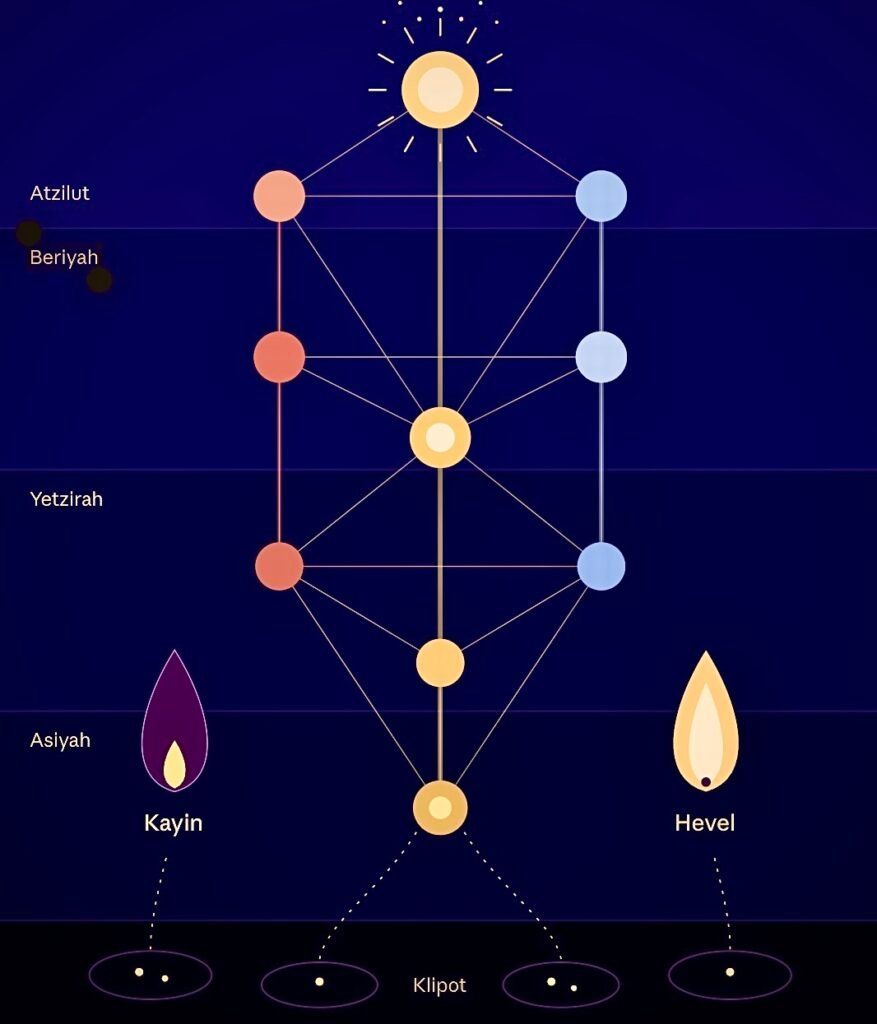
The passage describes a spiritual order in which the human soul is connected to a vast hierarchy of worlds, configurations, and levels of divine vitality. Its subject is Adam HaRishon and the spiritual inheritance that remained with him, passed to Kayin and Hevel, or fell into the grasp of the *Klipot*. At the farthest end of this hierarchy stand Zehr Anpin and Nukrah of Asiyah. Their place may seem remote from the higher radiances of Atzilut, but the text includes them in its account because the structure of the soul reaches through every world, from the highest levels of holiness to the lowest boundary of Asiyah.
The teaching begins with a numerical framework. It identifies ten *partzufim*, or configurations, and explains that each contains ten *sefiros*. Each partzuf therefore has a structure of ten, and together the ten partzufim contain one hundred *Kesarim*—crowns, or the highest points within those configurations. Each Keser, in turn, includes ten sefiros and the four upper soul-levels: *Yechidah*, *Chayah*, *Neshamah*, and *Ruach*. The account says that these upper levels were removed from Adam and ascended to their holy places. They are not described as ordinary remnants of his soul, but as exalted lights belonging to a higher order.
This numerical language gives the passage its sense of scale. Adam is not presented simply as an individual whose soul was divided into a few portions. He is understood as having been connected to a complete spiritual system, whose parts correspond to the worlds and their configurations. The count of one hundred Kesarim makes that system visible in outline. Yet the passage is not merely interested in numbers. It asks what happened to the spiritual levels represented by those numbers: which were restored to their proper places, which remained connected to Adam, which were inherited by his sons, and which descended into the Klipot.
Two Radiances
The text distinguishes two forms of *Zihara*, or spiritual radiance. The first is the *Zihara Ila’ah* of Atzilut. It is the highest radiance in the account, associated with Yechidah, Chayah, Neshamah, and Ruach in the World of Atzilut. This light is described as having been removed from Adam and returned to its sacred source. Its restoration underscores the distance between Adam’s original spiritual stature and the diminished condition that followed the events described in the text.
The second radiance belongs to the three lower worlds of Beriyah, Yetzirah, and Asiyah. This radiance includes the upper configurations of Beriyah—among them Arich Anpin, Abba, and Imma—and extends through the Kesarim of the partzufim in the lower worlds. The text describes the four upper levels within the Kesarim of the ten partzufim, from Zehr Anpin and Nukrah of Beriyah down to the final point of Asiyah, as part of this second radiance.
Although this second radiance is lower than the first in the hierarchy, it remains beyond the grasp of the Klipot. That distinction matters. The passage does not equate “lower” with “impure,” nor does it suggest that every level below Atzilut is exposed to spiritual harm. Some levels are lower in rank but remain protected by their holiness. The second radiance is diminished relative to the radiance of Atzilut, yet it is still too elevated for the Klipot to seize.
The difference between the two radiances is also a difference in what happened to them. The first was completely removed from Adam and returned to its proper place. The second did not depart in quite the same way. It remained connected to Adam, though not necessarily in a fully settled or ordinary form. The passage describes it as a level that was not wholly removed, and later suggests that some of it remained hovering above Adam until Kayin and Hevel were born. Thus the second radiance occupies an ambiguous position: it is not simply Adam’s possession, but neither is it entirely absent from him.
The Place of Asiyah
The account carefully counts the lower worlds. Yetzirah contains four sefiros, each of which has ten sefiros and its own Keser. This produces forty Kesarim in Yetzirah. Asiyah is counted in the same way and contains another forty. Together, the four sefiros of Yetzirah and the four of Asiyah account for eighty Kesarim.
The text also names the partzufim associated with these worlds. In Beriyah, it includes Zehr Anpin and Nukrah. In Yetzirah, it includes Abba, Imma, Zehr Anpin, and Nukvah. Asiyah likewise contains Abba, Imma, Zehr Anpin, and Nukrah. The sequence places Zehr Anpin and Nukrah of Asiyah at the lower end of a chain that begins in the higher worlds and descends through Beriyah and Yetzirah.
Their location at this boundary gives them a particular significance. Zehr Anpin and Nukrah of Asiyah represent the lowest named configurations in the passage’s account of the radiance extending through the worlds. They are part of the system’s final reach into Asiyah, where the spiritual order approaches the realm most distant from the highest levels of Atzilut. But “lowest” here describes position in the hierarchy; it does not mean that these configurations are irrelevant or outside the sacred order. The passage includes them precisely because its account of Adam’s spiritual structure extends all the way to them.
Asiyah therefore plays two roles. It is the lowest of the worlds considered in this passage, and it is an essential component of the complete spiritual map. Without Asiyah, the account would stop before reaching the lowest levels associated with Adam’s soul and the descent of spiritual vitality. By including Zehr Anpin and Nukrah of Asiyah, the text shows that the relationship between Adam and the worlds is not limited to the highest realms. It extends through the entire hierarchy.
What Remained, What Was Inherited, and What Fell
After describing the radiances, the passage divides Adam’s spiritual inheritance into three broad levels. The first is the highest radiance, which was entirely removed from Adam and returned to its holy place. The second is the radiance that remained connected to him in a diminished or suspended form. The third consists of the remaining sefiros of the ten partzufim, apart from the one hundred Kesarim already discussed. These, the text says, fell from Adam and descended into the Klipot.
This division is not presented as a complete and settled account. The author openly acknowledges uncertainty about the second level. He says that he did not receive a full explanation from his teacher and is unsure how this level was divided between Adam and his sons. The passage therefore combines firm assertions with questions that remain unresolved. It tells the reader what the author believes can be stated, while preserving the limits of what he knows.
The Inheritance of a Name
**To my children, Zehr Anpin and Niskrah, **
Fame is a peculiar inheritance. It may arrive before we are old enough to understand it, carried in a family name, a story told at gatherings, or the expectations others place upon us. It may come later, after years of work, when the world turns its attention toward what we have made. And sometimes it never comes at all. But whether a person is celebrated by thousands or known only to a few, the question remains the same: What do we do with the life and gifts entrusted to us?
The old teachings speak of Adam and his sons, Kayin and Hevel, in the language of inheritance. Adam kept certain lights within himself, while other portions—identified with Da’as, or knowledge—were bequeathed to his children. The account is mysterious, but its meaning reaches beyond mystery. It reminds us that no parent can give a child an entire life, complete with every answer and every safeguard. We pass on some things directly: our habits, our words, our customs, our hopes. Other things are received indirectly, through what we choose to do and what we fail to do. Still other things must be discovered by each child alone.
Inheritance, then, is never simply possession. It is a beginning. What you receive may be precious, but it is not finished. A gift becomes meaningful through the way you use it; a name becomes honorable through the life lived beneath it. You may inherit a story, but you must decide what kind of chapter you will write.
Fame can make this work more difficult. When a name is known, people may think they already understand the person who carries it. They may see a parent’s reputation, a family’s history, or an image shaped by rumor and admiration. They may praise you for qualities you have not yet developed, or blame you for things you did not choose. Such judgments can be flattering, painful, or both. But they are not the whole truth of you.
Remember this: you are not merely the continuation of another person’s story. You are its answer, its revision, and, in time, its own beginning. You may honor those who came before without becoming their copy. You may inherit their strengths without repeating their mistakes. You may even disagree with them and still love them. A true inheritance does not demand that you surrender your own judgment. It gives you something to consider, care for, and, when necessary, transform.
The story of Kayin and Hevel also warns us that what is powerful can be vulnerable. Their inheritance is described as connected to Da’as—the knowledge that can distinguish, choose, and act. Knowledge is a great light, but it is not automatically goodness. It can be used to understand another person or to manipulate them; to make something beautiful or to make oneself admired; to repair a wrong or to justify one. The same intelligence that builds a bridge can build a wall. The same eloquence that comforts can deceive.
Fame magnifies this danger because attention enlarges whatever it finds. It can magnify generosity, but it can magnify vanity too. It can help a good idea travel farther, but it can also make a careless word travel farther than its speaker intended. The more people who listen, the more important it becomes to ask what your words are doing. Are they making room for truth, or only for applause? Are they helping someone see more clearly, or making you appear more impressive? Are you speaking because something deserves to be said, or because silence feels like being forgotten?
If people admire you, let their admiration remind you to be responsible, not to imagine yourself beyond responsibility. Praise can be a beautiful thing when it is received with gratitude. It can encourage us to continue, and it can tell us that our work has reached another heart. But praise is not proof that we are always right. It is not permission to stop listening. It is not a substitute for the quiet work of becoming better.
If people criticize you, do not accept every judgment as truth, but do not dismiss every criticism as jealousy. Listen carefully. Ask whether there is something useful within it. A wise person can learn from an imperfect messenger; a proud person can find an excuse to learn from no one. Take what is true, make amends where you have caused harm, and release what is merely cruel or mistaken. You need not carry every opinion with you. Some judgments are only passing weather.
The teaching also suggests that brightness and safety are not always the same thing. A soul may shine with great intensity and still be exposed to danger; another may be more veiled, yet steady and enduring. Public life has the same paradox. The brightest attention is not necessarily the greatest achievement, and the quietest life is not necessarily a small one. There is dignity in work done without applause, in a promise kept when no one is watching, in a kindness that will never be mentioned in a speech. Some of the most important things a person does will never become part of a public story.
So do not spend your life trying only to be seen. Try to become worthy of being trusted. Visibility may bring opportunity, but trust is built slowly: by telling the truth when a lie would be convenient, by keeping your word when keeping it costs you something, by treating people with respect when they cannot reward you, and by admitting when you are wrong. Fame can make a person recognizable. Only character can make a person reliable.
There is another teaching in the passage, about a father who dies before his child is born and, according to the mystical account, returns in that child. Whether you understand this literally, spiritually, or as a sacred metaphor, it speaks to the way the dead remain among the living. Those who came before us continue through what they gave: their gestures, their sayings, their disciplines, their tenderness, their unfinished hopes. Sometimes we discover that we have inherited a habit or a courage whose origin lies far behind us. Sometimes we recognize a loved one in the way we care for someone else.
But carrying someone’s memory does not mean that you must become their substitute. A child is not a second chance for a parent to live another life. You are not required to fulfill every dream that someone else could not fulfill. To honor those who came before is not to disappear into them. It is to receive what is life-giving, set down what is harmful, and carry the rest forward with discernment. Love can preserve a memory without making a prison of it.
The passage also distinguishes between a soul rooted in the holiness of Shabbos and one that receives only an additional measure of that holiness. To me, this is a reminder that people do not all begin from the same place. We inherit different circumstances, different opportunities, different strengths, and different burdens. Some are given a wide road; others must find their way through a narrow one. Some are welcomed into the light early; others must gather it slowly, one small act at a time. Do not measure your worth by the height from which you began. A person is not diminished because the road is difficult, nor made superior because the road is smooth. What matters is how we meet the life that is ours.