The Division of the Souls: Unity, Fragmentation, and the Work of Repair
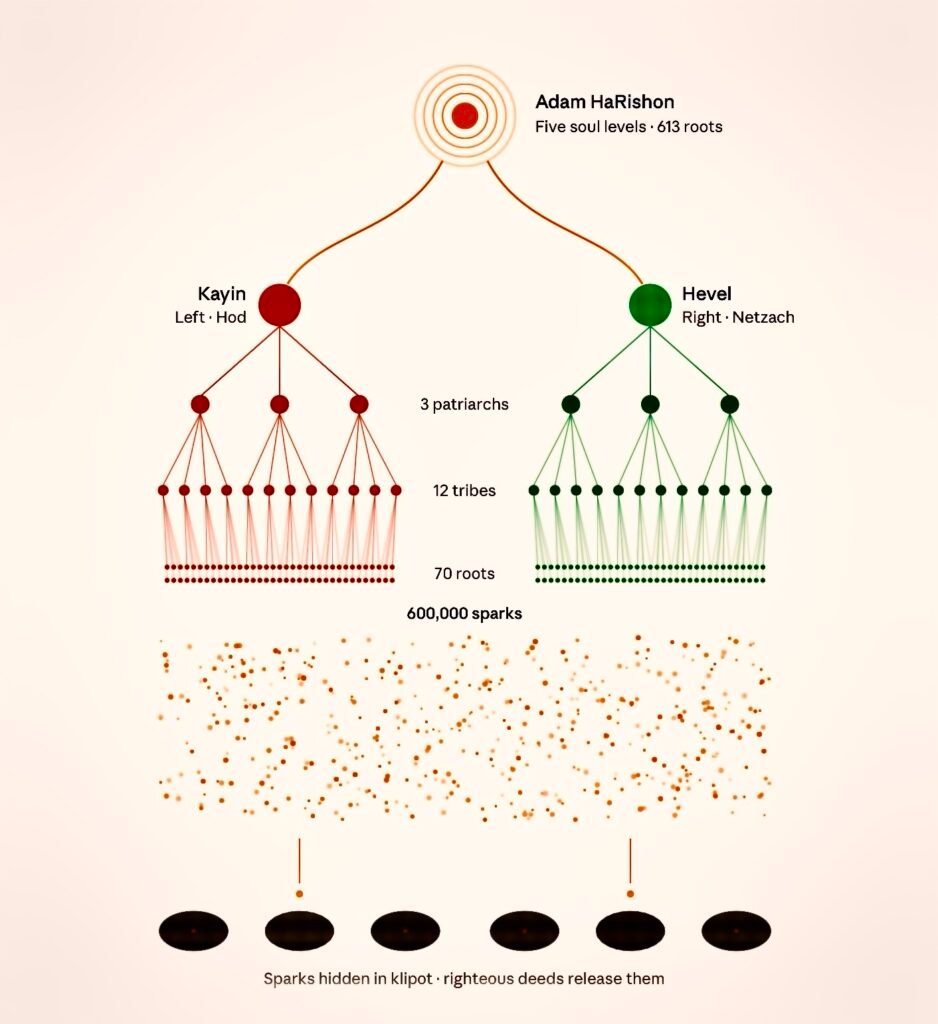
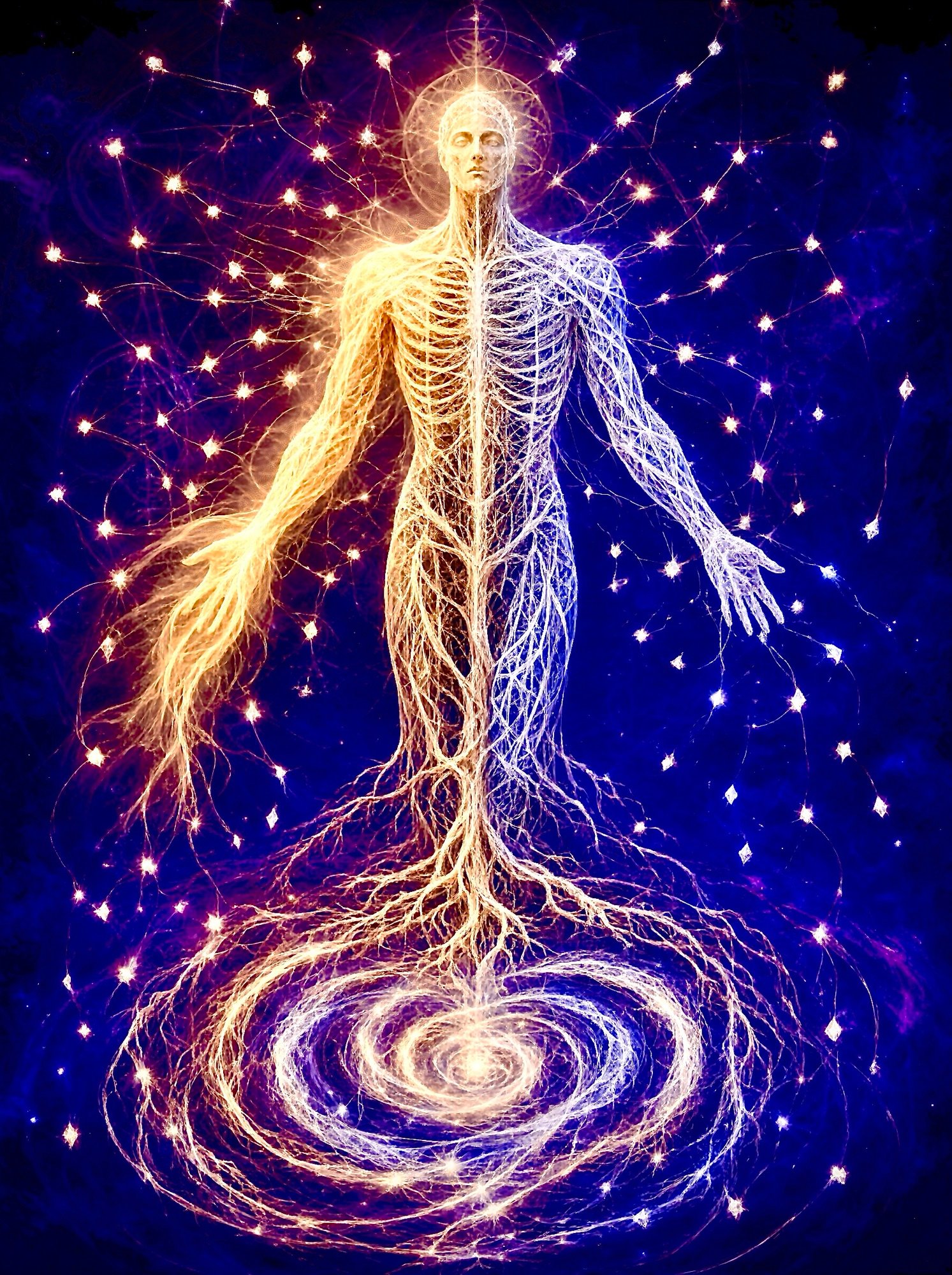
The teaching known as the division of the souls begins with a striking claim: all the souls that would ever inhabit the world were included in Adam HaRishon, the primordial human being. Humanity, in this view, did not begin as a collection of unrelated individuals. It began as a single spiritual structure, containing within itself the roots of every soul, every generation, and every human possibility.
This teaching offers a vision of human life in which individuality and unity coexist. Each person possesses a distinct soul and a particular path, yet no soul is entirely separate from the larger spiritual whole. Human beings are branches of one primordial root. Their lives unfold in different places and eras, but they remain connected through a shared origin and a shared responsibility: to help restore the unity that has become dispersed.
The Soul’s Five Levels
The passage describes the soul as having five levels: Nefesh, Ruach, Neshamah, Chayah, and Yechidah. These levels are associated with the five Partzufim and the ten sefirot, the spiritual structures through which divine life is understood to flow. The names are not simply labels for different kinds of feeling or thought. They describe dimensions of the soul, from its most embodied expression to its highest and most encompassing connection with its source.
The Nefesh is the level with which the passage begins. It is closest to embodied life and action: the soul as it animates a person’s presence in the world. From the Nefesh, the text says, one can infer the structure of the Ruach and Neshamah, and ultimately the higher levels as well. The discussion of the Nefesh is therefore not a narrow account of one part of the soul. It is an introduction to a larger pattern.
That pattern begins with Adam HaRishon. His Nefesh is described through the 248 limbs and 365 tendons of the body, a total of 613. These numbers recall the traditional count of the commandments. The correspondence suggests that the body and the moral life are deeply connected. The human form is not merely a physical container for the soul; it is a structure through which spiritual life becomes active. The body’s limbs make action possible, and the commandments give action a direction. Together, they represent the soul’s potential to participate in the repair of the world.
The teaching thus links spiritual identity with responsibility. A soul is not only something a person possesses inwardly. It is also something expressed through choices, relationships, and deeds. The body becomes the instrument through which the soul’s roots enter the world of action.
Every Part Reflects the Whole
The passage goes further, describing each limb and tendon as a complete spiritual structure in its own right. Every part contains a pattern of the whole: the 613 limbs and tendons are reflected within each individual limb or tendon. Each, in this sense, is a root—large, complete, and capable of containing a complex spiritual reality.
This image presents the human being as a world within a world. A single part is not merely an isolated fragment; it carries a reflection of the larger structure to which it belongs. The whole is present in its parts, even when the parts appear separate. This idea gives the teaching a remarkable sense of depth: the soul is not arranged as a simple chain of pieces, but as a living pattern that repeats at different scales.
The same principle applies to humanity. Each person is distinct, but each person also reflects something of the shared human root. The individual is not erased by belonging to the whole. Rather, individuality is one of the ways the whole becomes visible. Each soul expresses a particular aspect of a spiritual structure that no single person can embody alone.
How Unity Becomes Divided
The passage explains that the original roots can become subdivided through sin and spiritual blemish. The 613 great roots may divide into as many as 600,000 smaller roots or sparks. These smaller roots are still considered genuine roots, though they are more limited than the original ones. The text presents this division as a consequence of damage to the primordial structure.
The numbers describe more than an abstract system. They express a way of understanding the multiplicity of human life. The many souls who appear throughout history are not unrelated beginnings. They are smaller expressions of a larger spiritual reality that has become dispersed. What was once held together in a single structure now appears in many individuals, families, communities, and generations.
Yet division does not mean that the original unity has vanished. The roots remain connected to their source, even when that connection is hidden or difficult to perceive. The sparks are dispersed, but they still belong to the same spiritual order. Their separation is real, but it is not absolute.
This distinction is essential. If the souls were entirely severed from their origin, there could be no possibility of return. But because each spark remains connected to the root from which it came, repair remains possible. The work of spiritual life is not to erase individuality or to return the world to an undifferentiated state. It is to restore relationship—to bring the scattered parts into a more complete and harmonious order.
The passage also sets a limit on the division of the roots, speaking of a maximum of 600,000 smaller roots. Within its own symbolic framework, this limit suggests that fragmentation is extensive but not endless. The spiritual structure may be divided into many sparks, but it remains bounded by an underlying design. The dispersal of souls does not become a meaningless infinity. It takes place within a pattern that still points toward wholeness.
Kayin and Hevel: The Shoulders of Adam
The teaching gives the idea of shared roots a vivid form through Kayin and Hevel, who are described as the left and right shoulders of Adam HaRishon. Their placement within Adam’s body is significant. A shoulder joins the body to the arm, connecting the central form with the power of movement and action. It is a place of attachment and strength, but also of transition: the point at which the body reaches outward into the world.
Kayin and Hevel are therefore presented not as two wholly separate figures, but as two branches emerging from the same primordial human structure. Their distinction is real, yet their origins remain joined. The image of the shoulders embodies the larger teaching: plurality can exist within unity, and apparent separation does not necessarily mean complete disconnection.
The passage associates both shoulders with the possibility of subdivision into many soul sparks. Their division is connected with sin and blemish, but the image also suggests that the consequences of an act may extend beyond the person who performs it. When a root is damaged, its effects may spread through many expressions of that root. Conversely, the repair of a root may also have consequences beyond one individual life.
This is one reason the text gives such importance to spiritual ancestry. A soul’s history may be larger than the visible span of one lifetime. A particular person may carry a spark associated with an earlier root, and that spark may continue to appear in different forms across generations. The passage describes a chain of souls not as a simple repetition of the same personality, but as a continuing spiritual process.
The Shoulders of Adam HaRishon: Spiritual Roots, Bodily Signs, and the Division of Souls
In the mystical teaching presented here, the shoulders of Adam HaRishon are not simply parts of the body. They are spiritual locations within the primordial human being, places where particular souls take root and from which their qualities are understood to derive. The shoulders correspond to different aspects of the divine order: the right side is associated with one set of attributes, and the left with another. The souls of Hevel and Kayin, the passage teaches, are rooted on these respective sides.
This account links several kinds of symbolism. It moves from the structure of the sefirot to the anatomy of Adam HaRishon, from bodily features to the roots of individual souls, and from those roots to the vast division of humanity into lineages and sparks. The result is a vision in which the human body reflects a spiritual architecture, and every soul belongs to a larger pattern reaching back to the first human being.
The spiritual structure of the shoulders
The passage begins by describing a chain of relationships among the sefirot and the higher *partzufim*. Netzach and Hod of Atik Yomin are clothed within the two arms of Arich Anpin. These arms correspond to Chesed and Gevurah: the right arm to Chesed and the left to Gevurah. The arms of Arich Anpin are then clothed within Chochmah and Binah of Abba and Imma.
This layered structure provides the background for the symbolism of Adam HaRishon’s shoulders. The right shoulder is associated with Netzach, while the left shoulder is associated with Hod. Because the two sides correspond to different spiritual qualities, they also become the roots of different kinds of souls.
The right side is linked with the masculine aspect, Zeir Anpin. The left side is linked with the feminine aspect, Nukvah. The passage therefore places Hevel’s root in the right shoulder of Adam HaRishon and Kayin’s root in the left. Their biblical relationship as brothers is thus expressed through a deeper spiritual relationship: each is attached to a different side of the primordial human structure.
The distinction is not simply that one side is “good” and the other “bad.” Rather, the two shoulders represent different qualities and different roles within the spiritual order. The right side is associated with Netzach and the masculine aspect; the left is associated with Hod and the feminine aspect. The account locates Hevel and Kayin within this arrangement, while also emphasizing the particular importance of the left shoulder.
The “crown” of the left shoulder
The left shoulder receives special attention because Hod of Atik Yomin is clothed within Gevurah, the left shoulder of Arich Anpin. This aspect is called the “Crown of Gevurah.” The passage connects the language of a crown with the verse, “A capable woman is a crown to her husband” (Proverbs 12:4).
The image of the crown points to the relationship between Malchut and the masculine aspect. Although Malchut is not counted among the sefirot of Atik Yomin in the same way as the others, its root is hinted at through Hod. The passage describes Malchut as attaching to, or being alluded to within, this aspect. It then invokes the mystical idea that the feminine aspect can ascend to the place of the masculine, particularly in the form of *Or Makif*, or encompassing light.
This teaching gives the left shoulder a distinctive significance. From it, a spark of light extends as the encompassing light of Nukvah of Zeir Anpin. Since Kayin’s root is associated with the side of Nukvah, the passage says that he attaches to the left shoulder of Adam HaRishon. Hevel, whose root is associated with the masculine aspect of Zeir Anpin, attaches to the right shoulder.
The language of “attachment” suggests that a soul is not merely assigned a symbolic label. It is understood to have a particular point of connection within the spiritual body of Adam HaRishon. The shoulder is a place of origin and relationship—a point through which the soul participates in a larger spiritual structure.
Blemish and the body as a spiritual map
The passage also discusses the possibility that a spiritual blemish may be reflected in the body. If a blemish occurs in one shoulder through the sin of a soul rooted there, the corresponding side may also be affected. The text presents this as a general principle: a flaw in one limb can have an effect on its counterpart.
At the same time, the passage associates certain bodily features with the soul’s root. A person whose root is in the left shoulder may have long hair on both shoulders, with the hair more abundant on the left. Someone whose root is in the right shoulder may have more prominent hair on the right. Such features are treated as signs of where the person’s soul is attached within Adam HaRishon.
Within this system, the body becomes a kind of spiritual map. Its visible features may offer clues to the hidden root of a soul, just as the arrangement of the shoulders reflects the structure of the sefirot. The body is not presented as separate from the soul’s history. Instead, its form may bear traces of that history.
The passage refers readers to a discussion in *Sha’ar Ruach HaKodesh*, in a chapter concerning *Hakaras HaPartzuf*—the recognition or discernment of the *partzuf*—and the letters associated with the levels of the soul. The reference indicates that the interpretation of bodily signs belongs to a broader system of mystical knowledge. The signs are part of a framework that connects a person’s physical appearance with the spiritual structure from which the soul derives.
The division of souls within Adam HaRishon
After explaining the shoulders, the passage turns to the division of the souls included in Adam HaRishon. These souls are described as branching into successively smaller groupings. One account gives the sequence as follows: first, the souls divide into the three forefathers; then into the twelve tribes; then into the seventy souls; and finally into six hundred thousand smaller roots.
This sequence presents the history of the Jewish people—and, more broadly, the division of souls—as unfolding through nested levels. The forefathers represent an initial division into great spiritual lineages. The twelve tribes further differentiate those lineages. The seventy souls form another level, and the many smaller roots emerge from them.
The right shoulder is said to divide according to this same pattern. It contains its own divisions into the forefathers, the tribes, and the seventy roots. Together, those seventy roots form the *partzuf* of a single person. Each of the seventy roots, in turn, contains many individual sparks, arranged into a structure of 613 parts.
The passage therefore moves between two scales. At the larger scale, there are the great roots of Adam HaRishon, divided into families and lineages. At the smaller scale, each root contains many individual sparks, each belonging to a particular place within a spiritual structure. A root is not a single undifferentiated soul; it is itself a complete pattern containing many parts.
The Division of Souls: A Journey Through Worlds, Roots, and Repair
In the Kabbalistic account presented here, the soul is not a single, simple essence. It is a complex spiritual structure, rooted in higher worlds and expressed through many levels of being. A person may possess a Nefesh associated with Asiyah, a Ruach associated with Yetzirah, and a Neshamah associated with Beriyah. Beyond these levels, the soul may also include aspects rooted in Atzilus, the highest of the worlds described in this teaching. These dimensions are not separate souls living side by side; they are layers of a greater spiritual identity, each connected to a different level of divine reality.
The text organizes these spiritual roots through five principal configurations: Arich Anpin, Abba, Imma, Zeir Anpin, and Nukva. Each represents a distinct aspect of the structure of the upper worlds, and each becomes a source from which souls and soul-sparks may descend. The roots are not merely names in a system of mystical classification. They express the idea that human life is connected to an ordered spiritual pattern, and that every soul has a place within that pattern.
Within each world, the five roots divide further. Each root unfolds through ten sefirot, producing fifty roots in a world. Those roots then divide into still more levels and sparks. The result is a vast network of spiritual descent: from a general root to a more particular soul, and from that soul to the sparks that may appear in individual lives. The text compares this structure to a complete *partzuf*, a spiritual form made up of 613 components—248 limbs and 365 tendons. These numbers echo the traditional count of the Torah’s commandments, suggesting a connection between the soul’s inner form and the obligations through which a person serves G-d.
This correspondence gives the doctrine an ethical dimension. The soul’s structure is not simply something to contemplate; it is also something to express through action. The commandments are understood as more than external rules. They correspond to the spiritual form of the human being and provide a means through which that form may be brought into harmony. In this sense, spiritual life involves both knowing where the soul comes from and acting in a way that helps it fulfill its purpose.
The text also describes differences among people through the image of a tree. A single root may produce fruit, leaves, branches, wood, and peel. The fruit is compared to Torah scholars, while the other parts represent those who sustain and cultivate the world in different ways. The analogy suggests that people who differ in learning, position, or visible achievement may still belong to one living structure. A tree cannot be reduced to its fruit alone: its branches, leaves, and roots all contribute to its life. Likewise, a community depends on many kinds of people, each serving a different role.
This image is not a claim that some people possess no spiritual value unless they become scholars. Instead, it presents a shared source that expresses itself in varied forms. Some people may produce the “fruit” of deep learning; others may support the conditions in which learning and spiritual life can flourish. The tree’s unity does not erase its diversity. Rather, its many parts reveal the richness of the root from which they grow.
Because a root can contain many sparks, it is possible for several sparks associated with the same spiritual source to appear in the world at once. One spark may enter one person, while another spark from the same root enters someone else. The text even describes the possibility of several sparks emerging in one generation, or of different sparks appearing together in a single person. Their closeness is compared to different portions of one spiritual structure, such as parts associated with the eyes or fingers. They share an origin, but they are not necessarily identical in their role or expression.
This teaching helps explain why people who live in the same period may be connected to a common spiritual root despite their different lives and characters. Their relationship is not necessarily visible in ordinary terms. It belongs to a deeper pattern of origin and spiritual history. The text uses examples of figures from different generations to illustrate how souls connected to one root may appear in widely separated eras, or may emerge together within the same age.
The appearance of a soul-spark in the world is also connected to the condition of the Klipos. The Klipos are the forces or coverings that conceal holiness and obstruct its expression. In the text’s account, when the Divine Presence is exiled among the Klipos, the souls connected to that spiritual exile are also concealed. Their descent into the world is therefore part of a larger drama: sparks are hidden, and their return to holiness depends upon the work of spiritual repair.
Righteous deeds play an important role in this process. The text teaches that the actions of a righteous person may help release one or more sparks from the Klipos, making them ready to enter the world. The number of sparks released, and the time at which they emerge, depend on the nature and timing of those deeds. A soul’s arrival is therefore not described as an isolated event. It belongs to a wider history in which the actions of one person may help prepare the way for another.
This idea gives human action a far-reaching significance. A good deed may have consequences beyond the person who performs it. It may help restore a concealed spark, contribute to the repair of a spiritual root, or enable a soul to enter the world at the proper time. The teaching does not present these processes as something people can easily observe or control. Rather, it suggests that the visible course of history may be shaped by spiritual causes that remain hidden from ordinary sight.
At the center of this account stands Adam HaRishon, the first human being. Adam is described as possessing soul-levels from the lower worlds—Nefesh from Asiyah, Ruach from Yetzirah, and Neshamah from Beriyah—as well as higher aspects rooted in Atzilus. These higher levels are associated with Nukva, Zeir Anpin, and Imma. Together, the Atzilus aspects are called Adam’s *Zihara Ila’a*, his “supernal radiance.”
The text teaches that before Kayin and Hevel were born, Adam’s *Zihara Ila’a* departed from him. This departure is connected with the consequence of eating from the Tree of Knowledge. The divine decree of death, in this interpretation, involved more than the end of physical life. It also marked the loss or removal of elevated spiritual dimensions that Adam had previously possessed. The human condition after the sin is therefore portrayed as a diminished one: humanity continues to carry spiritual roots, but those roots are now entangled with concealment, separation, and mortality.
When Kayin and Hevel were born, the Nefesh of Atzilus that had departed from Adam was divided between them. Their story thus becomes part of the transmission of Adam’s spiritual inheritance. The brothers are not only two individuals in the earliest human family; they also represent portions of a soul-level that once belonged to Adam. Their lives and deaths unfold within a larger process of division and repair.
Yet this inheritance is not presented as pure or undamaged. Adam’s sin had mingled good with evil, and that mixture affected the spiritual condition of the soul-sparks that descended from him.
The Soul’s Ascent: Atzilut, Reincarnation, and the Hidden Order of Spiritual Life
The passage from *Sha’ar HaGilgulim*, the “Gate of Reincarnations,” presents a striking vision of spiritual history. Beneath the familiar stories of Pinchas, Chanoch, Yosef, Rabbi Yishmael, Moshe, and the patriarchs, it traces the movement of the soul through different generations and through the inner structure of the worlds. Its central claim is that spiritual attainment is not always received all at once: a person may first merit a particular level of soul, and only later receive a higher one. The text reads biblical events not only as episodes in history, but as moments in the gradual revelation of divine qualities within human life.
The passage’s framework is the Kabbalistic World of Atzilut, the highest of the four worlds. Within it, the soul is described in ascending levels: *Nefesh*, *Ruach*, *Neshamah*, *Chayah*, and *Yechidah*. These terms can refer to dimensions of spiritual life, from its most basic vitality to its most expansive awareness of the divine. The text’s particular concern is with the way a person may receive aspects of the *Nefesh*, *Ruach*, or *Neshamah* of Atzilut—an exceptionally elevated spiritual inheritance. Such an inheritance, it argues, is not simply a reward for a single act. It is part of a larger process of preparation, transformation, and spiritual repair.
Pinchas: From Zeal to Covenant
The first example is Pinchas, who killed Zimri during the crisis at Shittim. The passage connects this act with the divine promise, “Behold, I give to him My covenant of peace” (Bamidbar 25:12). It suggests that Pinchas had not yet merited the *Ruach* of Atzilut before this event. First, through his action, he received the *Nefesh* of Atzilut; afterward, he merited a portion of its *Ruach*.
The sequence is significant. In the text’s spiritual psychology, *Ruach* does not rest upon a person without a prior foundation of *Nefesh*. The ascent is ordered: one level prepares the vessel for the next. Pinchas’s story therefore becomes more than an account of dramatic intervention. It illustrates the passage’s principle that spiritual elevation requires a structure capable of receiving it.
The association between *Ruach* and the covenant of peace may seem surprising, since Pinchas’s deed was forceful and violent. The passage addresses this by relating *Ruach* to the divine attributes of *Tiferet* and *Yesod*, and by invoking the prophetic phrase, “Peace, peace, to the far and to the near” (Isaiah 57:19). The point is not that violence itself is peace. Rather, the text interprets Pinchas’s act as one that restored a broken spiritual order, after which the covenant of peace could be given. Its language is mystical and theological: the deed is understood through its place in a divine pattern, not as a general model for human conduct.
Chanoch and the Heavenly Minister
The passage next turns to Chanoch, son of Yered. Chanoch, it says, received a portion of the *Neshamah* of Atzilut and became the heavenly angel known as Metatron. His transformation is associated with the biblical statement that he “walked with God, and he was not, for G-d took him” (Bereshit 5:24). Unlike ordinary human beings, Chanoch did not die in the usual manner; his earthly life gave way to a celestial role.
The text calls this level of *Neshamah* the “Minister of the World,” because it flows from Atzilut, the world that governs the lower worlds. Metatron’s authority is thus presented as a reflection of the spiritual source from which his soul derives. He is not merely a powerful angelic figure, but a being whose function expresses the influence of the highest world upon the realms below.
This account also addresses a question about Chanoch and Metatron: if Metatron is associated with the World of Yetzirah and serves as its minister, how could he have held that role while Chanoch was still living on earth? The passage’s answer draws on the Zohar’s teaching that a person may possess two *ruachs*: one associated with earthly life and another with the heavenly realm. In this way, the text distinguishes between Chanoch as a human being and the heavenly dimension of his spiritual identity. The earthly person and the celestial minister are connected, but they are not simply identical in every respect.
Yosef: Beauty, Testimony, and Spiritual Inheritance
The next figure is Yosef HaTzaddik. The passage connects him with the verse, “As a testimony to Yosef” (Psalms 81:6), and identifies him with the upper *Neshamah* associated with Chanoch. This inheritance is used to explain the biblical description of Yosef as handsome: his beauty is understood as a reflection of the beauty of Adam HaRishon, which itself is linked to the elevated *Neshamah* of Atzilut.
Yosef’s spiritual attainment, however, is said to have come at a particular moment: the night marking the end of his two years in prison, just before his release and elevation in Egypt. The text reads this transition through the verse, “When He went out over the land of Egypt” (Psalms 81:6). In its mystical interpretation, the moment of Yosef’s ascent corresponds to the entry of a new spiritual level into him.
The timing matters. The passage emphasizes that the *Ruach* or *Neshamah* may enter a person at night, upon awakening from sleep. This gives Yosef’s liberation a double meaning. On the historical level, he leaves prison and rises to power. On the spiritual level, the night marks an inward awakening and the reception of a higher soul.
The same framework is used to interpret the tradition that the angel Gabriel taught Yosef seventy languages. The psalm continues, “A language I had not known, I heard” (Psalms 81:6), and the Talmud relates Yosef’s acquisition of languages. The passage links this gift to Metatron, who is described as minister over the seventy angelic princes associated with the seventy nations and as one who knows their languages. When the soul connected with Metatron enters Yosef, he immediately gains access to this extraordinary linguistic knowledge.
Here, language is more than a practical skill. It represents the ability to engage with the many peoples and cultures of the world. Yosef’s knowledge of languages suits his role as a leader in Egypt: he can move between worlds, interpret the needs of others, and administer a society far beyond his own family and homeland. The mystical inheritance thus illuminates the public function of the biblical figure.
Rabbi Yishmael and the Completion of a Repair
The passage then traces this *Neshamah* through Yosef to Rabbi Yishmael, son of Elisha the High Priest. Rabbi Yishmael is described as exceptionally handsome, and the text cites the tradition in *Pirkei Heichalot* in which Metatron addresses him: “Your beauty is my radiance.” The phrase suggests a deep affinity between the earthly sage and the celestial minister. Rabbi Yishmael’s beauty is not merely physical; it manifests a spiritual radiance inherited through the soul’s chain of transmigration.
Why, then, does this soul enter Rabbi Yishmael? The passage offers two reasons. The first concerns Adam HaRishon. Adam, it says, was originally destined to live forever, but the soul-level under discussion was not itself subject to the decree of death. Rather, it was separated from Adam when he sinned. Its later journey is therefore part of a process of restoration: what was lost or displaced must find a new place in human history.
The second reason concerns Yosef. Although Yosef is presented as a righteous figure, the passage identifies a failing in his conduct toward his brothers: he provoked them through his dreams and through the negative report he brought to his father. In this account, the soul’s later incarnation in Rabbi Yishmael allows it to undergo the punishment of death. The teaching is severe, but its underlying idea is one of moral continuity. Even the righteous are not beyond accountability, and the soul’s journey may include the repair of consequences that remain unresolved.
The passage therefore treats reincarnation not as an abstract speculation, but as a means of explaining the persistence of spiritual responsibility across generations. A soul may carry both a gift and an unfinished task. Its later lives are not simply repetitions; they are opportunities for completion, correction, and transformation.
Moshe and the Patriarchs: The Structure of Divine Qualities
The final section places Moshe Rabbeinu and the patriarchs within the same map of spiritual attributes. Moshe is associated with *Da’at* of Atzilut—the faculty of profound spiritual knowledge and integration. Abraham, Isaac, and Jacob are associated respectively with *Chesed*, *Gevurah*, and *Tiferet*: loving-kindness, disciplined strength, and harmony or compassion.
This arrangement gives the patriarchs distinct spiritual identities. Abraham embodies expansive generosity; Isaac represents restraint and judgment; Jacob brings the two into balance. Moshe, by contrast, is associated with *Da’at*, the knowledge that gathers and integrates the qualities that precede it. The passage is not merely assigning each biblical figure a mystical label. It is presenting sacred history as the unfolding of divine attributes through human lives.
A Vision of Spiritual History
Taken together, these teachings offer a vision of history in which the soul is both personal and transgenerational. Pinchas, Chanoch, Yosef, Rabbi Yishmael, Moshe, and the patriarchs remain distinct figures, yet each participates in a larger spiritual architecture. Their lives reveal different stages of the soul’s ascent, different expressions of divine qualities, and different forms of repair.
The passage also insists that spiritual development has an order. A higher level depends upon a lower one; *Ruach* follows *Nefesh*, and *Neshamah* represents a further expansion of awareness. At the same time, attainment is not always immediate. A soul’s gifts may emerge only after years of waiting, suffering, moral struggle, or transition. Yosef’s night in prison becomes the threshold of his elevation; Chanoch’s earthly life opens into a heavenly office; Rabbi Yishmael’s beauty becomes a sign of a spiritual inheritance reaching across generations.
The text’s language is deliberately intricate because its subject is intricate: the hidden relationship between human action, divine attributes, and the soul’s long journey. Its account of reincarnation may be read as a theological explanation of continuity, but it also carries an ethical message. Human beings are shaped by what they do, and the consequences of action may extend beyond the moment in which the action occurs. Yet the same continuity that preserves responsibility also makes transformation possible. What is incomplete may be repaired; what is hidden may be revealed; what is divided may be gathered into a higher form.
In this way, the passage portrays spiritual history as an ascent through successive vessels of life. Each generation receives something from those before it, and each person becomes a setting in which a particular divine quality can shine. The journey is neither effortless nor purely individual. It is a gradual unfolding—through deed, inheritance, struggle, and renewal—of the soul’s capacity to approach the divine.