

Sparks of a Common Root: Shared Responsibility, Spiritual Repair, and the Return to Wholeness
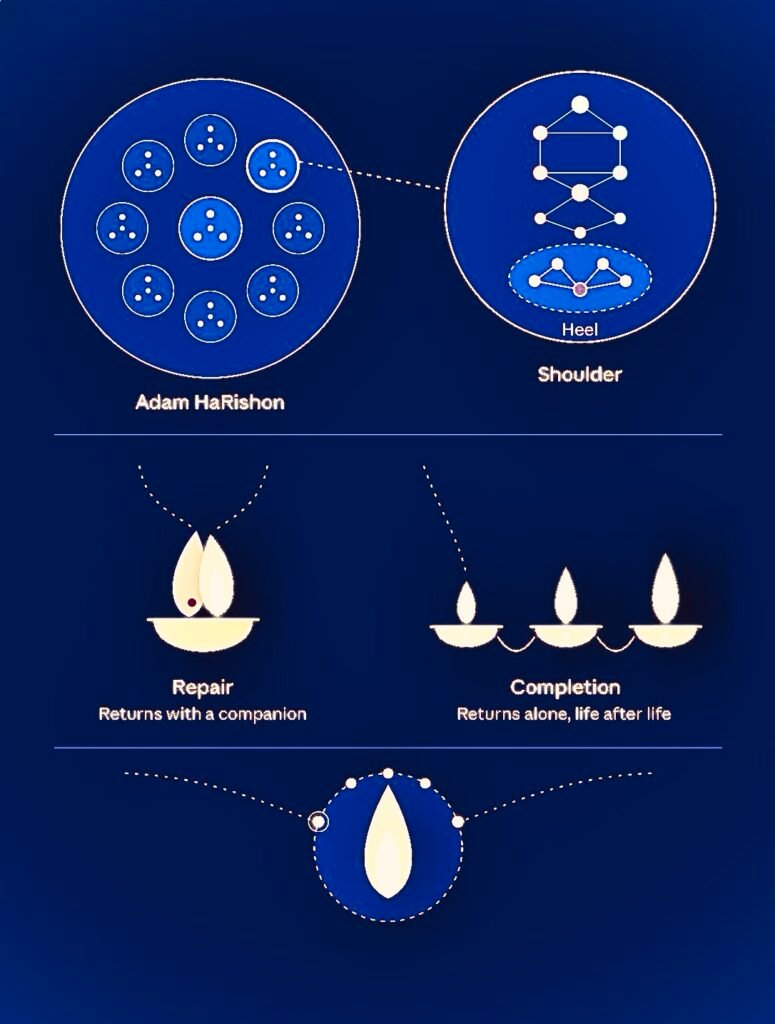
The passage describes a universe in which souls are at once distinct and deeply connected. Every person has a particular spiritual origin and a specific task to fulfill, yet no one’s journey is entirely separate from the journeys of others. Souls may share a common root, assist one another, and bear responsibility for the repair of a spiritual blemish caused by one of their own. They may also become mixed across different roots, so that the several levels of a single soul come from different spiritual sources.
Through its language of Adam HaRishon, reincarnation, mitzvot, and *ibur*—the presence of another soul-spark within a person—the passage offers a vision of human life as an ongoing process of repair. Its central concern is how what has become divided or damaged can be restored. The answer it suggests is both individual and communal: each person must do their own work, but that work is supported by others and contributes to the healing of a larger spiritual whole.
A complete pattern within every part
The passage begins with the soul of Adam HaRishon, the primordial human being. Adam’s soul is described as having 248 limbs, and each limb contains within it a miniature version of the entire structure, “from head to heel.” The image is one of spiritual completeness repeated at different scales. A limb is part of a larger body, but it also contains, in its own way, the pattern of the whole.
This idea resembles a world within a world. The individual is not simply an isolated fragment of a vast spiritual structure. Each part reflects the larger reality from which it comes. The whole is present in each portion, even when that portion has only a limited task to perform.
The passage illustrates this through the example of a person whose soul-root comes from the heel of the shoulder. The shoulder itself contains a complete spiritual structure, but the person whose root is specifically in its heel is not responsible for repairing every level of the shoulder. Their task is to repair the portion corresponding to their own root. The image establishes a principle of proportion: a person is accountable for a particular share of spiritual work, not for every blemish in the entire system.
This distinction is important. The passage does not suggest that each person must somehow repair everything. Instead, it gives each soul a defined place within a larger order. A person’s task is meaningful precisely because it is particular. The work of the heel is not the work of the head, but the heel’s repair still matters to the body as a whole.
The bond between sparks of one root
Although each spark has its own task, sparks from the same spiritual subdivision are connected. If one spark from the “heel” causes a blemish, the other sparks associated with that heel may share responsibility for its repair. The text describes them as guarantors for one another.
This idea changes the meaning of spiritual responsibility. Responsibility is not limited to the direct consequences of one’s own actions. A person is accountable for their own conduct, but they are also connected to the wellbeing of those with whom they share a root. The fault of one spark may become a task for the group, and the completed repair of that shared level may release the other sparks from the need to return for that particular blemish.
The passage therefore portrays a spiritual community that exists beyond ordinary social boundaries. Its members may not know one another, and they may live in different times or bodies, yet they remain linked through their common origin. Their connection is not merely symbolic. It has consequences for the work each must do.
At the same time, this shared responsibility does not mean that individual actions cease to matter. The spark that commits a sin still has a particular relationship to that sin, and the passage distinguishes among different forms of return and repair. The common root creates solidarity, but it does not erase personal accountability. Rather, it places personal accountability within a broader network of obligation.
Different forms of return
The passage distinguishes between reincarnation for the repair of a sin and reincarnation for the completion of a mitzvah. These are not treated as identical forms of spiritual work.
When a spark commits a sin that requires reincarnation for repair, it may return together with another spark from the same root. The companion spark participates in the work of correcting the blemish. The return is thus shared, reflecting the shared responsibility of the sparks.
The text describes a different situation when a sin carries the consequence of *kares*, a form of spiritual severance. In that case, the spark that sinned may return alone in another body, while the first body is described as lost and not rising in the resurrection. This distinction emphasizes the seriousness of certain forms of wrongdoing. Not every failure carries the same consequence, and not every spiritual repair takes the same form.
A soul that returns simply to complete a missing mitzvah, by contrast, does not need another spark to accompany it. It may return alone, and it may do so through more than one lifetime until it has completed the mitzvot it lacks. The passage also presents a striking account of resurrection: each body through which the soul lived may receive a portion associated with the spiritual work accomplished in that body.
This idea gives each life a lasting significance. A body is not merely a temporary vessel whose contribution disappears when the soul moves on. The good performed within it remains connected to it. Each life may contribute something distinct to the larger process of fulfillment, and each body may have a share in what was accomplished through its use.
The distinction between repair and completion also suggests that spiritual life is not only about correcting wrongdoing. It is also about fulfilling what remains unfinished. A person may need to address a blemish, but may also need to complete a positive obligation that has not yet been fulfilled. The soul’s journey includes both the mending of what is damaged and the realization of what is still incomplete.
*Ibur*: spiritual assistance from within
One of the passage’s most intimate ideas is *ibur*. When a spark completes the rectification of its *nefesh*, earlier sparks from the same root may become revealed within it. They illuminate the person and assist them in serving the Creator. This assistance is described as a kind of spiritual presence within the person, not simply as encouragement from outside.
The image is one of accumulated spiritual support. A person’s achievement does not stand alone; earlier sparks from the same root may become active through it. The individual becomes a point of meeting between their own effort and the light of those who came before them in the same spiritual lineage.
Yet this help is not automatic or permanent. The passage says that if the person sins, the assisting sparks may withdraw. Their presence depends upon the person’s actions. The more fully the person acts in accordance with the spiritual task, the more fully the sparks may be revealed; wrongdoing can diminish or remove that support.
This makes *ibur* both a gift and a responsibility. The person is not left to work alone, but neither can they rely on spiritual assistance as a substitute for their own effort. The help they receive is responsive to the way they live. The passage presents spiritual companionship as something that grows through faithful action and recedes through failure.