The Roots of Kayin and Hevel: Soul, Inheritance, and the Ascent Through the Worlds
The story of Kayin and Hevel is among the earliest and most familiar narratives in the Torah. It tells of two brothers, their offerings, their rivalry, and the first killing. Yet in the mystical teaching presented here, the brothers’ story also opens onto a hidden map of the soul. Kayin and Hevel are not only individuals in the first generations of humanity; they are spiritual roots, channels through which aspects of Adam HaRishon’s soul entered the world and continued to shape the lives of later generations.
This teaching describes the soul as part of a vast, interconnected order. The worlds are linked to one another, and the soul contains levels that correspond to them. A person’s spiritual work begins in the lower worlds, but, through refinement and repair, the soul may become capable of receiving from higher ones. Kayin and Hevel occupy a distinctive place in this account because their roots are associated with an unusual capacity for ascent. In certain cases, a soul from their root may attain the Nefesh of Atzilus in a single lifetime.
The claim is both remarkable and carefully qualified. It does not mean that every soul connected with Kayin or Hevel reaches this level, nor that such a soul automatically attains the highest dimensions of Atzilus. Rather, the teaching distinguishes among different kinds of souls, different levels within the roots of Kayin and Hevel, and different degrees of spiritual attainment. Its central concern is the way a soul inherits a spiritual task—and the possibility that, through repair, this inheritance can become a path of ascent.
The connected worlds
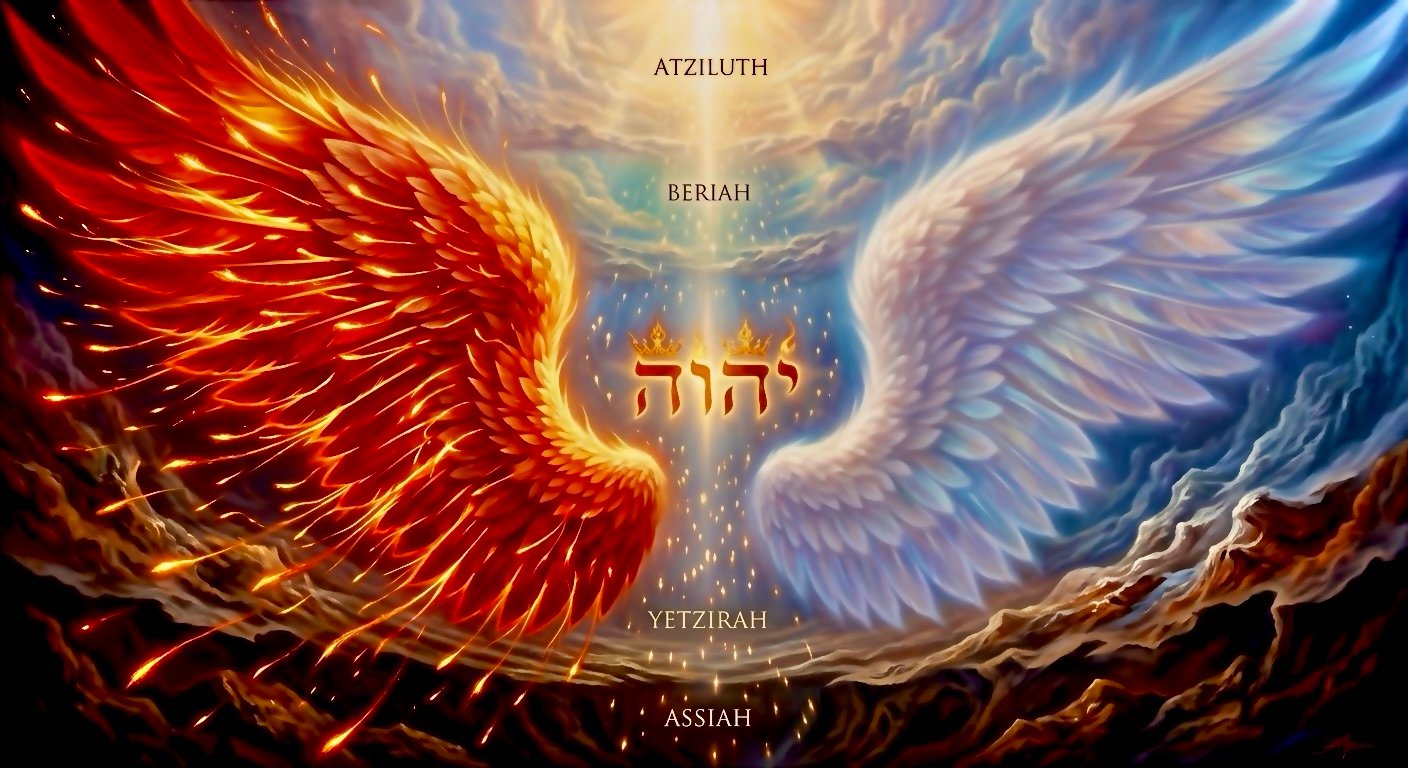
The passage begins from the premise that all the worlds are connected. Asiyah, Yetzirah, Beriyah, and Atzilus are not isolated domains, each sealed off from the others. They form a continuous spiritual order. Each level is related to the one above it, and the lower can serve as a foundation for the higher.
The soul, likewise, is understood as having multiple levels. Its Nefesh is associated with the most immediate dimension of life and action; Ruach and Neshamah correspond to higher dimensions of spiritual consciousness. These levels are connected to the worlds, so that the soul’s development may be described as an ascent through them. A person who rectifies the level of Asiyah may become able to receive from Yetzirah. Further work may open the way to Beriyah, and, in rare cases, to Atzilus.
This ascent is not presented as a rejection of the lower worlds. The soul does not rise by abandoning the work of ordinary life. Rather, its higher attainments depend upon the repair of what is lower. Asiyah, the world of action, is not an obstacle to spiritual elevation; it is its starting point. The work done there can become the foundation for what follows.
The passage compares the worlds to a structure in which one level supports another. Each serves as a kind of throne or foundation for the level above it. The image suggests that spiritual growth is cumulative. A higher attainment rests upon a lower one, just as a building’s upper stories depend upon the strength of its foundations. To reach a higher world, the soul must first establish and rectify the level beneath it.
Still, this progression is not equally available to everyone in a single lifetime. Some souls rectify only the level of Nefesh in Asiyah. Others attain a level associated with Yetzirah, while others reach Beriyah. The attainment of the Nefesh of Atzilus is exceptionally rare. The passage emphasizes that only a small number of soul-roots are able to reach this level through a single reincarnation.
That distinction matters. The teaching is not describing a universal spiritual ladder that every person climbs at the same pace. It is describing a world in which souls have different roots, histories, and capacities. A soul’s potential is shaped by its origin, but that potential must still be realized through repair.
New souls and old souls
A key distinction in the passage is between “new” souls and “old” souls. The terms refer to spiritual roots and histories, not simply to age. The teaching explains that the possibility of rising through the worlds in a single reincarnation is especially associated with new souls.
The roots of Kayin and Hevel are described as new in a particular respect. Because of this, they could attain the Nefesh of Atzilus in one lifetime, though not beyond that level. Other roots, described as old souls, generally did not attain the Nefesh of Atzilus from Adam HaRishon in a single incarnation. Their attainment, according to the text, was ordinarily limited to the Neshamah of Beriyah.
This distinction should not be mistaken for a simple ranking in which one kind of soul is always superior to another. The passage is concerned with the conditions under which a soul can complete particular levels of repair within a given incarnation. A soul’s history may shape the path it must take, and different roots may have different capacities for accomplishing that work at once.
The roots of Kayin and Hevel are exceptional not because the teaching dismisses the importance of other souls, but because it assigns them a distinctive role. Their connection to Adam HaRishon’s spiritual inheritance gives them a particular possibility: to reach the Nefesh of Atzilus in the first lifetime. The attainment is high, but it remains limited. The text repeatedly distinguishes the Nefesh of Atzilus from the Ruach and Neshamah of Atzilus, which it treats as higher dimensions.
The result is a carefully layered picture. A soul may be capable of reaching an extraordinary level without reaching every level above it. Spiritual attainment is not all-or-nothing. It is made up of degrees, and the difference between those degrees is essential to understanding the teaching.
Two levels within the roots of Kayin and Hevel
The passage then makes a further distinction: within the roots of Kayin and Hevel themselves, there are two levels.
The first level consists of the souls of Kayin and Hevel as such. These are described as the souls that fell from Adam HaRishon and are associated with the worlds of Beriyah, Yetzirah, and Asiyah. In this sense, the first level is connected with the lower worlds and with the process of repair that takes place within them.
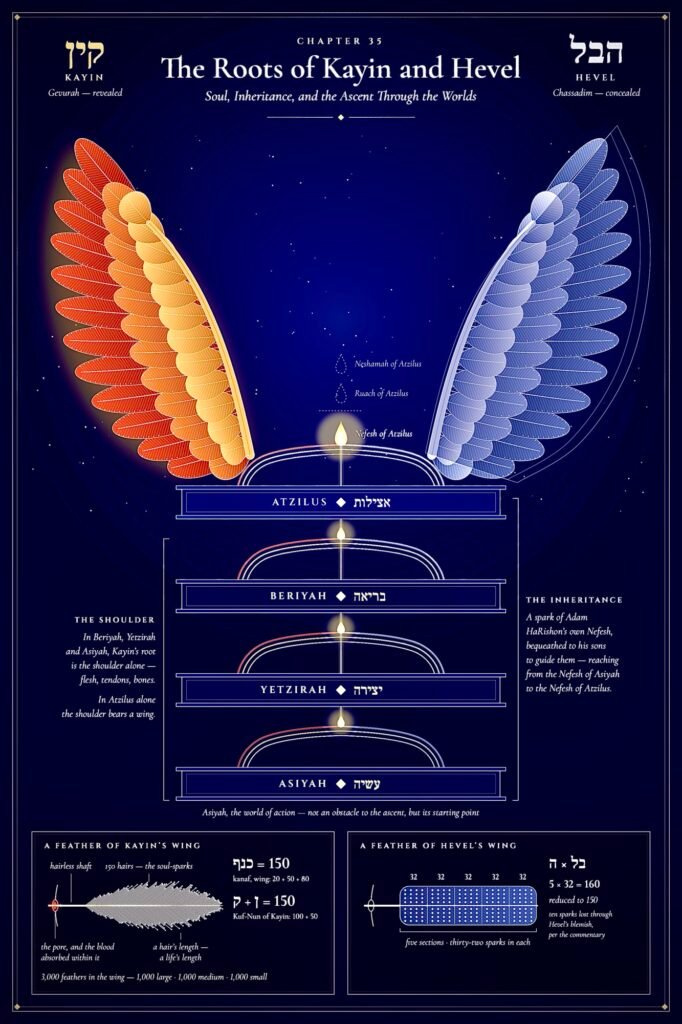
The second level is higher. It consists of a portion of Adam HaRishon himself, which he bequeathed to Kayin and Hevel, his sons. The passage offers the image of a spark from the father’s own Nefesh, given to the children to guide them. This is a striking image of spiritual inheritance: Adam does not merely give his sons life in the ordinary sense. He transmits something of his own soul, a portion that may accompany and direct them.
The inheritance described here extends across the worlds. It reaches from the Nefesh of Asiyah to the Nefesh of Atzilus. A soul rooted in this second level is therefore said to have a great advantage. In its first appearance in the world, it may be able to rectify the whole range from Asiyah up to the Nefesh of Atzilus.
The Root of Kayin and the Right Wing of Hevel
The teaching of the *Gate of Reincarnations* presents Kayin and Hevel as more than two brothers whose lives ended in tragedy. Their story is also a map of spiritual roots: a way of describing how souls emerge from the structure of Adam HaRishon and how they are connected to distinct parts of that structure. Kayin is associated with the left side, and Hevel with the right. Their roots are pictured as a shoulder and a wing: the shoulder provides the underlying limb, while the wing extends from it, bearing feathers, shafts, and hairs that represent increasingly particular levels of soul-sparks.
This imagery is intricate, but its central idea is clear. A soul does not belong to an undifferentiated spiritual mass. It has a place, a structure, and a relationship to other roots. Some souls are connected to the shoulder itself; others are associated with the wing that grows from it, or with a particular feather, shaft, pore, or hair. The account uses the anatomy of the arm and wing to portray a spiritual order in which each level has its own character, and in which even closely related souls may occupy distinct positions.
Kayin’s Root in the Left Shoulder
Kayin is identified with the left shoulder of Adam HaRishon. The shoulder is described as having three levels: flesh, tendons, and bones. These are not simply physical components. Within the teaching’s symbolic language, they represent distinguishable levels of spiritual root. A soul connected to the flesh is not rooted in precisely the same way as one connected to the tendons or bones, even though all belong to the same limb.
The shoulder-root is present in the worlds of Beriyah, Yetzirah, and Asiyah. In each of these worlds, and in each of their five partzufim, there is a root of Kayin in the left arm, in the limb nearest the shoulder. Yet in these lower worlds, the root is limited to the shoulder itself. It includes the levels of flesh, tendons, and bones, but it does not include a wing.
Atzilus is different. In the five partzufim of Atzilus, the left shoulder has both the three levels of the shoulder and an additional level: the wing. This means that the root of Kayin in Atzilus has a broader expression. It includes the shoulder as its foundation and the wing that extends from it. The wing is not separate from the shoulder, but it is more than the shoulder: it is an extension that carries its own elaborate structure.
The distinction between the lower worlds and Atzilus is therefore essential. In Beriyah, Yetzirah, and Asiyah, Kayin’s root is described through the shoulder alone. In Atzilus, the shoulder is accompanied by the wing, with its feathers and the many soul-sparks associated with them. The wing represents an additional level of differentiation and extension. It is as though the shoulder establishes the root, while the wing unfolds its further possibilities.
The Wing and Its Three Thousand Feathers
The left wing of Kayin is said to contain three thousand feathers. These are divided into three groups: one thousand large feathers, one thousand medium feathers, and one thousand small feathers. The three groups are not interchangeable. Their different sizes express different levels within the wing’s structure, just as the shoulder’s flesh, tendons, and bones express different levels within the limb.
Each feather contains 150 hairs, which correspond to soul-sparks. Thus, the wing is not merely a large collection of feathers; every feather is itself a structured root containing many individual sparks. The teaching also describes a pore into which each feather is set. The feather begins within the pore, then rises outward through its shaft and extends into the hairs that grow from either side.
The parts of the feather mark a sequence of spiritual levels. The pore is one level; the base of the feather, where it enters the pore, is another. The shaft that emerges from the pore is distinct from both, and the hairs that grow from the shaft represent further divisions. The feather therefore becomes an image of a branching spiritual lineage: a root gives rise to an extension, and that extension gives rise to more particular branches.
The portion of the feather lodged in the pore is associated with the level of blood absorbed there. Above it is a small section of shaft that has no hairs. Farther along, the shaft continues and hairs grow from both sides. The shaft extends toward the end of the feather, with the hairs attached along its length. This description gives each part a place in the spiritual anatomy: the pore, the absorbed blood, the hairless portion of the shaft, the parts between the hairs, and the hairs themselves.
The teaching also establishes an order of relative height. The feather itself is higher than the pore from which it grows and higher than the blood absorbed at its base. The feather is higher than the hairs that extend from it. Among the hairs, the long ones are higher than the short ones. Each level is related to the others, but each has its own degree and significance.
The Meaning of Hair Length
The different lengths of the hairs are connected to the different lengths of human lives. The short hairs correspond to the soul-sparks of young people who die in childhood. They are not all the same length, and therefore they represent many distinct levels. The longer hairs correspond to souls whose lives extend through more years, with their length indicating the measure of their life in this world.
This comparison makes the feather more than a diagram of spiritual hierarchy. It also connects the structure of the wing to human experience. A soul’s place in the wing is described through an image of growth and duration: some roots are represented by short hairs, others by long ones. The hairs vary in length just as lives vary in their span, and no two hairs need be identical to belong to the same feather.
The image also suggests that distinction is not the same as separation. All the hairs grow from the same shaft, and all the feathers belong to the same wing. Yet each hair has its own length and position. In the same way, souls may share a broad spiritual root while still possessing sharply particular identities. The common structure does not erase individual difference; it makes those differences intelligible.
The Numerical Pattern of Kayin and Hevel
The number 150 is associated with Kayin’s wing through the word *kanaf*, meaning “wing.” In Hebrew, *kanaf* has the numerical value of 150. The teaching also connects this number with the name Kayin, through the letters Kuf and Nun, whose combined value is 150. Accordingly, each feather of Kayin’s wing contains 150 soul-sparks, and those sparks are counted individually.
Hevel’s right wing is organized according to a different pattern. Each feather is divided into five sections, and each section contains 32 sparks. The name Hevel is associated with this fivefold division. The underlying number is 160—five times 32—and the account explains that Hevel’s pattern is reduced to 150 in relation to the sparks under discussion. The accompanying commentary understands this reduction as reflecting a loss of ten sparks through Hevel’s blemish.
The Hidden Roots of Kayin and Hevel: Divine Light, Torah, and the Future Order
The passage presents a mystical account of Kayin and Hevel—not merely as the first brothers in human history, but as the earthly expressions of two spiritual roots. Kayin is associated with **Gevurah**, the force of strength, judgment, and restraint; Hevel is associated with **Chassadim**, the force of kindness, generosity, and expansive love. Through this framework, the text explores why the brothers’ spiritual descendants may differ in what they can perceive, how their souls relate to divine light, and how their roles may be transformed in the future.
Its argument belongs to the symbolic world of Kabbalah, where biblical figures, the sefirot, and the structure of the divine emanations illuminate one another. The passage is not simply assigning virtue to one brother and fault to the other. Rather, it describes two distinct modes of spiritual experience: one marked by forceful revelation and ascent through levels of judgment, the other by benevolence whose light is more concealed.
Kayin and Hevel as Spiritual Roots
The passage begins from a striking premise: even Adam, described as the work of G-d’s own hands, was capable of sin. It follows, the author suggests, that Kayin’s sin should not be considered surprising. Kayin inherited a spiritual constitution in which the element of Gevurah was especially powerful. His nature was therefore more exposed to the force of judgment and to the possibility of its distortion.
This is not a claim that Gevurah is evil. In the Kabbalistic imagination, Gevurah is indispensable: it gives form, boundary, discipline, and the capacity to withstand. Without restraint, kindness can become indiscriminate or diffuse. Yet Gevurah carries a particular danger. When strength is not harmonized with compassion, it may harden into severity. Kayin’s story becomes a dramatic illustration of what can happen when a powerful spiritual force is not properly integrated.
Hevel, by contrast, is associated with Chassadim, the divine qualities of lovingkindness and expansive giving. His spiritual root is gentler, but gentleness does not necessarily mean greater visibility or immediate influence. The text emphasizes that the Chassadim are often concealed and only later revealed. Thus the two brothers represent not simply “bad” and “good,” but different patterns of spiritual emergence: Gevurah is more readily disclosed, while Chassadim may remain hidden until the right time.
The Paradox of Revelation
A central theme of the passage is that spiritual rank and spiritual visibility are not always the same. One might expect the higher or more refined source to shine more openly. The text proposes the opposite: a light that passes through fewer coverings may appear brighter and more powerful than a light originating in a higher place but filtered through additional layers.
To explain this, the passage describes the transmission of divine light through the partzufim—the configurations or “faces” of divine emanation. These structures act as channels through which the infinite is gradually made accessible to lower levels of existence. The light is not simply diminished; it is mediated, shaped, and concealed so that it can be received.
The author compares the differing souls associated with Kayin and Hevel through this structure. Certain lights associated with Imma are described as more openly revealed, while those associated with Abba pass through additional coverings. As a result, a soul connected to a more exposed channel may possess a striking brightness, even if its source is not, in a simple hierarchy, “higher.” This is the spiritual logic behind the Talmudic image of an “upside-down world,” in which what appears lower may prove greater, and what appears higher may be less manifest.
The passage thus resists a crude equation between concealment and weakness. Concealment can indicate depth, but it can also limit what is immediately accessible. Revelation can make a spiritual quality powerful and influential, but it can also expose it to danger. The light of Gevurah may be readily available and capable of rising through successive levels; the light of Chassadim may be subtler, more hidden, and slower to emerge. Each mode has its own strength and its own vulnerability.
Rabbi Akiva and Moses: Two Modes of Torah
This distinction is applied to the relationship between Rabbi Akiva and Moses. The passage cites the tradition that Rabbi Akiva perceived teachings that had not been revealed to Moses, and that Moses saw G-d fastening crowns to the letters of the Torah. When Moses asked who would make use of these crowns, G-d answered that a future sage, Rabbi Akiva, would arise and interpret them.
The image is profound. The Torah is not only a sequence of words. Its letters bear crowns, and its sounds, vowels, and forms contain layers of meaning. The passage associates these dimensions with different modes of interpretation: the plain sense, allusion, exposition, and esoteric meaning. Rabbi Akiva’s greatness lies in his ability to draw meaning from the fine details of the Torah’s written form, even from the crowns attached to its letters.
The author explains Rabbi Akiva’s capacity through his association with Kayin’s spiritual root, while Moses is associated with Hevel. In this account, Rabbi Akiva’s root gives him access to a particular kind of revealed force: the ability to ascend through levels of interpretation and uncover meanings that remain hidden from others. Moses, however, is not thereby diminished. The passage explicitly preserves his extraordinary stature, saying that through his own immense spiritual achievements he was ultimately able to understand everything.
The comparison is therefore not a contest in which one sage simply surpasses the other. It is a meditation on the plurality of revelation. Moses and Rabbi Akiva embody different relationships to Torah: one receives and transmits the foundational revelation; the other discovers inexhaustible implications within its letters. The Torah’s fullness exceeds any single moment of disclosure. A later interpreter may reveal something not articulated at an earlier stage, without displacing the authority or greatness of the original revelation.
This is one of the passage’s most compelling ideas: spiritual inheritance shapes what a person is prepared to perceive, but it does not impose an absolute limit. A person’s root may establish a characteristic path, yet devotion and spiritual achievement can carry that person beyond what the path alone would predict.
The Reversal of Roles in the Future
The passage’s most dramatic claim concerns the future roles of the descendants of Kayin and Hevel. In the present order, the priesthood belongs to the descendants associated with Hevel, while the Levites are linked to Kayin. In the messianic future, this arrangement is said to be reversed: those rooted in Kayin will become priests, and those rooted in Hevel will become Levites.
The argument connects Kayin’s status as the firstborn with the priesthood, understood as the portion of the firstborn. The passage invokes the biblical language of Reuben as the firstborn and interprets the future priestly order as a restoration or transformation of Kayin’s original claim. It further reads Ezekiel’s description of “the priests, the Levites, the sons of Zadok” as a clue to this coming arrangement. In this mystical interpretation, the unusual language of the prophet reflects his own spiritual connection to Kayin’s root.
The reversal should not be read as a simple reward for one family and punishment for another. It expresses a more intricate vision of history: spiritual qualities that are concealed, restrained, or misdirected in one era may find their proper place in another. Kayin’s forceful Gevurah, which in the biblical narrative becomes associated with violence, is not necessarily condemned to remain destructive. In the future, it may be refined and redirected into sacred service. Hevel’s Chassadim, now associated with the priesthood, may likewise assume a different role without losing its spiritual value.
The future order is therefore not merely a rearrangement of offices. It is a picture of repair. The energies that once appeared in conflict may be reconciled through a transformed structure of service. Gevurah can become disciplined holiness rather than violence; Chassadim can remain generous while taking a new form. The history of the brothers is not erased, but its unresolved tension is given the possibility of redemption.
A Theology of Hidden Potential
Taken as a whole, the passage offers a theology of spiritual potential. A person’s inner root matters, but it does not determine the final meaning of that person’s life. A force that is dangerous in one setting may become essential in another. A quality that is concealed today may be revealed tomorrow. And a hierarchy that seems obvious in the present may be overturned when the hidden dimensions of reality become visible.
This outlook also changes how we understand religious greatness. The most luminous person is not always the one whose light is most apparent, and the most concealed source is not necessarily the least powerful. Some souls are suited to uncover the fine structures of sacred teaching; others are suited to transmit its central revelation. Some spiritual qualities emerge through direct, forceful disclosure; others work quietly beneath the surface until their proper hour.
The passage’s account of Kayin and Hevel thus extends far beyond the first family. It asks how human beings carry inherited strengths and dangers, how divine light can be both revealed and concealed, and how religious history may contain possibilities that are not yet visible. Its answer is neither that every difference will disappear nor that every role will remain fixed. Rather, it imagines a future in which opposing spiritual forces are purified and brought into a new harmony.
In that vision, the story of Kayin and Hevel does not end with the first act of violence. It remains an unfinished spiritual drama. The descendants of each brother carry distinct forms of divine potential, and the world’s present arrangements do not exhaust what those potentials may become. Through Torah, spiritual labor, and the transformations of history, what was once divided may be reordered—and what seemed destined for concealment or failure may yet find its place in holiness.