
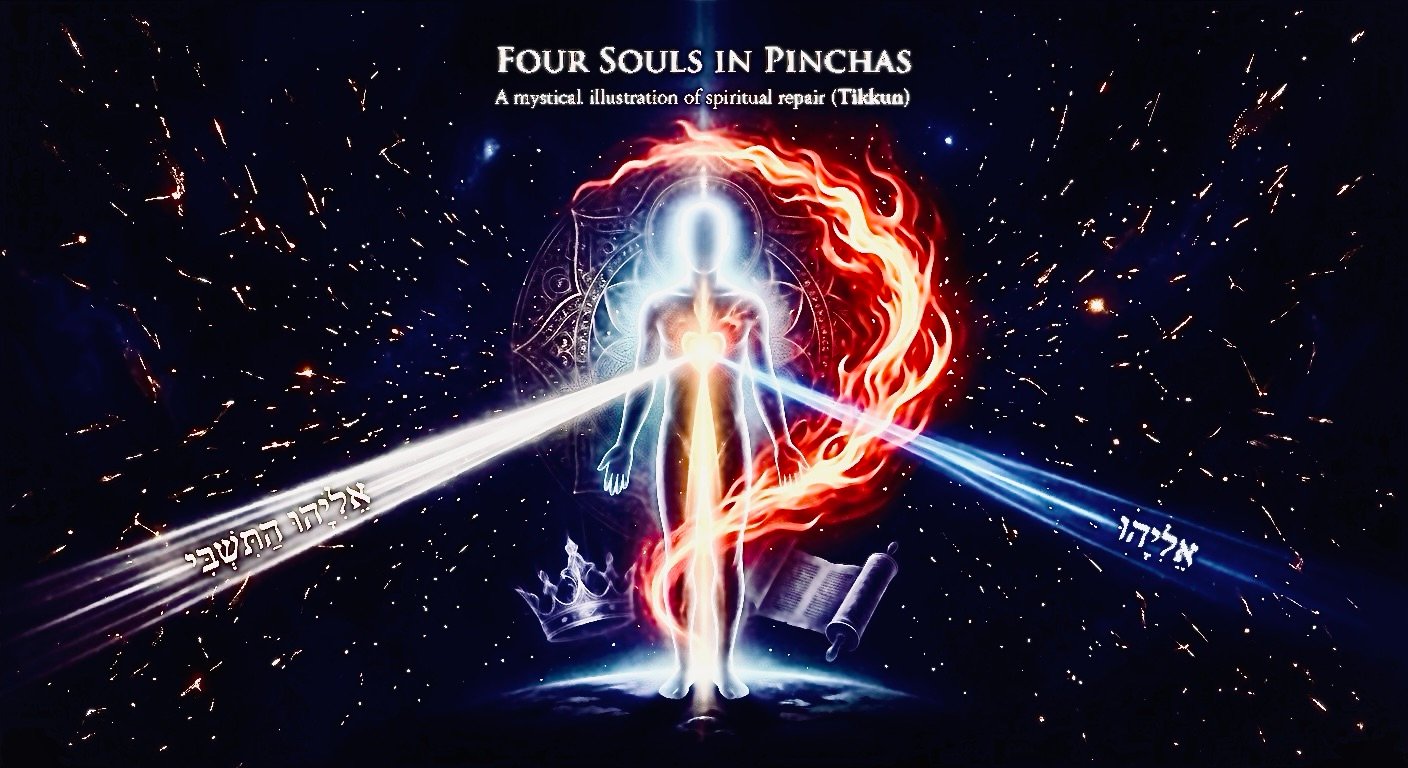
Four Souls in Pinchas: The Mystery of Nadav and Avihu
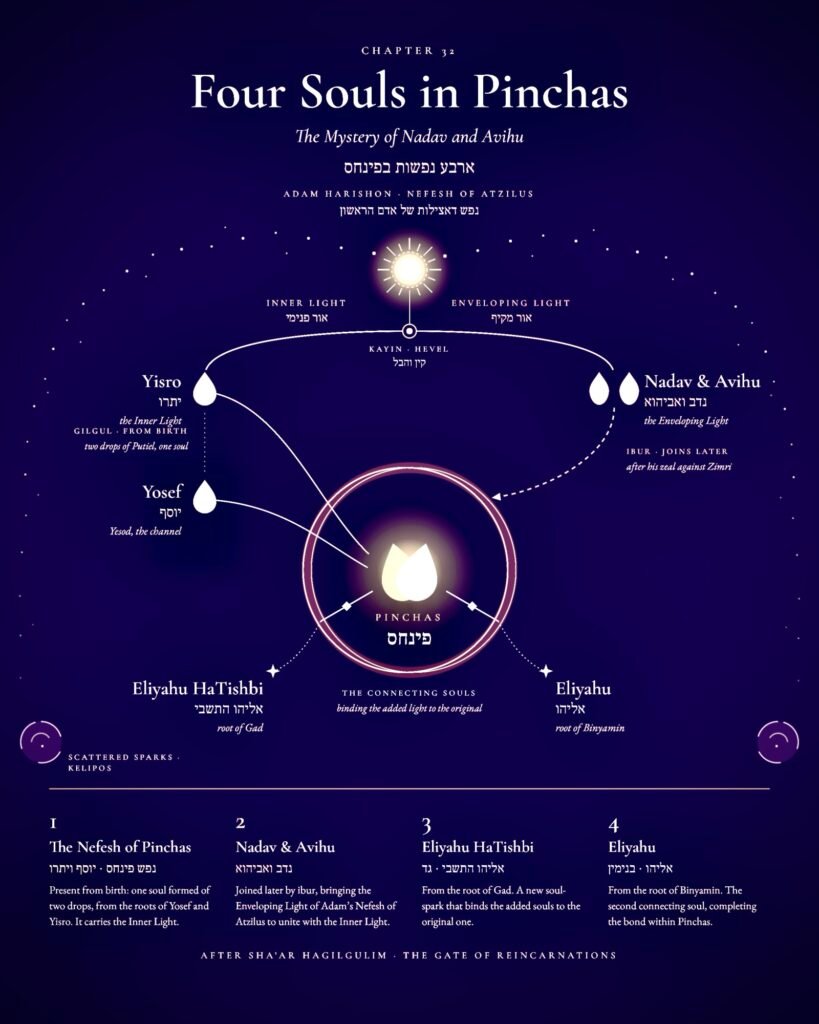
The account of Pinchas in *Sha’ar HaGilgulim*, the *Gate of Reincarnations*, presents a striking vision of the soul: a person may be the meeting place of several spiritual histories, each arriving in a different way and at a different stage of life. Pinchas, the grandson of Aharon, is described not as possessing a single, simple soul, but as the bearer of four distinct soul-levels. Together, these levels connect Yosef, Yisro, Nadav and Avihu, and the prophets Eliyahu HaTishbi and Eliyahu.
This teaching is not merely an intricate genealogy of souls. It offers a way to understand spiritual repair: what is incomplete in one generation may be gathered, joined, and brought toward completion in another. Pinchas becomes the vessel through which separate sparks and spiritual lights converge.
Adam HaRishon and the scattering of souls
The discussion begins with Adam HaRishon. Before his sin, Adam possessed levels of soul associated with the worlds of Asiyah, Yetzirah, and Beriyah, as well as higher levels connected to Atzilus. The souls of humanity were included within him, as though the many future lives and spiritual roots of humankind were gathered within a single primordial person.
After Adam sinned, however, the souls and soul-sparks included in him were scattered. The text describes them as falling away from him into the depths of the *kelipos*, the realms of spiritual concealment and impurity. Each spark descended to a level suited to its condition. Adam’s sin thus becomes more than an individual failure: it marks a rupture in the unity of the human soul and a dispersal of the spiritual potential contained within it.
Yet not every level of Adam’s soul fell. The text distinguishes the soul-levels of Atzilus from those that descended. Adam’s Ruach and Neshamah of Atzilus withdrew upward, while his Nefesh of Atzilus remained hovering above him. This distinction matters because the later history of Pinchas is bound to the recovery and completion of that remaining light.
The teaching describes the Nefesh of Atzilus as possessing both an *Inner Light* and an *Enveloping Light*. These terms refer to two modes in which spiritual vitality may be present. Inner Light is absorbed within a person, entering and shaping the person from within. Enveloping Light, by contrast, surrounds or accompanies the person without being fully internalized. The difference between them will explain why the soul of Pinchas and the souls of Nadav and Avihu enter him in different ways.
Kayin, Hevel, and the light of Atzilus
When Adam fathered Kayin and Hevel, they received the ordinary soul-levels associated with Asiyah, Yetzirah, and Beriyah. They also received a share in the Nefesh of Atzilus that had remained connected to Adam. The text identifies this higher level as possessing both Inner and Enveloping Light.
Later, Yisro, after his conversion, merited the Inner Light of this Nefesh of Atzilus. Nadav and Avihu, in turn, received its Enveloping Light, associated in the passage with Kayin. The precise relationships among these figures are part of the text’s mystical account of soul-roots: they are not simply family connections in the ordinary sense, but links between spiritual qualities and the soul-sparks that carry them.
This distinction sets the stage for Pinchas. He will receive the Inner Light through one spiritual root and the Enveloping Light through another. His role is to bring together what had been distributed among different souls.
Yosef and Yisro in Pinchas
The Torah introduces Pinchas through the marriage of Elazar, son of Aharon, to a daughter of Putiel: “Elazar the son of Aharon took for himself a wife from the daughters of Putiel, and she bore him Pinchas” (Shemos 6:25). The Sages interpret the name *Putiel* as alluding both to Yosef and to Yisro. Yosef resisted the temptation of Potiphar’s wife; Yisro, before his conversion, had been associated with idolatry and the fattening of calves for idol worship.
The text reads this interpretation as a disclosure of Pinchas’s soul-roots. His soul contains two sparks: one from the root of Yosef and one from the root of Yisro. The name *Putiel* is associated with “drops,” hinting at the two spiritual drops from which Pinchas’s soul is formed.
This combination may initially seem surprising. Yosef and Yisro appear to represent very different spiritual histories. But the text explains that Yosef is associated with Yesod, the channel through which the “drops” of seed—symbolically, the flow of spiritual influence—are conveyed. In that sense, a spark from Yisro’s root can be joined with a spark from Yosef’s root. Pinchas is born with both.
These two sparks form the first level of his soul: the Nefesh with which he is born. Although it contains more than one root, it is regarded as a single soul because its elements are present from the beginning of his life. The text emphasizes that a soul born as a unified whole does not require another soul to join its components later.
Nadav and Avihu: the Enveloping Light returns
Pinchas’s spiritual story does not end at birth. Nadav and Avihu, the sons of Aharon, die after bringing an unauthorized offering of incense. Their deaths are tragic, but the mystical teaching also sees in them a spiritual process still awaiting completion.
Later, after Pinchas acts zealously in the incident involving Zimri, the souls of Nadav and Avihu enter him. They do not enter as part of his original soul, present from birth. Rather, they come *b’sod ibur*—by way of *ibur*, a temporary or additional indwelling of a soul within a living person.
The text identifies the soul-level of Nadav and Avihu with the Enveloping Light of Adam’s Nefesh of Atzilus. Pinchas already possesses the Inner Light, through the spark associated with Yisro. When the souls of Nadav and Avihu enter him, the corresponding Enveloping Light joins that Inner Light. In this way, the two modes of the Nefesh of Atzilus become united within Pinchas.
The image is one of spiritual completion. A light that had been divided between different figures is gathered again. Pinchas becomes the meeting point of the inner and the surrounding, the absorbed and the accompanying, the spark carried from Yisro and the light carried by Nadav and Avihu.
Reincarnation and *ibur*
The passage then pauses to distinguish two ways in which a soul may be present in a person.
The first is *gilgul*, reincarnation: a soul enters a person from the beginning of life. Such a soul may itself contain several sparks, as Pinchas’s original soul contains the roots of both Yosef and Yisro. Because those sparks arrive together as part of one soul, they are treated as a single, integrated identity.
The second is *ibur*: a soul joins a person after birth. This is the mode through which the souls of Nadav and Avihu enter Pinchas. According to the teaching, when an additional soul comes by *ibur*, a new soul-spark is also required to connect it with the person’s existing soul. The added soul provides a kind of spiritual bond, allowing the newly joined presence to relate to the person’s original soul.
This principle explains why the story requires not one, but two soul-levels associated with Eliyahu. One is called Eliyahu HaTishbi, rooted in Gad; the other is called Eliyahu, rooted in Binyamin. These new soul-levels join Pinchas in order to connect the souls of Nadav and Avihu with his original soul.
The passage links the name Eliyahu HaTishbi with the verse describing the prophet as being “of the inhabitants of Gilad,” and it also cites a tradition that Eliyahu identified himself as belonging to the descendants of Rachel. In the text’s mystical framework, these references point toward the distinct roots of the two Eliyahu soul-levels.
The four levels within Pinchas
The teaching therefore identifies four Nefesh-levels within Pinchas:
1. **The original Nefesh of Pinchas**, present from birth and containing the sparks of Yosef and Yisro.
2. **The Nefesh of Nadav and Avihu**, which enters later by *ibur*.
3. **The Nefesh called Eliyahu HaTishbi**, associated with the root of Gad.
4. **The Nefesh called Eliyahu**, associated with the root of Binyamin.
These are not simply four interchangeable names for one identity. They represent distinct spiritual levels, each with its own history and function. Pinchas’s original soul provides the foundation. Nadav and Avihu bring the Enveloping Light. The two Eliyahu levels provide the new soul-connections required for the different presences to join.
The text’s reference to the teaching of the Sages—“Michael in one, Eliyahu in two”—is presented as a hint to this complex spiritual arrangement. Its meaning is not reduced to a simple arithmetic formula. Rather, the phrase gestures toward a mystery in which one person may contain several soul-levels, and a name may point to more than one spiritual root.
A life of gathering and completion
The account of Pinchas offers a powerful image of spiritual history. Souls are not portrayed as isolated units, sealed off from the past. They carry traces of earlier lives, unfinished tasks, and relationships that cross generations. A person may be born with a soul already composed of several roots; later, another soul may join by *ibur*; and still further soul-sparks may be needed to bind those presences together.
Pinchas’s story is therefore one of gathering. The sparks of Yosef and Yisro are present in him from birth. The souls of Nadav and Avihu join him later, bringing the Enveloping Light associated with the Nefesh of Atzilus. The two Eliyahu levels complete the connections among these spiritual elements. What had been scattered is, for a time, brought into a single person.
The teaching also suggests that spiritual completion does not always occur in one moment or through one life-event. It may unfold in stages: birth, later action, and the arrival of additional spiritual presences. Each stage contributes something different. The original soul establishes the person’s foundation; the added soul brings a new dimension; and the connecting soul makes integration possible.
In this way, the mystery of Nadav and Avihu is not presented only as a story of loss. Their souls remain part of a wider process of repair. Through Pinchas, their spiritual light is joined to a new setting, alongside the roots of Yosef, Yisro, Gad, and Binyamin. The result is a portrait of the soul as both individual and relational: a personal identity, yet one woven from histories larger than itself.
The teaching invites the reader to see spiritual life as an ongoing work of restoration. What has been divided may be gathered; what has remained incomplete may find a place within a later generation. Pinchas becomes the vessel for that meeting—not because all distinctions disappear, but because distinct lights can be joined without losing their particular roots.
The Long Journey of the Soul: Pinchas, Yiftach, and Eliyahu
This passage presents a broad spiritual history in which biblical events are connected through the movement of souls across different lives. Its central figures are Pinchas, Yiftach, Chiel of Bethel, and Eliyahu. Their stories are linked not only by the events recorded in Scripture, but also by a kabbalistic understanding of how souls may join one another, depart, and return in later generations.
The passage draws on the concept of *ibur*, a temporary joining of one soul to another. In this framework, a soul can accompany a person for a particular spiritual purpose without becoming that person’s primary soul. When its task is complete, it may leave and continue its journey elsewhere. The text also speaks of spiritual sparks, roots, and reincarnation, suggesting that the consequences of earlier actions can continue beyond a single lifetime.
This account does not present people as passive instruments of fate. Rather, it insists that they remain responsible for their choices. The movement of souls may help explain why certain events unfold as they do, but it does not erase the moral responsibility of the people involved. The story of Yiftach’s vow, in particular, shows that responsibility belongs not only to the person who creates a crisis, but also to those with the knowledge and authority to prevent harm.
Pinchas and the souls within him
Pinchas, the grandson of Aharon, is the starting point for this spiritual chain. The passage describes him as carrying more than one spiritual element. His own soul remained the principal soul, while the souls of Nadav and Avihu—the two sons of Aharon—were joined to him through *ibur*. They accompanied him temporarily, rather than replacing his own soul or becoming the primary source of his identity.
The distinction between a primary soul and an accompanying soul is essential to the passage’s interpretation. Although several spiritual elements were present within Pinchas, they did not all share equal responsibility for his actions. His own soul remained at the center of his life. The other souls were present for particular purposes, and their presence could change as those purposes were completed.
The passage also connects Pinchas to a spiritual spark associated with Yisro, Moshe’s father-in-law. Before joining the people of Israel, Yisro had been a priest devoted to idolatry. He later turned away from his former beliefs and recognized the greatness of the G-d of Israel. In the passage’s kabbalistic framework, a spark connected to Yisro became part of Pinchas’s spiritual makeup.
This connection becomes important when the passage considers Pinchas’s later failure. It attributes that failure not to the souls of Nadav and Avihu, but to the spark associated with Yisro. The other souls were present in Pinchas, but they were not responsible for every choice he made. By making this distinction, the text presents the soul as a complex spiritual reality while still preserving the idea of individual accountability.
Pinchas’s life, then, is portrayed as a meeting point of several spiritual histories. His own soul, the souls temporarily joined to him, and the spark associated with Yisro all have different origins and different roles. His story is personal, but it also forms part of a much longer spiritual process.
Yiftach’s vow and its tragic consequence
The first major event in that process is the story of Yiftach and his daughter. Before going to battle against the Ammonites, Yiftach made a vow to G-d. He declared that if he returned safely from the battle, whatever came out of the doors of his house to greet him would belong to G-d, and he would offer it as a burnt offering.
Yiftach defeated the Ammonites and returned home. The first person to come out to greet him was his only daughter. She came to celebrate her father’s victory, accompanied by music and dancing. She had no reason to expect that her joyful welcome would place her in danger.
When Yiftach saw her, he tore his clothes and cried out in grief. He understood that his vow applied to her and claimed that he could not withdraw it. The passage, however, challenges the idea that the vow had to be carried out as he had stated it. It says that Jewish law would have allowed him to seek the vow’s annulment. A person with the necessary legal authority could have helped release him from it.
Pinchas was one such person. As a leader and religious authority, he had the standing to intervene. Yet Yiftach did not go to Pinchas, and Pinchas did not go to Yiftach. The passage describes them as remaining apart, each waiting for the other to act. In the end, neither did.
This failure of communication becomes one of the central moral lessons of the account. Yiftach was responsible for making a reckless vow, but the tragedy did not depend on his actions alone. Pinchas had the knowledge and authority to help prevent it. By failing to intervene, he too became responsible for what followed.
The passage therefore broadens the meaning of responsibility. A person may be accountable not only for causing harm directly, but also for refusing to act when intervention is possible. The failure to help can become a serious moral failure, especially when the person who could help holds a position of leadership.
Yiftach’s daughter is the person who suffers most. She does not choose to become part of her father’s vow, and she is not responsible for the circumstances that place her in danger. The passage says that she remained unmarried and devoted herself to the service of G-d. Her fate gives the story its human and emotional force. The episode is not merely a debate about the rules of vows; it is a tragedy involving a young woman whose life is shaped by a rash promise and by the failure of others to prevent its consequences.
The consequences for Yiftach and Pinchas
The passage describes Yiftach as suffering a severe punishment after the incident. Wherever he went, his limbs fell off, and each limb had to be buried. It connects this fate to the biblical description of his burial in the cities of Gilead. His body is portrayed as becoming scattered across the land, with each part requiring burial in a different place.
Pinchas’s punishment takes a different form. He does not suffer the same visible bodily affliction. Instead, the Divine Presence that had once accompanied him withdraws. The passage compares biblical descriptions of Pinchas at different points in his life. Earlier, the text says that G-d was with him; later, that description is absent. The author interprets this change as evidence that Pinchas lost a measure of spiritual closeness.
The contrast between these punishments reflects the passage’s view that consequences do not always appear in the same way. Yiftach experiences physical suffering, while Pinchas experiences spiritual loss. Their failures are different, and so are the consequences associated with them. Yiftach’s rashness sets the tragedy in motion; Pinchas’s failure to intervene allows it to continue.
The episode also highlights the responsibilities attached to leadership. Pinchas’s authority is not presented merely as a mark of status. It gives him an obligation to use his knowledge for the protection of others.
When Peace Was Taken from Him: Elijah, Elisha, and the Journey of the Soul
In the mystical teachings of *Sha’ar HaGilgulim*, the “Gate of Reincarnations,” the lives of the prophets are woven into a vast history of souls. A soul does not always belong to one life alone. It may return in another body, divide into different spiritual levels, or accompany another person for a time to help complete a particular task. The passage’s account of Elijah, Elisha, Nadav, and Avihu is built upon this vision. It presents the prophet Elijah not only as a defender of faith, but as a human being who experiences the loss of spiritual support. When peace is removed from him, he becomes afraid and flees. Yet his fear is not the end of his story. It marks a transition in the work of the souls connected to him.
The passage begins with Elijah’s great confrontation against idolatry. His mission is one of uncompromising devotion: he challenges the worship of Baal and calls the people of Israel back to the service of G-d. The text associates this mission with Nadav and Avihu, whose souls, though already rectified, come to assist Elijah through an *ibur*. In the language of Jewish mysticism, an *ibur* is a temporary attachment of one soul to another. The accompanying soul does not necessarily replace the person’s own soul. Instead, it joins that person to provide help, strength, or spiritual capacity for a particular purpose.
Nadav and Avihu are therefore not merely figures from the past who are remembered by Elijah. In the passage’s account, their spiritual presence becomes active within his mission. Their souls help him carry out his service of G-d, and their association with fire and incense gives his prophetic zeal a deeper meaning. Elijah’s strength is not portrayed as an isolated achievement. It is supported by a network of spiritual relationships, including the assistance of souls whose own histories are far older than his life.
But this support does not remain with Elijah. At a certain point, he feels that the gift has been taken from him. The passage describes this loss as the removal of his peace and spiritual strength. What had accompanied him is no longer present in the same way, and he is left with only his own *nefesh*, his own vital soul. This change is followed by fear. The prophet who had confronted powerful enemies now becomes vulnerable and begins to flee.
The biblical account says, “He saw, and he arose and went for his life” (I Kings 19:3). In the mystical interpretation, these words describe more than Elijah’s physical escape from danger. They reveal his inner condition. He runs because he feels that he has been left alone, without the additional spiritual presence that had helped sustain him. His fear of Jezebel is real, but the passage also presents it as the consequence of a spiritual loss. Elijah no longer feels accompanied by the same forces that had enabled him to act with such certainty.
This reading gives Elijah’s flight to Mount Horeb a particular poignancy. He has just been a figure of extraordinary spiritual power, yet he now seeks shelter in a cave. The contrast between these two moments is striking. The prophet who once stood before the people with confidence is now alone, exhausted, and afraid. The passage does not treat this fear as proof that Elijah’s faith has failed. Instead, it shows that spiritual greatness does not make a person immune to loss. Even a prophet may feel abandoned when the forces supporting him are withdrawn.
Elijah’s experience also suggests that peace is not simply an emotion that a person can summon at will. In this account, peace is connected to spiritual companionship and to the presence of forces that help a person carry out a mission. When those forces depart, Elijah’s inner world changes. The loss of peace is not merely a passing disturbance; it is a sign that the spiritual arrangement around him has shifted. His fear marks the beginning of a new stage in the work of the souls involved.
The passage then introduces a distinction between two figures called Elijah. Elijah the Tishbite, associated with the tribe of Gad, ascends to heaven in a storm and does not descend again in the ordinary way. Another Elijah, associated with the tribe of Benjamin, is identified with a person mentioned in the Book of Chronicles. After his death, this second Elijah joins the heavenly Elijah. The text identifies the Benjaminite Elijah as the one who continues to descend into the world, perform miracles for the righteous, and speak with them.
This distinction is important because it explains how Elijah can be both a prophet who has ascended and a presence who continues to act among human beings. The passage does not treat the name “Elijah” as referring to only one simple spiritual identity. Instead, it describes Elijah as comprising several levels. The rabbis, according to the text, knew that Elijah contained four levels, but they did not know which one appeared to them when he came to speak. They debated the matter until Elijah revealed which level was present.
The idea of different levels allows the passage to preserve two truths at once. Elijah has ascended to heaven, and yet Elijah continues to appear in the world. His presence is not explained by denying either fact. Rather, the text imagines his spiritual identity as complex enough to operate in different ways. One aspect has ascended; another can descend to guide, assist, and perform miracles. The prophet’s continuing presence is thus part of a larger mystical account of how souls and spiritual levels remain active beyond ordinary human life.
The transfer of Nadav and Avihu to Elisha forms the next major stage in this account. Before Elijah departs, Elisha asks him, “Please, may twice as much as your spirit be mine” (II Kings 2:9). The request is often understood as a plea for a double portion of Elijah’s prophetic spirit. The passage gives it a more specific mystical meaning: Elisha is asking to receive the souls of Nadav and Avihu, who had previously accompanied Elijah.
The words of Elisha’s request are treated as clues. The Hebrew word translated as “please” is connected through its letters to the names Nadav and Avihu. The phrase “twice as much” also suggests their doubled spiritual presence. Elisha is therefore not simply asking to become more powerful. He is asking that the spiritual forces that assisted Elijah should now assist him. The request represents a transfer of responsibility as well as a transfer of spiritual aid.
Elisha’s ability to receive these souls is connected to his own spiritual origin. The passage associates him with the root of Enoch, who is called Metatron, and with a lofty level of the soul of Adam. Nadav and Avihu are also connected to an exalted level of Adam’s soul. Their attachment to Elisha is therefore presented as a meeting between compatible spiritual roots. The transfer is not arbitrary. It is possible because Elisha’s soul has a relationship to the same deep spiritual source.
The passage also links this process to the soul of Cain. In its account, the histories of Elijah, Elisha, Nadav, Avihu, and Korah are connected through a long process of spiritual repair. These figures are not simply arranged as unrelated characters in a sequence. Their souls carry traces of earlier lives, earlier failures, and unfinished tasks.
The Crown That Waited: A Soul’s Long Journey Toward Redemption
The passage describes a soul whose destiny stretches across generations. In its mystical account, a person’s spiritual life does not necessarily end with one earthly lifetime. A soul may return again and again, carrying unfinished responsibilities from one incarnation to the next. Each life offers another opportunity to repair what was damaged, complete what was left undone, and draw closer to the purpose for which the soul was first created.
At the center of this story is a soul associated with Cain. Its journey is marked by both extraordinary promise and painful incompletion. The soul was once meant to receive a crown of kingship and, according to the passage, was even intended to become the Messiah. Yet it did not reach that destiny at the appointed time. The crown was withheld, and the soul’s path became a long process of spiritual correction.
The account begins with a moment of immense possibility. The Holy One, blessed be He, intended to make this soul the Messiah. The soul was the firstborn and was therefore associated with the privileges and responsibilities of the firstborn: inheritance, leadership, and the right to bear a crown of authority. But the promise was not fulfilled. The passage connects this failure with the absence of a song of praise after the deliverance associated with King Hezekiah. The soul did not offer the gratitude that the moment demanded. As a result, the crown of kingship remained beyond its reach.
This detail gives the story a particular moral weight. The loss was not described as the consequence of a lack of ability or importance. The soul had been given a remarkable destiny. Its failure lay in not responding properly to a moment of divine deliverance. The missing song becomes a symbol of a deeper failure: the inability to recognize, acknowledge, and praise the source of salvation. The crown was not simply taken away; it became an unfinished responsibility that the soul would have to approach again.
The passage then traces the soul through a series of later lives. Its first significant return was as Mattathias, son of the Hasmonean family, who served as both priest and king. In this incarnation, the soul recovered part of the honor that had once been lost. Mattathias’s life brought it closer to royal dignity, and the passage presents this as a meaningful step in the restoration of its spiritual inheritance. Yet the repair was not complete. Although the soul gained a measure of kingship, it did not receive the full portion of the firstborn.
That distinction matters. The soul’s progress is real, but it is gradual. It does not instantly regain everything it once forfeited. Instead, each incarnation restores one part of its purpose while leaving another part unresolved. Mattathias represents a beginning: the return of leadership and authority, but not yet the complete recovery of the firstborn’s crown.
The soul next appeared as Akavya ben Mahalalel. The passage connects Akavya with Cain and with the “heel of Esau,” a symbolic expression that suggests a lingering attachment to an ancient spiritual struggle. The heel is the lowest part of the body, close to the ground; in mystical interpretation, it can represent the most difficult or vulnerable aspect of a spiritual root. To say that the soul is connected with the heel of Esau is to suggest that its work involves confronting a deep and persistent source of conflict.
Akavya’s name also carries significance within this account. The text links it to the name and spiritual lineage of Mahalalel, one of the figures in the genealogy associated with Cain. Names, in this way of reading, are not incidental. They can serve as traces of a soul’s history, revealing connections that might otherwise remain hidden. Akavya’s identity becomes part of a larger pattern: the same spiritual root continues to appear in different people, each one contributing another stage to the work of repair.
The journey then continues through Rabbi Yochanan ben Zakkai, one of the great sages of Jewish tradition. At the moment of his death, he is said to have announced, “Prepare a throne for Hezekiah, King of Judah, who has come to accompany me.” The passage interprets this declaration as a revelation of the soul’s connection to Hezekiah and to the origin of its unfinished mission.
The words are especially meaningful because Hezekiah recalls the earlier failure to offer a song of praise. The soul that once failed to respond properly to a moment of deliverance now encounters Hezekiah again at the threshold of death. The past is not erased, but it is brought into view. The soul’s words suggest recognition: the figure connected to its earlier history has come to accompany it. In this way, the end of Rabbi Yochanan ben Zakkai’s life becomes a moment of spiritual remembrance and reconciliation.
The passage also says that, in this incarnation, the soul merited a share of the “crown” of the priesthood associated with the firstborn. This is another step toward restoration. The soul had once been connected to the privileges of the firstborn but had failed to retain them. Now, through a life of learning and leadership, it regains part of that lost dignity. The crown is still not fully recovered, but the soul has moved closer to it.
Another major stage in the journey comes through Rabbi Akiva ben Yosef. The text again associates him with the heel of Esau and the root of Cain, continuing the pattern established in the account of Akavya. Rabbi Akiva’s connection to this spiritual lineage is also supported by a mystical identification of Issachar with Rabbi Akiva. The passage states that Issachar, too, belongs to the root of Cain.
This association broadens the story beyond a single sequence of individuals. It suggests that the soul’s history is woven into a larger spiritual network. Rabbi Akiva is not merely another name in a list of reincarnations; he represents a powerful expression of the soul’s potential for learning, endurance, and influence. His life demonstrates how a soul associated with an ancient failure can also become a source of profound wisdom and teaching. The past remains present, but it does not determine the future. Through study and devotion, the soul can transform its inherited spiritual burden into a means of service.
The account then turns to a more specialized form of spiritual repair. It says that the soul entered, as an *ibur*, into two Geonim: Rav Achai and Rav Acha of Shabcha. An *ibur* is described in mystical traditions as a form of spiritual accompaniment or temporary indwelling. Unlike a full reincarnation, it suggests that a soul may join another person’s life in order to assist with a particular task of correction.
These two Geonim are associated with the soul-root of King Ahab. Through their spiritual connection, three letters of Ahab’s name—Aleph, Chet, and Aleph—were repaired. The remaining letter, Bet, was corrected through Rabbi Avraham Galid. The passage treats this work as a careful, letter-by-letter restoration. A name becomes more than a label: it is a structure that can hold spiritual meaning, and its letters can represent aspects of a soul’s history that require correction. This final stage reveals the intricate nature of the passage’s worldview. Spiritual repair is not always accomplished through dramatic public achievements and scholarship.