
Assyria, Babylon and Bereshit 9 in rabbinic, academic and Jewish thought
Oct 24, 2026 · @Kamil Levi Pyka-Penner
Introduction
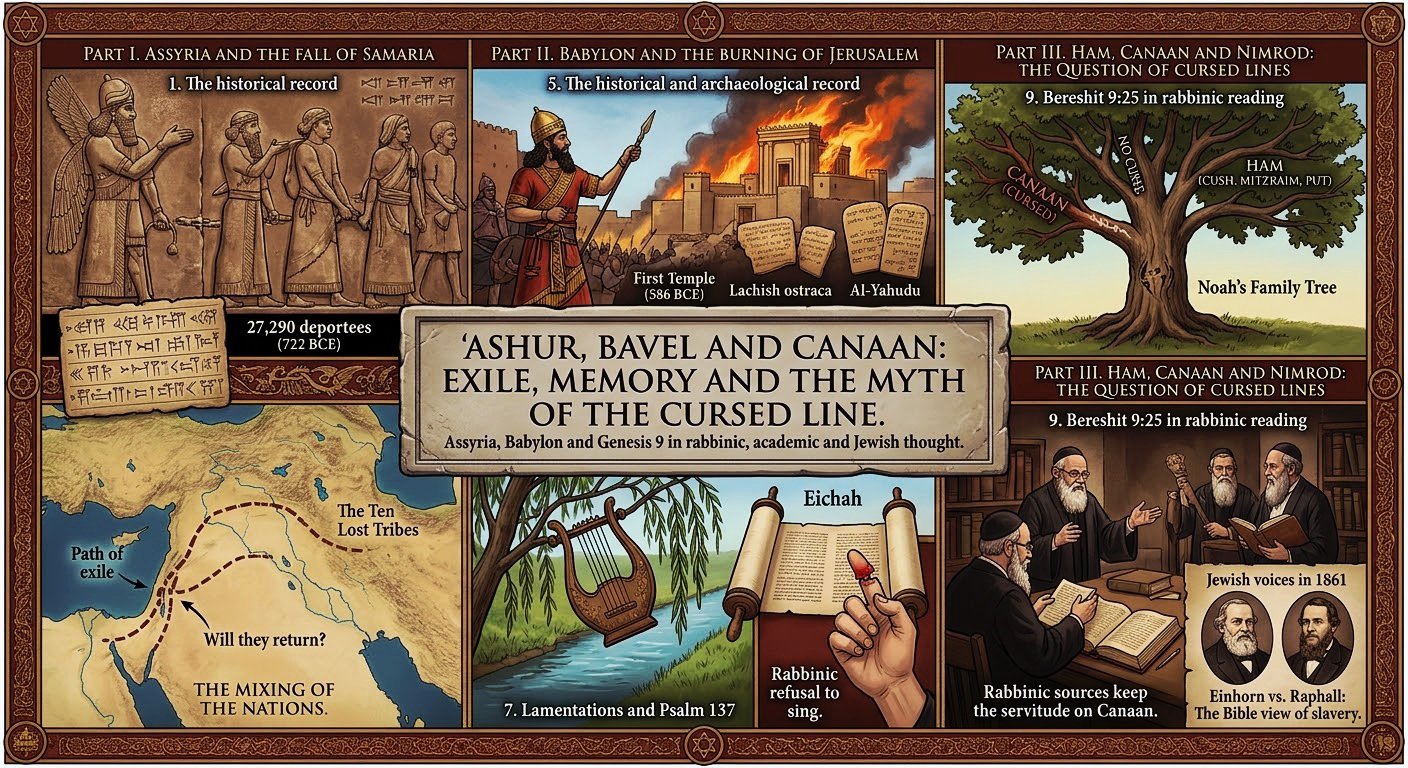
Three disasters stand behind these pages. Assyria conquered Samaria around 722 BCE, and Babylon burned Jerusalem and its Temple in 586 BCE. Behind both stands a much older text that later readers turned into a weapon: the curse of Canaan in Bereshit 9:25.
Readers have approached each in three ways. The rabbis read these events as Torah, asking what G-d was teaching and what Israel must remember. Historians and archaeologists read them as events, weighing the Bible against Assyrian annals, Babylonian chronicles and burnt layers in the soil. The Jewish people read them with their whole lives: in fasts, in a glass broken under the wedding canopy, in a psalm sung before grace after meals.
These readings often disagree. They differ on dates, causes, and what counts as evidence. Yet on one question they meet. Neither rabbinic tradition nor modern scholarship supports the popular claim that Assyria, Babylon or the peoples of Africa suffered because they descended from a cursed line of Ham or Nimrod.
Scripture curses one person, Canaan. Rabbinic law and ethics refuse to make guilt hereditary, and the Talmud goes further: it names Torah teachers descended from the very kings who destroyed Israel. That refusal is the thread of this essay.
The essay follows the events in order. Each part presents the historical record, then the rabbinic reading, then how the memory lives in Jewish practice.
Part I. Assyria and the fall of Samaria
1. The historical record
Second Kings tells the end of the northern kingdom in a few verses. Hoshea son of Elah, Israel’s last king, became a vassal of Shalmaneser, then sent to “So king of Egypt” and stopped his tribute (17:3-4). The Assyrian king imprisoned him, besieged Samaria for three years, and in Hoshea’s ninth year carried Israel to Halah, to Habor by the river of Gozan, and to the cities of the Medes (17:5-6).
Second Kings 18:9-11 repeats the account and ties it to Judah’s calendar: the siege began in Hezekiah’s fourth year, and the city fell in his sixth. Most historians date the fall to 722 BCE, with the siege beginning in 725 or 724.
The Assyrian record agrees on the outcome and differs on the victor. Babylonian Chronicle 1 credits Shalmaneser V with ravaging Samaria, the one event of his reign that it records. Sargon II, who took the throne in 722, claims the conquest himself in the Khorsabad Annals and the Nimrud Prism. He reports 27,290 deportees (other copies read 27,280), a chariot unit of 50 raised from them, new settlers, and tribute laid on the city.
Hayim Tadmor’s study of Sargon’s campaigns (1958) proposed the solution most scholars still use. Shalmaneser took Samaria in 722 and died soon after. Samaria then joined a western revolt led by Hamath, and Sargon crushed it in 720, deporting its people and making it the Assyrian province of Samerina. Bob Becking’s The Fall of Samaria (1992) argued for two separate conquests along similar lines.
The deportation of 720 was not the first. Second Kings 15:29 records that Tiglath-pileser III took Galilee and Gilead around 734-732, and 1 Chronicles 5:26 names Reuben, Gad and half of Manasseh among the exiles. Tiglath-Pileser’s own summary inscription says the Israelites overthrew Pekah and that he set Hoshea on the throne in his place.
Assyria moved peoples on purpose. Bustenay Oded’s Mass Deportations and Deportees in the Neo-Assyrian Empire (1979) estimated about 4.5 million people moved over roughly three centuries. The policy ran in two directions: rebels were scattered to break local loyalties, and newcomers were settled to farm, build, and serve in the army.
Second Kings 17:24 describes the second direction: the Assyrians placed settlers from Babylon, Cuthah, Avva, Hamath, and Sepharvaim in Samaria’s towns. Cuneiform legal tablets from Gezer and Tel Hadid, dated to the seventh century, name people with Mesopotamian names living in the land. Ezra 4:2 and 4:10 remember further settlers brought by Esarhaddon and by “Osnappar”, whom most scholars identify with Ashurbanipal.
Not every Israelite went east. Magen Broshi argued in 1974 that Jerusalem’s sudden growth onto the western hill in the late eighth century reflects refugees from the north. Israel Finkelstein and others developed the idea, while critics question the scale. The debate matters because it bears on an old rabbinic question: did the northern tribes vanish, or did some survive inside Judah?
Royal inscriptions were written to praise the king, so historians read them with care. In a 2019 study in the Journal of the American Oriental Society, Shawn Zelig Aster tested Sargon’s claims about rebuilding Samaria against the archaeology of western Samaria. He concluded that the king’s provincial governor carried out the work.
2. The rabbinic reading
The rabbis begin with a puzzle. Second Kings 17:2 says Hoshea did evil, “yet not as the kings of Israel that were before him.” Why, then, did the exile fall in the reign of the least wicked king?
The Talmud answers with a story about roads. Jeroboam son of Nebat had posted guards to stop northern pilgrims from going up to Jerusalem for the festivals. Hoshea removed them, yet the people still did not go; so God decreed that they would go into exile for as many years as they had stayed away (Gittin 88a). The day the guards were removed is remembered among the joys of the Fifteenth of Av, while Taanit 30b-31a adds that Hoshea let the people go to any shrine they wished, not to Jerusalem.
The lesson is sharp. While a king blocked the road, the guilt was his. Once the road was open and empty, the people owned it. Rashi on 17:2 adds that Hoshea could remove the guards only because earlier deportations had already carried off the golden calves.
The rabbis also flatten the Assyrian king list that historians work so hard to untangle. The Talmud gives Sennacherib eight names, including Tiglath-pileser, Shalmaneser, Pul, Sargon, and Osnappar (Sanhedrin 94a). Historians see four or five kings here; the rabbis see one archetype of the conqueror. Seder Olam Rabbah, followed by Rashi, counts the northern exile in stages, beginning with the tribes east of the Jordan.
The mixing of the nations
Assyria’s deportation policy left a mark on Jewish law. Mishnah Yadayim 4:4 tells of Yehudah, an Ammonite convert, who asked whether he could marry a Jewish woman. Rabban Gamliel forbade it, citing Deuteronomy 23:4; Rabbi Yehoshua permitted it, reasoning: כְּבָר עָלָה סַנְחֵרִיב מֶלֶךְ אַשּׁוּר וּבִלְבֵּל אֶת כָּל הָאֻמּוֹת, “Sennacherib king of Assyria long ago came up and mixed all the nations.”
The sages ruled with Rabbi Yehoshua (compare Berakhot 28a), and Maimonides codifies it (Issurei Bi’ah 12:25). The ancient nations named in the Torah can no longer be identified by descent. In effect, Jewish law took the empire’s policy as a historical fact and drew a principle from it: lineage claims about peoples are no longer reliable, and a convert is judged as a person.
The Kutim
Second Kings 17:24-41 tells how lions attacked the new settlers in Samaria, and how an exiled priest was sent back to teach them “the manner of the G-d of the land.” They feared HaShem and served their own gods (17:33). The rabbis called them Kutim, after Cuthah, one of the cities named in 17:24.
Their status divided the sages. Rabbi Yishmael called them גֵּרֵי אֲרָיוֹת, “lion converts” who joined out of fear; Rabbi Akiva called them true converts (Kiddushin 75b). The minor tractate Kutim lists where they keep the commandments and where they do not, and ends by saying they will be received when they renounce Mount Gerizim, acknowledge Jerusalem, and affirm the resurrection of the dead.
Scholarship complicates the biblical picture. The Samaritans call themselves Shamerim, “keepers” of the Torah, and trace their descent to Ephraim and Manasseh. Yitzhak Magen’s excavations on Mount Gerizim found a sanctuary built in the fifth century BCE. Most historians now see Samaritan origins as a mix of remaining Israelites and newcomers, closer to the Samaritan claim than 2 Kings 17 alone suggests.
The rod of anger
Isaiah calls Assyria שֵׁבֶט אַפִּי, “the rod of Mine anger” (10:5). Two verses later he adds that Assyria does not see itself that way: “it is in his heart to destroy” (10:7). The axe cannot boast against the one who swings it (10:15), and the king of Assyria will be punished in turn (10:12).
The rishonim built on this. Ramban, Bereshit 15:14, asks why Egypt was punished for enslaving Israel when G-d had decreed the servitude. His answer: a nation that carries out a decree for its own cruelty and glory, and goes beyond it, is judged for what it chose, and he cites Isaiah on Assyria and Zechariah 1:15, “they helped for evil.” Maimonides (Teshuvah 6:5) adds that a general decree never compels any particular person to do evil.
So rabbinic thought holds two claims together. Assyria’s victory had meaning within Israel’s covenant story. Yet Assyria remained fully responsible for its violence, and nothing in its role made its people a cursed race.
3. The ten tribes in Jewish memory
The Bible ends the northern story with a hard line: “there was none left but the tribe of Judah only” (2 Kings 17:18). Rabbinic tradition never fully accepted that silence. Its argument about the ten tribes has run for two thousand years, from the Mishnah to the Israeli rabbinate.
Will they return?
Mishnah Sanhedrin 10:3 records the classic dispute. Rabbi Akiva says the ten tribes will not return, reading Devarim 29:27, “and cast them into another land, as it is this day”: as the day passes and does not come back, so they went and will not come back. Rabbi Eliezer reads the same words the other way: as the day grows dark and then light again, so the darkness of the ten tribes will turn to light.
The prophets lean toward Rabbi Eliezer. Jeremiah calls toward the north, “Return, thou backsliding Israel” (3:12). Ezekiel joins the stick of Judah to the stick of Joseph in his hand (37:15-28), a passage read each year as the haftarah of Vayigash, when Joseph and Judah meet again in the Torah portion.
A partial return
The Talmud holds that part of the north came back long before the end of days. Jeremiah brought some of the exiles home and Josiah ruled over them, which is why the Jubilee could still be counted in his time (Arakhin 33a). Megillah 14b explains Huldah’s prophecy in Josiah’s court by the same mission: Jeremiah was away bringing back the ten tribes.
Scripture supports a partial reunion. Hezekiah invited Ephraim and Manasseh to his Passover, and some came (2 Chronicles 30). Josiah collected Temple funds from “Manasseh and Ephraim, and of all the remnant of Israel” (2 Chronicles 34:9). After the return from Babylon, Ezra’s community offered twelve goats “according to the number of the tribes of Israel” (Ezra 6:17).
Here rabbinic memory and modern archaeology meet. Broshi’s refugee hypothesis, described above, is in a sense the academic version of Arakhin 33a: some of the north survived inside Judah, and “Jews” came to mean all Israel.
The legend
Alongside the halakhic debate grew a legend. The Talmud blames the loss of the tribes on comfort, not only on conquest: the wines of Perugita and the baths of Diomsit cut them off from their brothers (Shabbat 147b). Bereshit Rabbah 73:6 says Israel was exiled to three places: beyond the river Sambatyon, to Daphne near Antioch, and to a place where a cloud came down and covered them.
The Sambatyon rests on the Sabbath and rages all week (Sanhedrin 65b). Josephus knew a Sabbatical river that did the opposite, flowing only on the seventh day (Jewish War 7.5.1). He also wrote that the ten tribes still lived beyond the Euphrates as an immense multitude (Antiquities 11.133).
The legend shaped real history. In the ninth century Eldad ha-Dani arrived in Kairouan claiming to come from the tribe of Dan, and the community wrote to the Geonim to ask whether his customs could be trusted. In 1650 Menasseh ben Israel of Amsterdam published The Hope of Israel, which reported lost Israelites in the Americas and helped his campaign to reopen England to Jews in 1655-1656.
In modern Israel the question became legal. Chief Rabbi Ovadia Yosef ruled in 1973, building on a responsum of the Radbaz, that the Beta Israel of Ethiopia descend from the tribe of Dan. In 2005 Chief Rabbi Shlomo Amar recognized the Bnei Menashe of north-east India as being of Israelite descent, while still requiring formal conversion.
Historians treat the lost tribes as a powerful idea more than a traceable population. Tudor Parfitt’s The Lost Tribes of Israel: The History of a Myth (2002) and Zvi Ben-Dor Benite’s The Ten Lost Tribes: A World History (2009) follow how communities across the world have claimed the tribes, and how outsiders have pinned them on others. Both treat the legend as revealing the people who tell it.
4. Nineveh between Jonah and Nahum
The Bible gives Assyria’s capital two endings. In Jonah the city repents and is spared. In Nahum it is “the bloody city” (3:1), laid waste with no one to mourn it (3:7).
The historical record
Nineveh fell in 612 BCE to the Babylonians under Nabopolassar and the Medes under Cyaxares, as the Babylonian tablet called the Fall of Nineveh Chronicle records. An Assyrian remnant held out at Harran until about 609. Nahum 3:8 alludes to the sack of Thebes, No-Amon, in 663, so the book is usually dated between those two events.
Nineveh’s ruins tell Judah’s side of the Assyrian story too. Sennacherib’s palace at Kuyunjik, excavated by Austen Henry Layard in the 1840s, held the Lachish reliefs, now in the British Museum. They show the siege of Lachish in 701 BCE and Judean families walking into exile, the scene behind 2 Kings 18:13-14.
Jonah’s own memory is part of the site. The mound of Nebi Yunus, across the Khosr river from Kuyunjik, held a shrine honoured as Jonah’s tomb. Militants blew it up in 2014, and the tunnels they dug beneath it exposed remains of an Assyrian royal palace.
Most academic scholars read Jonah as a later prophetic tale, written after the exile, about a historical prophet. Jonah son of Amittai appears in 2 Kings 14:25 under Jeroboam II. Scholars also note that the two books answer each other: Jonah 4:2 quotes the merciful half of G-d’s attributes from Exodus 34:6-7, while Nahum 1:3 cites the other half, that HaShem “will by no means clear the guilty.”
The rabbinic reading
The Mishnah turns Nineveh into a model of repentance. On public fast days the elder addressed the people: Scripture does not say that God saw Nineveh’s sackcloth and fasting, but that God “saw their works, that they turned from their evil way” (Jonah 3:10; Mishnah Taanit 2:1). The Bavli adds that a Ninevite who had built a stolen beam into his palace tore down the palace to return it (Taanit 16a).
The Yerushalmi is less kind. Resh Lakish called it a repentance of deceit: the Ninevites separated calves from their mothers so that the animals’ cries would force heaven’s hand (Yerushalmi Taanit 2:1). Pirkei de-Rabbi Eliezer (ch. 43) says the repentance lasted forty years before the city returned to its ways, and only then did Nahum’s prophecy fall.
Why did Jonah run? The Mekhilta (Bo, Pischa 1) says he knew that the nations were quick to repent. Their repentance would shame Israel, which had not repented, so he chose Israel’s honour over the mission. The tradition does not let him win the argument: the book ends with G-d’s question about the city’s 120,000 people “and also much cattle” (4:11).
In Jewish practice
The Jewish people meet Nineveh every year at the holiest hour of the calendar. The Book of Jonah is the haftarah at Minchah on Yom Kippur (Megillah 31a), with Micah 7:18-20 added at the end. Its message is that repentance is open to every people, even the empire that destroyed Samaria.
No rabbinic text treats Nineveh as cursed by birth. The same city is spared when it changes and falls when it returns to violence. Its fate follows its deeds, not its ancestry.
Part II. Babylon and the burning of Jerusalem
5. The historical and archaeological record
The Bible tells the fall of Judah four times: in 2 Kings 24-25, in Jeremiah 39 and 52, and in 2 Chronicles 36. Nebuchadnezzar II first took Jerusalem in 597 BCE, deported King Jehoiachin with the craftsmen and nobility, and made Zedekiah king. When Zedekiah rebelled, Babylon returned, besieged the city, and burned the Temple, the palace and the great houses.
The first capture has a precise Babylonian date. Babylonian Chronicle 5 (British Museum, BM 21946) records that in his seventh year, on the second of Adar, Nebuchadnezzar took the “city of Judah” and seized its king. That date falls in mid-March 597 BCE. The surviving chronicle breaks off after 594, so it says nothing of 586.
The year of the burning is still argued. Depending on how Judah counted regnal years, the evidence gives 587 or 586 BCE. Edwin Thiele and many after him favoured 586; a strong minority holds to 587. This essay uses 586, the most common scholarly date; rabbinic chronology, discussed below, gives a very different year.
Voices from the siege
Inscriptions from Judah’s last years bring the biblical account close. The Lachish ostraca, found by James Leslie Starkey in 1935, are letters from an outpost to the commander of Lachish. Letter 4 says the writer is watching for Lachish’s fire signals because he can no longer see Azekah. Jeremiah 34:7 names Lachish and Azekah as the last fortified cities left in Judah.
From the southern fortress of Arad, an ostracon orders troops to a post in the Negev against a threat from Edom. It is a small piece of evidence behind the bitterness toward Edom in Obadiah and Psalm 137:7.
The burned city
Yigal Shiloh’s excavations in the City of David (1978-1985) found houses buried in destruction debris, among them the “Burnt Room” and the “House of the Bullae.” The latter held 51 clay sealings, one of them naming Gemaryahu son of Shaphan, the scribe in whose chamber Baruch read Jeremiah’s scroll (Jeremiah 36:10). Fire had baked the clay hard, preserving the seals.
Nahman Avigad’s excavations in the Jewish Quarter uncovered arrowheads beside an Iron Age tower, both Israelite and Scythian-type. In the Givati Parking Lot, a 2023 study by N. Shalom and colleagues used FTIR spectrometry and archaeomagnetic analysis to reconstruct how a large elite building, known as Building 100, burned during the Babylonian campaign.
Names from Jeremiah 38:1 have also surfaced. Eilat Mazar found bullae of Yehuchal son of Shelemyahu (2005) and Gedalyahu son of Pashhur (2008), two officials who demanded Jeremiah’s death. A seal impression from Lachish reads “Gedalyahu who is over the house,” possibly the Gedaliah whom Babylon later appointed governor.
After the fire
The land was not emptied. At Mizpah, now Tell en-Nasbeh, life continued through the sixth century, and a seal of “Jaazaniah servant of the king” recalls the officer of 2 Kings 25:23. Hans Barstad called the idea of a deserted Judah The Myth of the Empty Land (1996). Oded Lipschits, in The Fall and Rise of Jerusalem (2005), showed that Jerusalem was devastated while the land of Benjamin to its north largely survived.
In Babylon the exiles appear in cuneiform. Ration tablets from Nebuchadnezzar’s palace, published by Ernst Weidner in 1939, list oil for “Ya’u-kinu, king of the land of Yahudu” and his sons. They fit the closing verses of Kings, where Jehoiachin eats at the Babylonian king’s table (2 Kings 25:27-30).
The Al-Yahudu tablets, published by Laurie Pearce and Cornelia Wunsch in 2014, add ordinary lives. About two hundred legal and business records come from Babylonian villages, among them one called Al-Yahudu, “the town of Judah.” The earliest dates to 572 BCE, and the records show Judean farmers with names built on the divine name, renting land and paying taxes for generations.
6. The rabbinic reading of the destruction
The rabbis looked inward for the cause. The First Temple, says Yoma 9b, was destroyed for three sins: idolatry, sexual immorality and bloodshed. The Second fell for groundless hatred, which the Talmud weighs as heavily as all three together.
A quieter answer appears in Nedarim 81a. Jeremiah asks why the land perished, and G-d answers, “Because they have forsaken My law” (9:11-12). Rav explains that they still studied, but did not bless the Torah first: learning had lost its sense of holiness.
The blood of Zechariah
The Talmud tells a story about the captain who burned the Temple (Gittin 57b; Sanhedrin 96b). Nebuzaradan found blood seething on the Temple floor and learned that it belonged to the prophet Zechariah son of Jehoiada, murdered in the courtyard (2 Chronicles 24:20-22). He slaughtered sages, children and priests over it until the blood was still.
Then he stopped and asked himself: if this was the price of one life, what would be the price of his? He fled and became a convert. The man who carried out the burning is, in the Talmud’s telling, a righteous proselyte.
Three dates, one fast
The Bible gives two dates for the burning: the seventh of Av (2 Kings 25:8) and the tenth (Jeremiah 52:12). Taanit 29a reconciles them. On the seventh the enemy entered the sanctuary; on the ninth, toward evening, they set it alight; and it burned through the tenth.
Rabbi Yochanan said that had he lived then, he would have fixed the fast on the tenth, when most of the sanctuary burned. The sages fixed it on the ninth, because the beginning of a calamity weighs more. Mishnah Taanit 4:6 adds that both Temples fell on that day, and that it was the day of the spies’ report in the wilderness.
Zechariah 8:19 names four fasts of exile, and the Talmud assigns each to a stage of the catastrophe (Rosh Hashanah 18b). The tenth of Tevet marks the start of the siege (2 Kings 25:1). The seventeenth of Tammuz marks the breaching of the walls, the ninth of Av the burning, and the third of Tishri the murder of Gedaliah.
The last fast says much about rabbinic values. Gedaliah was a Judean governor killed by a Judean, and his murder ended the remnant’s hope of staying in the land (2 Kings 25:25-26). The Talmud draws the lesson that the death of the righteous is equal to the burning of the house of God (Rosh Hashanah 18b).
Mercy inside the exile
The rabbis also found mercy in the timing. G-d “did righteousness” with Israel by sending Jehoiachin’s exiles first, says Gittin 88a. Among them were “the craftsmen and the smiths” (2 Kings 24:14), whom the Talmud reads as Torah scholars, so learning was already rooted in Babylon when Zedekiah’s exiles arrived eleven years later.
Why Babylon? Pesachim 87b offers several answers. Its language was close to the language of the Torah. Israel could not have endured Edom’s decrees. And, in a parable, a husband angry with his wife sends her to her mother’s house: Abraham had come from Ur, so Babylon was Israel’s first home.
The same page adds a striking view of exile’s purpose. Rabbi Elazar says Israel was scattered among the nations so that converts would join them. Exile is not only punishment here; it is also mission.
The Shechinah goes too
The most influential teaching comes in Megillah 29a. Rabbi Shimon bar Yochai says that wherever Israel was exiled, the Shechinah went with them: גָּלוּ לְבָבֶל שְׁכִינָה עִמָּהֶן, “they were exiled to Babylon, and the Shechinah was with them.” He cites Isaiah 43:14, “for your sake I have sent to Babylon.”
The same passage names the synagogue of Shaf ve-Yativ in Nehardea. Tradition held that Jehoiachin’s exiles built it from stones and earth carried from Jerusalem. The rabbis pictured the exiles bringing a piece of the Temple with them, and the Divine Presence choosing to live there.
Eichah Rabbah (Petichta 24) carries the theme into heaven. The patriarchs and Moses plead for Israel and are not answered. Only Rachel, who did not shame her sister Leah, moves God to promise return, as in Jeremiah 31:14-16.
Rabbinic chronology and academic chronology
The rabbis also dated the destruction differently. Seder Olam Rabbah gives the First Temple 410 years, the exile 70, and the Second Temple 420. On that reckoning, the First Temple fell in the year 3338 from creation, about 423-422 BCE.
The academic date of 586 lies about 165 years earlier. Most of the difference sits in the Persian period, which Seder Olam compresses into a few decades. Azariah dei Rossi raised the problem in Me’or Einayim (1573), using Greek and Roman sources, and Jewish scholars have debated it ever since.
For most rabbinic readers the chronology is secondary to its meaning. The seventy years of Jeremiah 25:11-12 and 29:10 shape the story, and the fast days fix it in the calendar whichever year is right.
7. Lamentations and Psalm 137
Two poems carry the destruction into Jewish memory. Lamentations mourns the city from inside its ruins. Psalm 137 mourns it from a canal bank in Babylon.
Lamentations: the text and the scholars
Lamentations holds five poems. The first four are alphabetic acrostics, and the third runs a triple acrostic of three verses per letter; the fifth has twenty-two lines but no acrostic. The book opens אֵיכָה יָשְׁבָה בָדָד, “How doth the city sit solitary” (1:1).
Modern scholars mostly date the poems to the years soon after 586 and doubt that Jeremiah wrote them. F. W. Dobbs-Allsopp’s Weep, O Daughter of Zion (1993) set them beside the Mesopotamian city laments, such as the Sumerian lament over Ur. Alan Mintz’s Hurban (1984) read the acrostic as an act of order against chaos: grief told from aleph to tav, so that suffering has a shape and an end.
Lamentations: the rabbis
Tradition gave the book to Jeremiah: he wrote his own book, the Book of Kings and Lamentations (Bava Batra 15a). Eichah Rabbah notes that three prophets spoke with the word eichah: Moses (Deuteronomy 1:12), Isaiah (1:21) and Jeremiah. Moses saw Israel in its glory, Isaiah in its corruption, and Jeremiah in its ruin.
The midrash also hears in eichah the question G-d asked Adam, אַיֶּכָּה, “Where art thou?” (Bereshit 3:9; Bereshit Rabbah 19:9). Adam was placed in a garden, sinned and was sent out; so was Israel in its land. The exile of the nation repeats the exile of the first human.
In chapters 2, 3 and 4 the letter peh comes before ayin, against the usual order. Sanhedrin 104b explains it through the spies, who spoke with their mouths (peh) what their eyes (ayin) had not seen. Scholars note that some early Hebrew abecedaries, such as the one from Izbet Sartah, show the same order, so the poet may have followed an older alphabet.
Lamentations: practice
Lamentations is chanted on the night of the Ninth of Av, with the congregation seated on the floor in dim light, followed by the kinot, the elegies of Kalir and later poets. On Shabbat Chazon, the Sabbath before the fast, the reader chants Devarim 1:12 in the Torah reading and Isaiah 1:21 in the haftarah to the melody of Lamentations, so that all three eichah verses are heard in one voice. When the book ends, the congregation repeats the verse before last, “Turn Thou us unto Thee, O HaShem,” so that it does not close on rejection (5:21-22).
Psalm 137: the text and the scholars
The psalm begins עַל נַהֲרוֹת בָּבֶל שָׁם יָשַׁבְנוּ גַּם בָּכִינוּ, “By the rivers of Babylon, there we sat down, yea, we wept” (137:1). The captors ask for a song of Zion, and the singers refuse. They swear an oath: אִם אֶשְׁכָּחֵךְ יְרוּשָׁלָםִ תִּשְׁכַּח יְמִינִי, “If I forget thee, O Jerusalem, let my right hand forget” (137:5).
The “rivers” are Babylonia’s irrigation canals. Ezekiel received his first vision “by the river Chebar” (1:1), and business tablets from Nippur in the Persian period name a canal called Kabaru. The psalm’s setting is real geography, close to the villages of the Al-Yahudu tablets.
Verse 7 turns on Edom, who cheered the destruction: “Raze it, raze it, even to the foundation thereof.” Obadiah 11-14 and Lamentations 4:21-22 make the same charge, and archaeology shows Edomite expansion into Judah’s Negev in this period.
The last verses curse Babylon and bless whoever dashes its infants “against the rock” (137:9). Scholars point out that the image comes from ancient warfare: Nahum 3:10 says Thebes’ children were dashed in pieces, and Hosea 14:1 and 2 Kings 8:12 describe the same horror. The exiles throw the conquerors’ own practice back at them.
Psalm 137: the rabbis
The midrash expands the refusal to sing. In Pesikta Rabbati and Midrash Tehillim, Nebuchadnezzar’s men demand music from the Levites. The Levites bite off their own thumbs and say, “How shall we sing?” For the rabbis, “let my right hand forget” is no metaphor.
The rabbis read Edom as Rome, the destroyer of the Second Temple, so verse 7 came to cover both destructions. Rashi and other medieval commentators read verses 8 and 9 as a prophecy of measure-for-measure judgement through Babylon’s later conquerors. They read them as a cry for justice, not as permission for any person to act.
Psalm 137: practice
The oath of verses 5-6 shaped Jewish law. After the destruction, says Bava Batra 60b, a person plasters a house but leaves a small square bare, a woman leaves off one piece of her jewellery, and a bridegroom places ashes on his head. The proof text is the end of verse 6: “if I set not Jerusalem above my chiefest joy.” The Shulchan Aruch codifies these customs (Orach Chayim 560).
Music too was restricted. Gittin 7a cites Hosea 9:1, “Rejoice not, O Israel,” and Sotah 48a condemns song in a house of feasting. Maimonides forbids music as a memorial of the destruction (Ta’aniyot 5:14), and later authorities allow it for weddings and other mitzvah celebrations.
At the wedding itself the glass is broken. The Talmud tells that Mar son of Ravina broke an expensive cup at his son’s wedding to temper the guests’ joy (Berakhot 30b-31a). Later authorities tied the custom to Jerusalem, and today many grooms recite “If I forget thee, O Jerusalem” just before they break it.
On weekdays many recite Psalm 137 before grace after meals; on Sabbaths and festivals they sing Psalm 126, “When HaShem brought back those that returned to Zion.” The custom sets the two psalms in sequence: weeping by the rivers on ordinary days, and the dream of return on holy days. Every meal becomes a small act of memory.
Part III. Ham, Canaan and Nimrod: the question of cursed lines
8. Bereshit 10: Nimrod, Asshur and the table of nations
Popular retellings say Assyria and Babylon were heirs of Nimrod and of a cursed line of Ham. Bereshit 10 supports neither claim. It names Nimrod’s kingdom, lists Asshur among the sons of Shem, and mentions no curse at all.
What the text says
Nimrod is a son of Cush and so a grandson of Ham (10:6-8). He was “a mighty hunter before HaShem,” and his kingdom began with Babel, Erech, Akkad and Calneh in the land of Shinar (10:9-10). Then comes the ambiguous verse: מִן הָאָרֶץ הַהִוא יָצָא אַשּׁוּר וַיִּבֶן אֶת נִינְוֵה, “Out of that land went forth Asshur, and builded Nineveh” (10:11).
The Hebrew can mean that a person named Asshur left Shinar, or that Nimrod went out “to Asshur,” the land. The 1917 JPS translation keeps the first reading, as Rashi does; many modern translations take the second. Either way, Bereshit 10:22 places Asshur among the sons of Shem, the son whom Noah blesses (9:26).
The rabbinic reading
Rashi, following Bereshit Rabbah 37:4, takes Asshur as a person. When Asshur saw his descendants obeying Nimrod and rebelling against G-d by building the tower, he left the land. In this reading the founder of Nineveh is praised for walking away from Nimrod, not condemned as his heir.
Ramban reads the verse the other way. Asshur is the land, and the verse tells how Nimrod extended his rule north and built Nineveh, Rehoboth-Ir, Calah and Resen. Two great commentators read the same words in opposite ways, and neither draws from them a curse on the Assyrian people.
Rabbinic lore makes Nimrod a villain by his own choices. His name is read from מָרַד, “he rebelled”: he led the whole world in rebellion (Eruvin 53a; Pesachim 94b). He is the “hunter” who trapped people’s minds with words (Rashi on 10:9), the builder of the tower (Chullin 89a), and the king who threw Abraham into the furnace (Bereshit Rabbah 38:13). Eruvin 53a records a dispute between Rav and Shmuel over whether he is also Amraphel of Genesis 14.
None of this passes to his descendants. Nimrod’s guilt is rebellion, and rebellion is an act, not an inheritance. The tradition that condemns Nimrod is the same tradition that praises Abraham, born in his kingdom, for breaking with it.
One passage comes close to a lineage charge. A heavenly voice rebukes Nebuchadnezzar as “wicked son of a wicked man, grandson of Nimrod the wicked, who made the whole world rebel” (Chagigah 13a; Pesachim 94a-b). But the rebuke answers Nebuchadnezzar’s own boast, “I will be like the Most High” (Isaiah 14:14), and the Talmud elsewhere imagines G-d wishing to bring his descendants under the wings of the Shechinah (Sanhedrin 96b). The ancestry is rhetoric; the guilt is his own.
The academic reading
Scholars note that Micah 5:5 sets “the land of Assyria” beside “the land of Nimrod” in poetic parallel. That supports reading Bereshit 10:11 as Nimrod going to Assyria. Calah is Kalhu, an Assyrian royal city, and its ruins still carry the Arabic name Nimrud.
Who was Nimrod? E. A. Speiser’s “In Search of Nimrod” (1958) proposed Tukulti-Ninurta I, a thirteenth-century Assyrian king who conquered Babylon. Others point to the war god Ninurta, or to the memory of Sargon of Akkad. The figure may combine several of them.
The Table of Nations is not a racial chart. It puts Canaan, whose people spoke a Semitic language, among the sons of Ham, and Elam, whose people did not, among the sons of Shem (10:6, 22). Most scholars read it as a map of the political and geographic world as Israel knew it, not a catalogue of bloodlines or skin colours.
9. Bereshit 9:25 in rabbinic reading
The verse is short: אָרוּר כְּנָעַן עֶבֶד עֲבָדִים יִהְיֶה לְאֶחָיו, “Cursed be Canaan; a servant of servants shall he be unto his brethren.” Ham sinned, but Canaan is cursed. The rabbis asked why, and every answer they gave keeps the curse on Canaan.
Why Canaan and not Ham?
Bereshit Rabbah 36:7 records two answers. Rabbi Yehudah notes that G-d had already blessed Noah and his sons (9:1), and a curse cannot fall where G-d has placed a blessing; so Noah cursed Ham’s son instead. The other view holds that Canaan himself saw Noah’s shame and told his father, so the curse fell on the one who began the offence.
The first answer is very old. A Dead Sea Scrolls commentary on Bereshit, 4Q252, uses the same reasoning: Ham could not be cursed because G-d had blessed him. Here a rabbinic midrash and a Second Temple text share one tradition, which shows how early readers were already troubled by the verse.
The Talmud preserves a darker reading (Sanhedrin 70a). Rav and Shmuel dispute what Ham did to his father, and one view holds that he maimed him so that Noah could have no more sons. Rashi on 9:25 draws the measure-for-measure lesson: Ham denied Noah a fourth son, so Noah cursed Ham’s fourth son, Canaan (10:6).
Canaan as a moral type
The rabbis did treat “Canaan” as a type, but a type of conduct. Pesachim 113b says Canaan charged his sons with five things: love one another, love robbery, love lewdness, hate your masters, and never speak the truth. The Torah’s warning, “after the doings of the land of Canaan… shall ye not do” (Leviticus 18:3), is a warning about practices, and Sifra reads it as a list of forbidden acts.
Classical rabbinic sources keep the servitude on Canaan. Sanhedrin 108b says that Ham was “smitten in his skin” for a sin aboard the ark, and a late midrash in some versions of Tanhuma speaks of dark-skinned descendants; later readers joined these to the curse. David Goldenberg’s study shows that the rabbinic texts offer stories about skin colour, not a doctrine of slavery: none ties dark skin to servitude, and the servitude in Genesis remains Canaan’s alone.
The “Canaanite slave” in Jewish law
Honesty requires one more point. Rabbinic law did permit the ownership of non-Jewish slaves, and it called such a slave an eved Kena’ani, a “Canaanite slave,” drawing on Bereshit 9:25 and Leviticus 25:44-46. The term is a legal category, not an ethnic one: it applied to any non-Jewish slave of any origin.
The law surrounded that status with protections. A slave who lost a tooth or an eye through the master went free (Shemot 21:26-27). An escaped slave was not to be handed back (Devarim 23:16-17). Such slaves were immersed and bound by many commandments, and on release they became full Jews.
Maimonides closes his laws of slaves with a warning (Avadim 9:8). The law permits hard work, he writes, but piety and wisdom demand mercy: a master must not shame a slave by word or hand, and must feed him from his own dishes. Cruelty belongs to idolaters; the children of Abraham are merciful, as God’s mercies are over all His works (Psalm 145:9).
Africa in Scripture and midrash
Scripture’s own picture of Cush runs against the later racial reading. Amos 9:7 asks: הֲלוֹא כִבְנֵי כֻשִׁיִּים אַתֶּם לִי בְּנֵי יִשְׂרָאֵל, “Are ye not as the children of the Ethiopians unto Me, O children of Israel?” In the very story of Jerusalem’s fall, Ebed-melech the Cushite pulls Jeremiah from the pit and receives G-d’s promise of rescue (Jeremiah 38:7-13; 39:15-18).
When Miriam and Aaron speak against Moses “because of the Cushite woman” (Numbers 12:1), the rabbis side with the woman. Sifrei (Be-ha’alotekha 99) and Targum Onkelos read “Cushite” as “beautiful,” and the Sifrei notes that the letters of kushit equal those of yefat mar’eh, “fair to look upon.” Moed Katan 16b reads the word as praise: as a Cushite is distinguished by his skin, so Moses was distinguished by his deeds.
10. From Canaan to Africa: the academic account and the American debate
The academic story has two halves: how the verse came to be, and how it was later misused. The first is a story of ancient Israel and its neighbours. The second is a story of slavery, and Jews took part in it on both sides.
How the text came to be
Hermann Gunkel and later critics noticed the strain in Bereshit 9. Ham sins and Canaan is cursed, and the phrase “Ham, the father of Canaan” (9:18, 22) looks like a bridge between two traditions. In one, Noah’s sons were Shem, Ham and Japheth; in an older one, the trio may have been Shem, Japheth and Canaan.
On that view the curse is a political etiology. It explains why the Canaanites of Israel’s land ended in subjection: the Gibeonites became “hewers of wood and drawers of water” (Joshua 9:23, 27), and Solomon put the remaining Canaanite peoples to forced labour (1 Kings 9:20-21). Egypt’s rule over Canaan in the Late Bronze Age may explain why Canaan was counted a son of Ham at all.
How the reading moved
David Goldenberg’s The Curse of Ham: Race and Slavery in Early Judaism, Christianity, and Islam (2003) traces the long shift. Writers from late antiquity onward said the curse fell on Ham or on all his descendants. As the number of black African slaves grew, first in the Islamic world and then in Christian Europe and the Americas, the curse was attached to them.
By the 1450s the Portuguese chronicler Gomes Eanes de Zurara was already invoking Noah’s curse to explain the African captives landed at Lagos. Not everyone accepted the idea. A century earlier Ibn Khaldun had rejected the claim that Noah’s curse explained dark skin, and pointed instead to climate.
Stephen Haynes’s Noah’s Curse: The Biblical Justification of American Slavery (2002) follows the reading into the American South. Ministers such as James Smylie of Mississippi (1836) and Benjamin Morgan Palmer of New Orleans made it a pillar of proslavery preaching. Haynes finds that many of them read the story as one of dishonour: Ham’s failure to honour his father became a charter for a society built on rank.
The abolitionists answered from the text itself. Theodore Weld’s The Bible Against Slavery (1837) argued that the verse named only Canaan, foretold national subjection rather than personal ownership, and that Africans descended from Cush and Mizraim, not Canaan. Frederick Douglass, in his 1845 Narrative, added a sharp point: so many enslaved people had white fathers that the argument from Ham’s line was refuting itself.
Jewish voices in 1861
On January 4, 1861, a national fast day, Rabbi Morris Raphall of B’nai Jeshurun in New York delivered The Bible View of Slavery. He argued that Scripture sanctioned slavery, cited Noah’s curse as condemning Africans to servitude, and pointed to the Tenth Commandment’s protection of a neighbour’s servants. He also condemned the Southern slave code as heathen, because it treated the slave as a thing without rights.
The Jewish answer came quickly. Rabbi David Einhorn of Har Sinai in Baltimore replied in his journal Sinai, calling the sermon a farce made in G-d’s name. Citing Job 31:15 and the creation of all people in G-d’s image, he wrote that “this blessing of G-d ranks higher than the curse of Noah.” Proslavery mobs drove him from Baltimore that spring.
Michael Heilprin attacked Raphall in the New York Tribune, and abolitionists published Moses Mielziner’s study Slavery Among the Ancient Hebrews to show how different biblical servitude was from the American system. Bertram Korn’s American Jewry and the Civil War records the uncomfortable rest: Jews held slaves in the South, and rabbis divided along regional and political lines like other clergy.
The twentieth century
The idea took a new form in colonial science. The “Hamitic hypothesis,” set out in C. G. Seligman’s Races of Africa (1930), credited Africa’s achievements to invading “Hamites.” Edith Sanders’s 1969 study traced its history, and historians link its later use in Rwanda to the ideology that divided Hutu from Tutsi.
Jewish voices joined the turn against racial theology. In 1963 Abraham Joshua Heschel told the National Conference on Religion and Race that the first such conference was the meeting of Moses and Pharaoh. Two years later he marched at Selma, and Rabbi Joachim Prinz spoke at the March on Washington just before Martin Luther King Jr.
Scholars and churches have since rejected the racial reading. In 2018 the Southern Baptist Convention formally renounced the curse of Ham as a justification for racism, admitting that many of its churches had once taught it.
11. Why Jewish tradition rejects an inherited curse
Jewish law does know inherited status. A Kohen, a Levi and certain marriage rules all pass by descent. What the tradition refuses is inherited guilt, and it refuses it in Scripture, in the Mishnah and in the stories the Talmud chose to tell.
Scripture
The Torah rules that “the fathers shall not be put to death for the children, neither shall the children be put to death for the fathers” (Devarim 24:16). Second Kings 14:6 shows King Amaziah keeping that law. Ezekiel turns it into a principle of divine justice: בֵּן לֹא יִשָּׂא בַּעֲוֹן הָאָב, “the son shall not bear the iniquity of the father” (18:20).
The Decalogue speaks of God “visiting the iniquity of the fathers upon the children” (Shemot 20:5). The rabbis limit it at once: only when the children hold on to the deeds of their fathers (Berakhot 7a; Sanhedrin 27b). Targum Onkelos writes the same limit into its translation of the verse.
The Mishnah
Mishnah Sanhedrin 4:5 explains why humanity began with one person: so that no one could say to another, אַבָּא גָּדוֹל מֵאָבִיךָ, “my father is greater than yours.” Every lineage runs back to the same parent. A doctrine of cursed races is ruled out at the root of the human family.
The Mishnah also places learning above birth. A mamzer who is a Torah scholar takes precedence over a High Priest who is ignorant (Horayot 3:8). Status by descent is real in the law, but it does not measure a person’s worth.
The grandchildren of the destroyers
The Talmud makes the point through the very enemies of this essay (Sanhedrin 96b; Gittin 57b). מִבְּנֵי בָנָיו שֶׁל סַנְחֵרִיב לִמְּדוּ תּוֹרָה בָּרַבִּים: descendants of Sennacherib taught Torah in public, and the Talmud names them as Shemaya and Avtalyon. Descendants of Haman studied Torah in Bnei Brak, descendants of Sisera taught children in Jerusalem, and Nebuzaradan, who burned the Temple, became a righteous convert.
Shemaya and Avtalyon were no minor figures. They led the Sanhedrin and taught Hillel (Avot 1:10-11), who once nearly froze on their roof to hear them (Yoma 35b). The heirs of the king who destroyed Samaria became the teachers of the teacher of rabbinic Judaism.
Yoma 71b tells how they answered pride of birth. A High Priest, leaving the Temple on Yom Kippur, mocked them as “descendants of the nations.” They replied that descendants of the nations who do the deeds of Aaron may go in peace, but a descendant of Aaron who does not do Aaron’s deeds may not.
Rahab, Ruth and the convert
The line of Canaan itself enters Israel. Rahab of Jericho was a Canaanite, and Megillah 14b says she married Joshua and that eight prophets who were also priests descended from her, Jeremiah among them. The prophet who lived through the fall of Jerusalem was, in rabbinic memory, a son of the cursed line.
Ruth the Moabite became the great-grandmother of David, and the rabbis read the Torah’s ban on Moabites as excluding men only (Yevamot 76b). Maimonides wrote to Ovadiah the convert that he may pray “our G-d and G-d of our fathers,” because Abraham is the father of everyone who comes under the wings of the Shechinah. Descent, in the end, is something a person can join.
Conclusion: exile, judgement and meaning
The three readings meet on one ground: deeds, not descent. Historians show empires moving whole peoples for power and recording their victories to glorify kings. The rabbis read the same disasters as a call to Israel’s own accountability, and they refused to turn their conquerors into a cursed race. Jewish practice turned memory into law, so that no generation would forget and none would be taught to hate by blood.
What each reading contributes
The academic reading gives precision. It separates Shalmaneser from Sargon, 597 from 586, the biblical numbers from the cuneiform ones, and the myth of an empty land from the evidence of Mizpah and Al-Yahudu. It also shows that the Bible is itself a survivors’ book, gathered and edited by exiles who had to explain how G-d’s people could lose G-d’s city.
The rabbinic reading gives meaning without excuse. Assyria is the rod of G-d’s anger and still answers for its cruelty. The exile is judgement and also mercy: scholars sent ahead to plant Torah in Babylon, converts gathered in, and the Shechinah going into exile with her children (Megillah 29a).
Later Jewish thought deepened that last idea. The Maharal of Prague argued in Netzach Yisrael (ch. 1) that exile is a departure from the natural order of things, and what is unnatural cannot last; therefore return is certain. The Lurianic Kabbalists taught that Israel’s scattering gathers sparks of holiness hidden among the nations, an idea already latent in Pesachim 87b.
The lived tradition gives memory a body. A bare square of wall, a broken glass, a psalm before grace, four fasts a year: these keep Jerusalem present without demanding vengeance. Jeremiah’s letter told the first exiles to “seek the peace of the city” where they lived and to pray for it (29:7), and synagogues still pray for the welfare of their governments in that spirit (compare Avot 3:2).
The plain conclusion
Bereshit 9:25 curses Canaan, and only Canaan. Genesis 10 lists Asshur among the sons of Shem and never mentions a curse. The rabbis kept the curse on Canaan, refused to pass guilt from parent to child, and told of Canaanites, Moabites and the grandchildren of Assyrian and Babylonian kings who became part of Israel and its Torah.
The myth of a cursed bloodline reverses the meaning of these texts. The people who suffered Assyria and Babylon wrote them, and they chose to imagine their destroyers’ descendants as teachers of Torah. Zechariah’s promise for the fasts of exile is the right last word: the fasts of the fourth, fifth, seventh and tenth months will become “joy and gladness, and cheerful seasons; therefore love ye truth and peace” (8:19).
Sources and further reading
The Gittin 88a passage and the 1861 Raphall-Einhorn debate were checked against the pages linked below while writing. The other rabbinic and academic references are given from the standard editions and studies named here; check folio and page numbers against a printed text before publication.
Biblical quotations come from The Holy Scriptures According to the Masoretic Text (Jewish Publication Society, 1917).
Rabbinic and classical Jewish sources
Mishnah: Sanhedrin 4:5, 10:3; Taanit 2:1, 4:6; Yadayim 4:4; Horayot 3:8; Avot 1:10-12, 3:2
Babylonian Talmud: Berakhot 7a, 28a, 30b-31a; Shabbat 147b; Eruvin 53a; Pesachim 87b, 94a-b, 113b; Yoma 9b, 35b, 71b; Rosh Hashanah 18b; Taanit 16a, 29a, 30b-31a; Megillah 14b, 29a, 31a; Moed Katan 16b; Chagigah 13a; Yevamot 76b; Nedarim 81a; Sotah 48a; Gittin 7a, 57b, 88a; Kiddushin 75b; Bava Batra 15a, 60b; Sanhedrin 27b, 65b, 70a, 94a, 96b, 104b, 108b; Chullin 89a; Arakhin 33a
Yerushalmi and minor tractates: Yerushalmi Taanit 2:1; Tractate Kutim
Midrash: Bereshit Rabbah 19:9, 36:7, 37:4, 38:13, 73:6; Eichah Rabbah (Petichta 24); Mekhilta de-Rabbi Yishmael, Bo, Pischa 1; Sifra on Leviticus 18:3; Sifrei Bamidbar 99; Pesikta Rabbati; Midrash Tehillim on Psalm 137; Pirkei de-Rabbi Eliezer 43; Seder Olam Rabbah
Targum, commentaries and codes: Targum Onkelos; Rashi on Genesis 9-10 and 2 Kings 17; Ramban on Genesis 10:11 and 15:14; Maimonides, Mishneh Torah (Issurei Bi’ah 12:25; Teshuvah 6:5; Ta’aniyot 5:14; Avadim 9:8) and Letter to Ovadiah the Proselyte; Shulchan Aruch, Orach Chayim 560
Later Jewish thought: Azariah dei Rossi, Me’or Einayim (1573); Maharal of Prague, Netzach Yisrael, ch. 1
Ancient Near Eastern and Second Temple sources
Babylonian Chronicles 1 (Shalmaneser V), 3 (Fall of Nineveh) and 5 (BM 21946, 597 BCE)
Sargon II, Khorsabad Annals and Nimrud Prism
Lachish ostraca; Arad ostraca; Weidner ration tablets; Al-Yahudu tablets
Josephus, Jewish War 7.5.1 and Antiquities 11.133; Dead Sea Scrolls 4Q252
Academic studies
Aster, Shawn Zelig. Study of Sargon II’s claims about Samaria. Journal of the American Oriental Society (2019)
Barstad, Hans. The Myth of the Empty Land (1996)
Becking, Bob. The Fall of Samaria (1992)
Ben-Dor Benite, Zvi. The Ten Lost Tribes: A World History (2009)
Broshi, Magen. “The Expansion of Jerusalem in the Reigns of Hezekiah and Manasseh.” Israel Exploration Journal (1974)
Dobbs-Allsopp, F. W. Weep, O Daughter of Zion (1993)
Goldenberg, David M. The Curse of Ham: Race and Slavery in Early Judaism, Christianity, and Islam (2003)
Haynes, Stephen R. Noah’s Curse: The Biblical Justification of American Slavery (2002)
Korn, Bertram W. American Jewry and the Civil War (1951)
Lipschits, Oded. The Fall and Rise of Jerusalem (2005)
Mintz, Alan. Hurban: Responses to Catastrophe in Hebrew Literature (1984)
Oded, Bustenay. Mass Deportations and Deportees in the Neo-Assyrian Empire (1979)
Parfitt, Tudor. The Lost Tribes of Israel: The History of a Myth (2002)
Pearce, Laurie, and Cornelia Wunsch. Documents of Judean Exiles and West Semites in Babylonia (2014)
Sanders, Edith. “The Hamitic Hypothesis.” Journal of African History (1969)
Shalom, N., et al. Study of Building 100, Givati Parking Lot. Journal of Archaeological Science (2023)
Speiser, E. A. “In Search of Nimrod” (1958)
Tadmor, Hayim. “The Campaigns of Sargon II of Assur.” Journal of Cuneiform Studies (1958)
Nineteenth-century texts
Douglass, Frederick. Narrative of the Life of Frederick Douglass (1845)
Einhorn, David. Response to Raphall, Sinai (1861)
Raphall, Morris J. The Bible View of Slavery (1861)
Weld, Theodore. The Bible Against Slavery (1837)
Pages consulted
The three articles supplied by the user, by Lamr3 in The Ancientzen (October 24, 2026), on the fall of Samaria, the burning of Jerusalem and Psalm 137, and Genesis 9:25
NJOP, On the 15th of Av: What Hoshea Did
Chabad.org, 2 Kings 17 with Rashi
Encyclopaedia Judaica via Encyclopedia.com, Hoshea
Avi Y. Decter, Jewish Museum of Maryland, “Remember That You Were a Slave”
The Posen Library, Raphall, The Bible View of Slavery and Einhorn, Response
Jewish Encyclopedia, Antislavery Movement in America
Wikipedia, Morris Jacob Raphall