
The Soul of Adam and the Generations of Kayin: A Journey of Inheritance and Repair
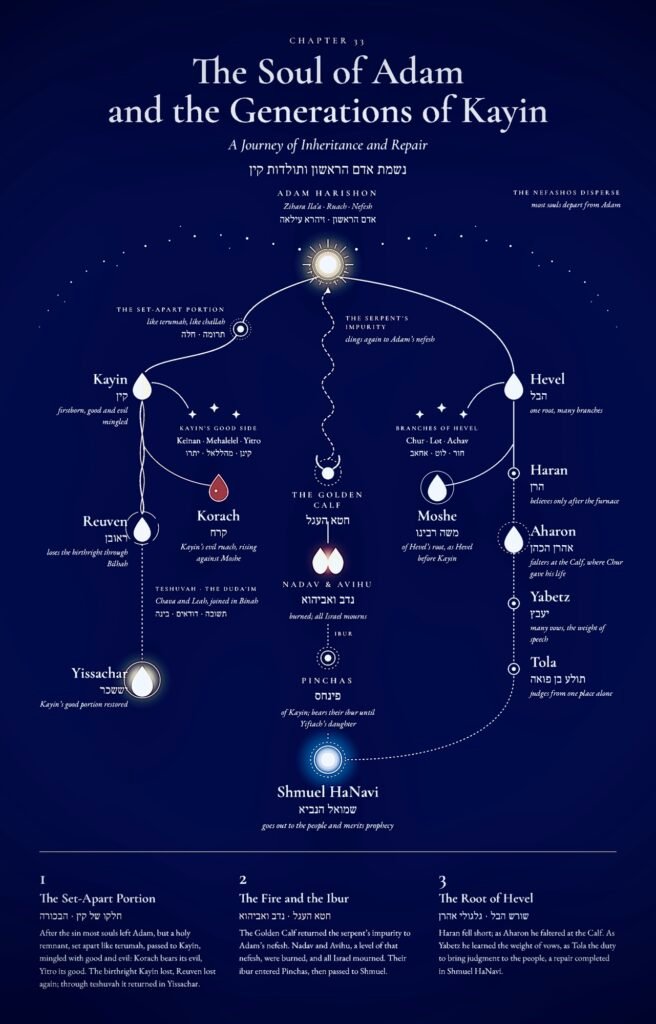
The passage describes human history as a spiritual journey that begins with Adam HaRishon and unfolds through the generations that follow him. It presents the souls of later figures as connected to the spiritual roots contained within Adam, and it interprets their lives as part of an ongoing process of repair. In this account, the story of Kayin is especially significant. As Adam’s firstborn, Kayin inherits a unique spiritual portion, but he also carries the consequences of the rupture caused by Adam’s sin. His descendants and later reincarnations become part of a long effort to transform that inheritance.
This is not simply a genealogy in the ordinary sense. The relationships described are spiritual as well as familial. A soul, or a portion of a soul, may reappear in a later person, bringing with it both potential and responsibility. One generation may lose a spiritual privilege through wrongdoing; another may recover it through repentance and good deeds. The passage therefore presents history as a layered process: the past continues to influence the present, but it can also be repaired.
Adam’s soul and the dispersal of its spiritual roots
According to the teaching, Adam HaRishon contained within his soul the roots of all future human souls. His spiritual structure included several levels, among them *Nefesh* and *Ruach*, as well as a higher aspect called *Zihara Ila’a*, or “supernal radiance.” These terms describe different dimensions of spiritual life. In broad terms, *Nefesh* is associated with vitality and action, while *Ruach* is associated with a higher spiritual dimension. The passage uses these distinctions to explain how particular aspects of Adam’s soul were carried forward into later generations.
When Adam sinned, the spiritual unity represented by his soul was broken. The souls that had been included within him were dispersed, and most of the *Nefashos* departed from him. The text describes this dispersal as a dramatic loss: Adam’s soul no longer held all the spiritual potential that had once been gathered within it.
Yet the loss was not total. A small and elevated portion remained. The passage compares this remnant to *terumah*, a sacred portion separated from produce, or to the portion of dough set aside as *challah*. The comparison suggests that what remained was not merely a fragment left behind by accident. It was a portion set apart, carrying a particular holiness and purpose.
This remnant is associated with Kayin. As Adam’s firstborn son, Kayin receives a special connection to the spiritual inheritance of his father. But that inheritance is complicated. It contains a precious element of Adam’s soul, while also bearing the consequences of the spiritual damage that followed Adam’s sin. Kayin’s story therefore begins with both privilege and danger.
Kayin as a mixture of good and evil
The passage emphasizes that Kayin is a combination of good and evil. This does not mean that he is simply divided into two unrelated parts. Rather, it means that his spiritual root contains opposing possibilities. From the good within him can emerge righteous souls; from the evil within him can emerge souls inclined toward destructive or corrupt behavior.
This mixed inheritance explains why the generations associated with Kayin cannot be understood as entirely virtuous or entirely wicked. They represent an unfinished spiritual reality. Their lives reveal the tension between the possibility of holiness and the persistence of impurity. The good within Kayin is real, but it must be brought into expression and protected from the evil that also accompanies it.
Among the righteous figures associated with Kayin’s good side are Keinan and Mehalelel. Their place in this spiritual genealogy demonstrates that Kayin’s legacy is not defined only by his failure. Even within a damaged root, the potential for righteousness remains. The good can continue through later generations, although it may require effort and refinement to emerge fully.
The birthright: privilege, responsibility, and loss
The passage next considers Reuven, the firstborn son of Ya’akov. Reuven is described as having been suited to receive the birthright associated with Kayin, who was the firstborn son of Adam. The birthright is more than a family title. It represents a combination of spiritual authority and responsibility, including the privileges associated with priesthood, kingship, and leadership.
Reuven’s loss of the birthright is linked to the incident involving Bilhah. The passage interprets this event as a failure that caused Reuven to lose what he might otherwise have inherited. This echoes the earlier story of Kayin. Kayin, too, had the potential for a sacred role, but his sin caused him to lose it.
The comparison between Kayin and Reuven reveals a central principle of the passage: spiritual privilege is not guaranteed by birth. A person may inherit a special opportunity, but that opportunity must be sustained through conduct. Being firstborn may establish a claim, but it does not remove the need for moral responsibility. The birthright can be lost when a person fails to act in accordance with the spiritual demands of that position.
The verse describing Reuven as “foremost in rank and foremost in power” is connected to the birthright, priesthood, and kingship. The passage also links the idea of priesthood to the biblical account of Kayin, interpreting the words “If you improve” as an indication that Kayin had once possessed the possibility of spiritual service. His failure caused him to forfeit that role. Reuven’s loss thus repeats, in a new form, the loss that began with Kayin.
But the inheritance does not disappear. It moves forward, awaiting another opportunity for repair.
Yissachar and the recovery of Kayin’s good portion
The passage associates the recovery of Kayin’s spiritual inheritance with Yissachar, the son of Ya’akov and Leah. Reuven repents, and the text connects that repentance to the later emergence of Yissachar as a recipient of the birthright’s spiritual potential.
Yissachar’s birth is linked to the episode of Leah’s *duda’im*. Leah says that she has “hired” Ya’akov with her son’s *duda’im*, and the passage reads this statement as a clue to the deeper spiritual significance of Yissachar’s birth. The circumstances of his conception are treated as more than a domestic episode: they become part of a symbolic process through which the good portion of Kayin is restored.
The text also connects Leah and Chava, Adam’s first wife, through the spiritual concept of *Binah*, sometimes called the “Upper Mother.” This association allows the passage to trace a line of spiritual meaning from the beginning of humanity to the birth of Yissachar. The statement made by Chava at Kayin’s birth—“I have acquired a man with G-d”—is understood as anticipating a later rectification. The full repair of Kayin’s spiritual root, the passage suggests, will come through Yissachar.
Yissachar therefore represents more than an individual descendant. He embodies the recovery of a portion of Kayin’s good. What was once compromised is not simply discarded; it is reclaimed through a later generation and given a new expression.
The Golden Calf, Nadav and Avihu, and the Repair of Cain
In this mystical account, the deaths of Nadav and Avihu are part of a much larger story—one that begins with Adam HaRishon, continues through the sin of the Golden Calf, and reaches its later expression in Pinchas, Korach, and Shmuel HaNavi. The events are linked by the idea that spiritual qualities and unfinished tasks can pass from one generation to another. A soul may carry within it a trace of an earlier life, and a later person may become the setting in which an earlier spiritual history is continued, repaired, or, at times, repeated.
The account therefore treats the deaths of Nadav and Avihu as more than a private tragedy within the family of Aaron. Their deaths are bound to the spiritual condition of Israel as a whole and to the primordial history of humanity. To understand why the entire people are commanded to mourn them, the text first returns to Adam HaRishon and the impurity associated with the primordial serpent.
The Golden Calf and the Return of Impurity
According to the teaching, had Israel not sinned with the Golden Calf, the impurity brought into the world by the serpent would have been completely removed. The sin of the calf interrupted that possibility. Instead of allowing the impurity to disappear, the people’s failure caused it to cling once again to the *nefesh* of Adam HaRishon—the spiritual root of the first human being and, in this account, the source from which humanity as a whole descends.
This connection changes the meaning of the Golden Calf. The sin is not presented only as an act of disobedience committed by one generation in the wilderness. It becomes a recurrence of a much older disorder: the contamination of the human soul by the serpent’s influence. Israel’s action reawakens a spiritual condition that had been present since the beginning of human history.
Nadav and Avihu are drawn into this story because they are associated with a level of Adam’s *nefesh*. Their own sin, involving the offering of incense, is one part of the explanation for their deaths. But the text adds another dimension: the people’s sin with the calf caused the impurity of the serpent to attach itself once more to the *nefesh* of Adam, and Nadav and Avihu were connected to that *nefesh*. Their fate therefore reflects both their own actions and the collective spiritual failure of Israel.
In this interpretation, death alone would not have been sufficient. The brothers had to be burned because the renewed impurity had become attached to the spiritual root they embodied. Their burning is thus not simply a physical detail in the biblical account. It becomes a sign of the way the people’s sin affected the soul of Adam HaRishon, and through him, the spiritual condition of humanity.
Why All Israel Must Mourn
The command that “all your brothers, the entire House of Israel, shall cry over the burning” (Vayikra 10:6) receives special emphasis. If Nadav and Avihu’s deaths concerned only their own family, the mourning might have remained within Aaron’s household. Instead, the entire people are called upon to grieve.
The mystical explanation is that the whole people must mourn because the tragedy belongs to the whole people. The sin of the Golden Calf renewed the impurity of the serpent, and that impurity affected the *nefesh* of Adam HaRishon, the spiritual father of humanity. Nadav and Avihu’s burning therefore represents a wound that reaches beyond two individuals. It is a wound to the shared human root.
Their deaths are consequently understood as a collective loss. Israel is not merely asked to feel sympathy for two priests; the people are asked to recognize that their own sin has contributed to the tragedy. The mourning becomes a form of acknowledgment: the people grieve because their actions have harmed something larger than themselves.
This also explains why Nadav and Avihu are described as having a stature comparable to Moses and Aaron. The comparison is not simply a statement about their public authority or their place in the priesthood. It is grounded in their connection to Adam HaRishon. If they embody a level of Adam’s *nefesh*, then they carry a spiritual significance reaching back to the first human being. Their deaths therefore resonate throughout the community and across generations.
The Continuing Presence of Nadav and Avihu
The account does not end with the brothers’ deaths. It introduces the concept of *ibur*: a spiritual attachment in which the soul or spiritual presence of one person enters another person, allowing an unfinished task to continue. Nadav and Avihu are said to have become an *ibur* within Pinchas.
This idea provides a way to understand how a spiritual life can continue after physical death. Nadav and Avihu are gone as individuals, but their spiritual qualities are not lost. They remain active through another person, and their presence can influence the course of later events.
Pinchas is especially suited to this role because he is also connected to Cain. The text draws attention to the initial letters of Nadav and Avihu’s names, associating them with the root of Cain’s name. This connection places the brothers within the same broad spiritual history: the history of Cain, his descendants, and the possibility of repairing what went wrong at the beginning of human life.
The *ibur* in Pinchas is therefore not an incidental detail. It represents a possible continuation of the brothers’ spiritual work. Their connection to Adam and to Cain can be carried forward in a new generation, where it may be transformed through a different life and a different set of choices.
Yet this process is not permanent or automatic. The text explains that, after Pinchas’s later involvement in the episode concerning Yiftach’s daughter, the *ibur* of Nadav and Avihu departed from him. Their spiritual presence then went to Shmuel HaNavi. The movement from Pinchas to Shmuel suggests that the work associated with Nadav and Avihu was still incomplete. It required a new bearer, one whose life could express their spiritual qualities in another way.
Korach and the Two Sides of Cain
The discussion of Korach clarifies why the legacy of Cain can lead in different directions. Korach is described as carrying the evil *ruach* of Cain. In this interpretation, his opposition to Moses is not merely a political dispute or a struggle for leadership. It reenacts the ancient conflict between Cain and Abel.
Moses is associated here with Abel, while Korach represents the destructive side of Cain. Korach’s rebellion thus becomes a recurrence of the first brotherly conflict: resentment against the one who has been chosen, followed by an attempt to overturn his position. The biblical struggle between Korach and Moses is read as a spiritual echo of the conflict between the first brothers.
The account contrasts Korach with Yitro, who is also connected to Cain but belongs to Cain’s good side. Yitro acts with generosity toward Moses. He gives his daughter Tzipporah to him, welcomes him, and provides him with food. His conduct shows that a connection to Cain does not determine a person’s character or destiny. The same spiritual lineage may be expressed through kindness and support, or through hostility and accusation.
The Root of Hevel: A Journey of Spiritual Repair Across Generations
In the mystical teachings presented in *Gate of Reincarnations*, the lives of biblical figures are connected by a hidden continuity of souls. A person’s life does not always stand alone, bounded by birth and death. Instead, a soul may pass through several incarnations, carrying unfinished work from one generation to the next. Each life offers an opportunity to repair what was left incomplete before. Through this lens, biblical history becomes a vast spiritual tapestry: individual stories remain distinct, yet they are joined by a deeper thread of responsibility, consequence, and renewal.
At the center of this account is Hevel, the son of Adam. His spiritual root is described as dividing into several branches, each expressed through different people and different destinies. Among those associated with Hevel’s root are Aharon HaKohen, Chur, Lot, Achav, and Moshe Rabbeinu. They are not presented as identical in character or purpose. Rather, each is understood to carry a particular aspect of a shared spiritual origin. Their lives reveal how one root may unfold in many forms, and how its different branches may each be assigned a distinct task.
The text traces some of these connections through the letters of names. Haran, the brother of Avram, is associated with Aharon: the letters of Haran are said to appear within Aharon’s name, with an aleph added. Chur is linked to Nachor, while Lot, the son of Haran, is also connected to Hevel. The arrangement of Lot’s name is interpreted as a hint to this relationship, as though the letters preserve a trace of the soul’s hidden origin. These readings treat names as more than ordinary identifiers. A name can become a spiritual sign, a small inscription of the past carried into a new life.
The connections among these figures are intricate. Chur, Aharon, Lot, and others may all be associated with the root of Hevel, yet their individual roles differ greatly. Some are remembered for leadership; others for courage, failure, or tragedy. The shared root does not make their stories interchangeable. Instead, it gives their differences a larger meaning. Each life reveals a different expression of the same underlying spiritual history.
Aharon’s story is especially significant because it is presented as a long and difficult process of repair. Before Aharon, the soul is associated with Haran, the brother of Avram. Haran was meant to rectify the sin of Adam, who had turned toward idolatry. But Haran’s life did not complete that task. According to the passage, he did not fully believe in God until after Avraham emerged from the fiery furnace. His own death in Ur therefore becomes part of an unfinished spiritual history. When the soul later appears as Aharon, it receives another opportunity to address the earlier failure.
That opportunity is tested in the episode of the Golden Calf. When the people demand that Aharon make them an object of worship, he does not stop them. The text interprets this moment as more than a political or personal mistake: it is a repetition of the earlier failure to stand firmly against idolatry. Aharon had once been meant to repair the sin of Adam, yet now he again finds himself at the center of an act of religious betrayal.
The passage emphasizes that Aharon should have been willing to give his life rather than take part in the making of the calf. Chur had already opposed the people and was killed for doing so. Aharon, however, seems to have reasoned that Chur’s sacrifice was enough—that the death of another person had already answered the crisis. The text treats this as a profound error. Chur’s courage could not substitute for Aharon’s own responsibility. Another person’s sacrifice could not complete the work assigned to him.
This is one of the account’s most demanding moral ideas: responsibility cannot simply be transferred. A person may be inspired by someone else’s courage, and may benefit from another’s sacrifice, but cannot use that sacrifice as an excuse to avoid a personal duty. Aharon’s failure was not only that he did not prevent the people from sinning. It was also that he failed to recognize that his own spiritual task required a choice of his own. His later incarnations are described as a prolonged effort to make the choice he had not made.
The first stage of this later journey is associated with Yabetz, or Jabez, the judge. There, Aharon’s soul is said to have sinned through the repeated making of vows. The passage connects this failure to the power of speech. Words are not harmless sounds; they create commitments and can bind a person to obligations. A vow may be made in a moment of passion or urgency, but its consequences can endure. Through Yabetz, the soul’s challenge shifts from the problem of idolatry to the responsibility of speech: the mouth that speaks must also answer for what it has said.
The next incarnation is Tola, the son of Puah, another judge. Tola’s name is associated with a worm, which is said to possess strength through its mouth. The image continues the theme of speech, but now in a different form. The mouth may be small, yet it can hold great power. Words can create, destroy, promise, accuse, guide, or mislead. Tola’s name therefore becomes a reminder that spiritual repair may depend on learning how to use speech rightly.
Yet Tola’s life brings another failure. The text says that he established his dwelling in one place rather than traveling throughout the land to judge the people. A judge who remains fixed in a single location may still be available to those who can reach him, but many people may be kept away by distance and difficulty. Justice becomes less accessible when those who need it must bear the burden of seeking it. In this way, Tola’s shortcoming is not simply a matter of geography. It concerns the nature of leadership: a leader must not only possess authority but must make that authority reachable.
The next incarnation, Shmuel HaNavi, is presented as a correction of this failure. Shmuel travels from place to place, judging the people and making himself available throughout the land. Where Tola remained in one city, Shmuel moves among the people. His service demonstrates that justice must be brought close to those who need it. The progression from Yabetz to Tola to Shmuel thus forms a sequence of moral lessons. First comes the need to discipline speech and honor one’s commitments. Then comes the need to make judgment accessible. In Shmuel, the earlier failures are answered through a more active and public form of service.
The account also describes Nadav and Avihu, Aharon’s sons, as entering into Shmuel through a spiritual attachment known as *ibur*. Through their presence, Shmuel is said to merit prophecy. This detail extends the pattern of shared spiritual life: one person may carry not only his own soul but also the influence or presence of another. The relationship is not described simply as a replacement of one person by another. It is a joining, in which the spiritual qualities of more than one soul may operate within a single life.