
The Light of Redemption and Education: A Rabbinic Commentary on Sefer HaChinuch (The Book of Mitzvos)
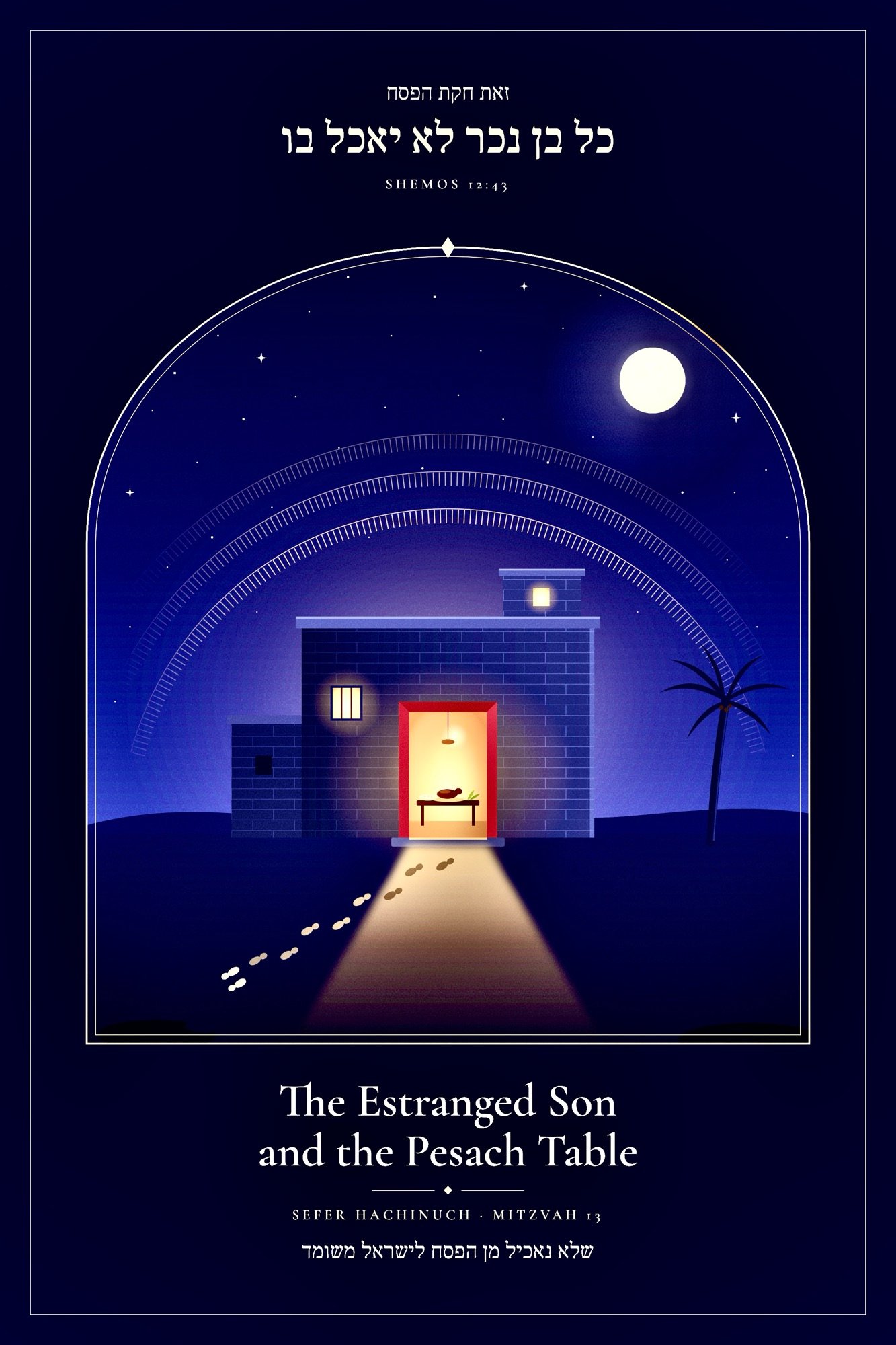
The Estranged Son and the Pesach Table
A commentary on Sefer HaChinuch, Mitzvah 13 — שלא נאכיל מן הפסח לישראל משומד
Nov 23, 2026 · @Kamil Levi Pyka-Penner
Introduction: An Exception to the Rule
At the pesach table, the Torah excludes a Jew who, by every other measure, remains a Jew. The Schottenstein edition opens its treatment of Mitzvah 13 with the general rule: a Jew who serves idols, or has “converted” to another faith, is still a Jew, bound by every obligation and prohibition. The eating of the pesach (Mitzvah 6), it notes, is the exception (p. 139).
In Parashas Bo the Chinuch counts a dense cluster of mitzvot around this offering, beginning with its slaughter (Mitzvah 5) and its eating (Mitzvah 6). Three of them define who may eat: the meshumad (Mitzvah 13), the toshav and sachir (Mitzvah 14), and the arel (Mitzvah 17).
The Chinuch’s treatment of Mitzvah 13 runs four short paragraphs, and each raises a question:
- The exegesis. He reads ben neichar, which ordinarily means a foreigner, as a Jew whose deeds have become foreign to Hashem.
- The reason. He grounds the mitzvah in what the pesach signifies, then calls his reason a sevara that needs no further proof.
- The addressee. With Rambam, he counts a prohibition on the one who feeds (שלא נאכיל), though the verse speaks of the one who eats (לא יאכל).
- The penalty. He exempts the transgressor from malkus because “it involves no action,” though feeding seems an action par excellence.
This commentary argues that the four answers are one answer, stated in the Chinuch’s own shoresh. The pesach is the act by which Klal Yisrael testifies, as a community, that it came under the wings of the Shechinah and entered the covenant. The prohibition therefore governs what the community confers, more than what the apostate consumes.
The discussion stays within Sefer HaChinuch, its commentators, the sifrei ha-mitzvos it draws upon, and the sources these works themselves cite. The base text is the Schottenstein Edition Sefer HaChinuch / Book of Mitzvos, Vol. 1, pp. 139–142, with its Notes and its Insight, “Whose Prohibition Is It?”
The Text of the Mitzvah
The Chinuch states the mitzvah in four paragraphs: source, root, scope, and penalty. The Hebrew follows the Schottenstein edition (pp. 139–140); the English is a fresh rendering for this essay.
Source
שלא נאכיל מן הפסח לישראל משומד, שנאמר (שמות יב, מג) כל בן נכר לא יאכל בו, ובא הפירוש עליו, בן ישראל שנתנכרו מעשיו לאביו שבשמים, וכן תרגם אונקלוס.
We are not to feed of the pesach to a Jewish apostate, as it is said, “No alien may eat from it” (Shemos 12:43). The interpretation handed down is: a son of Israel whose deeds have become foreign to his Father in Heaven. So, too, Onkelos renders it.
Root
משרשי מצוה זו, מה שכתוב בשחיטתו, לזכר נסי מצרים, ועל כן ראוי שלא יאכל בו משומד, אחר שאנו עושין אותו לאות ולזכרון שבאנו באותו הזמן לחסות תחת כנפי השכינה ונכנסנו בברית התורה והאמונה, אין ראוי שנאכיל ממנו למי שהוא הפך מזה שיצא מן הכלל וכפר באמונה. ועל כיוצא בזה נאמר בתלמוד לפעמים סברא הוא, כלומר ואין צריך ראיה אחרת.
Among the roots of this mitzvah is what was written of its slaughter: it is a remembrance of the miracles of Egypt. Therefore it is fitting that an apostate not eat of it. Since we make it a sign and a remembrance that at that time we came to shelter under the wings of the Shechinah and entered the covenant of the Torah and the faith, it is not fitting that we feed of it to one who is the opposite of this, who has left the community and denied the faith. In such cases, the Talmud sometimes says, “It is a sevara”—meaning no other proof is needed.
Scope
ונוהגת בזכרים ונקבות, בזמן הבית שיש שם פסח.
It applies to men and women, in the time of the Beis HaMikdash, when there is a pesach.
Penalty
ועובר עליה והאכיל ממנו לבן נכר, עובר על לאו, ואין בו מלקות לפי שאין בו מעשה.
One who transgresses it and feeds of it to a ben neichar violates a negative commandment. There are no lashes, since it involves no action.
Ben Neichar: From Stranger to Estranged
The Chinuch’s first move turns a word for foreignness into a word for estrangement. Ordinarily ben neichar denotes a gentile; the Schottenstein edition cites the mitzvah of milah, “מכל בן נכר אשר לא מזרעך הוא” (Bereishis 17:12), as the typical usage (p. 139).
The Chinuch instead invokes a received interpretation: “בן ישראל שנתנכרו מעשיו לאביו שבשמים.” The edition traces it to the Mechilta of R’ Shimon bar Yochai, to Pesachim 96a and Yevamos 71a with Rashi, and to Onkelos, who renders “כל בר ישראל דישתמד” (notes 3 and 5). It also points to Yechezkel 44:7, 9, where the prophet joins “ערל לב” to “ערל בשר” and speaks of the ben neichar “אשר בתוך בני ישראל” (note 4).
The plain sense is not discarded. Targum Yonasan and the Mechilta, as quoted by Rashi, apply the verse to gentile and apostate alike (note 5). In the Chinuch’s count, however, the gentile belongs to the next verse and the next mitzvah: Mitzvah 14 forbids feeding it to the toshav, a gentile who has renounced idolatry, and the sachir, a convert circumcised but not yet immersed (Shemos 12:45; Yevamos 71a).
Rambam sharpens the point from another side. For him the ben neichar is “העובד אל נכר,” and the transgression is feeding “למשומד לעבודה זרה” (Hil. Korban Pesach 9:7). In his reading, the foreignness belongs to the god served; in the Mechilta’s phrase, it belongs to the deeds.
Who, then, is the meshumad? The edition records two views (note 2). Some limit him to a Jew who practices idolatry (Mechilta of R’ Shimon bar Yochai; Rambam). Others include one who rejects any mitzvah outright, even without idolatry (Rashi to Shemos 12:48 as understood by R’ Eliyahu Mizrachi), a reading R’ Y. F. Perla questions (Sefer HaMitzvos of Rav Saadia Gaon, Lo Saaseh 175); see Minchas Chinuch §2.
The Chinuch’s own text leans toward the first view. Common printings open “שלא נאכיל מן הפסח לישראל מומר לעבודה זרה,” while the Machon Yerushalayim text in the Schottenstein edition reads simply “לישראל משמד.” Either way, the shoresh describes him as one who “יצא מן הכלל וכפר באמונה”: a defector from the community’s faith, not a Jew who merely falters.
The Mechilta’s phrase repays attention. He is still a “son of Israel,” and Hashem is still “his Father in Heaven”; only his deeds have become foreign. The exclusion targets the deeds, and, as we will see, it reaches no further than the pesach itself.
The Shoresh: A Sign of Entry
The Chinuch’s reason turns on what the pesach says. It is a sign of entry into the covenant, and the meshumad is defined by his exit from it.
He begins from Mitzvah 5: the pesach recalls the miracles of Egypt. Then he adds a second layer. The offering is also a sign of what we did: “שבאנו באותו הזמן לחסות תחת כנפי השכינה ונכנסנו בברית התורה והאמונה.”
The vocabulary is that of geirus. The first Pesach is cast as the moment a nation took shelter under the wings of the Shechinah, and each later Pesach re-enacts that entry. The meshumad moves the other way: we “came” and “entered,” while he “left the community” (יצא מן הכלל), and so he is “הפך מזה,” the antithesis of what the offering declares.
Elsewhere in the cluster, the Chinuch’s reasons concern how the pesach is eaten. It is roasted because, as free men, “ראוי לנו להתנהג באכילתו דרך חירות ושרות” (Mitzvah 7). It is not left over, and its bones are not broken, after the manner of kings and nobles (Mitzvos 8 and 16).
Mitzvos 13, 14 and 17 concern who eats, and their reasons concern the covenant. Of the toshav and sachir the Chinuch writes that the pesach is for “רק אותם שהשלימו באמונה, והם ישראלים גמורים, ולא אלו שעדין לא באו עמנו בברית שלם,” and that the arel’s exclusion grows “מזה השורש” (Mitzvah 14). Of the arel he says only: “מה שכתבנו בתושב ושכיר” (Mitzvah 17).
The three exclusions map the covenant’s threshold. The toshav and sachir have not yet come in; the arel, though a Jew, lacks the covenant’s sign in his flesh; the meshumad came in and walked out. The Chinuch himself links the two: milah is “אות קבוע בגופם,” and it and the pesach are the only positive commandments whose neglect carries kares (Mitzvah 2).
This is why the Chinuch can call his reason a sevara. The edition compares the Talmud’s usage, as at Shabbos 96b and Pesachim 21b, for a conclusion that needs no verse (note 6). The reason here is not an outside benefit but the definition of the act: a sign of entry, granted to one who has publicly exited, would be a false sign.
Shelo Na’achil: Whose Prohibition Is It?
With Rambam, the Chinuch counts the lav on the one who feeds. His own shoresh, and the contrast with the arel, suggest why.
The Schottenstein Insight lays out the question (pp. 141–142). The Chinuch follows Rambam, who frames the mitzvah as a ban on feeding the apostate (Hil. Korban Pesach 9:7; Sefer HaMitzvos, Lo Saaseh 128), though the edition notes that Rambam’s lists in the Yad carry contradictory implications. Others hold that the verse forbids the apostate himself to eat (Smag, Lo Saaseh 353; Tzlach, Pesachim 73a).
The difficulty is plain. The verse says “לא יאכל בו” and names no one but the eater. As Minchas Chinuch notes (§3), Rambam does not ordinarily leave a verse’s simple meaning without a source.
One answer holds that the Torah would hardly address apostates, who would ignore the command anyway (Kesef Mishneh; Ralbag to the verse). R’ Y. F. Perla finds this inadequate (Lo Saaseh 175). Even an idolatrous meshumad may still believe in Hashem and keep other mitzvos: one who serves an idol while believing that Hashem rules over him and his idol is still a full idolater (Mitzvah 26). Such a man might well obey.
Minchas Chinuch takes another approach (§3, §11). For Rambam and the Chinuch, he suggests, the lav addresses the apostate as well: if one may not feed him, surely he may not eat (see Zohar, Acharei Mos 73a; Tzlach). He leaves unanswered why neither of them says so.
The answer may lie in the shoresh itself. Its subject is “we”: “אנו עושין אותו לאות ולזכרון,” “שבאנו,” “ונכנסנו”—and therefore “אין ראוי שנאכיל.” The sign is the community’s testimony, and only the community can falsify it, by conferring it on one who has renounced what it attests.
R’ Elchanan Poupko reads the lav in this spirit, as a duty resting on the owners of the offering, which he says resolves the Minchas Chinuch’s question; he cites this shoresh in support (Chochmas HaChinuch, Mitzvah 13). He even raises, tentatively, a practical consequence: one who is not an owner and gives a meshumad from another’s pesach might not violate this lav at all (“ויש לדון בזה”).
The Chinuch’s own formulations support this. Mitzvos 13 and 14 read “שלא נאכיל,” and in both the feeder is not lashed, “שאין בו מעשה.” Mitzvah 17 reads “שלא יאכל הערל,” and an arel who eats a kezayis is lashed, though the arel of the verse is chiefly one “שמתו אחיו מחמת מילה,” a Jew kept from milah by danger.
Rambam shows the same pattern. In Sefer HaMitzvos, Lo Saaseh 126 warns “מהאכיל פסח לגר תושב,” while 127 forbids the arel himself to eat. In the Yad, the one who feeds a meshumad or toshav is not lashed, while the arel who eats is (Hil. Korban Pesach 9:7–8).
The pattern suggests a principle. The arel stands inside the covenant, in the Chinuch’s paradigm case through no fault of his own, and the Torah addresses him directly. The meshumad and the gentile stand outside the circle the pesach defines, one by renunciation and one by not yet having entered, and so the Torah addresses the circle.
This keeps the Kesef Mishneh’s intuition without its weakness: what matters is not whether the apostate will obey, but where he has placed himself. Nor does it contradict Minchas Chinuch. The apostate may be bound as well, but the Chinuch counts the lav where its essence lies: in what the community confers.
Ein Bo Malkus: Responsibility Without the Deed
The Chinuch exempts the feeder from lashes because the deed belongs to the eater. The community bears the prohibition; the apostate performs the act.
Lashes are generally not given for a prohibition broken without an action (note 10; see Insight B to Mitzvah 11 and Minchas Chinuch §9). Feeding looks like an action. The edition explains that the transgression is completed only when the apostate eats, so handing him the meat, or even placing it in his mouth, is not significant enough for malkus (Beis Yitzchak, Orach Chaim 29 §8).
Others see it differently (see Minchas Chinuch §9 and R’ Shmuel Landau’s gloss to Doresh LeTzion §8; see also Minchas Yitzchak). For other explanations, the edition refers to Kesef Mishneh on Hil. Korban Pesach 9:7, and to Sfas Emes on that halachah (note 10).
Rambam, agreeing that there is no Biblical malkus, rules that the feeder receives makkas mardus: “ואינו לוקה, אבל מכין אותו מכת מרדות” (Hil. Korban Pesach 9:7; see Bris Yaakov, Orach Chaim §19, cited by Sdei Chemed, Vol. III). Such lashes of discipline may follow even a Biblical prohibition that carries no Biblical lashes (Rambam, Hil. Sanhedrin 18:5; Pri Chadash, Orach Chaim §496; Shoshanas HaAmakim, Klal 8).
If the apostate is also addressed, his case differs. His eating is a complete transgression by itself, so he should be lashed (Minchas Chinuch §3). Indeed, Kiryas Sefer writes that while the feeder is not lashed, the apostate who eats is (Hil. Korban Pesach, ch. 9).
The Chinuch’s neighboring rulings draw the same line. One who carries pesach meat out of its chaburah is lashed, provided he lifts it and sets it down outside, as on Shabbos (Mitzvah 15), and the arel who eats a kezayis is lashed (Mitzvah 17). Where the transgressor completes the act himself, there are lashes; where another’s eating completes it, there are none (Mitzvos 13 and 14).
Read with the previous section, the two halves of the ruling fit together. The prohibition is ours (שלא נאכיל), but the deed is his (אין בו מעשה). The Torah holds the community answerable for what it confers, yet will not charge the feeder with an act that only the eater completes.
The Aramean of Netzivin: The Parallel in Mitzvah 14
The same question returns in Mitzvah 14, and a Talmudic story puts it to the test.
There the Chinuch and Rambam again frame the lav as a ban on feeding. The logic seems stronger still: refraining from the pesach is not among the Seven Noahide Laws, so the command should bind the Jew who feeds, not the gentile who eats (Minchas Chinuch 14:2; R’ Shmuel Landau to Doresh LeTzion §8; R’ Perla, Lo Saaseh 175).
Still, some hold that the prohibition reaches the gentile himself (Smag, Lo Saaseh 354; Tzlach; Tosafos HaRosh, Yevamos 71a, cited in the Mechon edition of Minchas Chinuch, Mitzvah 14, fn. 2). Minchas Chinuch finds support in an incident at Pesachim 3b, which the Insight recounts (p. 142).
An Aramean would go up to Jerusalem each Pesach, pass himself off as a Jew, and eat of the pesach. At home he boasted of it to R’ Yehudah ben Beseirah, who asked whether he had ever been served from the fat tail. The next year he asked for it and was exposed, for the tail goes up on the Altar.
He was punished, and word was sent to the sage that while he sat in Netzivin, his net was spread in Jerusalem. If the prohibition does not bind a gentile, the question runs: on what basis was he punished?
One answer: since he was ineligible to eat, his registration with the group had no legal force, and the meat he took was stolen. Theft is among the Seven Noahide Laws (Kovetz Shiurim, Pesachim §6; Chazon Yechezkel to Pesachim 3b; see Minchas Chinuch there).
The Aramean is the Meshumad’s mirror image. One is an outsider who pretends to belong; the other, a member who has declared that he does not. In both cases the sign is guarded not by the eater’s conscience but by the vigilance of the community, and in the story, by a sage far away.
Bizman ha-Bayis: What Remains Without the Korban
Today the prohibition is dormant, but its shape still teaches. The meshumad stays bound to matzah; only the pesach is withheld.
The Chinuch limits the mitzvah to “בזמן הבית שיש שם פסח,” since the offering is brought only in the Beis HaMikdash (note 8; see Mitzvah 5). It binds men and women alike, under the general rule for prohibitions (note 7).
The ban does not extend to matzah, still a Torah obligation, or to maror, still eaten by Rabbinic law (note 8; Mitzvah 10, note 5). From “בו” the Gemara learns that only the pesach is withheld: the apostate may eat matzah and maror, and, as a Jew, he must (Pesachim 28b). The Chinuch says the same of the arel, and of the toshav and sachir: “ו’בו’ הוא דאינו אוכל, אבל אוכל הוא במצה ומרור” (Mitzvah 17).
The result is a precise structure. Obligation is never lifted, and matzah binds the meshumad like any Jew. What is withheld is the one act whose meaning is belonging.
This should guard against loose use of the term. By the Chinuch’s own definition, the meshumad is one who “יצא מן הכלל וכפר באמונה” (in common printings, an apostate to idolatry), not a Jew who struggles or does not know. Mitzvah 13 speaks of renunciation, not weakness.
And because the Mechilta locates the estrangement in deeds, it points to its own remedy. Deeds are what teshuvah changes. The road back to the pesach is the road the pesach commemorates: coming, and entering.
Conclusion: One Idea in Four Laws
The Chinuch’s four short paragraphs make one claim. The pesach is Klal Yisrael’s yearly testimony that it entered the covenant, and the community may not falsify it.
The exegesis names the meshumad a son whose deeds are estranged. The shoresh defines the pesach as the sign of entry and him as its antithesis, so plainly that it needs no proof. The formulation lays the prohibition on those who make the sign “ours,” and the penalty clause leaves the deed with the one who eats.
Explaining why the Torah surrounds the Exodus with so many commandments, the Chinuch writes: “כי הוא יסוד גדול ועמוד חזק בתורתנו ובאמונתנו” (Mitzvah 21). Mitzvah 13 guards that pillar at its most public point: the table at which Klal Yisrael declares who it is.
For those who teach, the lesson is twofold. The boundary is real, and keeping it is the community’s charge. Yet it is drawn around a son who remains a son, and its own terms, coming and entering, describe the way home.
Sources and Translations
Every source below is Sefer HaChinuch, a commentary on it, a sefer ha-mitzvos, or a work that these themselves cite.
Base text
- The Schottenstein Edition Sefer HaChinuch / Book of Mitzvos, Vol. 1 (ArtScroll/Mesorah), Mitzvah 13, pp. 139–142: text, Notes 1–10, and the Insight “Whose Prohibition Is It?”
Sefer HaChinuch
- Mitzvos 2, 5, 7, 8, 13, 14, 15, 16, 17, 21 and 26
Commentaries on the Chinuch
- Minchas Chinuch, Mitzvah 13 §§2, 3, 9, 11; Mitzvah 14 §2 (Mechon edition, fn. 2)
- R’ Elchanan Poupko, Chochmas HaChinuch, Mitzvah 13
Sifrei ha-mitzvos
- Rambam, Sefer HaMitzvos, Lo Saaseh 126–128, and the count at the head of the Yad
- Smag, Lo Saaseh 353–354
- Rav Saadia Gaon, Sefer HaMitzvos, with R’ Y. F. Perla’s commentary, Lo Saaseh 175 (Vol. II, pp. 385, 390)
- Kiryas Sefer, Hil. Korban Pesach, ch. 9
Rambam’s Yad, as the Chinuch’s source
- Hil. Korban Pesach 9:7–8, with Kesef Mishneh and Sfas Emes; Hil. Sanhedrin 18:5
Works cited by the Chinuch and the edition
- Mechilta and Mechilta of R’ Shimon bar Yochai, Targum Onkelos, Targum Yonasan, Rashi with Mizrachi, and Ralbag, to Shemos 12:43–48
- Bavli: Shabbos 96b; Pesachim 3b, 21b, 28b, 73a, 96a; Yevamos 71a
- Zohar, Acharei Mos 73a; Tzlach, Pesachim 73a; Tosafos HaRosh, Yevamos 71a
- Beis Yitzchak, Orach Chaim 29; Bris Yaakov, Orach Chaim 19, cited by Sdei Chemed, Vol. III; Pri Chadash, Orach Chaim 496; Shoshanas HaAmakim, Klal 8; Doresh LeTzion with R’ Shmuel Landau’s gloss; Minchas Yitzchak
- Kovetz Shiurim, Pesachim §6; Chazon Yechezkel, Pesachim 3b
Translations
- Shemos 12:43 is quoted in the Schottenstein edition’s rendering; other verses appear in Hebrew. The Chinuch and Rambam are translated fresh for this essay.
Online texts used to check quotations
- Rambam, Hil. Korban Pesach, ch. 9
- Rambam, Sefer HaMitzvos, Lo Saaseh 126–127 (digest) and Lo Saaseh 126 in Hebrew
- Sefer HaChinuch, Frankfurt order: Mitzvah 2, Mitzvah 7, Mitzvah 14, Mitzvah 17
- Sefer HaChinuch, Venice order, Parashas Bo (Mitzvos 13, 14, 21)
- Sefer HaChinuch, Torat Emet text (Mitzvos 8, 14, 16) and as reproduced at parashat.co.il (opening line of Mitzvah 13)
- Chochmas HaChinuch, Mitzvah 13