
The Light of Redemption and Education: A Rabbinic Commentary on Sefer HaChinuch (The Book of Mitzvos)
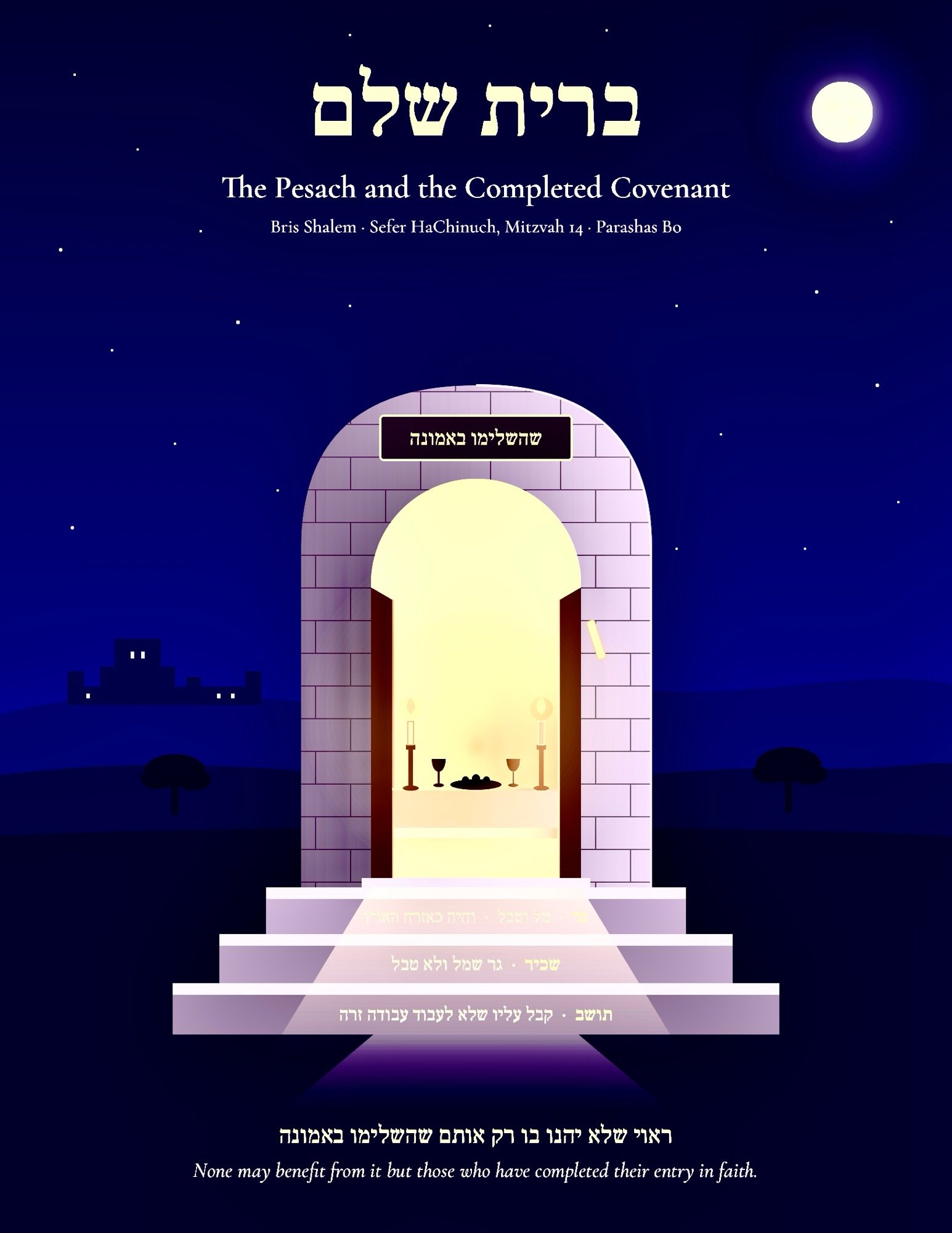
Bris Shalem: The Pesach and the Completed Covenant
A commentary on Sefer HaChinuch, Mitzvah 14 (Parashas Bo): the prohibition to serve the Pesach offering to a toshav or a sachir
Nov 23, 2026 · @Kamil Levi Pyka-Penner
Introduction
The Sefer HaChinuch gives Mitzvah 14 only a few lines, yet those lines say plainly what the Korban Pesach is: a memorial “of our freedom and of our entry into a faithful covenant with Hashem, blessed be He.” From that root the Chinuch draws a boundary. The Pesach belongs to those who have completed their entry into the covenant, and not to those who stand at its threshold, however near.
The mitzvah is one of the Pesach laws of Parashas Bo. The Chinuch ties its purpose to “what we have written regarding the others,” the remembrance of the Exodus, and the Book of Mitzvos sends the reader to Mitzvos 5 through 15 for that shared root. Within the cluster, three prohibitions define who may eat: Mitzvah 13 excludes the apostate, Mitzvah 14 the toshav and the sachir, and Mitzvah 17 the uncircumcised.
This essay argues that every element of Mitzvah 14 turns on a phrase the Chinuch uses almost in passing: בְּרִית שָׁלֵם, a complete covenant. That holds for its definitions, for its root, and for its framing as a prohibition on the one who serves rather than the one who eats. It holds as well for the Raavad’s dissenting reading through the law of registration. The Pesach is not a meal of proximity, sympathy or partial commitment; it is the meal of those who have finished entering.
As befits a commentary on the Chinuch, the sources are confined to the literature of the Book of Mitzvos. These are the Chinuch’s own text and the related mitzvos to which it points; the elucidation, notes and Insight of the Book of Mitzvos edition (pp. 143–146); the commentaries on the Chinuch, chiefly the Minchas Chinuch; and the other sifrei hamitzvos that the Book of Mitzvos brings into the discussion. Talmudic passages, the Rambam’s Mishneh Torah and other Rishonim appear only as the Book of Mitzvos cites them. Verses are quoted in Hebrew with the renderings of Jewish translations.
The text and its two categories
The Chinuch defines the mitzvah in a single sentence, and both of its categories describe people who have begun to draw near to Israel but have not arrived.
שלא להאכיל מבשר הפסח לגר ולתושב, שנאמר (שמות יב, מה) תושב ושכיר לא יאכל בו. והתושב הוא אדם מן האומות שקבל עליו שלא לעבוד עבודה זרה ואוכל נבלות, ושכיר הוא גר שמל ולא טבל, שכן פירשו חכמים זכרונם לברכה.
Not to feed of the meat of the Pesach to a ger or to a toshav, as it is said, “A toshav and a sachir may not eat of it” (Shemot 12:45). The toshav is a man of the nations who has accepted upon himself not to worship idols, yet eats neveilos. The sachir is a ger who was circumcised but has not immersed. So did the Sages, of blessed memory, explain these terms.
(The Chinuch’s Hebrew is rendered freely here; the verse follows the Book of Mitzvos.)
The word ger. The Chinuch’s opening says ger where the verse says sachir: he names the sachir by what he is in halachah, a convert still in process. The Book of Mitzvos (note 1) cautions that ger here cannot mean a completed convert, who is a full Jew and may — indeed must — bring and eat the Pesach (Shemot 12:48). One word thus covers a man on both sides of the threshold, and the Pesach is where the difference shows.
The toshav. His definition matches the Chinuch’s own definition of the ger toshav in Mitzvah 94: אי זהו גר תושב? זה שקבל שלא לעבוד עבודה זרה. There, renouncing idolatry is what permits him to dwell in the land at all, against the verse לא ישבו בארצך. The Book of Mitzvos records the view that a ger toshav must accept all seven Noahide laws (citing the Rambam, Hil. Avodah Zarah 10:6, Mitzvah 426, and Minchas Chinuch 94:2). The Chinuch, however, gives the same narrower definition in both places.
“Yet eats neveilos.” The clause ואוכל נבלות is not incidental: the Chinuch defines the toshav by what he has accepted and by what he has not. The Book of Mitzvos (note 2) adds that the Torah itself assigns the neveilah to him — לגר אשר בשעריך תתננה ואכלה (Devarim 14:21), rendered there “to the resident alien who is in your cities you shall give it.” The Torah thus sets two tables before the toshav. What Israel may not eat, he may receive; what Israel must eat, he may not. The neveilah marks the outer edge of Israel’s table, and the Pesach marks its center.
The sachir. He stands one step further in. The Book of Mitzvos opens the mitzvah by recalling that conversion requires circumcision (for a male), acceptance of the mitzvos and immersion, and that one is not a Jew until every step is complete (citing Yevamos 46a and Shulchan Aruch, Yoreh De’ah 268:1–2). The sachir has entered the covenant in his flesh but has not finished entering. One may suggest why the Sages heard him in the word sachir, a hired laborer: he already works within the household, yet he is not of it.
Why these two? The Book of Mitzvos (note 3) reasons that a non-Jew who has neither begun to convert nor accepted the Noahide laws is “certainly” barred, citing the Rambam (Hil. Korban Pesach 9:7, with the Mirkeves HaMishneh), Tosafos (Yevamos 70b) and the Mechilta. The Rambam’s formulation there carries the same logic: ואין מאכילין ממנו לגוי, אפילו גר תושב או שכיר — not to a gentile, even a ger toshav or a sachir. The verse legislates at the border, naming the cases nearest the threshold, where one might have thought partial attachment enough.
The root: freedom and a faithful covenant
The Chinuch makes the Pesach a memorial of two things at once, “our freedom” and “our entry into a faithful covenant,” and it is the second that closes the door to the toshav and the sachir.
משרשי מצוה זו, מה שכתבנו באחרות, לזכור יציאת מצרים. ובעבור שקרבן זה לזכור חרותנו ובואנו בברית נאמנה עם השם יתברך, ראוי שלא יהנו בו רק אותם שהשלימו באמונה, והם ישראלים גמורים, ולא אלו שעדין לא באו בברית שלם עמנו. וענין הרחקת הערל מאכילתו, גם כן מזה השורש.
Among the roots of this mitzvah is what we wrote regarding the others: to remember the Exodus from Egypt. Since this offering is a memorial of our freedom and of our entry into a faithful covenant with Hashem, blessed be He, it is fitting that none benefit from it but those who have completed [their entry] in faith — full Israelites — and not those who have not yet come into a complete covenant with us. Keeping the uncircumcised from eating it stems from this root as well.
One system, one purpose. “What we wrote regarding the others” tells us that the Chinuch reads the Pesach laws as a single system, and the Book of Mitzvos sends the reader to Mitzvos 5 through 15. Two mitzvos later he explains why a system of detailed acts can carry a memory: דע, כי האדם נפעל כפי פעולותיו — for אחרי הפעולות נמשכים הלבבות (Mitzvah 16). If the heart follows the deeds, then the boundary of the table is itself one of the deeds. Who sits at the Pesach teaches as surely as how it is roasted.
Two memorials. Were the Pesach only a memorial of liberation, it would be hard to see why the toshav and the sachir must be kept from it. They live among the liberated; one has renounced idolatry, and the other has begun to convert. Because the offering also commemorates entry into the covenant, it belongs to those who have entered. The word ובואנו, “our coming into,” is the vocabulary of a threshold crossed.
Exit and threshold. The root of Mitzvah 13, the apostate, reads as this root’s twin. There the Pesach is a sign and memorial שבאנו באותו הזמן לחסות תחת כנפי השכינה ונכנסנו בברית התורה והאמונה, and it may not be fed to one שיצא מן הכלל וכפר באמונה. The apostate has gone out; the toshav and the sachir have not yet come in. The one denied the faith; the others have not yet completed it. The Pesach commemorates a movement — out of Egypt and into the covenant — and it is withheld both from one who reversed that movement and from one who has not finished it.
“Completed in faith.” The Chinuch could have described faith as inner conviction. Instead he defines it at once as a status: והם ישראלים גמורים. A toshav may reject idols with complete sincerity, and a sachir already bears the covenant in his flesh. Neither is yet “complete in faith” in the Chinuch’s sense, because faith here is measured by the completion of covenantal entry. The language is exact: ברית נאמנה and שהשלימו באמונה share one root. A covenant is “faithful” when its parties are fully bound, and one who is still binding himself cannot yet partake of its memorial.
“That none benefit from it.” The root’s verb is יהנו, to benefit, not merely to eat. The Pesach appears here as a good that belongs to the covenant. The Chinuch frames the exclusion as a privilege withheld, not a penalty imposed, and the next mitzvah to share this root shows how far that is true.
Sachir and arel: two halves of one covenant
The root’s last line extends the same principle to the uncircumcised, and the pairing shows that the Pesach requires two things together: full Jewish status and the sign of the covenant.
The blameless arel. In Mitzvah 17 the cross-reference runs back to ours: משרשי מצוה זו, מה שכתבנו בתושב ושכיר. The arel the Chinuch has in mind is striking: והוא הערל שמתו אחיו מחמת מילה. He is a Jew left uncircumcised not by rebellion but by the law’s own protection of his life. He is blameless, yet he may not eat, and if he eats a kezayis, לוקה.
Status, not sin. R’ Elchanan Poupko (Chochmas Chinuch, Mitzvah 17) asks whether the arel’s exclusion resembles the apostate’s, a consequence of neglecting a mitzvah, or is a disqualification of the person himself (פסולא דגופיה), like that of the toshav and the sachir. He notes that the Chinuch roots the arel’s law in the toshav and sachir, not in the apostate. The Chinuch’s choice of a blameless arel points the same way: the exclusion concerns what the man lacks, not what he did.
The symmetry. Set the sachir beside this arel. The sachir bears the sign of the covenant but is not yet a Jew; the arel is a Jew in full but lacks the sign. Each has what the other lacks, and neither may eat. The Pesach asks for the covenant whole: a full Israelite who bears the sign of Avraham.
Completion by one’s own hand. The Chinuch’s root for milah explains why the sign matters. Hashem wished to set an אות קבוע בגופם in the people He separated, and to leave the completion to man himself: ורצה להיות ההשלמה על ידי האדם ולא בראו שלם מבטן … כי כאשר תשלום צורת גופו על ידו, כן בידו להשלים צורת נפשו בהכשר פעולותיו (Mitzvah 2). The word of milah is השלמה; the word of our root is שהשלימו. The Pesach belongs to those who have completed: in the body through milah, and in status through full entry.
Two mitzvos of kares. The Chinuch draws the link himself in Mitzvah 2: אין בכל התורה מצות עשה שחייבין על ביטולה כרת, כי אם זו ושחיטת הפסח. It is fitting that being cut off attaches precisely to the two positive mitzvos that mark belonging, and that Mitzvah 17 binds them together at a single table.
With Hashem and with us. The same logic governs terumah. In Mitzvah 282 an uncircumcised kohen may not eat it, for the arel is reckoned like a zar, one שלא נכנס עם ישראל בברית המילה. Even priestly lineage does not substitute for the covenant, and the covenant is entered with Israel. Our root says the same with two prepositions: the covenant is נאמנה עם השם יתברך, and the toshav and sachir have not yet come into it in full עמנו. It is made with Hashem and entered with His people.
Where the exclusion stops. The law is also precise about its limit: ובו הוא דאינו אוכל אבל אוכל הוא במצה ומרור, וכן תושב ושכיר גם כן (Mitzvah 17; the Book of Mitzvos, note 5). For the arel, a Jew, matzah and maror remain his obligation. For the toshav and the sachir, the point is that the exclusion goes no further than the offering. The Seder table is wider than the Pesach: the memorials of servitude may be shared by those who stand near, while the offering of the covenant waits for those within it.
To whom the prohibition speaks
Following the Rambam, the Chinuch addresses this prohibition to the Jew who feeds the toshav or sachir, not to the one who eats, and that choice shapes both its penalty and its meaning.
Feeder or eater. The verse reads as though it speaks to the eater: תושב ושכיר לא יאכל בו. Yet the Chinuch’s heading is שלא נאכיל, in the first person plural, and his opening is שלא להאכיל. The Book of Mitzvos (note 9) explains that he follows the Rambam (Hil. Korban Pesach 9:7), whose own count is phrased the same way: שהזהירנו מהאכיל פסח לגר תושב (Sefer HaMitzvos, Lo Saaseh 126). The Minchas Chinuch states the dispute in a line: בסמ”ג נראה דהלאו הוא באוכל אבל הר”מ והרהמ”ח סוברים דהלאו קאי על המאכיל. The Smag (Lo Saaseh 354) addresses the eater; the Rambam and “the author” — the Minchas Chinuch’s name for the Chinuch — address the feeder.
A pattern and its exception. Mitzvah 13 is built the same way: שלא נאכיל מן הפסח לישראל מומר, ending עובר על לאו, ואין בו מלקות לפי שאין בו מעשה. Mitzvah 17 is not: שלא יאכל הערל, with lashes for the arel who eats a kezayis. Within the Chinuch’s own cluster, two prohibitions face the feeder and one faces the eater.
Why a second verse? If every non-Jew is an arel, Mitzvah 17 would seem to cover the toshav already. R’ Yerucham Fishel Perla, explaining one line of the Gemara’s reasoning, puts it bluntly: ולגופי’ לא איצטריך הך קרא. דהא לא עדיף מערל ובן נכר (on Rav Saadia Gaon’s Sefer HaMitzvos, Lo Saaseh 175). Two answers emerge from the Chinuch’s own words. First, the sachir is circumcised by definition, so the law of the arel cannot reach him; R’ Perla’s survey likewise finds the verse needed, on another line of reasoning, for non-Jews who are circumcised, the half-converted among them. Second, on the Rambam–Chinuch reading, Mitzvah 14 is a different kind of prohibition, binding the one who feeds where Mitzvah 17 binds the one who eats.
An act another completes. Because the prohibition falls on the feeder, the Chinuch rules ואין לוקין עליו, שאין בו מעשה. The Book of Mitzvos (note 10) explains that the feeder only hands over the meat and the eater completes the transgression, so the handing is not action enough for lashes. The Rambam nonetheless imposes makkas mardus, lashes of discipline (Hil. Korban Pesach 9:7). The covenant’s table may not be breached without consequence even where the Torah’s own lashes do not apply.
A suggestion: who stands within “us.” The Minchas Chinuch, as Chochmas Chinuch cites him on Mitzvah 13, asks how the Rambam knows that the prohibition falls on the feeder. Without presuming to answer for the Rambam, one may observe how the Chinuch’s roots line up with his formulations. The apostate of Mitzvah 13 has gone out of the כלל, and the toshav and sachir of Mitzvah 14 have not yet come in עמנו. Both stand outside the communal “we,” and both mitzvos are addressed to the “we”: שלא נאכיל. The arel of Mitzvah 17 stands inside, a full Jew who lacks the sign, and his mitzvah addresses him directly. Where the excluded person is outside, the Torah charges the household; where he is inside, it charges him.
The hosts’ charge. On this reading, the guardianship of the Pesach rests with its hosts. The Chinuch applies the mitzvah to men and women alike (בזכרים ונקבות; the Book of Mitzvos, note 8), so whoever serves at the covenant’s table guards its boundary. Those who lead communities will recognize the principle: the integrity of a sacred table is the charge of those who set it. The Smag addresses the toshav and sachir themselves; the Chinuch asks the household to keep faith with its own covenant.
The Raavad’s alternative: servants and registration
The Raavad reads תושב ושכיר as Hebrew servants and turns the verse into a law of registration; the Rambam and the Chinuch accept the duty to register but deny that eating without it is a prohibition.
The same pair elsewhere. The words return in Parashas Emor, regarding a kohen’s terumah: תושב כהן ושכיר לא יאכל קדש (Vayikra 22:10). The Book of Mitzvos (Insight) notes that Rashi there explains them as two kinds of Hebrew servant: the sachir serves six years, the toshav until Yovel (see Mitzvah 42). In Mitzvah 281 the Chinuch gives a variant of his own: כי התושב הוא שכיר עולם, והשכיר הוא שכיר שנים. There he contrasts them with the kohen’s purchased Canaanite servant, who does eat terumah. Closeness of labor does not make the hired man a member of the household.
The Rambam and the Chinuch. In our verse, the Rambam (Sefer HaMitzvos, Lo Saaseh 126; Hil. Korban Pesach 9:7) and the Chinuch hold that the terms cannot mean Hebrew servants. As the Book of Mitzvos explains from the Gemara (Yevamos 70a), a Hebrew servant is a full Jew, obligated to offer and to eat the Pesach. Hence the Sages’ reading: a resident non-Jew, and one half-converted.
The Raavad. The Raavad (Hil. Korban Pesach 9:7) keeps the Hebrew servants and makes the verse a law of registration. The Torah requires each eater to be counted on the offering before its slaughter: במכסת נפשת … תכסו על השה (Shemot 12:4), rendered in the Book of Mitzvos “according to the number of people … shall you be counted for the lamb.” One who fails to register does not fulfill his obligation (Pesachim 61a). The verse, says the Raavad, goes further. A Hebrew servant may not eat of his master’s Pesach unless registered on it, despite his bond to the household (Pesachim 88a). If even he must register, all the more so anyone else, and eating without registration becomes a prohibition for every Jew.
The Minchas Chinuch’s summary. He states the Raavad’s position in a line: להראב”ד דלאו זה הוא משום שלא למנויו נמי נוהג בכל החייבים במצות. On this view, the verse speaks to every obligated Jew and says nothing about non-Jews at all.
The reply. The Rambam and the Chinuch agree that registration is required. The Chinuch lists דיני מנוייו among the laws of Mitzvah 5, and the Book of Mitzvos points to Mitzvah 5, note 11, and to the Rambam, Hil. Korban Pesach 2:1. But they place the duty within the positive commandment of Shemot 12:4. One who eats unregistered has failed the aseh; he has not violated a lav (Kesef Mishneh, Hil. Korban Pesach 9:7). R’ Perla puts the Rambam’s position sharply, דליכא שום איסורא כלל באכילת הפסח שלא למנוייו, while noting a Mechilta that complicates the picture.
The practical difference. Lashes are given only for a lav (the Book of Mitzvos, General Introduction). On the Rambam–Chinuch view, one who eats without having registered before the slaughter is not lashed; on the Raavad’s, he is (Minchas Chinuch, §5). To reconcile the Raavad with the Gemara in Yevamos, the Book of Mitzvos directs the reader to Mahari Korkos, the Maharsha and the Aruch LaNer on Yevamos 70b, and to the Yerei’im, §59.
Two models of belonging
Beneath the dispute lie two ways: the Chinuch’s guarding of Pesach by covenantal identity and the Raavad’s by formal enrollment, and both refuse to let nearness stand in for membership.
Person
Where he stands
What he lacks
Prohibition binds
Penalty
Apostate (Mitzvah 13)
A Jew who has left the community
Faith: “he denied the faith”
The one who feeds him
Lav; no malkus; makkas mardus
Toshav (Mitzvah 14)
A non-Jew who renounced idolatry and may dwell in the land
Entry into the covenant
The one who feeds him (Smag: the toshav)
Lav; no malkus; makkas mardus
Sachir (Mitzvah 14)
A convert circumcised but not yet immersed
Immersion
The one who feeds him (Smag: the sachir)
Lav; no malkus; makkas mardus
Arel (Mitzvah 17)
A full Jew, even one whose brothers died from milah
The sign of the covenant
The arel who eats
Malkus for a kezayis
Unregistered Jew (the Raavad on Mitzvah 14)
A full Jew, even one living in his master’s household
Registration before the slaughter
The eater
Raavad: a lav, with malkus. Rambam and Chinuch: the aseh unfulfilled, no malkus
Read down the third column and the Pesach’s requirements appear: faith kept, entry completed, the sign borne, and, for the Raavad, a name counted.
Identity. For the Chinuch, the boundary of the Pesach is drawn around persons. Mitzvos 13, 14 and 17 each define a kind of person who may not be fed or may not eat, and each definition names something missing from his covenant. Registration exists in the Chinuch’s world too, but as a separate gate, among the laws of Mitzvah 5.
Enrollment. For the Raavad, the boundary is drawn around a counted company. Even a full Jew living in his master’s house does not belong to the offering until he is counted on it. The Raavad compresses both gates into one verse; the Chinuch keeps them apart.
What they share. Neither lets nearness stand in for membership. The toshav lives in the land, the sachir has begun his conversion, the Hebrew servant lives in the household, and the kohen’s hired man labors in his house (Mitzvah 281). None of these closenesses admits a man to the table. The Chinuch’s word is שהשלימו, they completed; the Raavad’s is registration, being counted. Both name a deliberate act of joining, and Mitzvah 2 had already taught that such completion is left to man himself: ורצה להיות ההשלמה על ידי האדם.
The convert’s road. The categories of Mitzvah 14 trace the stations of the convert’s road: renouncing idolatry, then milah, then immersion. The Torah that closes the Pesach to those still on the road opens it fully at the road’s end. Of the completed convert the verse says והיה כאזרח הארץ, “he shall be as one that is born in the land” (Exodus 12:48, JPS 1917). The Book of Mitzvos opens Mitzvah 14 with exactly this point: the convert is a full Jew, bound to bring and eat the Pesach like any other.
For those who guide converts. The law honors the road by naming its stations, and it honors the arrival with complete equality. The exclusion of the sachir is the measure of the welcome that awaits the ger. The gate is narrow because what lies within it is whole.
Kol ditzrich yeisei v’yifsach: registration at the Seder table
The law of registration reaches our own Seder through the Ha Lachma Anya, whose invitation to “come and partake of the pesach” seems to arrive a day too late.
The difficulty. At the opening of the Seder we declare כל דכפין ייתי ויכול, כל דצריך ייתי ויפסח. The Insight in the Book of Mitzvos observes that the second clause was apparently formulated when there was a Pesach offering. Yet registration had to precede the slaughter on the afternoon of 14 Nissan, whether the requirement is positive or prohibitive. How, then, could guests be invited to the Pesach on the night of the fifteenth?
Three answers. The Insight gathers three:
- Some Rishonim hold that the phrase should not be said at all. Today there is no Pesach, and even in Temple times only the registered could eat (Shibbolei HaLeket §218, citing Rabbeinu Yeshayah).
- Others hold that in Temple times it was said before the slaughter, as an invitation to come and register. We repeat it at the Seder as a remembrance, as we do many Seder practices (Shibbolei HaLeket, ibid.).
- Still others read ויפסח as referring to the afikoman, which stands in place of the Pesach, or to other commemorative items on our table (Raavan, end of Pesachim; Raaviah §525).
An invitation with a deadline. On the second answer, every Seder opens by remembering an invitation that once had to be accepted in time. The two clauses of Ha Lachma Anya are worth hearing side by side. Hunger is answered with bread: כל דכפין ייתי ויכול. Need for the Pesach is answered with enrollment: whoever would partake must first join the counted company. The generosity of the Jewish table is real, but the Pesach’s invitation is an invitation to belong, and belonging had to be accepted before the offering was slaughtered.
The memorial of a memorial. On the third answer, the afikoman inherits the Pesach’s place. The Chinuch says as much in his own order of the Seder: ואחר כך אוכל כל אחד ואחד מעט מצה, זכר לפסח שהיה נאכל על השבע (Mitzvah 21). Our mitzvah called the Pesach a memorial of our freedom and our covenant; the afikoman is a memorial of that memorial. Even in exile, the meal ends where the Pesach once ended, with a portion that recalls the covenant’s offering.
The host’s two roles. The one who recites Ha Lachma Anya speaks as the host of a chaburah, the very person on whom, in the Chinuch’s reading, Mitzvah 14 rests. His invitation and his guardianship come from one place. He opens the door wide, and he keeps the covenant’s table whole.
Conclusion: a Temple-bound mitzvah studied in exile
Mitzvah 14 applies only while the Beis HaMikdash stands, yet its root still instructs, because it defines what the Pesach is and who we are.
ונוהגת בזמן הבית. The Pesach is offered only when the Beis HaMikdash stands (the Book of Mitzvos, note 7, citing Mitzvah 5). The Chinuch nonetheless counts the prohibition and gives it a root. In Mitzvah 21 he calls the Exodus יסוד גדול ועמוד חזק בתורתנו ובאמונתנו, and a law that guards the memorial of that foundation deserves study even in the years when we cannot keep it.
What the mitzvah teaches. Read through the Chinuch’s own words, Mitzvah 14 offers four lessons to those who teach Torah:
- Completion, not approximation. The Pesach belongs to those שהשלימו באמונה. Sincerity, residence and partial commitment are honored, but they are not entry.
- The hosts guard the table. On the Chinuch’s reading the prohibition is שלא נאכיל: the integrity of a sacred meal is the charge of those who set it.
- Exclusion measures status, not worth. The blameless arel and the sincere toshav are both kept from the offering, and both may still eat matzah and maror.
- The road is honored. Toshav, sachir, ger: the Torah names each station, and at the end it says והיה כאזרח הארץ.
The heart follows the deeds. The Chinuch taught in Mitzvah 16 that אחרי הפעולות נמשכים הלבבות. The deeds of this mitzvah — guarding the table, completing the covenant, being counted — await the day we can perform them again. Until then, their logic can shape how we hold our own covenant and how we receive those who seek to enter it.
A closing prayer. In the blessing אשר גאלנו, which the Chinuch’s order of the Seder sets over the second cup (Mitzvah 21), we ask to eat once more מן הזבחים ומן הפסחים. When the Pesach returns, so will the question this mitzvah answers. May we be among those counted, complete in faith, at a table whose boundary is kept with care and whose door stands open to all who complete the road.
Works cited
Sefer HaChinuch and the Book of Mitzvos
- Sefer HaChinuch, Mitzvah 14, with the elucidation, notes 1–10 and the Insight “The Requirement of Prior Registration,” in the Book of Mitzvos edition, Parashas Bo, pp. 143–146.
- Sefer HaChinuch, related mitzvos (Hebrew, Sefaria Vocalized Edition): Mitzvah 2, Mitzvah 5, Mitzvah 13, Mitzvah 16, Mitzvah 17, Mitzvah 21, Mitzvah 94, Mitzvah 281, Mitzvah 282. Mitzvos 42 and 426 as cited in the Book of Mitzvos.
Commentaries on the Chinuch
- Minchas Chinuch, Mitzvah 14, including §5 as the Book of Mitzvos numbers it; 94:2 as cited in the Book of Mitzvos; on Mitzvah 13 as cited in Chochmas Chinuch.
- R’ Elchanan Poupko, Chochmas Chinuch, vol. 1, on Mitzvos 13, 14 and 17.
Sifrei hamitzvos
- Rambam, Sefer HaMitzvos, Lo Saaseh 126.
- Smag, Lo Saaseh 354, as cited in the Book of Mitzvos.
- Yerei’im §59, as cited in the Book of Mitzvos.
- Rav Saadia Gaon, Sefer HaMitzvos, with the commentary of R’ Yerucham Fishel Perla, Lo Saaseh 175 (Vol. II, pp. 385, 389 and 390 in the Book of Mitzvos’ citations).
Cited through the Book of Mitzvos
- Rambam, Hil. Korban Pesach 2:1 and 9:7, with the Raavad, Kesef Mishneh and Mirkeves HaMishneh; Hil. Avodah Zarah 10:6.
- Yevamos 46a, 70a and 70b, with Tosafos, Maharsha and Aruch LaNer; Pesachim 61a and 88a; Mechilta on Shemot 12:45; Rashi on Vayikra 22:10; Mahari Korkos; Shulchan Aruch, Yoreh De’ah 268:1–2.
- Shibbolei HaLeket §218, citing Rabbeinu Yeshayah; Raavan, end of Pesachim; Raaviah §525.
Translations
- Shemos 12:4, Shemos 12:45 and Devarim 14:21 as rendered in the Book of Mitzvos; Shemos 12:48 from The Holy Scriptures: A New Translation (JPS 1917).
- The Chinuch’s Hebrew and the other rabbinic texts are rendered freely.