
The Light of Redemption and Education: A Rabbinic Commentary on Sefer HaChinuch (The Book of Mitzvos)
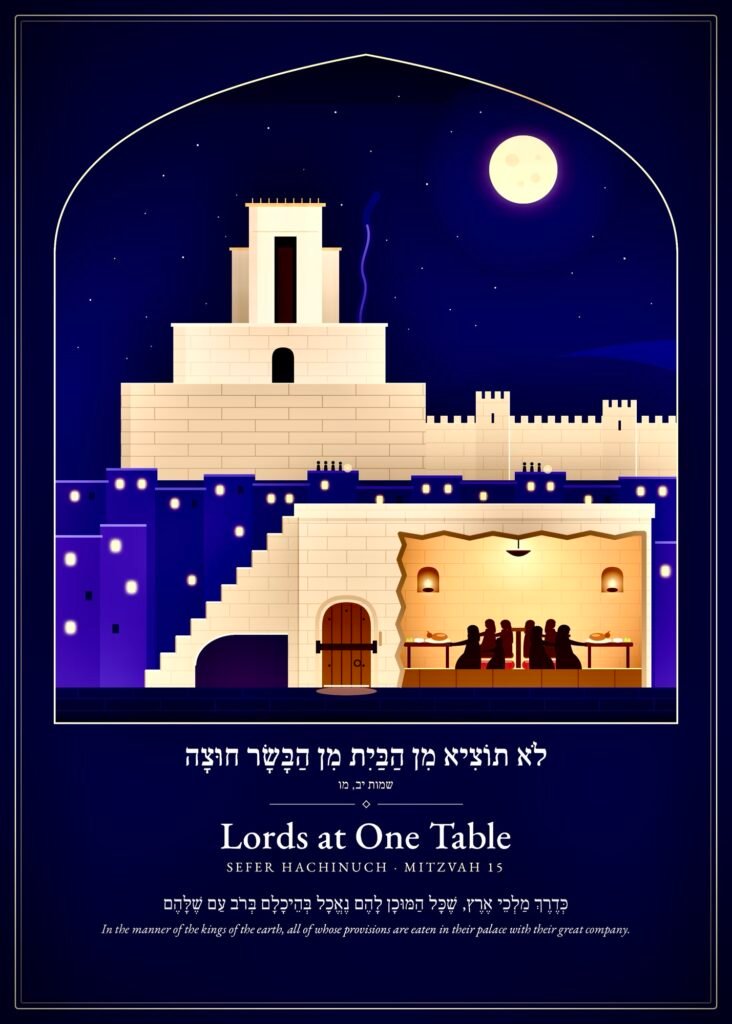
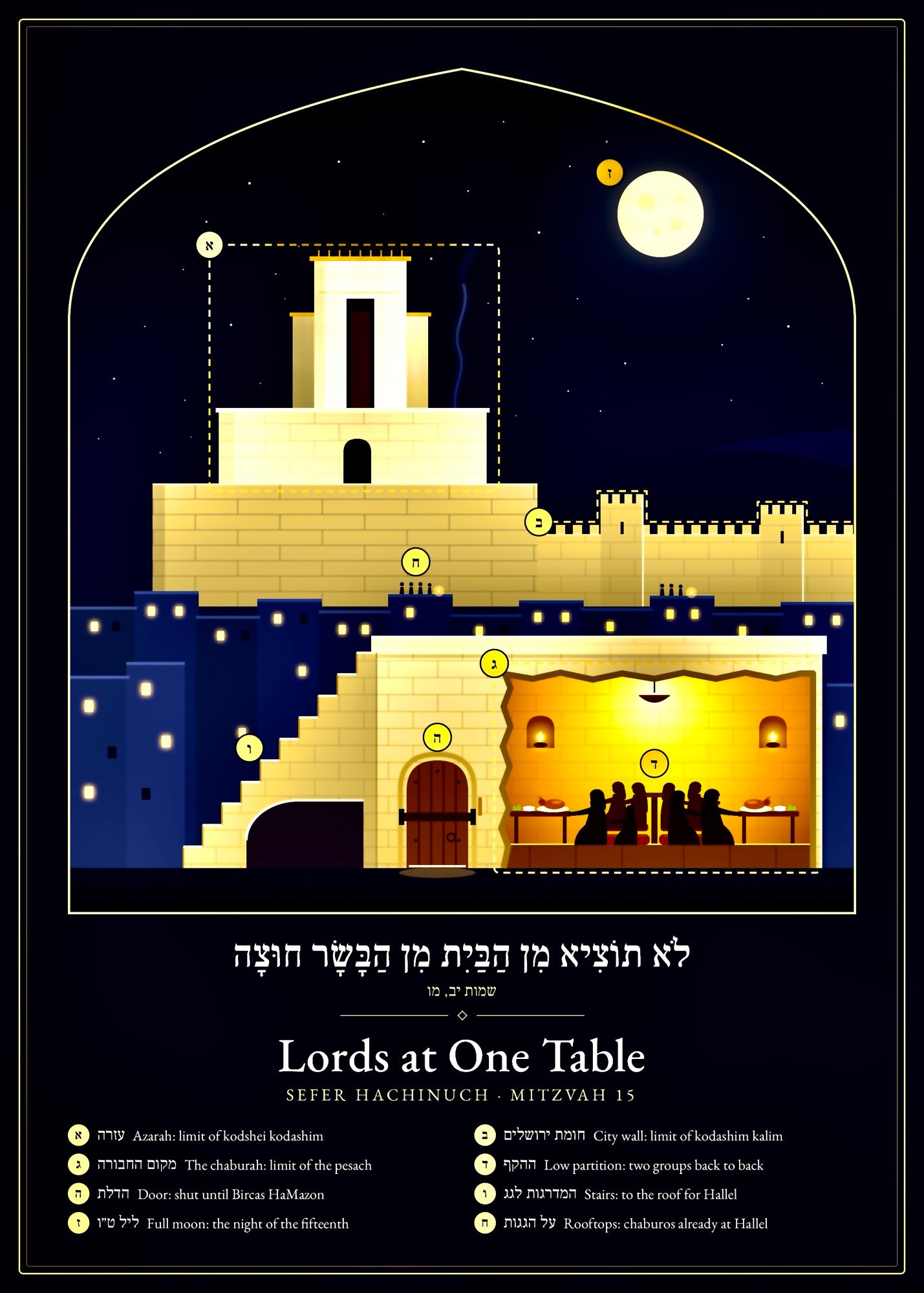
Lords at One Table: Sefer HaChinuch, Mitzvah 15
Nov 23, 2026 · @Kamil Levi Pyka-Penner
Mitzvah 15 of Sefer HaChinuch, שלא להוציא מבשר הפסח חוצה, runs to little more than a hundred Hebrew words, yet it holds a complete teaching: a redeemed people eats as royalty, and royalty shows itself in a table whose holiness does not leak outward.
The Chinuch states the prohibition, gives its root (שורש), sketches its laws and notes when it applies. Each part is compressed almost to the point of being a list. Read together, they form a single idea.
The law defines a “house” made of people: the place of the chaburah. The root explains why a free people’s banquet stays inside that house. And the Seder still carries the memory of that boundary each year, when the door is opened after Bircas HaMazon.
This essay offers that reading to colleagues for study and for critique. It moves in six steps: the text and its place in the count; the root; the laws of place and boundary; the two laws folded into one prohibition; the scope of the mitzvah; and the door at the Seder.
A note on sources. In keeping with the plan of this commentary, the essay draws only on Sefer HaChinuch itself, on its commentators (above all the Minchas Chinuch), on the Rambam’s Sefer HaMitzvos where the count is at issue, and on the authorities gathered in the elucidated Schottenstein edition of the Chinuch (ArtScroll/Mesorah), vol. 1, pp. 147–150. Citations of later authorities follow that edition’s notes and should be checked in the originals. Renderings of the Chinuch’s Hebrew are fresh translations; verses follow the Jewish Publication Society’s 1917 translation of the Tanakh.
I. The Text and Its Place in the Count
The Chinuch defines the prohibition by the group, not by the building: the meat may not leave ממקום החבורה, the place of the chaburah.
שלא להוציא מבשר הפסח ממקום החבורה, שנאמר (שמות יב, מו) לא תוציא מן הבית מן הבשר חוצה.
Not to take any of the meat of the pesach out of the place of the chaburah, as it is said: “thou shalt not carry forth aught of the flesh abroad out of the house.”
The verse joins three clauses: “In one house shall it be eaten; thou shalt not carry forth aught of the flesh abroad out of the house; neither shall ye break a bone thereof” (Shemos 12:46). The Chinuch counts the second clause as Mitzvah 15 and the third as Mitzvah 16. In the Rambam’s count, which the Chinuch follows, Mitzvah 15 is Lo Saaseh 123 of the Sefer HaMitzvos.
The first clause, בבית אחד יאכל, receives no number. The elucidators explain, after the Minchas Chinuch (15:17), that eating in one place is a detail of the positive mitzvah to eat the pesach (Mitzvah 6) and is subsumed within it; they also cite R’ Y. F. Perla’s comment, quoted in their Insight to Mitzvah 6. The result is an asymmetry worth holding onto: the where of the meal belongs to the positive mitzvah, while removal is a free-standing lav that carries malkus.
The Chinuch’s paraphrase does quiet interpretive work. Where the verse says מן הבית, he writes ממקום החבורה. The notes make the point explicit: בית here means the room of the meal, so the meat may not pass even to another room of the same house (Minchas Chinuch 15:5; Rashi, Pesachim 86a, s.v. יכול).
When two groups share one room, each group’s area is its own “house,” and carrying meat from one to the other is forbidden, from the word חוצה (Pesachim 85b with Rashi, s.v. מחבורה לחבורה; Tosafos 86b, s.v. ומר סבר). The Rambam’s Sefer HaMitzvos, citing the Mechilta, defines “outside” as outside the place where the meat is eaten. The Minchas Chinuch states the upshot plainly: לענין לאכול הפסח צריך דוקא במקום חבורתו — the pesach must be eaten specifically in the place of one’s own chaburah.
The boundary, then, is drawn by the meal rather than by masonry. “Outside” is wherever this chaburah is not eating. Everything else in the mitzvah follows from that definition.
II. The Root: “Because We Were Made Lords”
The Chinuch gives two roots. The general one is remembrance; the specific one is royalty, and it is the second that explains why this particular act was forbidden.
משרשי מצוה זו, מה שכתבנו, לזכר נסי מצרים. ומפני שנעשינו אדונים, באה המצוה עליו שיהא נאכל במקום החבורה, ולא נוציאהו לחוץ, כדרך מלכי ארץ שכל המוכן להם נאכל בהיכלם ברב עם שלהם. ודלת הארץ בעת יכינו סעדה גדולה, ישלחו ממנה לחוץ מנות לרעיהם לפי שהוא חדוש אצלם.
Among the roots of this mitzvah is what we have written: to remember the miracles of Egypt. And because we were made lords, the mitzvah was given concerning it that it be eaten in the place of the chaburah and that we not carry it outside, in the manner of the kings of the earth, all of whose provisions are eaten in their palace with their great company. But the poor of the land, when they prepare a great feast, send portions out of it to their friends, because for them it is a novelty.
“What we have written” points back to Mitzvah 5, where the pesach as a whole is a remembrance of the miracles of Egypt. The specific root shows how this prohibition carries that memory: we remember redemption by eating as the redeemed.
A textual note. The Schottenstein text reads שנעשינו אדונים. The vocalized text on Sefaria reads שנעשנו בני חורין ואדונים, “free men and lords.” The shorter reading puts the whole weight on lordship. Freedom is the absence of a master; lordship is the presence of dignity, and it is the second that this mitzvah trains.
Generosity turned inward. The contrast is not between generosity and meanness. The Chinuch describes the poor man’s portions without reproach: he sends them because a feast is rare for him. The king sends nothing out because his hall is already full, ברב עם שלהם; his generosity lies in the multitude he seats, not in the dishes he dispatches.
That is precisely the shape of the pesach. A chaburah widens its generosity by enrolling more members before the slaughter (Mitzvah 5), not by sending meat abroad after it. One may perhaps hear in ברב עם an echo of Mishlei 14:28: “In the multitude of people is the king’s glory.”
The scriptural phrases. The elucidators mark מלכי ארץ (Tehillim 2:2) and דלת הארץ (Melachim II 25:12) as stylistic citations (nn. 5–6), and a melitzah should not be overloaded. Still, a reader who knows the contexts may pause. In Tehillim, “the kings of the earth stand up” against Hashem and His anointed; in Melachim, after the Churban, the captain of the guard “left of the poorest of the land to be vinedressers and husbandmen.”
The royalty of the Seder night, then, is neither earthly power nor the station of a remnant. It is the conferred nobility of a people redeemed to serve.
A royal cluster. Mitzvah 15 does not stand alone. The Chinuch reads three neighboring laws of the pesach in the same royal key:
- Mitzvah 7 (not raw or boiled): roasting is the way of בני מלכים ושרים, while the rest of the people boil a little meat to fill their stomachs; we went out to be ממלכת כהנים וגוי קדוש.
- Mitzvah 8 (not to leave over): כדרך מלכים ושרים, who need not keep cooked dishes from day to day; whatever remains is burned as something unwanted.
- Mitzvah 16 (not to break a bone): שאין כבוד לבני מלכים ויועצי ארץ לגרר העצמות ולשברם ככלבים; that suits only the hungry poor.
Together the four govern how the meat is prepared (7), when it must be finished (8), where it is eaten (15), and how it is eaten (16). They are facets of a single banquet. The elucidators tie the theme to “ye shall be unto Me a kingdom of priests, and a holy nation” (Shemos 19:6), rendering כהנים in the courtly sense of “ministers” (n. 4).
Why act it out? In Mitzvah 16, the Chinuch anticipates an objection: why so many commandments for one remembrance? He answers his son (ואל תחשב בני לתפש על דברי) that a person is shaped by his deeds, כי אחרי הפעולות נמשכים הלבבות.
Mitzvah 15 is one such deed, and on Chinuch’s own theory, it works from the outside in. One who may not send his portion out learns to experience the feast as his natural estate rather than as a novelty. That is what it means to have been made a lord.
III. Place, Perimeter and Breach
The Chinuch’s list of laws treats the chaburah’s place as a domain whose walls can be built, turned and broken.
דיני המצוה, כגון זה, מה דינו של בשר כשיצא חוץ, וההקף שצריכה החבורה לעשות, ודין מחצה שנפרצה בין החבורות, ויתר הפרטים מבארים בפסחים (דף פ״ה – פ״ו).
The laws of the mitzvah: for example, what the law is regarding meat once it has gone outside; the perimeter that the chaburah must make; and the law of a partition between the groups that was breached. The remaining details are explained in Pesachim (85–86).
The first item, the status of meat that has left, belongs with the act of removal and is taken up in the next section. The other two describe the place itself. The elucidators locate all of these laws in the Rambam, Hil. Korban Pesach 9:1–5 (n. 10).
The perimeter. When two groups eat in one room, each must mark off its area (Rambam, Hil. Korban Pesach 9:3, cited in n. 8). A partition suffices even if it is low enough for the groups to see one another, provided they sit with their backs to each other. On the Kesef Mishneh’s reading, no partition is needed at all if the two groups turn away from one another.
The source is the word חוצה itself. A prohibition against going “outside” presupposes an inside, so the chaburah is obliged to create one (Rambam ibid., with Kesef Mishneh). The law does not merely protect a boundary; it requires that one be drawn.
Here the halachah and the root meet. A wall can be made of posture: a chaburah that turns its faces inward has built its hall. The king’s palace in the Chinuch’s root is defined the same way, by the company that dines within it, ברב עם שלהם.
The breached partition. If two groups eat in separate rooms or partitioned areas and the dividing wall falls, both must stop eating until it is restored (Pesachim 86b with Rashi and Meiri; Rambam, Hil. Korban Pesach 9:5; n. 9). No one moved, and nothing was carried. Yet the space each group occupies has changed, so further eating would be eating in a new place.
This law cannot rest on the law of removal, because nothing was removed. It rests on בבית אחד יאכל, the detail of Mitzvah 6. Yet the Chinuch lists it among the laws of Mitzvah 15.
The arrangement is telling. For the Chinuch, the counted lav is where the whole law of the chaburah’s place is housed; the uncounted positive clause and the counted negative are studied as one field. The Minchas Chinuch’s ruling on rooms belongs here as well: מחדר לחדר כל שחלוק במחיצות אסור להוציא מא’ לחבירו — from room to room, wherever partitions divide them, one may not carry from one to the other.
IV. Two Laws in One Prohibition: The Act and the Meat
The Chinuch’s wording separates the meat that went out (כשיצא חוץ) from the person who took it out (והוציא), and the later debates run along that seam.
ועובר עליה והוציא מן הבשר לחוץ, עבר על לאו, ולוקין עליו, והוא שיעשה בה עקירה מן הבית והנחה לחוץ, כדין הידוע בהוצאה של שבת.
One who transgresses and takes meat outside has violated a lav and receives malkus, provided he performs with it an akirah from the house and a hanachah outside, as in the well-known law of carrying on Shabbos.
The act. Liability follows the pattern of carrying on Shabbos: lifting from one domain and setting down in another. The link is the shared term הוצאה (Pesachim 85b with Tosafos, s.v. הוצאה; n. 13). The Chinuch calls the Shabbos law “well known” and teaches the less familiar law through it.
The measure, however, is not borrowed. On Shabbos one is liable for carrying food the size of a dried fig (Mishnah, Shabbos 76b); here a kezayis suffices (Tosefta Pesachim 6:9; Rambam, Hil. Korban Pesach 9:1; Mechilta of R’ Shimon bar Yochai 12:46; n. 13).
The Minchas Chinuch supplies the default: כ״מ שאין אנו מוצאים שיעור מפורש סתמא הוא בכזית — wherever no measure is stated, the unstated measure is a kezayis. The shared word imports the form of the act but not the Sabbath’s quantity. The elucidators flag a difficulty from the Rambam’s own Sefer HaMitzvos (Lo Saaseh 123), taken up by the Sfas Emes and the Minchas Soless.
One may add a conceptual note. A grogeres is the measure at which carried food becomes significant; a kezayis is the measure of eating. The form of this prohibition comes from Shabbos, but its measure comes from the meal it protects.
The meat. Meat that leaves its place becomes forbidden (Pesachim 85a). It must be burned like any disqualified sacred meat (Meiri, Pesachim 85b; Mahari Korkos, Hil. Korban Pesach 9:2), and one who eats it incurs malkus (Rashi, Pesachim, s.v. הרי זה בלא תעשה; n. 7). The Rambam’s Sefer HaMitzvos says that such meat is forbidden and treated like treifah.
The Chinuch’s own Mitzvah 73 supplies the frame. Its verse forbids “flesh that is torn of beasts in the field,” and the Chinuch extends it to sacred meat beyond its bounds: בשר קדשים שיצא חוץ לעזרה and בשר קדשים קלים שיצא חוץ לחומה, שאסור ונעשה כטרפה. In the derashah’s reading, meat that crosses its boundary is meat “in the field.”
Seen this way, the pesach has three concentric limits. Kodshei kodashim are held by the azarah; kodashim kalim, the pesach among them, by the wall of Jerusalem (Mitzvah 446, cited in the elucidation); and the pesach alone has a third, innermost limit, the chaburah. Each household eating the pesach thus keeps something like the inner boundary that kohanim keep, as befits a “kingdom of priests.”
A homiletical note: the verse of Mitzvah 73 opens, “And ye shall be holy men unto Me,” and closes, “ye shall cast it to the dogs” (Shemos 22:30). The Chinuch draws the same contrast in Mitzvah 16, where princes do not break bones ככלבים. Whether or not he intended the echo, the Torah sets the meat that wanders off and the dignity of a holy table side by side.
Must the meat be set down to become disqualified? Here the two laws part company in the later literature (n. 7). The Minchas Chinuch concludes that removal from the chaburah disqualifies the meat only through both acts: ע״כ נלע״ד דכאן אינו נפסל רק בהי׳ עקירה והנחה. Beyond the wall of Jerusalem, however, he holds that the meat is disqualified even without being set down.
The Tzlach (Pesachim 85b, s.v. אבר שיצא) and the Chazon Ish (Orach Chaim 124, to Pesachim 86a) take the other path. For them, hanachah is a condition of malkus alone. The meat itself is disqualified the moment it leaves, like any sacred meat that passes its limits.
The dispute reads as a disagreement about what kind of boundary the chaburah is. For the Tzlach and the Chazon Ish, it is a boundary of place, like the city wall, and crossing it is enough. For the Minchas Chinuch, it is a boundary defined by the act of hotza’ah, crossed only when that act is complete.
The Chinuch’s own layout fits either reading, though it leans toward a distinction: “the law of meat once it has gone out” stands among the dinim, while akirah and hanachah appear only with liability. Still, the Minchas Chinuch’s view has its own logic. A wall made of people and posture may well be crossed by an act rather than by motion alone.
Between two groups. When meat passes from one chaburah to another in the same room, the authorities ask whether liability requires bringing it into the other group’s area, or only taking it out of one’s own (Rashi, Pesachim 85b, s.v. עד שיניח; Minchas Chinuch 15:4; Chazon Ish, Orach Chaim 124; n. 3). The Minchas Chinuch observes that liability is not explicit where the meat came to rest outside one’s own group but not inside another. In a shared room, “outside” is simply someone else’s inside.
V. When, and for Whom
The prohibition binds men and women alike, only while the Beis HaMikdash stands and, according to the Rambam, only on the night of the fifteenth.
ונוהגת בזמן הבית, בזכרים ונקבות.
It applies in the time of the Beis HaMikdash, to men and women.
The pesach can be offered only in the Beis HaMikdash (Mitzvah 5), so the mitzvah has no application in exile. Women are bound by the general rule that prohibitions apply equally to men and women (n. 12).
Only on the night of the fifteenth. The Rambam limits the prohibition to the night on which the pesach is eaten (Hil. Korban Pesach 9:1; n. 11). The Minchas Chinuch records the ruling and then writes with notable candor: ובגמרתינו לא מצאתי כעת מפורש דוקא בליל ט״ו. He concludes that the Rambam must have found it in some Mechilta or Baraisa: ודאי מצא הר״מ באיזה מכילתא וברייתא.
For scholars, the moment is instructive. The Chinuch’s great halachic commentator declines to invent a derivation. He trusts the Rambam’s sources and marks the limit of his own.
Only while the chaburah eats? Some go further. On their view, the prohibition applies only while the group is eating together: not before it begins, and not after it has finished with meat left over (Aruch HaShulchan HeAsid, Kodashim 193:12; see Tzlach, Pesachim 85a, s.v. ובגוף, and Sfas Emes to the Rambam, Hil. Korban Pesach 9:1; n. 11).
The Minchas Chinuch reasons from the other direction: ומצד הסברא נראה דלאו זה הוא על כל פנים שהתחילו לאכול — by reason, this lav applies at the very least once they have begun to eat. The elucidators, citing him, add that from that moment neither members nor outsiders may remove the meat (Minchas Chinuch 15:17; cf. Minchah Chadashah 15:2; n. 2).
Two pictures of the mitzvah stand behind these views. If it is a law of the meat, the meat is bound to its place for as long as it may be eaten, which is all night. If it is a law of the meal, the boundary exists only while the banquet is in progress, as a king’s hall is a banquet hall only while he dines.
The Minchas Chinuch’s “once they have begun” may join the two pictures. The meal establishes the place, and once established, the place binds anyone, member or stranger. The chaburah creates the house; then the house governs the meat.
VI. The Door at the Seder
The elucidators close the mitzvah with an Insight that brings it into every Jewish home: the door we open after Bircas HaMazon may remind us of a door that was once kept shut.
The familiar reason. The Rama (Orach Chaim 480:1) grounds the custom in the night’s character as ליל שמרים, “a night of watching” (Shemos 12:42). We open the door to show our trust in Hashem’s protection. We hope that, in the merit of that trust, Mashiach will come, the theme of the section of the Haggadah that follows.
The door of the chaburah. R’ Yosef Salant offers a second reason, rooted in this mitzvah (quoted in Dvar Shmuel, Pesachim 86a, s.v. לא). In the time of the Beis HaMikdash, he says, the door of the room stayed closed until the meal and Bircas HaMazon were complete, because the members were zealous that no one carry meat outside.
Only then was the door opened, and the company climbed the outside stairs to the roof to say Hallel. Our open door after Bircas HaMazon preserves that moment, though the reason for the closed door, the pesach itself, is gone.
The roof and the afikoman. The background is in Pesachim 86a. The pesach could be eaten only on the ground floor, since roofs and upper stories lacked the sanctity of Jerusalem; yet after the meal the company went up to the roof for Hallel. The Baal HaMaor (Pesachim, fol. 26b) explains that the room below was crowded, because many people joined together for one offering, and the roof relieved the press (see also Maharsha, Chidushei Aggados, Pesachim 86a).
The Baal HaMaor adds that this change of place underlies the halachah אין מפטירין אחר הפסח אפיקומן (Mishnah, Pesachim 119b). Moving might confuse the company and make them forget Hallel, so the taste of the pesach was kept on the palate as a reminder.
One night, two doors. The two reasons need not compete. During the meal, the closed door expressed the Chinuch’s palace: a table complete in itself, from which nothing is sent out. After the meal, the open door turned toward the redemption still to come.
The order matters: enclosure first, then opening; dignity first, then hope. The Baal HaMaor’s crowded room makes Chinuch’s ברב עם visible. And the afikoman, after which we taste nothing, still carries the last flavor of that bounded meal up the stairs to Hallel.
A closing homiletical thought: on a night called שמרים, the chaburah once guarded its own door from within. Now we open it, and entrust the night to the One who guards it.
VII. Conclusion and Questions for Further Study
Mitzvah 15 teaches that a free people’s holiness is held, not exported: the chaburah is a palace made of people, and its walls are kept by law, posture, and memory.
Each part of the Chinuch’s brief entry serves that idea. The definition draws the boundary around the group, and the root explains it through a king who seats a multitude rather than dispatching portions. The laws build the boundary, turn it, mend it when it falls, and define how it is crossed; the Seder keeps it in memory.
The Chinuch writes as a father to a son (ואל תחשב בני), and his method here is a model for those of us who teach. He does not open with akirah and hanachah but with the picture of a king’s hall. The details then read as the architecture of that hall.
The mitzvah awaits the rebuilt Beis HaMikdash, but its root does not wait. A table that need not prove its abundance by sending it abroad is a lesson for every Jewish home. May we soon merit to eat Pesach again in one house, the door shut until Bircas HaMazon and then opened to Hallel.
Questions for further study
- If בבית אחד יאכל is a detail of Mitzvah 6, why does the Chinuch place the breached partition among the laws of Mitzvah 15?
- Does the Minchas Chinuch’s distinction between the chaburah (disqualified only with hanachah) and the city wall (disqualified without it) reflect a boundary of act versus a boundary of place?
- Is the prohibition a law of the meat, binding all night, or of the meal, binding only while the chaburah eats? How would each view treat meat left after the group has finished?
- Why does the shared term הוצאה import akirah and hanachah but not the Sabbath’s measure, and how does the Rambam’s Sefer HaMitzvos (Lo Saaseh 123) bear on the kezayis?
- Does the variant שנעשנו בני חורין ואדונים, against שנעשינו אדונים alone, change the meaning of the root?
- Do the stylistic citations מלכי ארץ and דלת הארץ carry their biblical contexts, or only their words?
Sources
Citations of later authorities follow the notes of the Schottenstein edition, except where a link below shows the passage I checked directly.
- Sefer HaChinuch, Mitzvah 15, with the elucidation, notes 1–13 and the Insight “Opening the Door at the Seder”: The Schottenstein Edition Sefer HaChinuch / Book of Mitzvos, vol. 1 (ArtScroll/Mesorah), pp. 147–150. The Hebrew of Mitzvah 15 is quoted from this edition.
- Sefer HaChinuch, Mitzvos 7, 8, 15, 16 and 73, Hebrew (Vocalized Edition) on Sefaria: Mitzvah 7, Mitzvah 8, Mitzvah 15, Mitzvah 16, Mitzvah 73.
- Minchas Chinuch, Mitzvah 15, Hebrew on Sefaria. Sefaria prints the comment in eight paragraphs; the section numbers given here (15:4, 15:5, 15:17) follow the Schottenstein notes.
- Rambam, Sefer HaMitzvos, Lo Saaseh 123, English translation on Chabad.org.
- Verses, JPS 1917, checked on ebible.org: Shemos 12:42 and 12:46; Shemos 19:6; Shemos 22:30; Tehillim 2:2; Melachim II 25:12; Mishlei 14:28.
- Cited from the Schottenstein notes: Pesachim 85a–86b and 119b, with Rashi, Tosafos and Meiri; Mishnah Shabbos 76b; Tosefta Pesachim 6:9; Mechilta of R’ Shimon bar Yochai 12:46; Rambam, Hil. Korban Pesach 9:1–5, with Kesef Mishneh and Mahari Korkos; Tzlach; Chazon Ish, Orach Chaim 124; Aruch HaShulchan HeAsid; Sfas Emes; Minchas Soless; Minchah Chadashah; R’ Y. F. Perla; Rama, Orach Chaim 480:1; Baal HaMaor; Maharsha; R’ Yosef Salant, in Dvar Shmuel.